
Study Guides
Pearson Edexcel International GCSE Physics (4PH1): Properties of waves
Transverse and longitudinal waves, wave definitions, v = fλ, f = 1/T, the Doppler effect, reflection and refraction for Edexcel IGCSE Physics 4PH1, 3b.
- Subject
- Physics
- Level
- IGCSE
- Topic
- Waves
- Author
- Marlbridge Academic Team
- Updated
- Reviewed by
- Hassan (what this means)
Aligned to Pearson Edexcel IGCSE Physics (4PH1), Issue 4. Official specification .
Syllabus page (what it covers and how it is assessed): Pearson Edexcel IGCSE Physics.
Syllabus points this page covers
4PH1
- 3b Properties of waves
Found an error? Report a correction.
Need help with this topic? Request a free trial class for IGCSE Physics (4PH1).
This guide goes deep on sub-topic 3(b) Properties of waves, statements 3.2 to 3.9 of the Pearson Edexcel International GCSE in Physics (4PH1), Issue 4. None of the statements carries a “P”, so all can be assessed on both papers. For Topic 3 as a whole, see the Waves study guide.
What the specification asks
- 3.2 explain the difference between longitudinal and transverse waves
- 3.3 know the definitions of amplitude, wavefront, frequency, wavelength and period of a wave
- 3.4 know that waves transfer energy and information without transferring matter
- 3.5 know and use wave speed = frequency × wavelength (v = f × λ)
- 3.6 use frequency = 1 ÷ time period (f = 1 ÷ T)
- 3.7 use these relationships in different contexts, including sound waves and electromagnetic waves
- 3.8 explain why there is a change in the observed frequency and wavelength of a wave when its source is moving relative to an observer, and that this is known as the Doppler effect
- 3.9 explain that all waves can be reflected and refracted
Transverse and longitudinal waves (3.2)
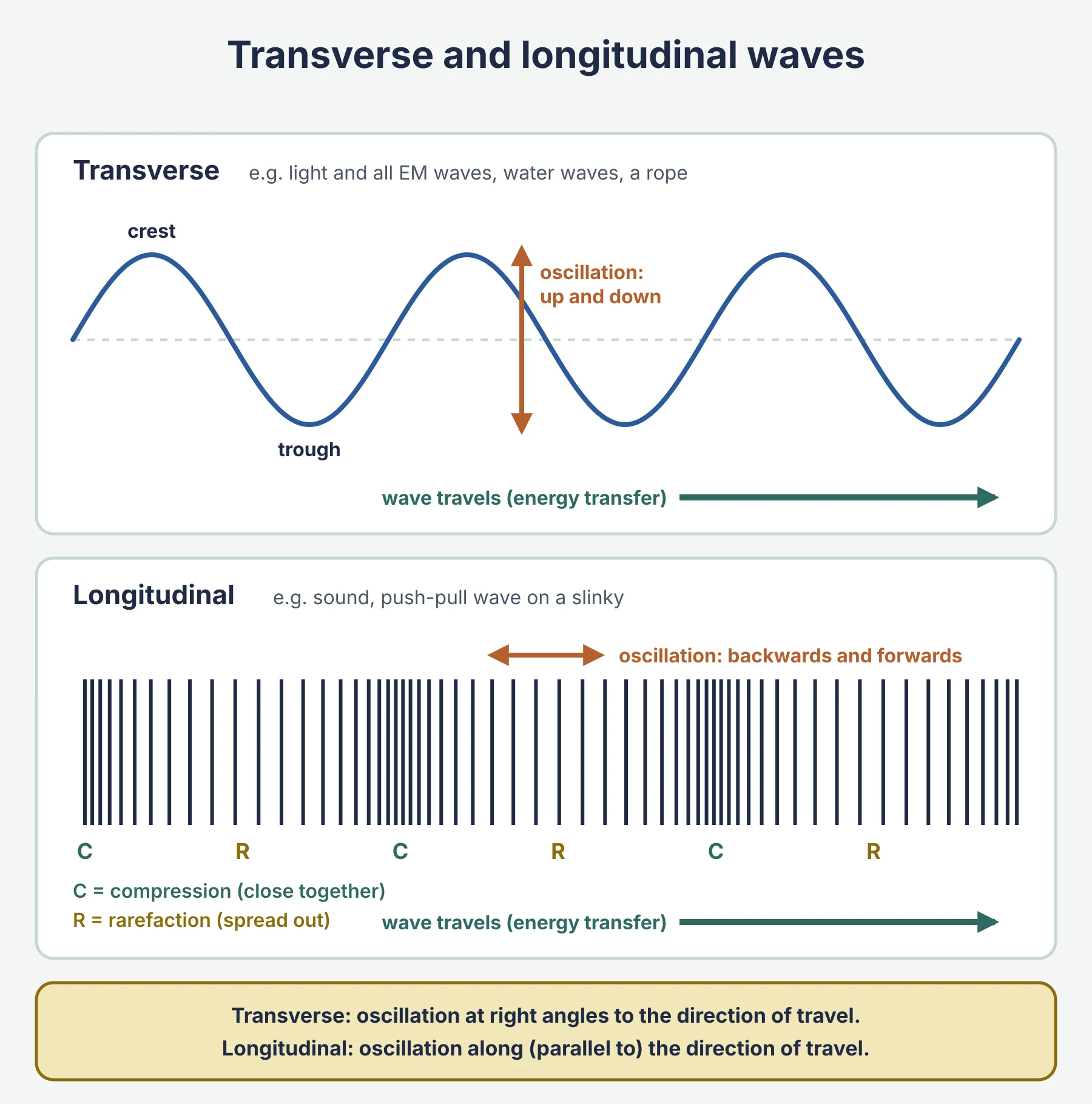
A wave is a travelling disturbance. The particles (or the field) oscillate about fixed positions while the wave moves on.
| Transverse | Longitudinal | |
|---|---|---|
| direction of oscillation | at right angles (perpendicular) to the direction the wave travels | along (parallel to) the direction the wave travels |
| features | crests (peaks) and troughs | compressions (particles close together) and rarefactions (particles spread out) |
| examples | light and all electromagnetic waves, water waves, waves on a rope or string | sound waves, push-pull waves on a slinky spring |
A slinky spring shows both. Moving one end from side to side sends a transverse wave along it. Pushing and pulling the end along the slinky’s length sends a longitudinal wave of compressions and rarefactions.
When asked to explain the difference, compare the direction of oscillation with the direction of energy transfer for both types in one answer.
Definitions (3.3)
| Term | Definition |
|---|---|
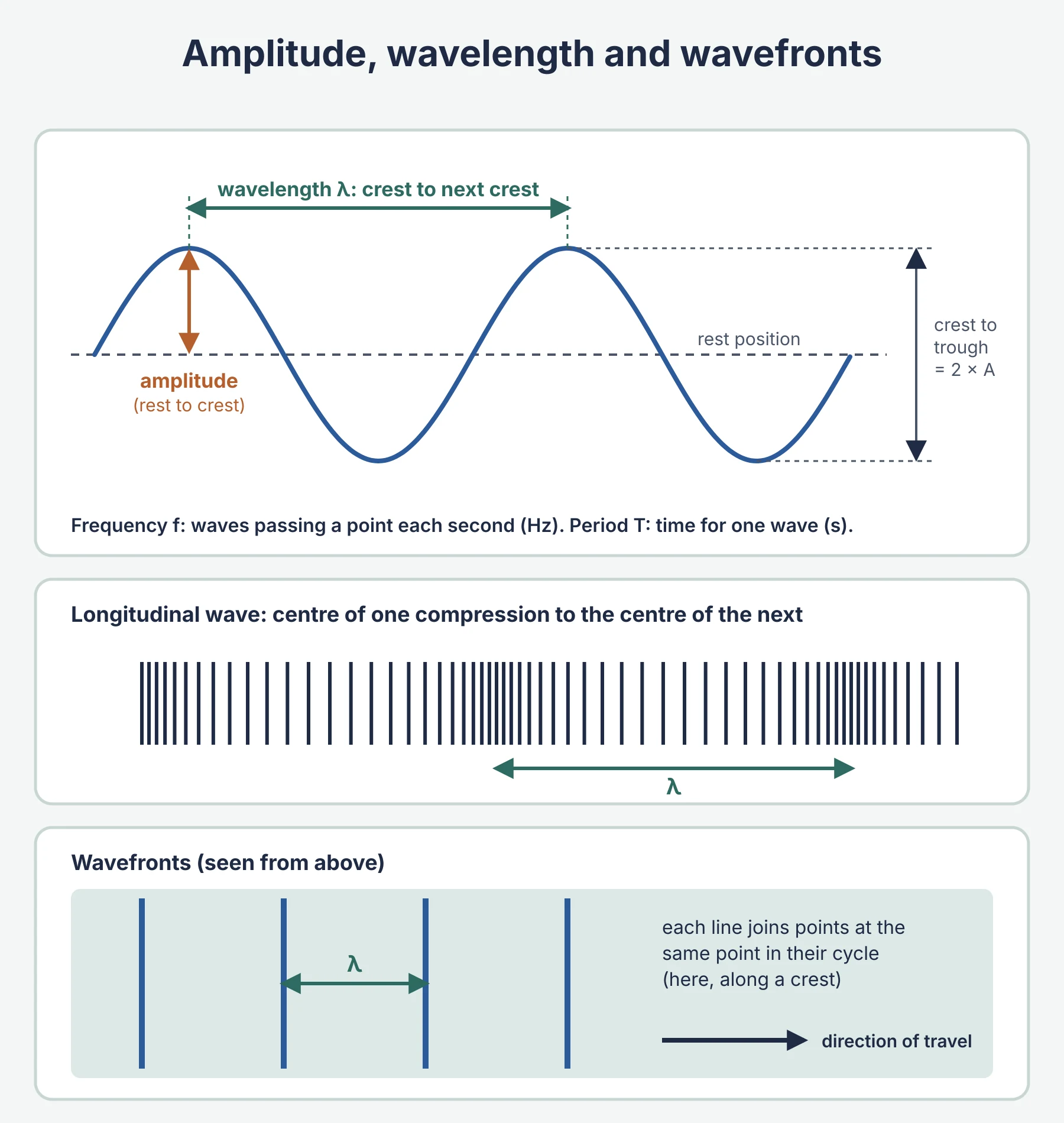
| amplitude | the maximum displacement of a point on the wave from its rest (undisturbed) position |
| wavelength (λ) | the distance from one point on a wave to the same point on the next wave, for example crest to crest |
| frequency (f) | the number of waves passing a point each second (or produced by the source each second), in Hz |
| period (T) | the time taken for one complete wave to pass a point, in s |
| wavefront | a line joining points on a wave that are at the same point in their cycle, such as a line along a crest |
Two precise points matter. Amplitude is measured from the rest position to a crest, not from crest to trough (that is twice the amplitude). Wavelength is a distance along the direction of travel, not a height.
For a longitudinal wave, the wavelength is the distance from the centre of one compression to the centre of the next.
Energy and information, not matter (3.4)
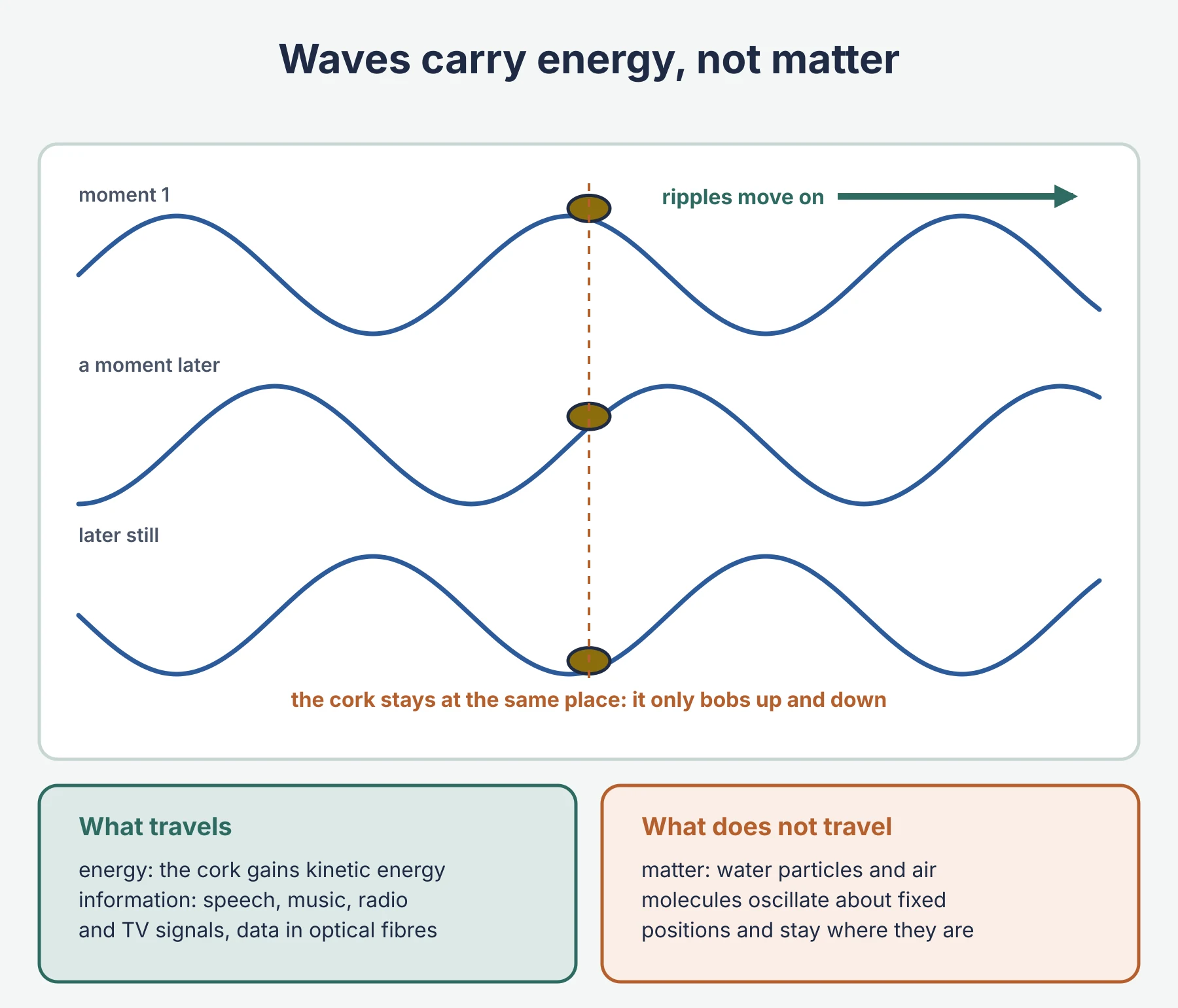
A cork floating on a pond bobs up and down as ripples pass but does not travel across the pond with them. Air molecules in a sound wave vibrate backwards and forwards about fixed positions and do not travel from the loudspeaker to your ear. What travels is energy (the cork gains kinetic energy; your eardrum is made to vibrate) and information (speech, music, television and radio signals, data in optical fibres).
The wave equations (3.5–3.7)
v = f × λ           wave speed (m/s) = frequency (Hz) × wavelength (m)
f = 1 / T           frequency (Hz) = 1 / time period (s)
v = f × λ follows from speed = distance ÷ time: in one period T, the wave moves forward one wavelength λ, so v = λ ÷ T = f × λ.
The relationships apply to all waves. Speeds for context: sound in air is about 340 m/s (faster in liquids and solids); electromagnetic waves travel at 3.0 × 10⁸ m/s in free space; water waves in a ripple tank travel at centimetres per second.
Worked example 1: a ripple tank. A dipper makes 12 waves in 4.0 s. The distance across 5 complete wavelengths is 7.5 cm.
f = 12 / 4.0 = 3.0 Hz
λ = 7.5 cm / 5 = 1.5 cm = 0.015 m
v = f × λ = 3.0 × 0.015 = 0.045 m/s
T = 1 / f = 1 / 3.0 = 0.33 s
Commentary. Measuring across several wavelengths and dividing gives a more accurate λ than measuring one. Converting cm to m gives the speed in m/s.
Worked example 2: sound. A tuning fork vibrates at 256 Hz. Sound travels at 340 m/s in air.
λ = v / f = 340 / 256 = 1.33 m ≈ 1.3 m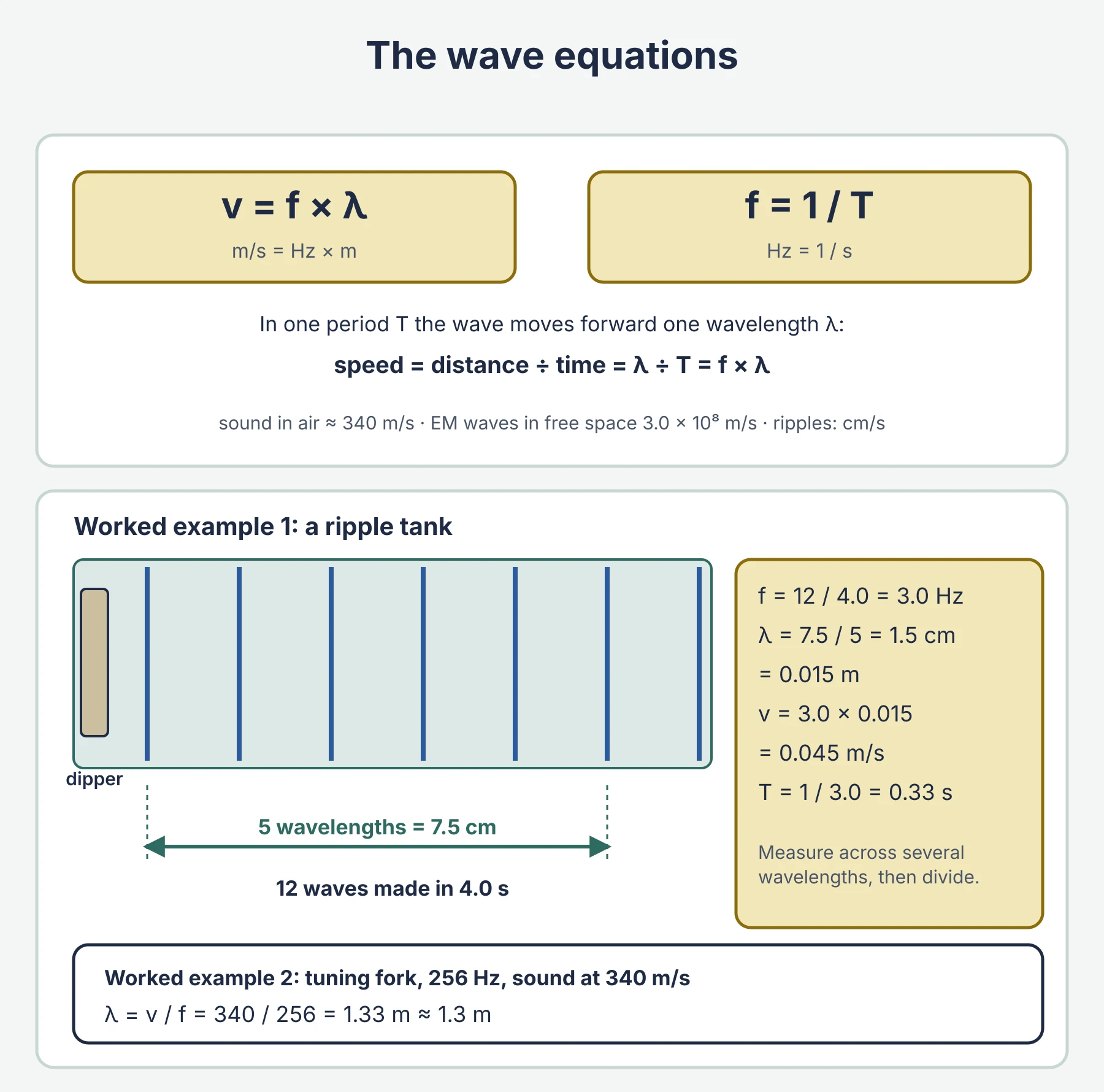
Reflection and refraction (3.9)
All waves can be reflected (bounce back from a surface) and refracted (change speed, and usually direction, when they pass into a different medium).
- Water waves reflect from the wall of a ripple tank; sound reflects from a cliff as an echo; light reflects from a mirror.
- Water waves travel more slowly in shallow water. Where the waves cross from deep to shallow water, their speed and wavelength decrease, and if they meet the boundary at an angle, they change direction.
- Light slows down when it enters glass from air and bends towards the normal. Sound refracts too, for example when it passes between air layers at different temperatures.
In refraction the frequency stays the same: the source sets the frequency, and waves cannot be created or lost at the boundary. Since v = f × λ, a lower speed means a shorter wavelength.
Worked example 3. Water waves of frequency 5.0 Hz travel at 0.30 m/s in deep water and 0.20 m/s in shallow water.
deep:    λ = 0.30 / 5.0 = 0.060 m
shallow: λ = 0.20 / 5.0 = 0.040 m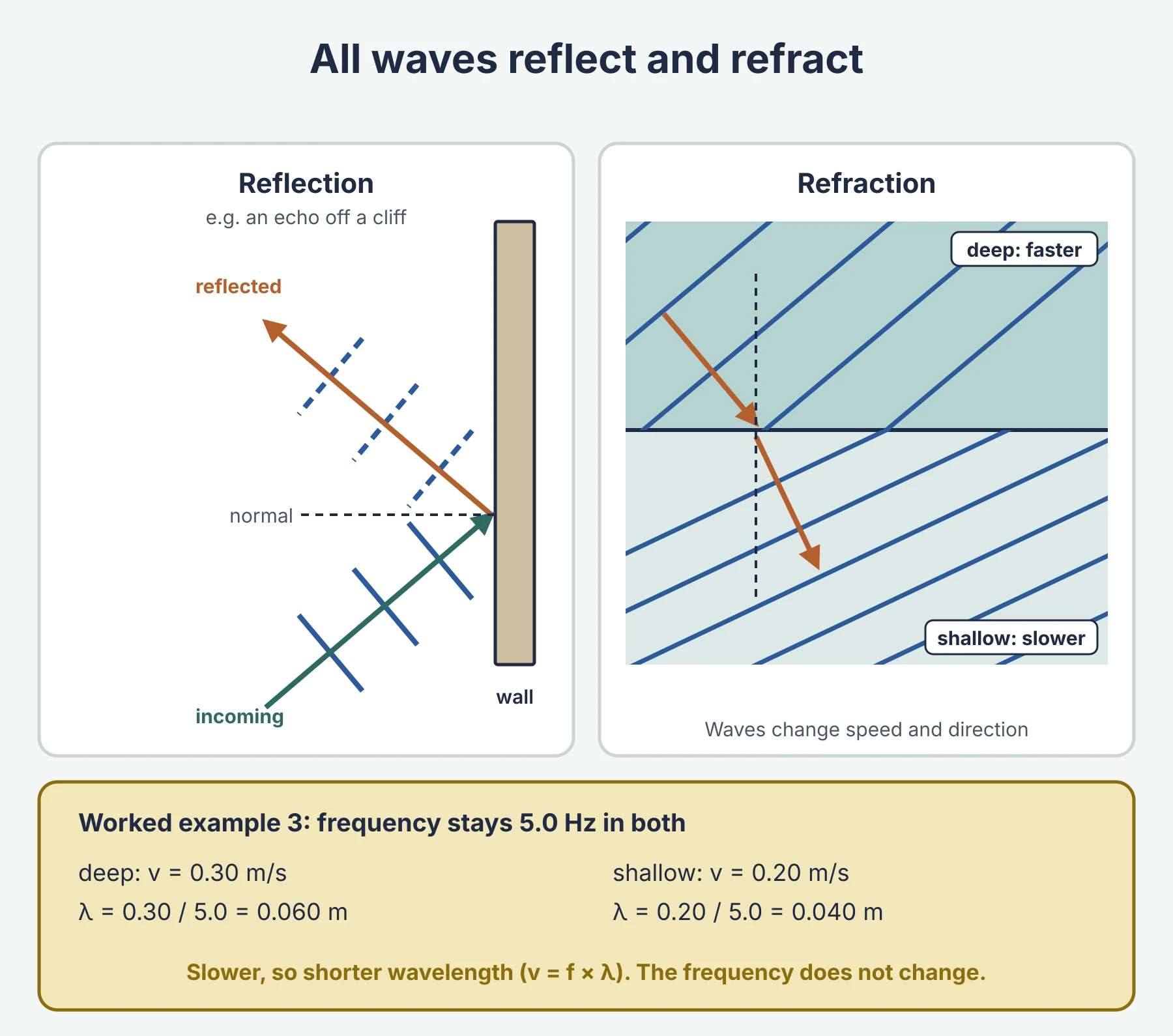
The Doppler effect (3.8)
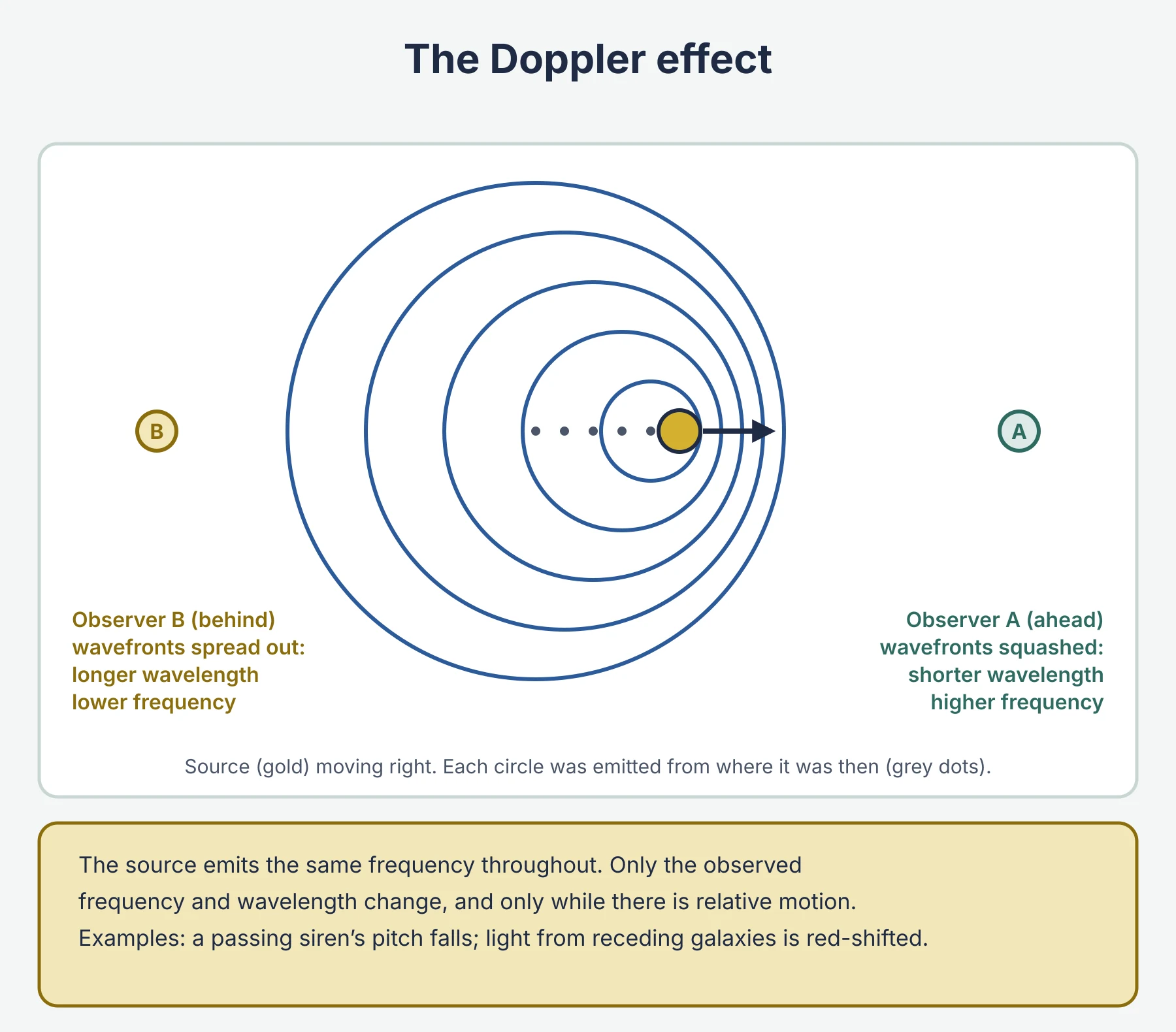
When a source of waves moves towards an observer, each wave is emitted a little closer to the observer than the previous one. The wavefronts are squashed together in front of the source, so the observed wavelength is shorter and the observed frequency is higher. When the source moves away, the wavefronts are spread out behind it: longer wavelength, lower frequency.
The source itself emits the same frequency throughout. Only the observed values change, and only while there is relative motion between source and observer. Examples: the pitch of a passing siren falls as it goes past; light from galaxies moving away from us is shifted to longer wavelengths (red-shifted), which is used in Topic 8.
Common mistakes
- Defining amplitude as the height from trough to crest.
- Saying sound is transverse, or that “particles travel with the wave”.
- Saying frequency changes in refraction. Speed and wavelength change; frequency does not.
- Forgetting to convert cm or kHz before using v = f × λ.
- Describing the Doppler effect as the source “changing its frequency”. The observed frequency changes because of relative motion.
Exam technique with command words
- Explain the difference between wave types: one sentence for each type, both comparing oscillation direction with travel direction.
- State a definition: use the precise wording, with “from the rest position” for amplitude and “each second” for frequency.
- Calculate: equation, converted values, answer with unit.
- Explain the Doppler effect: describe the wavefronts bunching (or spreading), then the effect on wavelength, then on frequency.
- Properties of waves revision notes
- Properties of waves practice questions
- Units and prefixes: Units for waves study guide
- Applying v = f × λ to light and radio: The electromagnetic spectrum study guide
Written against the Pearson Edexcel International GCSE in Physics (4PH1) specification, Issue 4. Always check the current specification for your examination year.
Related resources
-
Practice questions
Pearson Edexcel International GCSE Physics (4PH1): Properties of waves – Practice Questions
Original questions with full answers on wave types, wave definitions, v = fλ, f = 1/T, refraction and the Doppler effect for Edexcel IGCSE Physics 4PH1.
Physics · Pearson Edexcel · IGCSE
Try questions -
Revision notes
Pearson Edexcel International GCSE Physics (4PH1): Properties of waves – Revision Notes
Recall notes on wave types, wave definitions, v = fλ, f = 1/T, the Doppler effect and refraction, with a self-test, for Edexcel IGCSE Physics 4PH1.
Physics · Pearson Edexcel · IGCSE
Revise topic -
Study guides
Pearson Edexcel International GCSE Physics (4PH1): The electromagnetic spectrum
The order, shared speed, uses and harmful effects of electromagnetic waves, with protective measures, for Edexcel International GCSE Physics 4PH1, sub-topic 3c.
Physics · Pearson Edexcel · IGCSE
Read guide
Related articles
Get free revision emails (optional)
Occasional emails with practice questions, worked explanations and links to free resources for the qualification and subjects you choose. No spam, and you can unsubscribe from any email. The free tools on this site never need an email.