
Revision Notes
IB DP Computer Science A.4: Machine Learning – Revision Notes
Recall notes on IB DP Computer Science A.4 Machine learning: rules versus learning, features, labels, learning types, applications and ethics, with a self-test.
- Subject
- Computer Science
- Level
- IB
- Topic
- A.4 – Machine learning
- Author
- Marlbridge Academic Team
- Updated
- Reviewed by
- Harris Khan (what this means)
Aligned to International Baccalaureate IB Diploma Programme Computer Science (DP Computer Science), First assessment 2027. Official subject brief .
Syllabus page (what it covers and how it is assessed): IB Diploma Programme Computer Science.
Found an error? Report a correction.
Need help with this topic? Request a free trial class for IB Diploma Programme Computer Science (DP Computer Science (2014) / DP Computer Science (2027)).
Condensed for quick recall of A.4 Machine learning, the fourth sub-topic of Theme A in IB DP Computer Science, first assessment 2027 (5 hours SL / 18 hours HL). For explanations and the worked threshold example, use the A.4 study guide. The exact learning outcomes, including the HL extension, are in the full DP guide held by your school.
Key terms
| Term | Meaning |
|---|---|
| Rule-based programming | The programmer writes explicit rules the program follows |
| Machine learning | A system derives its own rules (a model) from data |
| Model | What learning produces; used to make predictions on new data |
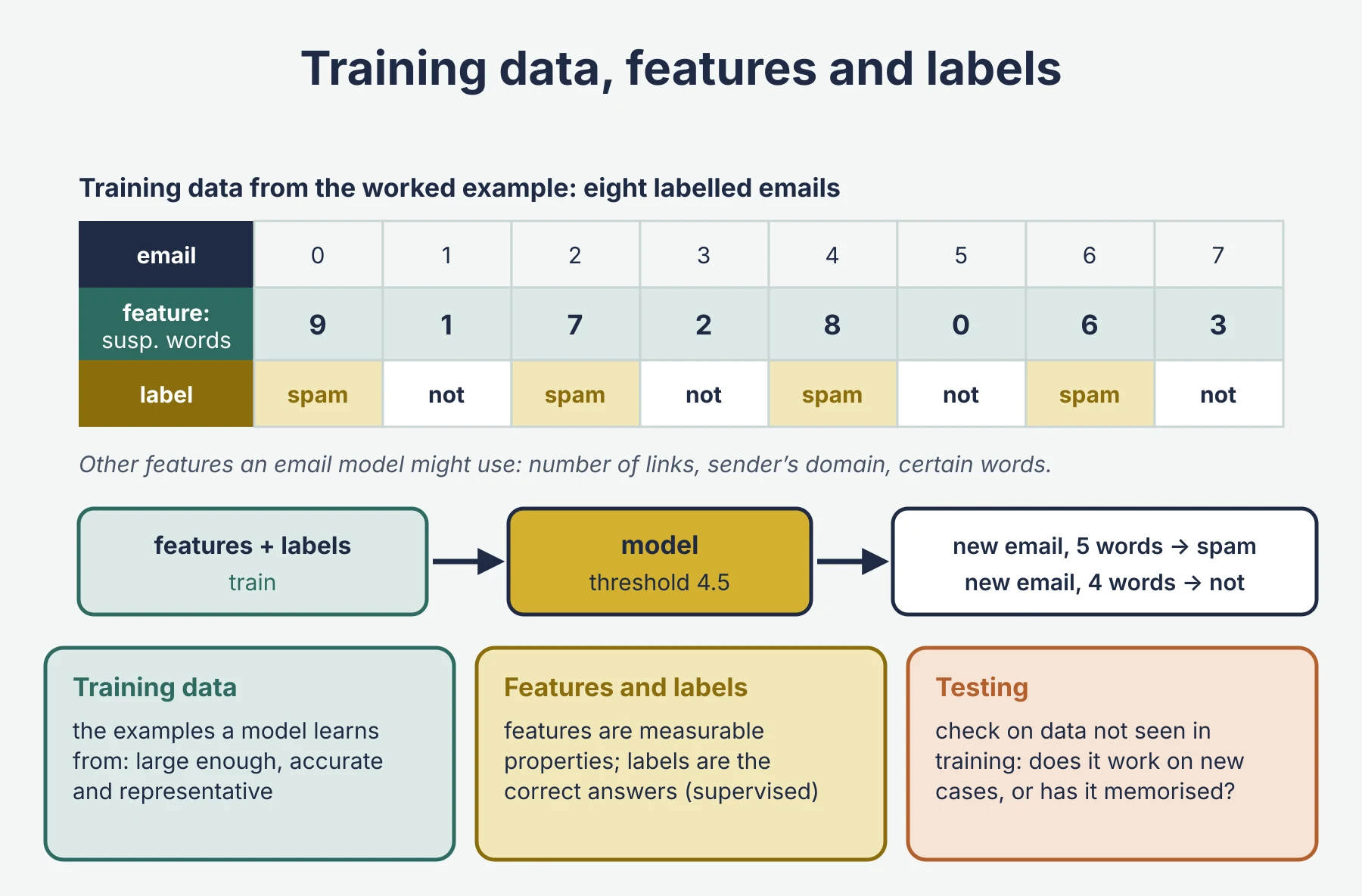
| Training data | The examples a model learns from |
| Test data | Examples kept back to check the model on unseen cases |
| Feature | A measurable property of an example used as input |
| Label | The correct output attached to a training example |
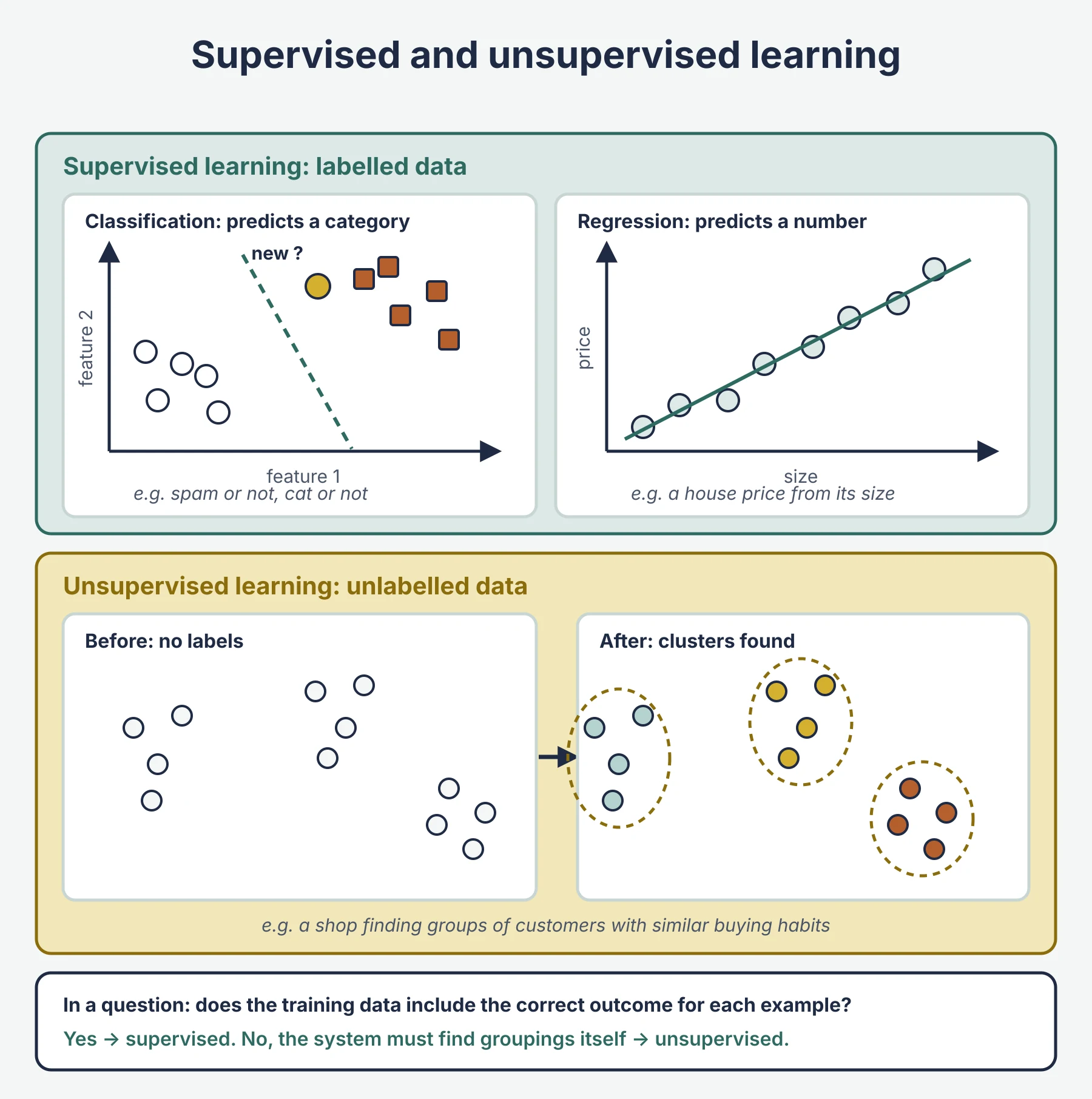
| Supervised learning | Learning from labelled examples |
| Unsupervised learning | Finding structure in unlabelled data |
| Classification | Predicting a category |
| Regression | Predicting a numerical value |
| Clustering | Grouping similar examples without labels |
| Bias (in data) | Data that misrepresents groups or reflects past unfairness |
| Transparency | Being able to explain how a decision was reached |
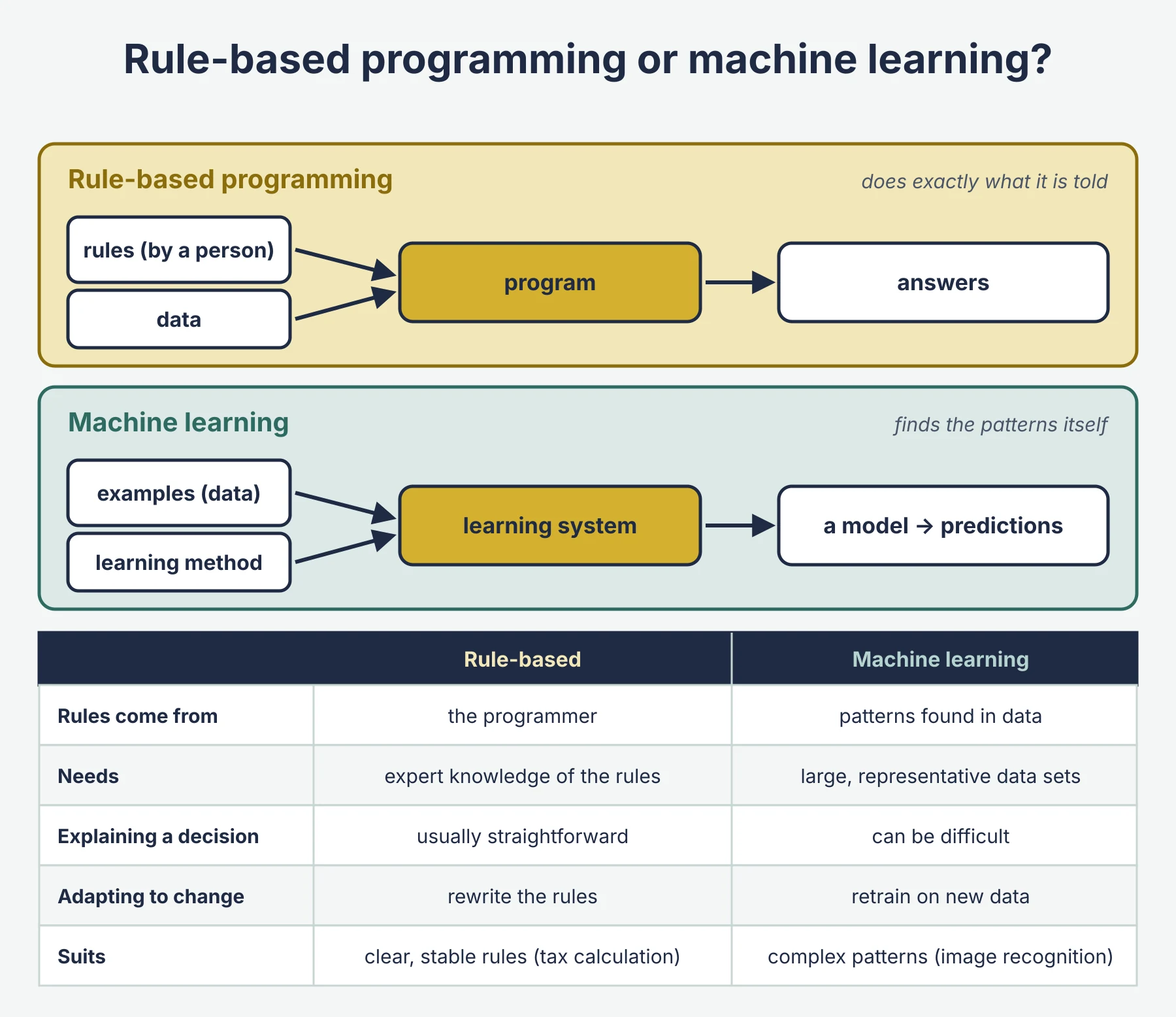
Rules vs learning in four lines
- Rules come from the programmer vs from patterns in data.
- Rule-based suits clear, stable rules; learning suits complex or changing patterns.
- Rule-based decisions are easy to explain; learned models can be hard to explain.
- Rule-based needs expert knowledge; learning needs large, representative data.
The learning process
- Collect data relevant to the task.
- Prepare it: correct errors, remove duplicates, check it represents the situations the model will meet.
- Choose features.
- Train the model on the training data.
- Test it on unseen data and evaluate its accuracy.
- Use it to make predictions; retrain when new data or new situations arise.
Supervised or unsupervised?
| Clue in the scenario | Type | Example |
|---|---|---|
| Each example has a known correct answer | Supervised (classification) | Emails labelled spam / not spam |
| Each example has a known numerical outcome | Supervised (regression) | Past house sales with prices |
| No answers given; find groups or patterns | Unsupervised (clustering) | Customers grouped by buying habits |
Applications to have ready
Medical image analysis · fraud detection · recommendations · speech recognition and translation · recognising road signs and obstacles.
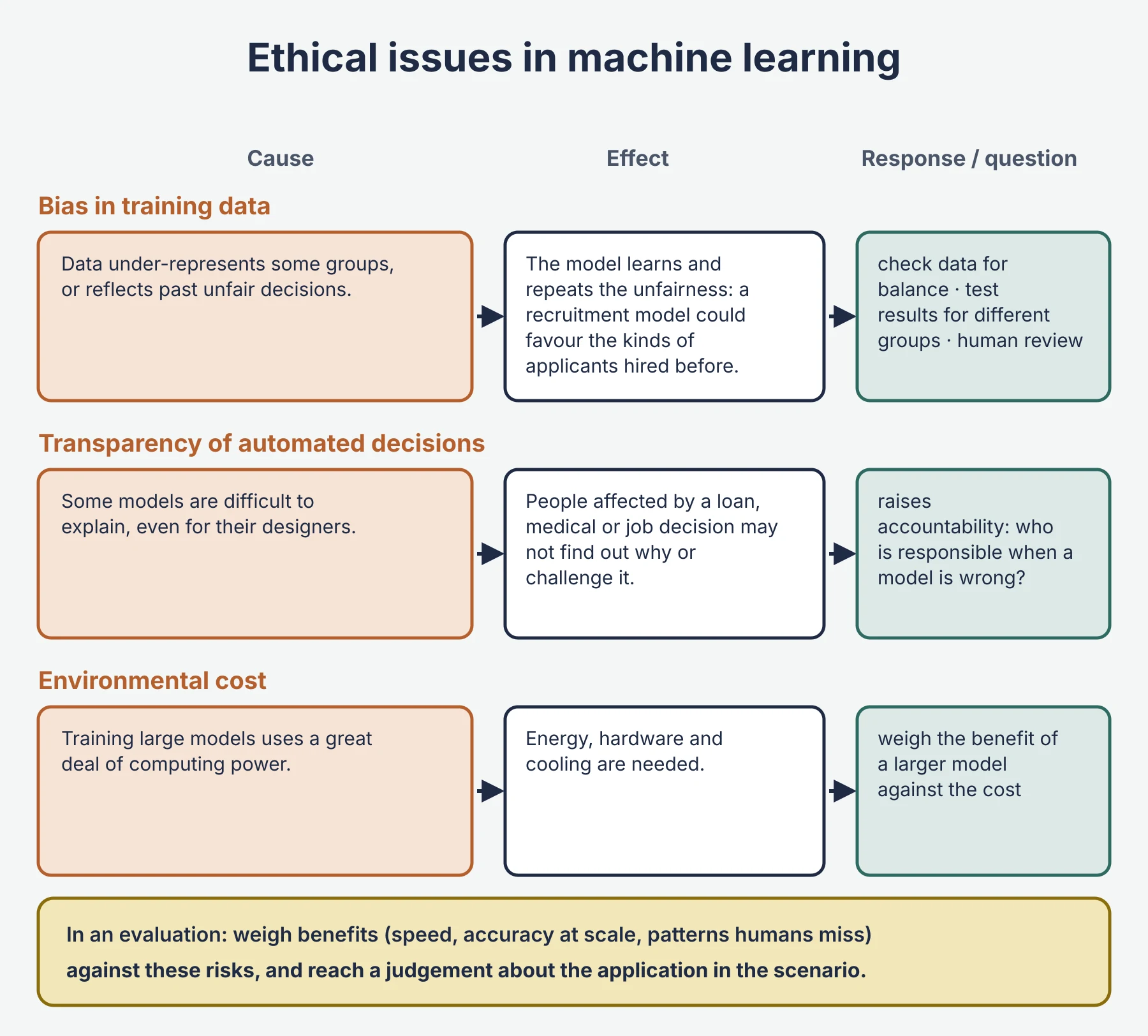
Ethical issues: what, why, response
| Issue | Why it matters | Possible responses |
|---|---|---|
| Bias in training data | The model can repeat unfairness against groups that are under-represented or were treated unfairly in the past | Check data balance; test results by group; human review |
| Transparency | People affected may not understand or be able to challenge a decision; unclear accountability | Explainable models where stakes are high; right to human review; clear responsibility |
| Environmental cost | Training large models uses large amounts of energy and hardware | Weigh benefit against cost; reuse existing models; efficient hardware |
Evaluation pattern: benefit for the scenario → specific risk from the scenario’s data or users → response → judgement.
Applying A.4 to a scenario
Suppose a council wants a model to decide which roads to repair first, trained on ten years of complaints. A strong answer names the learning type (supervised, if past repairs are labelled by urgency), the features (traffic volume, road age, number of complaints), a specific risk (areas where fewer people complain could be under-represented, so their roads are repaired later), a response (add objective sensor data and review decisions by area), and a judgement on whether the benefit outweighs the risk.
Exam traps
- “The computer understands.” It finds statistical patterns.
- Features vs labels. Features are inputs; labels are the correct outputs.
- Clustering is unsupervised, even if its results are useful.
- Testing on training data says little about new cases.
- Generic ethics. Tie bias, transparency or energy cost to the scenario.
- Ignoring the case study. Apply A.4 to the pre-released scenario.
Self-test
- State one difference between rule-based programming and machine learning.
- Give one advantage and one disadvantage of machine learning compared with rule-based programming.
- What are features?
- What is a label?
- Why must a model be tested on data it has not seen?
- A hospital trains a system on X-rays marked “fracture” or “no fracture”. What type of learning is this?
- A streaming service groups viewers by viewing patterns without predefined categories. What type of learning is this?
- Is predicting tomorrow’s temperature classification or regression?
- How can bias enter a machine learning system?
- Why is transparency important for a model that decides loan applications?
- Why does training large models raise an environmental concern?
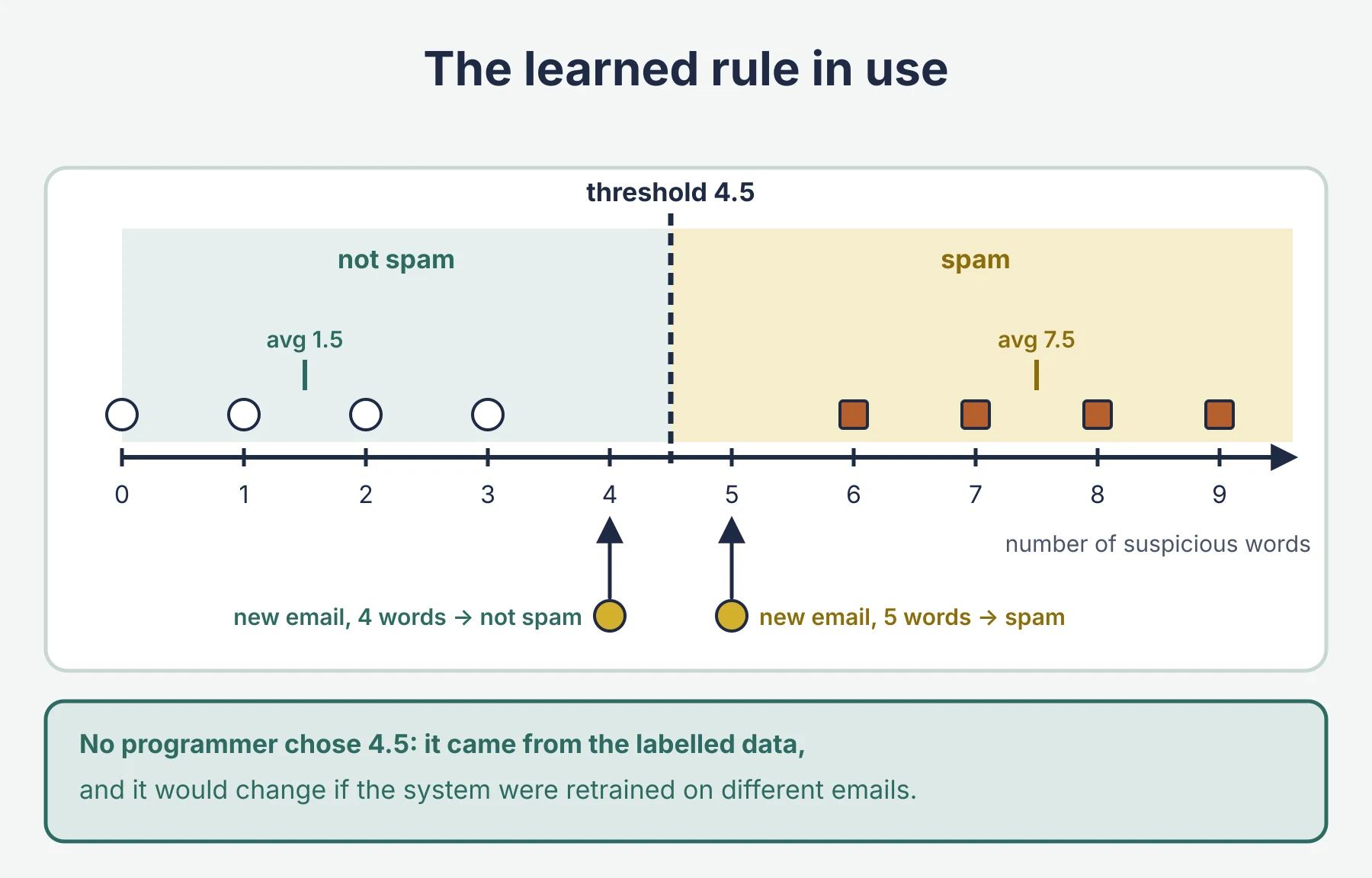
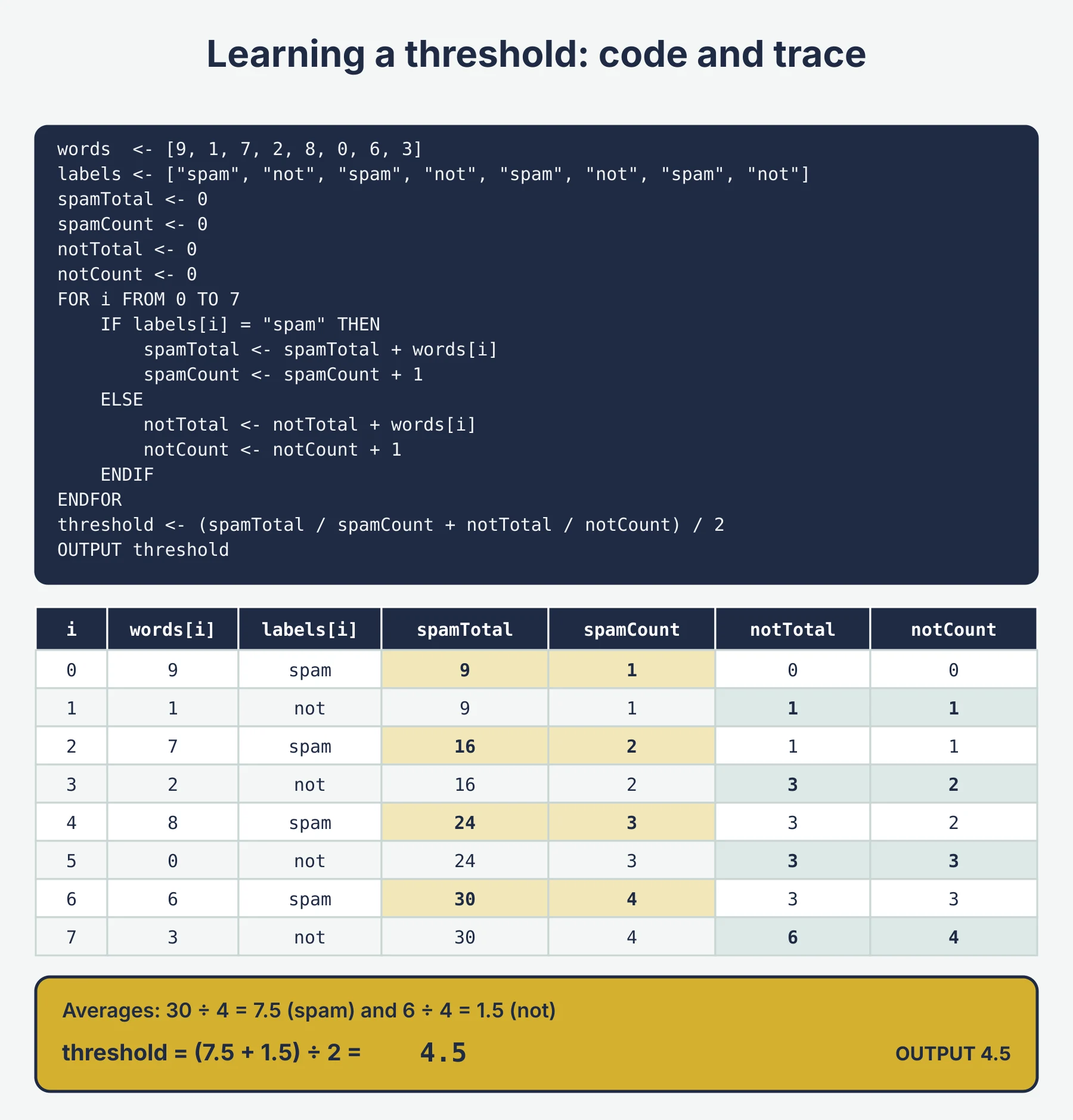
- In the study guide’s threshold example, what threshold is learned, and how would an email with 5 suspicious words be classified?
Answers: 1. In rule-based programming the programmer writes the rules; in machine learning the system derives them from data. 2. Advantage, any one: handles complex patterns; adapts by retraining; can find patterns people miss. Disadvantage, any one: needs large, representative data; harder to explain; may learn bias. 3. Measurable properties of each example used as inputs. 4. The correct output attached to a training example. 5. To check that it works on new cases rather than having memorised its examples. 6. Supervised (classification). 7. Unsupervised (clustering). 8. Regression, because the output is a number. 9. Through training data that under-represents some groups or reflects past unfair decisions. 10. Applicants need to know why they were refused and be able to challenge it, and someone must be accountable for errors. 11. It uses large amounts of computing power and therefore energy. 12. 4.5; spam, because 5 is above the threshold.
Related pages
Official syllabus
International Baccalaureate Organization, Diploma Programme Subject Brief – Sciences: Computer science, first assessment 2027, © 2024.
Related resources
-
Study guides
IB DP Computer Science (DP Computer Science): Data Preprocessing for Machine Learning (HL)
HL study guide to data preprocessing in IB DP Computer Science A.4: cleaning, missing values, outliers, scaling, encoding and splitting data, with calculations.
Computer Science · International Baccalaureate · IB
Read guide -
Practice questions
IB DP Computer Science (DP Computer Science): Data Preprocessing for Machine Learning (HL) – Practice Questions
Twelve original HL questions on data preprocessing for IB DP Computer Science A.4: cleaning, imputation, scaling, encoding and splitting, with full answers.
Computer Science · International Baccalaureate · IB
Try questions -
Revision notes
IB DP Computer Science (DP Computer Science): Data Preprocessing for Machine Learning (HL) – Revision Notes
Condensed HL notes on data preprocessing for IB DP Computer Science A.4: cleaning, imputation, outliers, scaling, encoding, splitting and a self-test.
Computer Science · International Baccalaureate · IB
Revise topic
Get free revision emails (optional)
Occasional emails with practice questions, worked explanations and links to free resources for the qualification and subjects you choose. No spam, and you can unsubscribe from any email. The free tools on this site never need an email.