
Study Guides
IB DP Computer Science A.4: Machine Learning
Study guide to A.4 Machine learning in IB DP Computer Science: rules versus learning, training data, features, supervised and unsupervised learning, and ethics.
- Subject
- Computer Science
- Level
- IB
- Topic
- A.4 – Machine learning
- Author
- Marlbridge Academic Team
- Updated
- Reviewed by
- Harris Khan (what this means)
Aligned to International Baccalaureate IB Diploma Programme Computer Science (DP Computer Science), First assessment 2027. Official subject brief .
Syllabus page (what it covers and how it is assessed): IB Diploma Programme Computer Science.
Found an error? Report a correction.
Need help with this topic? Request a free trial class for IB Diploma Programme Computer Science (DP Computer Science (2014) / DP Computer Science (2027)).
A.4 Machine learning is the fourth sub-topic of Theme A, “Concepts of computer science”, in the IB Diploma Programme Computer Science course first assessed in 2027. It asks how a computer can improve at a task by learning from data instead of following rules a programmer has written. It covers the difference between rule-based programming and machine learning, the core ideas of training data and features, supervised and unsupervised learning, real-world applications and the ethical issues they raise. The subject brief recommends 5 hours at SL and 18 at HL, the largest difference between the levels in Theme A, so HL students study it in considerably more depth.
Scope of this page. This page is written from the IB’s public Diploma Programme Subject Brief, Sciences: Computer science, first assessment 2027 (© International Baccalaureate Organization 2024) and the A.4 content summarised in our Theme A study guide. The detailed learning outcomes, including the HL extension, are in the full DP Computer Science guide; check your school’s copy for the exact content and depth.
What does A.4 cover?
- The distinction between traditional rule-based programming and machine learning, where a system derives its own rules from data.
- Core concepts: training data, features, and the difference between supervised and unsupervised learning.
- Real-world applications, and the ethical issues they raise, including bias in training data, transparency of automated decisions and the environmental cost of training large models.
Rule-based programming or machine learning?
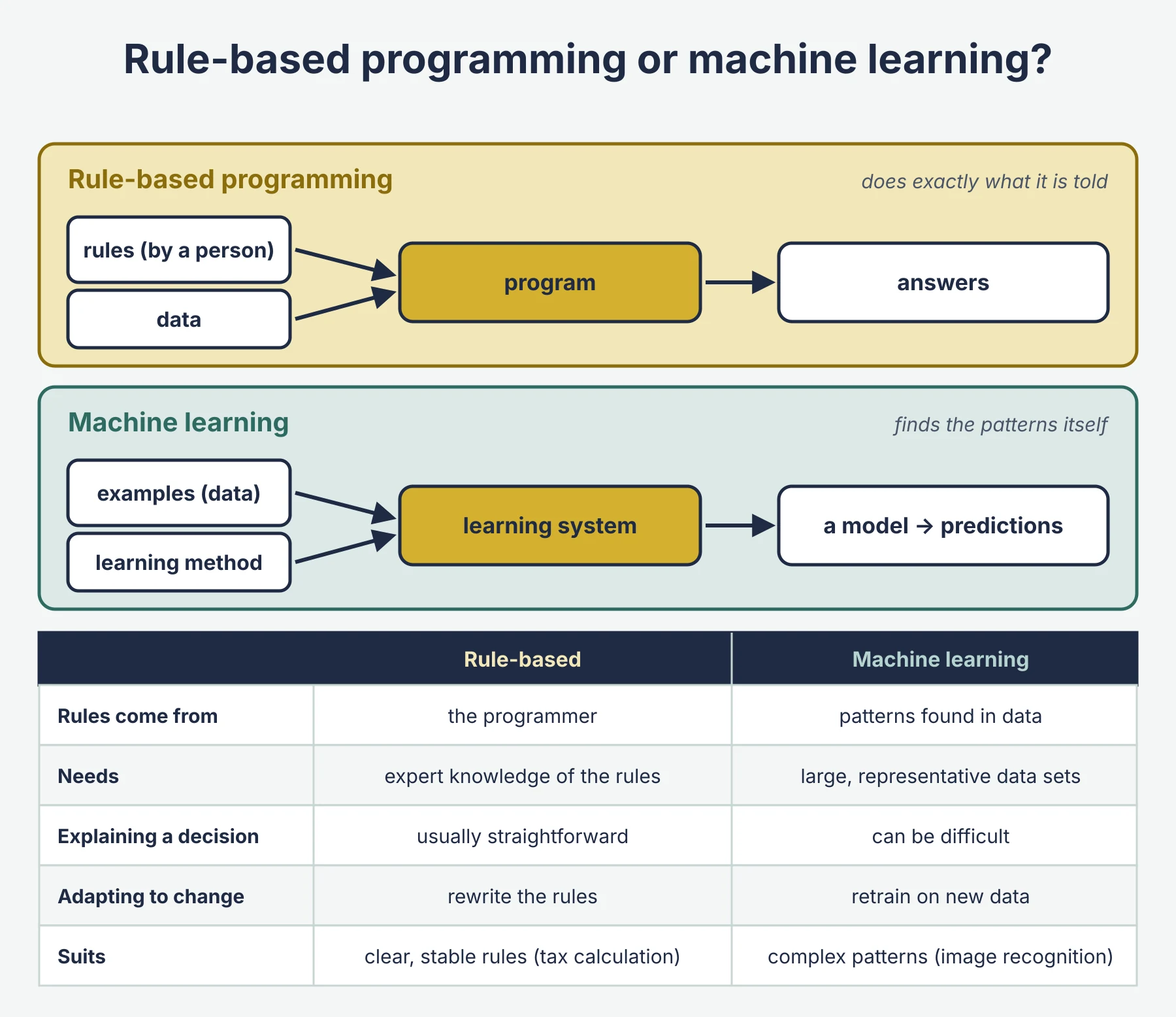
In rule-based programming, a programmer works out the rules and writes them as code: “if an email contains more than five words from this list, mark it as spam”. The program does exactly what it is told, and its behaviour can be explained line by line. It works well when the rules are known and stable, but it is hard to write rules for tasks such as recognising faces or speech, and the rules must be rewritten by hand when the problem changes.
In machine learning, the programmer supplies examples and a learning method; the system finds the patterns itself and produces a model, which is then used to make predictions about new data. It suits tasks where the rules are too complex to write down or change over time. The cost is that it needs large amounts of suitable data, its behaviour can be harder to explain, and it can only be as good as the data it learns from.
| Rule-based | Machine learning | |
|---|---|---|
| Where the rules come from | The programmer | Patterns found in data |
| Needs | Expert knowledge of the rules | Large, representative data sets |
| Explaining a decision | Usually straightforward | Can be difficult |
| Adapting to change | Rewrite the rules | Retrain on new data |
| Suits | Clear, stable rules (tax calculation) | Complex patterns (image recognition) |
Training data, features and labels
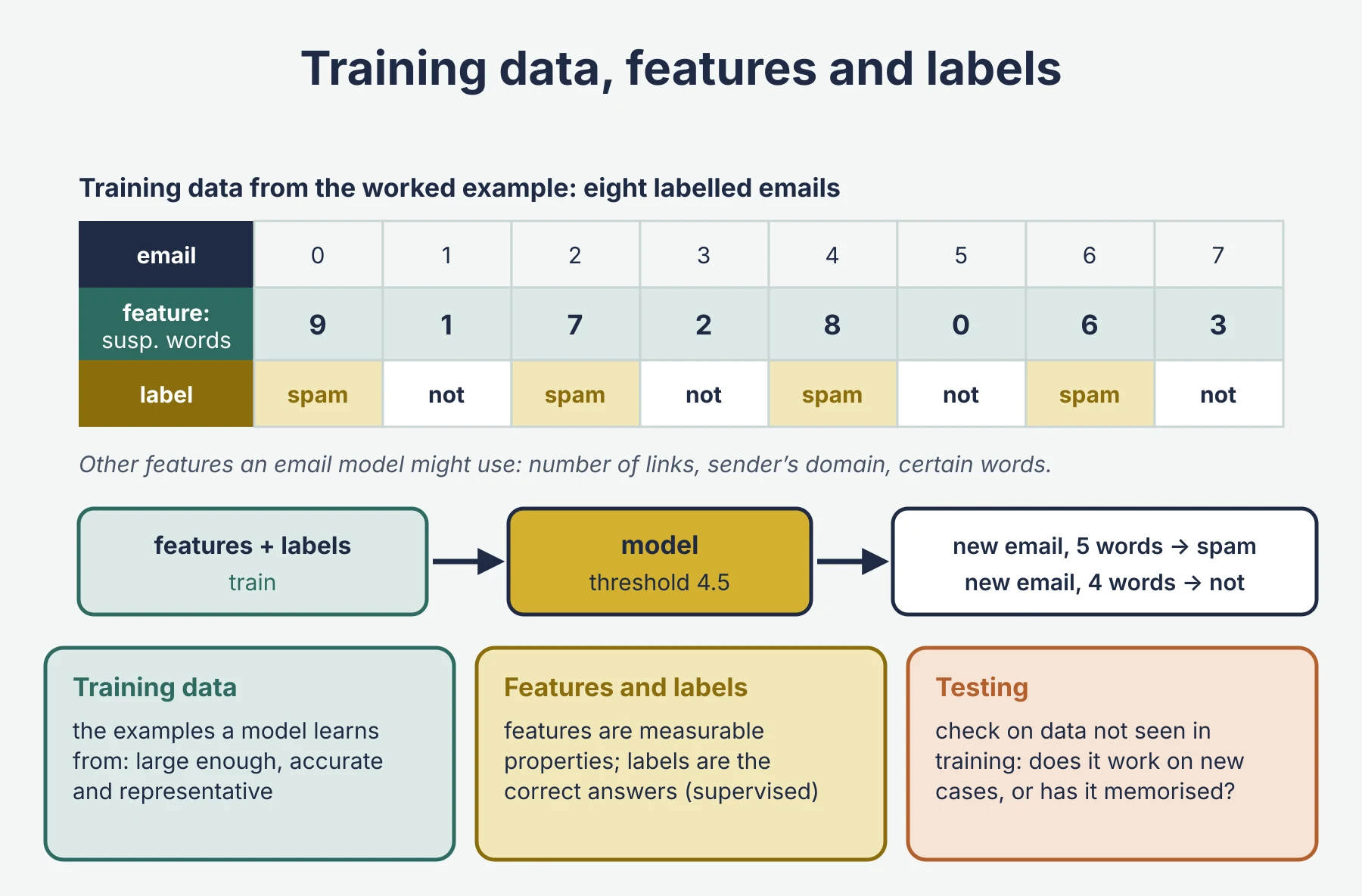
- Training data: the examples a model learns from. It must be large enough, accurate and representative of the situations the model will meet.
- Features: the measurable properties of each example that the model uses, such as an email’s number of links, its sender’s domain and certain words. Choosing useful features is part of designing a solution.
- Labels: in supervised learning, the correct answer attached to each training example, such as “spam” or “not spam”.
- Testing: a model is checked on data it has not seen during training, to find out whether it works on new cases and has not simply memorised its examples.
Supervised and unsupervised learning
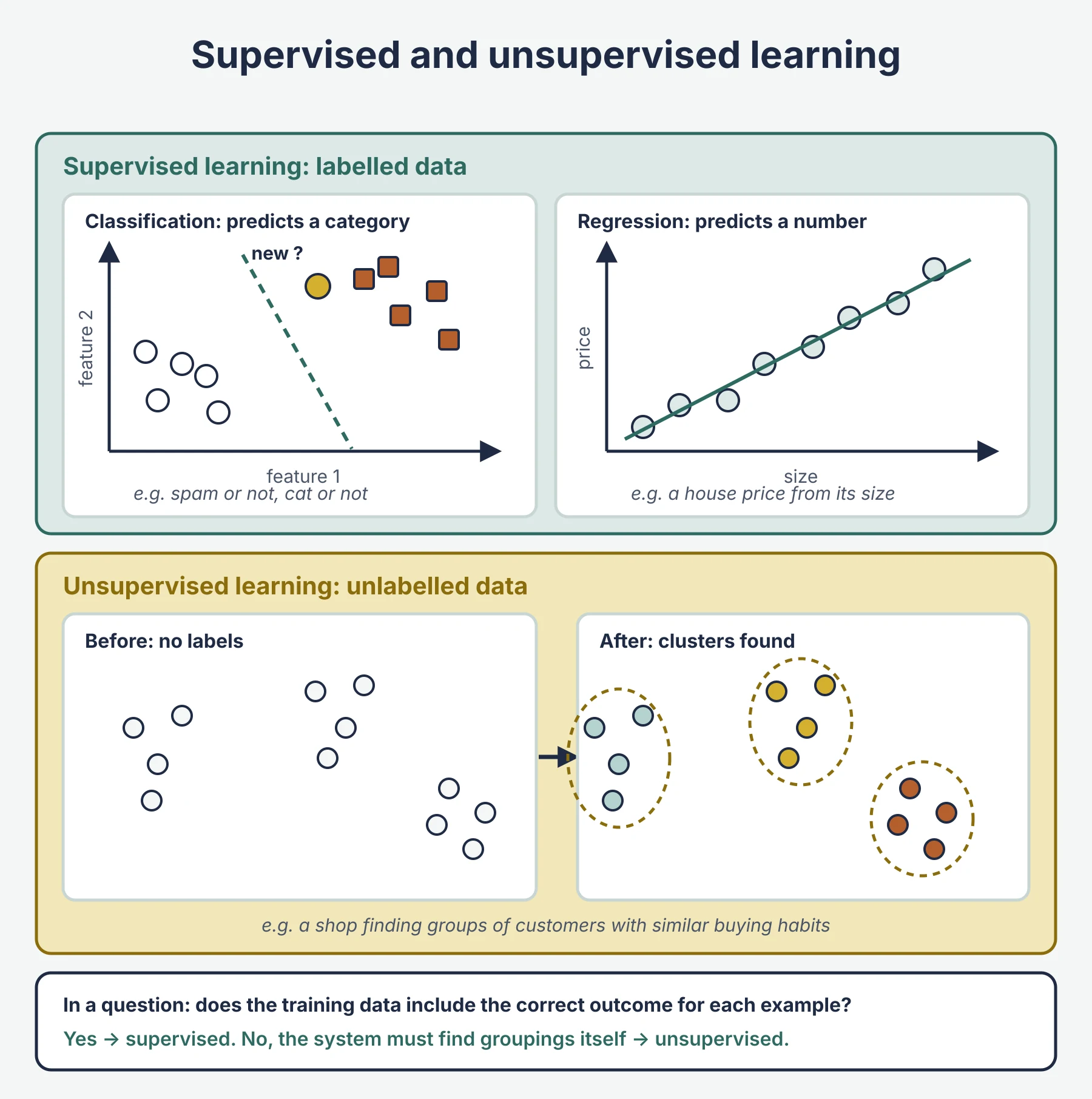
Supervised learning uses labelled data. The model learns the relationship between features and labels, then predicts labels for new examples.
- Classification predicts a category: spam or not spam, whether an image shows a cat.
- Regression predicts a number: the price of a house from its size and location.
Unsupervised learning uses unlabelled data. The model looks for structure on its own, such as clusters of similar items: a shop might discover groups of customers with similar buying habits without telling the system in advance what the groups are.
How to tell them apart in a question: if the scenario says the training data includes the correct outcome for each example, it is supervised; if the system must find groupings or patterns without being told the answers, it is unsupervised.
Worked example: learning a rule from data
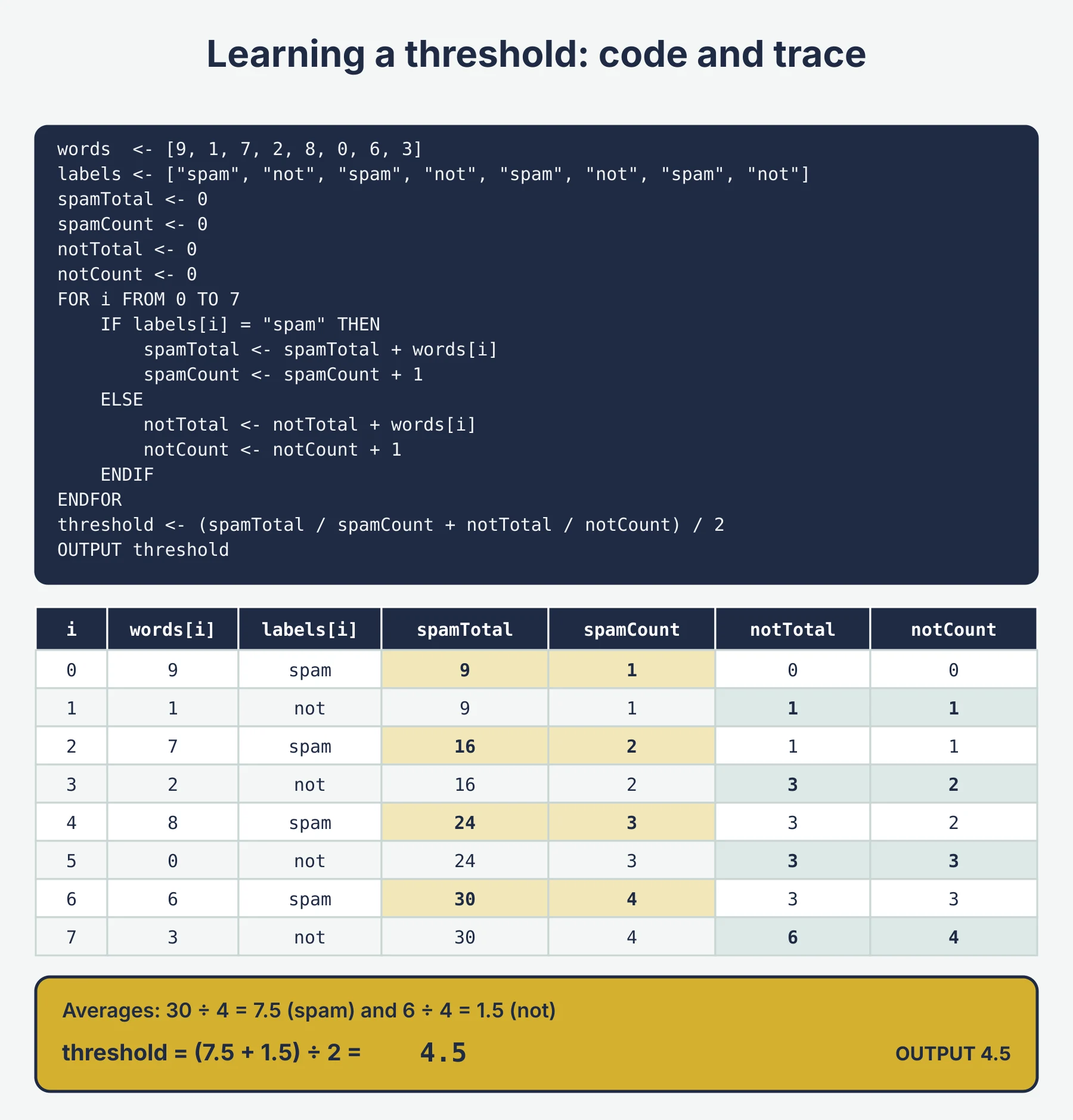
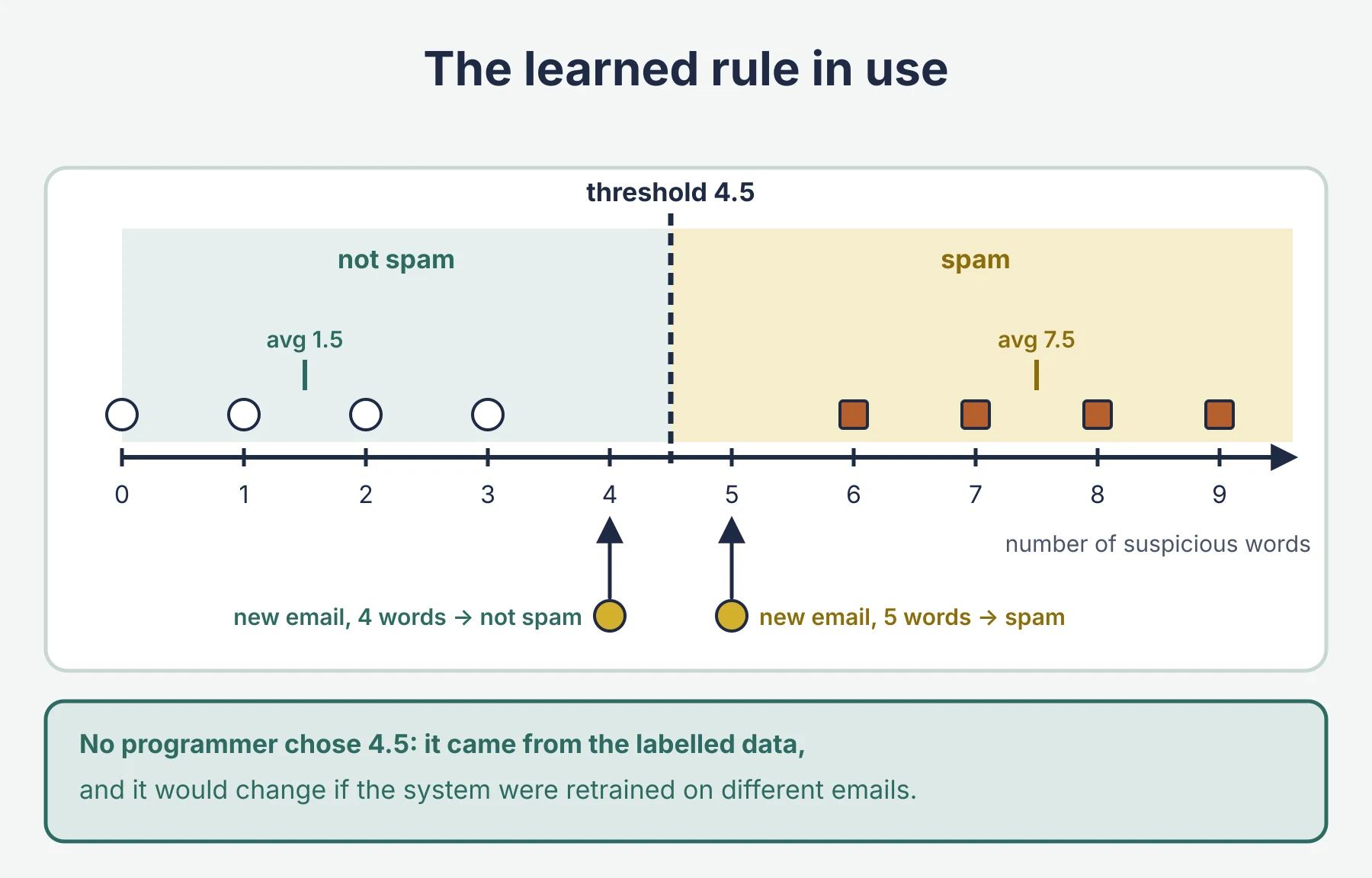
A very simple supervised learner can show the idea. Each training email has one feature, the number of suspicious words, and a label. The algorithm learns a threshold halfway between the average of each class.
words  <- [9, 1, 7, 2, 8, 0, 6, 3]
labels <- ["spam", "not", "spam", "not", "spam", "not", "spam", "not"]
spamTotal <- 0
spamCount <- 0
notTotal <- 0
notCount <- 0
FOR i FROM 0 TO 7
    IF labels[i] = "spam" THEN
        spamTotal <- spamTotal + words[i]
        spamCount <- spamCount + 1
    ELSE
        notTotal <- notTotal + words[i]
        notCount <- notCount + 1
    ENDIF
ENDFOR
threshold <- (spamTotal / spamCount + notTotal / notCount) / 2
OUTPUT threshold| i | words[i] | labels[i] | spamTotal | spamCount | notTotal | notCount |
|---|---|---|---|---|---|---|
| 0 | 9 | spam | 9 | 1 | 0 | 0 |
| 1 | 1 | not | 9 | 1 | 1 | 1 |
| 2 | 7 | spam | 16 | 2 | 1 | 1 |
| 3 | 2 | not | 16 | 2 | 3 | 2 |
| 4 | 8 | spam | 24 | 3 | 3 | 2 |
| 5 | 0 | not | 24 | 3 | 3 | 3 |
| 6 | 6 | spam | 30 | 4 | 3 | 3 |
| 7 | 3 | not | 30 | 4 | 6 | 4 |
Averages are 30 ÷ 4 = 7.5 and 6 ÷ 4 = 1.5, so the threshold is (7.5 + 1.5) ÷ 2 = 4.5. A new email with 5 suspicious words would be classified as spam; one with 4 would not. The important point is that no programmer chose 4.5: it came from the labelled data, and it would change if the system were retrained on different emails. Real systems use many features and far more sophisticated methods, but the principle is the same.
Where is machine learning used?
- Health care: spotting signs of disease in medical images.
- Finance: flagging card transactions that look fraudulent.
- Online services: recommending films, products or posts.
- Language: speech recognition, translation and predictive text.
- Transport: helping vehicles recognise road signs and obstacles.
What ethical issues does machine learning raise?
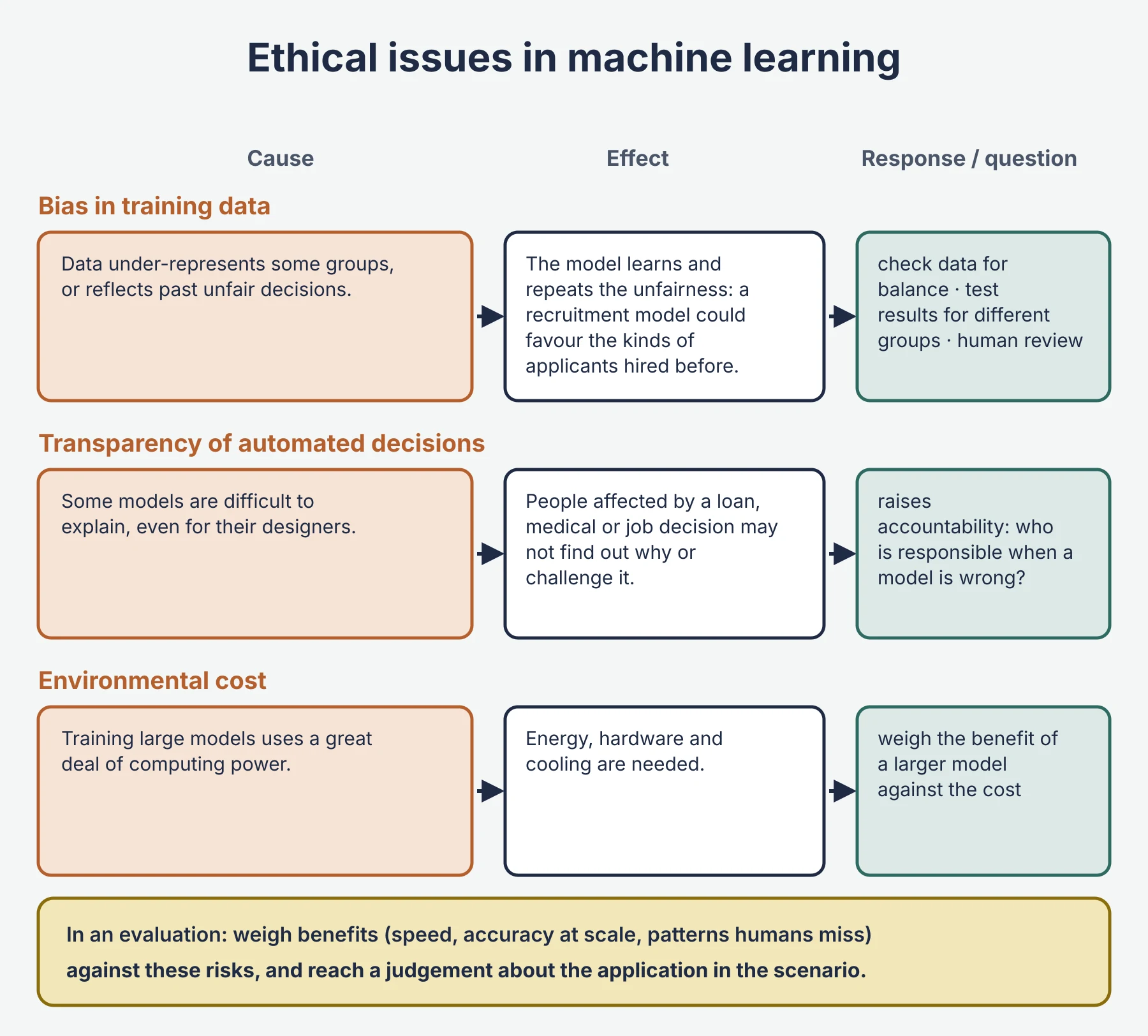
Bias in training data. If the training data under-represents some groups, or reflects past unfair decisions, the model can learn and repeat that unfairness. A recruitment model trained on a company’s past hiring could favour the kinds of applicants hired before. Responses include checking data for balance, testing the model’s results for different groups, and human review of decisions.
Transparency of automated decisions. Some models are difficult to explain, even for their designers. If a loan, a medical recommendation or a job application is decided automatically, the people affected may not be able to find out why or challenge the result. This raises questions of accountability: who is responsible when a model is wrong?
Environmental cost. Training large models uses a great deal of computing power, and therefore energy, along with the hardware and cooling it requires. Developers must weigh the benefit of a larger model against this cost.
In an evaluation question, balance benefits (speed, accuracy at scale, finding patterns humans miss) against these risks, and reach a judgement about the specific application in the scenario.
Common mistakes
- Saying a machine learning system “thinks” or “understands”: it finds statistical patterns in data.
- Confusing features (inputs) with labels (the correct outputs in supervised learning).
- Calling clustering “supervised” because the results are useful.
- Writing about ethics in general terms without linking it to the scenario’s data and users.
- Treating A.4 as purely technical: the course treats ethical issues as integral content.
Frequently asked questions
Why is A.4 so much longer at HL? The brief gives 5 hours at SL and 18 at HL; the full guide sets out the extra HL content.
Do I need to program a machine learning model? Theme A is mostly explanation and evaluation; short algorithms like the example above help you understand the idea of learning from data.
Related pages
- A.4 Machine learning revision notes
- A.4 Machine learning practice questions
- A.3 Databases study guide
- Theme A study guide
Source
International Baccalaureate Organization, Diploma Programme Subject Brief, Sciences: Computer science, first assessment 2027 (© 2024). The complete subject guide is available through the IB Programme Resource Centre.
Related resources
-
Practice questions
IB DP Computer Science A.4: Machine Learning – Practice Questions
Twelve original questions on rules versus learning, learning types, a trace table, bias, transparency and energy use for IB DP Computer Science A.4.
Computer Science · International Baccalaureate · IB
Try questions -
Revision notes
IB DP Computer Science A.4: Machine Learning – Revision Notes
Recall notes on IB DP Computer Science A.4 Machine learning: rules versus learning, features, labels, learning types, applications and ethics, with a self-test.
Computer Science · International Baccalaureate · IB
Revise topic -
Study guides
IB DP Computer Science (DP Computer Science): Data Preprocessing for Machine Learning (HL)
HL study guide to data preprocessing in IB DP Computer Science A.4: cleaning, missing values, outliers, scaling, encoding and splitting data, with calculations.
Computer Science · International Baccalaureate · IB
Read guide
Get free revision emails (optional)
Occasional emails with practice questions, worked explanations and links to free resources for the qualification and subjects you choose. No spam, and you can unsubscribe from any email. The free tools on this site never need an email.