
Revision Notes
IB DP Geography: 3.4 Extreme environments futures – Revision Notes
Condensed IB DP Geography notes on 3.4 Extreme environments: climate change impacts in cold and arid areas, feedbacks, scenarios, vulnerability and resilience, with a self-test.
- Subject
- Geography
- Level
- IB
- Topic
- Topic 3: Option C: Extreme environments
- Author
- Marlbridge Academic Team
- Updated
- Reviewed by
- Azam Siddique (what this means)
Aligned to International Baccalaureate IB Diploma Programme Geography (DP Geography), First assessments 2019. Official specification .
Syllabus page (what it covers and how it is assessed): IB Diploma Programme Geography.
Syllabus points this page covers
DP Geography
- 3.4 Extreme environments futures
Condensed recall for 3.4 Extreme environments futures (IB DP Geography, Option C: Extreme environments). The Extreme environments study guide has fuller discussion.
Main driver: climate change
| Environment | Likely changes |
|---|---|
| Cold | Glacier retreat, permafrost thaw, changing river regimes, new access for shipping and resource use |
| Arid | Changing rainfall and rising temperatures may intensify drought, though patterns differ from place to place |
Population growth and migration into marginal lands add pressure.
Why cold places change fastest
The Arctic has warmed considerably faster than the global average, a pattern called Arctic amplification. A major reason is the loss of snow and sea ice: bright ice reflects sunlight, but the darker ocean or land exposed beneath absorbs it, which causes more warming and more melting.
Changing river regimes and “peak water”
Many mountain rivers depend on glacier and snow melt in the dry season. As glaciers shrink, meltwater at first increases because more ice is melting each year. Once the glaciers become small, summer flow falls, leaving dry-season supply less reliable. This turning point is often called peak water. It matters for communities and cities below the glaciated ranges of the Andes and the Himalaya that rely on meltwater for drinking water, irrigation and hydroelectric power.
New hazards
- Glacial lake outburst floods (GLOFs): retreating glaciers leave lakes dammed by loose moraine. A collapse or a landslide into the lake can release a sudden flood. In October 2023 an outburst from South Lhonak Lake in Sikkim, India, sent a flood down the Teesta valley that destroyed a major hydroelectric dam and killed many people.
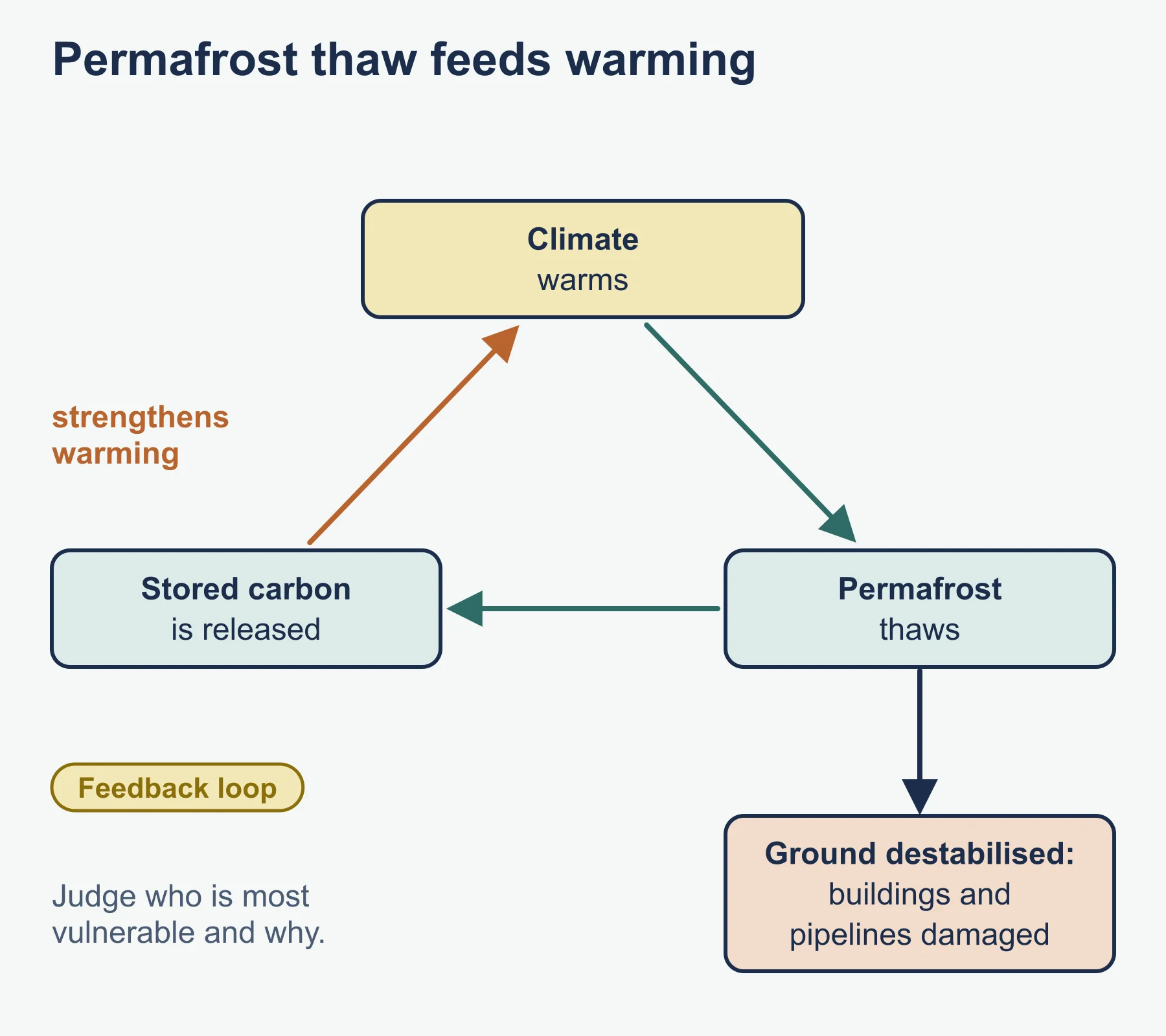
- Ground subsidence: thawing ice-rich permafrost makes the ground sink unevenly. In 2020 a fuel tank at a power plant near Norilsk in Arctic Russia failed and released a large diesel spill into rivers; the operator blamed subsiding supports in thawing ground.
- Coastal erosion: with less sea ice to shelter them and thawing cliffs, some Alaskan coastal villages, such as Newtok, have begun relocating to safer sites.
Feedbacks
Write feedbacks as chains of cause and effect.
Permafrost carbon feedback: warming -> permafrost thaws -> stored carbon released -> stronger warming -> more thaw. This is a positive (reinforcing) feedback.
Ice-albedo feedback: warming -> snow and ice melt -> darker surface exposed -> more solar energy absorbed -> more warming. Also positive.
Released carbon may be carbon dioxide or methane, depending on whether thawed organic matter decays with or without oxygen. Methane is a more powerful greenhouse gas over short periods, which is why waterlogged thaw areas attract concern.
New opportunities, new conflicts
- Shipping: shrinking summer sea ice is lengthening the season for Arctic routes such as the Northern Sea Route along Russia’s coast, which is shorter than routes between Europe and East Asia via the Suez Canal.
- Resources: easier access to oil, gas and minerals raises questions about who controls them. The Arctic Council, which includes the eight Arctic states and permanent participant organisations representing indigenous peoples, is the main forum for cooperation, although it does not deal with military security.
- Desert energy: strong sunshine makes hot deserts attractive for large solar plants, such as the Noor Ouarzazate complex in Morocco, which could support low-carbon futures but uses water for cleaning and cooling.
These opportunities can strengthen local economies, but they can also bring more pollution risk and pressure on indigenous land.
Scenarios
| Managed, adaptive future | Business-as-usual future |
|---|---|
| Cooperation and careful planning | Weak planning, degradation |
| Monitoring and adjustment | Pressure on marginal land continues |
| Greater resilience | Greater vulnerability |
Vulnerability and resilience
- Vulnerable: communities dependent on one resource or on a fragile water supply, with limited wealth or political voice.
- Resilient: diverse livelihoods, local knowledge, good governance and access to resources.
Judge which communities are most at risk and what would make them more resilient.
Adaptation options include early warning systems and artificial lowering of dangerous glacial lakes, water storage to replace lost meltwater, relocation of exposed settlements, building designs for thawing ground, and drought-tolerant crops in drylands. Each has costs and limits, so evaluate rather than list.
Comparing environments
| Cold and high-altitude | Hot arid | |
|---|---|---|
| Main physical change | Loss of ice and frozen ground | Changing rainfall and higher evaporation |
| Key hazard | GLOFs, subsidence, coastal erosion | Drought, heat stress, dust storms |
| Human opportunity | Shipping routes, resource access | Solar energy |
| Certainty | Warming trend clear; local rates vary | Rainfall change varies greatly between regions |
Model paragraph
Discuss the likely future of a glaciated mountain region. “In the short term, glacier retreat in ranges such as the Andes may increase river flow, supporting irrigation and hydropower. In the longer term, once glaciers pass peak water, dry-season flow is likely to decline, threatening communities that have few other sources. At the same time, new moraine-dammed lakes increase GLOF risk. The outcome depends on governance: storage, monitoring and warning systems can reduce harm, but poorer valley communities with limited political voice are likely to remain most vulnerable.”
Exam traps
- Assuming every arid area gets drier or every cold area melts at the same rate: changes vary.
- Describing a feedback without showing the loop closing.
- Treating the future as one outcome; use scenarios.
- Giving projected figures from memory; keep to general trends.
- Saying glacier melt always means less water: it rises before it falls.
- Presenting new Arctic shipping and resource access only as a benefit, without risks or stakeholders.
Self-test
- Give two likely changes in cold environments under warming.
- Why is permafrost thaw a positive feedback?
- How might climate change affect arid areas?
- Contrast the two scenarios above in one sentence.
- Name one factor that increases resilience.
- What is Arctic amplification?
- Explain the ice-albedo feedback as a chain.
- What is meant by “peak water”?
- Why are glacial lake outburst floods becoming more of a concern?
- Give one benefit and one risk of shrinking Arctic sea ice.
- Why does it matter whether thawing permafrost releases methane or carbon dioxide?
- Name one adaptation for a community threatened by a glacial lake.
Answers: 1. For example glacier retreat and permafrost thaw. 2. Thaw releases stored carbon, which strengthens warming and causes more thaw. 3. Changing rainfall and higher temperatures may intensify drought in some places. 4. A managed future adapts through cooperation and planning; business as usual leads to degradation. 5. For example diverse livelihoods or good governance. 6. The Arctic warming faster than the global average. 7. Warming melts snow and ice; a darker surface absorbs more energy; this causes more warming and melting. 8. The point after which glacier meltwater declines because the remaining ice is too small. 9. Retreating glaciers leave more lakes dammed by unstable moraine. 10. Benefit: shorter shipping routes; risk: oil spills or pressure on indigenous land. 11. Methane is a more powerful greenhouse gas over short periods, so it strengthens the feedback. 12. For example an early warning system or artificially lowering the lake level.
More resources on this topic
Related resources
-
Subject guides
IB Diploma Programme Geography: Subject Overview
An overview of IB Diploma Programme Geography – interactions between individuals, societies and physical processes across time and space.
Geography · International Baccalaureate · IB
Read course guide -
Revision notes
IB DP Geography: 3.3 Managing extreme environments – Revision Notes
Condensed IB DP Geography notes on 3.3 Extreme environments: adaptation, pressures, opportunities and risks, stakeholders and management strategies, with a self-test.
Geography · International Baccalaureate · IB
Revise topic -
Revision notes
IB DP Geography: 3.2 Physical processes and landscapes – Revision Notes
Condensed IB DP Geography notes on 3.2 Extreme environments: weathering, glacial, periglacial and arid processes and landforms, and mountain environments, with a self-test.
Geography · International Baccalaureate · IB
Revise topic
Studying Geography?
This page is free and stays free. Marlbridge is not offering Geography classes at the moment, so there is no tuition to book for it. The free study resources stay open to everyone.
Get free revision emails (optional)
Occasional emails with practice questions, worked explanations and links to free resources for the qualification and subjects you choose. No spam, and you can unsubscribe from any email. The free tools on this site never need an email.