
Revision Notes
IB DP Geography: 6.3 Stakeholders in food and health – Revision Notes
Condensed IB DP Geography notes on 6.3 Food and health: stakeholders from household to global scale, agricultural and health strategies and their trade-offs, with a self-test.
- Subject
- Geography
- Level
- IB
- Topic
- Topic 6: Option F: Food and health
- Author
- Marlbridge Academic Team
- Updated
- Reviewed by
- Azam Siddique (what this means)
Aligned to International Baccalaureate IB Diploma Programme Geography (DP Geography), First assessments 2019. Official specification .
Syllabus page (what it covers and how it is assessed): IB Diploma Programme Geography.
Syllabus points this page covers
DP Geography
- 6.3 Stakeholders in food and health
Condensed recall for 6.3 Stakeholders in food and health (IB DP Geography, Option F: Food and health). The Food and health study guide has the longer account.
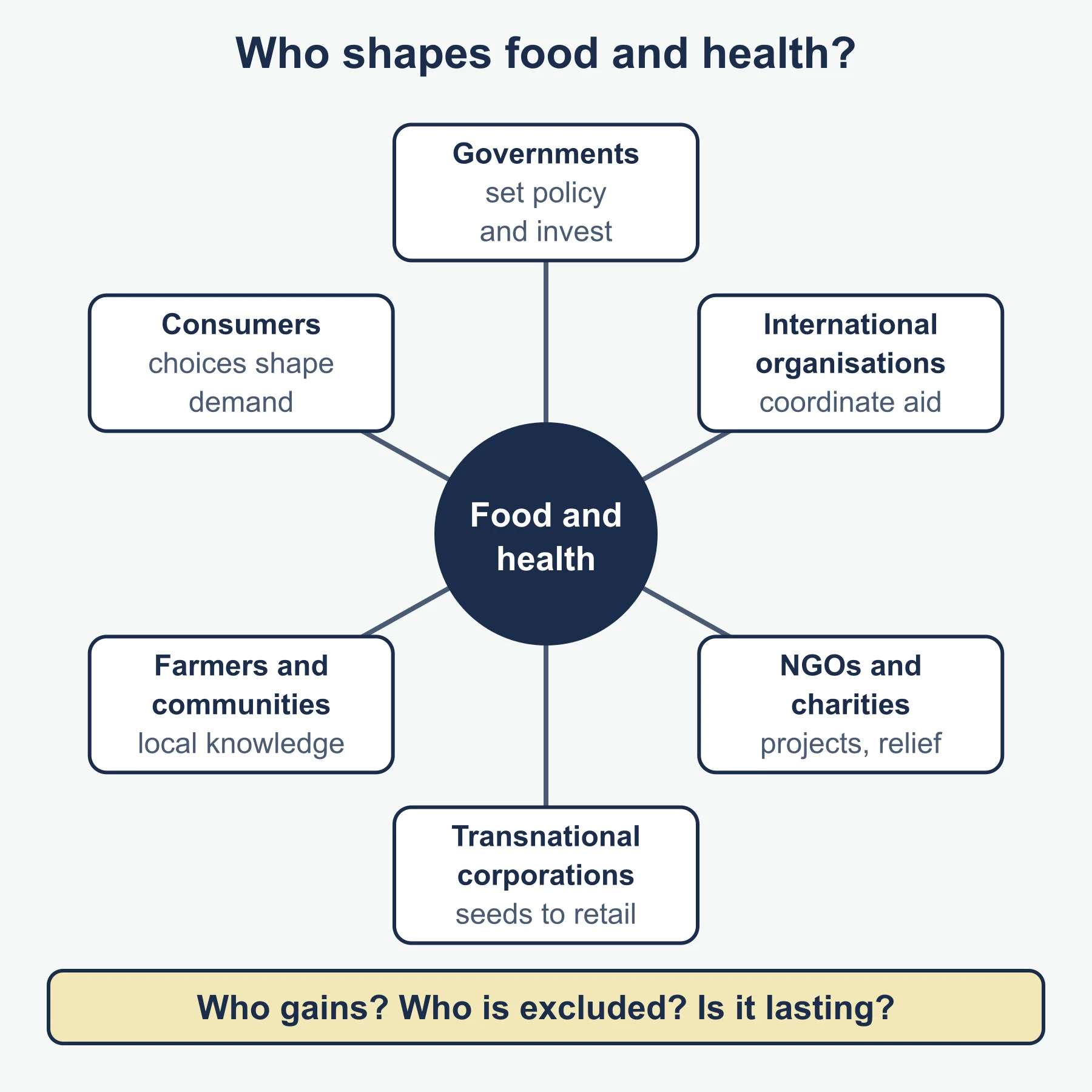
Stakeholders (household to global)
| Stakeholder | Role |
|---|---|
| Governments | Set agricultural, trade, health and nutrition policy; invest in infrastructure |
| International organisations (UN agencies) | Coordinate responses, set standards, provide emergency aid |
| NGOs and charities | Deliver projects, advocacy and relief |
| Transnational corporations | Seeds, fertiliser, food processing, retail, pharmaceuticals |
| Farmers and communities | Produce food; hold local knowledge |
| Consumers | Choices influence demand |
Who does what in the United Nations system
- Food and Agriculture Organization (FAO): collects food and farming data, advises on agriculture and food security.
- World Food Programme (WFP): delivers emergency food assistance and school meals.
- World Health Organization (WHO): sets health standards, coordinates responses to disease outbreaks and leads campaigns such as immunisation.
- UNICEF: focuses on children, including child nutrition, vaccination and safe water.
Alongside them, philanthropic foundations and public-private partnerships (for example Gavi, the Vaccine Alliance, which helps lower-income countries buy vaccines) now fund much global health work. Their money brings speed and scale but also raises questions about who sets priorities.
Scale matters
At the household scale, decisions about who eats first, how income is spent and who cares for children shape nutrition, and women’s education is strongly linked to child health. At the national scale, governments set subsidies, taxes and health budgets. At the global scale, trade rules, aid flows and the research priorities of large firms influence which crops and medicines are developed.
Strategies
- Agricultural innovation: Green Revolution style high-yield seeds, fertiliser and irrigation
- Genetically modified crops
- Better storage and transport to cut post-harvest loss
- Nutrition programmes
- Vaccination campaigns and primary health care
- Clean water and sanitation
Top-down strategies are planned by governments or international bodies and applied over large areas; bottom-up strategies are led by communities. Top-down approaches can achieve scale quickly; bottom-up ones often fit local needs better and last longer. Many successful programmes combine both.
Trade-offs
| Strategy | Benefit | Drawback |
|---|---|---|
| High-input agriculture | Higher yields | Pollution; costs for small farmers |
| Aid | Saves lives | Dependency if not linked to local capacity |
| GM crops | Potential yield or resilience gains | Debate over access, cost and control |
Case studies
The Green Revolution in India
From the 1960s, high-yielding varieties of wheat and rice, linked to the work of plant breeder Norman Borlaug, were combined with irrigation, fertiliser and government price support, especially in Punjab. Grain output rose sharply and India moved away from dependence on food imports. Costs followed: falling groundwater levels from heavy pumping, soil degradation, chemical pollution, and benefits concentrated among farmers who could afford irrigation and inputs. It is a strong example of a top-down, technology-led strategy with clear gains and long-term environmental costs.
Smallpox eradication
A WHO-led campaign using vaccination and surveillance and containment (finding cases and vaccinating everyone around them) led to smallpox being declared eradicated in 1980, the only human disease eradicated so far. It shows what coordinated international action can achieve, helped by the fact that smallpox has no animal reservoir and an effective vaccine existed.
Polio
The global polio eradication effort has driven wild poliovirus out of almost every country, but it remains endemic in Pakistan and Afghanistan, where conflict, mistrust of vaccination teams and hard-to-reach communities slow progress. The contrast with smallpox shows that technology is not enough without access and trust.
Regulating the food industry
Mexico introduced a tax on sugar-sweetened drinks in 2014 to tackle high rates of obesity and diabetes, and several other countries, including the United Kingdom with its soft drinks levy, have followed. Earlier, concern about the marketing of infant formula in lower-income countries led to a consumer boycott of Nestle in the 1970s and an international WHO code on marketing breast-milk substitutes in 1981. Both show governments and civil society trying to change the behaviour of transnational corporations.
Evaluating
Ask: who gains, who is excluded, and is it lasting? Consider effectiveness, cost, equity and sustainability.
Command words
- Examine the role of a stakeholder: say what it controls, what it wants, how it acts, and the limits on its power.
- Discuss a strategy: present arguments for and against, from more than one stakeholder’s view, then conclude.
- To what extent a stakeholder is responsible: weigh its influence against other stakeholders and reach a clear position.
Model paragraph
Discuss the view that technology is the key to improving food security. “The Green Revolution in India suggests that new seeds, irrigation and fertiliser can rapidly increase availability. However, it also shows that technology benefits those who can afford it and can damage the soils and groundwater on which future production depends. Food security also depends on access and utilisation, which are shaped by income, prices and sanitation rather than technology alone. Technology is therefore necessary but not sufficient: it works best when combined with policies on prices, land and health.”
Exam traps
- Assuming one technology, such as GM crops, is simply good or bad.
- Listing stakeholders without saying what each wants or controls.
- Treating aid as always sustainable.
- Naming a programme with invented outcomes.
- Forgetting the household scale, where many nutrition decisions are made.
- Claiming polio has been eradicated: only smallpox has.
Self-test
- Name four stakeholder groups in food and health.
- What did Green Revolution style farming rely on?
- Give one benefit and one drawback of high-input farming.
- Why can aid create dependency?
- Which three questions help evaluate a strategy?
- Distinguish the roles of the FAO and the WFP.
- What is a public-private partnership in global health? Give an example.
- Give two long-term costs of the Green Revolution in Punjab.
- Why was smallpox easier to eradicate than polio has been?
- Distinguish top-down from bottom-up strategies.
- How did Mexico try to change consumer behaviour in 2014?
- Why is the household an important scale for nutrition?
Answers: 1. For example governments, UN agencies, NGOs, transnational corporations. 2. High-yield seeds, fertiliser and irrigation. 3. Higher yields; pollution or costs for small farmers. 4. If it is not linked to local capacity, communities rely on outside supply. 5. Who gains, who is excluded, and is it lasting? 6. The FAO gathers data and advises on agriculture; the WFP delivers emergency food assistance. 7. Cooperation between governments, international bodies and private funders, for example Gavi. 8. For example falling groundwater levels and soil degradation. 9. It had no animal reservoir and could be contained through surveillance and vaccination, while polio campaigns face conflict and mistrust in the remaining endemic areas. 10. Top-down is planned centrally and applied widely; bottom-up is led by communities. 11. By taxing sugar-sweetened drinks. 12. Decisions about food sharing, spending and child care are made there.
More resources on this topic
Related resources
-
Subject guides
IB Diploma Programme Geography: Subject Overview
An overview of IB Diploma Programme Geography – interactions between individuals, societies and physical processes across time and space.
Geography · International Baccalaureate · IB
Read course guide -
Study guides
IB DP Geography: Option F: Food and health – Study Guide
A study guide to the Food and health option in IB DP Geography: measuring food and health, food systems and disease, stakeholders, and future security.
Geography · International Baccalaureate · IB
Read guide -
Study guides
IB DP Geography (DP Geography): Measuring food and health
IB DP Geography Food and health 6.1 in depth: age-standardised rates, the Preston curve, food crisis phases, mapping numbers versus rates, and combining indicators.
Geography · International Baccalaureate · IB
Read guide
Studying Geography?
This page is free and stays free. Marlbridge is not offering Geography classes at the moment, so there is no tuition to book for it. The free study resources stay open to everyone.
Get free revision emails (optional)
Occasional emails with practice questions, worked explanations and links to free resources for the qualification and subjects you choose. No spam, and you can unsubscribe from any email. The free tools on this site never need an email.