
Revision Notes
IB DP Geography: 1.3 Water scarcity and water quality – Revision Notes
Condensed IB DP Geography notes on 1.3 Freshwater: physical and economic scarcity, water stress, virtual water, pollutants and eutrophication, with a self-test.
- Subject
- Geography
- Level
- IB
- Topic
- Topic 1: Option A: Freshwater
- Author
- Marlbridge Academic Team
- Updated
- Reviewed by
- Azam Siddique (what this means)
Aligned to International Baccalaureate IB Diploma Programme Geography (DP Geography), First assessments 2019. Official specification .
Syllabus page (what it covers and how it is assessed): IB Diploma Programme Geography.
Syllabus points this page covers
DP Geography
- 1.3 Water scarcity and water quality
Condensed recall for 1.3 Water scarcity and water quality (IB DP Geography, Option A: Freshwater). See the Freshwater study guide for fuller treatment.
Key terms
| Term | Meaning |
|---|---|
| Physical scarcity | Not enough water to meet demand |
| Economic scarcity | Water exists but people lack infrastructure or money to use it |
| Water stress | Pressure on available supply, often compared with demand per person |
| Water footprint | Water used to produce goods and services |
| Virtual water | Water embedded in traded products, for example food exports from dry regions |
| Transboundary river | River shared by countries, so upstream use affects downstream users |
Keep these separate: students often blur scarcity, stress and quality.
Measuring stress: the Falkenmark indicator
One widely used measure divides a country’s renewable freshwater by its population:
| Renewable water per person per year | Category |
|---|---|
| Below 1,700 cubic metres | Water stress |
| Below 1,000 cubic metres | Water scarcity |
| Below 500 cubic metres | Absolute scarcity |
Worked check: a country with 12 cubic kilometres (12,000 million cubic metres) of renewable water and 8 million people has 12,000 / 8 = 1,500 cubic metres per person, so it is under stress but not yet scarce. If the population grows to 13 million with no change in supply, the figure falls to about 923, crossing into scarcity. The indicator is simple to calculate but ignores how water is distributed, used or stored, and treats all of a country as one unit.
Causes and consequences of scarcity
- Causes: climate variability, population growth, rising per-capita demand, agricultural irrigation, industrial use, leaking infrastructure, transboundary sharing.
- Consequences: reduced food production, conflict risk, and health problems when people turn to unsafe sources.
Agriculture accounts for the largest share of freshwater withdrawals worldwide, commonly estimated at around 70 per cent, so changes in irrigation efficiency matter more than household savings. Two irrigation problems recur:
- Salinisation: in hot, dry areas, irrigation water evaporates and leaves salts behind; over-irrigation raises the water table and brings salts to the surface by capillary action, eventually making soil infertile.
- Groundwater depletion: pumping faster than aquifers recharge lowers water tables, so wells must be deepened and pumping costs rise. Parts of north-west India and the Ogallala aquifer under the US Great Plains are well-known examples.
Consequences fall unevenly: women and girls often spend hours collecting water where supply is distant, which reduces time for school and paid work.
Water quality and pollutants
Sources: sewage, agricultural fertiliser and pesticides, industrial effluent, heavy metals, plastics, and saline intrusion in coastal aquifers.
Monitoring: dissolved oxygen, biological indicators and chemical tests.
Further quality indicators include biochemical oxygen demand (BOD, how much oxygen microbes need to break down organic matter: high BOD means heavy organic pollution), turbidity, faecal coliform bacteria (a sign of sewage), nitrate and phosphate levels and pH. Biological indicators work because some invertebrates, such as mayfly larvae, survive only in clean, well-oxygenated water.
Saline intrusion: when coastal aquifers are over-pumped, the fresh groundwater level drops and denser seawater moves inland underground, contaminating wells. Rising sea level adds to the problem.
Point sources (a sewage outfall, a factory pipe) are easier to regulate than non-point sources (fertiliser washing off thousands of fields).
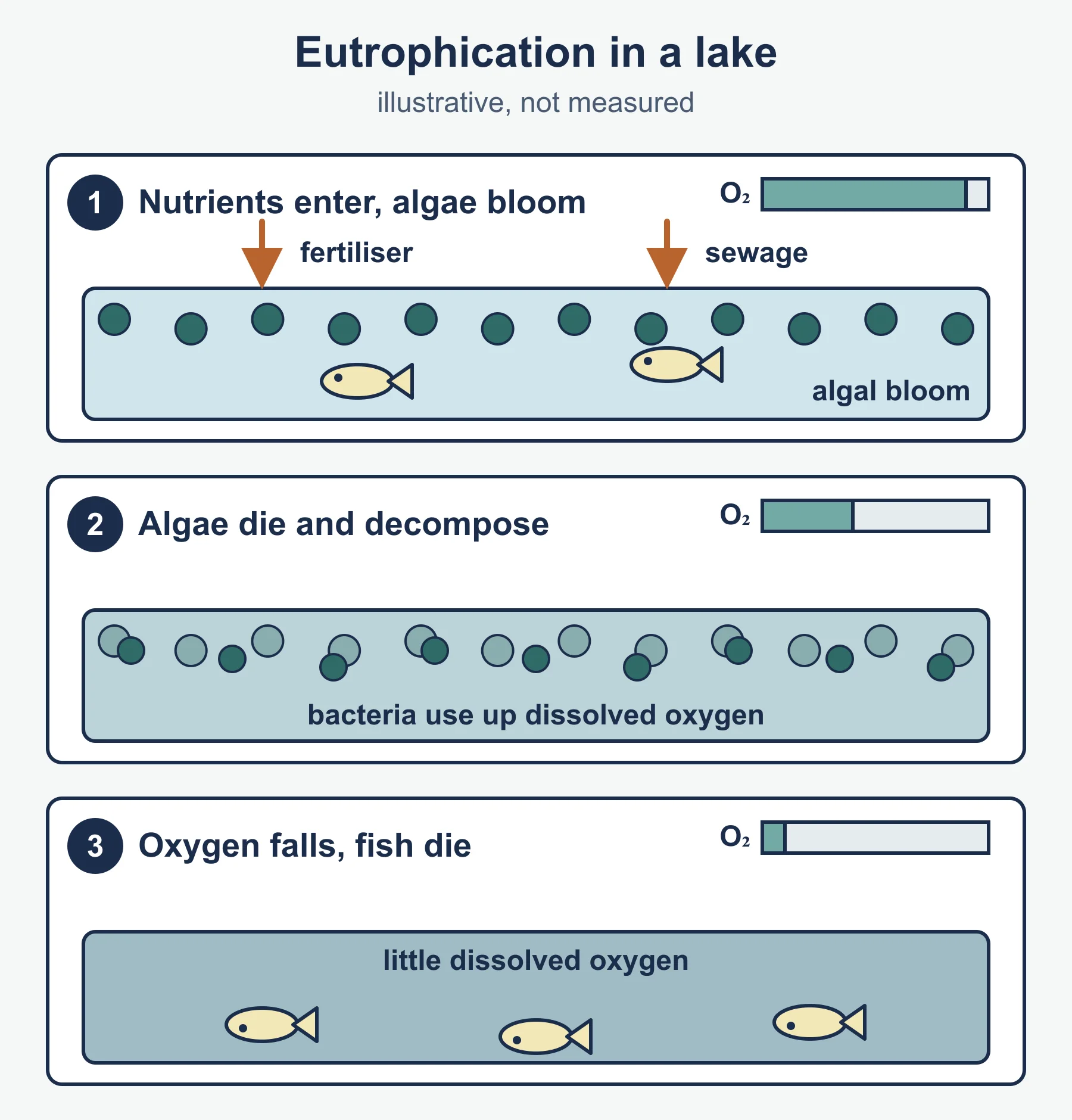
Eutrophication, in order
- Nutrients (fertiliser, sewage) enter a lake or slow river.
- Algal blooms form at the surface.
- Blooms block light; algae die and sink.
- Bacteria decomposing the dead algae use up dissolved oxygen.
- Fish and other organisms die.
Some blooms are of cyanobacteria that produce toxins. In 2014 a toxic bloom in Lake Erie led the city of Toledo, Ohio, to warn hundreds of thousands of residents not to drink tap water for a few days, a clear example of agricultural runoff affecting urban supply.
Physical versus economic scarcity
| Physical | Economic | |
|---|---|---|
| Problem | Supply too small | Access limited |
| Cause | Dry climate, over-abstraction | Lack of money, pipes, treatment |
| Response | Demand management, new sources | Investment, infrastructure, governance |
Case studies
The Aral Sea
From the 1960s the Soviet Union diverted the Amu Darya and Syr Darya rivers to irrigate cotton in Central Asia. With little inflow, the Aral Sea shrank dramatically and split into separate water bodies, salinity rose, the fishing industry collapsed and winds carried salty, pesticide-laden dust from the exposed bed, harming health. A dam completed in 2005 helped the smaller northern part recover, but the southern part has largely dried. It shows physical scarcity created by human overuse.
The Nile and the Grand Ethiopian Renaissance Dam
Ethiopia has built a large hydroelectric dam on the Blue Nile, the source of most of the Nile’s water. Egypt, which relies on the Nile for almost all its freshwater, fears reduced flow, especially while the reservoir fills during droughts; Sudan sees both risks and benefits from regulated flow. Ethiopia argues it has a right to development and electricity. It is a classic transboundary dispute in which upstream and downstream states hold competing claims and no comprehensive agreement covers all basin states.
Model paragraph
Examine the causes of water scarcity in a region you have studied. “In Central Asia, scarcity around the Aral Sea was mainly caused by human decisions rather than climate. Large-scale irrigation for cotton diverted the inflowing rivers, and inefficient unlined canals lost much of the water before it reached fields. The resulting shrinkage then created further problems, including salinisation and toxic dust. Climate still mattered, because high evaporation in a dry continental interior made the sea highly sensitive to reduced inflow, but the dominant cause was over-abstraction.”
Exam traps
- Using scarcity, stress and quality as if they were the same idea.
- Saying nutrients kill fish directly: the killer is the oxygen loss after decomposition.
- Ignoring transboundary issues when asked about causes.
- Inventing statistics for a named river or country.
- Assuming households use most water: agriculture usually dominates.
- Treating a national per-person figure as true for every region of that country.
Self-test
- Define virtual water.
- Distinguish physical from economic scarcity.
- Give three causes of water scarcity.
- Outline how eutrophication reduces oxygen.
- Name two sources of water pollution and one way to monitor quality.
- State the Falkenmark threshold for water stress.
- A country has 6,300 million cubic metres of renewable water and 9 million people. Classify it.
- Explain how irrigation can cause salinisation.
- What does a high biochemical oxygen demand indicate?
- How does over-pumping cause saline intrusion?
- Why is the Aral Sea an example of human-made physical scarcity?
- Why do Egypt and Ethiopia disagree over the Blue Nile dam?
Answers: 1. Water embedded in a traded product. 2. Physical: not enough water; economic: water exists but cannot be accessed for lack of money or infrastructure. 3. For example population growth, irrigation, leaking pipes. 4. Nutrients cause algal blooms; the algae die and decompose, and bacteria consume dissolved oxygen. 5. Sewage and fertiliser; dissolved oxygen tests. 6. Below 1,700 cubic metres per person per year. 7. 6,300 / 9 = 700 cubic metres per person, which is water scarcity. 8. Evaporation leaves salts behind, and a raised water table brings salts to the surface. 9. Heavy organic pollution, such as sewage. 10. Falling fresh groundwater levels let denser seawater move inland underground. 11. River diversion for irrigation removed the inflow, so the supply that remained was too small. 12. Ethiopia wants electricity and development; Egypt fears reduced downstream flow.
More resources on this topic
Related resources
-
Subject guides
IB Diploma Programme Geography: Subject Overview
An overview of IB Diploma Programme Geography – interactions between individuals, societies and physical processes across time and space.
Geography · International Baccalaureate · IB
Read course guide -
Study guides
IB DP Geography (DP Geography): Drainage basin hydrology and geomorphology
IB DP Geography Freshwater 1.1 in depth: how precipitation shapes basin flows, soil water budgets, channel efficiency, load, and landform answers.
Geography · International Baccalaureate · IB
Read guide -
Practice questions
IB DP Geography (DP Geography): Drainage basin hydrology and geomorphology – Practice Questions
Original practice questions with answers on drainage basin systems, soil water budgets, discharge, channel efficiency and river landforms for IB DP Geography.
Geography · International Baccalaureate · IB
Try questions
Studying Geography?
This page is free and stays free. Marlbridge is not offering Geography classes at the moment, so there is no tuition to book for it. The free study resources stay open to everyone.
Get free revision emails (optional)
Occasional emails with practice questions, worked explanations and links to free resources for the qualification and subjects you choose. No spam, and you can unsubscribe from any email. The free tools on this site never need an email.