
Revision Notes
IB DP Geography: 5.2 Tourism and sport at the local and national scale – Revision Notes
Condensed IB DP Geography notes on 5.2 Leisure, tourism and sport: tourism types, Butler, Doxey and Plog models, local and national impacts and sport legacy, with a self-test.
- Subject
- Geography
- Level
- IB
- Topic
- Topic 5: Option E: Leisure, tourism and sport
- Author
- Marlbridge Academic Team
- Updated
- Reviewed by
- Azam Siddique (what this means)
Aligned to International Baccalaureate IB Diploma Programme Geography (DP Geography), First assessments 2019. Official specification .
Syllabus page (what it covers and how it is assessed): IB Diploma Programme Geography.
Syllabus points this page covers
DP Geography
- 5.2 Tourism and sport at the local and national scale
Condensed recall for 5.2 Tourism and sport at the local and national scale (IB DP Geography, Option E: Leisure, tourism and sport). See the Leisure, tourism and sport study guide.
Types of tourism
Domestic and international; mass and niche; beach, cultural, heritage, adventure, ecotourism, urban.
- Mass tourism: large numbers, packaged and standardised, often at coastal resorts.
- Niche tourism: smaller markets built around a special interest, such as wildlife, food, pilgrimage or extreme sport.
- Urban tourism: visits to cities for heritage, culture, shopping, events and business. Tourist activity tends to cluster in a historic core or waterfront.
- Rural tourism: countryside visits for walking, scenery and farm stays; pressure concentrates at honeypot sites, attractions that draw large crowds to a small area.
Hierarchy of facilities
Leisure and sports facilities form a hierarchy, like shops and services:
| Level | Example | Threshold and sphere of influence |
|---|---|---|
| Local | Playground, park, community pitch | Small threshold; serves a neighbourhood |
| District | Leisure centre, swimming pool | Needs a town-sized population |
| Regional | Professional football stadium, large arena | Draws spectators from a whole region |
| National | National stadium, major heritage site | Serves the whole country and international visitors |
- Threshold population: the minimum number of users needed to support a facility.
- Sphere of influence (catchment area): the area from which a facility draws its users; it is larger for higher-order facilities.
- Users usually show distance decay: the number of visitors falls with distance from the facility.
Models (evaluate, do not treat as fact)
| Model | Idea |
|---|---|
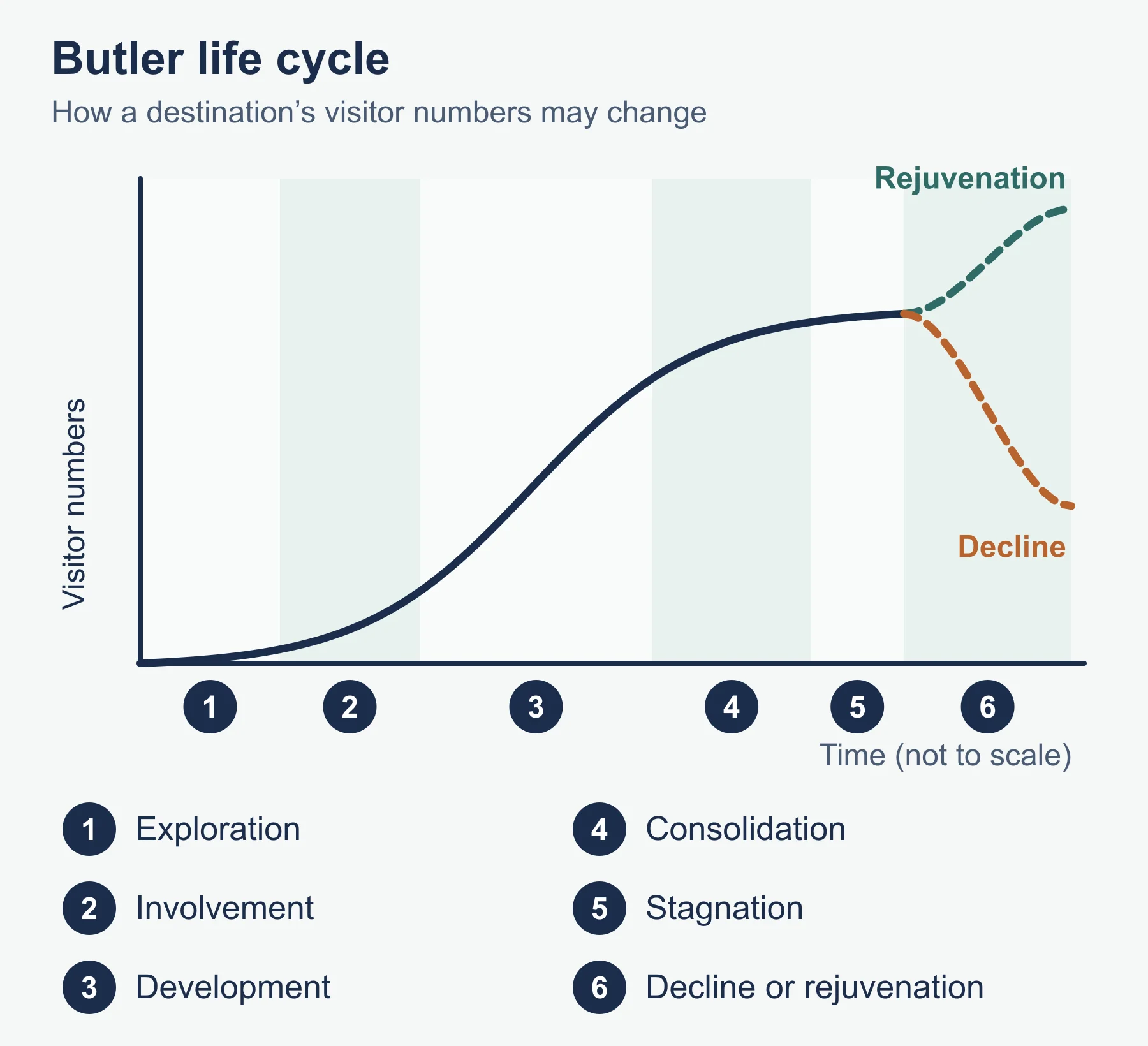
| Butler’s tourism area life cycle | Exploration, involvement, development, consolidation, stagnation, then decline or rejuvenation |
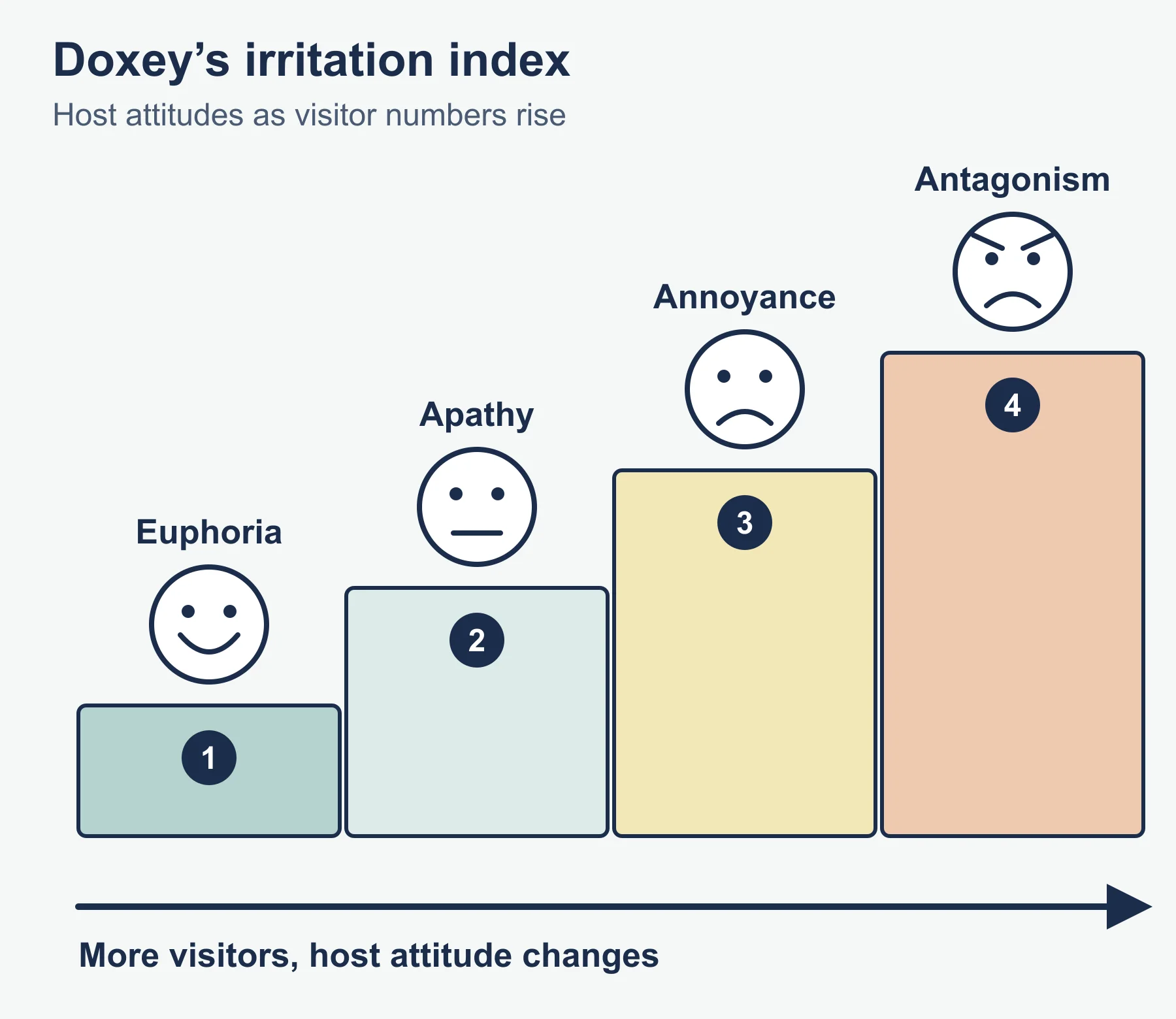
| Doxey’s irritation index | Host attitudes move from euphoria through apathy and annoyance to antagonism as visitor numbers rise |
| Plog’s model | Links traveller personality types to destination popularity |
Limits: not every destination follows Butler’s curve, and management can alter its path.
Applying the models
- Butler: British seaside resorts such as Blackpool grew rapidly in the age of rail travel, then stagnated and declined when cheap package holidays to sunnier destinations became available from the late twentieth century. Attempts at rejuvenation include new attractions, events and conference business. Stagnation is often marked by reaching carrying capacity, ageing infrastructure and a fall in visitor spending.
- Plog: allocentric (venturer) travellers seek new, unspoilt places; psychocentric (dependable) travellers prefer familiar, safe, developed ones; most people are mid-centric. As a destination develops, its visitors shift from allocentric towards psychocentric, which links Plog to Butler.
- Doxey: useful for explaining resident protests against overcrowding in popular cities, but attitudes vary within a community: residents who earn from tourism may stay positive while others become hostile.
Carrying capacity
| Type | Meaning |
|---|---|
| Physical | The maximum number of people a site can physically hold, such as a beach or stadium |
| Ecological (environmental) | The level of use beyond which habitats and wildlife are damaged |
| Perceptual (social) | The level of crowding beyond which visitors’ or residents’ enjoyment falls |
Perceptual capacity is often reached first in wilderness areas, where visitors expect solitude.
Impacts
| Positive | Negative | |
|---|---|---|
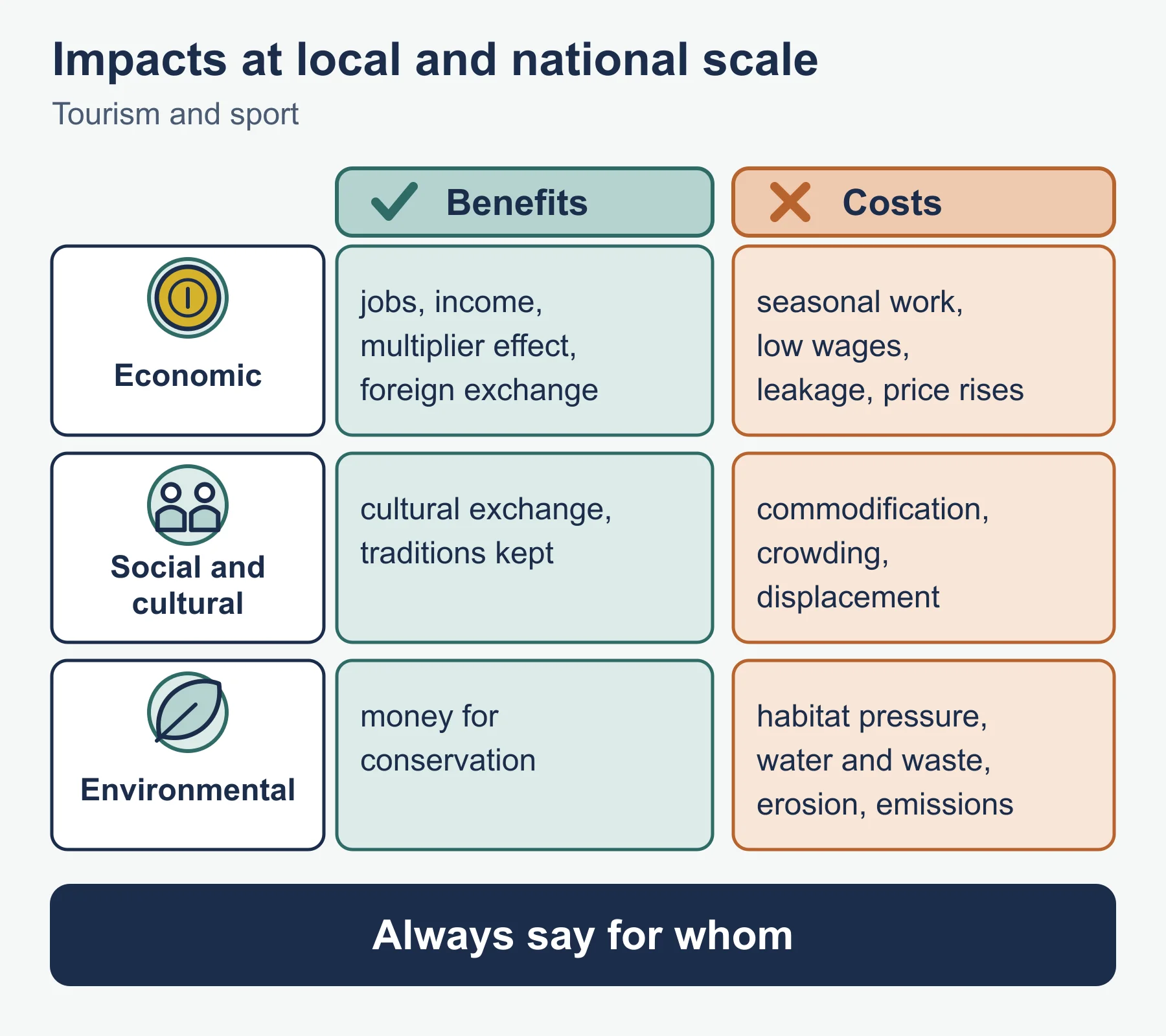
| Economic | Employment, income, multiplier effects, foreign exchange | Seasonal work, low wages, leakage of profits, price inflation |
| Social and cultural | Cultural exchange, preservation of traditions | Commodification, crowding, displacement |
| Environmental | Funding for conservation | Pressure on habitats and water, waste, erosion, carbon emissions |
Always say for whom an impact is positive or negative.
Multiplier effect: tourist spending in a hotel pays wages and buys supplies from local businesses, whose owners and workers then spend their income locally, so the total effect on the economy is larger than the first spending. Leakage weakens the multiplier.
Sport at local and national scale
- Local clubs support health and community.
- National stadiums and events promote identity and regeneration.
- Large events can bring investment and infrastructure but may leave costly, underused facilities.
- Evaluate legacy: who benefits, and for how long?
Case study: London 2012 and Stratford
The Olympic Park was built on former industrial and contaminated land in Stratford, east London. Legacy plans converted the main stadium for use by a football club and athletics, reused other venues, and added new housing, parkland and transport links, with a large shopping centre next to the site. Supporters point to regeneration of a deprived area; critics argue that rising house prices and rents meant many long-standing residents gained less than newcomers, an example of gentrification. A further example of reuse is the stadium built for the 2002 Commonwealth Games in Manchester, which became a Premier League football ground.
Worked check
Arrivals rise from 1.2 million to 1.5 million: 0.3 / 1.2 x 100 = 25 per cent increase.
Model paragraph
Evaluate the usefulness of Butler’s model for explaining the growth of a resort. “Butler’s model helps explain why a resort such as Blackpool grew, stagnated and then declined, because it links visitor numbers to accessibility, investment and competition. It also highlights management choices at the stagnation stage. However, it is descriptive rather than predictive: it cannot say when a stage will begin, it assumes a single curve for the whole resort, and many destinations, particularly cities, never decline because they constantly diversify. It is therefore useful as a framework but not as a forecast.”
Exam traps
- Listing impacts without saying for whom.
- Using Butler’s model as fact.
- Writing a general holiday description rather than geography.
- Ignoring leakage when judging economic benefit.
- Confusing threshold (minimum users) with sphere of influence (catchment area).
- Treating the whole host community as holding one attitude in Doxey’s index.
Self-test
- List the stages of Butler’s model.
- What does Doxey’s index describe?
- Give one economic and one environmental negative of tourism.
- What is meant by the legacy of a sporting event?
- Arrivals rise from 800,000 to 920,000: what is the percentage rise?
- Define threshold population.
- Why does a national stadium have a larger sphere of influence than a local park?
- Distinguish allocentric from psychocentric tourists.
- Name and define three types of carrying capacity.
- Explain the tourism multiplier effect.
- What is a honeypot site?
- Give one benefit and one criticism of the London 2012 legacy in Stratford.
Answers: 1. Exploration, involvement, development, consolidation, stagnation, decline or rejuvenation. 2. Changing host attitudes as tourist numbers grow. 3. For example leakage and habitat pressure. 4. The lasting benefits and costs after the event, and who receives them. 5. 120,000 / 800,000 x 100 = 15 per cent. 6. The minimum number of users needed to support a facility. 7. It is a higher-order facility that people will travel further to use. 8. Allocentric tourists seek new, unspoilt places; psychocentric tourists prefer familiar, developed ones. 9. Physical (how many a site can hold), ecological (use before habitats are damaged), perceptual (crowding before enjoyment falls). 10. Tourist spending creates wages and orders that are spent again locally, enlarging the total effect. 11. An attraction that draws large crowds to a small area. 12. Benefit: regeneration of former industrial land; criticism: rising housing costs benefited newcomers more than long-standing residents.
More resources on this topic
Related resources
-
Subject guides
IB Diploma Programme Geography: Subject Overview
An overview of IB Diploma Programme Geography – interactions between individuals, societies and physical processes across time and space.
Geography · International Baccalaureate · IB
Read course guide -
Study guides
IB DP Geography (DP Geography): Changing leisure patterns
IB DP Geography Leisure, tourism and sport 5.1 in depth: how leisure is measured, why participation varies between and within countries, and how to read leisure data.
Geography · International Baccalaureate · IB
Read guide -
Practice questions
IB DP Geography (DP Geography): Changing leisure patterns – Practice Questions
Original practice questions with full answers on classifying leisure, measuring participation, explaining change and reading leisure data for IB DP Geography.
Geography · International Baccalaureate · IB
Try questions
Studying Geography?
This page is free and stays free. Marlbridge is not offering Geography classes at the moment, so there is no tuition to book for it. The free study resources stay open to everyone.
Get free revision emails (optional)
Occasional emails with practice questions, worked explanations and links to free resources for the qualification and subjects you choose. No spam, and you can unsubscribe from any email. The free tools on this site never need an email.