
Revision Notes
IB DP Geography: 2.3 Managing coastal margins – Revision Notes
Condensed IB DP Geography notes on 2.3 Oceans and coastal margins: hard and soft engineering, shoreline management policies, ICZM, stakeholders and cost-benefit analysis, with a self-test.
- Subject
- Geography
- Level
- IB
- Topic
- Topic 2: Option B: Oceans and coastal margins
- Author
- Marlbridge Academic Team
- Updated
- Reviewed by
- Azam Siddique (what this means)
Aligned to International Baccalaureate IB Diploma Programme Geography (DP Geography), First assessments 2019. Official specification .
Syllabus page (what it covers and how it is assessed): IB Diploma Programme Geography.
Syllabus points this page covers
DP Geography
- 2.3 Managing coastal margins
Condensed recall for 2.3 Managing coastal margins (IB DP Geography, Option B: Oceans and coastal margins). The Oceans and coastal margins study guide gives fuller discussion.
Management responses
| Approach | Examples | Evaluation |
|---|---|---|
| Hard engineering | Sea walls, rock armour, revetments, groynes, breakwaters | Protect specific assets; expensive; can alter sediment movement; may create a false sense of security |
| Soft engineering | Beach nourishment, dune stabilisation, managed realignment | Work with natural processes; may need repeating or space |
| Planning | Shoreline management plans, integrated coastal zone management | Take a system-wide, long-term view |
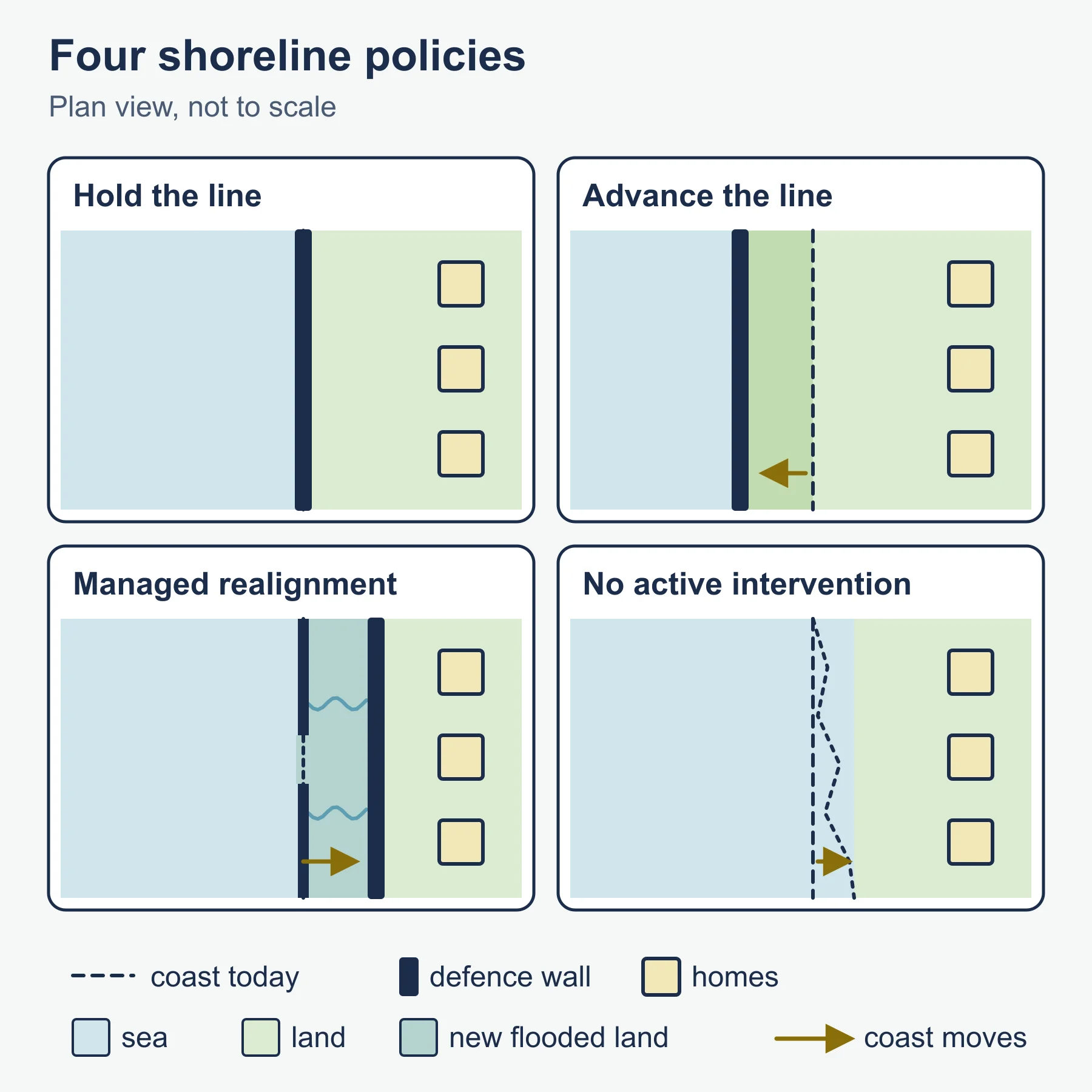
Managed realignment: defences are deliberately breached so land can flood and form natural buffers such as marsh.
How each measure works
| Measure | How it works | Main drawback |
|---|---|---|
| Sea wall | Concrete barrier reflects wave energy; a curved face throws waves back | Reflected energy can scour the beach in front, undermining the wall |
| Rock armour (rip-rap) | Large boulders absorb and break up wave energy | Can be unattractive; rocks may shift in storms |
| Revetment | Sloping structure that absorbs wave energy | Needs maintenance; limits beach access |
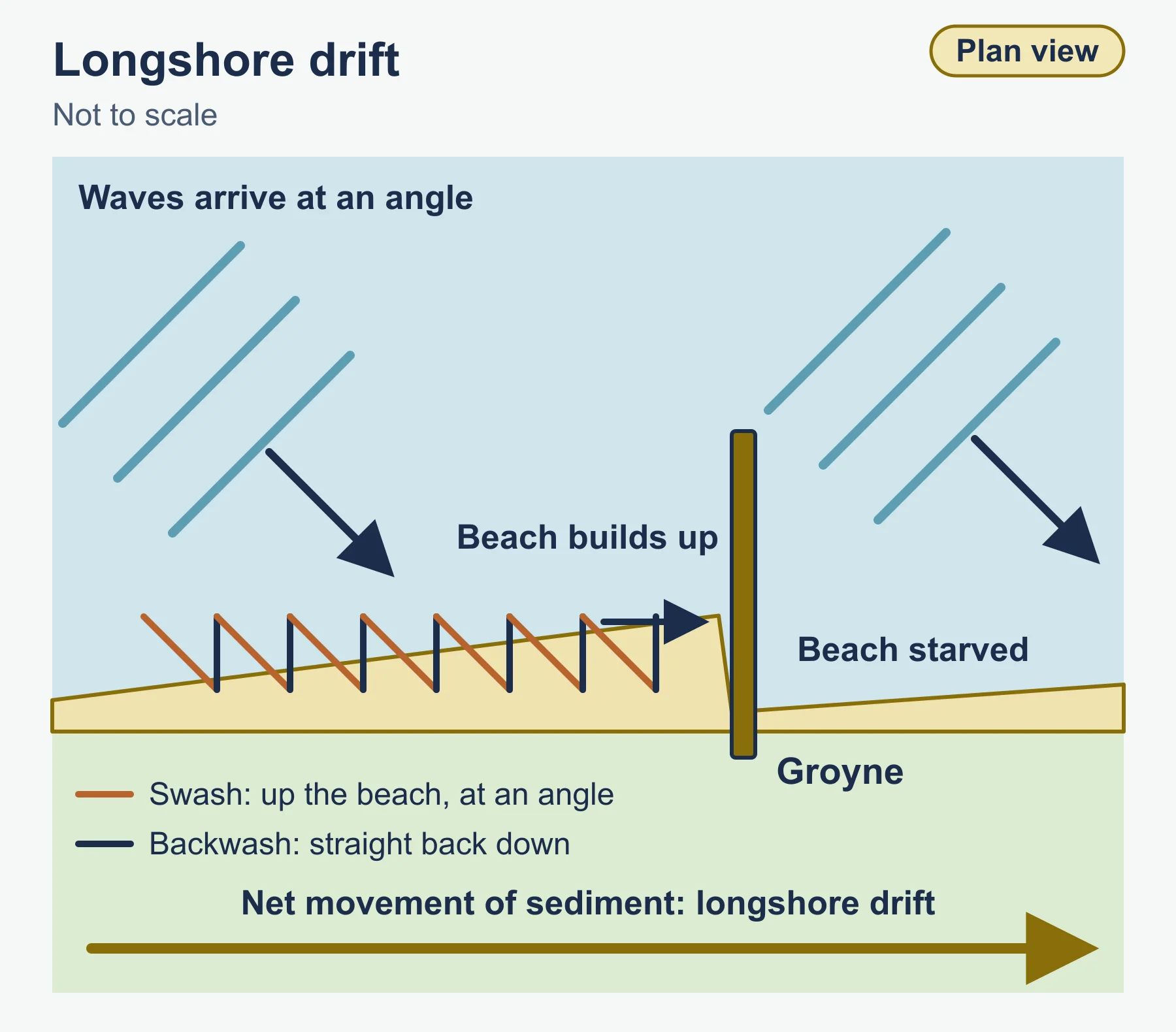
| Groynes | Barriers across the beach trap sediment moved by longshore drift, widening the beach | Starve beaches further along the coast (downdrift) |
| Offshore breakwater | Breaks waves before they reach the shore | Costly; can change sediment patterns |
| Beach nourishment | Sand or shingle is added to the beach so waves expend energy on it | Must be repeated; dredging can damage offshore habitats |
| Dune stabilisation | Fencing, boardwalks and planting of marram grass trap sand and limit trampling | Needs controls on visitor access |
Wide, healthy beaches and dunes are themselves the most effective natural defence, which is why many strategies aim to keep sediment in the system.
Shoreline management policy options
- Hold the line
- Advance the line
- Managed realignment
- No active intervention
Integrated coastal zone management (ICZM) brings stakeholders together and treats land and sea as one system.
In England and Wales, shoreline management plans are drawn up for each sediment cell or sub-cell, so that a decision in one place takes account of its effects on neighbouring coast. Each stretch is given one of the four policy options for the short, medium and long term, which can change over time as sea level rises.
ICZM principles include a long-term view, managing the whole system across the land-sea boundary, involving all stakeholders, working with natural processes and adapting as conditions change.
Stakeholders and conflict
Residents, local councils, national agencies, developers, businesses, conservation groups, insurers. Interests clash: a homeowner may want a wall while a conservation group favours a restored marsh.
Cost-benefit analysis
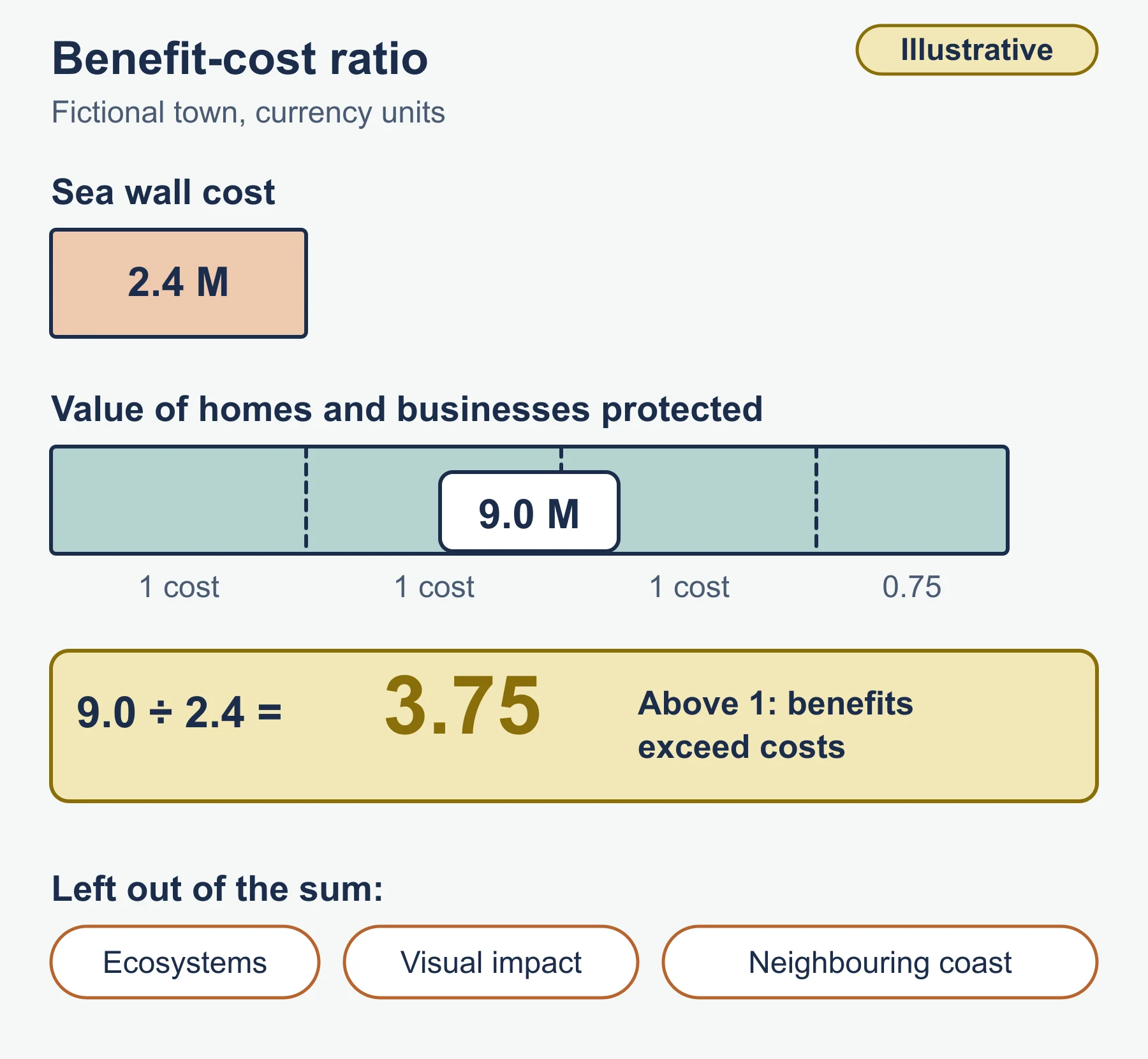
Compares the value of assets protected with the cost of defence. Worked check: benefits 9.0 million against cost 2.4 million gives a ratio of 9.0 / 2.4 = 3.75; above 1 suggests benefits exceed costs.
Limits: it struggles to value habitats, heritage and community ties, and can omit effects on neighbouring coast. State this in evaluative answers.
Case studies
Mappleton, Holderness coast, England
In the early 1990s, two rock groynes and a rock revetment were built to protect the village of Mappleton and its coast road on one of Europe’s fastest-eroding coastlines. The village was protected, but by trapping sediment the groynes reduced the supply moving south, and erosion increased on the farmland beyond. It is a classic example of hard engineering solving a local problem while shifting it downdrift, and of why decisions need to consider the whole sediment cell.
Medmerry, West Sussex, England
Completed in 2013, this was one of the largest open-coast managed realignment schemes in the United Kingdom at the time. A new, stronger embankment was built inland and the old shingle bank was allowed to breach, creating intertidal habitat that absorbs wave energy and protects homes and roads behind it. Evaluation: it gives long-term protection and new habitat at a lower ongoing cost than holding the old line, but farmland was lost and the approach needs space and public acceptance.
The Netherlands: Delta Works and the Sand Motor
After the catastrophic North Sea flood of 1953, the Dutch built the Delta Works, a system of dams, sluices and storm surge barriers, including a movable barrier across the Eastern Scheldt that stays open in normal conditions to protect the estuary’s tidal ecosystem. More recently, the Sand Motor (completed in 2011) placed a very large volume of sand offshore of the South Holland coast so that waves and currents would spread it along the shore over many years. Evaluation: the Dutch approach shows a shift from purely hard defences towards “building with nature”, but it depends on high national wealth and strong institutions.
Model paragraph
Evaluate the use of groynes as a coastal management strategy. “Groynes are effective at trapping sediment moved by longshore drift, building a wider beach that absorbs wave energy and protects the coast behind it, as at Mappleton. However, the same process reduces sediment moving downdrift, so neighbouring beaches narrow and erosion can accelerate, as happened south of Mappleton. They are relatively cheap compared with sea walls, but their effects must be judged across the whole sediment cell. Groynes are therefore a useful local measure only when the downdrift consequences are acceptable or managed.”
Exam traps
- Treating hard engineering as always bad and soft as always good.
- Forgetting knock-on effects on sediment supply elsewhere.
- Naming a stakeholder without saying what they want.
- Relying on cost-benefit ratios without criticising what they leave out.
- Saying “no active intervention” means doing nothing for no reason: it is a deliberate policy where defence is not justified.
- Describing beach nourishment as permanent: it needs repeating.
Self-test
- Name three forms of hard engineering.
- What is managed realignment?
- List the four shoreline management policy options.
- What does ICZM aim to do?
- Give one limit of cost-benefit analysis.
- How do groynes work, and what problem can they cause?
- Why can a sea wall be undermined over time?
- Why are shoreline management plans organised by sediment cell?
- What happened at Mappleton after the groynes were built?
- Give one benefit and one drawback of the Medmerry scheme.
- What is the idea behind the Sand Motor?
- A defence costs 3.2 million and protects assets worth 4.0 million. Calculate the benefit-cost ratio and comment.
Answers: 1. For example sea wall, groyne, rock armour. 2. Deliberately breaching defences so land floods and forms a natural buffer. 3. Hold the line, advance the line, managed realignment, no active intervention. 4. Bring stakeholders together and manage land and sea as one system. 5. It cannot easily value habitats, heritage or community ties. 6. They trap sediment moved by longshore drift, but starve beaches downdrift. 7. Reflected wave energy scours the beach in front, exposing its base. 8. So decisions in one place account for effects on connected stretches of coast. 9. The village was protected, but erosion increased further south. 10. Benefit: new habitat and long-term protection; drawback: loss of farmland. 11. Placing a large volume of sand offshore and letting natural processes spread it along the coast. 12. 4.0 / 3.2 = 1.25; benefits slightly exceed costs, but unvalued impacts could change the decision.
More resources on this topic
Related resources
-
Subject guides
IB Diploma Programme Geography: Subject Overview
An overview of IB Diploma Programme Geography – interactions between individuals, societies and physical processes across time and space.
Geography · International Baccalaureate · IB
Read course guide -
Revision notes
IB DP Geography: 2.1 Ocean-atmosphere interactions – Revision Notes
Condensed IB DP Geography notes on 2.1 Oceans and coastal margins: gyres, thermohaline circulation, upwelling, ENSO, ocean warming and acidification, with a self-test.
Geography · International Baccalaureate · IB
Revise topic -
Revision notes
IB DP Geography: 2.4 Ocean management futures – Revision Notes
Condensed IB DP Geography notes on 2.4 Oceans and coastal margins: ocean governance, UNCLOS and EEZs, marine protected areas, pressures on oceans and adaptive management, with a self-test.
Geography · International Baccalaureate · IB
Revise topic
Studying Geography?
This page is free and stays free. Marlbridge is not offering Geography classes at the moment, so there is no tuition to book for it. The free study resources stay open to everyone.
Get free revision emails (optional)
Occasional emails with practice questions, worked explanations and links to free resources for the qualification and subjects you choose. No spam, and you can unsubscribe from any email. The free tools on this site never need an email.