
Revision Notes
IB DP Geography: 10.3 Resource stewardship – Revision Notes
Condensed IB DP Geography notes on 10.3: stewardship approaches, the circular economy, the rebound effect and criteria for evaluating strategies, with a self-test.
- Subject
- Geography
- Level
- IB
- Topic
- Topic 10: Unit 3: Global resource consumption and security
- Author
- Marlbridge Academic Team
- Updated
- Reviewed by
- Azam Siddique (what this means)
Aligned to International Baccalaureate IB Diploma Programme Geography (DP Geography), First assessments 2019. Official specification .
Syllabus page (what it covers and how it is assessed): IB Diploma Programme Geography.
Syllabus points this page covers
DP Geography
- 10.3 Resource stewardship
Condensed recall for 10.3 Resource stewardship (Unit 3: Global resource consumption and security). For the full explanation, read the Global resource consumption study guide.
Definition
Stewardship is responsible management of resources so that they are available for the future. It operates from individual to global scale and involves governments, businesses, international organisations, non-governmental groups, communities and consumers.
Perspectives on population and resources
| Perspective | Core idea | Evaluation |
|---|---|---|
| Malthus (1798) | Population tends to grow faster than food supply, so growth is checked by famine, disease or war | Did not foresee the farming and technological gains of the 19th and 20th centuries |
| Boserup (1965) | Population pressure stimulates new farming methods (“necessity is the mother of invention”) | The Green Revolution supports her, but intensification can damage soils and water |
| Neo-Malthusian: The Limits to Growth (Club of Rome, 1972) | Continued exponential growth in population, industry and pollution would exceed the Earth’s limits | Criticised for underestimating technology, but revived by concern over climate and biodiversity |
| Resource optimists (for example Julian Simon) | Human ingenuity and markets will find substitutes as resources become scarce | Price signals work poorly for unpriced resources such as the atmosphere |
The Green Revolution (from the 1960s), with high-yielding varieties of wheat and rice, fertiliser and irrigation, greatly raised yields in Asia and Latin America. It is evidence for Boserup, but in places such as Punjab it also depleted groundwater and increased fertiliser and pesticide use.
Approaches
| Approach | Examples |
|---|---|
| Efficiency and conservation | Insulation, efficient appliances, irrigation efficiency, reducing food waste |
| Substitution and technology | Renewable energy, recycled materials, improved crop varieties |
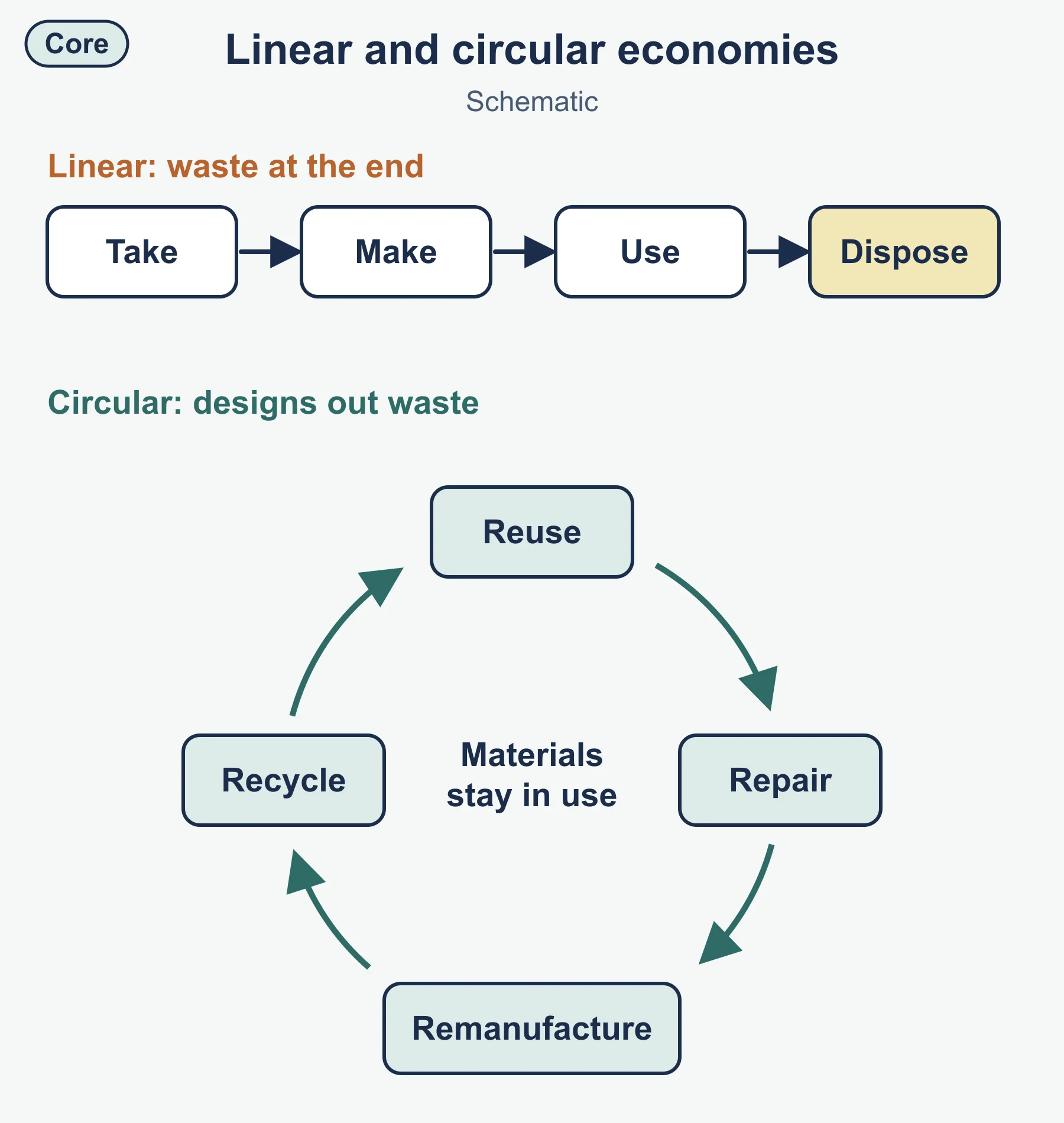
| Circular economy | Designs out waste by reusing, repairing, remanufacturing and recycling |
| Certification and labelling | Forestry and fisheries certification |
| Regulation, pricing and incentives | Taxes, quotas, standards, subsidies, carbon pricing |
| Agreements and cooperation | International agreements on shared resources; local community management |
The linear model is take-make-dispose; the circular economy contrasts with it.
Stewardship in practice
- Sustainable Development Goals (2015): the 17 goals include clean water and sanitation (Goal 6), affordable and clean energy (Goal 7) and responsible consumption and production (Goal 12), giving a shared framework for national targets.
- Water efficiency: drip irrigation, developed commercially in Israel from the 1960s, delivers water to plant roots and cuts losses to evaporation. Singapore recycles treated wastewater as NEWater.
- Waste and the circular economy: the European Union has adopted circular economy action plans (2015 and 2020); Germany’s deposit return scheme for drinks containers achieves very high return rates; England’s charge on single-use plastic bags (introduced in 2015) sharply reduced their use.
- Food waste: the UN Food and Agriculture Organization has estimated that around a third of food produced is lost or wasted, so cutting waste is one of the cheapest ways to raise food security.
- Fisheries: the collapse of the Grand Banks cod fishery off Newfoundland, which led Canada to impose a moratorium in 1992, shows what happens without effective stewardship. Certification by the Marine Stewardship Council rewards sustainably managed fisheries.
- Community management: Elinor Ostrom (Nobel economics prize, 2009) showed that local communities can manage shared resources such as forests, pastures and irrigation systems well, challenging Garrett Hardin’s “tragedy of the commons” (1968) argument that shared resources are always overused.
Evaluating stewardship
Ask whether the strategy is effective, affordable, fair and enforceable.
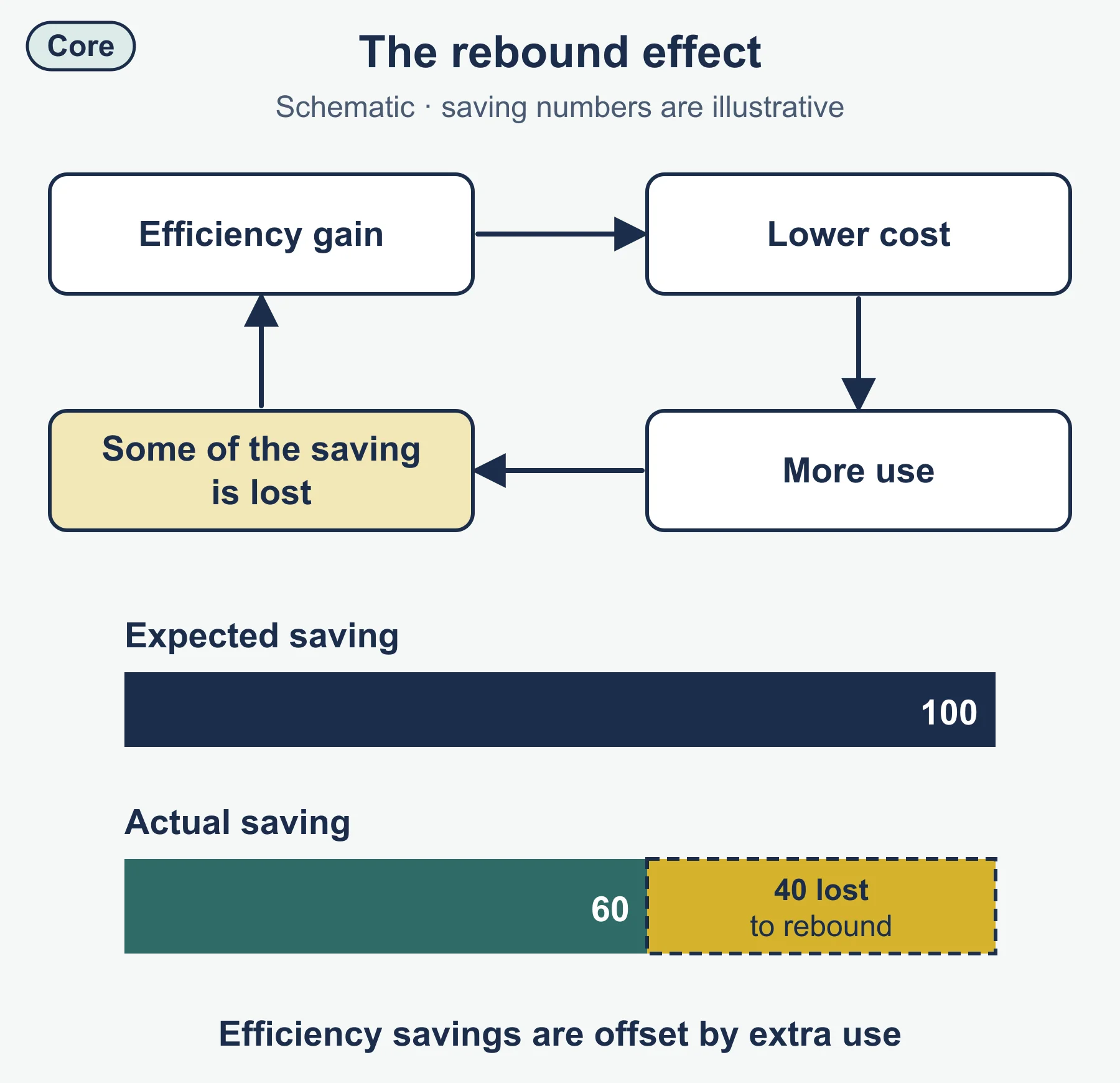
- Rebound effect: efficiency gains reduce cost and lead to more consumption, offsetting savings.
- Equity: lower-income countries argue that their right to develop must be respected, while higher-income countries are responsible for most past consumption.
- Balance competing views and use clear criteria.
The rebound effect was first described by William Stanley Jevons in 1865, who observed that more efficient steam engines increased total coal use in Britain (the Jevons paradox).
Worked example: the rebound effect (invented figures)
A household buys a car that uses 25 per cent less fuel per kilometre. Because driving is now cheaper, it drives 10 per cent further.
- New fuel use = 0.75 x 1.10 = 0.825 of the original.
- Actual saving = 17.5 per cent, not the 25 per cent expected.
- Rebound = (25 - 17.5) / 25 = 30 per cent of the expected saving was lost.
- If driving rose by more than a third (above 1.333 times), fuel use would exceed the original: “backfire”.
Model paragraph (evaluate)
“Germany’s deposit return scheme is effective because the deposit gives consumers a direct incentive to return containers, and it is enforceable because retailers must accept returns. It is less transferable to lower-income countries without the same retail infrastructure, and it tackles drinks packaging rather than wider overconsumption. It is therefore a strong but narrow stewardship strategy.”
Exam traps
- Offering stewardship ideas with no evaluation or no named stakeholders.
- Assuming efficiency always reduces total use (the rebound effect).
- Ignoring the fairness dispute between countries.
- Listing places without explaining a pattern.
- Presenting Malthus or Boserup as simply right or wrong instead of weighing evidence.
- Treating recycling as the whole circular economy; reuse and repair come higher in the hierarchy.
Self-test
- Define resource stewardship.
- Contrast the circular and linear economy.
- What is the rebound effect?
- Give four criteria for evaluating a stewardship strategy.
- Why is stewardship contested between countries?
- Summarise Malthus’s argument.
- How does the Green Revolution support Boserup?
- What did Ostrom show about common resources?
- A household replaces its fridge with one using 40 per cent less electricity, then adds a second identical efficient fridge. Has total use fallen?
- What happened to the Grand Banks cod fishery?
- Name one Sustainable Development Goal linked to resource stewardship.
Answers: 1. Responsible management so resources remain available for the future. 2. Circular designs out waste through reuse, repair and recycling; linear is take-make-dispose. 3. Efficiency lowers costs and encourages more consumption. 4. Effective, affordable, fair and enforceable. 5. States disagree about historic responsibility, rights to develop and who bears the costs. 6. Population grows faster than food supply, so growth is checked by famine, disease or war. 7. Population pressure was met by new seeds, fertiliser and irrigation that raised yields. 8. Local communities can manage shared resources sustainably with suitable rules. 9. No: two fridges at 0.6 each use 1.2 times the original electricity. 10. It collapsed from overfishing, and Canada imposed a moratorium in 1992. 11. For example Goal 12, responsible consumption and production.
More resources on this topic
Related resources
-
Subject guides
IB Diploma Programme Geography: Subject Overview
An overview of IB Diploma Programme Geography – interactions between individuals, societies and physical processes across time and space.
Geography · International Baccalaureate · IB
Read course guide -
Study guides
IB DP Geography (DP Geography): Global trends in consumption
IB DP Geography 10.1 in depth: splitting consumption growth into population and affluence, the energy ladder, water withdrawal and doubling times.
Geography · International Baccalaureate · IB
Read guide -
Practice questions
IB DP Geography (DP Geography): Global trends in consumption – Practice Questions
Original practice questions with full answers on consumption trends, per-capita data, the energy ladder, water use and footprints for IB DP Geography 10.1.
Geography · International Baccalaureate · IB
Try questions
Studying Geography?
This page is free and stays free. Marlbridge is not offering Geography classes at the moment, so there is no tuition to book for it. The free study resources stay open to everyone.
Get free revision emails (optional)
Occasional emails with practice questions, worked explanations and links to free resources for the qualification and subjects you choose. No spam, and you can unsubscribe from any email. The free tools on this site never need an email.