
Revision Notes
IB DP History (DP History): HL options: Depth studies – Revision Notes
Revision notes for IB DP History HL Paper 3: the four regional options, how the 36-question paper works, essay markbands, revision grids and common traps.
- Subject
- World History
- Level
- IB
- Topic
- Topic 3: HL options: Depth studies
- Author
- Marlbridge Academic Team
- Updated
- Reviewed by
- Azam Siddique (what this means)
Aligned to International Baccalaureate IB Diploma Programme History (DP History), First assessment 2017. Official specification .
Syllabus page (what it covers and how it is assessed): IB Diploma Programme History.
Syllabus points this page covers
DP History
- 1 History of Africa and the Middle East
- 2 History of the Americas
- 3 History of Asia and Oceania
- 4 History of Europe
This page covers all 4 subtopics recorded here in topic 3, HL options: Depth studies.
Found an error? Report a correction.
Need help with this topic? Request a free trial class for IB Diploma Programme History (DP History / DP History (2028)).
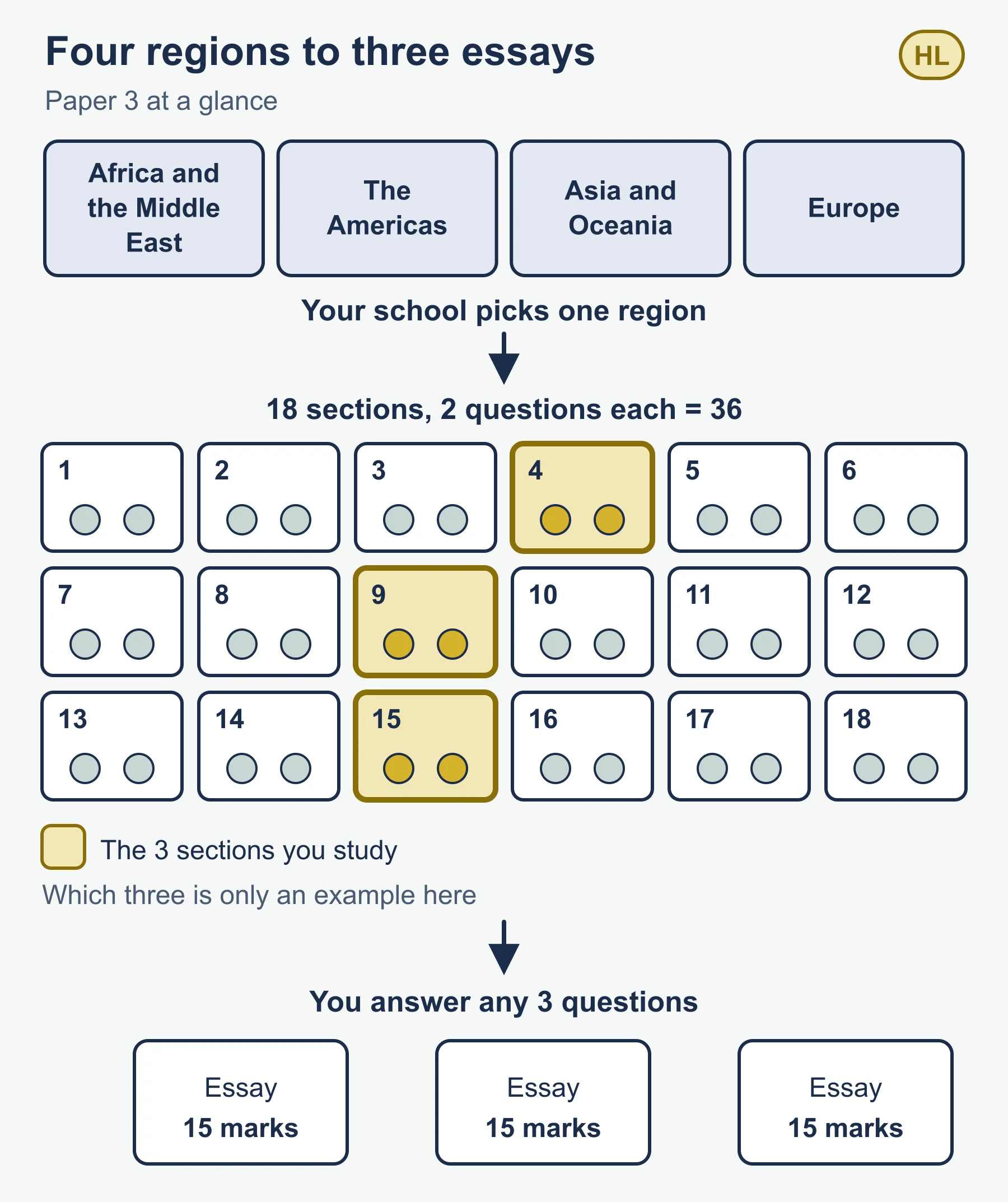
The HL options are the regional depth studies examined on IB DP History Paper 3, taken only by Higher Level students in the course first assessed in 2017. You study one region – Africa and the Middle East, the Americas, Asia and Oceania, or Europe – and three of its eighteen sections, then write three 15-mark essays in 2 hours 30 minutes, worth 35% of the HL grade.
Related: HL options study guide and practice questions.
Syllabus coverage (DP History, first assessment 2017)
| No. | HL option | Structure | Typical modern content areas (check your school’s three sections) |
|---|---|---|---|
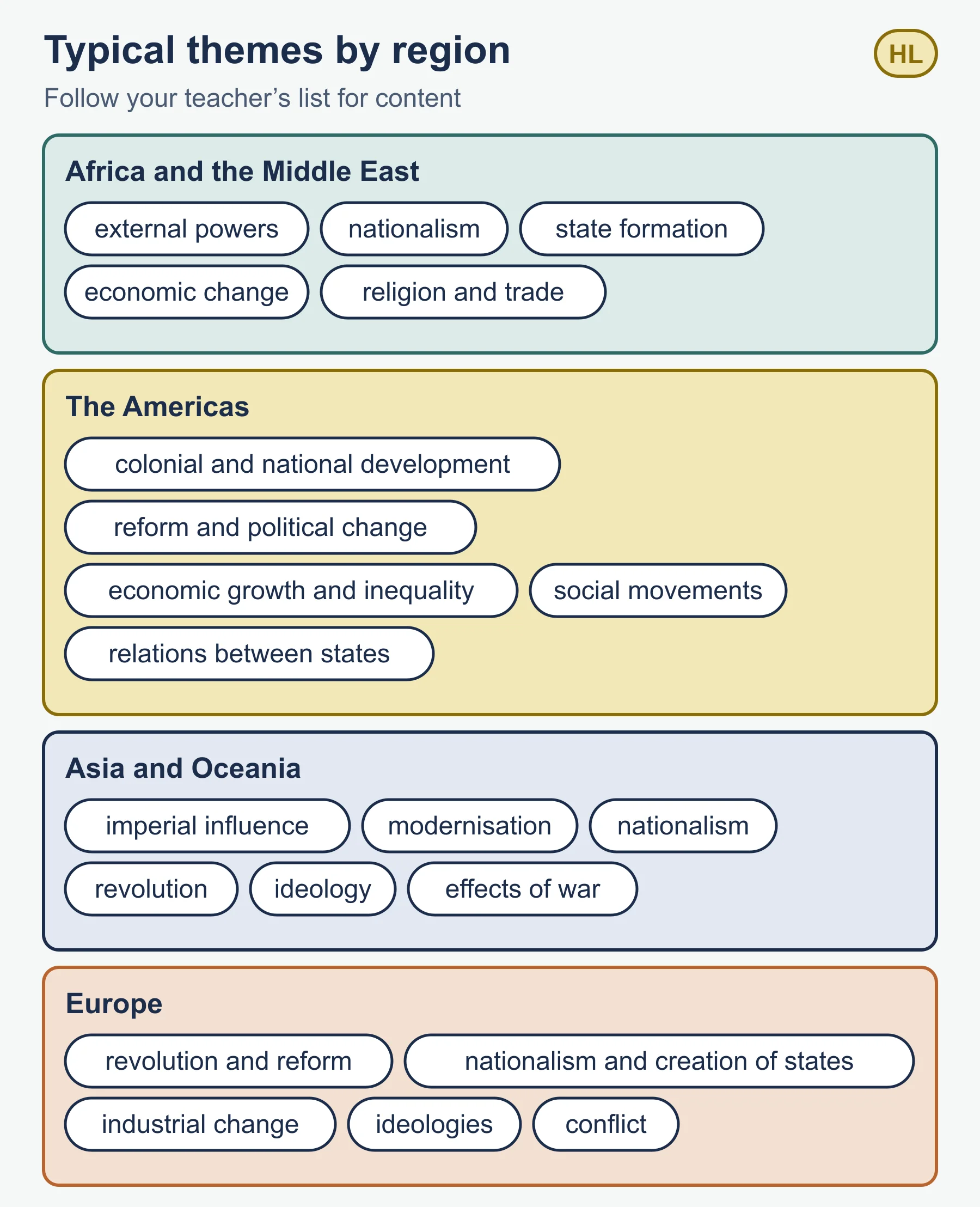
| 1 | History of Africa and the Middle East | 18 sections, study 3 | European imperialism and resistance; nationalism and independence; apartheid South Africa; Egypt and the Arab world after 1945; the Iranian Revolution |
| 2 | History of the Americas | 18 sections, study 3 | Independence movements; the US Civil War; the Mexican Revolution; the Great Depression in the Americas; the Cold War in the Americas; civil rights and social movements |
| 3 | History of Asia and Oceania | 18 sections, study 3 | Qing decline and the Chinese revolutions; Meiji and twentieth-century Japan; the impact of the world wars in South-East Asia; South Asia after 1947; the People’s Republic of China |
| 4 | History of Europe | 18 sections, study 3 | The French Revolution and Napoleon; imperial Russia and the revolutions of 1917; Europe and the First World War; inter-war states and diplomacy; the Soviet Union; post-war Europe |
The guide’s sections run roughly chronologically from the medieval period to the end of the twentieth century; most schools choose three connected modern sections.
Paper 3 at a glance
| Feature | Detail |
|---|---|
| Who | HL only |
| Length | 2 hours 30 minutes |
| Question paper | One paper per region; two questions on each of the 18 sections (36 questions) |
| Task | Answer any three questions from your region |
| Marks | 15 per essay, 45 in total |
| Weighting | 35% of the HL grade (Paper 1 20%, Paper 2 25%, internal assessment 20%) |
| Time per essay | 50 minutes, including about 5 minutes planning |
How Paper 3 differs from Paper 2
| Paper 2 | Paper 3 |
|---|---|
| Thematic and often comparative across regions | Regional and in depth |
| Two essays in 90 minutes | Three essays in 150 minutes |
| Examples chosen by you within a topic | Questions often name a specific country, leader or period |
| Breadth of examples | Precise detail, chronology and historiography for a narrower area |
The same five 15-mark markbands (13-15, 10-12, 7-9, 4-6, 1-3) are used for both essay papers.
Building a revision grid for each section
For every section studied, fill one grid like this (example: imperial Russia and the revolutions of 1917, History of Europe):
| Heading | Content |
|---|---|
| Chronology | Alexander II’s emancipation of the serfs (1861); assassination (1881); 1905 Revolution and October Manifesto; Stolypin (1906-11); First World War; February and October Revolutions (1917) |
| Causes and turning points | Defeat in the Crimean and Russo-Japanese wars; industrialisation under Witte; the war’s strain |
| Key people | Alexander II, Alexander III, Nicholas II, Witte, Stolypin, Lenin, Kerensky |
| Debates | Was 1917 inevitable? “Optimists” stressing pre-war modernisation versus “pessimists” stressing structural crisis |
| Likely questions | “To what extent was the First World War responsible for the collapse of Tsarism?”; “Evaluate the success of reform, 1861-1914” |
Command terms on Paper 3
| Term | What it demands |
|---|---|
| Evaluate | Weigh strengths and limitations to reach a judgement |
| Discuss | Offer a considered, balanced review with a range of arguments |
| To what extent | Consider the merits of the claim and reach a judgement on degree |
| Examine | Consider an argument or concept, revealing assumptions and links |
| Compare and contrast | Similarities and differences throughout |
Worked example: choosing three questions
You studied three Europe sections: Russia to 1924, Europe and the First World War, and the inter-war states. The paper offers two questions on each. Choose by:
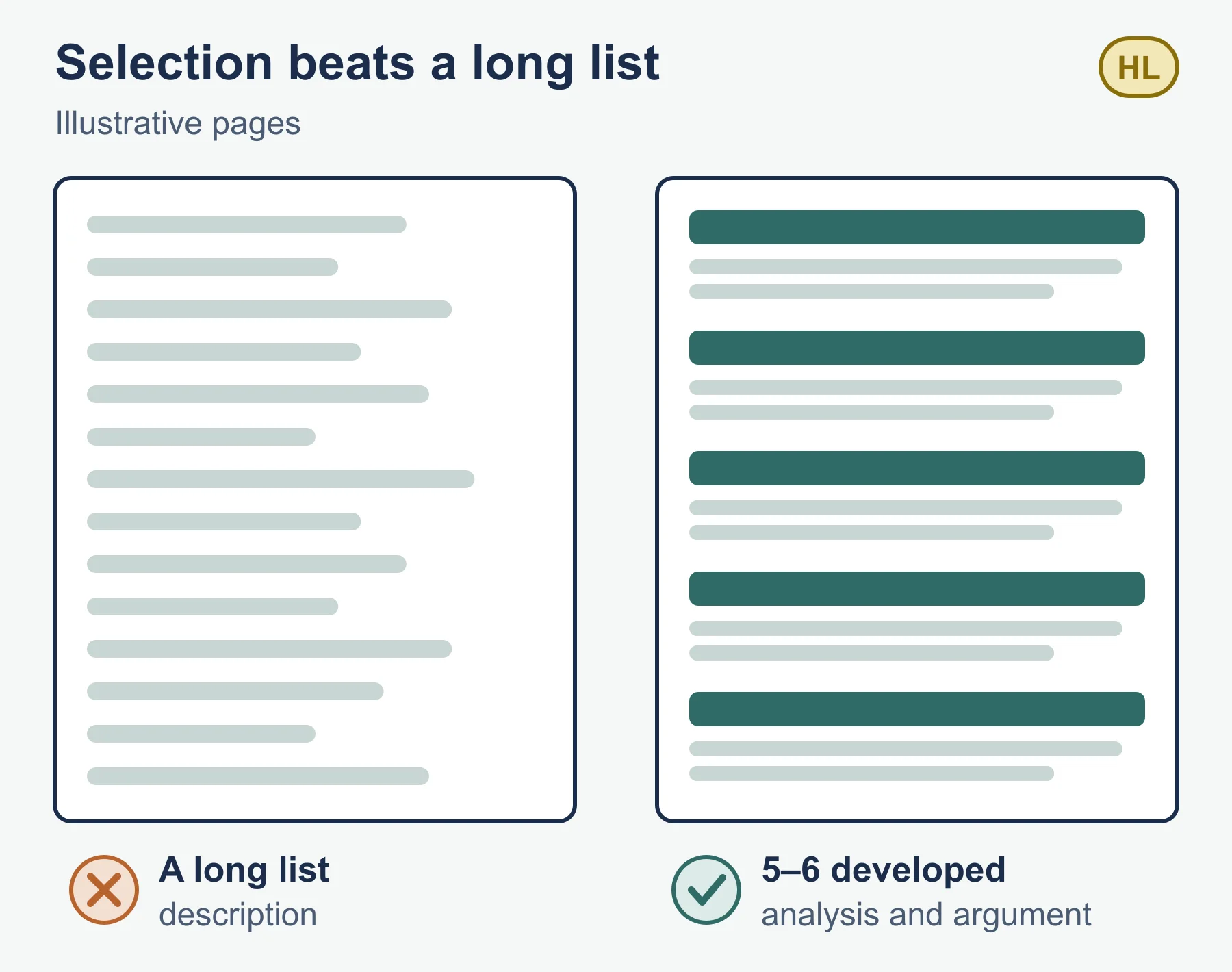
- Fit to evidence: pick the question where you can name five or six precise pieces of evidence in planning.
- Clear judgement: avoid a question if you cannot write a one-line thesis within two minutes.
- Time: 150 / 3 = 50 minutes each; never “borrow” from the third essay.
Essay skeleton for a 50-minute Paper 3 answer
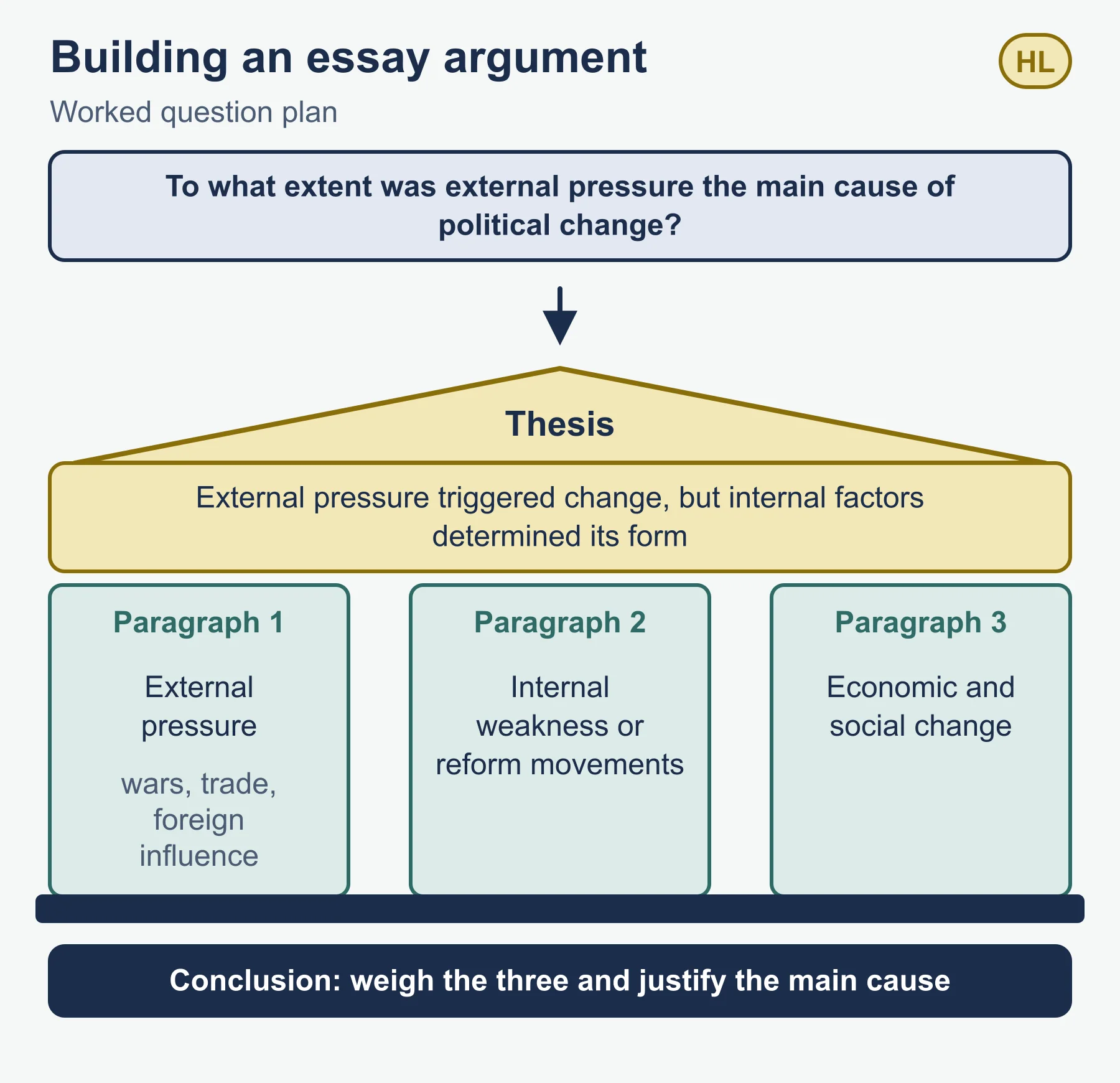
- Introduction (5 minutes): define the key term in the question, set the date range and state your thesis.
- Three or four analytical paragraphs (35 minutes): one factor or argument each, with precise evidence and a mini-judgement.
- Counter-argument (included in the body): the strongest case against your thesis, and why it is weaker.
- Conclusion (5 minutes): answer the question directly, weighing the factors.
Common mistakes / exam traps
- Answering a question on the wrong date range. Paper 3 questions are tightly dated; examiners do not reward material outside it.
- Paper 2 habits. Comparisons across regions are not asked for; depth within the named case is.
- Revising only two sections. With two questions per section, three well-revised sections give you a choice of six.
- Historiography as decoration. Use historians’ views to support or challenge your argument.
- Three unequal essays. The third essay counts as much as the first.
Frequently asked questions
Can SL students take Paper 3? No. Paper 3 and the regional options are HL only.
How many sections should I study? The guide asks for three sections of one region; revise all three fully.
Do I have to answer questions from different sections? No. You answer any three questions from your region, so two from the same section are allowed.
Self-test
- How many questions are on each regional Paper 3? 36 – two per section.
- What is Paper 3 worth at HL? 35%.
- How long is each essay? About 50 minutes.
- How many sections does a student study? Three.
- Which markbands are used? The five 15-mark essay bands shared with Paper 2.
Related resources
-
Study guides
IB DP History (DP History): HL options: Depth studies – Study Guide
How HL students approach the regional depth studies for IB History Paper 3: Africa and the Middle East, the Americas, Asia and Oceania, and Europe.
World History · International Baccalaureate · IB
Read guide -
Study guides
IB DP History (DP History): History of Africa and the Middle East
The HL History of Africa and the Middle East option for Paper 3: imperialism and resistance, South Africa, Nasser's Egypt and Iran, with essay technique.
World History · International Baccalaureate · IB
Read guide -
Practice questions
IB DP History (DP History): History of Africa and the Middle East – Practice Questions
Twelve original HL Paper 3-style practice questions on Africa and the Middle East, from short recall to full 15-mark essays, with mark-scheme answers.
World History · International Baccalaureate · IB
Try questions
Get free revision emails (optional)
Occasional emails with practice questions, worked explanations and links to free resources for the qualification and subjects you choose. No spam, and you can unsubscribe from any email. The free tools on this site never need an email.