
Study Guides
IB DP History (DP History): History of Africa and the Middle East
The HL History of Africa and the Middle East option for Paper 3: imperialism and resistance, South Africa, Nasser's Egypt and Iran, with essay technique.
- Subject
- World History
- Level
- IB
- Topic
- Topic 3: HL options: Depth studies
- Author
- Marlbridge Academic Team
- Updated
- Reviewed by
- Azam Siddique (what this means)
Aligned to International Baccalaureate IB Diploma Programme History (DP History), First assessment 2017. Official specification .
Syllabus page (what it covers and how it is assessed): IB Diploma Programme History.
Syllabus points this page covers
DP History
- 1 History of Africa and the Middle East
Found an error? Report a correction.
Need help with this topic? Request a free trial class for IB Diploma Programme History (DP History / DP History (2028)).
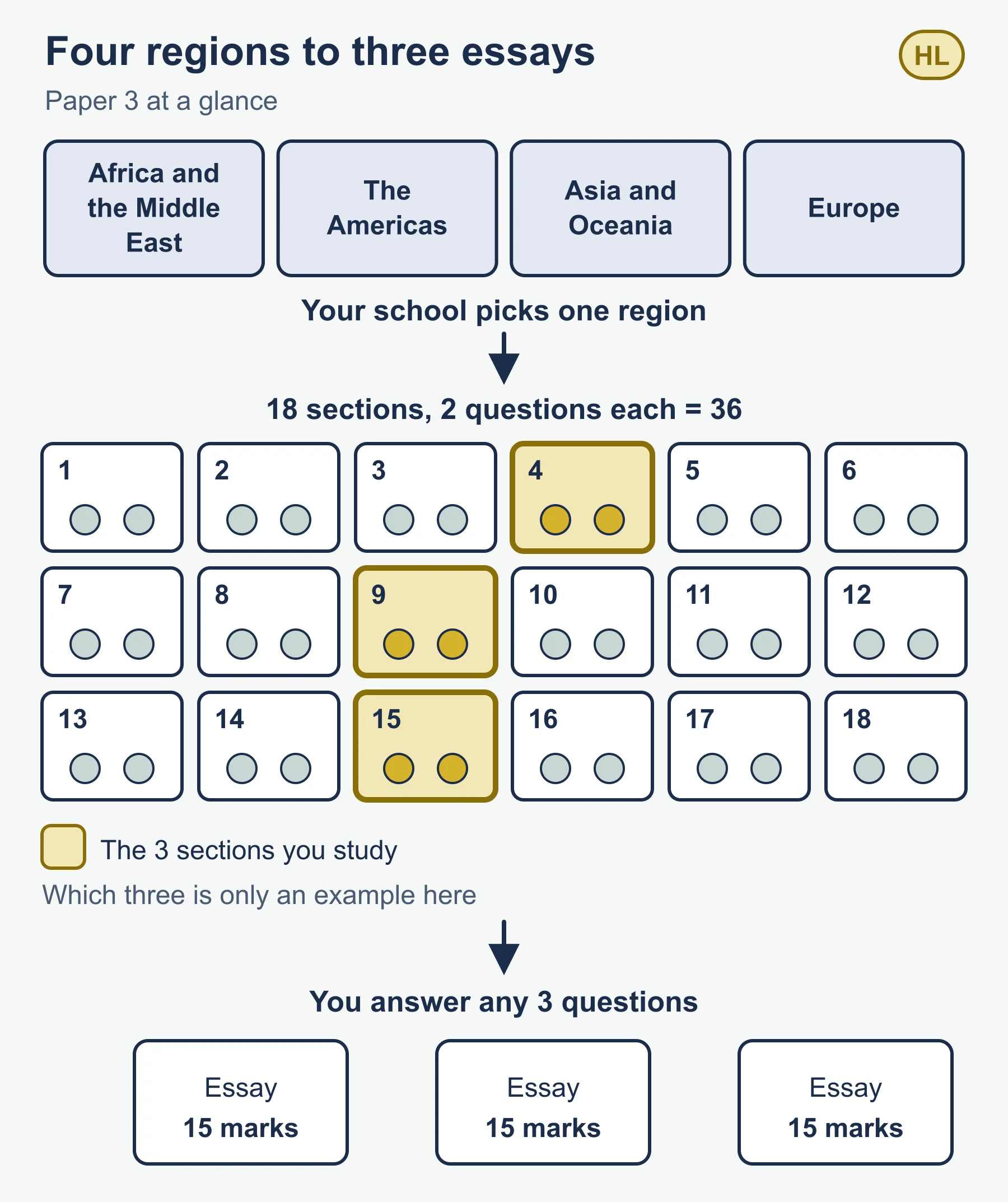
The History of Africa and the Middle East is one of the four regional options for Higher Level Paper 3. Your school studies three of its eighteen sections in depth, and Paper 3 then asks for three essays in 2 hours 30 minutes, chosen from the two questions set on each section. This guide shows how to approach three content areas that schools in this region often teach, and what “depth” means for them. Check your own three sections against your teacher’s list, because the guide’s section titles and date ranges define what can be asked.
What the option covers
The sections run broadly from the medieval period to the end of the twentieth century and cover North Africa, sub-Saharan Africa and the Middle East. Widely taught modern content areas include:
- European imperialism in Africa in the late nineteenth century and African responses to it;
- nationalism and independence movements across the continent;
- South Africa from the late nineteenth century to the end of apartheid in 1994;
- the Ottoman Empire’s decline and the states that followed it;
- Egypt and the Arab world after 1945, including the Arab-Israeli conflict;
- Iran in the twentieth century and the revolution of 1979.
Paper 3 questions often name a specific country, leader or period, so your notes must be precise on chronology and detail within each section.
Content area 1: imperialism and resistance
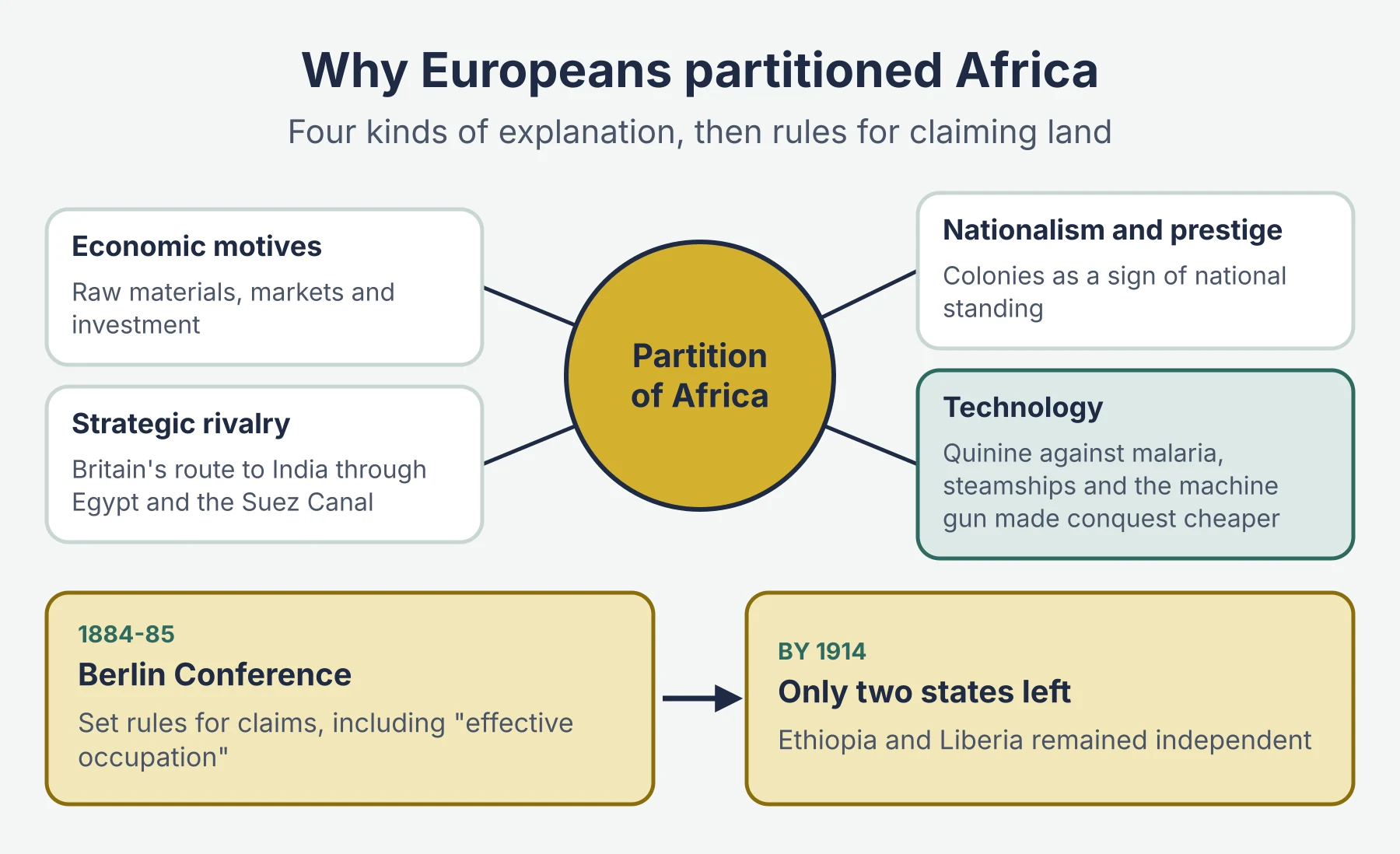
Why Europeans partitioned Africa. Explanations combine economic motives (raw materials, markets, investment), strategic rivalry (Britain’s concern for the route to India through Egypt and the Suez Canal), nationalism and prestige, and technology that made conquest cheaper: quinine against malaria, steamships and the machine gun. The Berlin Conference (1884-85) set rules for claims, including “effective occupation”. By 1914 only Ethiopia and Liberia remained independent.
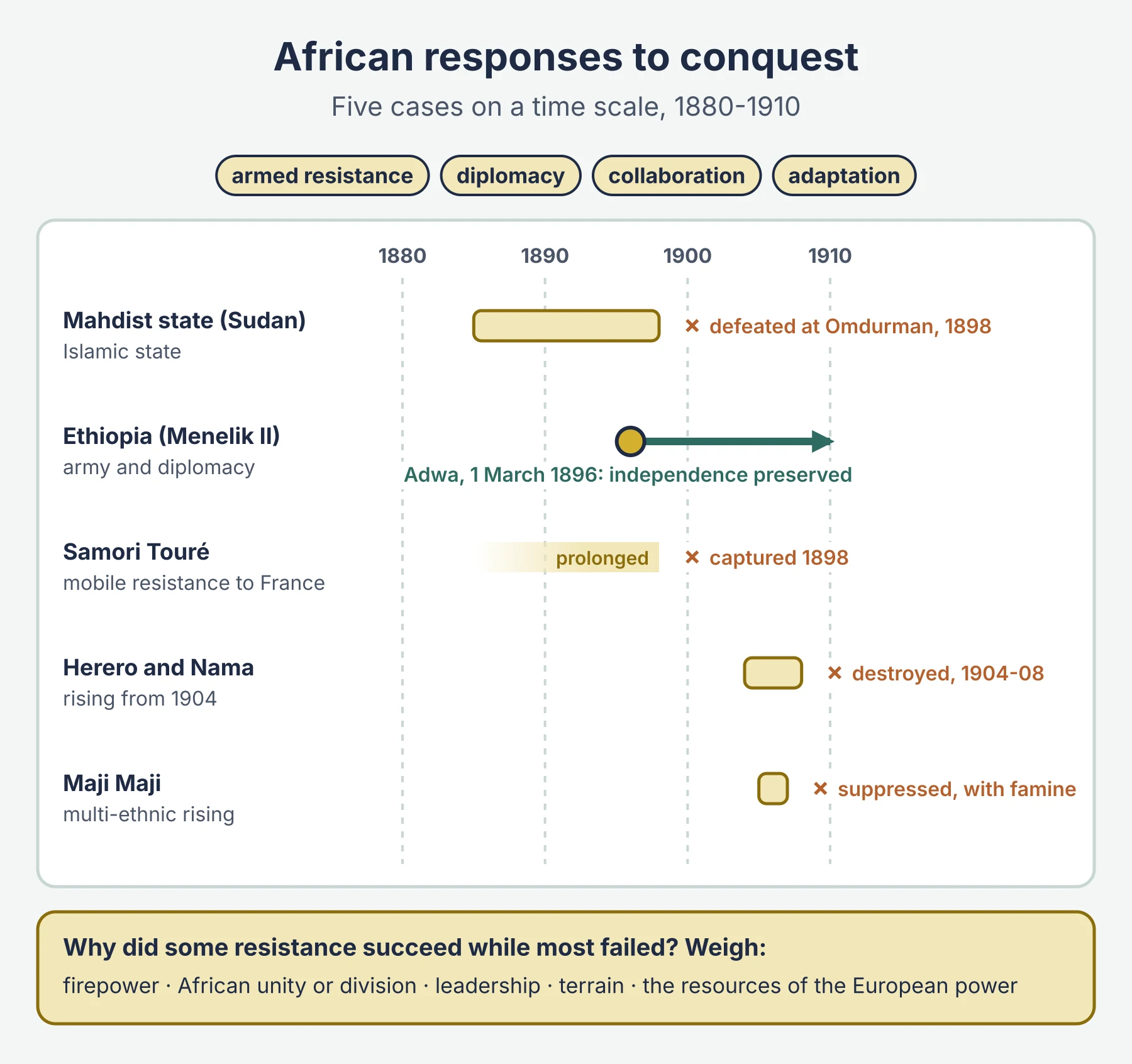
African responses. Responses ranged across armed resistance, diplomacy, collaboration and adaptation.
| Case | Response | Outcome |
|---|---|---|
| Ethiopia under Menelik II | Modernized army, diplomacy, defeat of Italy at Adwa (1 March 1896) | Independence preserved |
| Samori Touré (West Africa) | Prolonged mobile resistance to France | Captured 1898 |
| Herero and Nama (German South West Africa) | Rising from 1904 | Destroyed in campaigns of 1904-08, which Germany formally acknowledged as genocide in 2021 |
| Maji Maji (German East Africa) | Multi-ethnic rising, 1905-07 | Suppressed, with famine |
| Mahdist state (Sudan) | Islamic state after 1885 | Defeated at Omdurman (1898) |
Depth question to prepare: why did some resistance succeed while most failed? Weigh firepower, African unity or division, leadership, terrain and the resources of the European power.
Content area 2: South Africa, 1880s to 1994
| Period | Key developments |
|---|---|
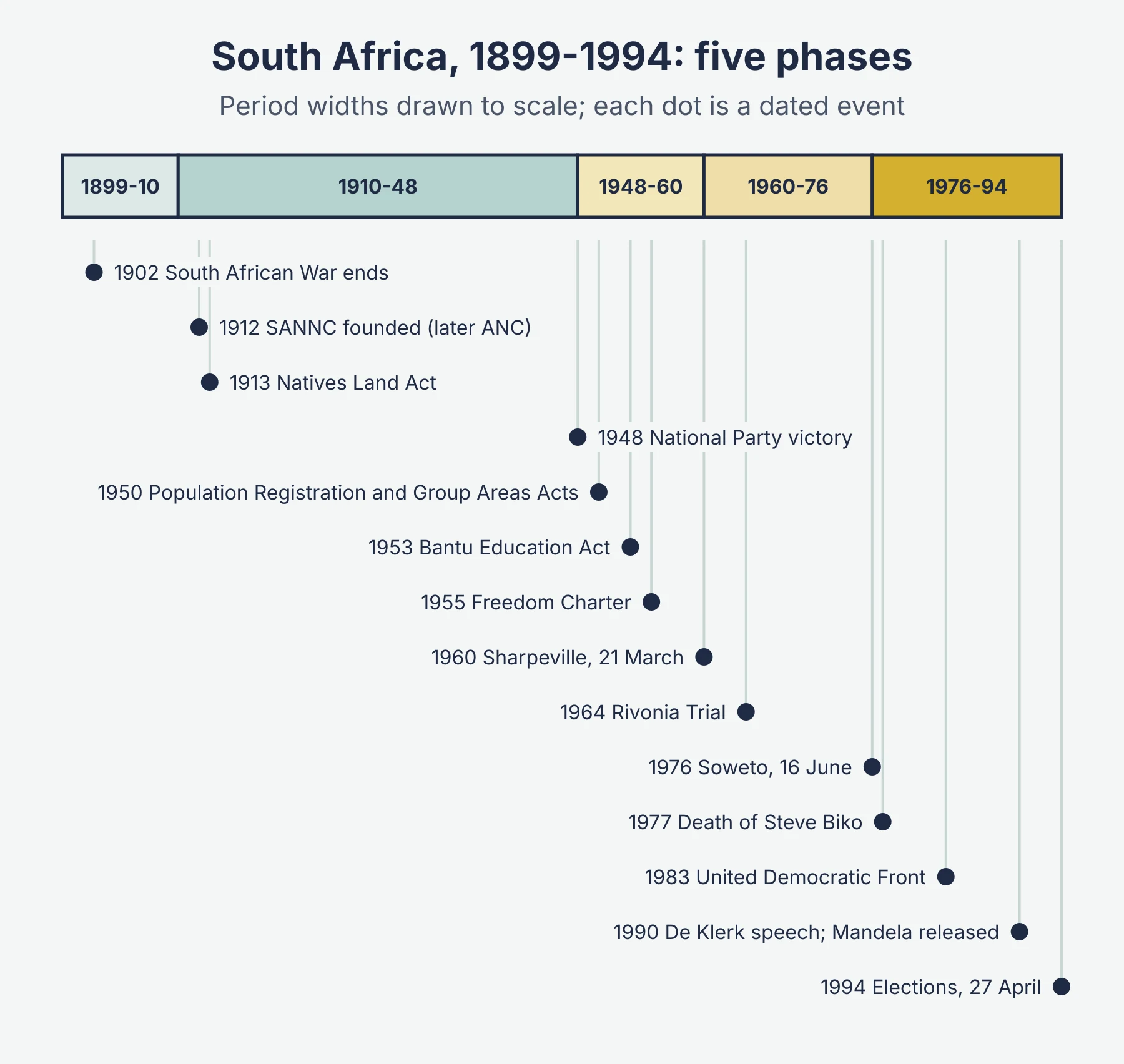
| 1899-1910 | South African War (1899-1902); Union of South Africa (1910) |
| 1910-1948 | South African Native National Congress founded (1912), later the ANC; Natives Land Act (1913) restricted African land ownership to a small fraction of the country |
| 1948-1960 | National Party victory (1948); Population Registration and Group Areas Acts (1950); Bantu Education Act (1953); Freedom Charter (1955); Treason Trial (1956-61) |
| 1960-1976 | Sharpeville massacre (21 March 1960); ANC and PAC banned; armed struggle (Umkhonto we Sizwe, 1961); Rivonia Trial and Mandela’s life sentence (1964); Soweto uprising (16 June 1976) |
| 1976-1994 | Steve Biko’s death in detention (1977); P. W. Botha’s reforms and repression; United Democratic Front (1983); states of emergency; de Klerk’s speech (2 February 1990); Mandela released (11 February 1990); elections (27 April 1994) |
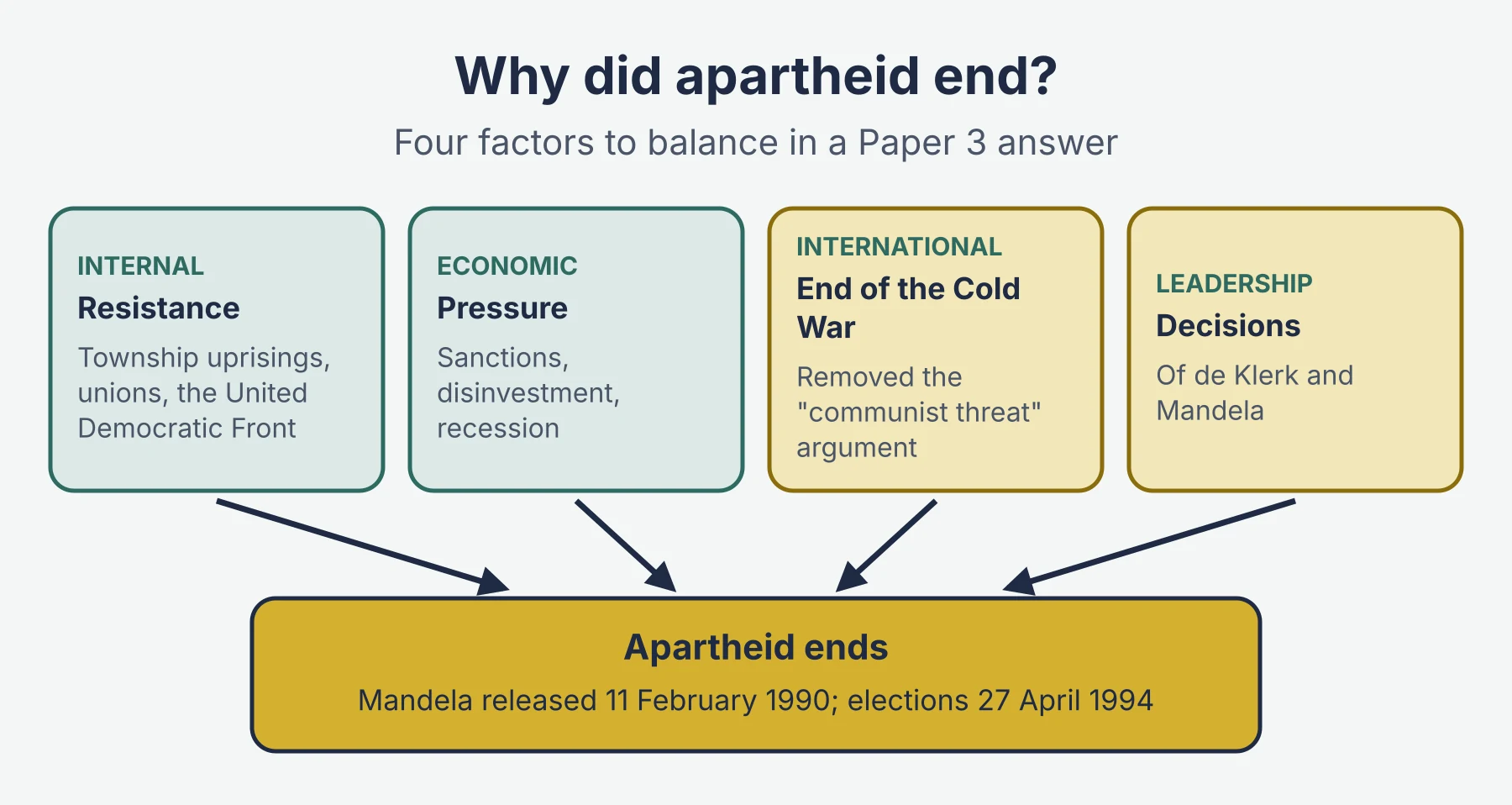
Depth question to prepare: why did apartheid end? Balance internal resistance (township uprisings, unions, the UDF), economic pressure (sanctions, disinvestment, recession), the end of the Cold War (which removed the “communist threat” argument), and the decisions of de Klerk and Mandela.
Content area 3: the Middle East after 1945
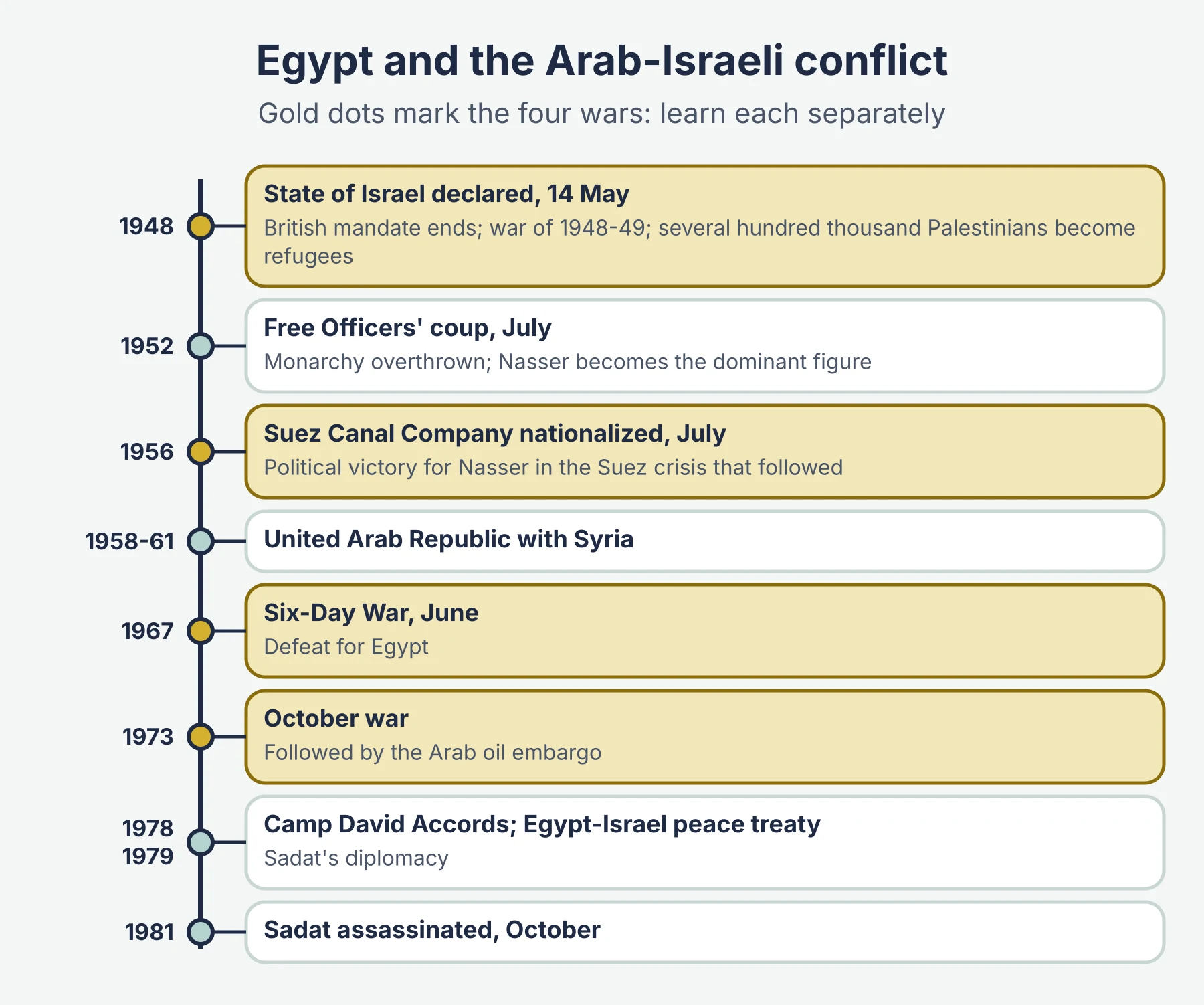
Egypt under Nasser. The Free Officers’ coup (July 1952) overthrew the monarchy; Nasser became the dominant figure. Domestic policy: land reform, nationalization, the Aswan High Dam, one-party rule. Foreign policy: nationalization of the Suez Canal Company (July 1956) and political victory in the Suez crisis that followed; the United Arab Republic with Syria (1958-61); defeat in the Six-Day War (June 1967).
The Arab-Israeli conflict. The British mandate in Palestine ended with the declaration of Israel (14 May 1948) and the war of 1948-49, in which several hundred thousand Palestinians became refugees. Later wars came in 1956, 1967 and 1973; the October 1973 war was followed by the Arab oil embargo. Sadat’s diplomacy led to the Camp David Accords (1978) and the Egypt-Israel peace treaty (1979); he was assassinated in October 1981.
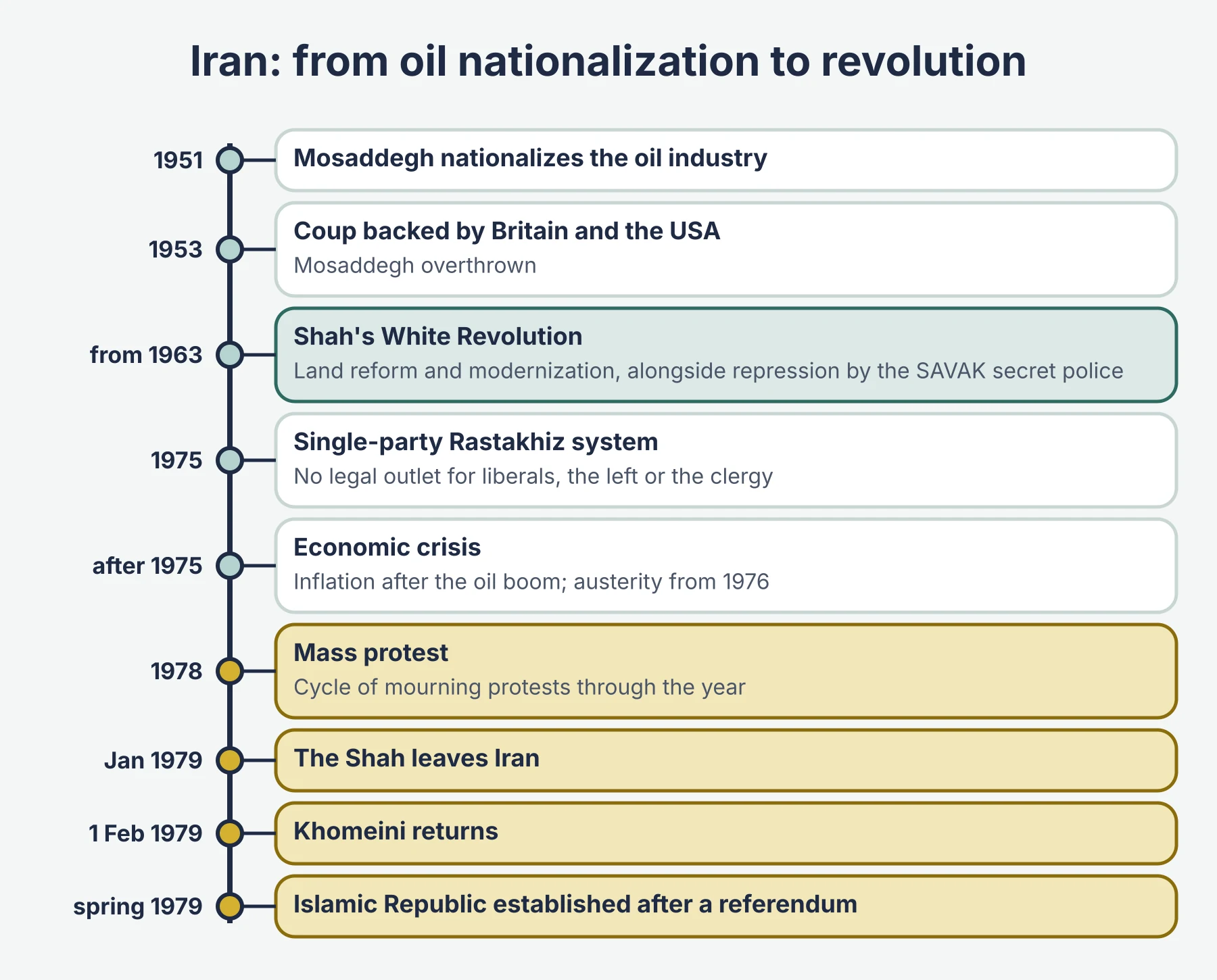
Iran. Mosaddegh nationalized the oil industry (1951) and was overthrown in a coup backed by Britain and the USA (1953). The Shah’s White Revolution (from 1963) brought land reform and modernization alongside repression by the SAVAK secret police. Mass protest in 1978 forced the Shah to leave in January 1979; Khomeini returned on 1 February, and the Islamic Republic was established after a referendum that spring.
Worked example: a Paper 3 plan
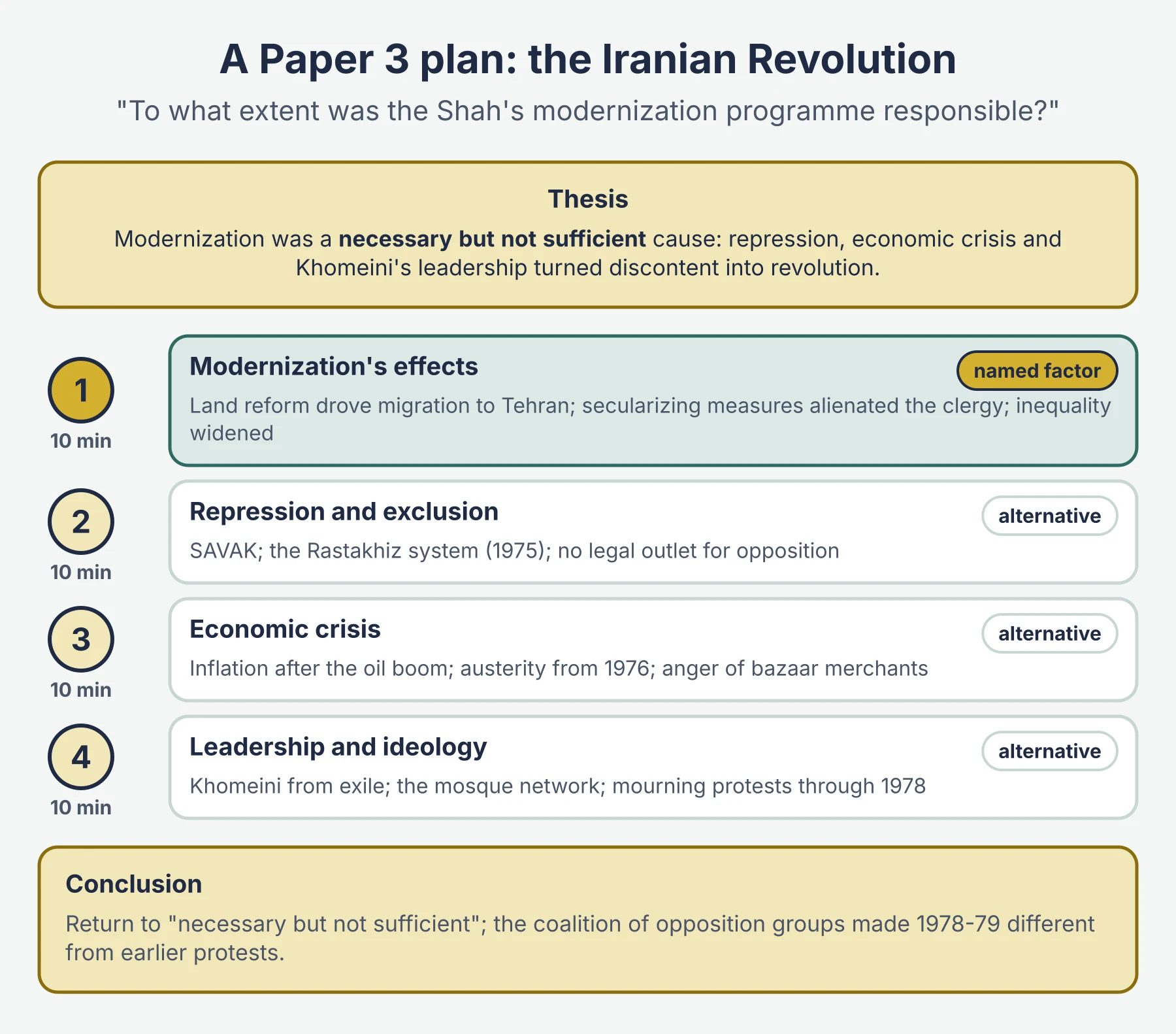
Question: “To what extent was the Shah’s modernization programme responsible for the Iranian Revolution of 1979?”
Thesis: “Modernization created the social groups and grievances that made revolution possible, but the Shah’s repression, the economic crisis after 1975 and Khomeini’s leadership turned discontent into revolution; modernization was a necessary but not sufficient cause.”
- Modernization’s effects (10 minutes). The White Revolution’s land reform disrupted rural life and drove migration to Tehran; secularizing measures alienated the clergy; rapid oil-funded growth widened inequality.
- Repression and political exclusion (10 minutes). SAVAK; the single-party Rastakhiz system (1975); no legal outlet for liberals, the left or the clergy.
- Economic crisis (10 minutes). Inflation after the oil boom; austerity from 1976; the anger of bazaar merchants targeted by anti-profiteering campaigns.
- Leadership and ideology (10 minutes). Khomeini’s leadership from exile; the network of mosques; the cycle of mourning protests through 1978.
Conclusion: return to “necessary but not sufficient”, and identify the coalition of opposition groups as the factor that made 1978-79 different from earlier protests.
Annotation: each paragraph tests the question’s named factor, the evidence is dated and specific, and the conclusion uses the language of causation. That is what moves an essay from the middle markbands to the top.
Common mistakes
- Treating Africa as one place. Questions usually name a country or a part of the continent; answer for that case.
- Only European agency. Imperialism questions need African responses and initiatives as well.
- Apartheid as one block from 1948 to 1994. Distinguish phases and policies.
- Mixing Middle East wars. Learn 1948, 1956, 1967 and 1973 with their causes and results.
- Going outside the section’s dates, which examiners do not reward.
Exam technique
Each Paper 3 essay is marked out of 15 with the five markbands, and you have about 50 minutes per essay, as explained in the HL options study guide. For this region:
- “Evaluate the reasons for…”: weigh internal factors against external powers; this region’s history always involves both.
- “To what extent…”: test the named factor first, then weigh alternatives.
- “Discuss…”: offer more than one interpretation, including African or Middle Eastern perspectives as well as those of external powers.
- “Compare and contrast…”: compare cases within the region, such as two African independence movements or two Arab leaders.
Use with the other pages
Learn the chronologies with the Africa and the Middle East revision notes, then write essays from the Africa and the Middle East practice questions.
Check your understanding
- How many essays do you write on Paper 3, and in how long? Three essays in 2 hours 30 minutes.
- What principle did the Berlin Conference establish for colonial claims? Effective occupation.
- Which African state defeated Italy at Adwa, and when? Ethiopia, on 1 March 1896.
- What happened at Sharpeville on 21 March 1960? Police opened fire on a crowd protesting against the pass laws, killing dozens; the ANC and PAC were then banned.
- When did Nasser nationalize the Suez Canal Company? July 1956.
- Why is modernization described as “necessary but not sufficient” for the Iranian Revolution? It created grievances, but repression, economic crisis and Khomeini’s leadership were needed to produce revolution.
Related resources
-
Practice questions
IB DP History (DP History): History of Africa and the Middle East – Practice Questions
Twelve original HL Paper 3-style practice questions on Africa and the Middle East, from short recall to full 15-mark essays, with mark-scheme answers.
World History · International Baccalaureate · IB
Try questions -
Revision notes
IB DP History (DP History): History of Africa and the Middle East – Revision Notes
Condensed HL notes for Africa and the Middle East: imperialism, resistance, South Africa to 1994, Nasser, the Arab-Israeli wars and Iran, with a self-test.
World History · International Baccalaureate · IB
Revise topic -
Study guides
IB DP History (DP History): History of the Americas
The HL History of the Americas option for Paper 3: the US Civil War, the Mexican Revolution to 1940 and civil rights movements, with essay technique.
World History · International Baccalaureate · IB
Read guide
Get free revision emails (optional)
Occasional emails with practice questions, worked explanations and links to free resources for the qualification and subjects you choose. No spam, and you can unsubscribe from any email. The free tools on this site never need an email.