
Study Guides
IB DP History (DP History): History of the Americas
The HL History of the Americas option for Paper 3: the US Civil War, the Mexican Revolution to 1940 and civil rights movements, with essay technique.
- Subject
- World History
- Level
- IB
- Topic
- Topic 3: HL options: Depth studies
- Author
- Marlbridge Academic Team
- Updated
- Reviewed by
- Azam Siddique (what this means)
Aligned to International Baccalaureate IB Diploma Programme History (DP History), First assessment 2017. Official specification .
Syllabus page (what it covers and how it is assessed): IB Diploma Programme History.
Syllabus points this page covers
DP History
- 2 History of the Americas
Found an error? Report a correction.
Need help with this topic? Request a free trial class for IB Diploma Programme History (DP History / DP History (2028)).
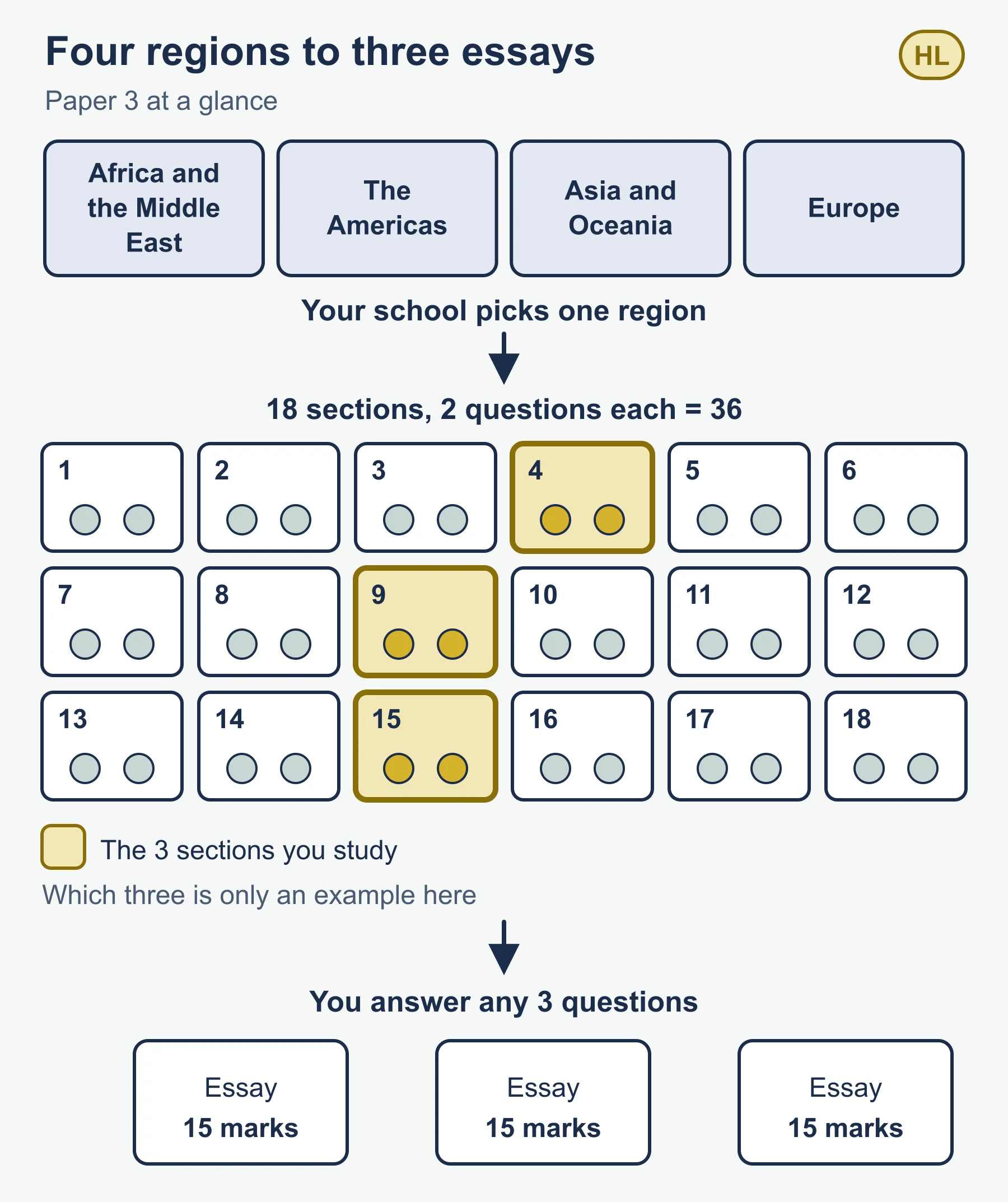
The History of the Americas is one of the four HL regional options. It covers North America, Central America, the Caribbean and South America, and your school studies three of its eighteen sections for Paper 3. This guide works through three content areas that many schools teach, showing the depth of chronology, evidence and debate that Paper 3 expects. Your teacher’s list of the guide’s section titles and dates decides what you need.
What the option covers
The sections run roughly from early colonial societies to the end of the twentieth century. Commonly taught modern content areas include:
- the independence movements of the late eighteenth and early nineteenth centuries;
- the United States Civil War, its causes, course and effects, including Reconstruction;
- the Mexican Revolution and the reconstruction of the Mexican state;
- the Great Depression and the responses of governments in the Americas;
- the Second World War and the Americas;
- the Cold War in the Americas, including the Cuban Revolution;
- civil rights and social movements after 1945.
Questions often specify one country, so prepare at least one country in detail for each comparison the sections allow.
Content area 1: the US Civil War and Reconstruction
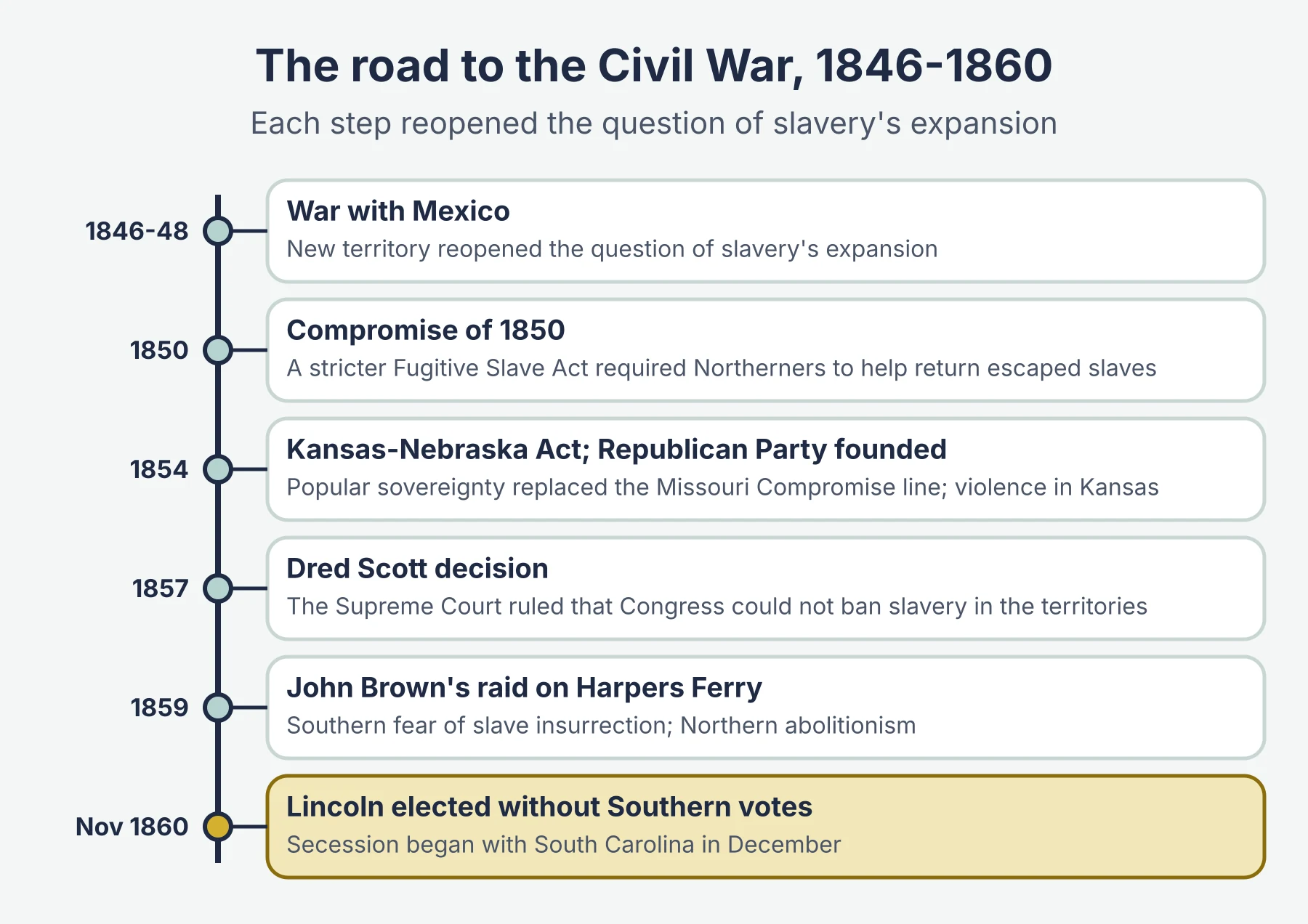
Causes. Slavery and its expansion into the western territories lay at the centre.
| Date | Event | Why it raised tension |
|---|---|---|
| 1846-48 | War with Mexico | New territory reopened the question of slavery’s expansion |
| 1850 | Compromise of 1850, including a stricter Fugitive Slave Act | Northerners were required to help return escaped slaves |
| 1854 | Kansas-Nebraska Act; Republican Party founded | Popular sovereignty replaced the Missouri Compromise line; violence in Kansas |
| 1857 | Dred Scott decision | The Supreme Court ruled that Congress could not ban slavery in the territories |
| 1859 | John Brown’s raid on Harpers Ferry | Southern fear of slave insurrection and Northern abolitionism |
| November 1860 | Lincoln elected without Southern votes | Secession began with South Carolina in December |
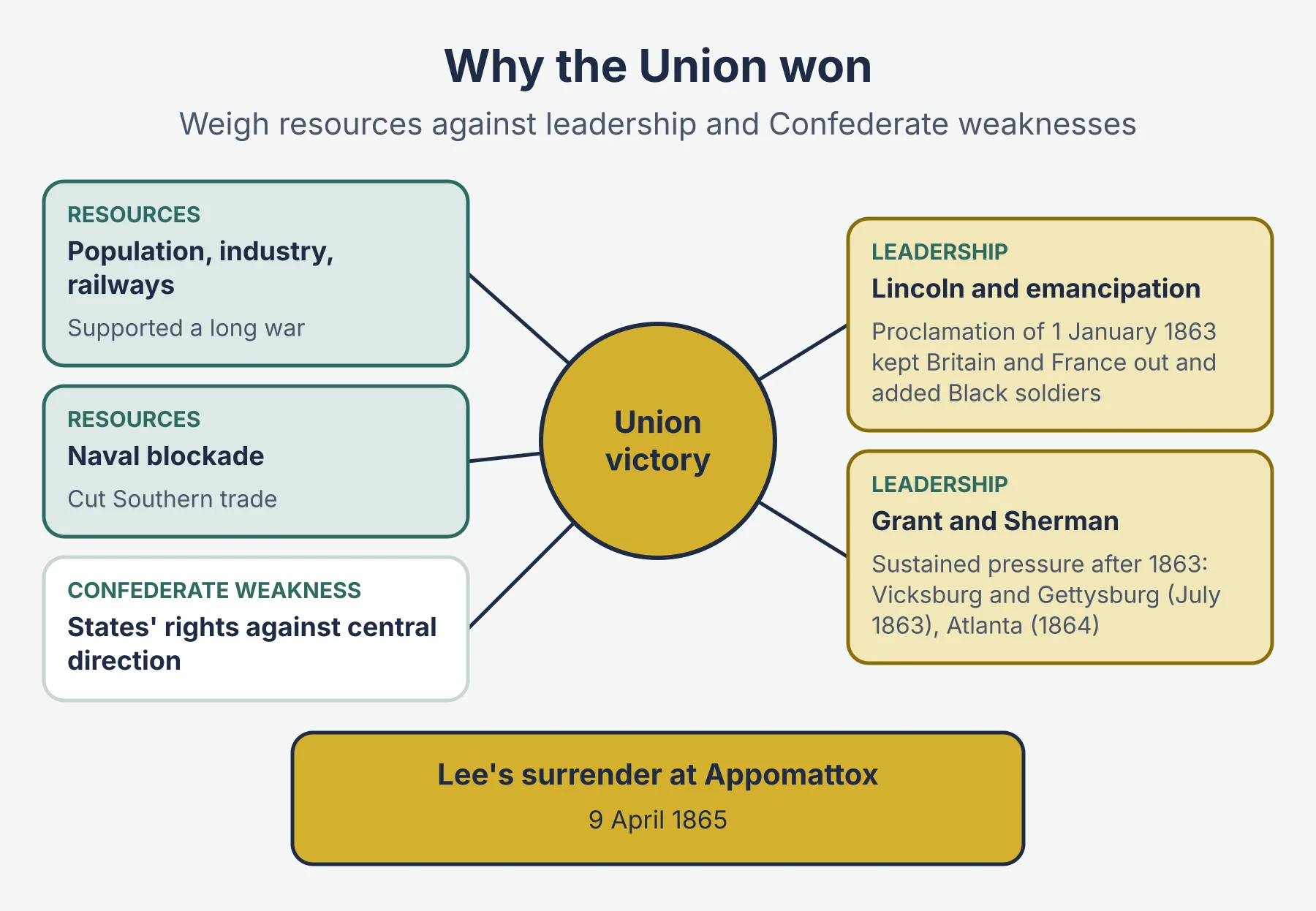
Why the Union won. The Union’s larger population, industry and railways supported a long war; the naval blockade cut Southern trade; Lincoln’s leadership, including the Emancipation Proclamation (1 January 1863), kept Britain and France out and added Black soldiers to Union armies; Grant and Sherman’s strategy of sustained pressure after 1863 (Vicksburg and Gettysburg in July 1863; Atlanta in 1864) wore the Confederacy down. Lee’s surrender at Appomattox came on 9 April 1865. Weigh resources against leadership and Confederate weaknesses, including tensions between states’ rights and central direction.
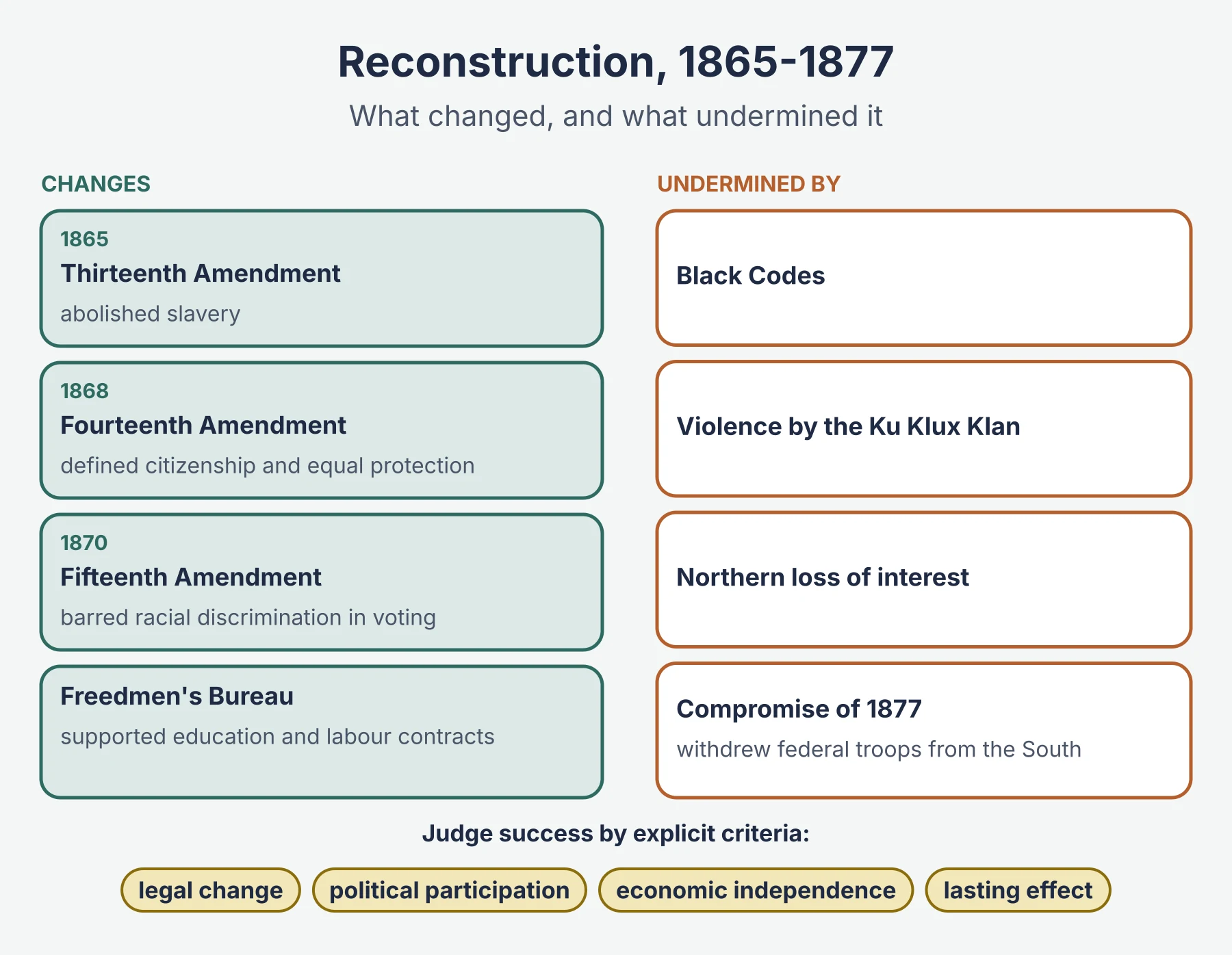
Reconstruction (1865-1877). The Thirteenth (1865), Fourteenth (1868) and Fifteenth (1870) Amendments abolished slavery, defined citizenship and equal protection, and barred racial discrimination in voting. The Freedmen’s Bureau supported education and labour contracts. But Black Codes, violence by the Ku Klux Klan and Northern loss of interest undermined change; the Compromise of 1877 withdrew federal troops from the South. A strong essay judges Reconstruction’s success by explicit criteria: legal change, political participation, economic independence and lasting effect.
Content area 2: the Mexican Revolution, 1910-1940
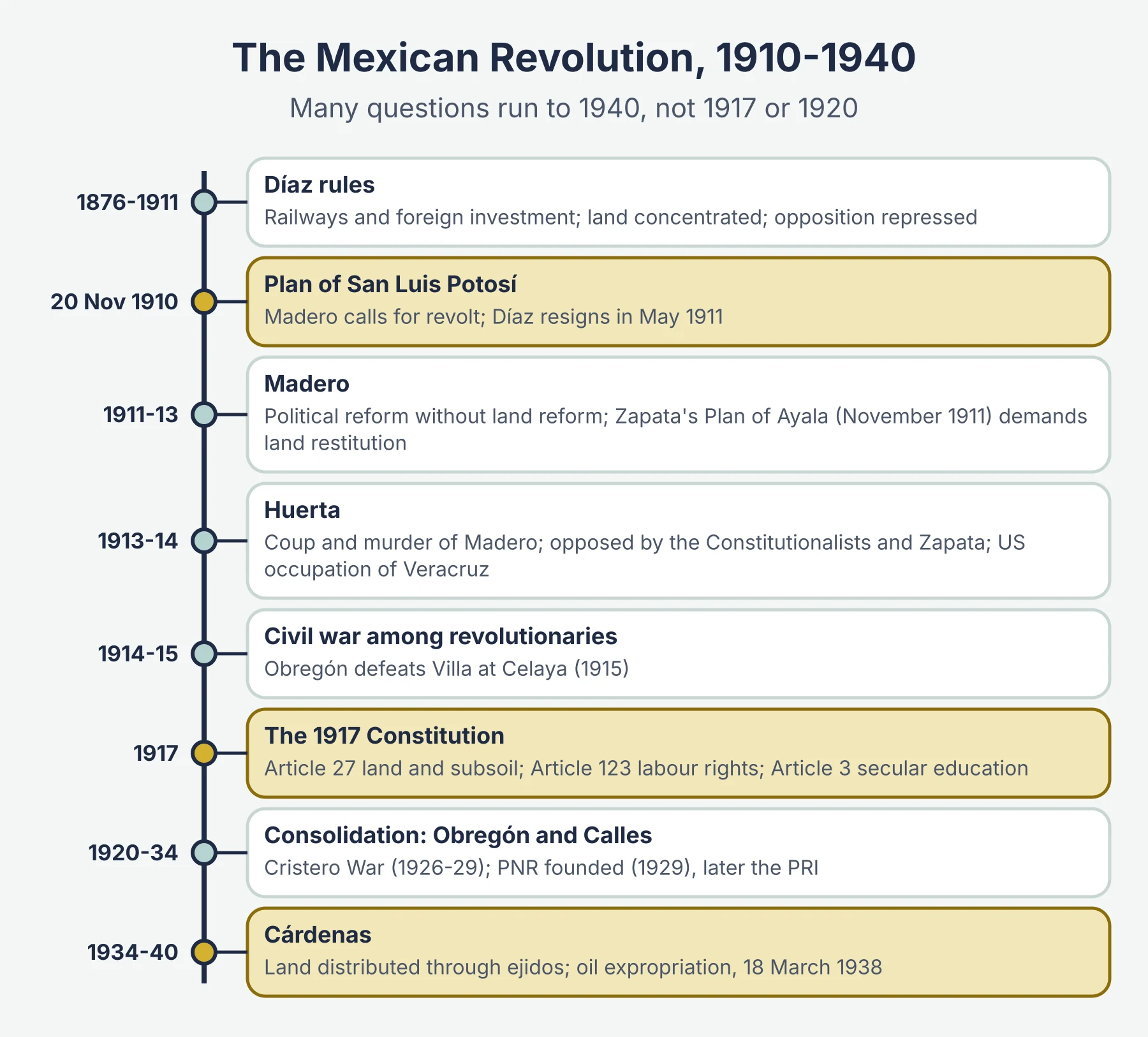
Causes. Porfirio Díaz ruled from 1876 to 1911 (with a short break), promoting railways and foreign investment while concentrating land and repressing opposition. His 1908 interview with James Creelman suggested he would allow a free election; Francisco Madero challenged him and, after being jailed, issued the Plan of San Luis Potosí calling for revolt on 20 November 1910. Díaz resigned in May 1911.
Phases of the revolution.
- Madero (1911-13): political reform without land reform; Zapata’s Plan of Ayala (November 1911) demanded land restitution.
- Huerta (1913-14): coup and murder of Madero (February 1913); opposed by the Constitutionalists (Carranza, Obregón and Villa) and by Zapata; US occupation of Veracruz (1914).
- Civil war among revolutionaries (1914-15): Obregón defeated Villa at Celaya (1915).
- The 1917 Constitution: Article 27 (land and subsoil belong to the nation), Article 123 (labour rights), Article 3 (secular education).
- Consolidation (1920-1934): Obregón and Calles; the Cristero War (1926-29); the founding of the PNR (1929), the party that later became the PRI.
- Cárdenas (1934-40): large-scale land distribution through ejidos; oil expropriation (18 March 1938); reorganization of the ruling party.
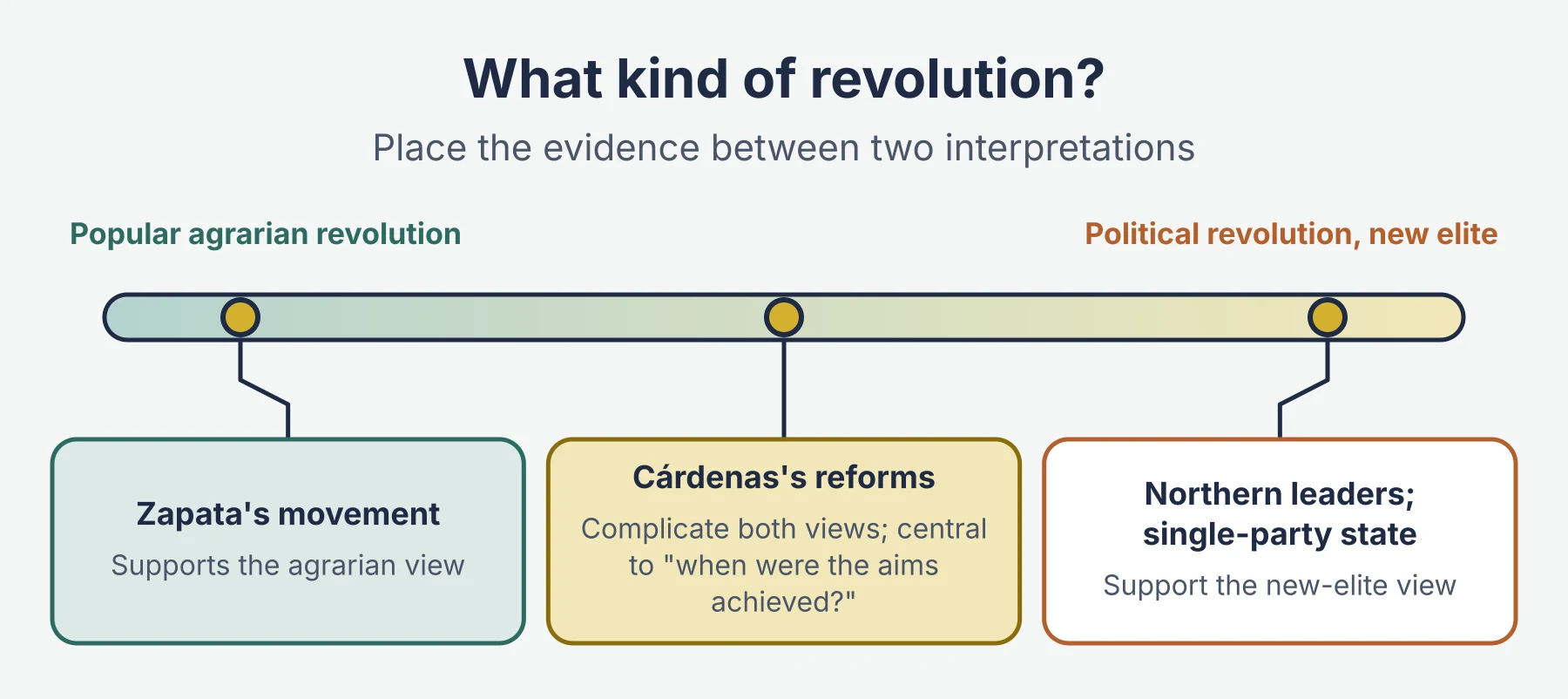
Debate to use. Was this a popular agrarian revolution or a political revolution that created a new elite? Zapata’s movement supports the first view; the dominance of northern leaders and the single-party state that followed support the second. Cárdenas’s reforms complicate both, and are central to any question that asks when the revolution achieved its aims.
Content area 3: civil rights and social movements after 1945
| Date | Event |
|---|---|
| 1954 | Brown v. Board of Education: segregated public schools unconstitutional |
| 1955-56 | Montgomery bus boycott; emergence of Martin Luther King Jr |
| 1957 | Little Rock: federal troops enforce school integration |
| 1960 | Greensboro sit-ins; SNCC founded |
| 1961 | Freedom Rides |
| 1963 | Birmingham campaign; March on Washington (August) |
| 1964 | Civil Rights Act |
| 1965 | Selma marches; Voting Rights Act; assassination of Malcolm X |
| 1966 onward | Black Power; Black Panther Party |
| 4 April 1968 | Assassination of King |
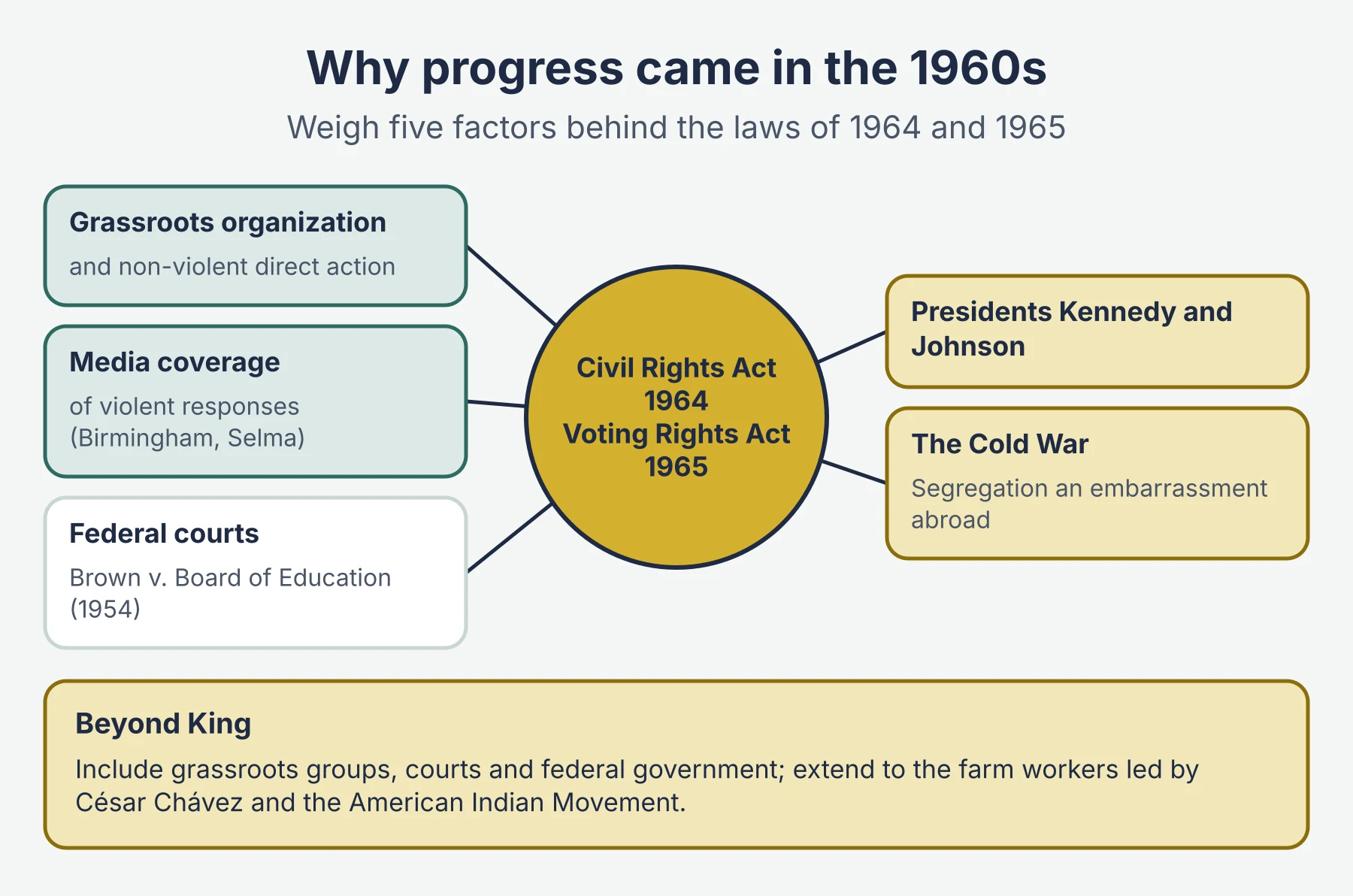
Why progress came in the 1960s. Weigh grassroots organization and non-violent direct action, media coverage of violent responses (Birmingham, Selma), federal courts, Presidents Kennedy and Johnson, and the Cold War, which made segregation an embarrassment abroad. Other social movements, such as the farm workers led by César Chávez and the American Indian Movement, can extend a section on social movements beyond African American civil rights.
Worked example: a model conclusion
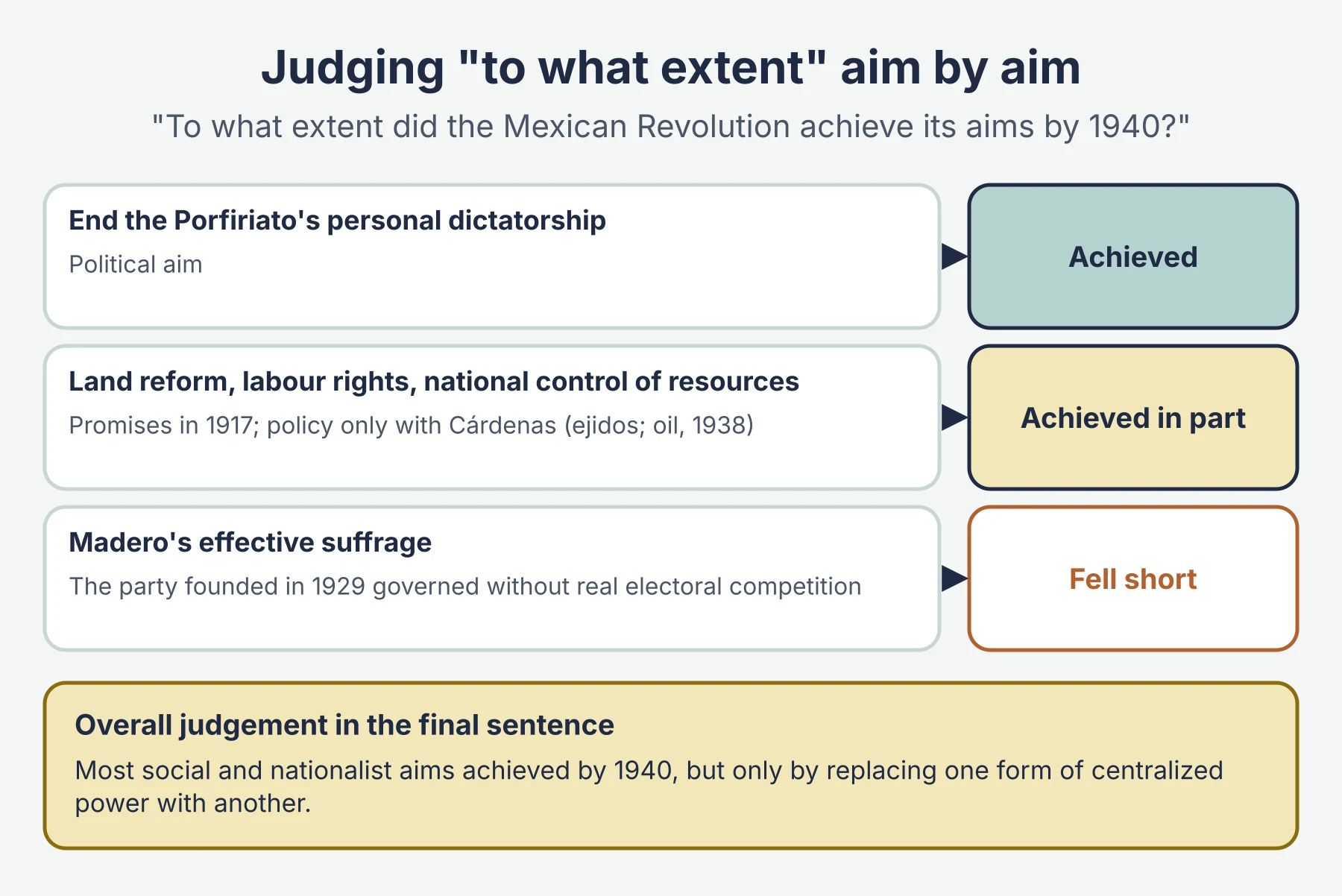
Question: “To what extent did the Mexican Revolution achieve its aims by 1940?”
“By 1940 the Revolution had achieved its political aim of ending the personal dictatorship of the Porfiriato and its social aims in part. The 1917 Constitution created a legal basis for land reform, labour rights and national control of resources, but for two decades these remained largely promises; it was Cárdenas’s distribution of land through ejidos and the oil expropriation of 1938 that turned them into policy. Yet the political settlement fell short of Madero’s ideal of effective suffrage: the party founded in 1929 governed without real electoral competition. The Revolution therefore achieved most of its social and nationalist aims by 1940, but only by replacing one form of centralized power with another.”
Why it works: it separates the different aims, uses precise evidence, judges each aim, and gives an overall answer to “to what extent” in the final sentence.
Common mistakes
- Writing about “the Americas” in general when the question names a country.
- Causes of the Civil War as “states’ rights” alone. Show how states’ rights arguments related to slavery.
- The Mexican Revolution ending in 1917 or 1920. Many questions run to 1940.
- Civil rights as the story of King alone. Include grassroots groups, courts, federal government and other leaders.
- Ignoring Canada and Latin America where your sections include them.
Exam technique
Paper 3 gives you about 50 minutes per essay, each marked out of 15, as the HL options study guide explains. For this region, questions often ask:
- “Evaluate the success of…” a policy or leader: set criteria first.
- “To what extent…”: weigh the named factor against alternatives within the named country.
- “Compare and contrast…” two countries within the Americas, such as the Depression in the USA and Brazil.
- “Discuss…”: present more than one interpretation and decide between them.
Use with the other pages
Revise the chronologies in the History of the Americas revision notes, then write timed answers using the History of the Americas practice questions.
Check your understanding
- What did the Dred Scott decision rule? That Congress could not ban slavery in the territories.
- Give two reasons for Union victory. Any two: greater population and industry, the blockade, Lincoln’s leadership and emancipation, Grant and Sherman’s strategy, Confederate weaknesses.
- What did the Compromise of 1877 do? Withdrew federal troops from the South, ending Reconstruction.
- What did Article 27 of the 1917 Constitution establish? National ownership of land and subsoil resources, the basis for land reform and oil expropriation.
- When did Cárdenas expropriate the oil industry? 18 March 1938.
- Name the two federal laws of 1964 and 1965 that followed the civil rights campaigns. The Civil Rights Act (1964) and the Voting Rights Act (1965).
Related resources
-
Practice questions
IB DP History (DP History): History of the Americas – Practice Questions
Twelve original HL Paper 3-style practice questions on the History of the Americas, from short recall to full 15-mark essays, with mark-scheme answers.
World History · International Baccalaureate · IB
Try questions -
Revision notes
IB DP History (DP History): History of the Americas – Revision Notes
Condensed HL notes for the History of the Americas: US Civil War and Reconstruction, the Mexican Revolution and civil rights, with key terms and a self-test.
World History · International Baccalaureate · IB
Revise topic -
Study guides
IB DP History (DP History): History of Asia and Oceania
The HL History of Asia and Oceania option for Paper 3: the fall of the Qing, Japan's road to war 1912-41 and China under Deng, with essay technique.
World History · International Baccalaureate · IB
Read guide
Get free revision emails (optional)
Occasional emails with practice questions, worked explanations and links to free resources for the qualification and subjects you choose. No spam, and you can unsubscribe from any email. The free tools on this site never need an email.