
Revision Notes
IB DP History (DP History): History of the Americas – Revision Notes
Condensed HL notes for the History of the Americas: US Civil War and Reconstruction, the Mexican Revolution and civil rights, with key terms and a self-test.
- Subject
- World History
- Level
- IB
- Topic
- Topic 3: HL options: Depth studies
- Author
- Marlbridge Academic Team
- Updated
- Reviewed by
- Azam Siddique (what this means)
Aligned to International Baccalaureate IB Diploma Programme History (DP History), First assessment 2017. Official specification .
Syllabus page (what it covers and how it is assessed): IB Diploma Programme History.
Syllabus points this page covers
DP History
- 2 History of the Americas
Found an error? Report a correction.
Need help with this topic? Request a free trial class for IB Diploma Programme History (DP History / DP History (2028)).
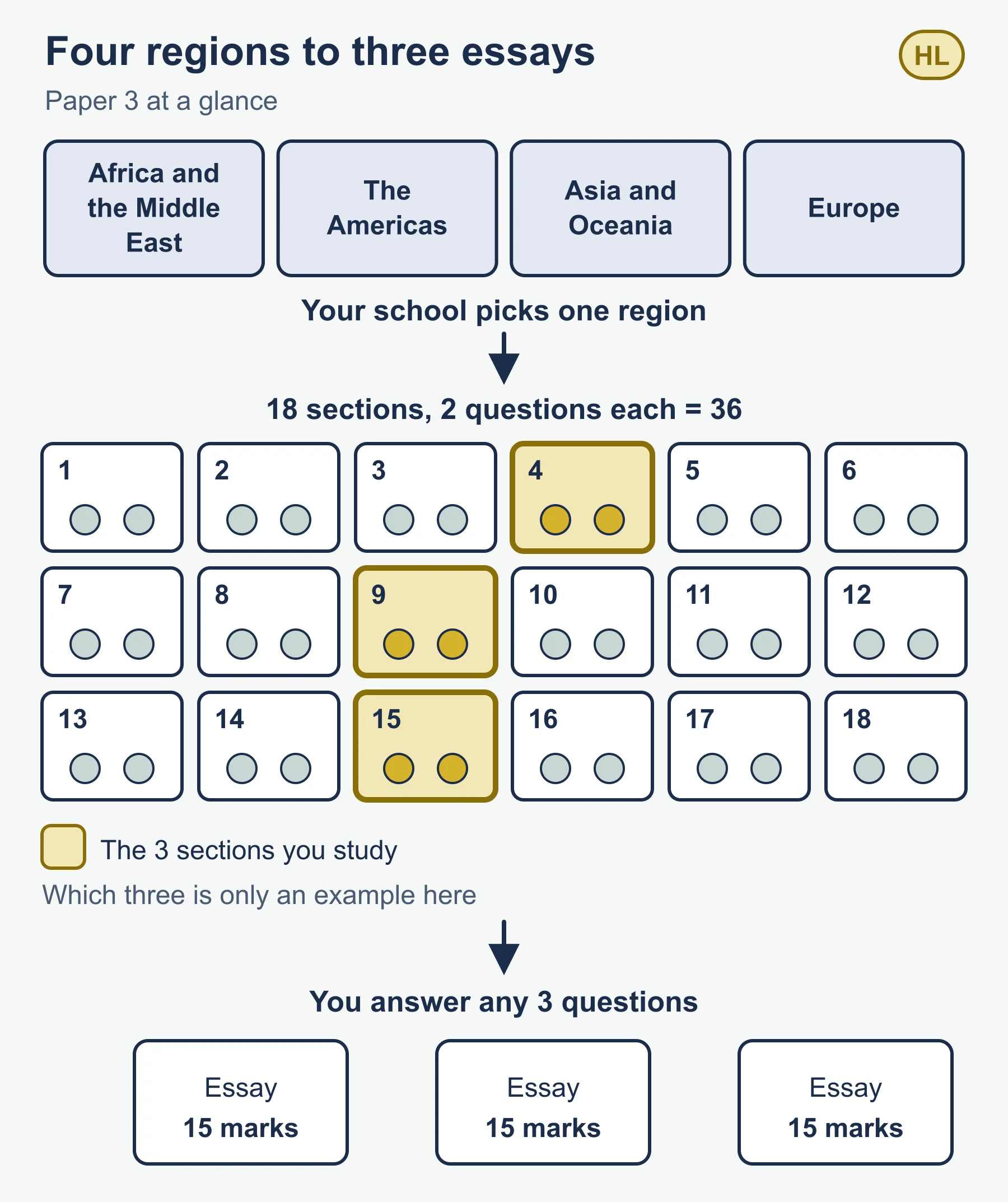
These notes condense three widely taught content areas from the HL History of the Americas option for Paper 3. The arguments are developed in the History of the Americas study guide; apply them with the History of the Americas practice questions. Revise the sections on your school’s list.
Paper 3 essentials
Three 15-mark essays in 2 hours 30 minutes, from 36 questions (two on each of the region’s 18 sections). Plan five minutes and write for about 45 minutes per essay.
US Civil War and Reconstruction
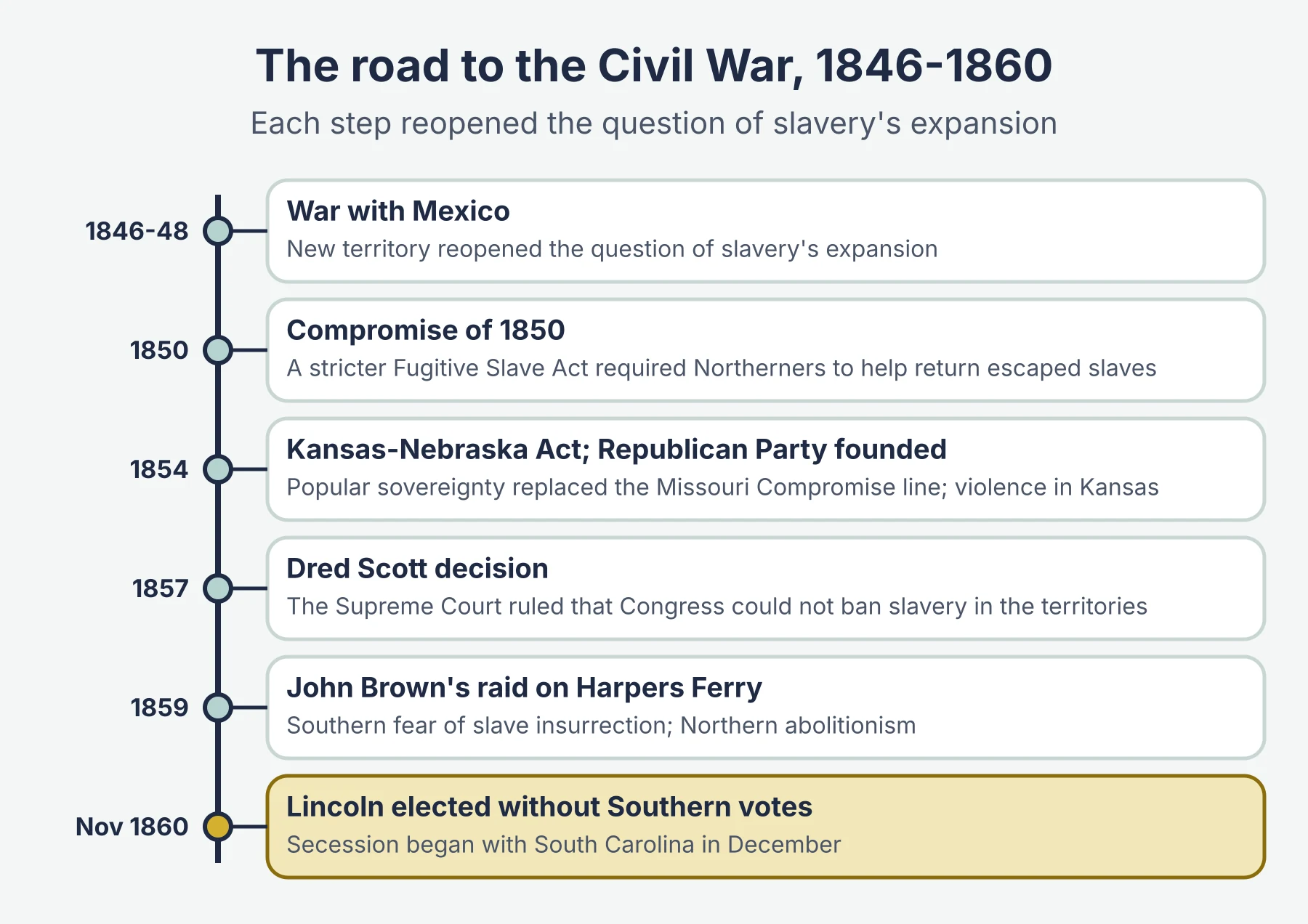
Road to war
- 1820: Missouri Compromise (no slavery north of 36°30′ in the Louisiana Purchase lands, except Missouri).
- 1846-48: Mexican War; Wilmot Proviso debate over slavery in new lands.
- 1850: Compromise of 1850; Fugitive Slave Act.
- 1852: Uncle Tom’s Cabin published.
- 1854: Kansas-Nebraska Act; Republican Party founded.
- 1856: “Bleeding Kansas”.
- 1857: Dred Scott decision.
- 1859: John Brown’s raid.
- November 1860: Lincoln elected; December: South Carolina secedes.
- February 1861: Confederate States of America formed.
- 12 April 1861: Fort Sumter.
The war
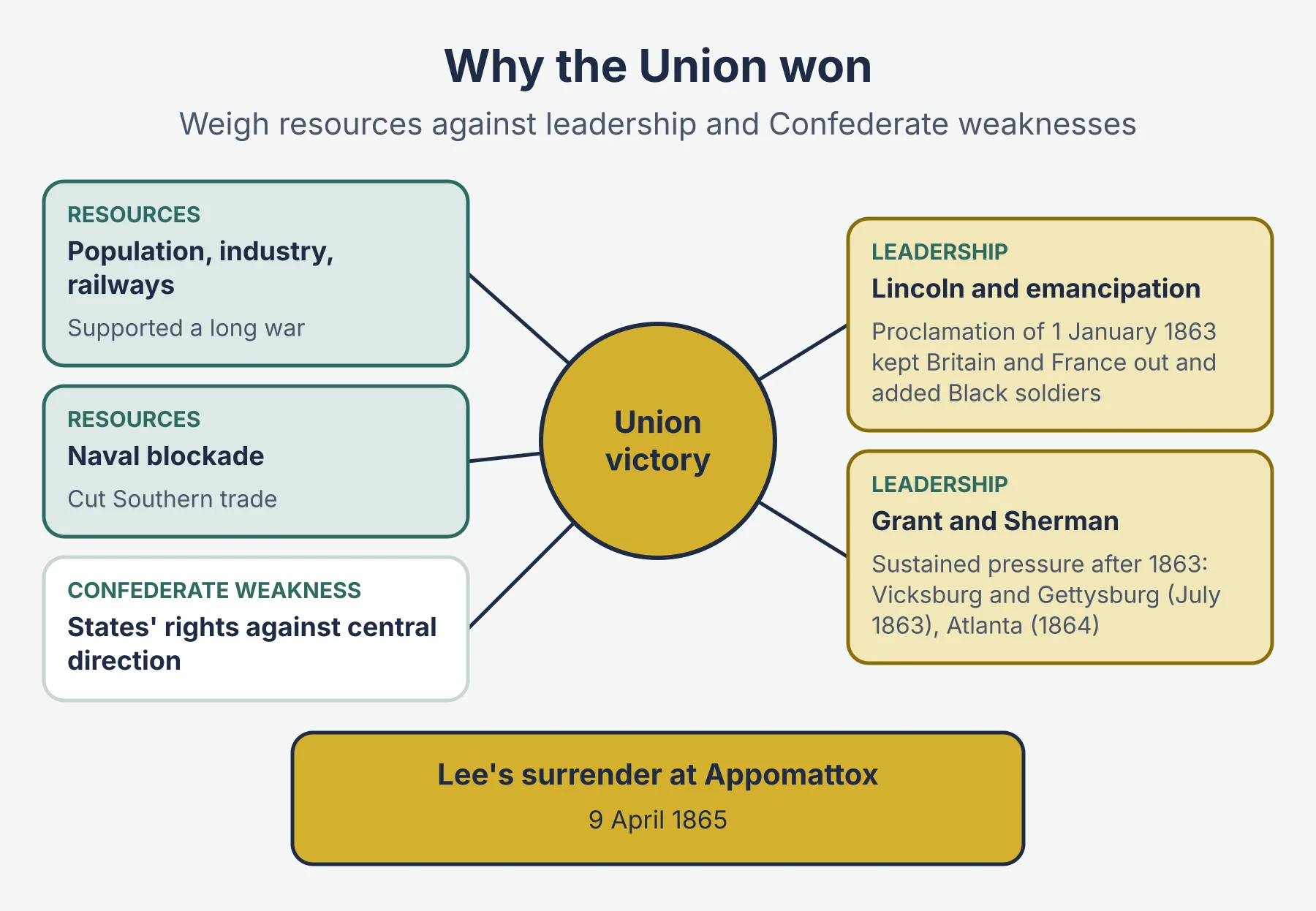
- September 1862: Antietam; preliminary Emancipation Proclamation.
- 1 January 1863: Emancipation Proclamation takes effect.
- July 1863: Gettysburg and Vicksburg.
- September 1864: Atlanta falls; Sherman’s march to the sea.
- November 1864: Lincoln re-elected.
- 9 April 1865: Lee surrenders at Appomattox; 14 April: Lincoln assassinated.
Reconstruction
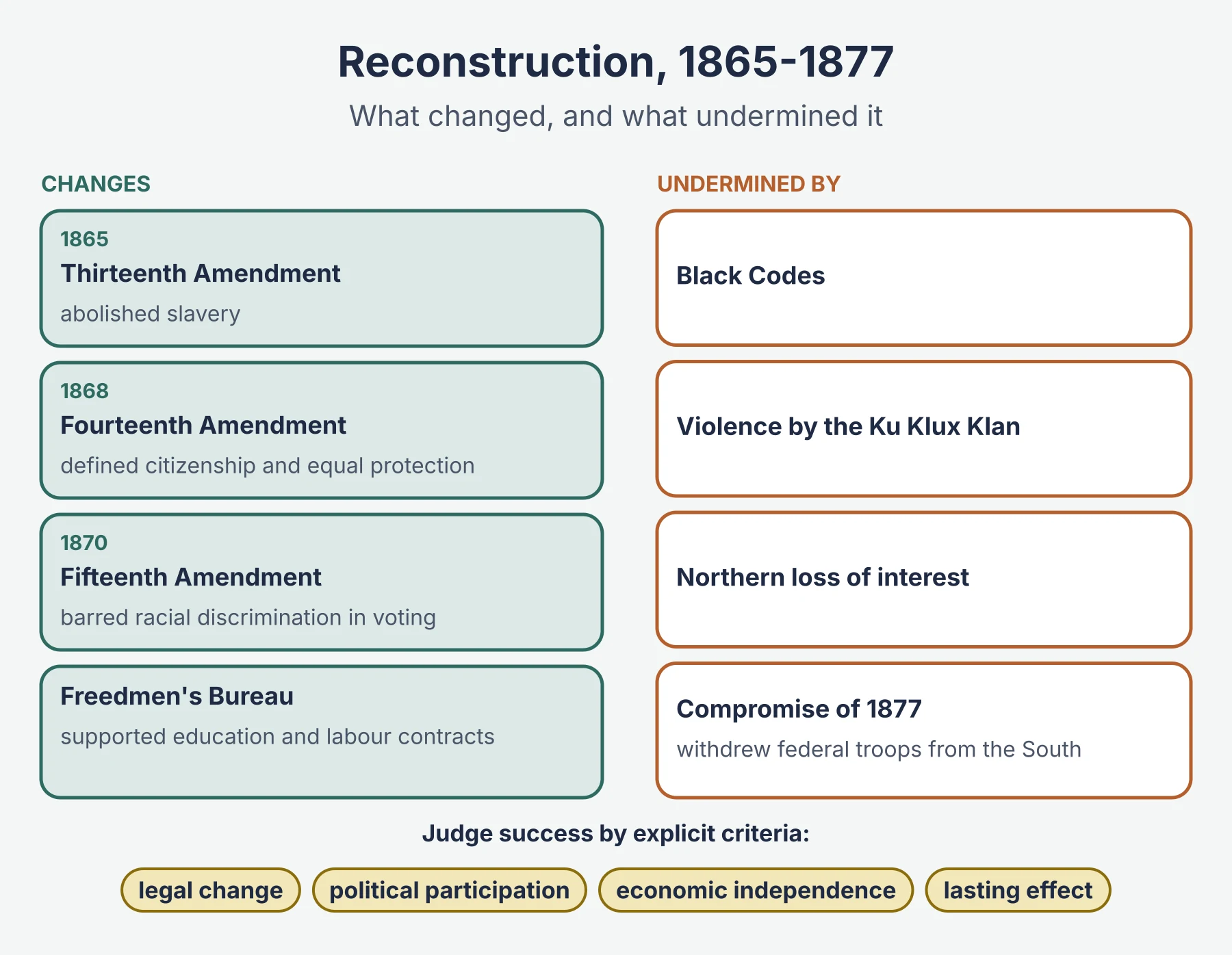
- 1865: Thirteenth Amendment; Freedmen’s Bureau; Black Codes; Ku Klux Klan founded.
- 1867: Reconstruction Acts place the South under military districts.
- 1868: Fourteenth Amendment; President Johnson impeached and acquitted.
- 1870: Fifteenth Amendment.
- 1877: Compromise of 1877; federal troops withdrawn.
The Mexican Revolution, 1910-1940
| Phase | Key points |
|---|---|
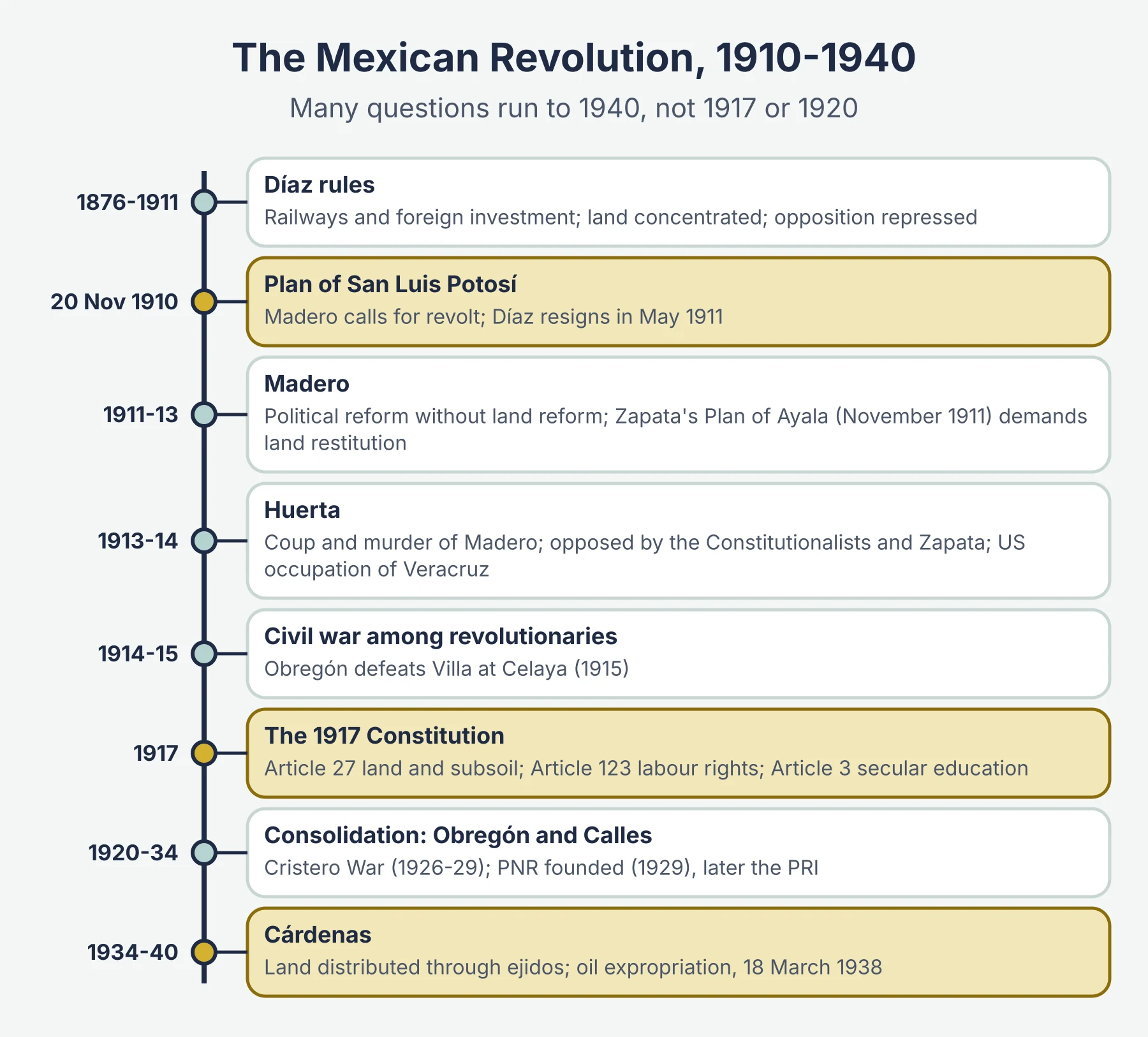
| Porfiriato (1876-1911) | Order and progress; railways; foreign investment; land concentration; rurales; repression |
| Outbreak (1908-11) | Creelman interview (1908); Madero’s campaign; Plan of San Luis Potosí; Díaz resigns (May 1911) |
| Madero (1911-13) | Political reform; Zapata’s Plan of Ayala (1911); Huerta’s coup and Madero’s murder (February 1913) |
| Constitutionalist war (1913-15) | Carranza, Obregón, Villa; US at Veracruz (1914); Aguascalientes Convention (1914); Celaya (1915) |
| Constitution (1917) | Articles 3, 27 and 123 |
| Sonoran dynasty (1920-34) | Obregón; Calles; Cristero War (1926-29); PNR founded (1929) |
| Cárdenas (1934-40) | Ejido land distribution; oil expropriation (1938); party reorganized as the PRM |
Leaders and aims
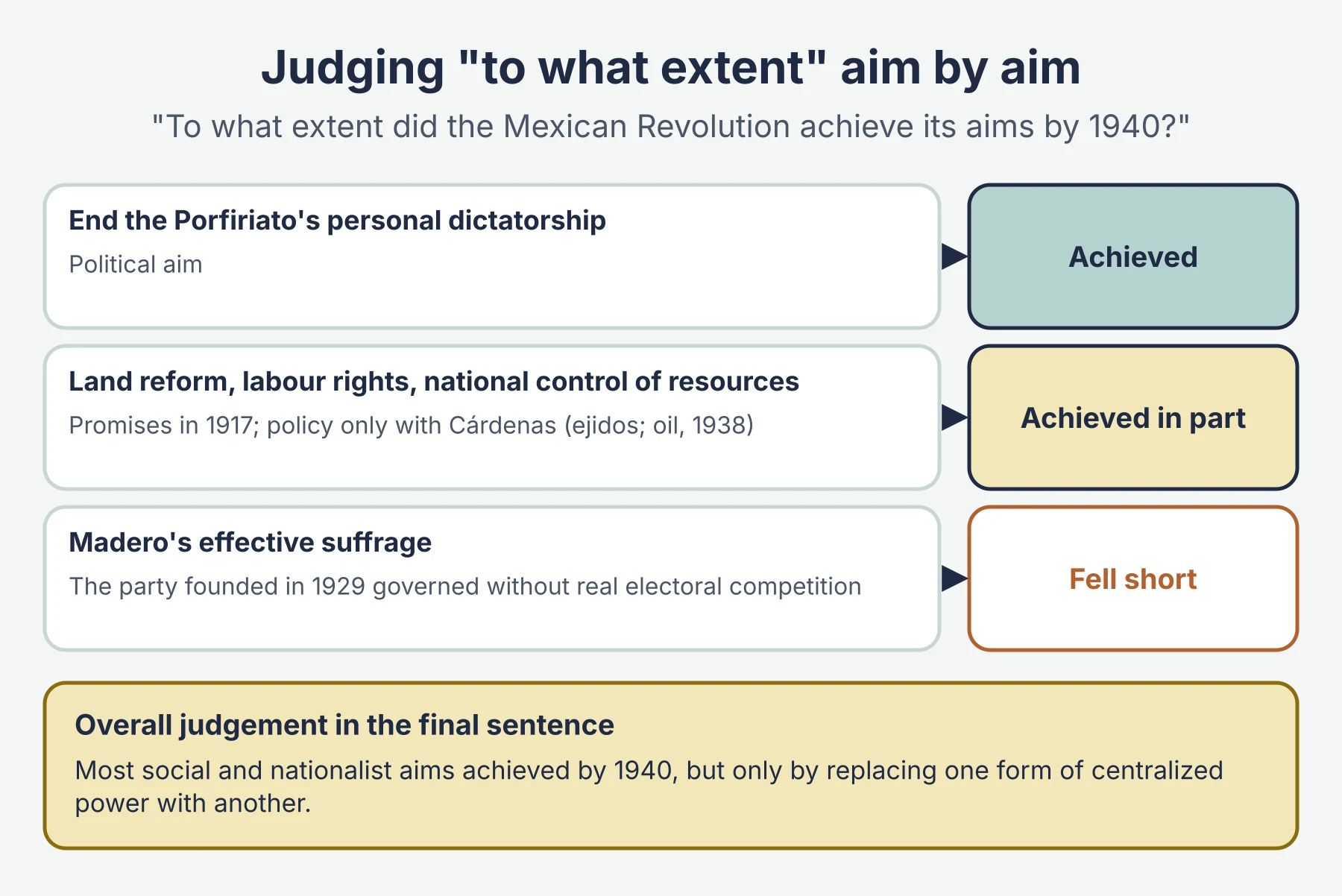
- Madero: “effective suffrage, no re-election”.
- Zapata: land restitution for villages (“land and liberty”).
- Villa: northern popular leader; land and justice for followers.
- Carranza: constitutional order; cautious on land reform.
- Obregón and Calles: state-building, anticlericalism, central control.
- Cárdenas: agrarian reform, labour rights, economic nationalism.
Civil rights and social movements after 1945
| Strategy | Examples | Organizations |
|---|---|---|
| Legal challenge | Brown v. Board (1954) | NAACP |
| Non-violent direct action | Montgomery (1955-56), sit-ins (1960), Freedom Rides (1961), Birmingham (1963), Selma (1965) | SCLC, SNCC, CORE |
| Mass demonstration | March on Washington (August 1963) | Coalition of groups |
| Black Power and self-defence | Calls for Black Power (1966) | Black Panther Party; Malcolm X earlier in the Nation of Islam |
| Federal action | Civil Rights Act (1964); Voting Rights Act (1965) | Kennedy and Johnson administrations |
| Other movements | Farm workers’ strikes and boycotts from 1965; American Indian activism | United Farm Workers (César Chávez); American Indian Movement |
Key terms
| Term | Meaning |
|---|---|
| Popular sovereignty | Letting settlers of a territory decide on slavery |
| Secession | A state’s withdrawal from the Union |
| Black Codes | Southern laws after 1865 restricting freedmen’s rights |
| Sharecropping | Farming land for a share of the crop, common among freedmen |
| Porfiriato | The period of Díaz’s rule |
| Ejido | Communal landholding in Mexico |
| Cristeros | Catholic rebels against anticlerical laws, 1926-29 |
| Segregation / Jim Crow | Legal separation of races in the US South |
| Direct action | Protest such as sit-ins and boycotts that confronts injustice publicly |
Essay angles to prepare
| Content area | Question angle | Factors to weigh |
|---|---|---|
| Civil War causes | Was slavery the main cause of the war? | Expansion of slavery, states’ rights, economic differences, the breakdown of parties, Lincoln’s election |
| Union victory | Why did the North win? | Resources, blockade, leadership, emancipation, Confederate weaknesses |
| Reconstruction | How far did Reconstruction succeed? | Amendments, Freedmen’s Bureau, Black officeholders, Black Codes, violence, the 1877 settlement |
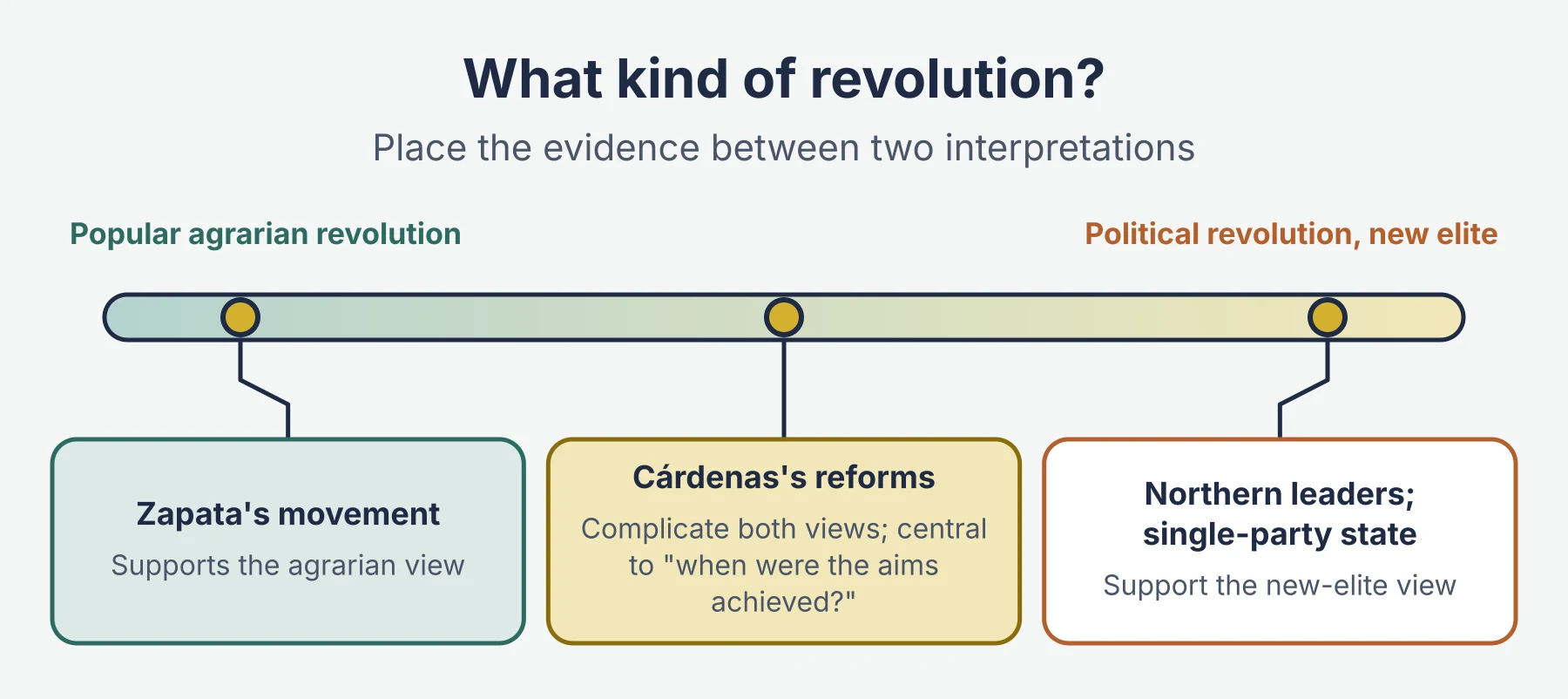
| Mexican Revolution | Why did the revolution last so long? | Divided aims of leaders, foreign intervention, regional armies, weak central state |
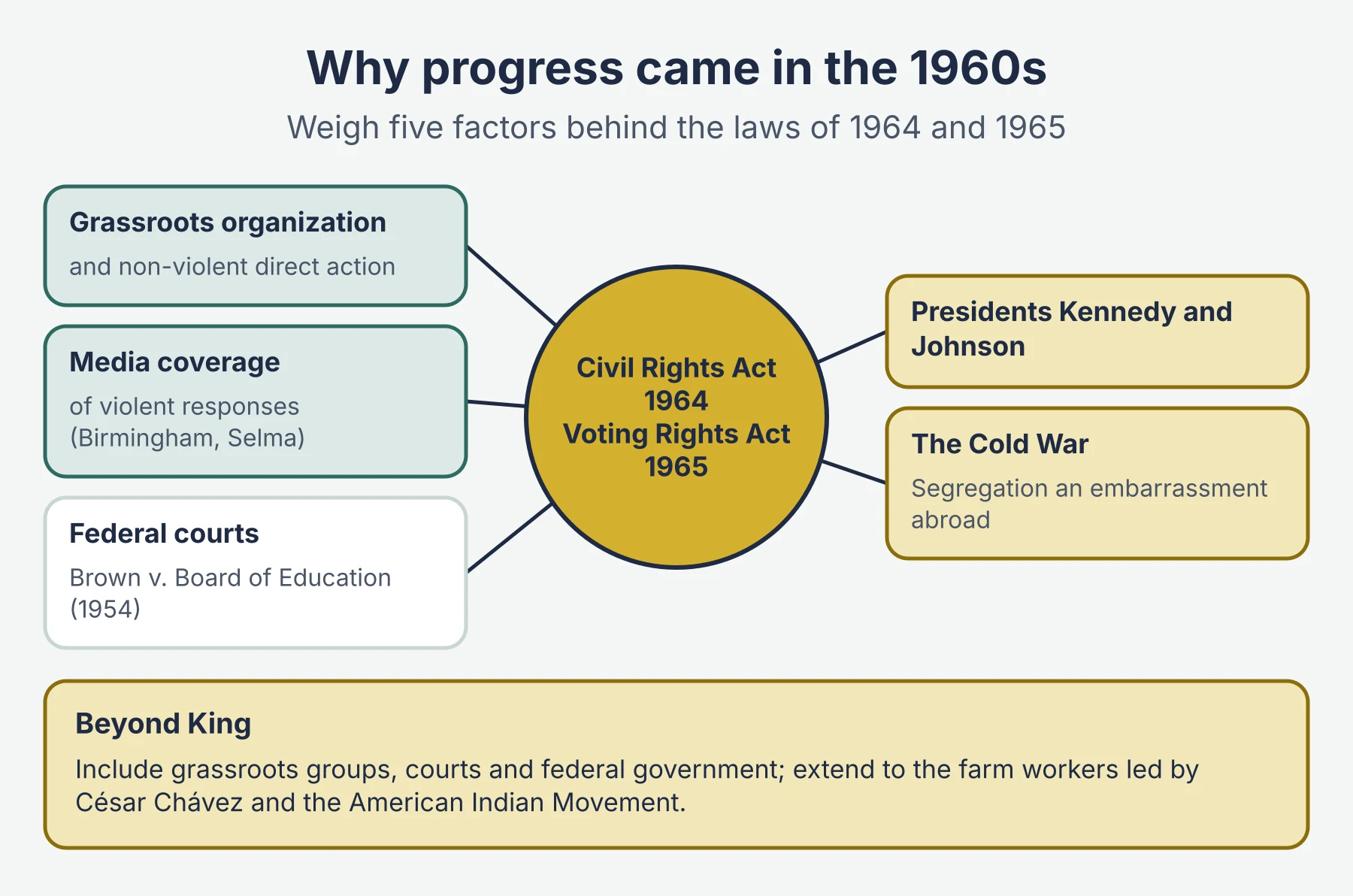
| Civil rights | Why did progress come in the 1960s? | Grassroots action, courts, presidents, media, Cold War image |
Exam traps
- Slavery left out of Civil War causes. It was central to every crisis of the 1850s.
- Union victory as inevitable. Show that resources needed leadership and strategy to be decisive.
- The Mexican Revolution as one event. Separate phases and leaders, and read the question’s end date.
- Civil rights as only King. Include grassroots groups, courts, presidents and Black Power.
- Moving outside the named country. Answer for the country in the question.
Self-test
- What did the Kansas-Nebraska Act do? Allowed settlers to decide on slavery, overturning the Missouri Compromise line.
- Which state seceded first, and when? South Carolina, December 1860.
- Why was the Emancipation Proclamation significant beyond the battlefield? It made the war a war against slavery and discouraged British and French intervention.
- What were the two Union victories of July 1863? Gettysburg and Vicksburg.
- What did the Fourteenth Amendment establish? Citizenship and equal protection of the laws for all persons born or naturalized in the USA.
- What was Madero’s slogan? “Effective suffrage, no re-election.”
- What did Zapata’s Plan of Ayala demand? Restitution of land to villages.
- Who defeated Villa at Celaya? Obregón, in 1915.
- What was the Cristero War? A Catholic rebellion (1926-29) against the anticlerical laws of the Calles government.
- Which party did Calles found in 1929? The PNR, forerunner of the PRI.
- What did Brown v. Board of Education decide? That segregated public schools were unconstitutional.
- Name two organizations of the civil rights movement besides the NAACP. Any two: SCLC, SNCC, CORE, the Black Panther Party.
Related resources
-
Study guides
IB DP History (DP History): History of Asia and Oceania
The HL History of Asia and Oceania option for Paper 3: the fall of the Qing, Japan's road to war 1912-41 and China under Deng, with essay technique.
World History · International Baccalaureate · IB
Read guide -
Practice questions
IB DP History (DP History): History of Asia and Oceania – Practice Questions
Twelve original HL Paper 3-style practice questions on the History of Asia and Oceania, from short recall to full 15-mark essays, with mark-scheme answers.
World History · International Baccalaureate · IB
Try questions -
Revision notes
IB DP History (DP History): History of Asia and Oceania – Revision Notes
Condensed HL notes for Asia and Oceania: late Qing decline and 1911, Japan's road to war 1912-41 and China under Deng, with key terms and a self-test.
World History · International Baccalaureate · IB
Revise topic
Get free revision emails (optional)
Occasional emails with practice questions, worked explanations and links to free resources for the qualification and subjects you choose. No spam, and you can unsubscribe from any email. The free tools on this site never need an email.