
Study Guides
IB DP History (DP History): History of Asia and Oceania
The HL History of Asia and Oceania option for Paper 3: the fall of the Qing, Japan's road to war 1912-41 and China under Deng, with essay technique.
- Subject
- World History
- Level
- IB
- Topic
- Topic 3: HL options: Depth studies
- Author
- Marlbridge Academic Team
- Updated
- Reviewed by
- Azam Siddique (what this means)
Aligned to International Baccalaureate IB Diploma Programme History (DP History), First assessment 2017. Official specification .
Syllabus page (what it covers and how it is assessed): IB Diploma Programme History.
Syllabus points this page covers
DP History
- 3 History of Asia and Oceania
Found an error? Report a correction.
Need help with this topic? Request a free trial class for IB Diploma Programme History (DP History / DP History (2028)).
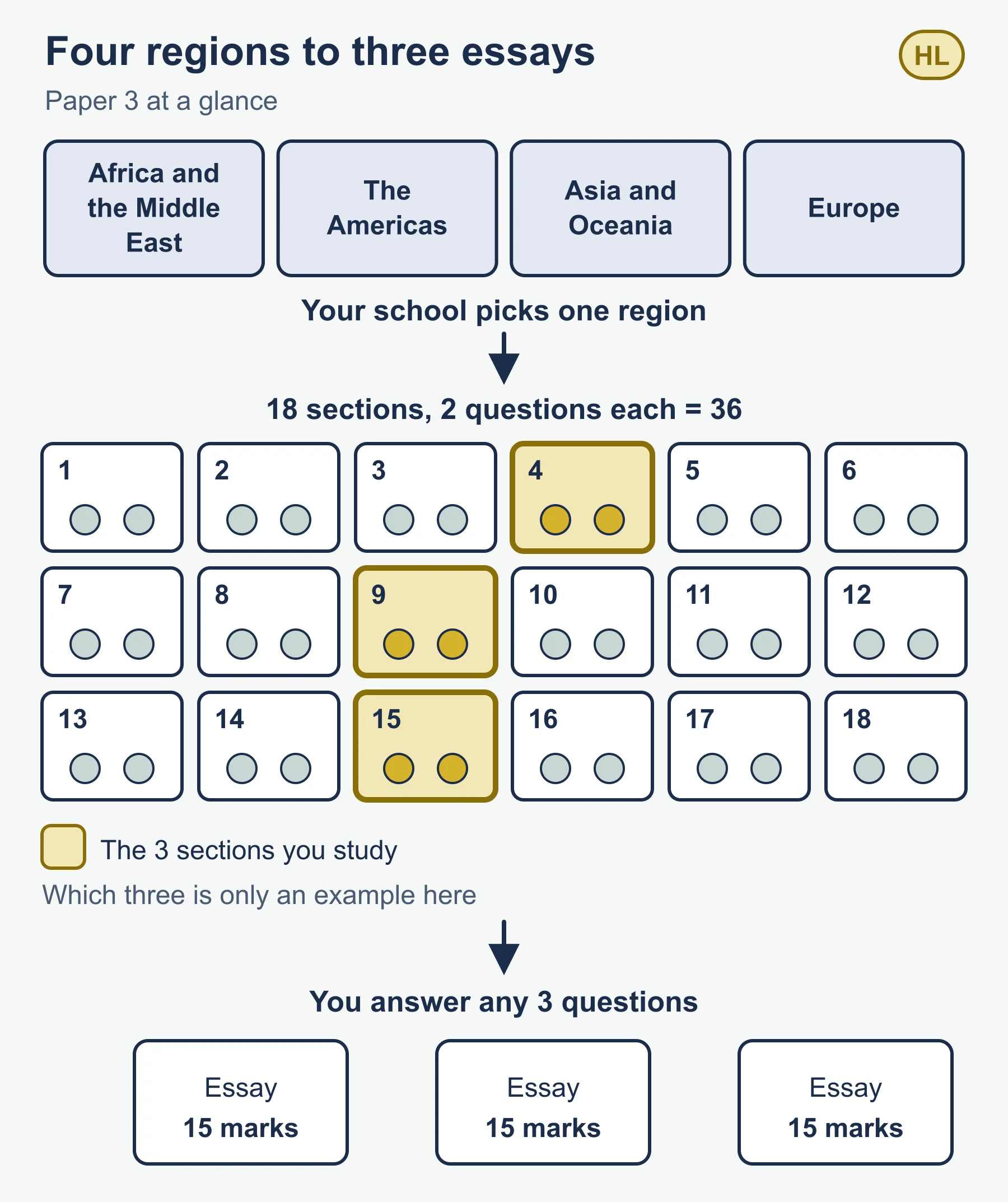
The History of Asia and Oceania is the HL regional option covering East, South-East and South Asia, together with Australia, New Zealand and the Pacific. Your school chooses three of its eighteen sections, and Paper 3 tests them through three essays in 2 hours 30 minutes. This guide takes three content areas that many schools teach and shows the chronology, explanation and debate a Paper 3 answer needs. Use your teacher’s list of the guide’s section titles and dates as the boundary of what you revise.
What the option covers
The sections run from early modern states to the end of the twentieth century. Widely taught modern content areas include:
- the decline of the Qing dynasty and the revolution of 1911;
- Meiji Japan and its transformation after 1868;
- Japan from the Taishō era to the Second World War, and its post-war recovery;
- the Chinese republic, the Guomindang and the rise of the communists;
- the impact of the world wars on South-East Asia;
- independence and partition in South Asia;
- the People’s Republic of China under Mao and after;
- Australia and New Zealand in the twentieth century.
Content area 1: the decline of the Qing and the 1911 Revolution
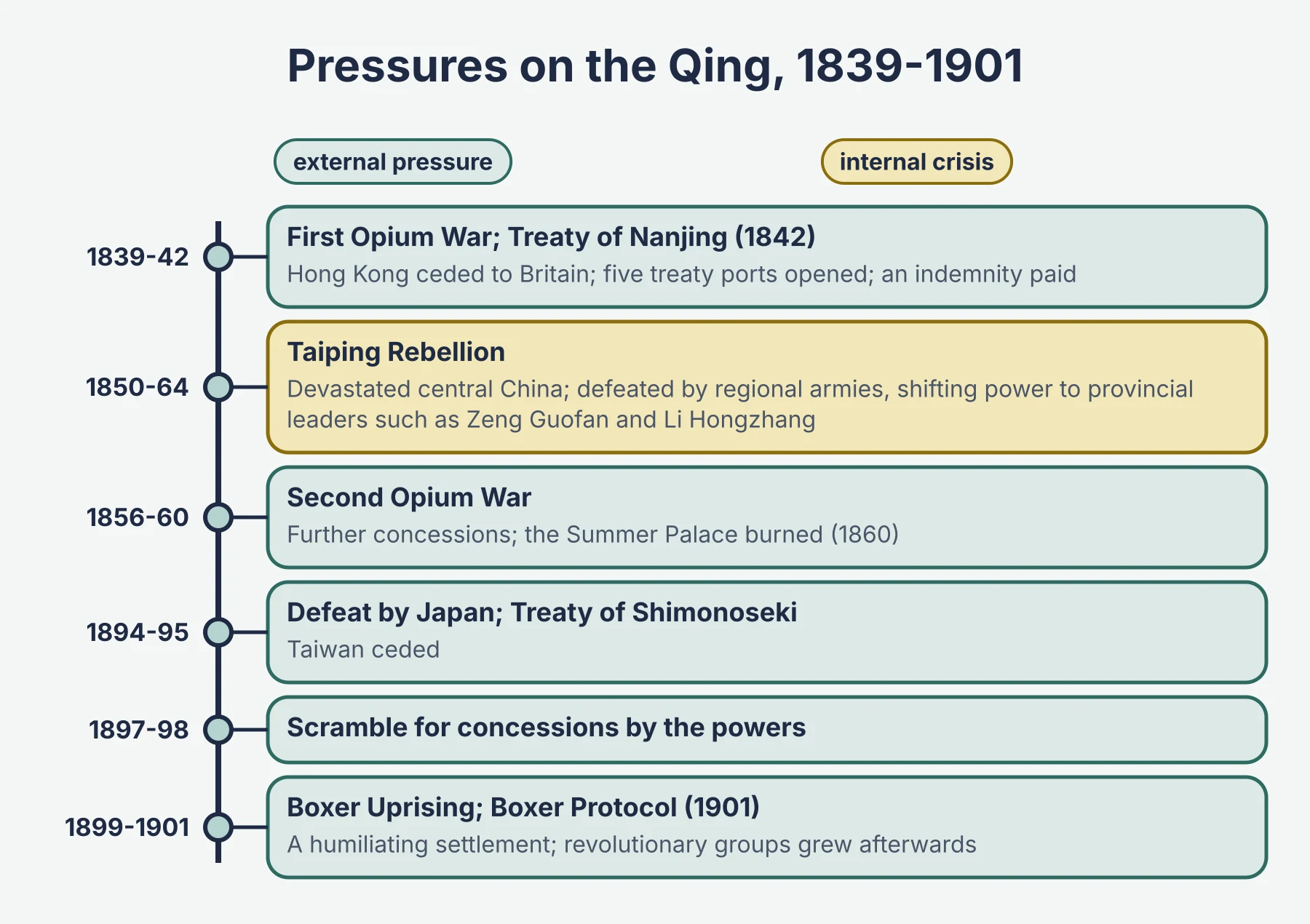
External pressure. The First Opium War (1839-42) ended with the Treaty of Nanjing (1842): Hong Kong ceded to Britain, five treaty ports opened and an indemnity paid. The Second Opium War (1856-60) brought further concessions and the burning of the Summer Palace (1860). Defeat by Japan (1894-95) and the Treaty of Shimonoseki, which ceded Taiwan, triggered a scramble for concessions by the powers in 1897-98.
Internal crisis. The Taiping Rebellion (1850-64), led by Hong Xiuquan, devastated central China and was defeated by regional armies rather than the imperial forces, shifting power to provincial leaders such as Zeng Guofan and Li Hongzhang.
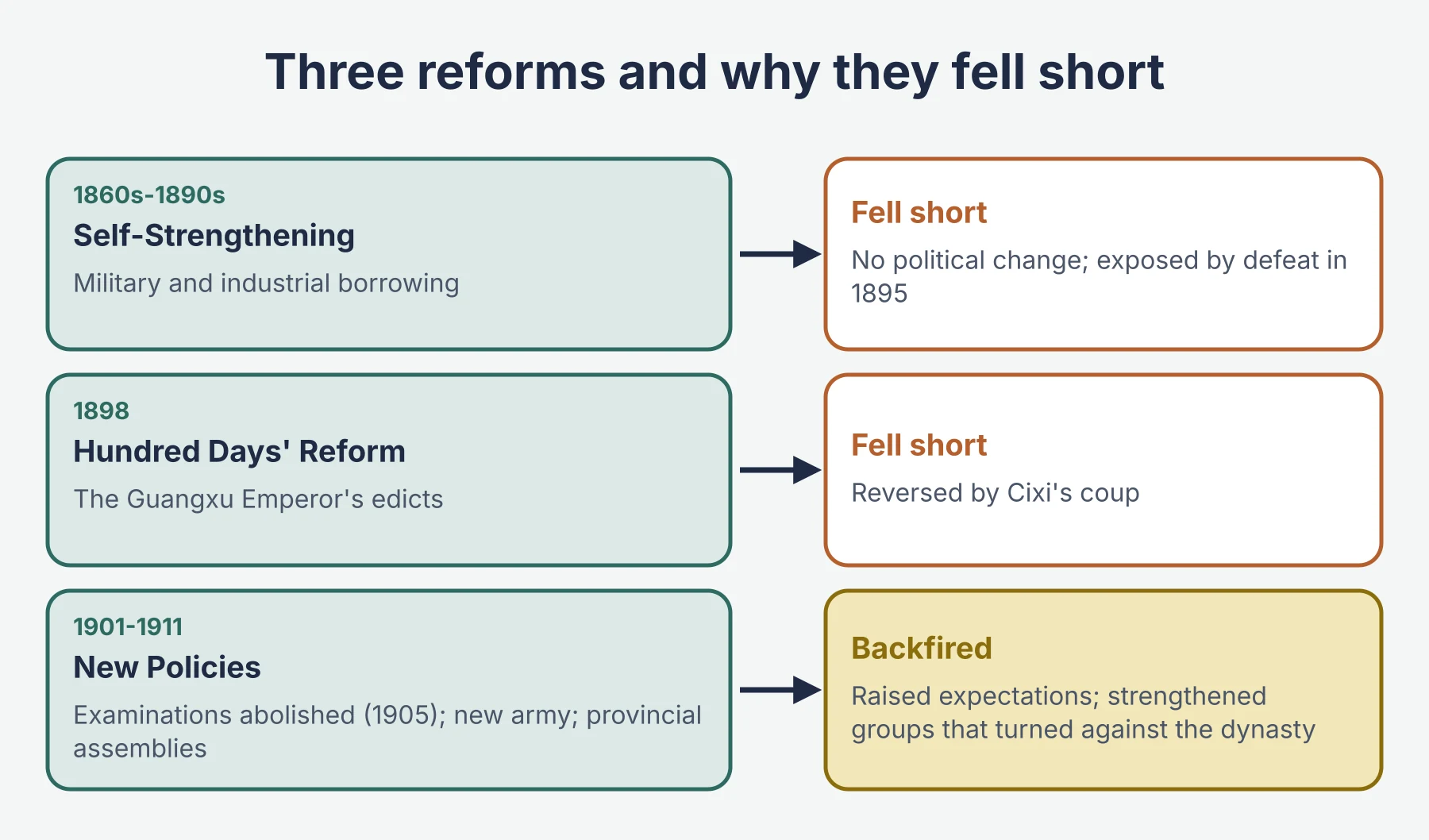
Reform and its limits.
| Reform | Dates | Why it fell short |
|---|---|---|
| Self-Strengthening | 1860s-1890s | Military and industrial borrowing without political change; exposed by defeat in 1895 |
| Hundred Days’ Reform | 1898 | The Guangxu Emperor’s edicts were reversed by Cixi’s coup |
| New Policies | 1901-1911 | Real reforms (the civil service examination abolished in 1905; new army; provincial assemblies) raised expectations and strengthened groups that turned against the dynasty |
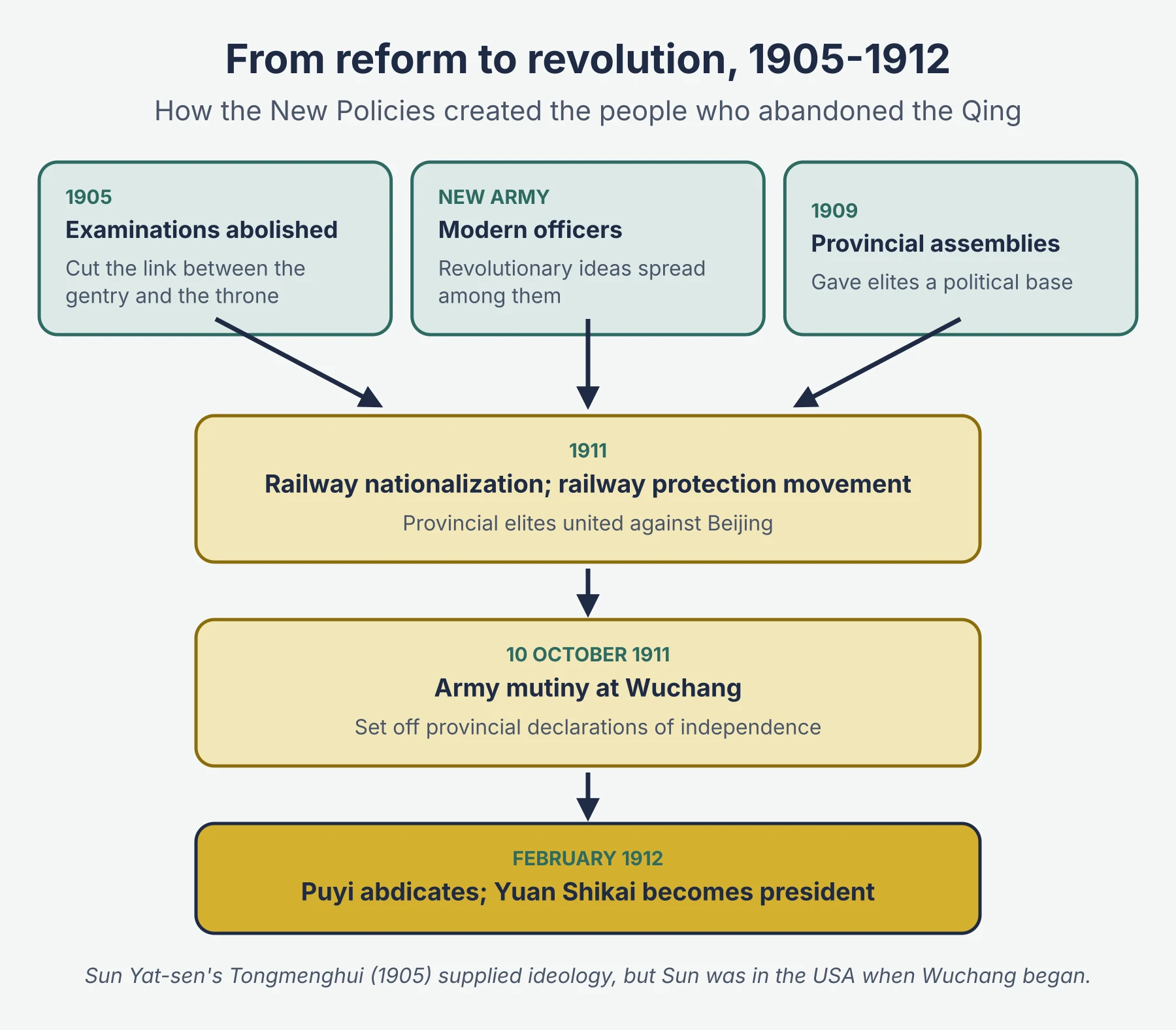
The revolution. After the Boxer Uprising (1899-1901) and the humiliating Boxer Protocol (1901), revolutionary groups grew, including Sun Yat-sen’s Tongmenghui (1905). The railway protection movement of 1911 and an army mutiny at Wuchang (10 October 1911) set off provincial declarations of independence. The last emperor, Puyi, abdicated in February 1912, and Yuan Shikai became president.
Debate. Was the dynasty brought down by foreign imperialism or by its own reforms? The New Policies argument is strong: the reforms created a modern army and provincial elites who, in 1911, chose to abandon the Qing.
Content area 2: Japan, 1912-1941
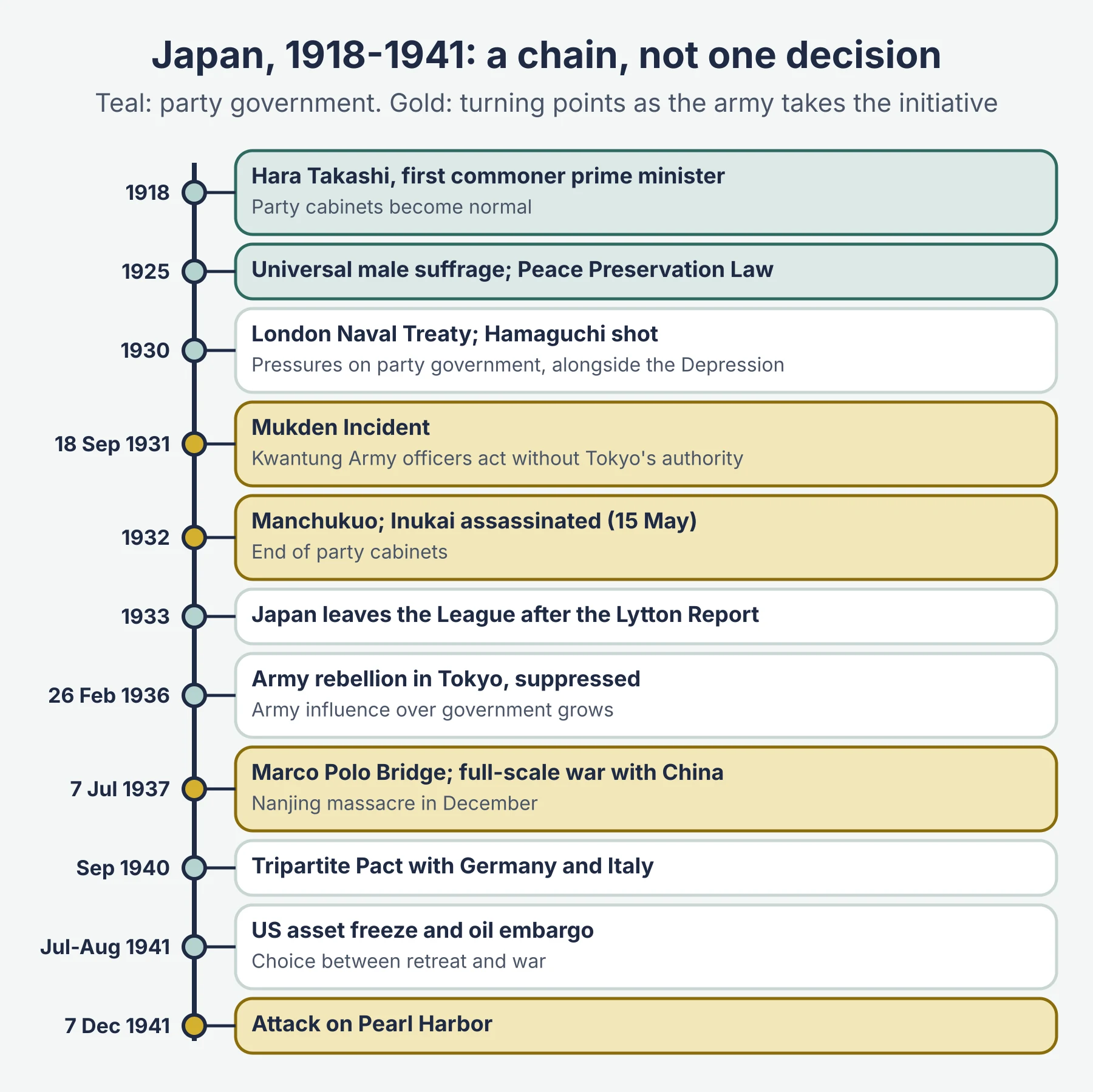
Taishō democracy. Party cabinets became normal after Hara Takashi, the first commoner prime minister (1918), took office; universal male suffrage was introduced in 1925, but in the same year the Peace Preservation Law restricted left-wing movements.
Pressures on party government. The Depression collapsed silk exports to the USA and hit rural Japan hard; the London Naval Treaty (1930) angered the navy and nationalists; Prime Minister Hamaguchi was shot in 1930.
The army takes the initiative.
| Date | Event | Significance |
|---|---|---|
| 18 September 1931 | Mukden (Manchurian) Incident | Kwantung Army officers acted without Tokyo’s authority |
| 1932 | Manchukuo created; Prime Minister Inukai assassinated (15 May) | End of party cabinets |
| 1933 | Japan leaves the League of Nations after the Lytton Report | Diplomatic isolation |
| 26 February 1936 | Army rebellion in Tokyo, suppressed | Increased army influence over government |
| 7 July 1937 | Marco Polo Bridge incident; full-scale war with China | The Nanjing massacre follows in December |
| September 1940 | Tripartite Pact with Germany and Italy | Alignment with the Axis |
| 1941 | US freezing of Japanese assets and oil embargo (July-August) | Choice between retreat and war |
| 7 December 1941 | Attack on Pearl Harbor | War with the USA and Britain |
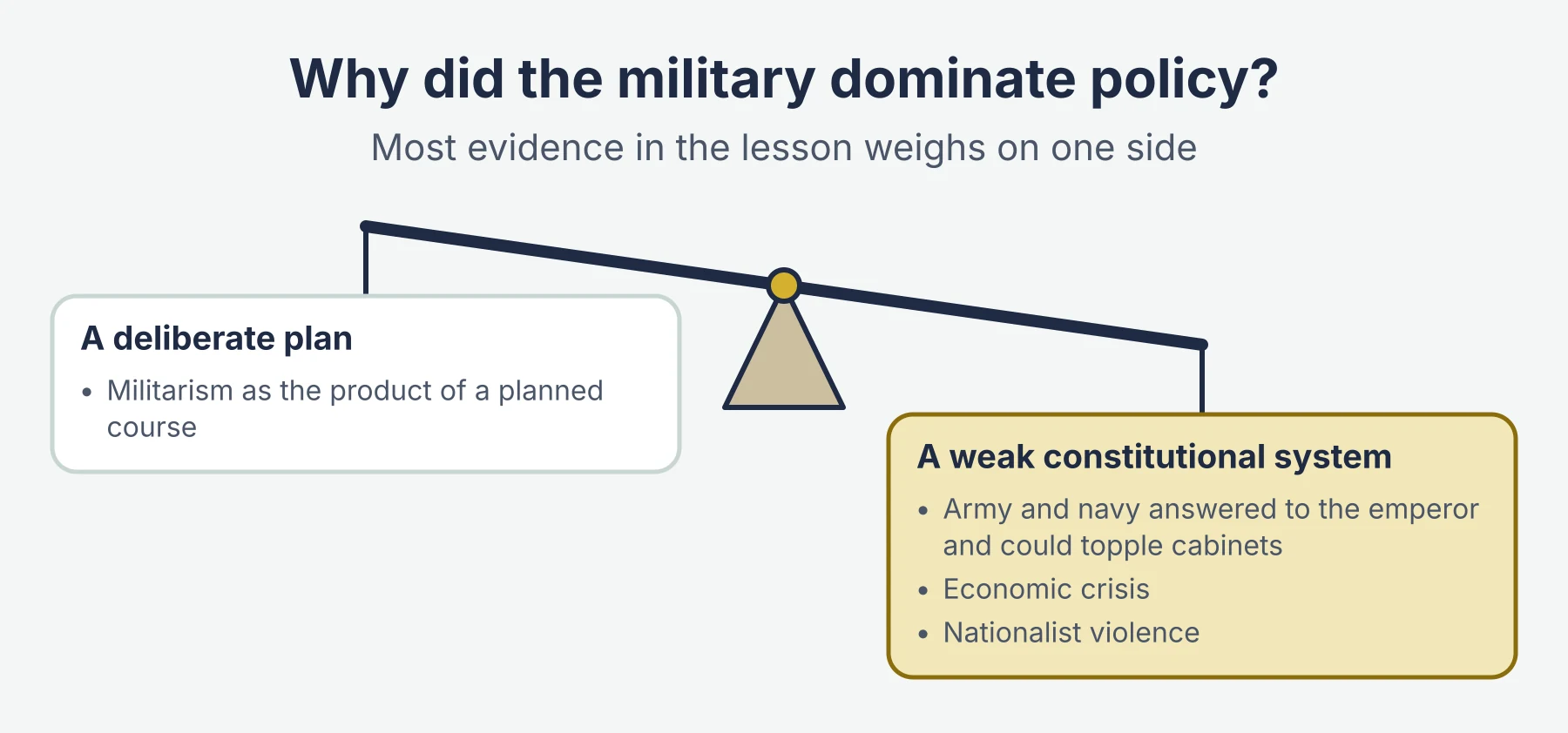
Debate. Was militarism the product of a deliberate plan, or of a weak constitutional system in which the army and navy answered to the emperor and could topple cabinets? Most evidence supports the second: the Meiji Constitution’s structure, economic crisis and nationalist violence let the military dominate policy.
Content area 3: China under Deng Xiaoping, 1976-1997
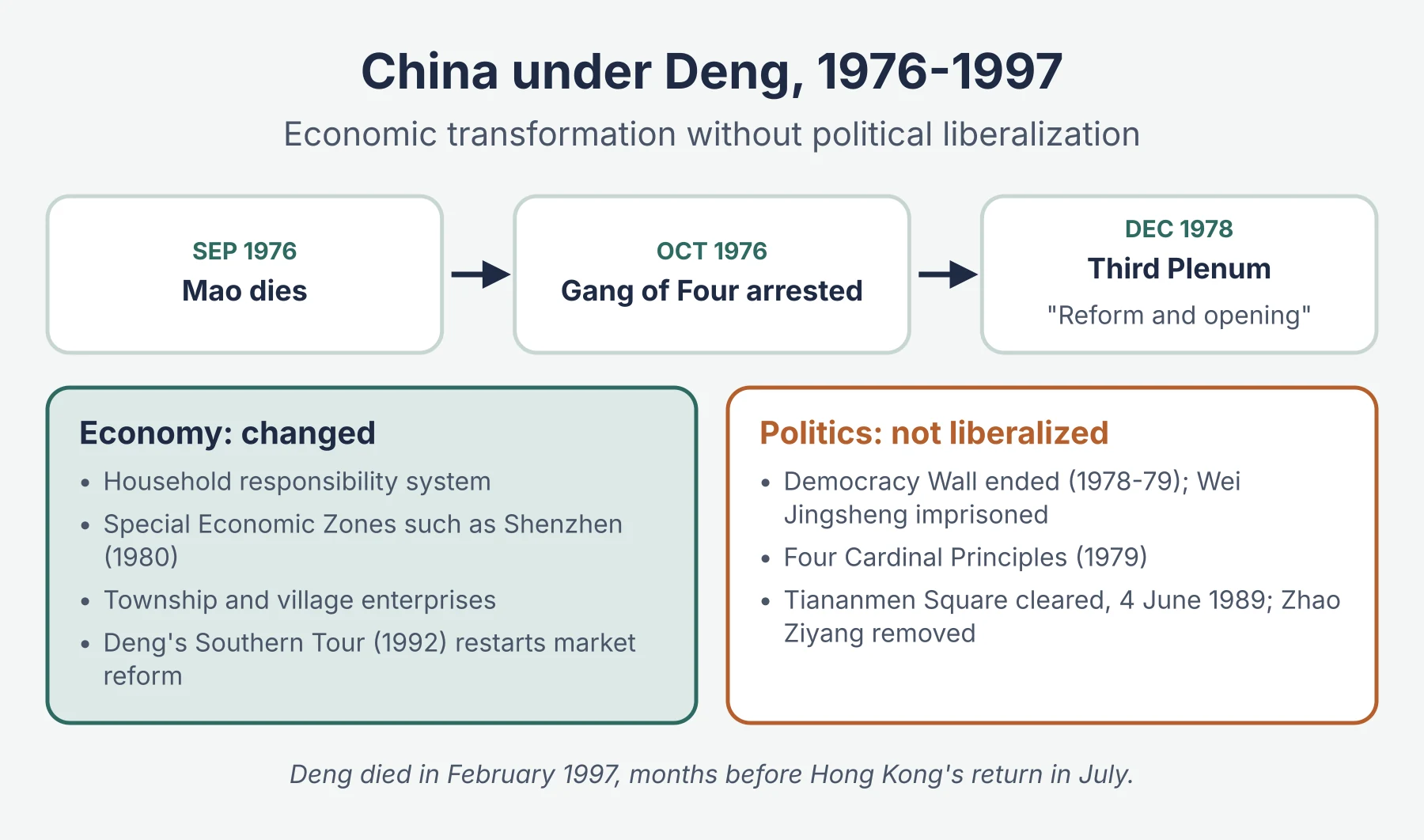
- Succession: Mao died in September 1976; the Gang of Four were arrested in October; the Third Plenum (December 1978) confirmed Deng’s leadership and the policy of “reform and opening”.
- Economic reform: the household responsibility system returned farming decisions to families; Special Economic Zones such as Shenzhen (1980) attracted foreign investment; township and village enterprises grew.
- Political limits: the Democracy Wall movement (1978-79) was ended, and Wei Jingsheng, who called for democracy as a “Fifth Modernization”, was imprisoned; Deng set out the Four Cardinal Principles (1979), including the leadership of the Communist Party.
- Social policy: the one-child policy, introduced from 1979-80.
- 1989: after Hu Yaobang’s death in April, protests grew in Tiananmen Square; martial law was declared and the army cleared the square on 4 June. Zhao Ziyang was removed.
- Afterwards: Deng’s Southern Tour (1992) restarted market reform; he died in February 1997, months before Hong Kong’s return in July.
Key judgement: economic transformation without political liberalization.
Worked example: plan and annotation
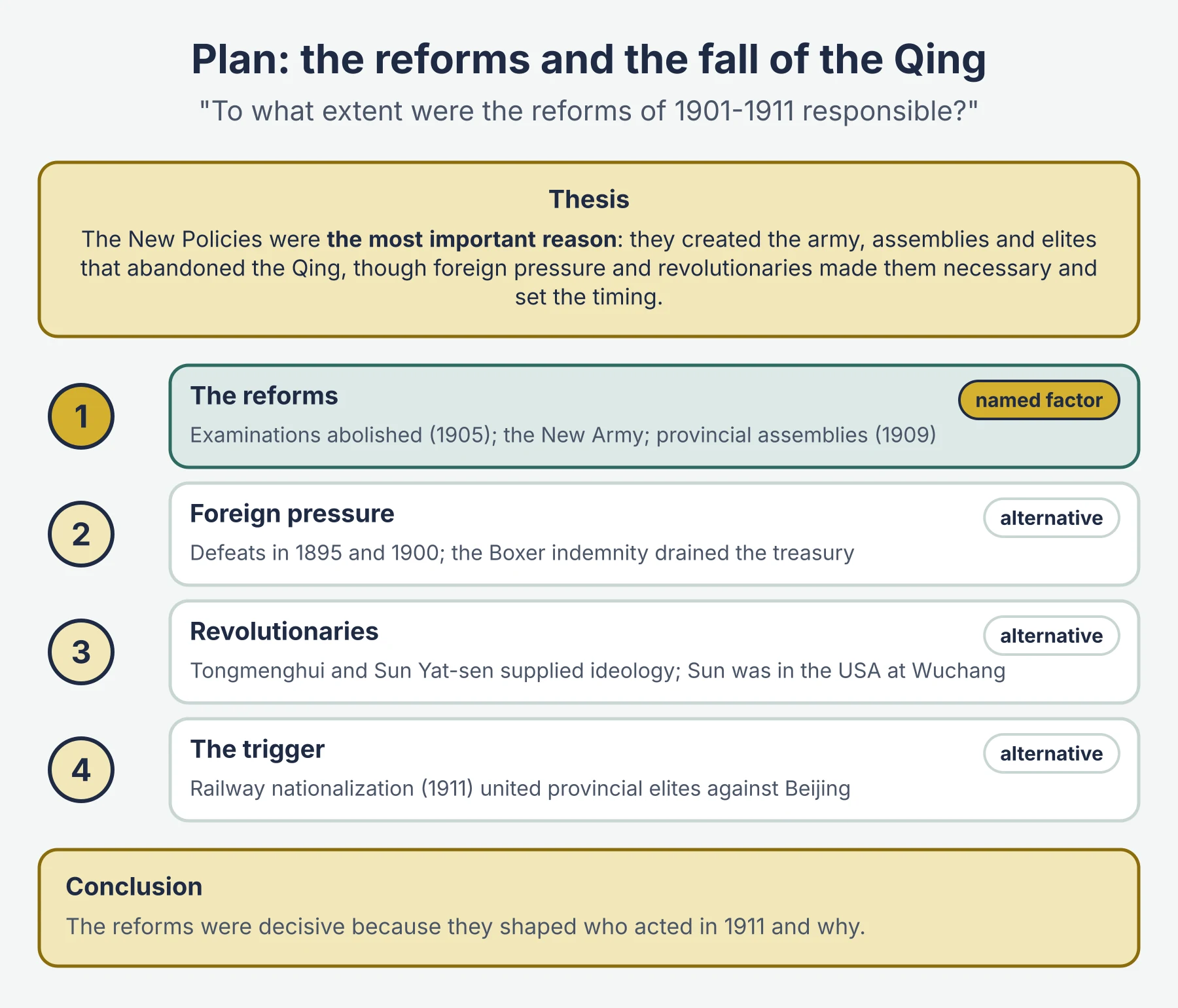
Question: “To what extent were the reforms of 1901-1911 responsible for the fall of the Qing dynasty?”
- Thesis: “The New Policies were the most important reason for the dynasty’s fall, because they created the army, provincial assemblies and educated elites that abandoned the Qing in 1911, although foreign pressure and revolutionary organization made those reforms necessary and gave the collapse its timing.”
- Paragraph 1: the reforms. Abolition of the examinations (1905) cut the link between the gentry and the throne; the New Army spread revolutionary ideas among officers; provincial assemblies (1909) gave elites a political base.
- Paragraph 2: foreign pressure. Defeats in 1895 and 1900 and the Boxer indemnity drained the treasury and destroyed legitimacy.
- Paragraph 3: revolutionaries. The Tongmenghui and Sun Yat-sen supplied ideology, but Sun was in the USA when the Wuchang uprising began.
- Paragraph 4: the trigger. The railway nationalization policy (1911) united provincial elites against Beijing.
- Conclusion: the reforms were decisive because they shaped who acted in 1911 and why.
Annotation: the plan answers the “to what extent” by weighing the named factor against three others, uses precise dates, and keeps a clear line of argument.
Common mistakes
- Treating “Asia” as China and Japan only. Sections may cover South-East Asia, South Asia and Oceania.
- Narrating the Opium Wars when the question asks about the dynasty’s fall in 1911.
- Seeing Japanese militarism as a single decision. Show the chain of events and the constitutional context.
- Assuming Deng’s reforms included political freedom. Separate economic and political change.
- Unsupported figures, especially for famines and massacres; describe the scale if you are not certain of a figure.
Exam technique
Allow about 50 minutes for each 15-mark essay, as set out in the HL options study guide. In this region:
- “Evaluate the reasons for…” usually requires weighing internal against external factors.
- “To what extent did X transform…” needs change and continuity.
- “Discuss the impact of…” asks for political, economic and social effects, with a judgement on which mattered most.
- “Compare and contrast…” may pair two countries or two periods in the same country.
Use with the other pages
Revise the chronologies with the History of Asia and Oceania revision notes and practise with the History of Asia and Oceania practice questions.
Check your understanding
- What did the Treaty of Nanjing (1842) give Britain? Hong Kong, the opening of five treaty ports and an indemnity.
- Who ended the Hundred Days’ Reform? The Empress Dowager Cixi, by a coup in 1898.
- Where did the uprising of 10 October 1911 begin? Wuchang.
- What two laws of 1925 show the limits of Taishō democracy? Universal male suffrage alongside the Peace Preservation Law.
- What happened on 18 September 1931? The Mukden Incident, used by the Kwantung Army to seize Manchuria.
- What was the household responsibility system? A reform letting farming households decide what to produce and sell surplus after meeting quotas.
Related resources
-
Practice questions
IB DP History (DP History): History of Asia and Oceania – Practice Questions
Twelve original HL Paper 3-style practice questions on the History of Asia and Oceania, from short recall to full 15-mark essays, with mark-scheme answers.
World History · International Baccalaureate · IB
Try questions -
Revision notes
IB DP History (DP History): History of Asia and Oceania – Revision Notes
Condensed HL notes for Asia and Oceania: late Qing decline and 1911, Japan's road to war 1912-41 and China under Deng, with key terms and a self-test.
World History · International Baccalaureate · IB
Revise topic -
Study guides
IB DP History (DP History): History of Europe
The HL History of Europe option for Paper 3: the French Revolution and Napoleon, Italian and German unification and Eastern Europe after 1945.
World History · International Baccalaureate · IB
Read guide
Get free revision emails (optional)
Occasional emails with practice questions, worked explanations and links to free resources for the qualification and subjects you choose. No spam, and you can unsubscribe from any email. The free tools on this site never need an email.