
Study Guides
IB DP History (DP History): History of Europe
The HL History of Europe option for Paper 3: the French Revolution and Napoleon, Italian and German unification and Eastern Europe after 1945.
- Subject
- World History
- Level
- IB
- Topic
- Topic 3: HL options: Depth studies
- Author
- Marlbridge Academic Team
- Updated
- Reviewed by
- Azam Siddique (what this means)
Aligned to International Baccalaureate IB Diploma Programme History (DP History), First assessment 2017. Official specification .
Syllabus page (what it covers and how it is assessed): IB Diploma Programme History.
Syllabus points this page covers
DP History
- 4 History of Europe
Found an error? Report a correction.
Need help with this topic? Request a free trial class for IB Diploma Programme History (DP History / DP History (2028)).
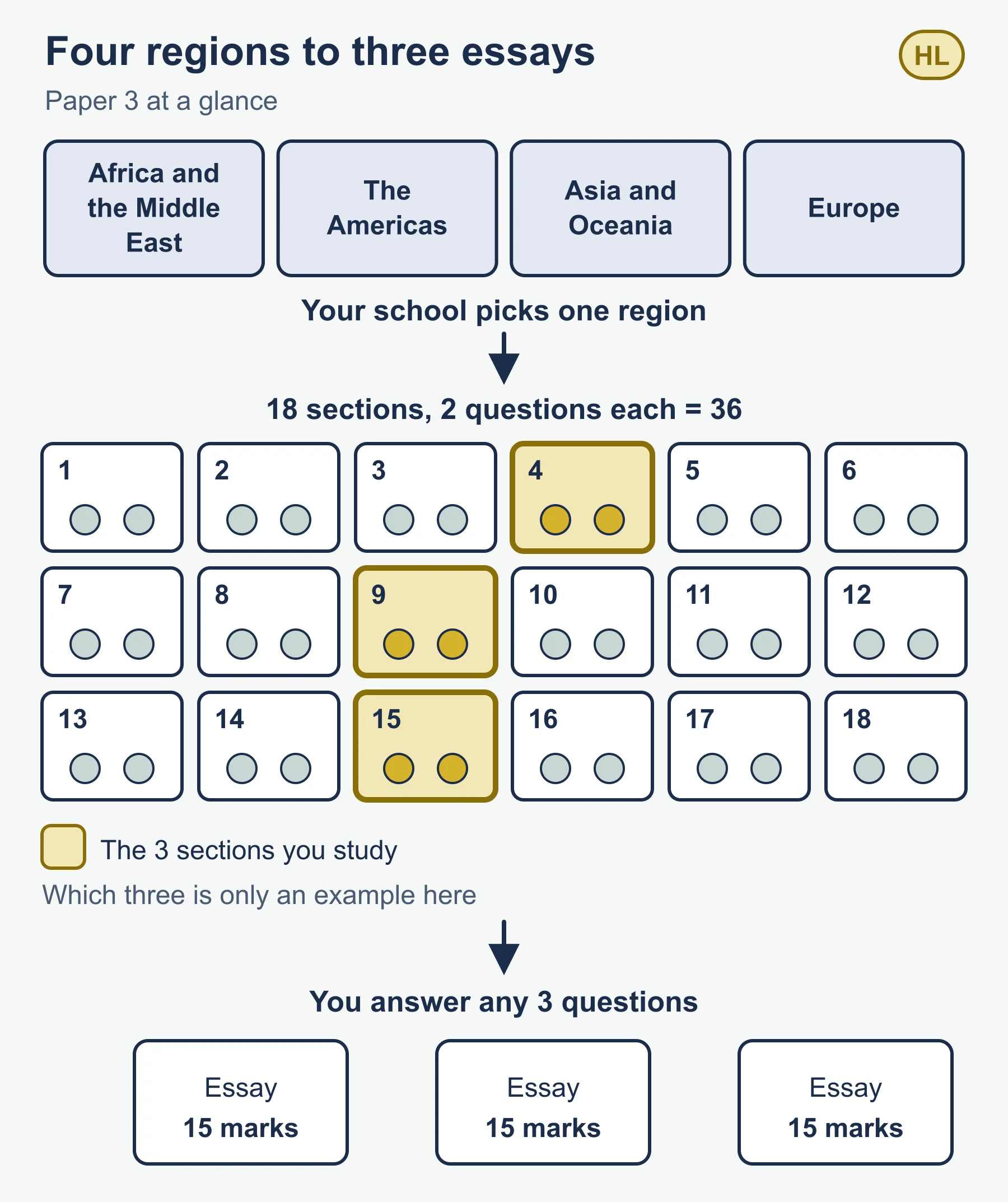
The History of Europe is the HL regional option covering the continent from the medieval period to the end of the twentieth century, including Russia and the Soviet Union. Your school chooses three of its eighteen sections, and Paper 3 asks you to write three essays on them in 2 hours 30 minutes. This guide works through three content areas taught in many schools, with the chronology, analysis and debate that depth demands. Your teacher’s list of the guide’s section titles and dates sets what you must know.
What the option covers
Widely taught modern content areas include:
- the French Revolution and Napoleon;
- France and the European states in the nineteenth century, including the revolutions of 1848;
- the unification of Italy and of Germany;
- imperial Russia, the revolutions of 1917 and the Soviet state;
- Europe and the First World War;
- the inter-war states and diplomacy;
- the Soviet Union after 1924;
- post-war Western Europe and post-war Central and Eastern Europe.
Questions are often tied to one country and to a date range, so organize your notes by section and period.
Content area 1: the French Revolution and Napoleon
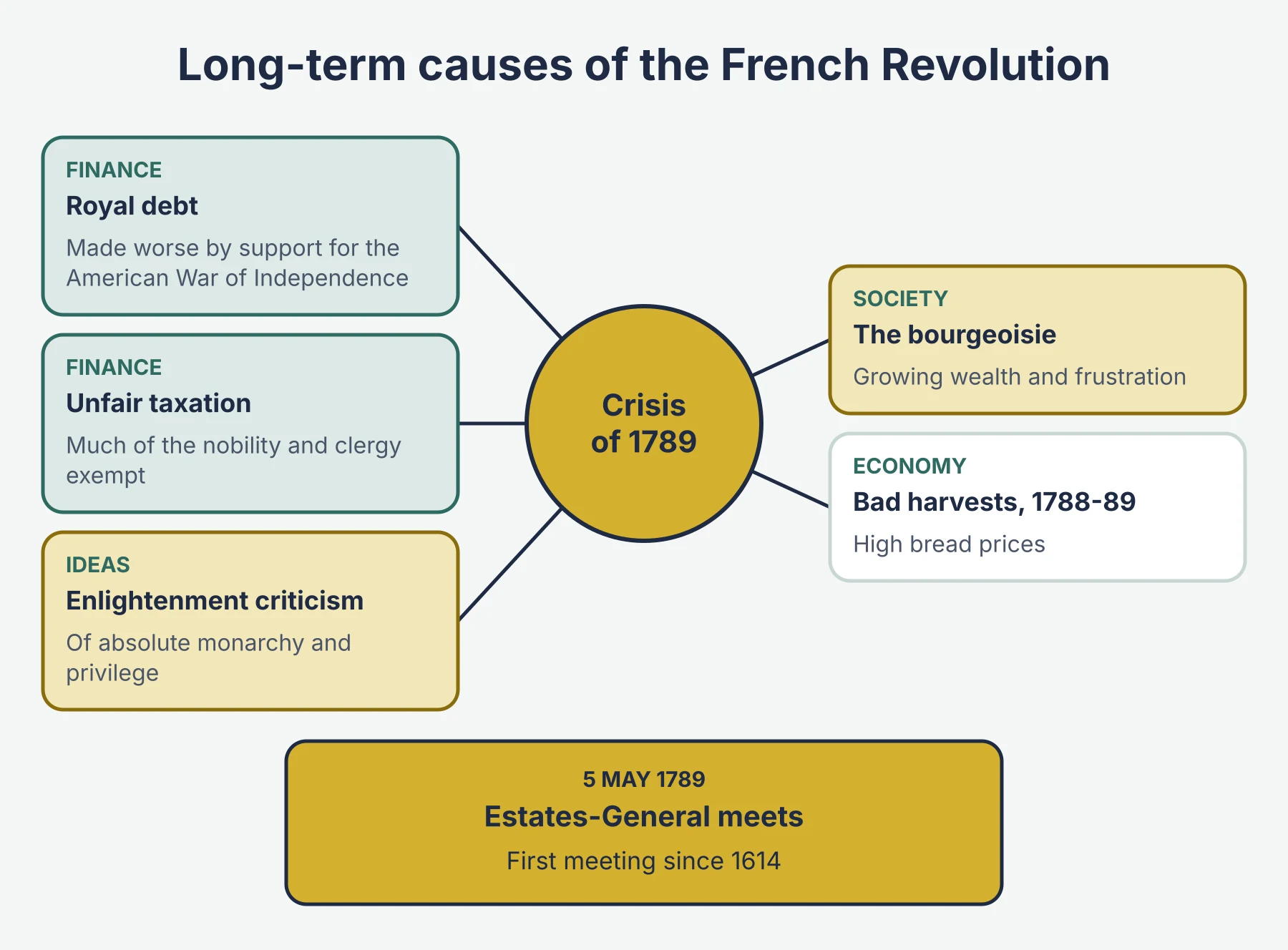
Long-term causes. Royal debt, made worse by French support for the American War of Independence; a tax system that exempted much of the nobility and clergy; Enlightenment criticism of absolute monarchy and privilege; the growing wealth and frustration of the bourgeoisie; bad harvests and high bread prices in 1788-89.
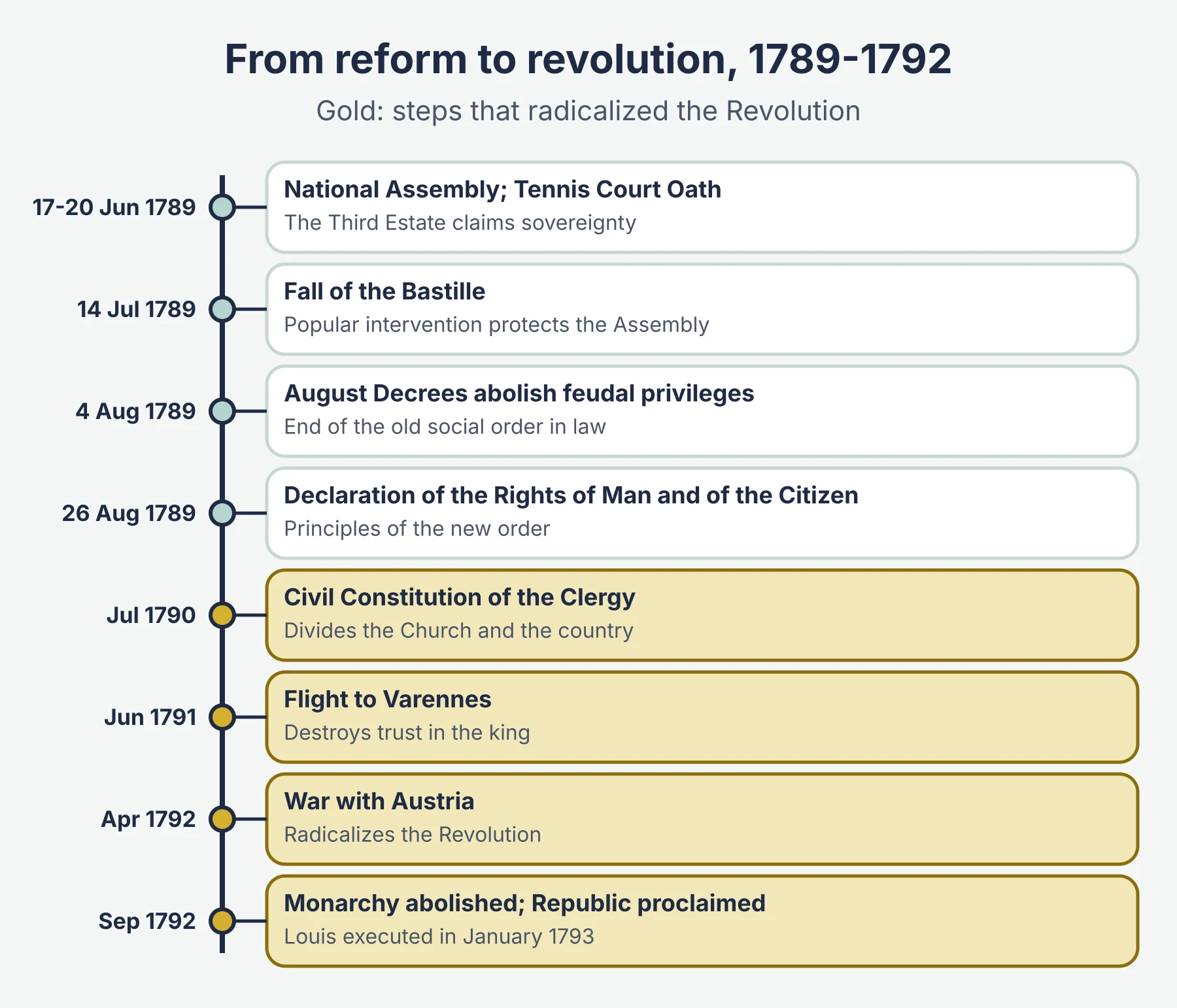
From reform to revolution, 1789-1792.
| Date | Event | Significance |
|---|---|---|
| 5 May 1789 | Estates-General meets | First meeting since 1614 |
| 17 and 20 June 1789 | Third Estate declares itself the National Assembly; Tennis Court Oath | Claim to sovereignty |
| 14 July 1789 | Fall of the Bastille | Popular intervention protects the Assembly |
| 4 August 1789 | August Decrees abolish feudal privileges | End of the old social order in law |
| 26 August 1789 | Declaration of the Rights of Man and of the Citizen | Principles of the new order |
| July 1790 | Civil Constitution of the Clergy | Divides the Church and the country |
| June 1791 | Flight to Varennes | Destroys trust in the king |
| April 1792 | War with Austria | Radicalizes the Revolution |
| September 1792 | Monarchy abolished; Republic proclaimed | Louis executed in January 1793 |
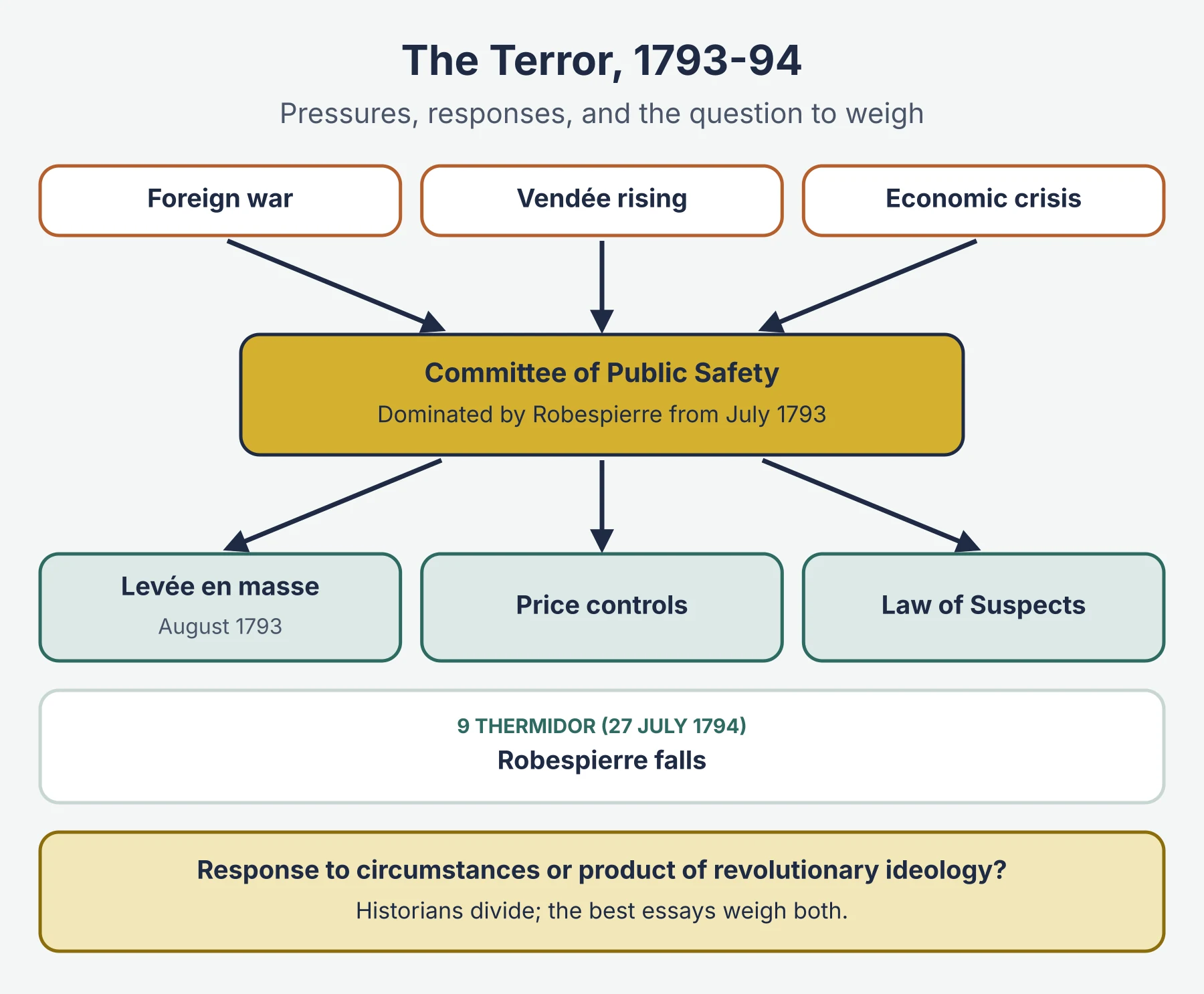
The Terror (1793-94). The Committee of Public Safety, dominated by Robespierre from July 1793, faced foreign war, the Vendée rising and economic crisis. Its responses included the levée en masse (August 1793), price controls and the Law of Suspects. Robespierre fell on 9 Thermidor (27 July 1794). Evaluate whether the Terror was a response to circumstances or a product of revolutionary ideology; historians divide on this, and the best essays weigh both.
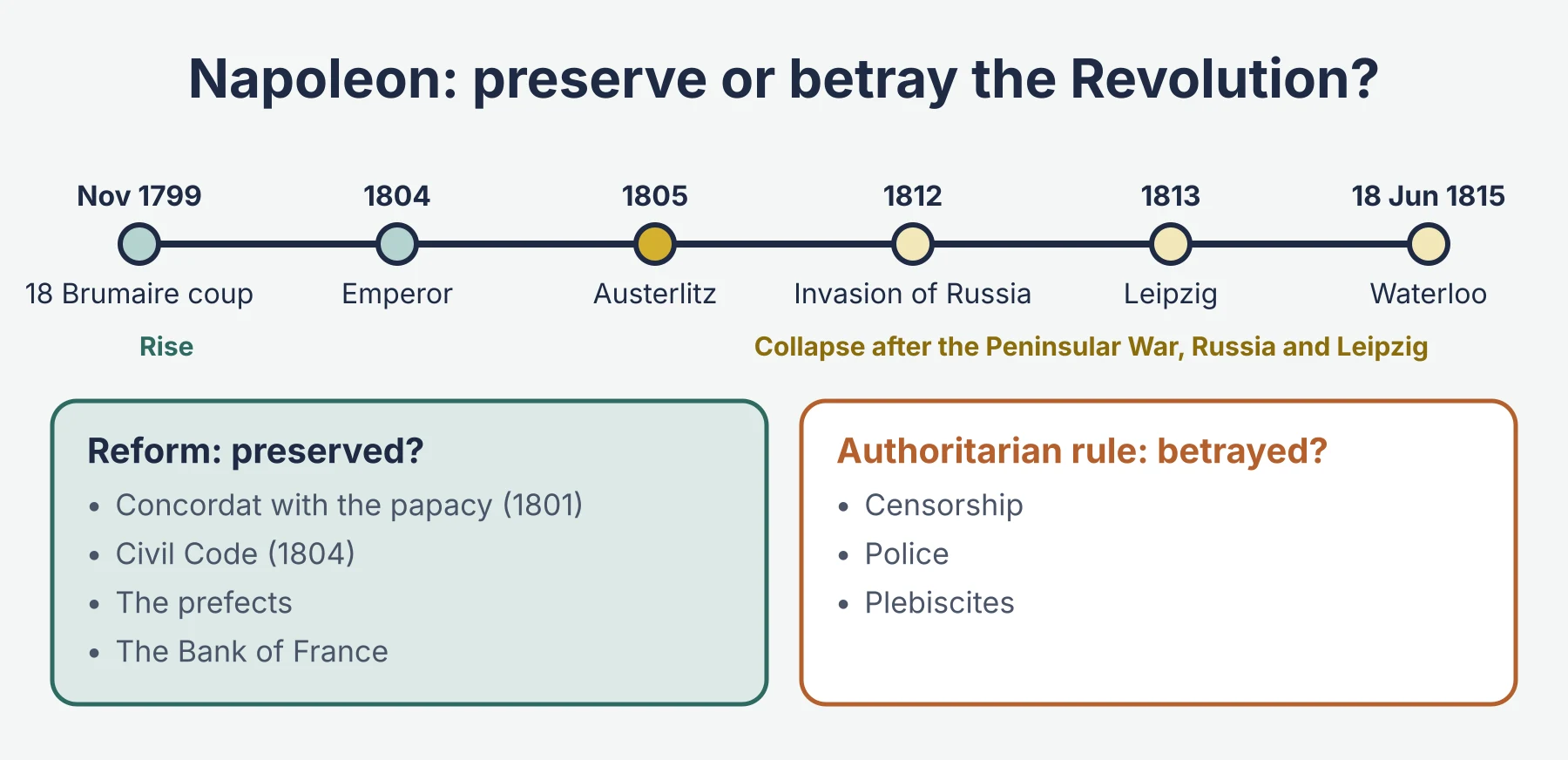
Napoleon. His coup of 18 Brumaire (November 1799) ended the Directory. As First Consul and, from 1804, emperor, he combined reform (the Concordat with the papacy, 1801; the Civil Code, 1804; the prefects; the Bank of France) with authoritarian rule (censorship, police, plebiscites). His empire rested on military success (Austerlitz, 1805) and collapsed after the Peninsular War, the invasion of Russia (1812) and defeat at Leipzig (1813). Waterloo (18 June 1815) ended the Hundred Days. Typical question: did Napoleon preserve or betray the Revolution?
Content area 2: Italian and German unification
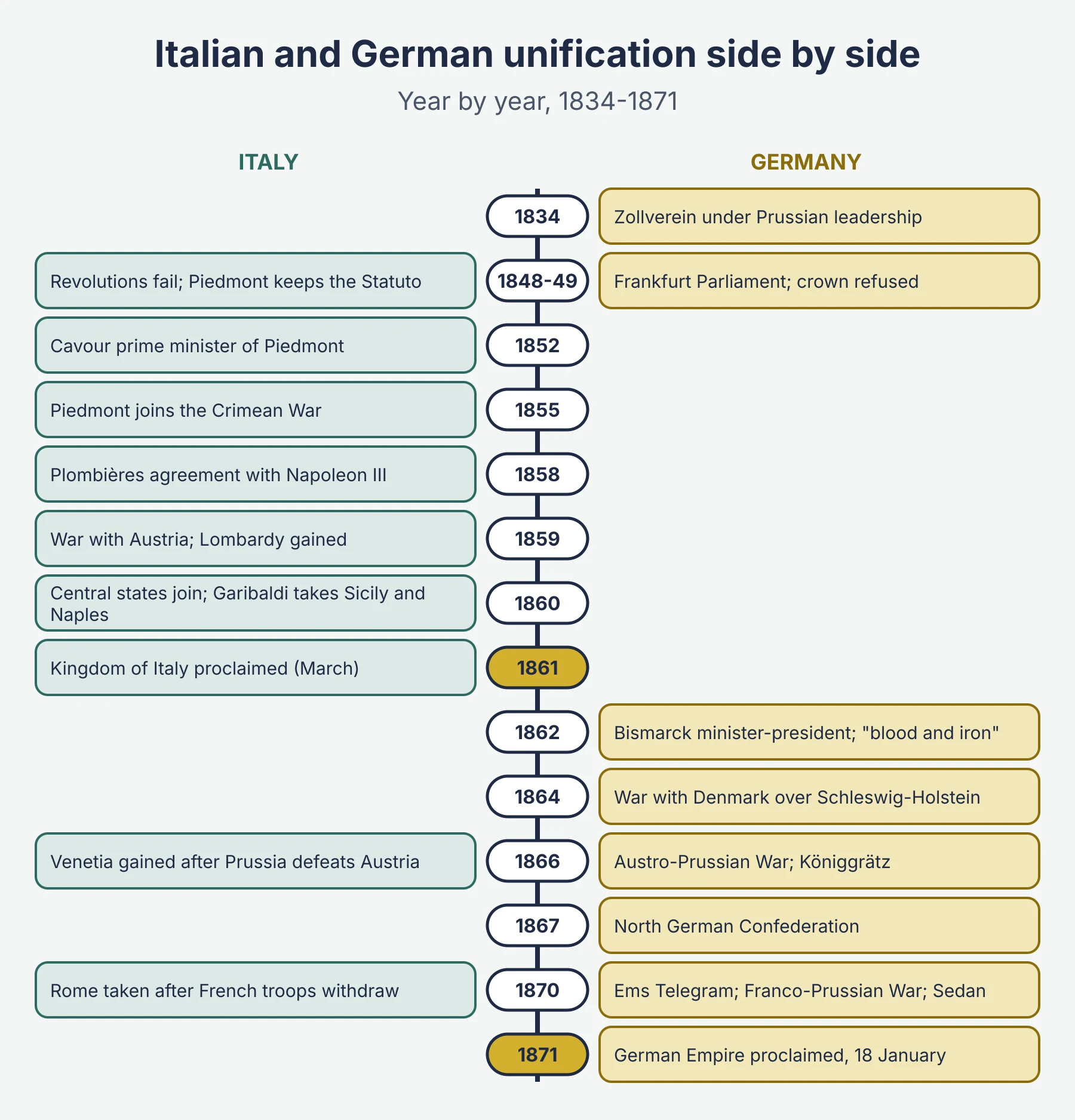
Italy.
- 1848-49: revolutions fail; Piedmont keeps its constitution (the Statuto).
- 1852: Cavour becomes prime minister of Piedmont; economic modernization.
- 1855: Piedmont joins the Crimean War, gaining a seat at the peace conference.
- 1858: Plombières agreement with Napoleon III.
- 1859: war with Austria; victories at Magenta and Solferino; Lombardy gained.
- 1860: central Italian states vote to join Piedmont; Nice and Savoy go to France; Garibaldi’s Thousand conquer Sicily and Naples.
- March 1861: Kingdom of Italy proclaimed.
- 1866: Venetia gained after Prussia defeats Austria.
- 1870: Rome taken after French troops withdraw.
Germany.
- 1834: Zollverein under Prussian leadership.
- 1848-49: Frankfurt Parliament; Frederick William IV refuses the crown “from the gutter”.
- 1862: Bismarck becomes minister-president; “blood and iron” speech.
- 1864: war with Denmark over Schleswig-Holstein.
- 1866: Austro-Prussian War; Königgrätz; North German Confederation (1867).
- July 1870: Ems Telegram; Franco-Prussian War; Sedan (September).
- 18 January 1871: German Empire proclaimed at Versailles.
Debate. Was unification planned by Cavour and Bismarck, or did they exploit circumstances? For Italy, Garibaldi’s independent campaign and French interests suggest improvisation. For Germany, Prussia’s economic strength and Austria’s isolation after the Crimean War mattered as much as Bismarck’s diplomacy. A strong essay weighs leadership against economic, international and nationalist forces.
Content area 3: Central and Eastern Europe, 1945-1991
- Soviet control (1945-48): communist parties took power through coalitions, pressure and purges; the Czech coup of February 1948 completed the process; Tito’s Yugoslavia broke with Moscow (1948).
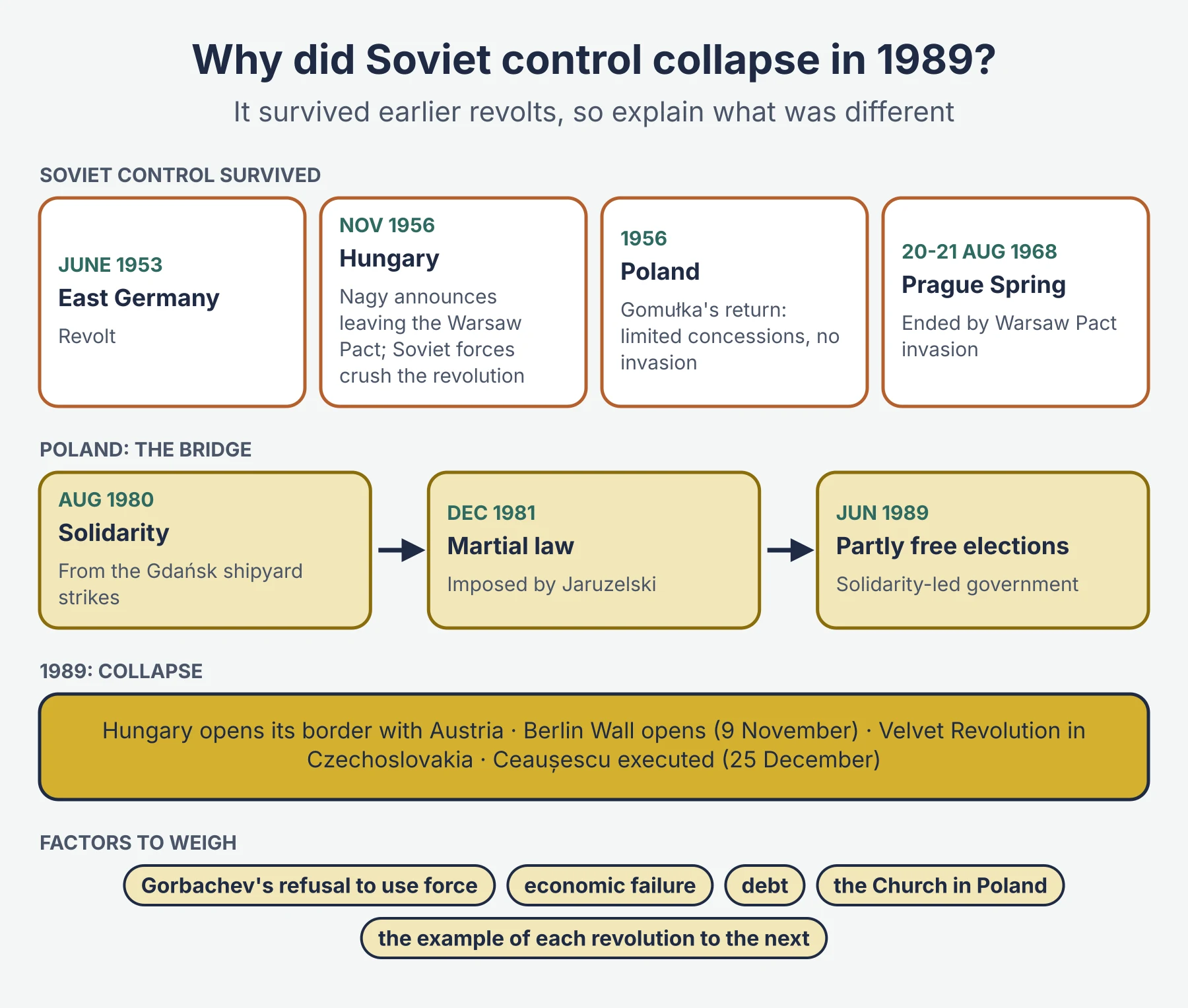
- Revolts: East Germany (June 1953); Poland and Hungary (1956). In Hungary, Imre Nagy announced withdrawal from the Warsaw Pact, and Soviet forces crushed the revolution in November; Nagy was executed in 1958. In Poland, Gomułka’s return allowed limited concessions without invasion.
- Prague Spring (1968): Dubček’s “socialism with a human face” ended with the Warsaw Pact invasion of 20-21 August 1968.
- Poland: Solidarity, led by Lech Wałęsa, emerged from the Gdańsk shipyard strikes (August 1980); Jaruzelski imposed martial law (December 1981); Round Table talks and partly free elections (June 1989) produced a Solidarity-led government.
- 1989: Hungary opened its border with Austria; the Berlin Wall opened (9 November); Czechoslovakia’s Velvet Revolution; Ceaușescu executed in Romania (25 December).
Key judgement: why did Soviet control survive in 1956 and 1968 but collapse in 1989? Gorbachev’s refusal to use force is central, but economic failure, debt, the Church in Poland and the example of each revolution to the next all matter.
Worked example: a model introduction
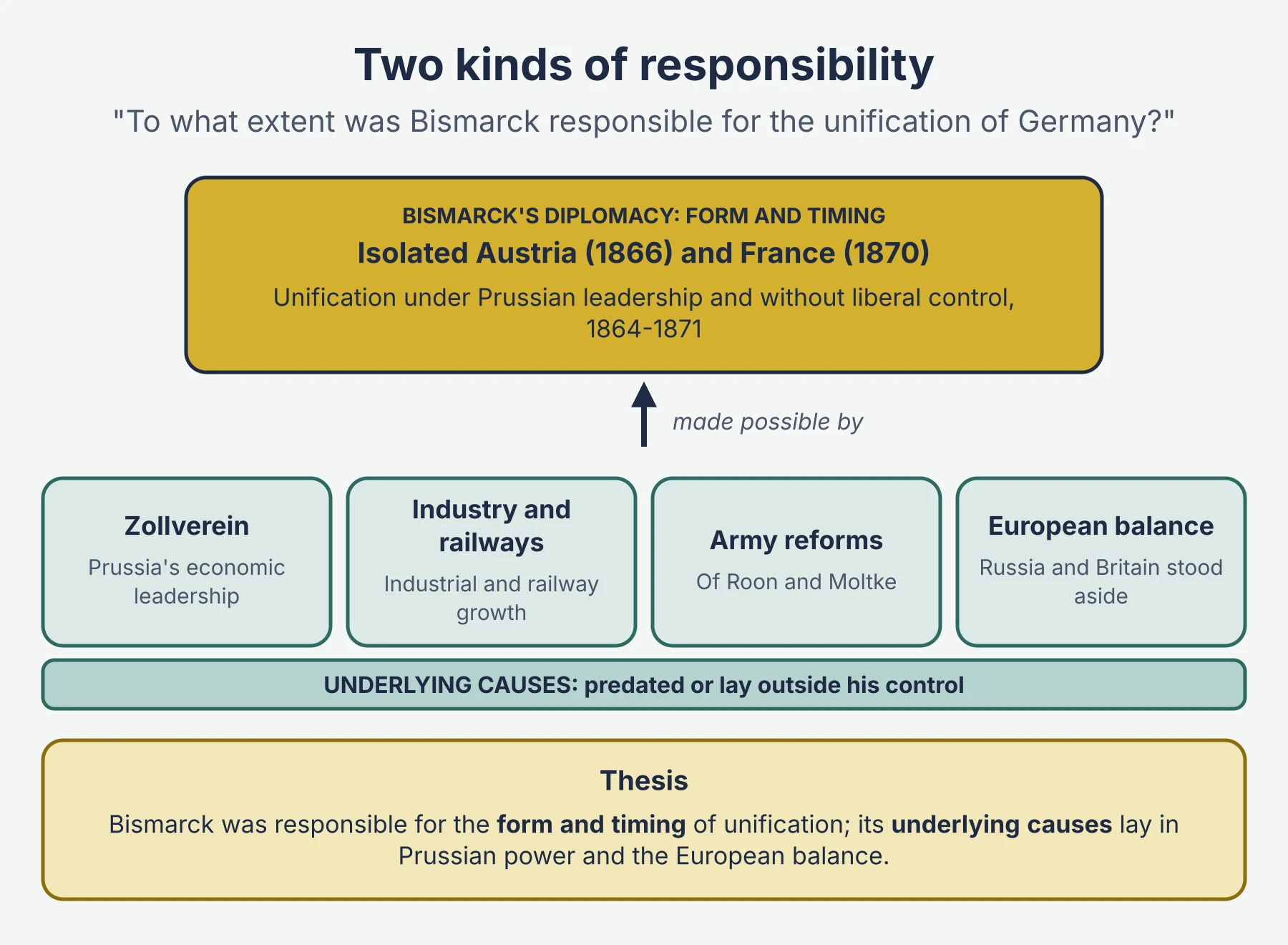
Question: “To what extent was Bismarck responsible for the unification of Germany?”
“Bismarck’s diplomacy determined how and when Germany was unified between 1864 and 1871: he isolated Austria in 1866 and France in 1870, and ensured that unification came under Prussian leadership and without liberal control. Yet he did not create the conditions that made unification possible. Prussia’s economic leadership through the Zollverein, its industrial and railway growth, the army reforms of Roon and Moltke, and an international situation in which Russia and Britain stood aside all predated or lay outside his control. This essay argues that Bismarck was responsible for the form and timing of unification, but that its underlying causes lay in Prussian power and the European balance.”
Why it works: the thesis distinguishes kinds of responsibility, lists the alternative factors the body will weigh, and sets precise dates for the argument.
Common mistakes
- Narrating 1789 to 1815. Select the events that answer the question.
- Treating Italian and German unification as identical. Compare where asked, but note the differences in leadership, popular involvement and foreign help.
- Explaining 1989 only through Gorbachev. Include internal movements and economic failure.
- Ignoring the section’s dates. A question on 1789-1795 does not reward Napoleon’s reforms.
- Historiography without accuracy. Describe positions you cannot attribute precisely rather than guess at names.
Exam technique
Allow about 50 minutes per 15-mark essay, as the HL options study guide explains. In this region, expect:
- “To what extent was [leader] responsible for…”: weigh the individual against structural factors.
- “Evaluate the domestic policies of…”: set criteria and judge against aims.
- “Discuss the reasons for…”: rank long- and short-term causes.
- “Compare and contrast…”: two countries or two periods, theme by theme.
Use with the other pages
Revise the chronologies in the History of Europe revision notes and write essays from the History of Europe practice questions.
Check your understanding
- Why did the Estates-General meet in 1789? Because the monarchy was bankrupt and needed agreement to new taxes.
- What did the August Decrees of 1789 do? Abolished feudal privileges.
- When did Robespierre fall? 9 Thermidor, 27 July 1794.
- Name two of Napoleon’s lasting domestic reforms. Any two: the Civil Code, the Concordat, the prefects, the Bank of France.
- Where was the German Empire proclaimed, and when? The Hall of Mirrors at Versailles, 18 January 1871.
- How did the outcome in Poland in 1956 differ from that in Hungary? Poland gained limited concessions under Gomułka without invasion; Hungary was invaded.
Related resources
-
Practice questions
IB DP History (DP History): History of Europe – Practice Questions
Twelve original HL Paper 3-style practice questions on the History of Europe, from short recall to full 15-mark essays, with mark-scheme answers.
World History · International Baccalaureate · IB
Try questions -
Revision notes
IB DP History (DP History): History of Europe – Revision Notes
Condensed HL notes for the History of Europe: the French Revolution and Napoleon, Italian and German unification, Eastern Europe 1945-91, with a self-test.
World History · International Baccalaureate · IB
Revise topic -
Practice questions
IB DP History (DP History): HL options: Depth studies – Practice Questions
Original IB DP History HL Paper 3-style essays for all four regional options, with indicative content, markbands and a timed three-essay practice plan.
World History · International Baccalaureate · IB
Try questions
Get free revision emails (optional)
Occasional emails with practice questions, worked explanations and links to free resources for the qualification and subjects you choose. No spam, and you can unsubscribe from any email. The free tools on this site never need an email.