
Revision Notes
IB DP History (DP History): History of Europe – Revision Notes
Condensed HL notes for the History of Europe: the French Revolution and Napoleon, Italian and German unification, Eastern Europe 1945-91, with a self-test.
- Subject
- World History
- Level
- IB
- Topic
- Topic 3: HL options: Depth studies
- Author
- Marlbridge Academic Team
- Updated
- Reviewed by
- Azam Siddique (what this means)
Aligned to International Baccalaureate IB Diploma Programme History (DP History), First assessment 2017. Official specification .
Syllabus page (what it covers and how it is assessed): IB Diploma Programme History.
Syllabus points this page covers
DP History
- 4 History of Europe
Found an error? Report a correction.
Need help with this topic? Request a free trial class for IB Diploma Programme History (DP History / DP History (2028)).
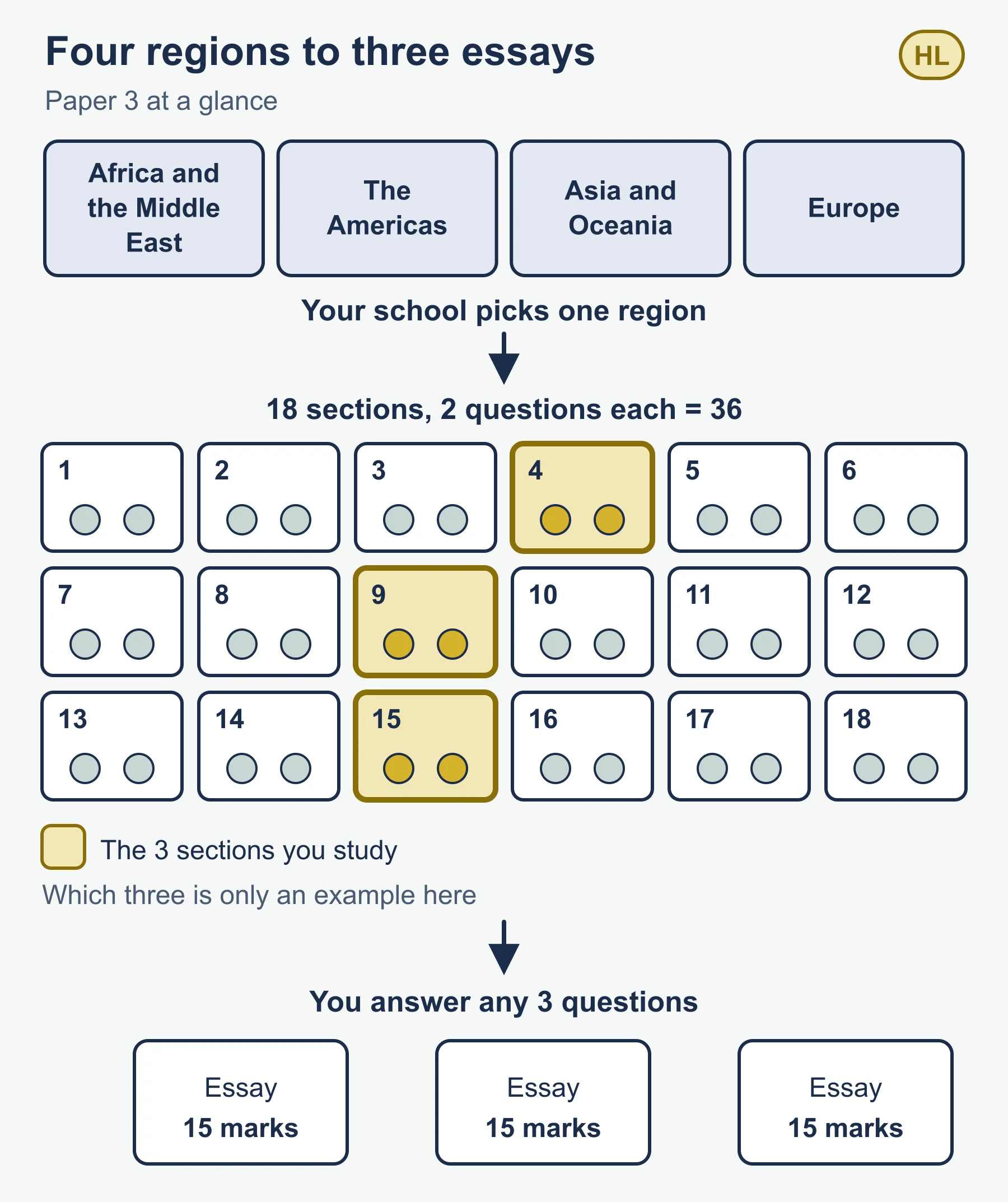
These notes condense three widely taught content areas from the HL History of Europe option for Paper 3. Read the History of Europe study guide for the arguments, and use the History of Europe practice questions to apply them. Revise against your school’s three sections.
Paper 3 essentials
Three essays from 36 questions in 2 hours 30 minutes; 15 marks each; about 50 minutes per essay, with five minutes of planning.
The French Revolution and Napoleon, 1774-1815
Chronology
- 1774: Louis XVI becomes king.
- 1778-83: French support for the American War of Independence deepens royal debt.
- 1787: Assembly of Notables rejects tax reform.
- 5 May 1789: Estates-General.
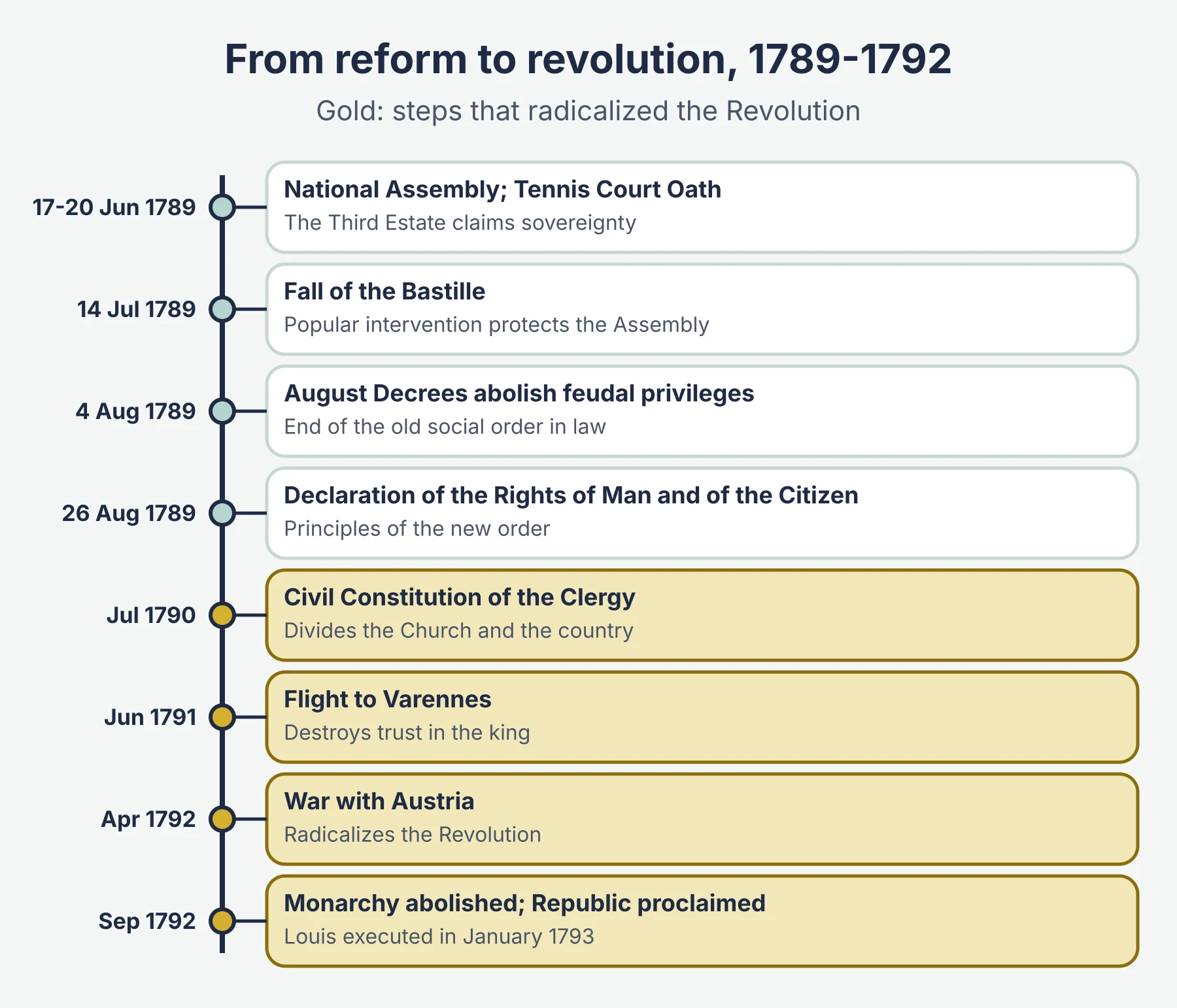
- June 1789: National Assembly; Tennis Court Oath.
- 14 July 1789: Bastille.
- August 1789: August Decrees; Declaration of the Rights of Man.
- October 1789: women’s march to Versailles; royal family brought to Paris.
- July 1790: Civil Constitution of the Clergy.
- June 1791: Flight to Varennes.
- April 1792: war with Austria.
- 10 August 1792: Tuileries stormed; September massacres.
- 21 January 1793: Louis XVI executed.
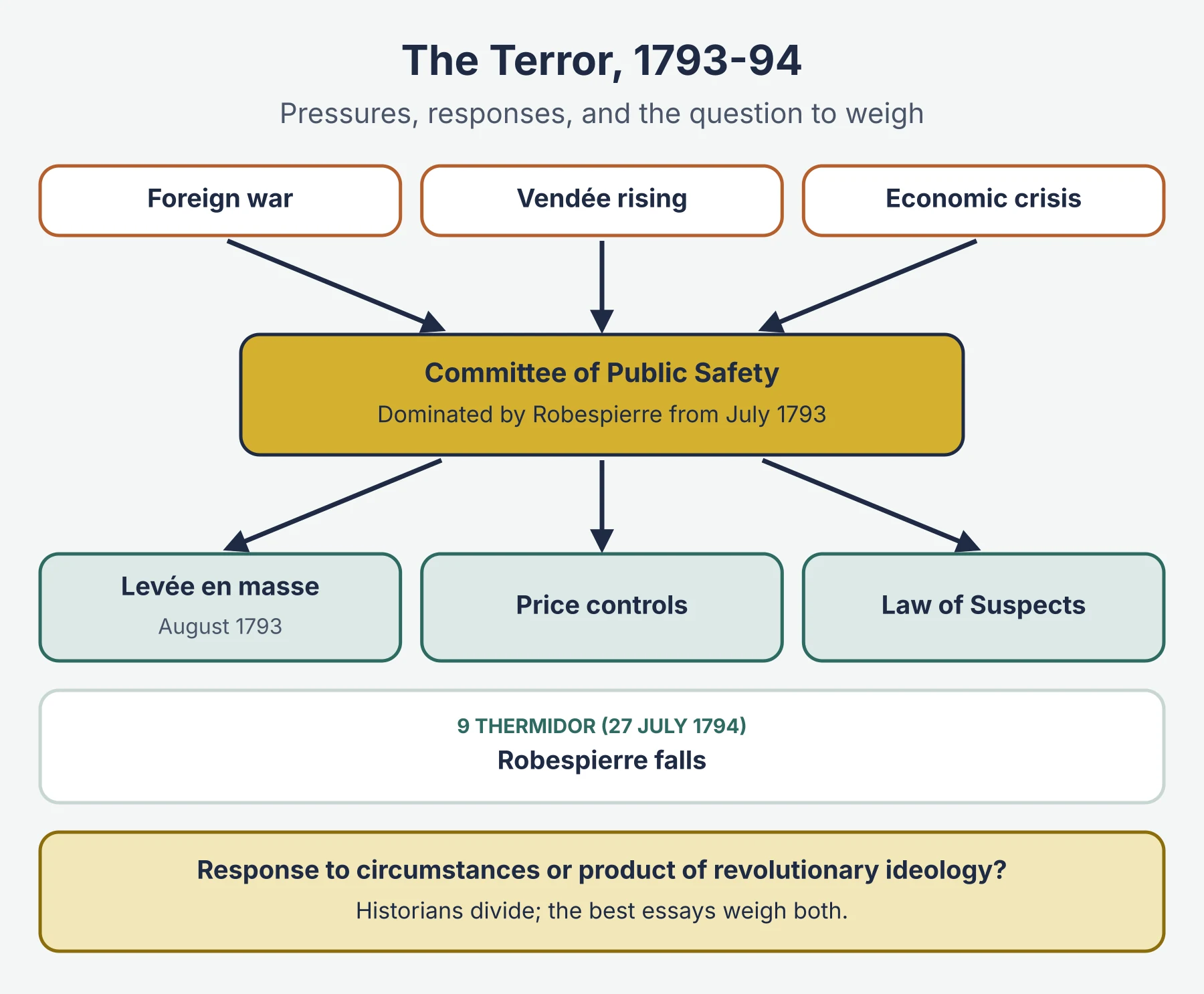
- March 1793: Vendée rising.
- 1793-94: the Terror; Committee of Public Safety; Law of Suspects.
- 27 July 1794: fall of Robespierre (9 Thermidor).
- 1795-99: the Directory.
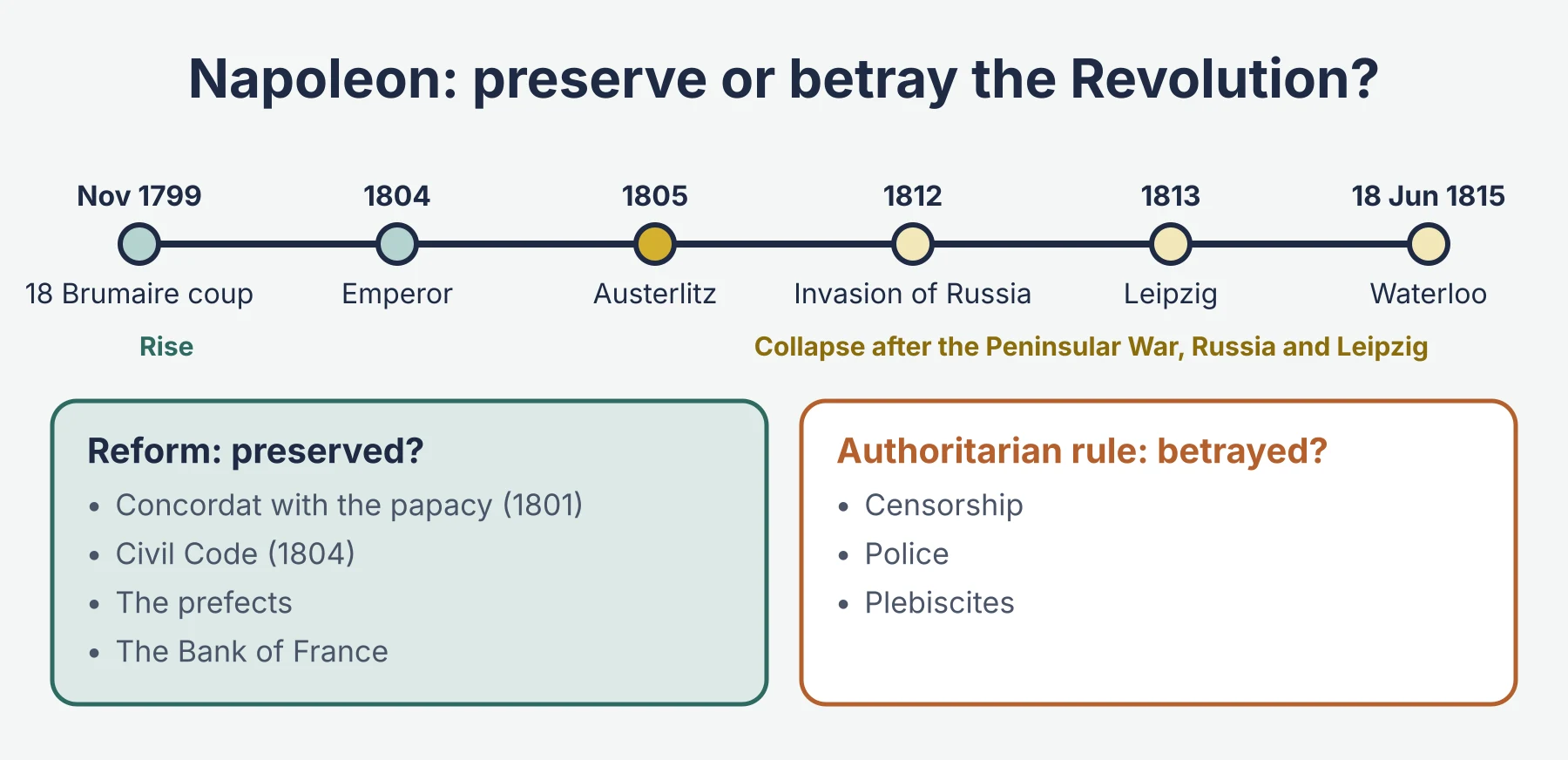
- November 1799: Brumaire coup; the Consulate.
- 1801: Concordat; 1804: Civil Code; December 1804: Napoleon crowned emperor.
- 1805: Austerlitz; 1806: Continental System.
- 1808-14: Peninsular War; 1812: invasion of Russia; 1813: Leipzig.
- April 1814: first abdication; 18 June 1815: Waterloo.
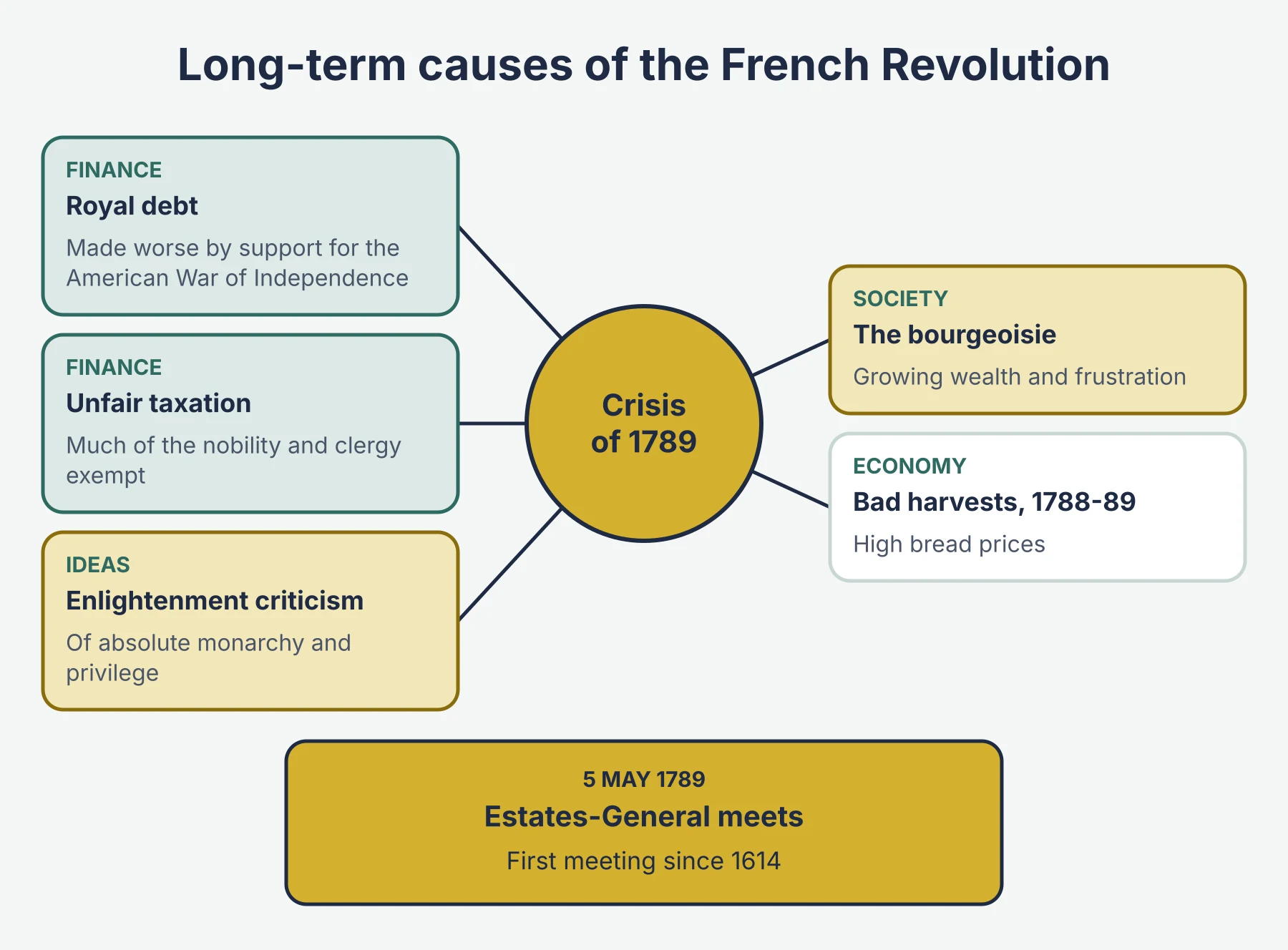
Causes of the Revolution, sorted
| Type | Factors |
|---|---|
| Financial | Debt; failed reform attempts by Calonne and others; tax exemptions |
| Social | Privileges of nobility and clergy; ambitions of the bourgeoisie; peasant burdens |
| Intellectual | Enlightenment ideas of rights, sovereignty and reason |
| Economic | Poor harvest of 1788; bread prices; unemployment |
| Political | Weak leadership of Louis XVI; the deadlock over voting in the Estates-General |
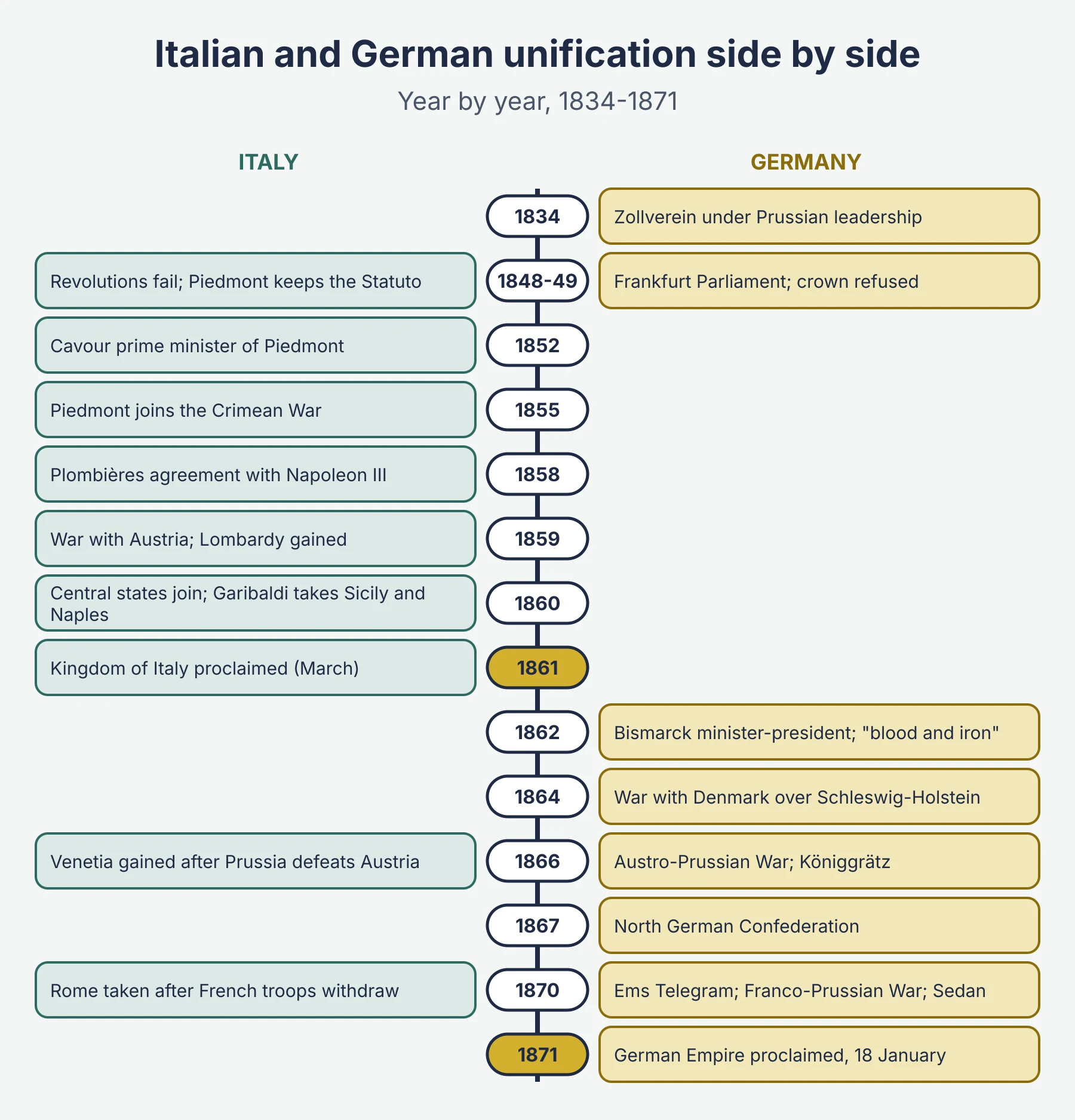
Italian and German unification
| Step | Italy | Germany |
|---|---|---|
| Economic base | Piedmont’s railways and trade under Cavour | Zollverein (1834); industrial and railway growth |
| Failed revolution | 1848-49 revolutions | Frankfurt Parliament (1848-49) |
| Leader | Cavour (prime minister from 1852) | Bismarck (minister-president from 1862) |
| Foreign help or neutrality | France in 1859; Prussia in 1866; French withdrawal from Rome in 1870 | Russian neutrality; French isolation in 1870 |
| Wars | 1859 against Austria; Garibaldi’s campaign (1860) | 1864 Denmark; 1866 Austria; 1870-71 France |
| Outcome | Kingdom of Italy (March 1861); Venetia (1866); Rome (1870) | German Empire (18 January 1871) |
| Popular involvement | Garibaldi’s volunteers; plebiscites | Limited; unification from above |
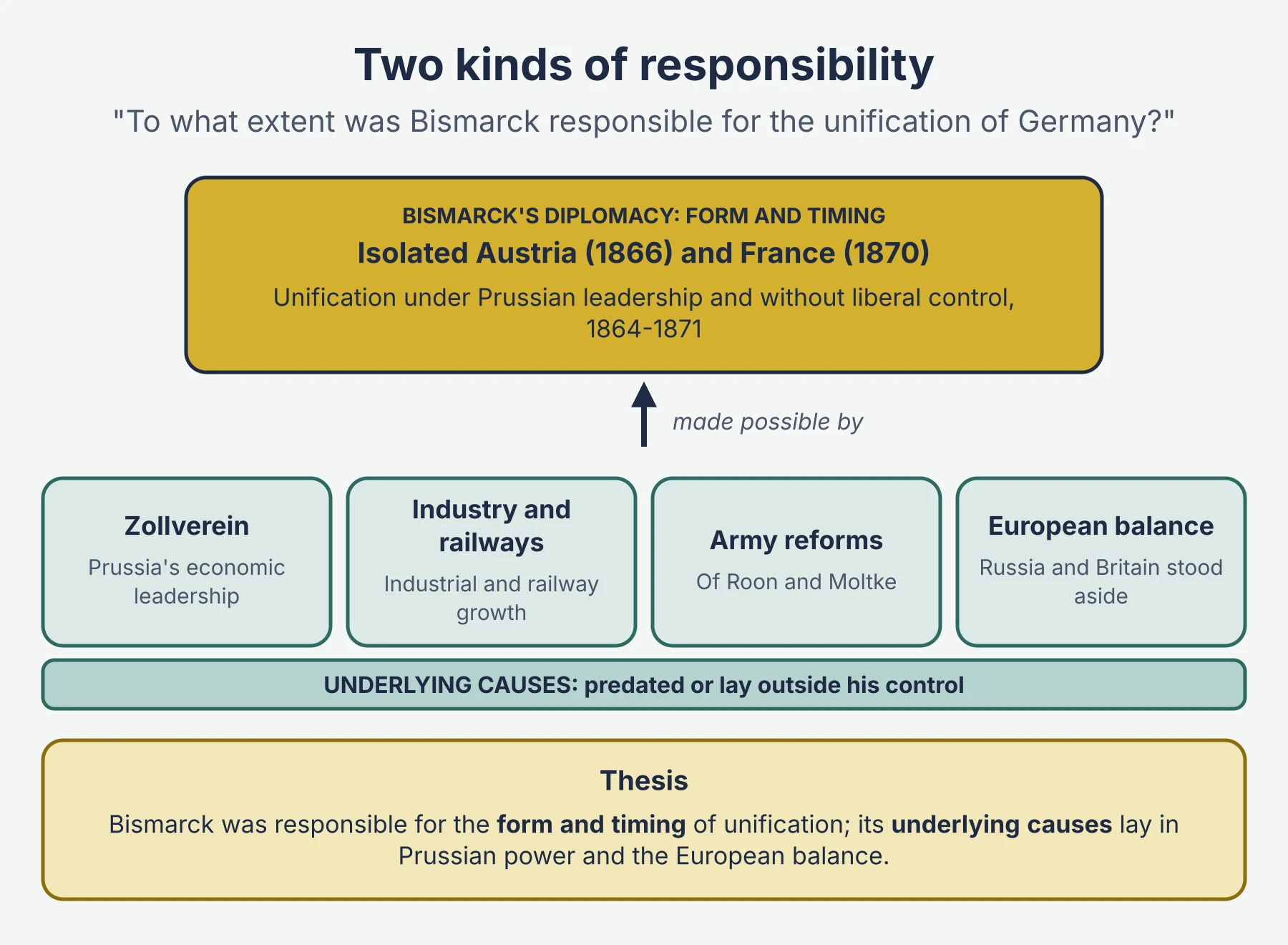
Key people: Mazzini (republican nationalist), Garibaldi, Cavour, Victor Emmanuel II, Napoleon III; Bismarck, William I, Roon, Moltke.
Central and Eastern Europe, 1945-1991
- 1945-48: communist takeovers; “salami tactics”.
- February 1948: Czech coup.
- 1948: Tito’s split with Stalin.
- 1949: Comecon founded.
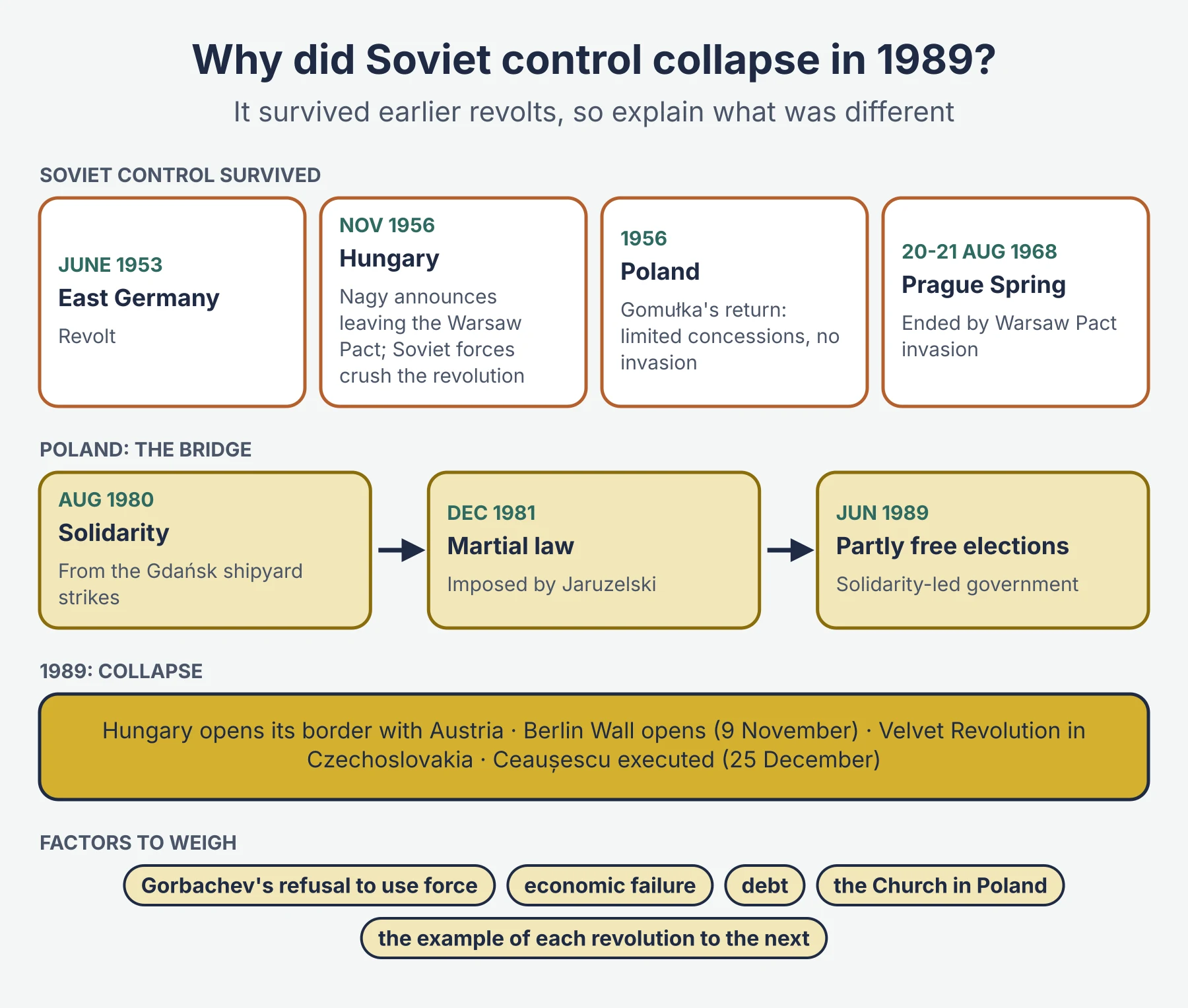
- June 1953: East German uprising.
- 1955: Warsaw Pact.
- 1956: Polish October (Gomułka); Hungarian revolution crushed (November).
- 1961: Berlin Wall.
- 1968: Prague Spring; invasion 20-21 August; Brezhnev Doctrine.
- 1975: Helsinki Final Act; human rights groups such as Charter 77 (1977) in Czechoslovakia.
- 1978: a Polish pope, John Paul II; visit to Poland 1979.
- August 1980: Solidarity founded.
- December 1981: martial law in Poland.
- 1985: Gorbachev in power.
- 1989: Polish Round Table and elections (June); Hungary opens the border; Berlin Wall opens (9 November); Velvet Revolution; Romanian revolution.
- 1990: German reunification (October).
- 1991: Comecon and the Warsaw Pact dissolved; Yugoslav wars begin; USSR dissolved (December).
Key terms
| Term | Meaning |
|---|---|
| Ancien régime | France’s social and political order before 1789 |
| Sans-culottes | Radical Parisian working people |
| Jacobins | Radical political club associated with Robespierre |
| Levée en masse | Mass conscription decreed in August 1793 |
| Risorgimento | The movement for Italian unification |
| Realpolitik | Politics based on power and practical interest rather than ideals |
| Salami tactics | Gradual removal of non-communist rivals in coalitions |
| Brezhnev Doctrine | Soviet claim to intervene to protect socialism in its bloc |
Exam traps
- French Revolution essays that stop in 1789 when the question runs to 1794 or 1799.
- Napoleon as purely a reformer or purely a tyrant. Show both and judge.
- Unification as the work of one man. Weigh leaders against economic and international factors.
- 1989 explained by one cause. Combine Gorbachev, economic failure, popular movements and the domino effect.
- Outside the section’s dates. Read the question’s date range twice.
Self-test
- Why did the Assembly of Notables matter in 1787? Its rejection of tax reform forced the king to call the Estates-General.
- What was the Tennis Court Oath? The National Assembly’s vow (20 June 1789) not to separate until France had a constitution.
- Why did the Flight to Varennes matter? It destroyed trust in the king and strengthened republicanism.
- What was the levée en masse? Mass conscription of the French population for war, decreed in August 1793.
- Name two of Napoleon’s lasting reforms. Any two: Civil Code, Concordat, prefects, Bank of France, lycées.
- What did Cavour gain from the Crimean War? A seat at the peace conference and French goodwill.
- What did Plombières (1858) agree? French help against Austria in return for Nice and Savoy.
- What were the three wars of German unification? Against Denmark (1864), Austria (1866) and France (1870-71).
- What was the Ems Telegram? Bismarck’s edited account of a meeting between William I and the French ambassador, published to provoke France.
- Why did Hungary in 1956 lead to invasion while Poland did not? Nagy announced withdrawal from the Warsaw Pact; Gomułka kept Poland in the Pact and the party in control.
- What was Solidarity? An independent Polish trade union and mass movement founded in 1980, led by Lech Wałęsa.
- Why did the Soviet Union not intervene in 1989? Gorbachev had abandoned the Brezhnev Doctrine and refused to use force, partly because of economic crisis.
Related resources
-
Practice questions
IB DP History (DP History): HL options: Depth studies – Practice Questions
Original IB DP History HL Paper 3-style essays for all four regional options, with indicative content, markbands and a timed three-essay practice plan.
World History · International Baccalaureate · IB
Try questions -
Revision notes
IB DP History (DP History): HL options: Depth studies – Revision Notes
Revision notes for IB DP History HL Paper 3: the four regional options, how the 36-question paper works, essay markbands, revision grids and common traps.
World History · International Baccalaureate · IB
Revise topic -
Study guides
IB DP History (DP History): HL options: Depth studies – Study Guide
How HL students approach the regional depth studies for IB History Paper 3: Africa and the Middle East, the Americas, Asia and Oceania, and Europe.
World History · International Baccalaureate · IB
Read guide
Get free revision emails (optional)
Occasional emails with practice questions, worked explanations and links to free resources for the qualification and subjects you choose. No spam, and you can unsubscribe from any email. The free tools on this site never need an email.