
Revision Notes
IB DP History (DP History): History of Africa and the Middle East – Revision Notes
Condensed HL notes for Africa and the Middle East: imperialism, resistance, South Africa to 1994, Nasser, the Arab-Israeli wars and Iran, with a self-test.
- Subject
- World History
- Level
- IB
- Topic
- Topic 3: HL options: Depth studies
- Author
- Marlbridge Academic Team
- Updated
- Reviewed by
- Azam Siddique (what this means)
Aligned to International Baccalaureate IB Diploma Programme History (DP History), First assessment 2017. Official specification .
Syllabus page (what it covers and how it is assessed): IB Diploma Programme History.
Syllabus points this page covers
DP History
- 1 History of Africa and the Middle East
Found an error? Report a correction.
Need help with this topic? Request a free trial class for IB Diploma Programme History (DP History / DP History (2028)).
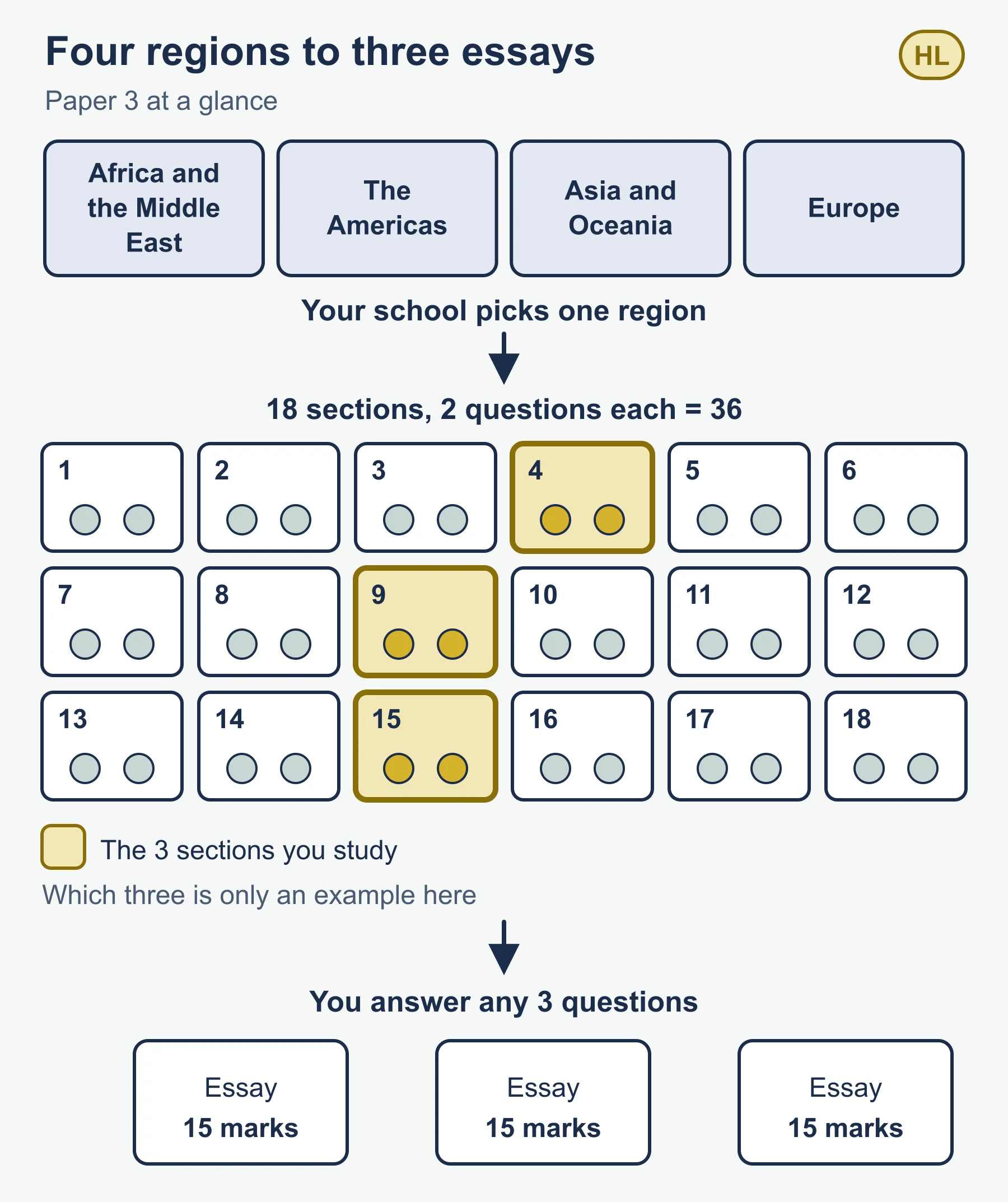
These notes condense widely taught content areas in the HL History of Africa and the Middle East option for Paper 3. Use them alongside the Africa and the Middle East study guide, which explains the arguments, and the Africa and the Middle East practice questions. Revise only the sections your school studies, using your teacher’s list of the guide’s section titles and dates.
Paper 3 reminders
| Feature | Detail |
|---|---|
| Sections | 18 in the region; your school studies 3 |
| Questions | Two per section, 36 in all; answer any three |
| Time | 2 hours 30 minutes; about 50 minutes per essay |
| Marks | 15 per essay, 45 in total |
Imperialism and resistance (late nineteenth century)
Causes of the partition of Africa
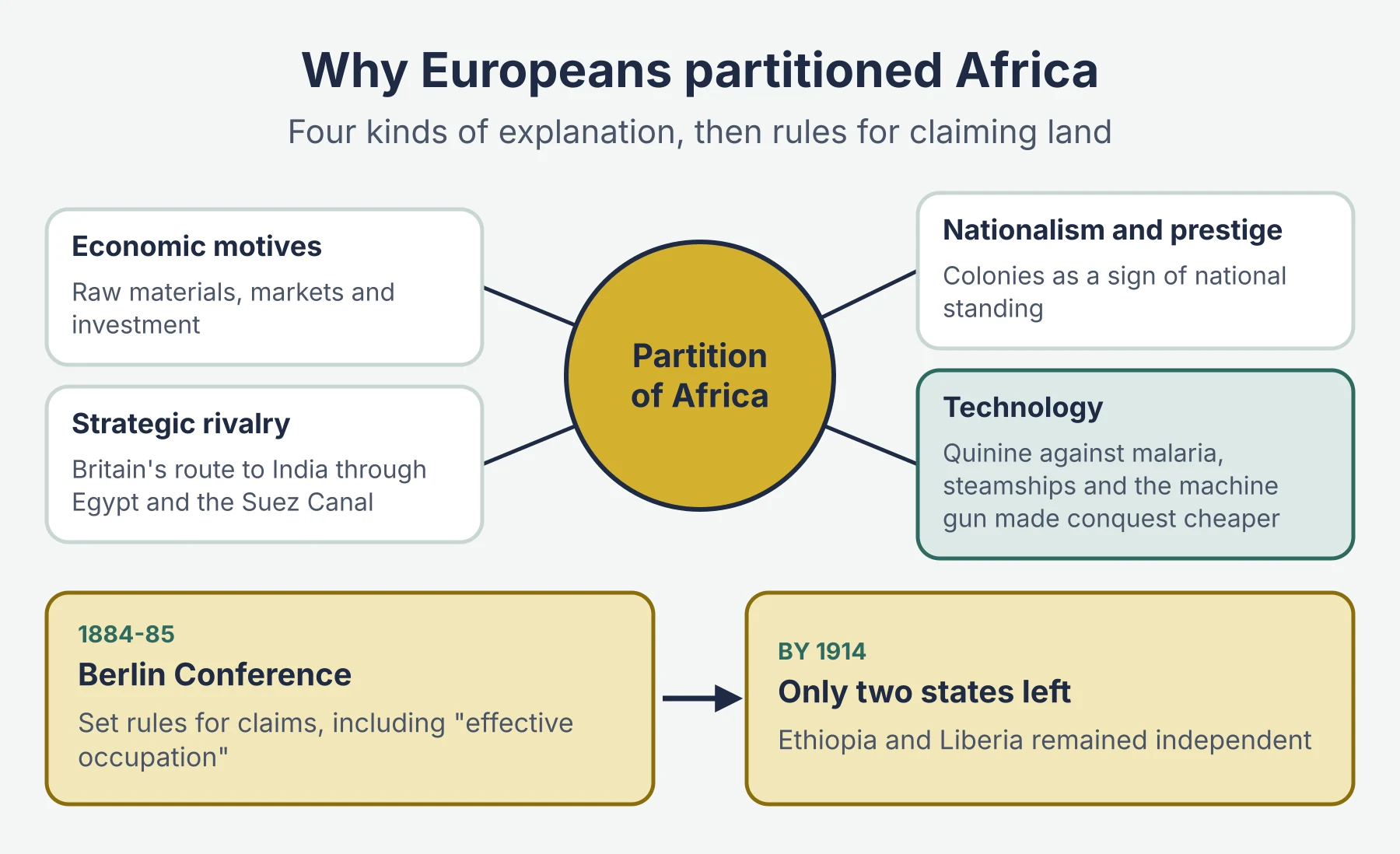
- Economic: raw materials, markets, investment opportunities.
- Strategic: Britain’s occupation of Egypt (1882) to protect the Suez Canal route.
- Political: nationalism, prestige, rivalry between European powers.
- Technological: quinine, steamships, railways, the machine gun.
- Diplomatic: the Berlin Conference (1884-85) and “effective occupation”.
Resistance timeline
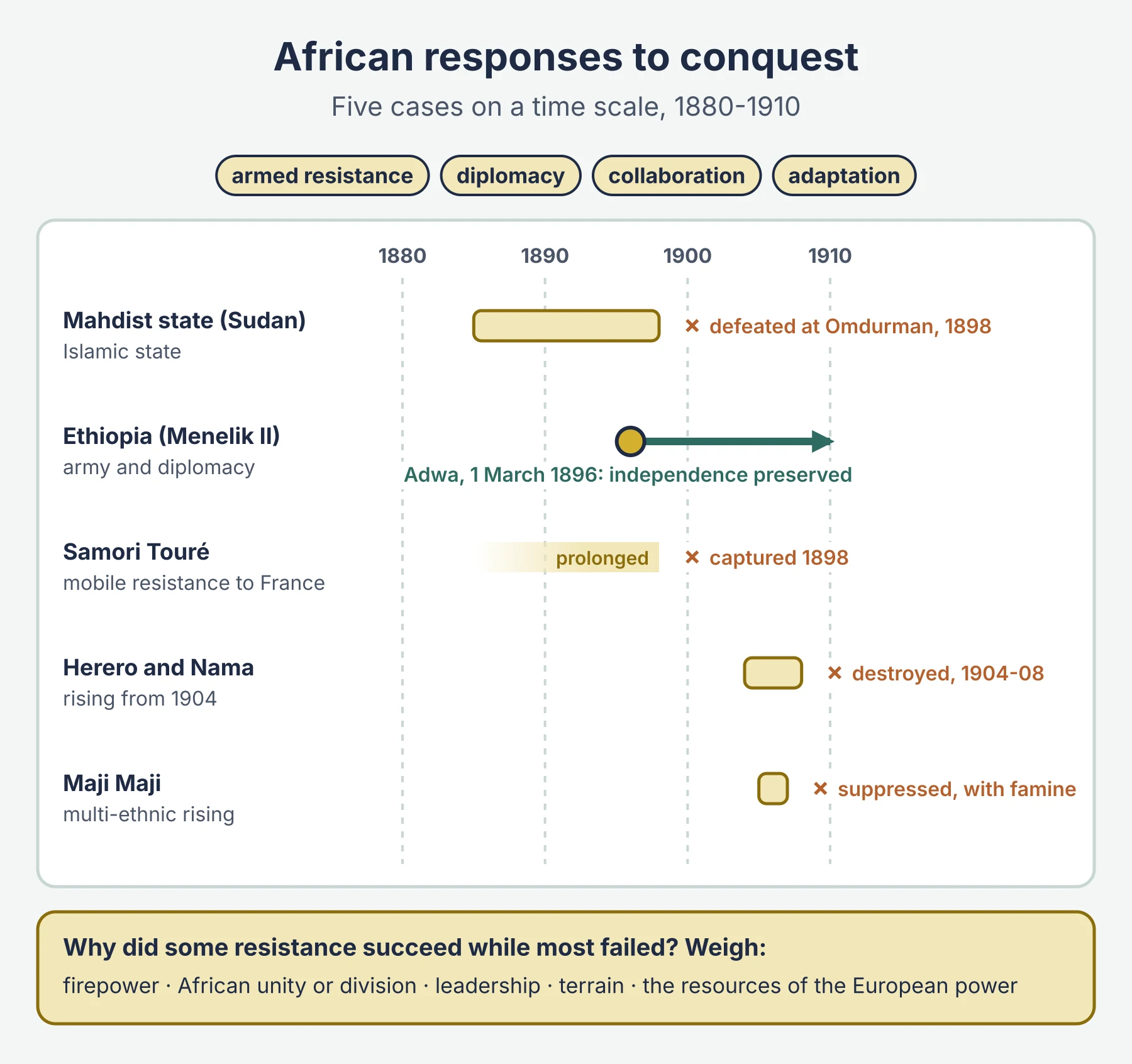
- 1879: Anglo-Zulu War; British defeat at Isandlwana, then Zulu defeat.
- 1885: Mahdist forces take Khartoum.
- 1 March 1896: Ethiopia defeats Italy at Adwa.
- 1898: Mahdist state defeated at Omdurman; Samori Touré captured by the French.
- 1900: Asante rising led by Yaa Asantewaa.
- 1904-08: Herero and Nama rising and its destruction in German South West Africa.
- 1905-07: Maji Maji rising in German East Africa.
South Africa, 1899-1994
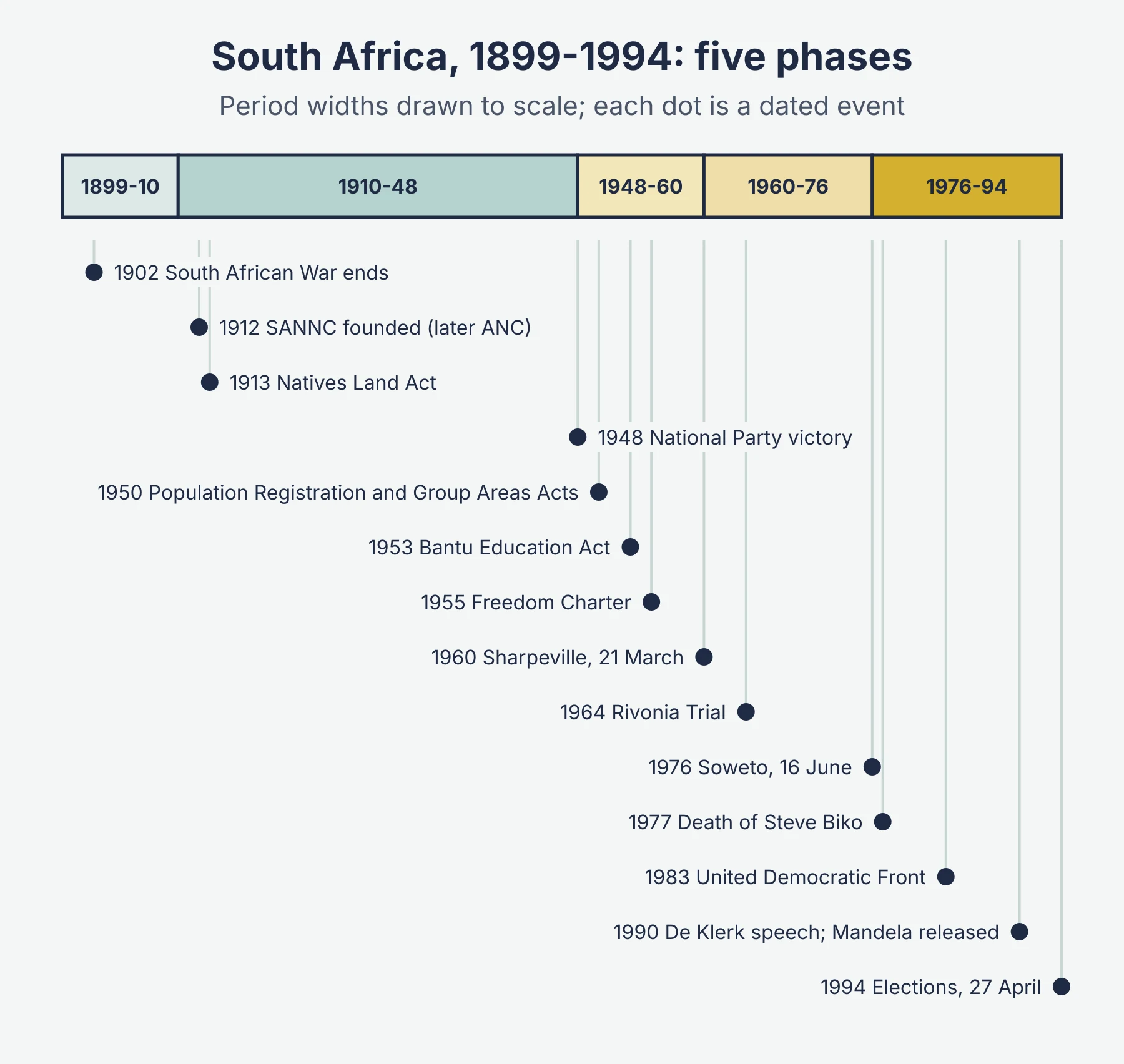
- 1899-1902: South African War.
- 1910: Union of South Africa.
- 1912: South African Native National Congress founded (renamed ANC in 1923).
- 1913: Natives Land Act.
- 1948: National Party wins; apartheid begins under D. F. Malan.
- 1950: Population Registration Act; Group Areas Act; Suppression of Communism Act.
- 1953: Bantu Education Act.
- 1955: Freedom Charter adopted at Kliptown.
- 1959: Pan Africanist Congress (PAC) formed.
- 21 March 1960: Sharpeville; ANC and PAC banned.
- 1961: Umkhonto we Sizwe begins sabotage; South Africa becomes a republic and leaves the Commonwealth.
- 1964: Rivonia Trial ends with life sentences for Mandela and others.
- 16 June 1976: Soweto uprising against Afrikaans-medium teaching.
- 1977: Steve Biko dies in police custody.
- 1983: tricameral parliament; United Democratic Front founded.
- 1985-86: states of emergency; growing international sanctions.
- 2 February 1990: de Klerk unbans the ANC; 11 February: Mandela released.
- 27 April 1994: first universal elections.
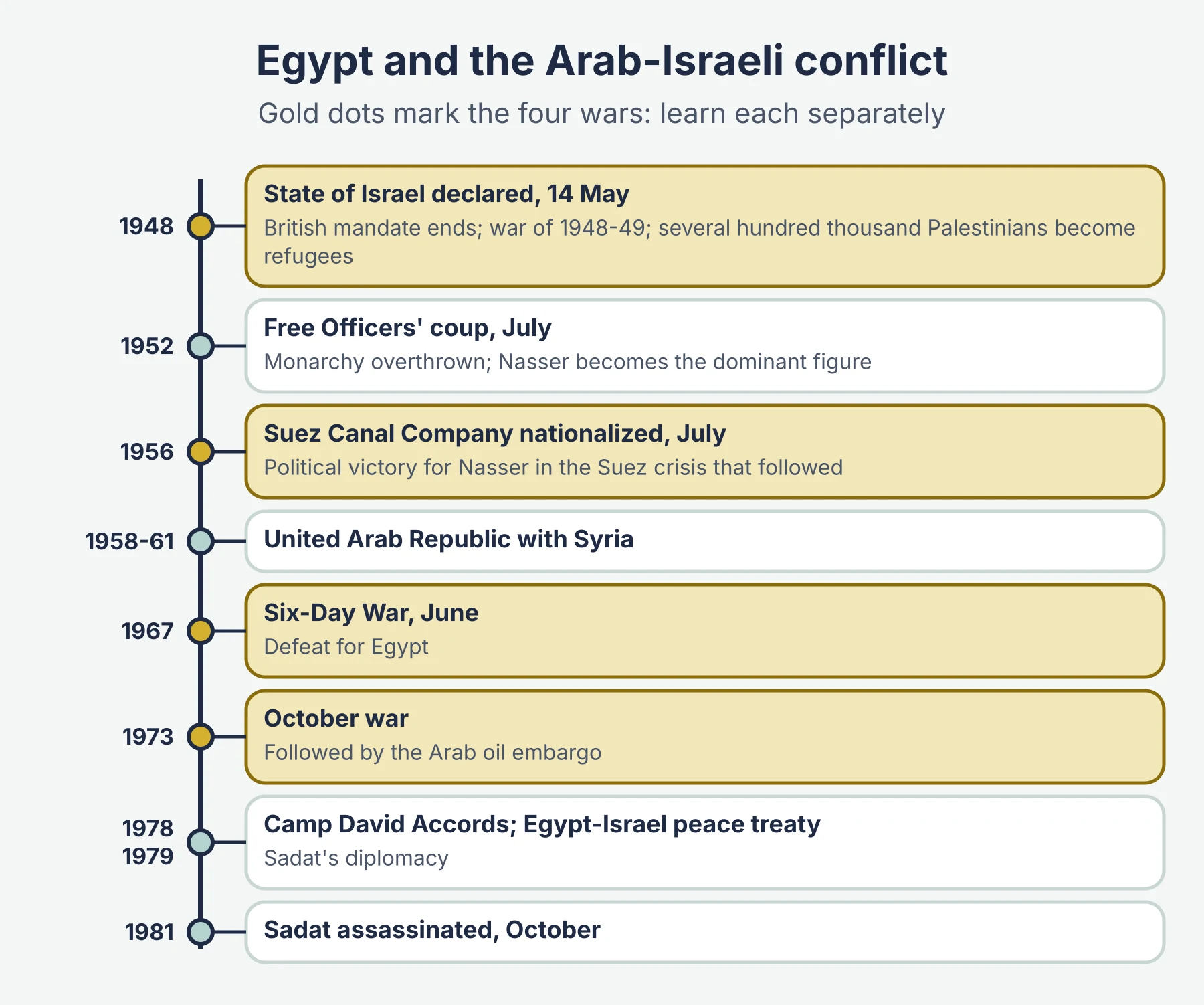
Egypt and the Arab-Israeli conflict
| Date | Event |
|---|---|
| 1917 | Balfour Declaration |
| 14 May 1948 | Israel declared; first Arab-Israeli war (1948-49); Palestinian refugee crisis |
| July 1952 | Free Officers’ coup in Egypt |
| July 1956 | Nasser nationalizes the Suez Canal Company |
| October-November 1956 | Suez crisis: Israeli, British and French attack; withdrawal under US and Soviet pressure |
| 1958-61 | United Arab Republic (Egypt and Syria) |
| June 1967 | Six-Day War: Israel takes Sinai, Gaza, the West Bank, East Jerusalem and the Golan Heights |
| October 1973 | October (Yom Kippur) War; Arab oil embargo |
| 1978-79 | Camp David Accords; Egypt-Israel peace treaty |
| October 1981 | Sadat assassinated |
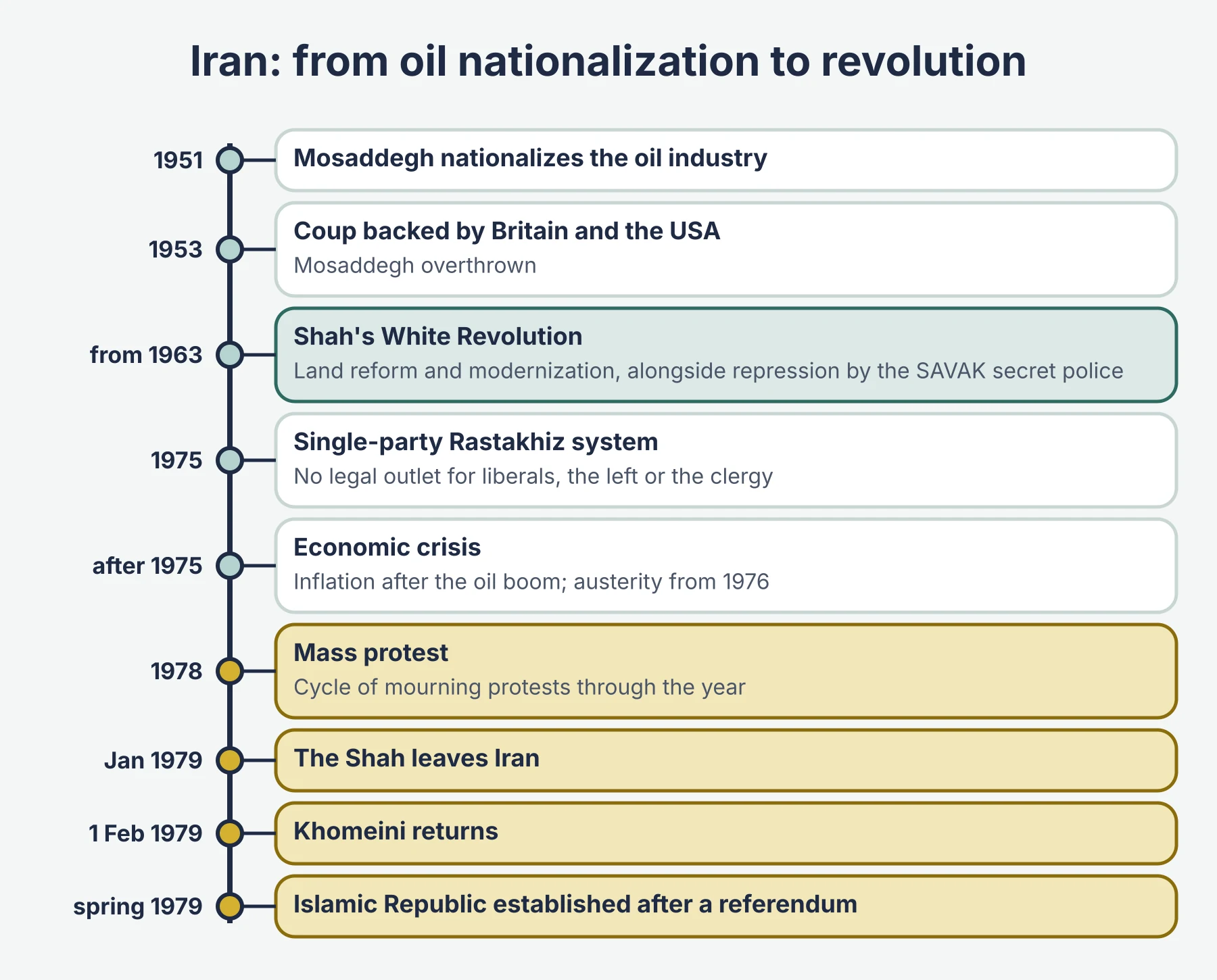
Iran, 1951-1979
- 1951: Mosaddegh nationalizes oil.
- 1953: Mosaddegh overthrown in a coup backed by Britain and the USA.
- 1963: White Revolution; protests; Khomeini exiled (1964).
- 1975: Rastakhiz single-party system.
- 1978: mass protests, strikes; martial law.
- January 1979: the Shah leaves; 1 February: Khomeini returns.
- 1979: Islamic Republic established; US embassy hostage crisis begins (November).
Key terms
| Term | Meaning |
|---|---|
| Effective occupation | Berlin Conference principle that claims required actual control |
| Indirect rule | Ruling through existing local rulers, as in British Northern Nigeria |
| Apartheid | System of legal racial segregation in South Africa from 1948 |
| Bantustans | Ethnic “homelands” created under apartheid |
| Pass laws | Laws restricting the movement of Black South Africans |
| Pan-Arabism | Movement for Arab unity, associated with Nasser |
| Mandate | League of Nations territory administered by a European power |
| White Revolution | The Shah’s reform programme from 1963 |
Essay angles to prepare
| Content area | Question angle | Factors to weigh |
|---|---|---|
| Imperialism | Why was partition so rapid after 1880? | Rivalry, technology, economic motives, the Berlin Conference, African divisions |
| Resistance | Why did Ethiopia survive when most states fell? | Menelik’s army and diplomacy, Italian errors, terrain, unity |
| South Africa | Why did apartheid last until 1990? | Repression, economic growth, Western Cold War support, opposition divisions |
| Egypt | How successful was Nasser? | Domestic reform against foreign policy, Suez against 1967 |
| Iran | Why did the Shah fall in 1979? | Modernization, repression, economic crisis, Khomeini, a broad coalition |
Exam traps
- Answering on “Africa” in general when the question names a country.
- Forgetting African agency in questions on imperialism.
- Confusing the dates of Middle Eastern wars. 1948, 1956, 1967, 1973.
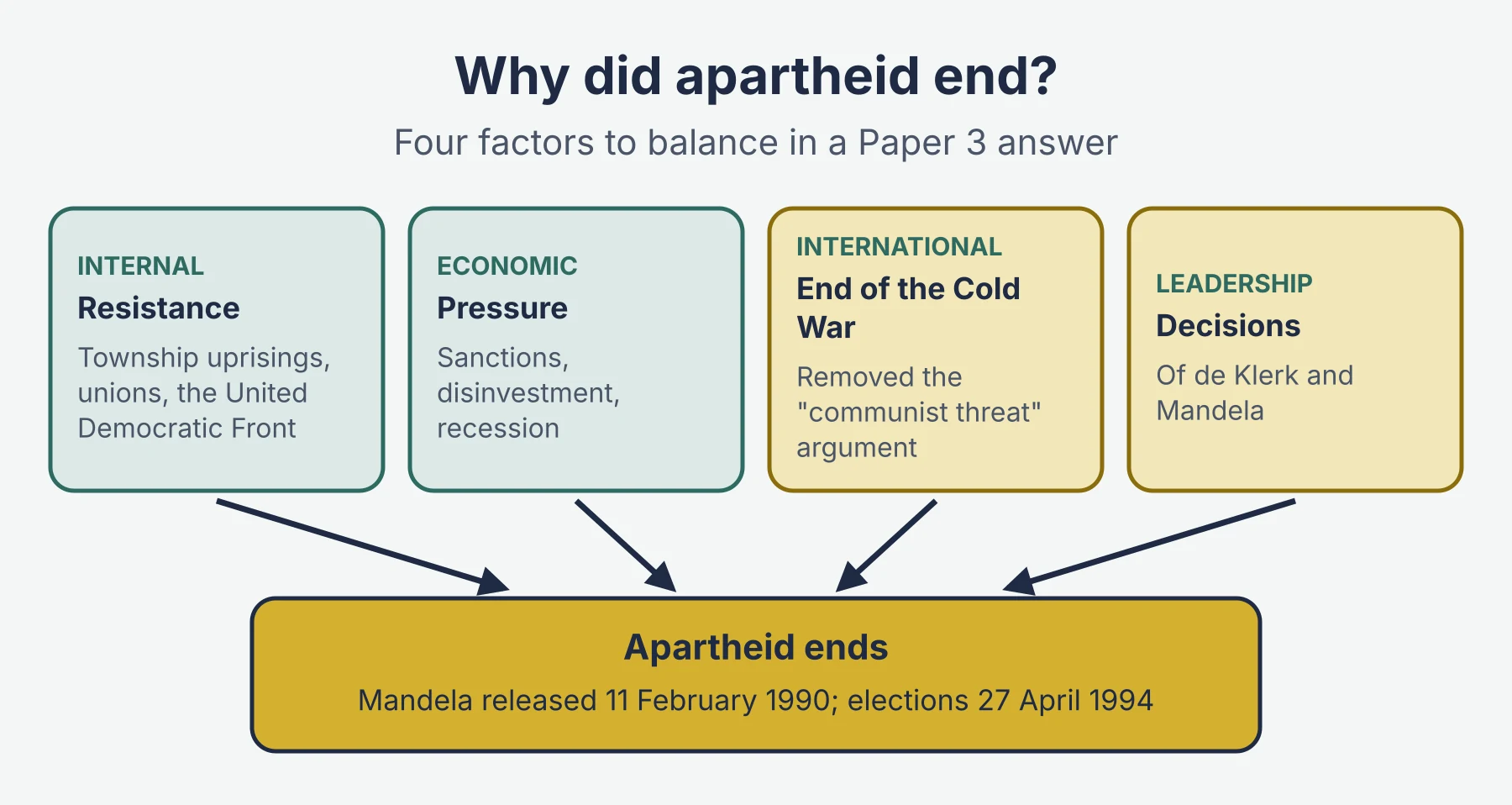
- Apartheid’s end explained by one factor. Weigh internal resistance, economic pressure, the end of the Cold War and leadership.
- Unsupported casualty figures. Use only figures you are sure of.
Self-test
- Why did Britain occupy Egypt in 1882? To secure the Suez Canal route to India and protect financial interests.
- What did the Berlin Conference decide about claims? They needed “effective occupation”.
- Which two African states were independent in 1914? Ethiopia and Liberia.
- Where were the Mahdist forces defeated in 1898? Omdurman.
- What did the Natives Land Act of 1913 do? Restricted African land ownership to designated reserves, a small fraction of the land.
- Name three apartheid laws of 1950-53. Population Registration Act, Group Areas Act, Bantu Education Act (also the Suppression of Communism Act).
- What was the Freedom Charter? The Congress Alliance’s 1955 statement of a non-racial democratic South Africa.
- What triggered the Soweto uprising? The requirement to use Afrikaans as a medium of teaching.
- What was the Suez crisis? The 1956 Israeli, British and French attack on Egypt after Nasser nationalized the canal company, ended by US and Soviet pressure.
- Which territories did Israel take in 1967? Sinai, Gaza, the West Bank, East Jerusalem and the Golan Heights.
- What happened to Mosaddegh in 1953? He was overthrown in a coup backed by Britain and the USA.
- When did Khomeini return to Iran? 1 February 1979.
Related resources
-
Study guides
IB DP History (DP History): History of the Americas
The HL History of the Americas option for Paper 3: the US Civil War, the Mexican Revolution to 1940 and civil rights movements, with essay technique.
World History · International Baccalaureate · IB
Read guide -
Practice questions
IB DP History (DP History): History of the Americas – Practice Questions
Twelve original HL Paper 3-style practice questions on the History of the Americas, from short recall to full 15-mark essays, with mark-scheme answers.
World History · International Baccalaureate · IB
Try questions -
Revision notes
IB DP History (DP History): History of the Americas – Revision Notes
Condensed HL notes for the History of the Americas: US Civil War and Reconstruction, the Mexican Revolution and civil rights, with key terms and a self-test.
World History · International Baccalaureate · IB
Revise topic
Get free revision emails (optional)
Occasional emails with practice questions, worked explanations and links to free resources for the qualification and subjects you choose. No spam, and you can unsubscribe from any email. The free tools on this site never need an email.