
Study Guides
IB DP History (DP History): Society and economy (750-1400)
IB History Paper 2 world history topic 1, Society and economy 750-1400: population, trade, ideas and religion across regions, with a worked essay plan.
- Subject
- World History
- Level
- IB
- Topic
- Topic 2: World history topics
- Author
- Marlbridge Academic Team
- Updated
- Reviewed by
- Azam Siddique (what this means)
Aligned to International Baccalaureate IB Diploma Programme World History (DP History), First assessment 2017. Official specification .
Syllabus page (what it covers and how it is assessed): IB Diploma Programme World History.
Syllabus points this page covers
DP History
- 1 Society and economy (750-1400)
Found an error? Report a correction.
Need help with this topic? Request a free trial class for IB Diploma Programme World History (DP History).
World history topic 1, Society and economy (750-1400), is the earliest of the Paper 2 topics. It asks how societies in different parts of the world produced wealth, traded, thought and worshipped over six and a half centuries, and how these changed. You study examples chosen by your teacher from more than one region, and Paper 2 essays usually ask you to compare them or to assess the causes and consequences of change. The world history topics overview explains Paper 2 as a whole; this guide goes into this topic in depth.
What the topic covers
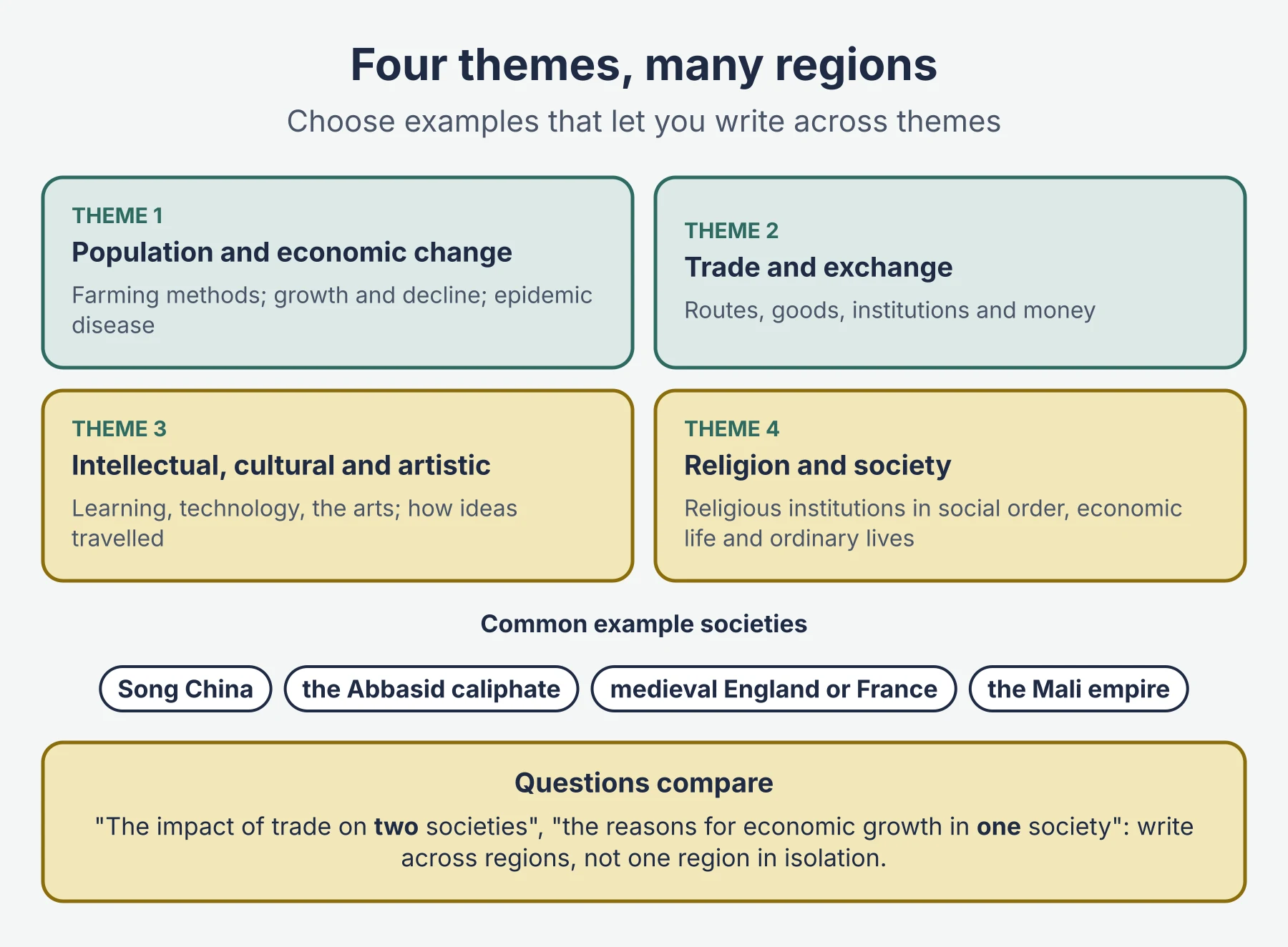
The topic’s content falls into four broad themes:
- Population and economic change: farming methods, demographic growth and decline, and the impact of epidemic disease.
- Trade and exchange: the routes, goods, institutions and money that connected regions.
- Intellectual, cultural and artistic developments: learning, technology and the arts, and how ideas travelled.
- Religion and society: the place of religious institutions in social order, economic life and the lives of ordinary people.
Questions rarely ask for one region’s history in isolation. They ask, for example, about “the impact of trade on two societies” or “the reasons for economic growth in one society”. Choose examples that let you write across themes: Song China, the Abbasid caliphate, medieval England or France, and the Mali empire are common choices.
Theme 1: population and economic change
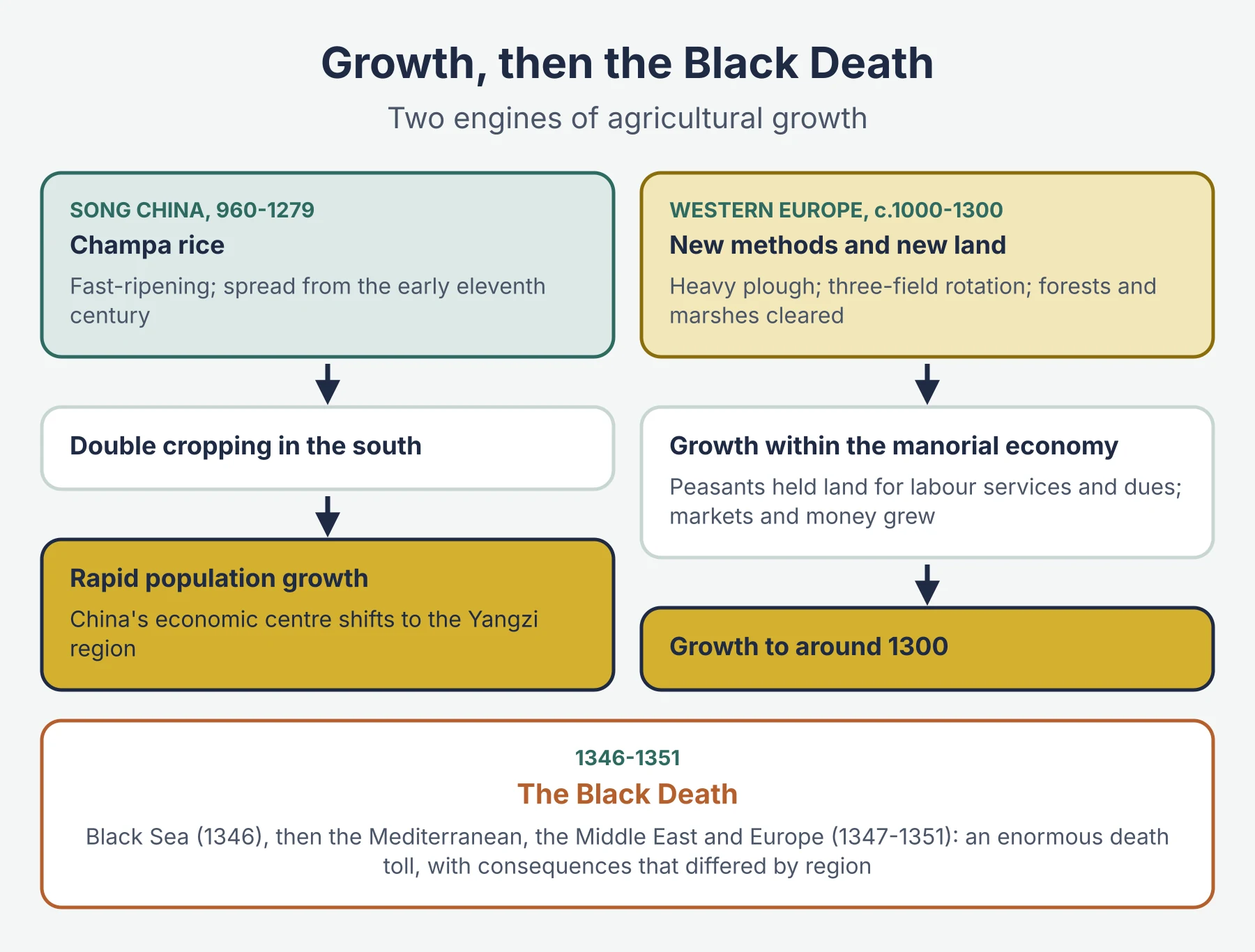
Agricultural growth. In Song China (960-1279) the spread of fast-ripening Champa rice from the early eleventh century allowed double cropping in the south, supporting rapid population growth and the shift of China’s economic centre to the Yangzi region. In western Europe, the heavy plough, the three-field rotation and the clearing of forests and marshes supported growth from around 1000 to 1300.
The manorial economy. Much of the European population lived on manors where peasants held land from a lord in return for labour services and dues. This was a system of obligations, not a market economy, though markets and money grew steadily within it.
The Black Death. Plague reached the Black Sea in 1346 and spread across the Mediterranean, the Middle East and Europe in 1347-1351. The death toll was enormous. Its consequences differed by region. In England, labour shortages raised wages; the Ordinance and Statute of Labourers (1349, 1351) tried to hold them down, and resentment fed into the Peasants’ Revolt of 1381. In Mamluk Egypt, where irrigated agriculture depended on maintaining canals and dykes under a centralised landholding elite, depopulation damaged the system and recovery was slow.
Theme 2: trade and exchange
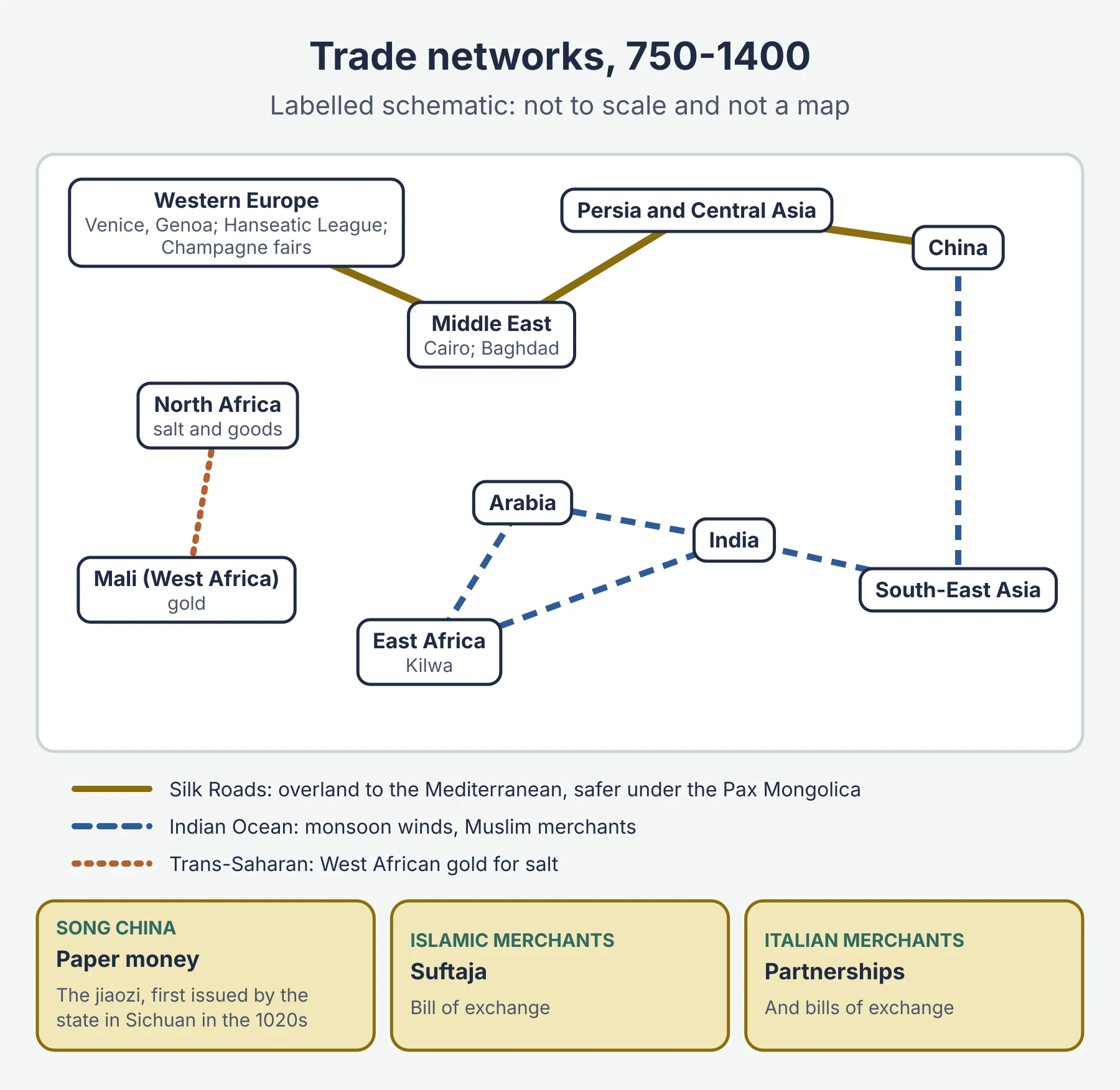
- Silk Roads and the Pax Mongolica. Overland routes linked China, Central Asia, Persia and the Mediterranean. After the Mongol conquests of the thirteenth century, one political authority across much of Eurasia made travel safer, and merchants and envoys moved further.
- The Indian Ocean. Monsoon winds structured maritime trade linking East Africa, Arabia, India, South-East Asia and China. Muslim merchants were central to it, and ports such as Kilwa grew rich.
- The trans-Saharan trade. Gold from West Africa was exchanged for salt and goods from North Africa. Mali’s wealth was displayed by Mansa Musa’s pilgrimage to Mecca in 1324-1325, when his spending in Cairo became legendary.
- European networks. Italian city-states such as Venice and Genoa dominated Mediterranean trade; the Hanseatic League linked Baltic and North Sea towns; the Champagne fairs connected north and south.
- Money and credit. Song China issued paper money (the jiaozi, first issued by the state in Sichuan in the 1020s). Islamic merchants used the suftaja bill of exchange; Italian merchants developed partnerships and bills of exchange.
Theme 3: intellectual, cultural and artistic developments
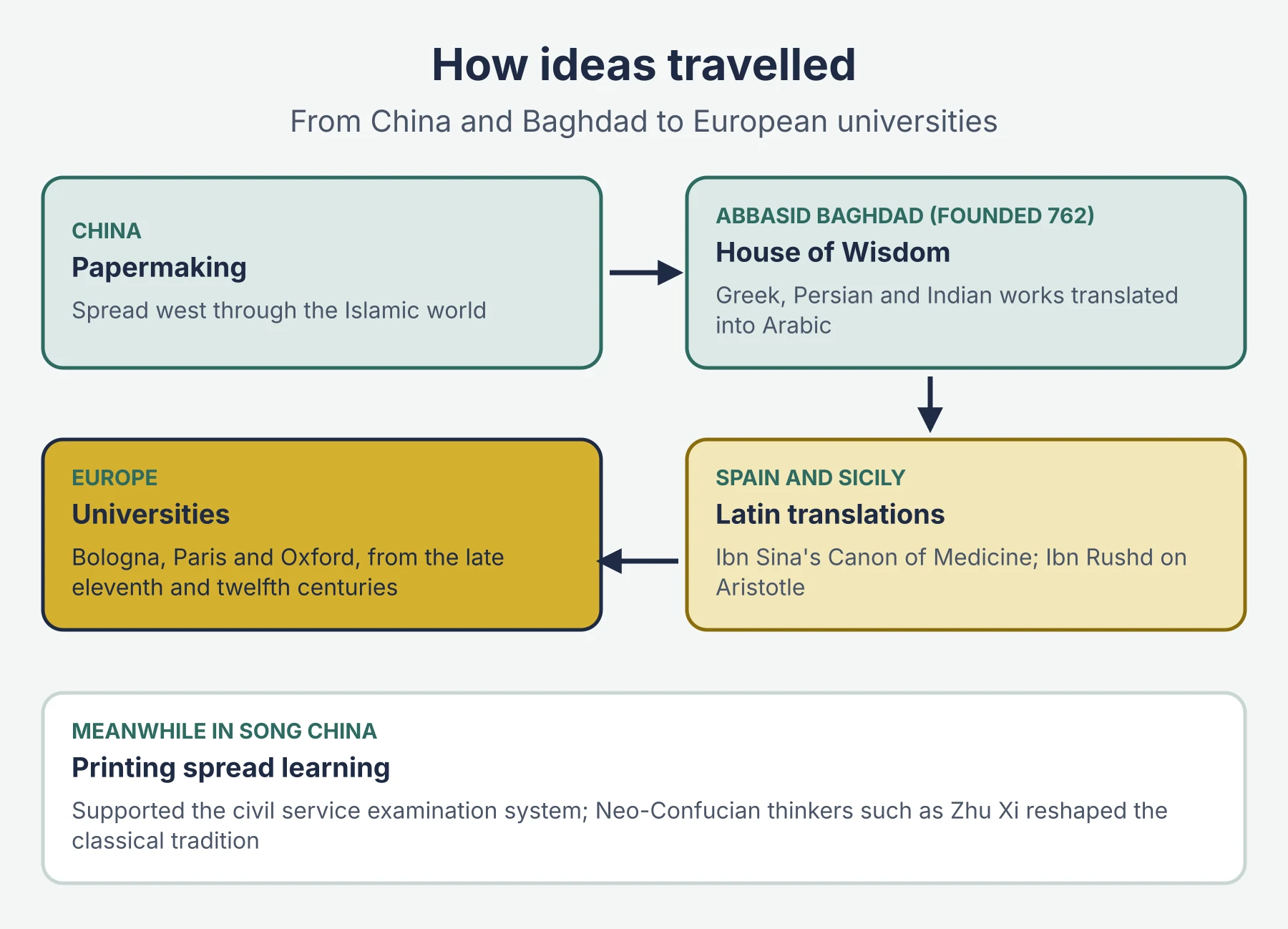
In Abbasid Baghdad (founded 762), scholars translated Greek, Persian and Indian works into Arabic, and the House of Wisdom became a centre of learning. Papermaking spread west from China through the Islamic world. Ibn Sina’s Canon of Medicine and Ibn Rushd’s commentaries on Aristotle later reached European universities through Latin translations made in Spain and Sicily. Universities emerged in Bologna, Paris and Oxford from the late eleventh and twelfth centuries. In Song China, printing spread learning and supported the civil service examination system, and Neo-Confucian thinkers such as Zhu Xi reshaped the classical tradition.
Theme 4: religion and society
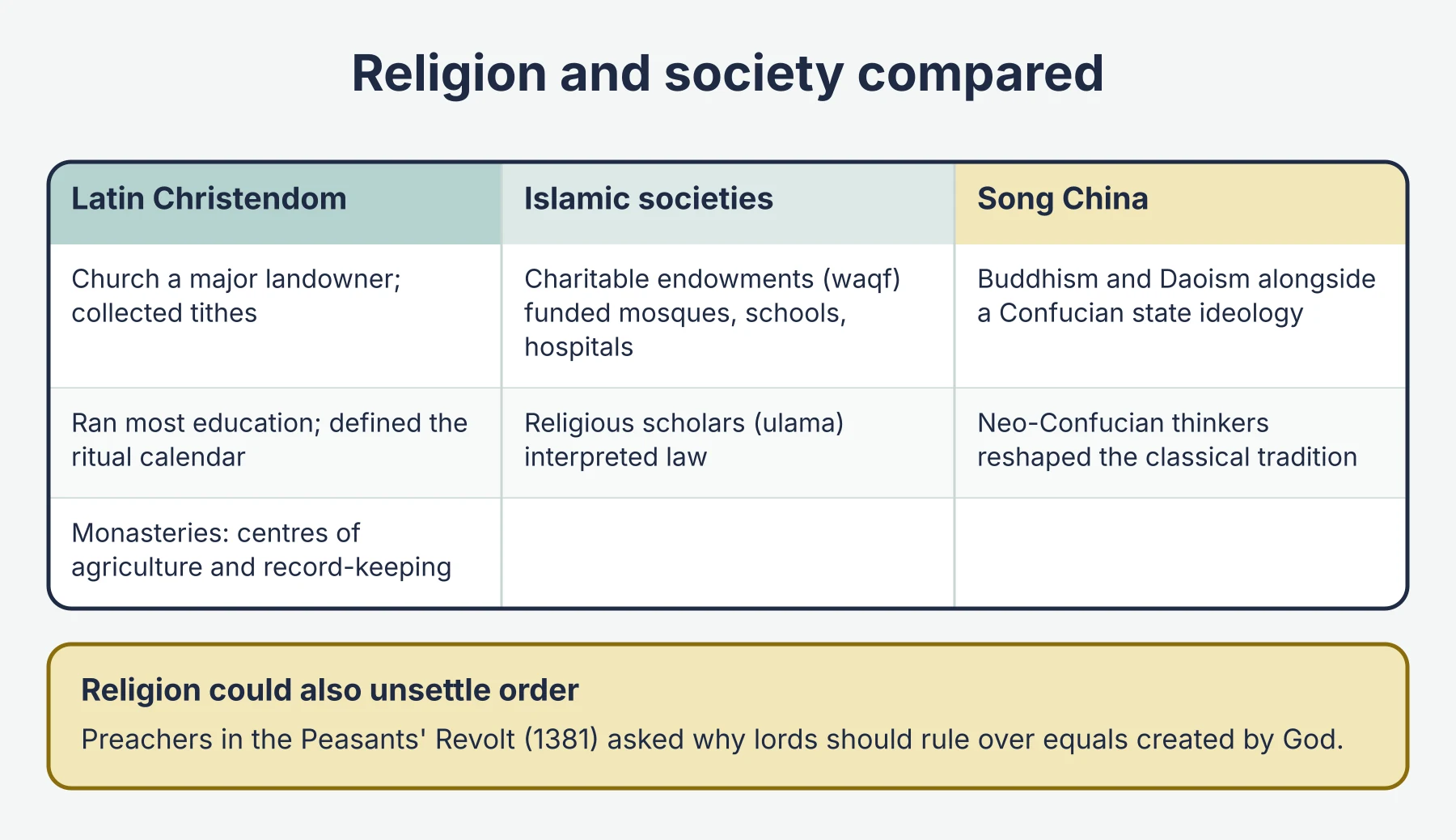
Religion shaped every society in this period. In Latin Christendom the Church was a major landowner, collected tithes, ran most education and defined the ritual calendar; monasteries were also centres of agriculture and record-keeping. In Islamic societies, charitable endowments (waqf) funded mosques, schools and hospitals, and religious scholars (ulama) interpreted law. In Song China, Buddhism and Daoism coexisted with a Confucian state ideology. Religion could also unsettle the social order: preachers in the Peasants’ Revolt asked why lords should rule over equals created by God.
Worked example: planning a comparative essay
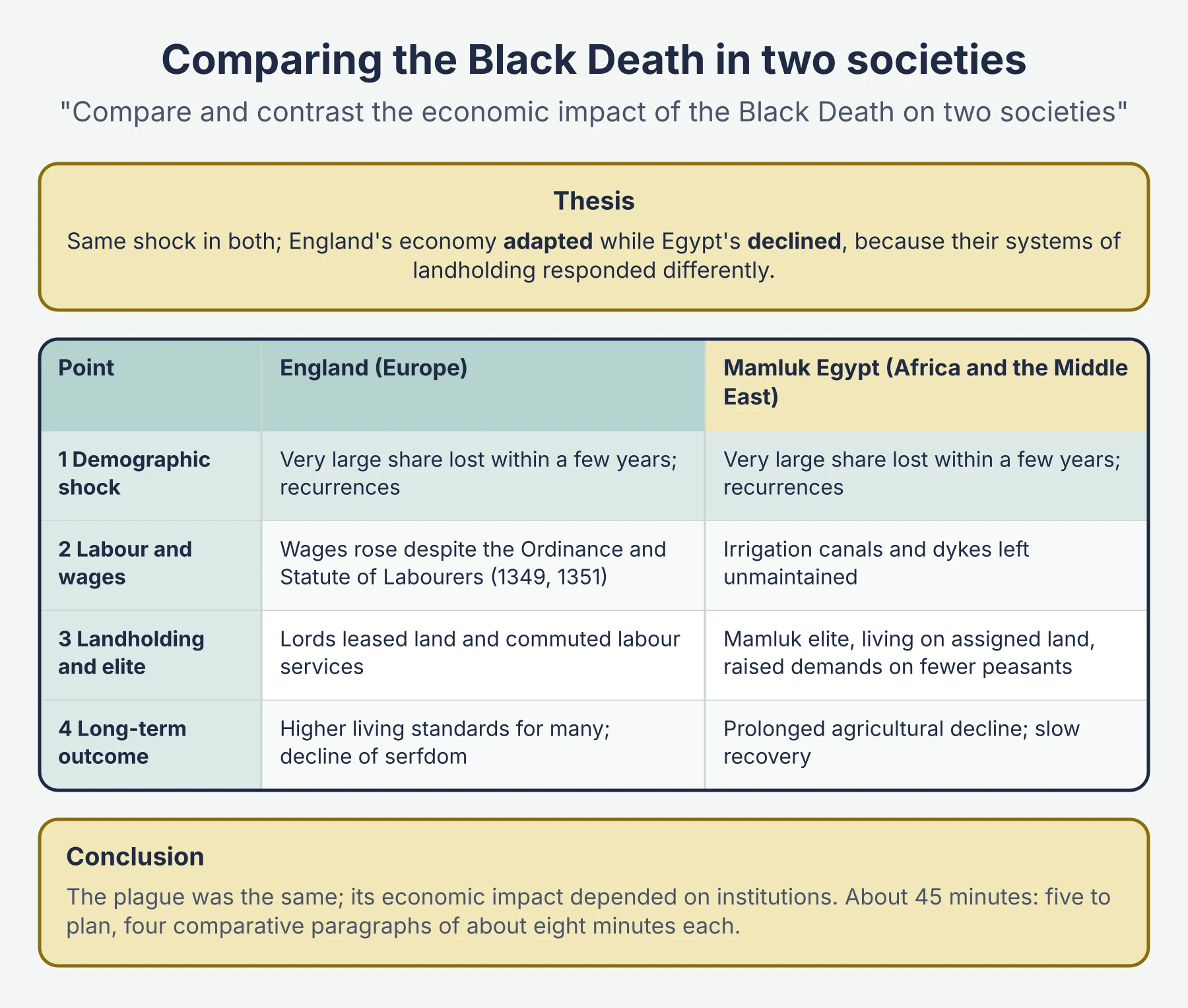
Question: “Compare and contrast the economic impact of the Black Death on two societies, each chosen from a different region.”
Choose examples: England (Europe) and Mamluk Egypt (Africa and the Middle East).
Thesis: in both societies the plague caused severe depopulation and labour shortage, but England’s economy adapted while Egypt’s declined, because their systems of landholding responded differently.
Paragraph plan (comparison throughout):
- Demographic shock. Both lost a very large share of their populations within a few years; recurrences followed in both.
- Labour and wages. In England labour shortage raised wages despite the Statute of Labourers; in Egypt the shortage left irrigation works unmaintained.
- Landholding and the elite response. English lords leased land and commuted labour services; Egypt’s Mamluk elite, who drew revenue from assigned land, raised demands on a reduced peasantry.
- Long-term outcomes. Rising living standards for many English survivors and the decline of serfdom; prolonged agricultural decline in Egypt.
Conclusion: the plague was the same, but its economic impact depended on institutions: the more flexible English system adapted, the more rigid Egyptian one did not.
Timing: about 45 minutes, with five for planning and four comparative paragraphs of about eight minutes each.
Interpretations
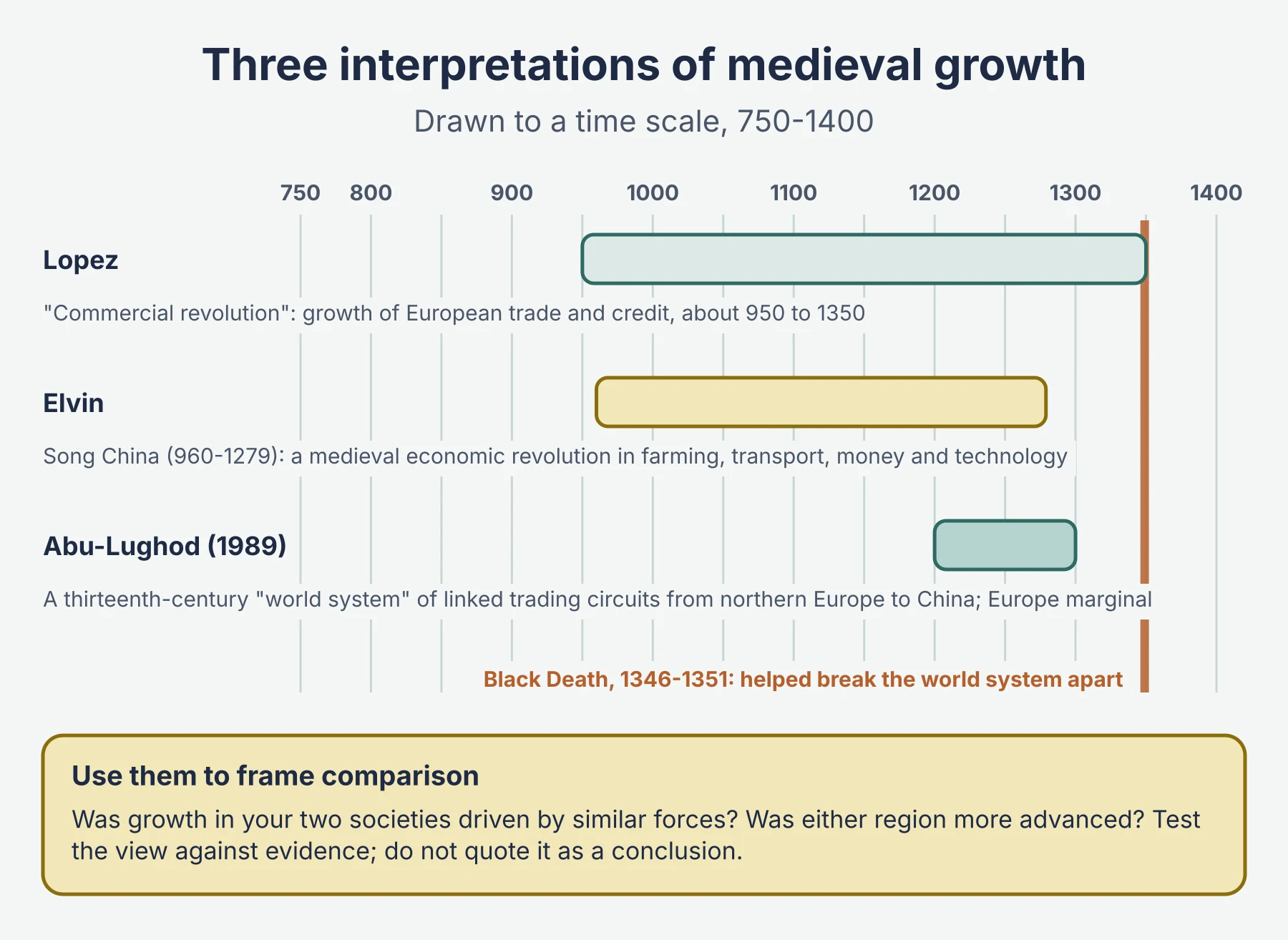
Historians have described dramatic economic change in more than one region. Robert S. Lopez called the growth of European trade and credit between about 950 and 1350 a “commercial revolution”. Mark Elvin argued that Song China underwent a medieval economic revolution in farming, transport, money and technology. Janet Abu-Lughod’s Before European Hegemony (1989) described a thirteenth-century “world system” of linked trading circuits from northern Europe to China, in which Europe was a marginal participant and which the Black Death helped to break apart. Use such views to frame comparison: was growth in your two societies driven by similar forces, and was either region more advanced than the other? Present an interpretation briefly and test it against your evidence rather than quoting it as a conclusion.
Common mistakes
- Writing “medieval society” as if it meant only Europe; the topic is global.
- Describing trade routes without explaining their impact on the society in the question.
- Treating the Black Death as a single cause of everything that followed.
- Using examples from one region when the question asks for two regions.
- Losing the date range: the topic ends in 1400, so do not run into the Renaissance.
Exam technique
Compare and contrast questions need both, set against each other in each paragraph. Discuss invites a balanced review. Examine asks you to test the importance of a factor. To what extent demands a clear judgement in the introduction and conclusion. Define abstract terms in the question, such as “economic growth” or “social change”, before you argue.
Revise with the Society and economy revision notes and practise with the Society and economy practice questions.
Get free revision emails (optional)
Occasional emails with practice questions, worked explanations and links to free resources for the qualification and subjects you choose. No spam, and you can unsubscribe from any email. The free tools on this site never need an email.
Related resources
-
Practice questions
IB DP History: The Six Key Concepts – Practice Questions
Original practice questions with worked answers on the six key concepts of IB DP History (first assessed 2017), from spotting the concept to essay plans.
World History · International Baccalaureate · IB
Try questions -
Practice questions
IB DP History (DP History): Society and economy (750-1400) – Practice Questions
Twelve original IB History practice questions on Society and economy 750-1400, from short recall to a full Paper 2 essay, with mark-scheme answers.
World History · International Baccalaureate · IB
Try questions -
Revision notes
IB DP History (DP History): Society and economy (750-1400) – Revision Notes
Revision notes for IB History Paper 2 Society and economy 750-1400: four themes across regions, key terms, comparison grids, exam traps and a self-test.
World History · International Baccalaureate · IB
Revise topic
Related articles
-
teaching
A Level tuition in Dubai: Cambridge or Pearson Edexcel International A Level?
Schools in Dubai and Abu Dhabi teach either Cambridge International AS & A Level or Pearson Edexcel International A Level. How the two are structured, why it matters for tuition, and how online classes from Lahore work.
9 October 2026
-
curriculum guides
Choosing subjects at IGCSE and A Level
How subject choices at 14 and 16 affect university options later, and how to keep pathways open without overloading a timetable.
28 July 2026
Studying this with a teacher
Working through World History IB?
This page is free and stays free. If you would rather be taught it, Marlbridge runs World History classes one-to-one, online in your own time zone. The first trial class is free. WhatsApp replies within an hour (8am–11pm Pakistan time, every day); email the same day.
IB World History teachers at Marlbridge
