
Revision Notes
IB DP History (DP History): Society and economy (750-1400) – Revision Notes
Revision notes for IB History Paper 2 Society and economy 750-1400: four themes across regions, key terms, comparison grids, exam traps and a self-test.
- Subject
- World History
- Level
- IB
- Topic
- Topic 2: World history topics
- Author
- Marlbridge Academic Team
- Updated
- Reviewed by
- Azam Siddique (what this means)
Aligned to International Baccalaureate IB Diploma Programme World History (DP History), First assessment 2017. Official specification .
Syllabus page (what it covers and how it is assessed): IB Diploma Programme World History.
Syllabus points this page covers
DP History
- 1 Society and economy (750-1400)
Found an error? Report a correction.
Need help with this topic? Request a free trial class for IB Diploma Programme World History (DP History).
Society and economy (750-1400) is world history topic 1 for Paper 2. Revise it as four themes (population and economic change, trade and exchange, intellectual and cultural developments, religion and society) applied to at least two societies from different regions.
Related: Society and economy study guide and Society and economy practice questions.
Society profiles
Song China (960-1279)
- Economy: Champa rice and double cropping; growth of the Yangzi delta; iron, porcelain and silk production; paper money.
- Trade: maritime trade through ports such as Quanzhou; state taxation of commerce.
- Ideas: printing, the civil service examinations, Neo-Confucianism (Zhu Xi).
- Society: scholar-officials at the top in theory; merchants rich but low in Confucian status.
- Limits: the north lost to the Jin in 1127; Southern Song conquered by the Mongols in 1279.
Abbasid caliphate (750-1258)
- Economy: irrigated agriculture in Iraq; craft production in cities; long-distance trade.
- Trade: Baghdad at the centre of land and sea routes; bills of exchange.
- Ideas: translation of Greek, Persian and Indian learning; the House of Wisdom; papermaking.
- Society: ulama as interpreters of law; waqf endowments.
- Limits: fragmentation of political power from the ninth century; Baghdad sacked by the Mongols in 1258.
Medieval England (to 1400)
- Economy: manorial agriculture; wool exports to Flanders; growth of towns and markets.
- Shock: the Black Death (1348-1349 in England) and recurrences.
- Response: Ordinance (1349) and Statute (1351) of Labourers; poll taxes; Peasants’ Revolt (1381).
- Society: lords, free and unfree peasants; the Church as landowner.
Mali empire (thirteenth and fourteenth centuries)
- Economy: control of gold-producing regions and the trade towns of the Sahel.
- Trade: trans-Saharan exchange of gold for salt, cloth and goods.
- Ideas and religion: Islam among the ruling elite and merchants; Timbuktu as a centre of learning.
- Display: Mansa Musa’s pilgrimage (1324-1325).
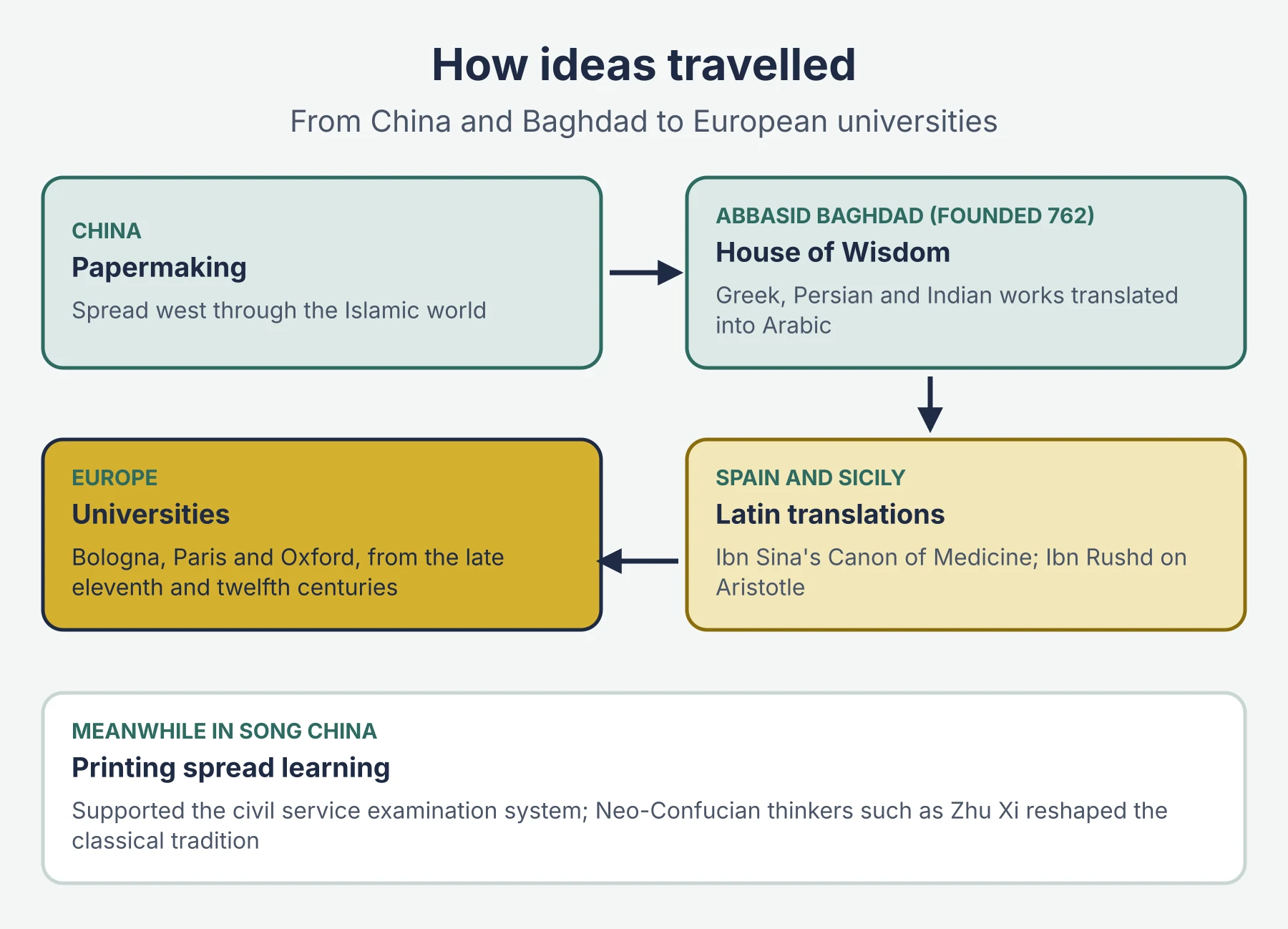
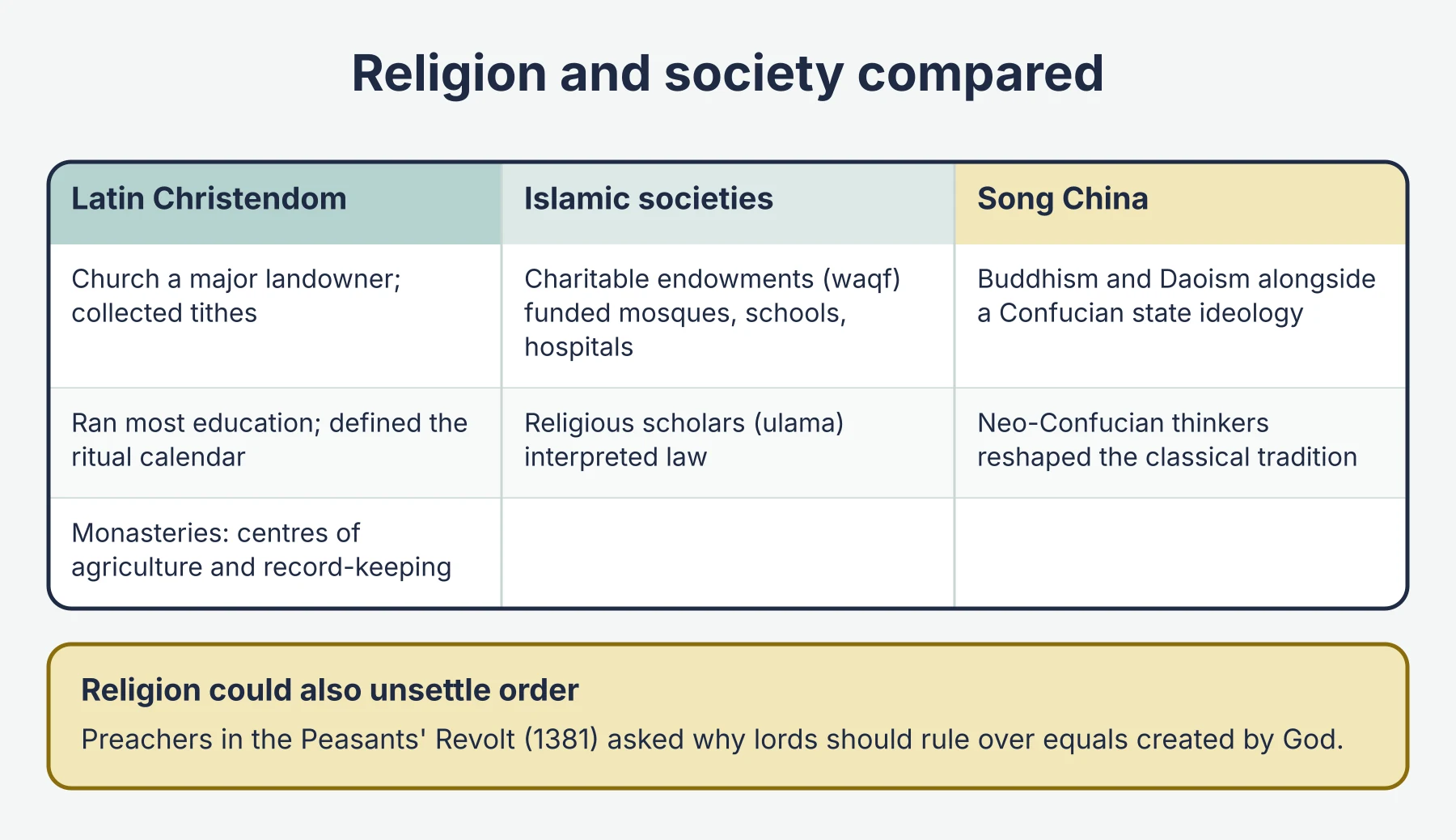
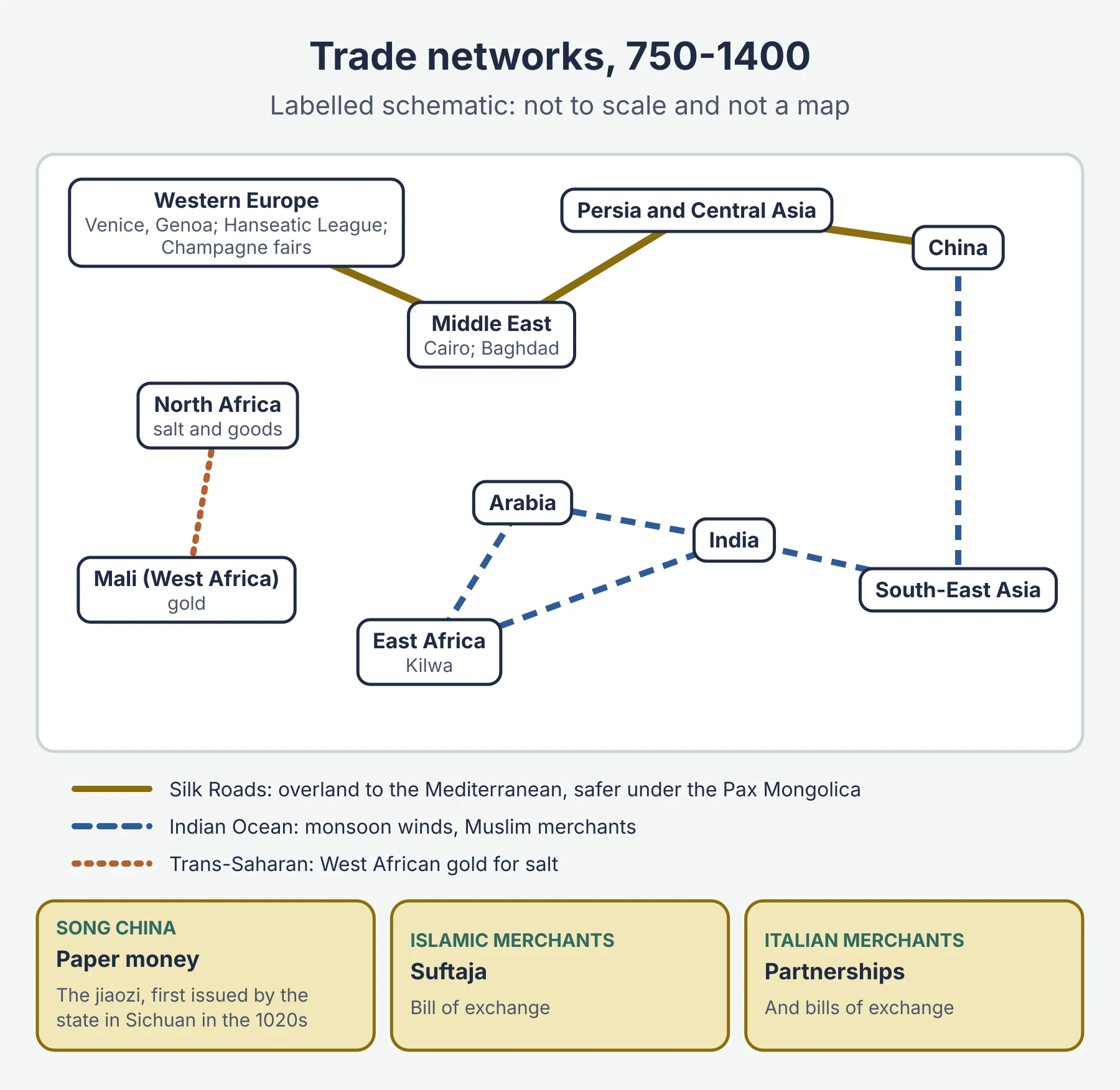
Comparison grid: drivers of economic growth
| Driver | Song China | Medieval Europe | Islamic world |
|---|---|---|---|
| Agriculture | New rice strains, irrigation | Heavy plough, three-field system, land clearance | Irrigation; new crops spread west |
| Trade | Internal canals; maritime ports | Italian cities, Hanse, fairs | Land and sea routes centred on Baghdad and Cairo |
| Money and credit | State paper money | Coinage; Italian banking | Bills of exchange (suftaja) |
| State role | Taxation, monopolies, infrastructure | Limited; towns gained charters | Caliphal and later sultanate patronage |
| Constraints | Confucian disdain for merchants | Church teaching on usury | Political fragmentation |
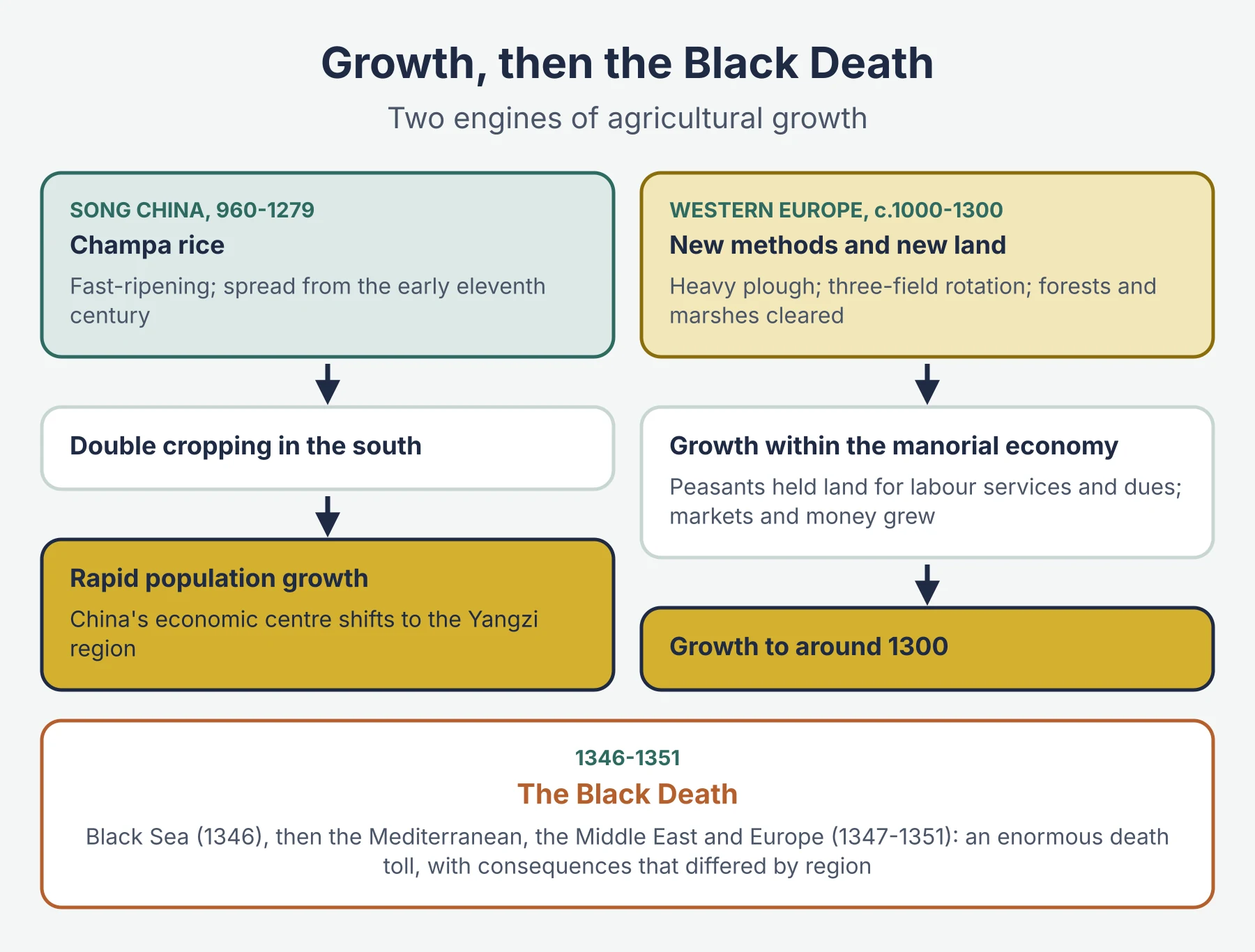
The Black Death: cause and consequence
| Aspect | Detail |
|---|---|
| Spread | From Central Asia to the Black Sea (1346), Mediterranean and Middle East (1347-1348), most of Europe (1348-1351) |
| Immediate effects | Mass mortality; collapse of labour supply; disruption of trade and harvests |
| Economic effects | Higher wages and lower rents in parts of Europe; abandonment of marginal land |
| Political responses | Wage laws in England; attempts by lords to enforce old obligations |
| Social effects | Persecution of Jews in many European towns; flagellant movements; challenges to the authority of the clergy |
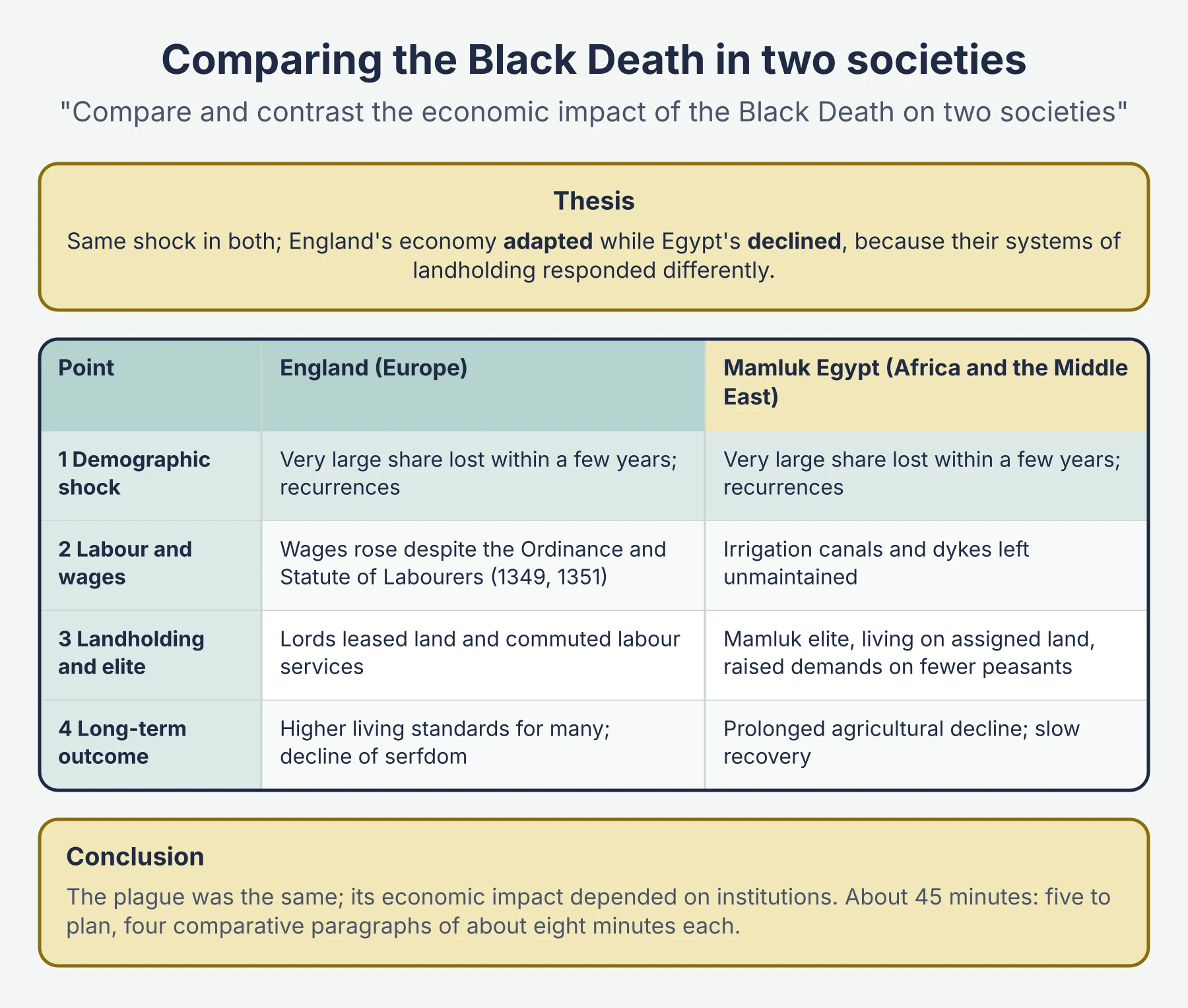
| Regional contrast | Faster adaptation in England; slower recovery in Mamluk Egypt’s irrigated agriculture |
Key terms
| Term | Meaning |
|---|---|
| Manorialism | Economic system in which peasants held land from a lord in return for labour and dues |
| Serf (villein) | Unfree peasant bound to the manor and its obligations |
| Commutation | Replacing labour services with money rents |
| Champa rice | Fast-ripening rice from South-East Asia spread in Song China |
| Jiaozi | Early Chinese paper money |
| Waqf | Islamic charitable endowment funding religious and public institutions |
| Ulama | Muslim religious scholars |
| Hanseatic League | Association of north German and Baltic trading towns |
| Pax Mongolica | Relative security of Eurasian travel under Mongol rule |
| Usury | Lending at interest, condemned by the medieval Church |
Exam traps
- One region only. “Each chosen from a different region” is a requirement; England and France are both Europe.
- Description of trade routes. Examiners want the effect on a society: wealth, urban growth, new ideas, disease.
- Overstating the Black Death. Long-term changes such as commutation had begun before 1348; the plague accelerated them.
- Static societies. Show change over time, such as Song commercialisation or the decline of serfdom.
- Vague dates. “Medieval” is not a date. Use 1024, 1324, 1348 and 1381 where they fit.
- Time limits. The topic runs to 1400; Zheng He’s voyages and the printing press in Europe fall outside it.
Self-test
- How did Champa rice change the Song economy? It ripened quickly and allowed double cropping, supporting population growth in the south.
- What was the jiaozi? Paper money issued by the Song state, first in Sichuan.
- What was manorialism? A system in which peasants held land from a lord in return for labour services and dues.
- Which English law of 1351 tried to fix wages after the Black Death? The Statute of Labourers.
- In which year did the Peasants’ Revolt take place? 1381.
- What did Mansa Musa’s pilgrimage reveal about Mali? The great wealth Mali drew from gold and the trans-Saharan trade, and the importance of Islam to its rulers.
- What was the House of Wisdom? A centre of learning and translation in Abbasid Baghdad.
- How did Islamic scholarship reach European universities? Through Latin translations made especially in Spain and Sicily.
- What was the Hanseatic League? An association of trading towns of northern Germany and the Baltic.
- Why did the Pax Mongolica help trade? Mongol rule across much of Eurasia made overland travel safer for merchants and envoys.
- What was the role of a waqf? To fund mosques, schools, hospitals and other public institutions through a charitable endowment.
- Give one reason why Egypt recovered more slowly from the Black Death than England. Its irrigation system needed labour and central maintenance that depopulation disrupted, and its landholding elite could not easily adapt.
Get free revision emails (optional)
Occasional emails with practice questions, worked explanations and links to free resources for the qualification and subjects you choose. No spam, and you can unsubscribe from any email. The free tools on this site never need an email.
Related resources
-
Practice questions
IB DP History: The Six Key Concepts – Practice Questions
Original practice questions with worked answers on the six key concepts of IB DP History (first assessed 2017), from spotting the concept to essay plans.
World History · International Baccalaureate · IB
Try questions -
Study guides
IB DP History (DP History): Authoritarian states (20th century)
Emergence, consolidation and policies of 20th-century authoritarian states, with Stalin, Hitler, Mao and Castro compared for IB History Paper 2 essays.
World History · International Baccalaureate · IB
Read guide -
Practice questions
IB DP History (DP History): Authoritarian states (20th century) – Practice Questions
Twelve original IB History practice questions on 20th-century authoritarian states, from short recall to a full Paper 2 essay, with mark-scheme answers.
World History · International Baccalaureate · IB
Try questions
Related articles
-
teaching
A Level tuition in Dubai: Cambridge or Pearson Edexcel International A Level?
Schools in Dubai and Abu Dhabi teach either Cambridge International AS & A Level or Pearson Edexcel International A Level. How the two are structured, why it matters for tuition, and how online classes from Lahore work.
9 October 2026
-
curriculum guides
Choosing subjects at IGCSE and A Level
How subject choices at 14 and 16 affect university options later, and how to keep pathways open without overloading a timetable.
28 July 2026
Studying this with a teacher
Working through World History IB?
This page is free and stays free. If you would rather be taught it, Marlbridge runs World History classes one-to-one, online in your own time zone. The first trial class is free. WhatsApp replies within an hour (8am–11pm Pakistan time, every day); email the same day.
IB World History teachers at Marlbridge
