
Study Guides
IB DP History (DP History): Causes and effects of wars (750-1500)
IB History Paper 2 world history topic 2, medieval wars 750-1500: causes, practices and effects of war across regions, with a worked comparative essay plan.
- Subject
- World History
- Level
- IB
- Topic
- Topic 2: World history topics
- Author
- Marlbridge Academic Team
- Updated
- Reviewed by
- Azam Siddique (what this means)
Aligned to International Baccalaureate IB Diploma Programme World History (DP History), First assessment 2017. Official specification .
Syllabus page (what it covers and how it is assessed): IB Diploma Programme World History.
Syllabus points this page covers
DP History
- 2 Causes and effects of wars (750-1500)
Found an error? Report a correction.
Need help with this topic? Request a free trial class for IB Diploma Programme World History (DP History).
World history topic 2, Causes and effects of wars (750-1500), asks why medieval societies went to war, how they fought, and what difference wars made. Your teacher chooses wars from different regions; Paper 2 questions then ask you to compare them, or to assess one war’s causes or consequences. The world history topics overview explains Paper 2; this guide concentrates on the content and arguments of this topic.
What the topic covers
The content can be organised under three headings, the same pattern used for the other war topics in the course:
- Causes of war: religious, dynastic, territorial, economic and political causes, and the distinction between long-term causes and short-term triggers.
- Practices of war and their impact on the outcome: types of war (crusades, dynastic wars, wars of conquest, civil wars), military technology and tactics, the mobilisation of resources, and leadership.
- Effects of war: territorial and political change, economic and social consequences, and the effect on religious and cultural life.
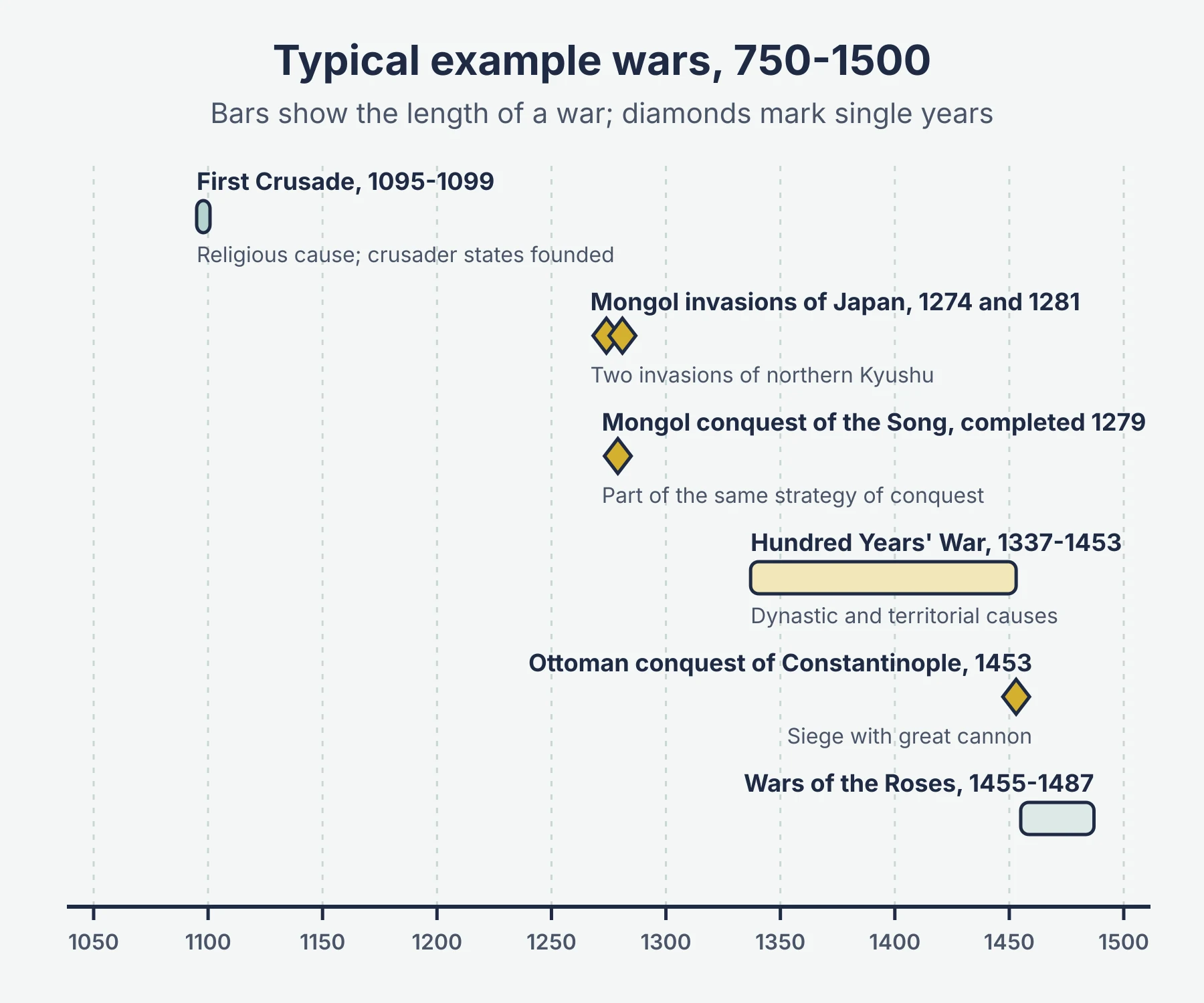
Typical examples include the First Crusade (1095-1099), the Hundred Years’ War (1337-1453), the Mongol invasions of Japan (1274 and 1281), the Mongol conquest of the Song (completed 1279), the Wars of the Roses (1455-1487) and the Ottoman conquest of Constantinople (1453).
Causes of medieval wars
Religious causes
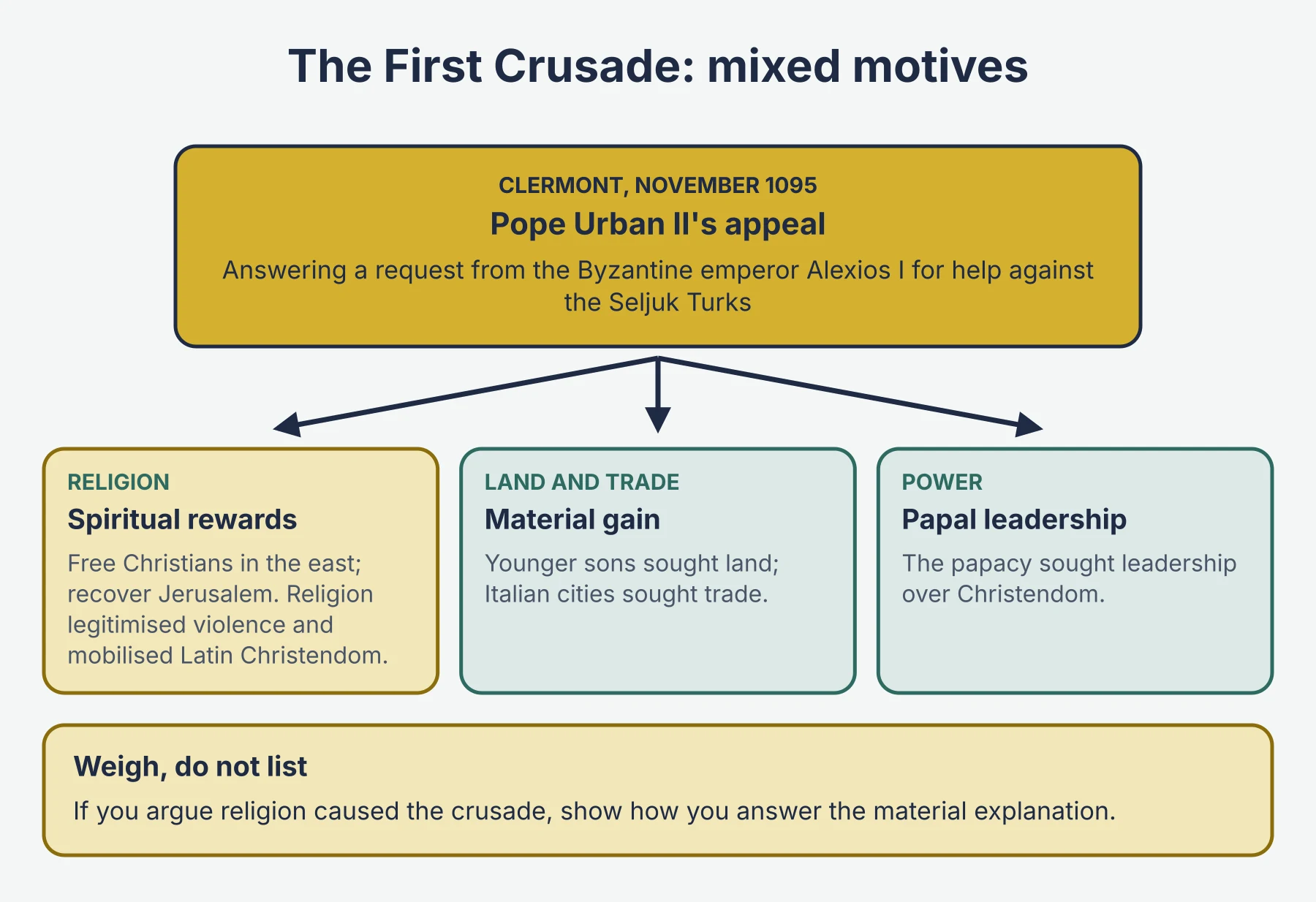
The First Crusade began with Pope Urban II’s appeal at Clermont in November 1095, answering a request from the Byzantine emperor Alexios I for help against the Seljuk Turks. Urban offered spiritual rewards to those who fought to free Christians in the east and to recover Jerusalem. Religion legitimised violence and mobilised people across Latin Christendom. But motives were mixed: younger sons sought land, Italian cities sought trade, and the papacy sought leadership over Christendom.
Dynastic and territorial causes
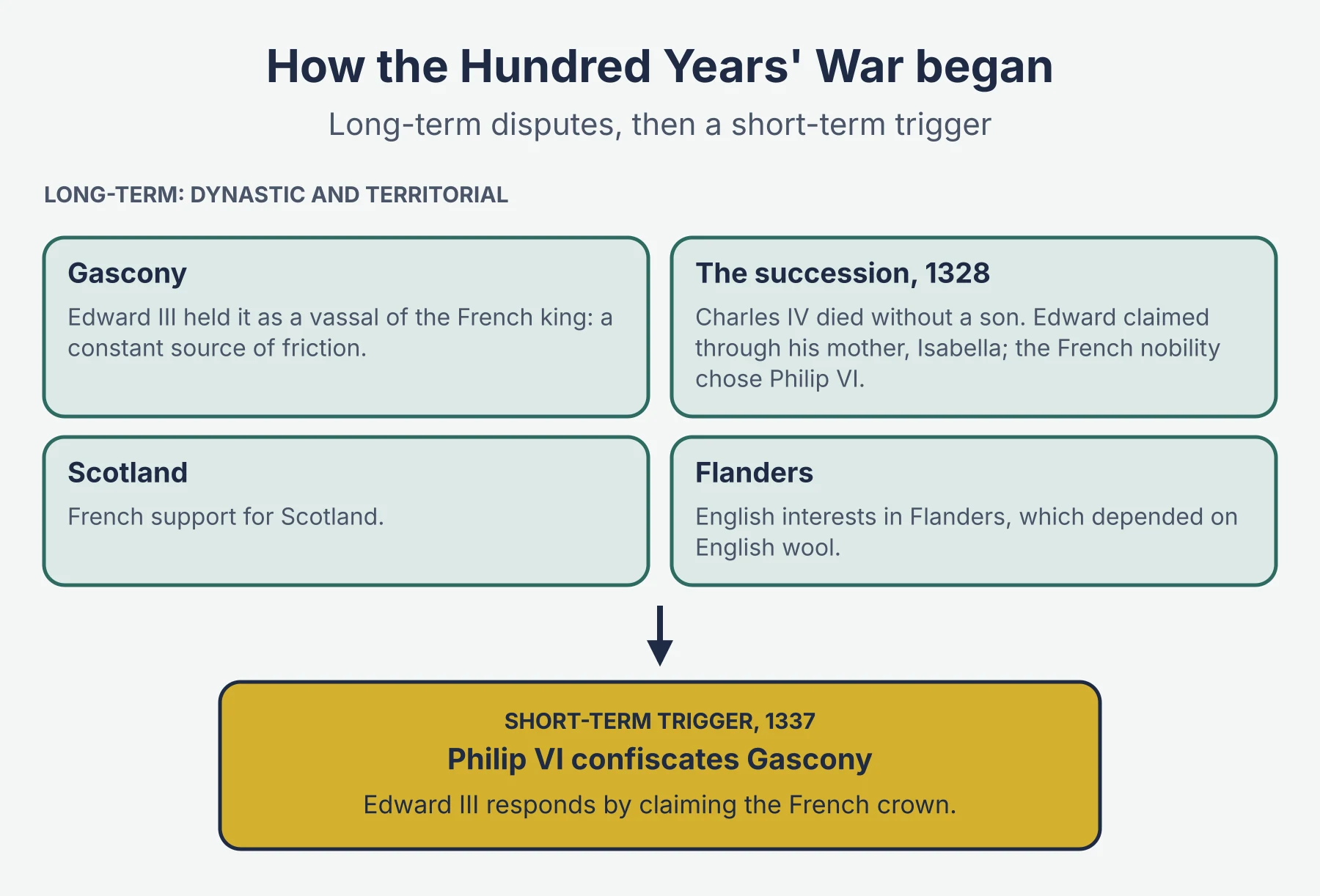
The Hundred Years’ War grew from a tangle of dynastic and territorial disputes. Edward III of England held Gascony as a vassal of the French king, a constant source of friction. When Charles IV of France died in 1328 without a son, Edward claimed the throne through his mother, Isabella, but the French nobility chose Philip VI. In 1337 Philip confiscated Gascony and Edward responded by claiming the French crown. Other causes included French support for Scotland and English interests in Flanders, which depended on English wool.
Imperial expansion
The Mongol invasions of Japan followed Kublai Khan’s demand that Japan submit as a tributary. The Kamakura shogunate refused and executed later envoys. The invasions were part of a wider strategy of conquest that also brought down the Song.
Short-term triggers
Distinguish underlying causes from the event that turned tension into war: Philip VI’s confiscation of Gascony (1337), or the Japanese refusal of Mongol demands.
Practices of war and their impact on the outcome
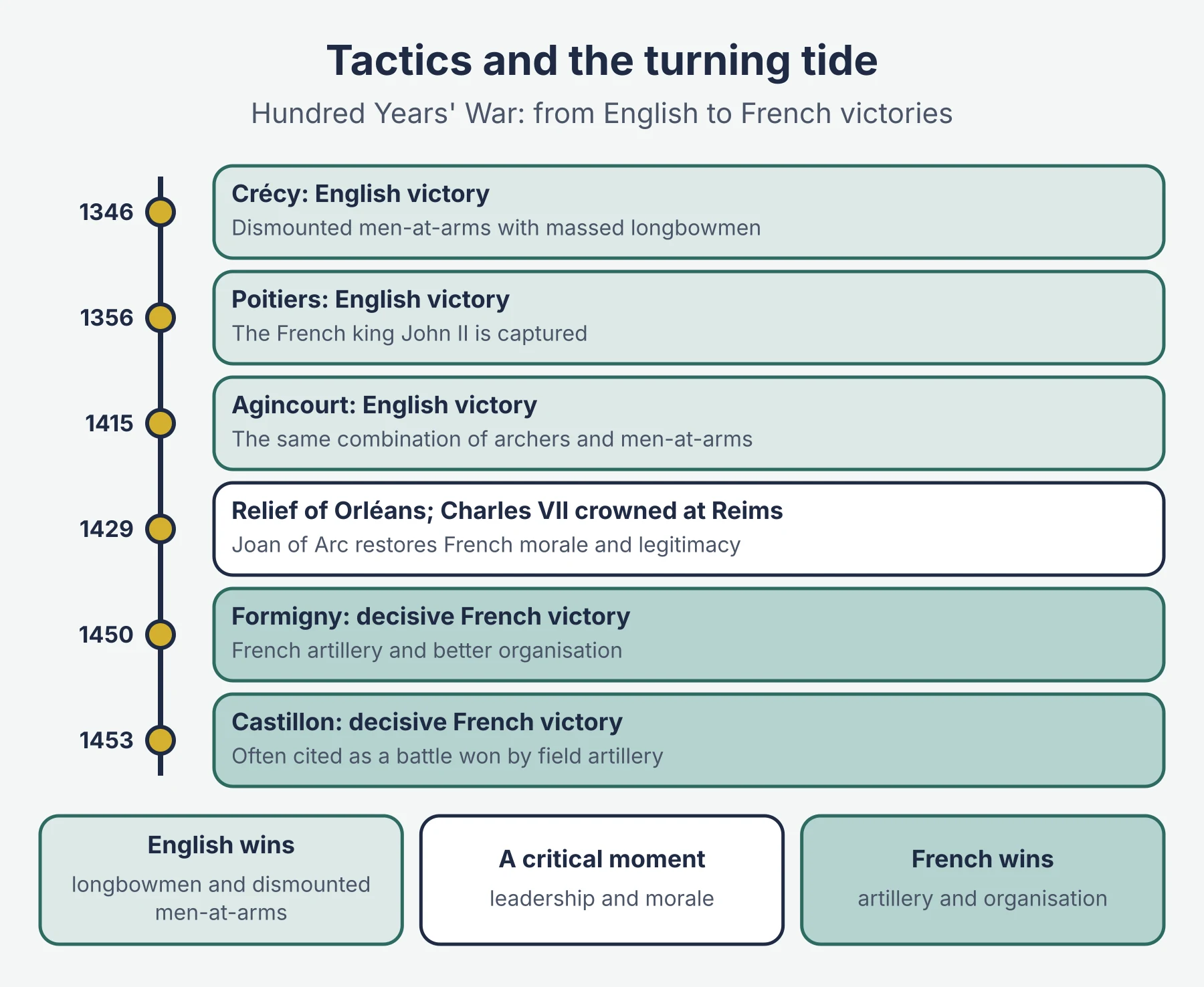
Tactics and technology. In the Hundred Years’ War, English armies combined dismounted men-at-arms with massed longbowmen, winning at Crécy (1346), Poitiers (1356, where the French king John II was captured) and Agincourt (1415). By the 1440s and 1450s French artillery and better organisation turned the tide: at Formigny (1450) and Castillon (1453) French forces won decisively, and Castillon is often cited as a battle won by field artillery.
Raiding. The English chevauchée devastated French countryside to weaken the enemy’s resources and authority, rather than to hold territory.
Siege warfare. Mehmed II’s army breached the ancient land walls of Constantinople with great cannon, including guns cast by the Hungarian founder Orban, and took the city on 29 May 1453.
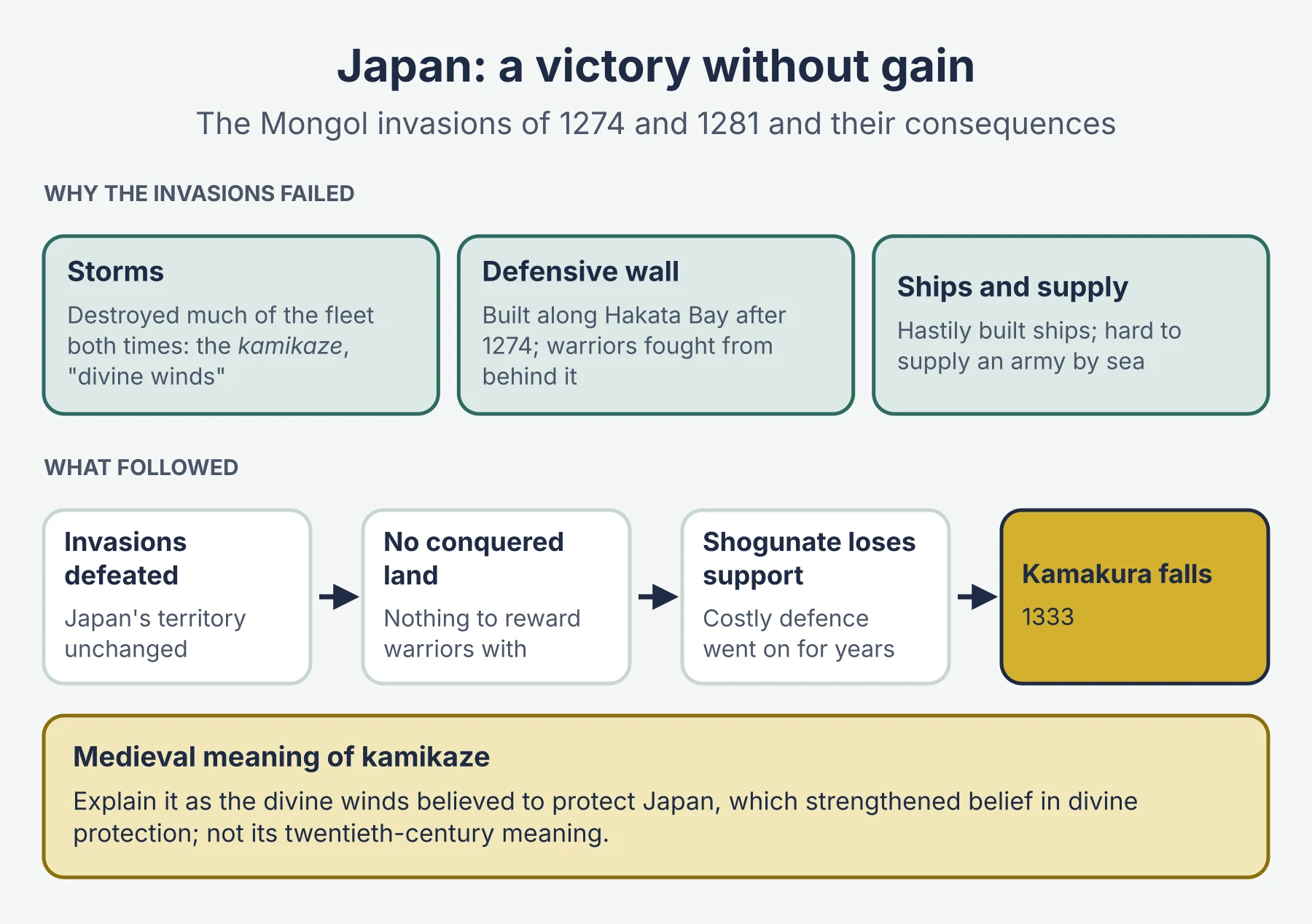
Environment and logistics. In 1274 and 1281 Mongol fleets carrying Mongol, Chinese and Korean troops landed in northern Kyushu. Japanese warriors fought from behind a defensive wall built along Hakata Bay after 1274. On both occasions storms destroyed much of the invasion fleet; the Japanese called them kamikaze, divine winds. Hastily built ships and the difficulty of supplying an army by sea weakened the invaders.
Leadership and morale. Joan of Arc’s role in the relief of Orléans and the coronation of Charles VII at Reims (1429) restored French morale and legitimacy at a critical moment.
Effects of war
| War | Political effects | Economic and social effects |
|---|---|---|
| First Crusade | Crusader states founded (Edessa, Antioch, Tripoli, Jerusalem); military orders created | Italian cities expanded Levantine trade; Muslim leaders later united against the crusaders |
| Hundred Years’ War | England lost all French lands except Calais; French monarchy strengthened with permanent taxation and a standing army | Devastation in France; English war taxation provoked resistance; growth of national identity on both sides |
| Mongol invasions of Japan | The Kamakura shogunate, unable to reward warriors with conquered land, lost support and fell in 1333 | Costly defence preparations continued for years; belief in divine protection strengthened |
| Fall of Constantinople | End of the Byzantine Empire; Ottoman capital moved to the city | Ottoman control of trade between the Black Sea and Mediterranean |
Worked example: a comparative essay
Question: “Compare and contrast the effects of two medieval wars, each chosen from a different region.”
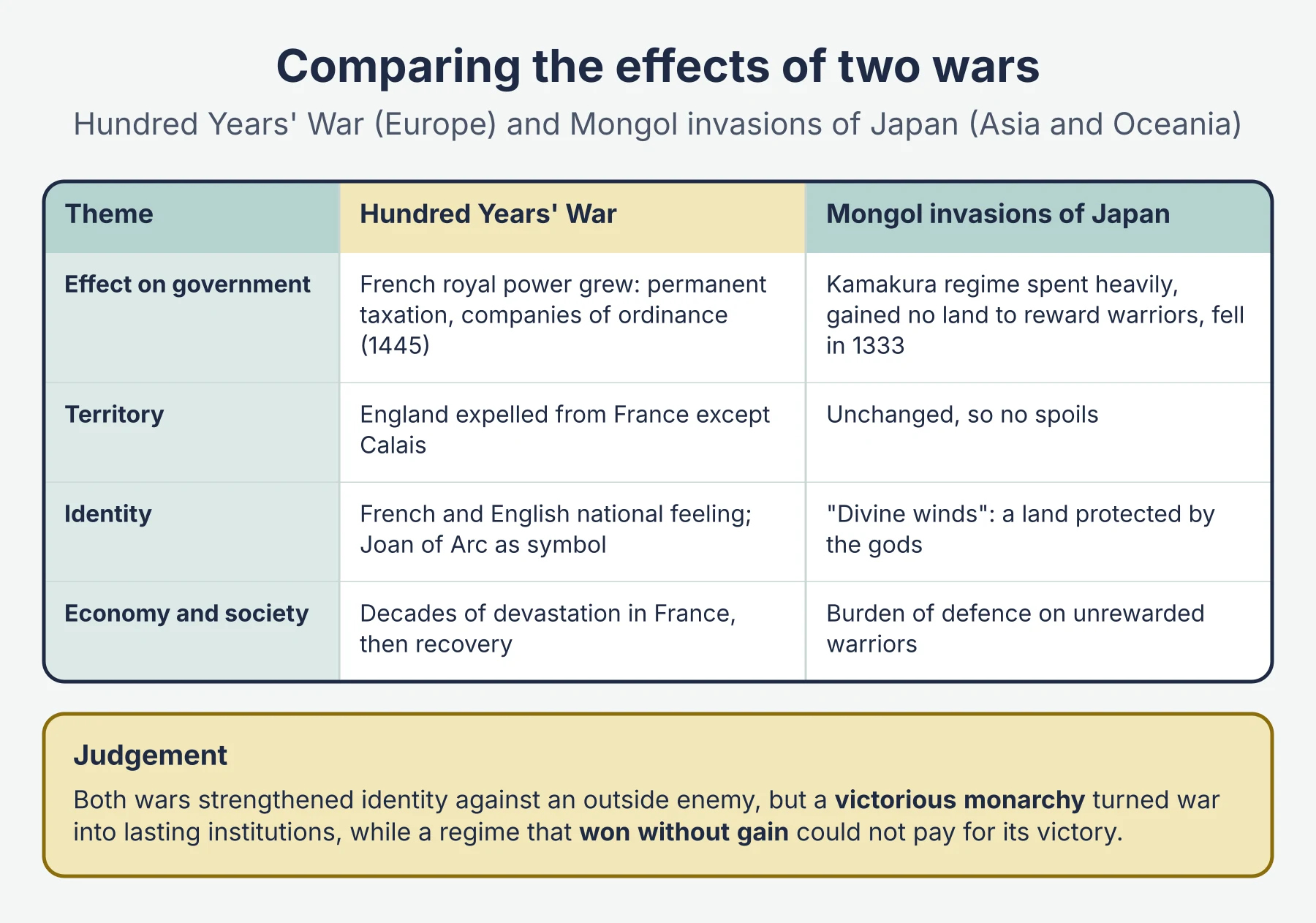
Examples: the Hundred Years’ War (Europe) and the Mongol invasions of Japan (Asia and Oceania).
Thesis: both wars strengthened a sense of collective identity against an outside enemy, but they had opposite effects on the governments that fought them: the French monarchy emerged stronger, while the Kamakura shogunate was fatally weakened.
Paragraphs:
- Political effects on governments. French royal power grew through permanent taxation and the companies of ordinance (1445); the Kamakura regime spent heavily but gained no land to reward its warriors and fell in 1333.
- Territorial effects. England was expelled from France except Calais; Japan’s territory was unchanged, so there were no spoils.
- Identity and ideology. The war encouraged French and English national feeling, symbolised by Joan of Arc; in Japan the “divine winds” reinforced the idea of a land protected by the gods.
- Economic and social effects. France suffered decades of devastation, then recovery; in Japan the burden of defence fell on warriors who were left unrewarded.
Conclusion: the decisive difference lay in the outcome: a victorious monarchy could convert war into lasting institutions, while a regime that won without gain could not pay for its victory.
Interpretations
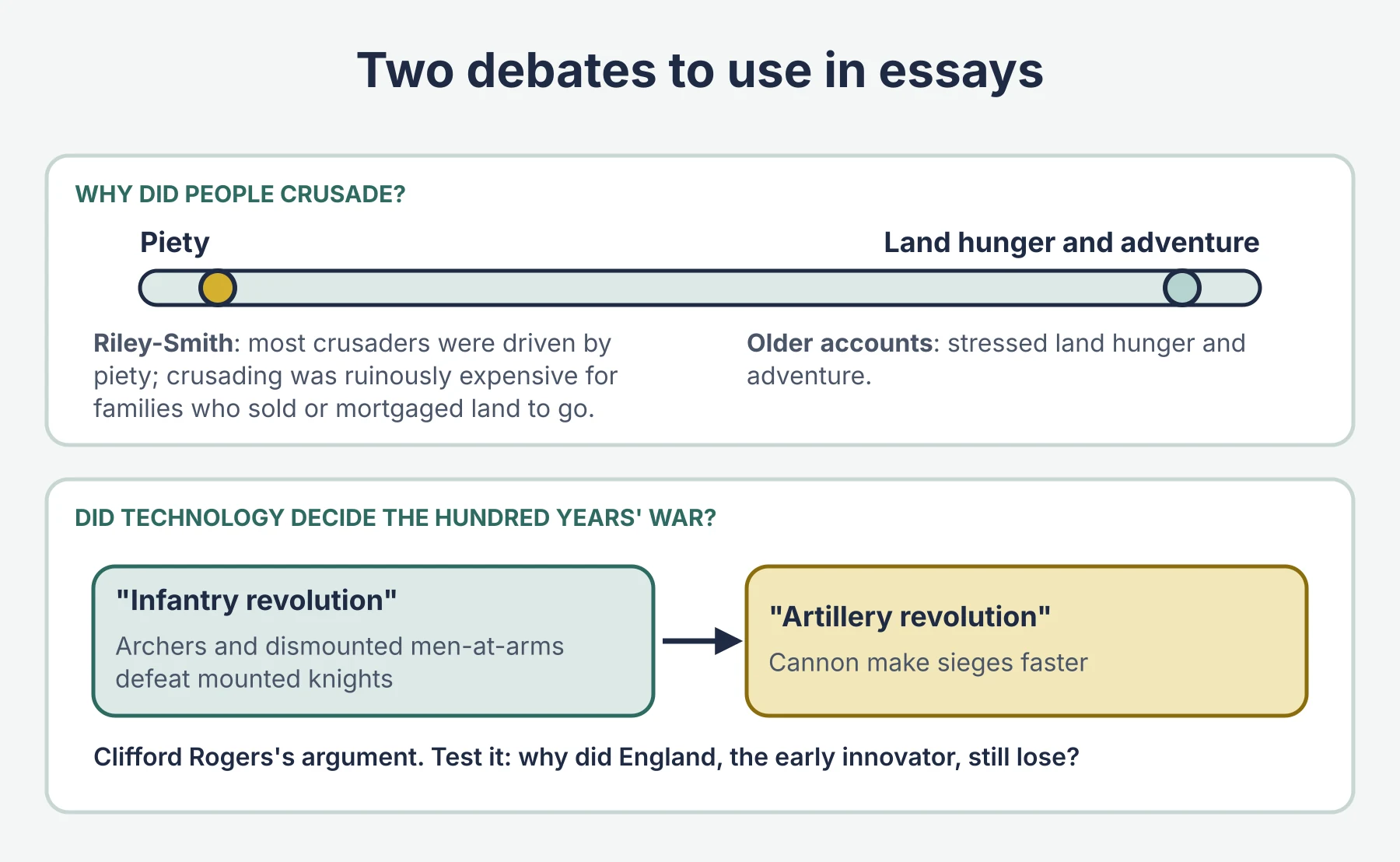
Two debates are especially useful. On the crusades, Jonathan Riley-Smith argued that most crusaders were driven by piety rather than greed, pointing out that crusading was ruinously expensive for families who sold or mortgaged land to go; older accounts stressed land hunger and adventure. On the Hundred Years’ War, Clifford Rogers argued that the war saw an “infantry revolution”, as archers and dismounted men-at-arms defeated mounted knights, followed by an “artillery revolution” in which cannon made sieges faster. Both debates help you weigh causes and practices: if you argue that religion caused the First Crusade, show how you answer the material explanation; if you argue that technology decided the Hundred Years’ War, explain why England, the early innovator, still lost.
Common mistakes
- Narrating the course of a war in place of analysing its causes or effects.
- Listing causes without distinguishing long-term from short-term, or ranking them.
- Choosing two European wars for a question requiring two regions.
- Giving effects that fall outside 1500, such as the Reformation.
- Using “kamikaze” with its twentieth-century meaning rather than explaining its medieval sense.
Exam technique
Questions often use examine, evaluate, discuss and compare and contrast. For “reasons for the outcome” questions, weigh military factors (tactics, technology, leadership) against political and economic ones (resources, alliances, internal divisions). For effects, separate short- and long-term, and political, economic, social and cultural.
Revise with the medieval wars revision notes and practise with the medieval wars practice questions.
Get free revision emails (optional)
Occasional emails with practice questions, worked explanations and links to free resources for the qualification and subjects you choose. No spam, and you can unsubscribe from any email. The free tools on this site never need an email.
Related resources
-
Practice questions
IB DP History: The Six Key Concepts – Practice Questions
Original practice questions with worked answers on the six key concepts of IB DP History (first assessed 2017), from spotting the concept to essay plans.
World History · International Baccalaureate · IB
Try questions -
Practice questions
IB DP History (DP History): Causes and effects of wars (750-1500) – Practice Questions
Twelve original IB History practice questions on medieval wars 750-1500, from short recall to full Paper 2 essays, with mark-scheme answers.
World History · International Baccalaureate · IB
Try questions -
Revision notes
IB DP History (DP History): Causes and effects of wars (750-1500) – Revision Notes
Revision notes for IB History Paper 2 medieval wars 750-1500: war profiles, causes, practices and effects, key terms, exam traps and a self-test.
World History · International Baccalaureate · IB
Revise topic
Related articles
-
teaching
A Level tuition in Dubai: Cambridge or Pearson Edexcel International A Level?
Schools in Dubai and Abu Dhabi teach either Cambridge International AS & A Level or Pearson Edexcel International A Level. How the two are structured, why it matters for tuition, and how online classes from Lahore work.
9 October 2026
-
curriculum guides
Choosing subjects at IGCSE and A Level
How subject choices at 14 and 16 affect university options later, and how to keep pathways open without overloading a timetable.
28 July 2026
Studying this with a teacher
Working through World History IB?
This page is free and stays free. If you would rather be taught it, Marlbridge runs World History classes one-to-one, online in your own time zone. The first trial class is free. WhatsApp replies within an hour (8am–11pm Pakistan time, every day); email the same day.
IB World History teachers at Marlbridge
