
Revision Notes
IB DP History (DP History): Causes and effects of wars (750-1500) – Revision Notes
Revision notes for IB History Paper 2 medieval wars 750-1500: war profiles, causes, practices and effects, key terms, exam traps and a self-test.
- Subject
- World History
- Level
- IB
- Topic
- Topic 2: World history topics
- Author
- Marlbridge Academic Team
- Updated
- Reviewed by
- Azam Siddique (what this means)
Aligned to International Baccalaureate IB Diploma Programme World History (DP History), First assessment 2017. Official specification .
Syllabus page (what it covers and how it is assessed): IB Diploma Programme World History.
Syllabus points this page covers
DP History
- 2 Causes and effects of wars (750-1500)
Found an error? Report a correction.
Need help with this topic? Request a free trial class for IB Diploma Programme World History (DP History).
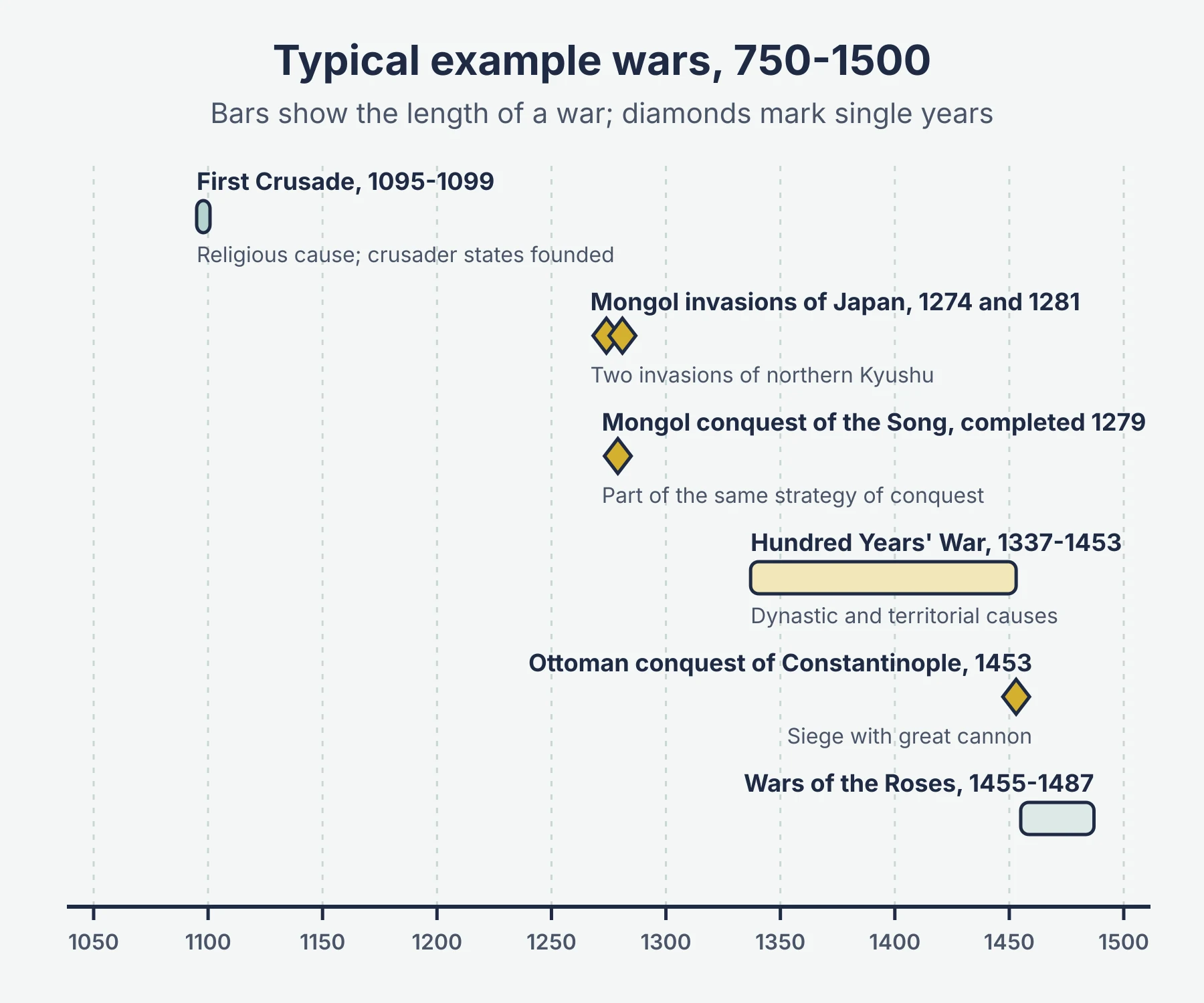
Causes and effects of wars (750-1500) is world history topic 2 for Paper 2. Revise at least two wars from different regions under three headings: causes, practices of war and their impact on the outcome, and effects.
Related: Medieval wars study guide and Medieval wars practice questions.
War profiles
The First Crusade (1095-1099)
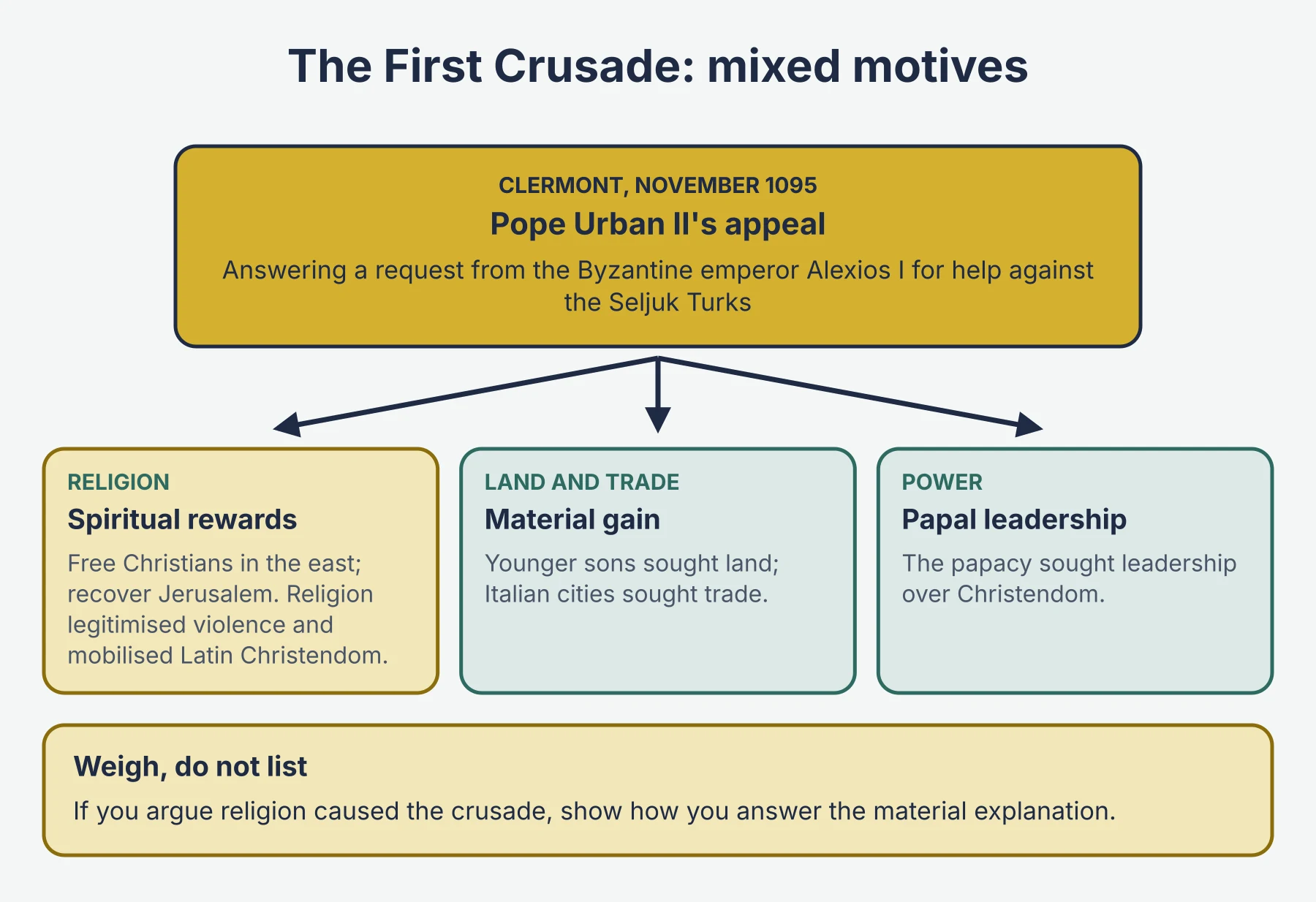
- Causes: Byzantine appeal against the Seljuks; Urban II’s preaching at Clermont (1095); religious enthusiasm and the promise of remission of sins; land, wealth and adventure; papal leadership.
- Practices: armies of knights and foot soldiers led by great nobles; long sieges (Nicaea 1097, Antioch 1098, Jerusalem 1099); victory at Dorylaeum (1097); Muslim states divided between Seljuk rivals and the Fatimids.
- Effects: four crusader states; capture of Jerusalem (July 1099) with massacre of its inhabitants; military orders such as the Templars and Hospitallers; later Muslim counter-crusade under Zengi, Nur al-Din and Saladin.
The Hundred Years’ War (1337-1453)
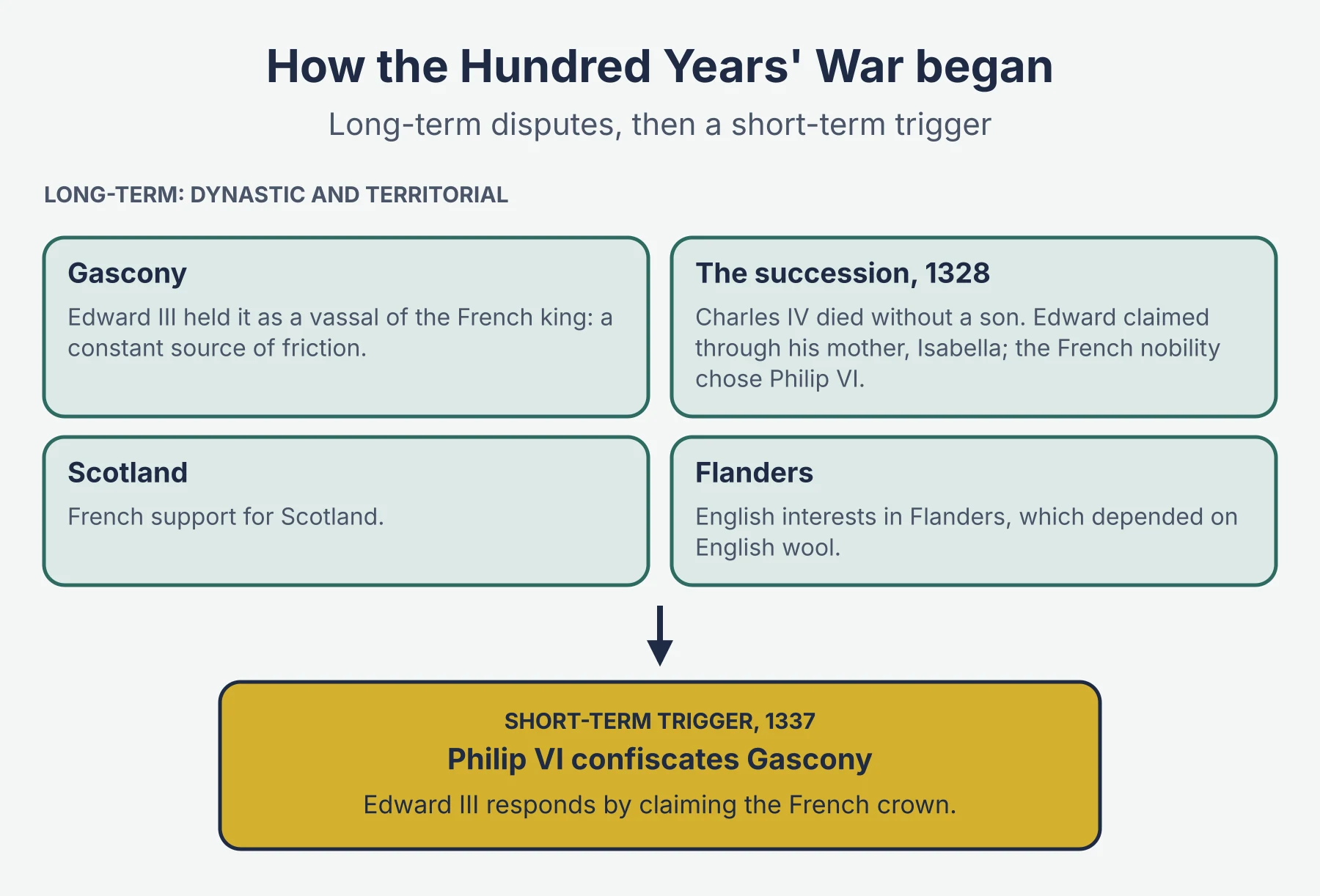
- Causes: Gascony and vassalage; Edward III’s claim to the French throne (1328 succession); Flanders and the wool trade; the Franco-Scottish alliance; confiscation of Gascony (1337).
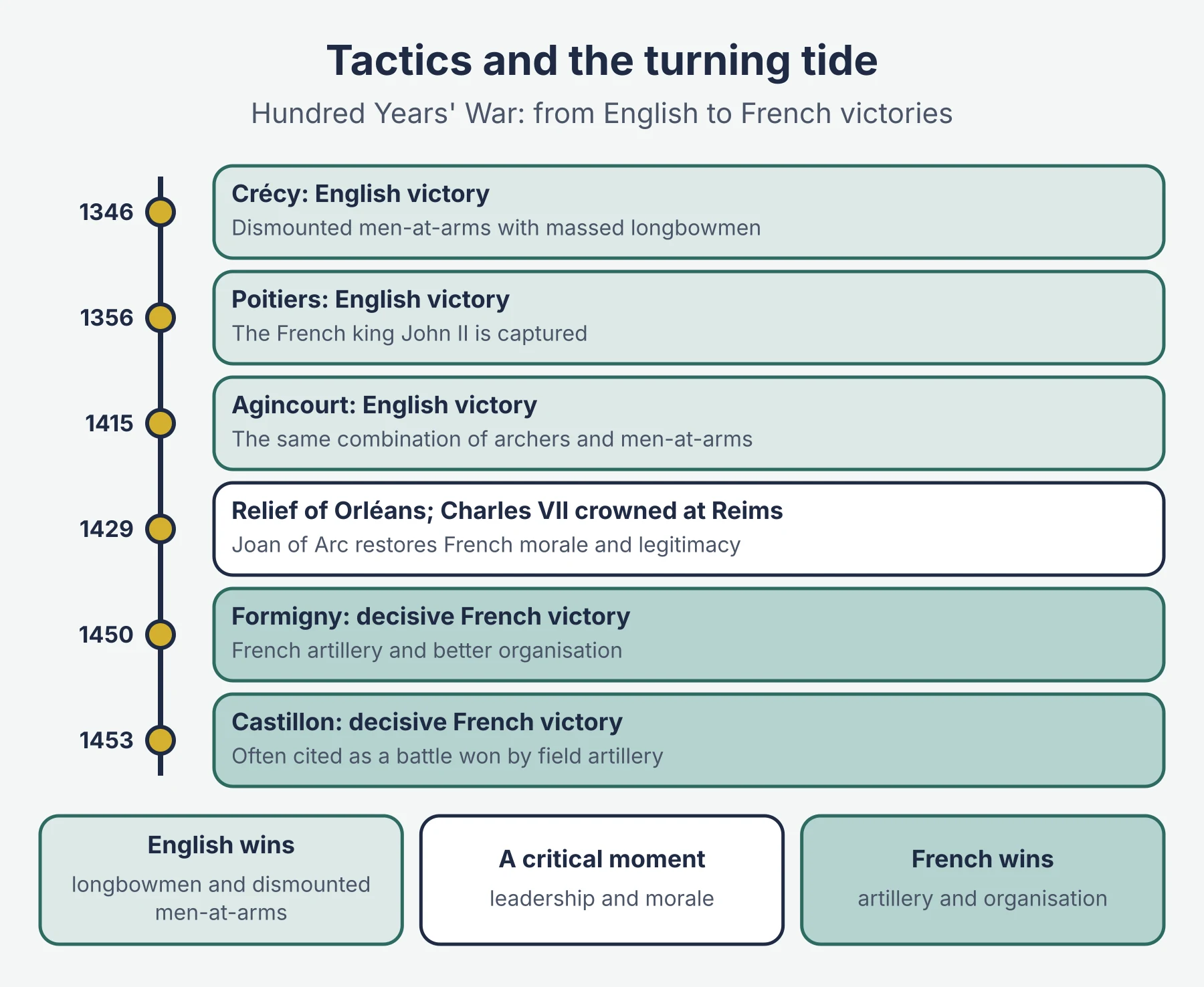
- Practices: longbow and dismounted men-at-arms (Crécy 1346, Poitiers 1356, Agincourt 1415); chevauchées; truces and treaties (Brétigny 1360, Troyes 1420); French recovery under Charles VII; artillery (Formigny 1450, Castillon 1453).
- Effects: English expelled except Calais; stronger French monarchy (permanent taxes, companies of ordinance); national identity; English political instability feeding the Wars of the Roses.
The Mongol invasions of Japan (1274, 1281)
- Causes: Kublai Khan’s demand for tribute; Japanese refusal; Mongol imperial ideology of universal rule; the war against the Song.
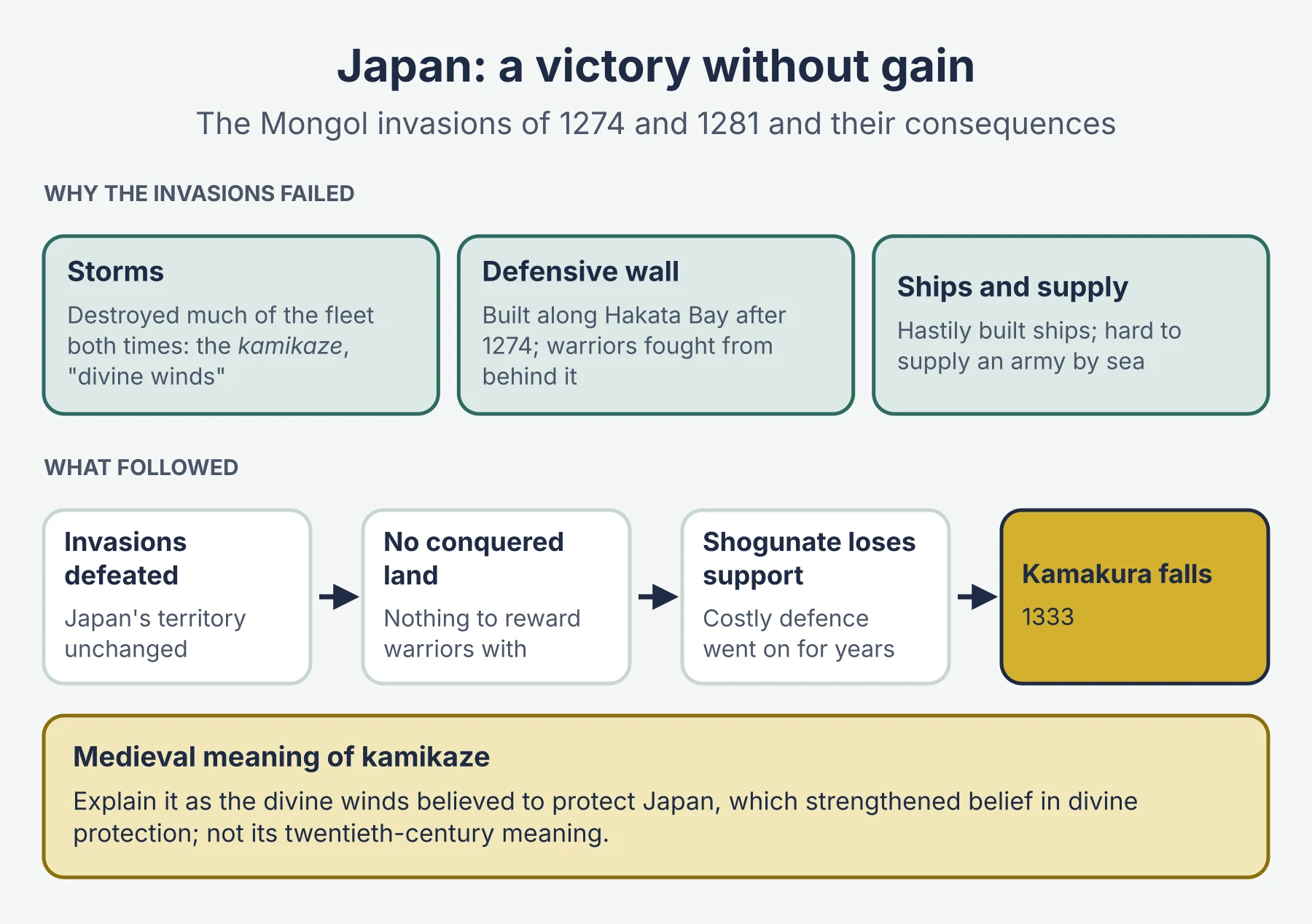
- Practices: amphibious landings at Hakata Bay; Mongol, Chinese and Korean forces; explosive projectiles; Japanese defensive wall; typhoons destroyed the fleets.
- Effects: no conquest; Kamakura shogunate weakened by costs and unrewarded warriors, falling in 1333; belief in divine protection.
The Ottoman conquest of Constantinople (1453)
- Causes: Ottoman expansion and Mehmed II’s ambition; the city’s strategic position; Byzantine weakness.
- Practices: blockade by land and sea; giant cannon; ships hauled overland into the Golden Horn.
- Effects: end of Byzantium; new Ottoman capital; Ottoman control of the straits; Greek scholars moved west.
Types of medieval war
| Type | Definition | Example |
|---|---|---|
| Crusade | War sanctioned by the papacy, with spiritual rewards for participants | First Crusade |
| Dynastic war | War over rights of succession or inheritance | Hundred Years’ War |
| Civil war | War between factions within one kingdom | Wars of the Roses |
| War of conquest | War to annex territory or exact tribute | Mongol invasions; Ottoman conquest |
| Holy war (jihad) | War presented as religious duty in Islamic terms | Saladin’s campaigns against the crusader states |
Causes: ranking framework
| Cause | Ask yourself |
|---|---|
| Religious | Was religion a motive, a justification, or both? |
| Dynastic | Whose claim was at stake, and why was it disputed then? |
| Territorial | Which lands were contested, and what were they worth? |
| Economic | Who gained from trade, plunder or ransom? |
| Political | Did a ruler need war to secure authority at home? |
| Trigger | What turned tension into fighting in that year? |
Key terms
| Term | Meaning |
|---|---|
| Vassal | A lord who held land from a superior lord in return for loyalty and service |
| Chevauchée | Destructive mounted raid through enemy territory |
| Longbow | Powerful bow with a high rate of fire, used en masse by English armies |
| Men-at-arms | Fully armoured soldiers, mounted or on foot |
| Companies of ordinance | France’s permanent royal cavalry companies from 1445 |
| Crusader states | The county of Edessa, principality of Antioch, county of Tripoli and kingdom of Jerusalem |
| Military orders | Religious orders of knights, such as the Templars and Hospitallers |
| Kamikaze | “Divine wind”: the storms credited with saving Japan in 1274 and 1281 |
| Siege train | Artillery and equipment moved with an army for sieges |
Exam traps
- Narrative. Telling the story of a war earns little; organise by cause or effect.
- Effects beyond 1500. Stay inside the topic’s dates.
- Religion as the only crusade motive. Show how religious and material motives combined.
- Technology as the only explanation. The longbow did not prevent England’s defeat; leadership, money and alliances mattered too.
- Same-region pairs. The Hundred Years’ War and the Wars of the Roses are both European.
- “Short-term” without a date. Name the trigger and its year.
Self-test
- Who appealed to the West for help in the 1090s, and against whom? The Byzantine emperor Alexios I, against the Seljuk Turks.
- Where and when did Urban II preach the First Crusade? At Clermont, in November 1095.
- Name the four crusader states. Edessa, Antioch, Tripoli and Jerusalem.
- On what grounds did Edward III claim the French throne? Through his mother, Isabella, sister of the last Capetian king, Charles IV.
- Which French king was captured at Poitiers in 1356? John II.
- Which battle of 1453 ended the Hundred Years’ War, and what weapon is it associated with? Castillon, field artillery.
- What were the companies of ordinance? France’s permanent royal cavalry companies, created in 1445.
- Why did Kublai Khan invade Japan? Japan refused his demand to submit as a tributary.
- What defensive measure did the Japanese take after 1274? They built a wall along Hakata Bay.
- Why did the Mongol invasions weaken the Kamakura shogunate? Defence was costly and, with no land conquered, it could not reward the warriors who fought.
- What technology helped Mehmed II breach the walls of Constantinople? Great cannon, including guns cast by Orban.
- Give one long-term effect of the First Crusade on the Muslim world. It provoked a counter-crusade that united Syria and Egypt under leaders such as Nur al-Din and Saladin.
Get free revision emails (optional)
Occasional emails with practice questions, worked explanations and links to free resources for the qualification and subjects you choose. No spam, and you can unsubscribe from any email. The free tools on this site never need an email.
Related resources
-
Practice questions
IB DP History: The Six Key Concepts – Practice Questions
Original practice questions with worked answers on the six key concepts of IB DP History (first assessed 2017), from spotting the concept to essay plans.
World History · International Baccalaureate · IB
Try questions -
Study guides
IB DP History (DP History): Dynasties and rulers (750-1500)
IB History Paper 2 world history topic 3, Dynasties and rulers 750-1500: legitimacy, gaining and keeping power, religion and decline, with a worked essay plan.
World History · International Baccalaureate · IB
Read guide -
Practice questions
IB DP History (DP History): Dynasties and rulers (750-1500) – Practice Questions
Twelve original IB History practice questions on Dynasties and rulers 750-1500, from short recall to full Paper 2 essays, with mark-scheme answers.
World History · International Baccalaureate · IB
Try questions
Related articles
-
teaching
A Level tuition in Dubai: Cambridge or Pearson Edexcel International A Level?
Schools in Dubai and Abu Dhabi teach either Cambridge International AS & A Level or Pearson Edexcel International A Level. How the two are structured, why it matters for tuition, and how online classes from Lahore work.
9 October 2026
-
curriculum guides
Choosing subjects at IGCSE and A Level
How subject choices at 14 and 16 affect university options later, and how to keep pathways open without overloading a timetable.
28 July 2026
Studying this with a teacher
Working through World History IB?
This page is free and stays free. If you would rather be taught it, Marlbridge runs World History classes one-to-one, online in your own time zone. The first trial class is free. WhatsApp replies within an hour (8am–11pm Pakistan time, every day); email the same day.
IB World History teachers at Marlbridge
