
Study Guides
IB DP History (DP History): Dynasties and rulers (750-1500)
IB History Paper 2 world history topic 3, Dynasties and rulers 750-1500: legitimacy, gaining and keeping power, religion and decline, with a worked essay plan.
- Subject
- World History
- Level
- IB
- Topic
- Topic 2: World history topics
- Author
- Marlbridge Academic Team
- Updated
- Reviewed by
- Azam Siddique (what this means)
Aligned to International Baccalaureate IB Diploma Programme World History (DP History), First assessment 2017. Official specification .
Syllabus page (what it covers and how it is assessed): IB Diploma Programme World History.
Syllabus points this page covers
DP History
- 3 Dynasties and rulers (750-1500)
Found an error? Report a correction.
Need help with this topic? Request a free trial class for IB Diploma Programme World History (DP History).
World history topic 3, Dynasties and rulers (750-1500), is about power: how rulers and ruling families gained it, justified it, used it and lost it. Your teacher chooses rulers and dynasties from different regions, and Paper 2 questions ask you to evaluate one ruler’s methods or compare two. The world history topics overview explains Paper 2; this guide gives the depth for this topic.
What the topic covers
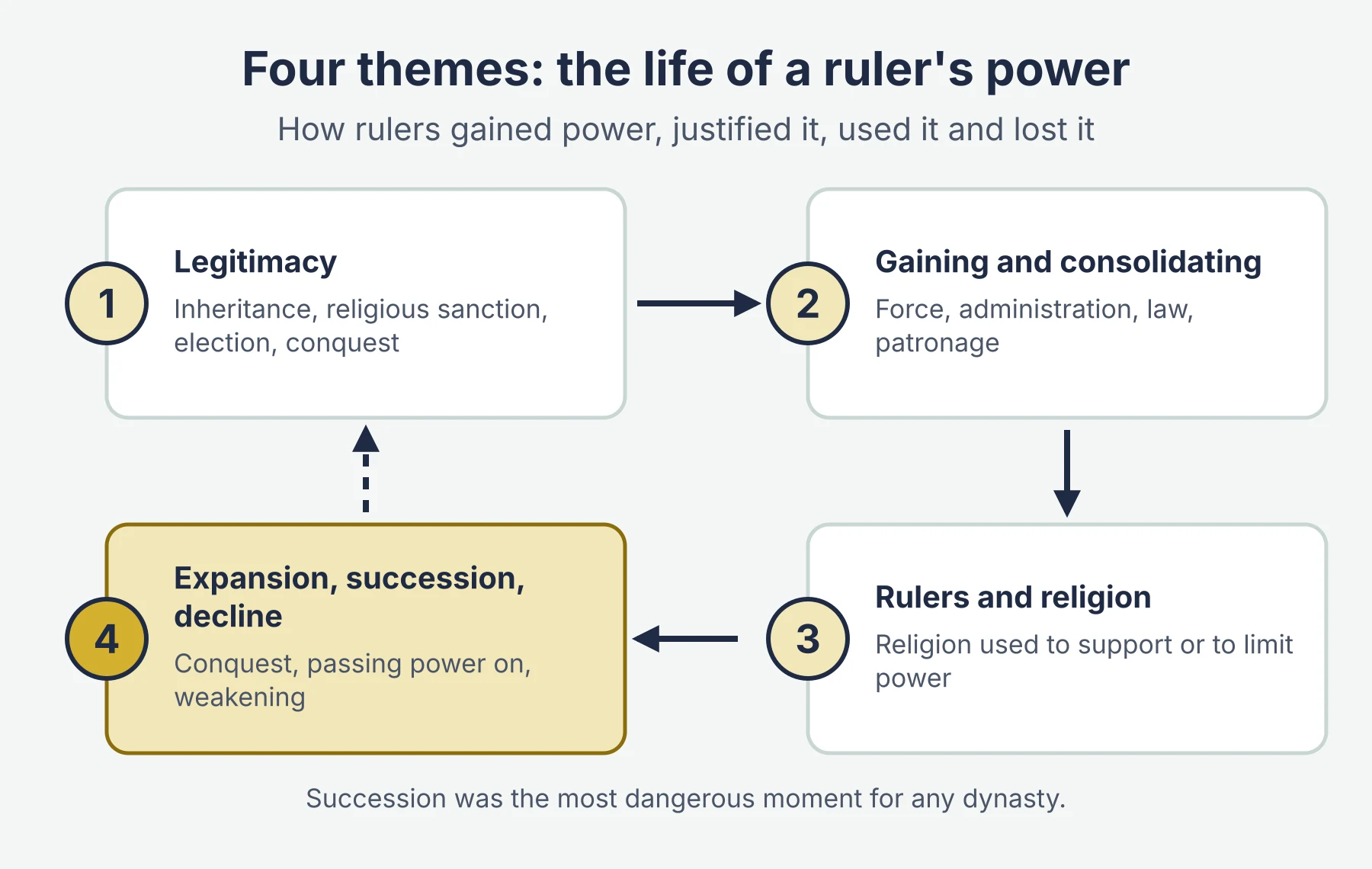
The content can be grouped into four themes:
- Legitimacy: the claims that made a ruler’s authority accepted, such as inheritance, religious sanction, election and conquest.
- Gaining and consolidating power: how rulers took power and secured it through military force, administration, law and patronage.
- Rulers and religion: the relationship between rulers and religious authorities, and the use of religion to support or limit power.
- Expansion, succession and decline: conquest and territorial growth, the problems of passing power on, and the reasons dynasties weakened.
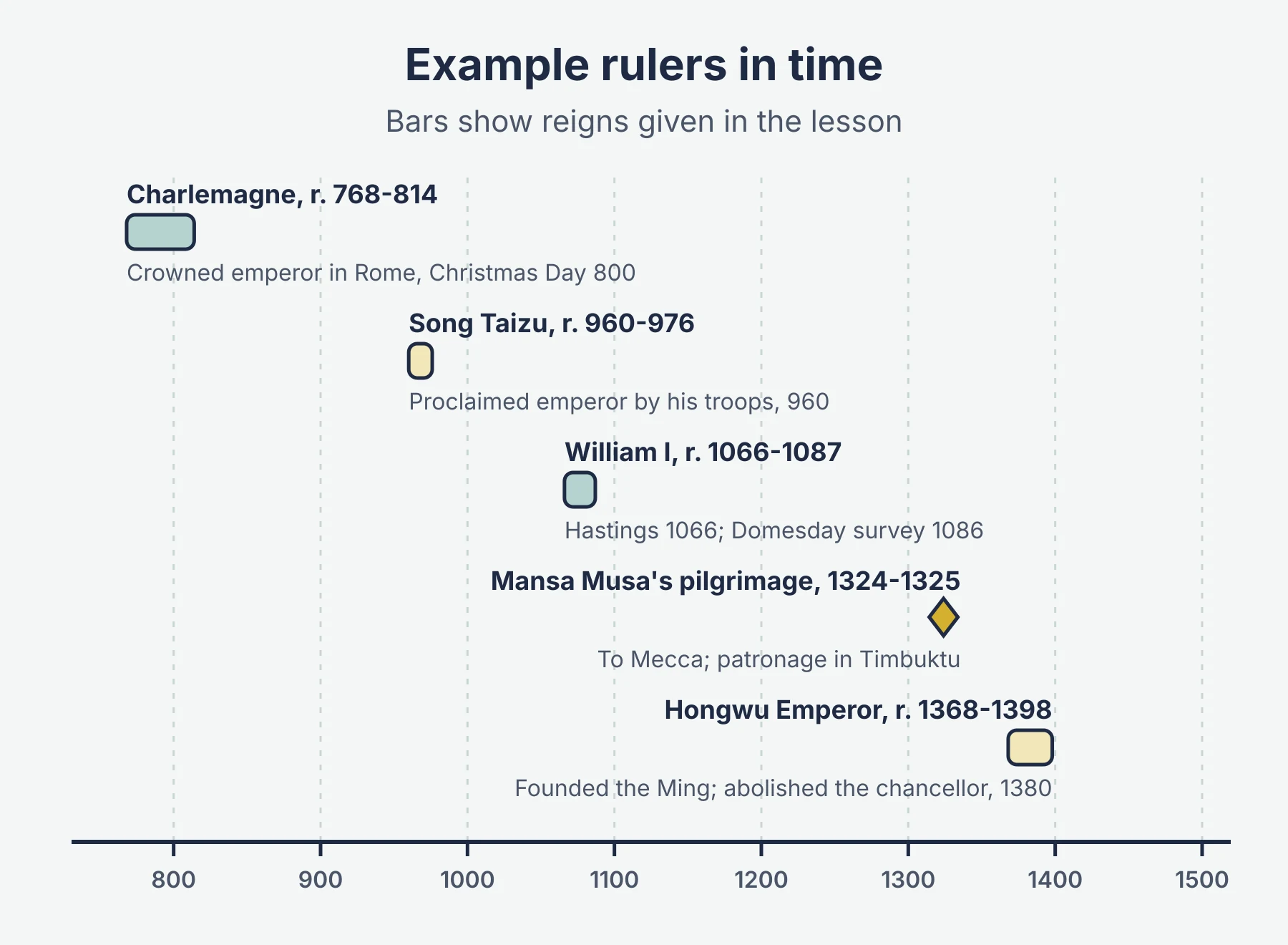
Common examples include Charlemagne and the Carolingians, the Abbasid caliphs, Song Taizu and the Song dynasty, William I of England, Mansa Musa of Mali, the Hongwu Emperor of the Ming, and Mehmed II of the Ottomans.
Legitimacy
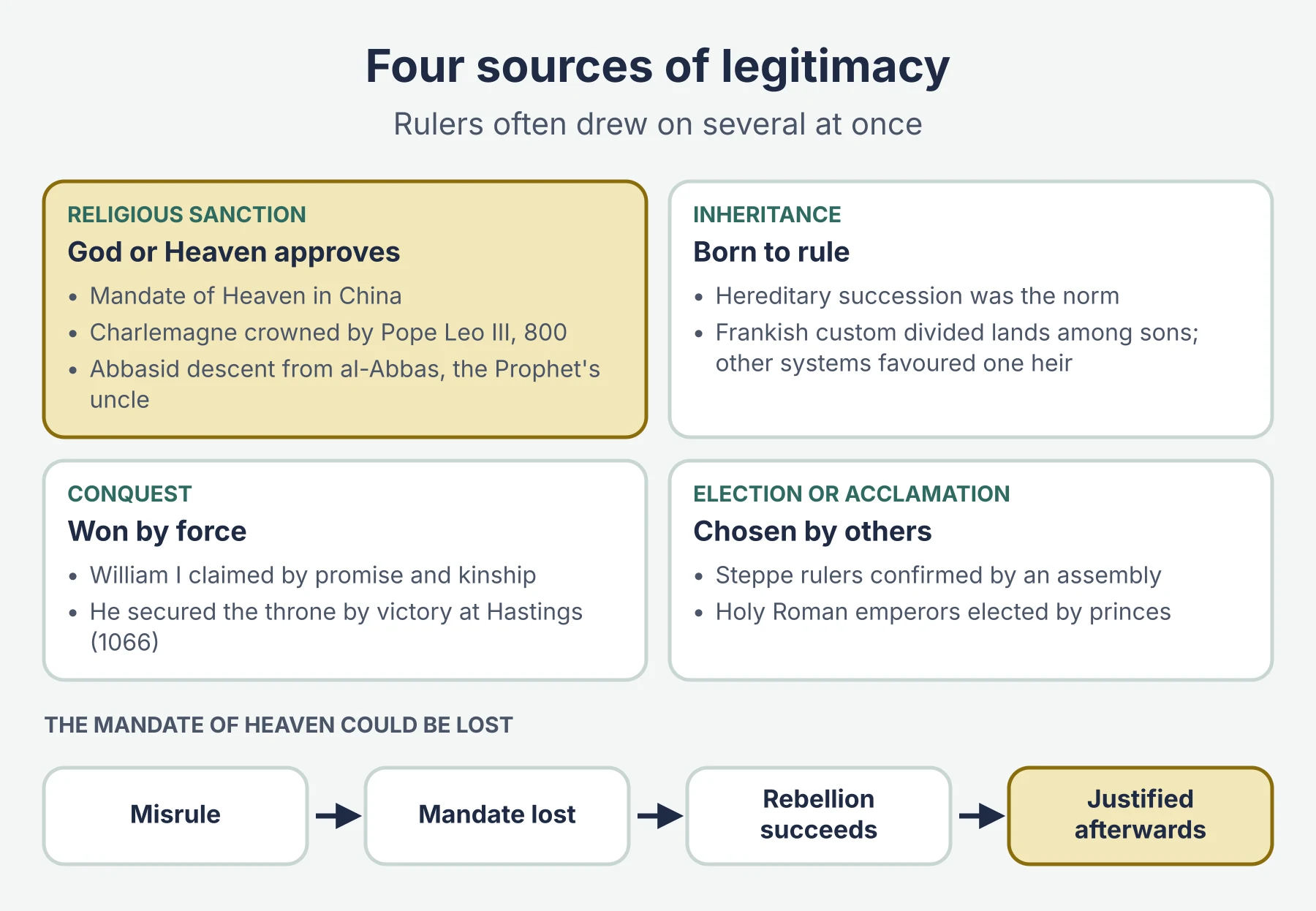
Rulers drew on different sources of authority, often several at once.
- Religious sanction. Chinese emperors ruled by the Mandate of Heaven, which could be lost through misrule, so rebellion that succeeded could be justified afterwards. Pope Leo III crowned Charlemagne emperor in Rome on Christmas Day 800, linking Frankish power to the Roman imperial tradition and the Church. The Abbasid caliphs claimed authority as successors of the Prophet and stressed their descent from his uncle al-Abbas.
- Inheritance. Hereditary succession was the norm, but rules differed: Frankish custom divided lands among sons, while other systems favoured a single heir.
- Conquest. William I claimed the English throne by promise and kinship, but secured it by victory at Hastings (1066).
- Election or acclamation. Steppe rulers needed confirmation by an assembly; Holy Roman emperors were elected by princes.
Gaining and consolidating power
Song Taizu (r. 960-976). A general, Zhao Kuangyin, was proclaimed emperor by his troops in 960. Knowing that generals had toppled the dynasties before him, he persuaded leading commanders to retire with rewards, placed armies under civilian control and expanded the civil service examinations. The Song created a state run by scholar-officials, which brought stability but, critics argue, military weakness against northern neighbours.
Charlemagne (r. 768-814). He expanded the Frankish kingdom through annual campaigns against the Lombards, Saxons, Avars and Muslim Spain. He governed through counts in each locality and sent paired royal agents, the missi dominici, to inspect them. Royal decrees (capitularies) set out law and administration, and he sponsored learning at Aachen under scholars such as Alcuin.
William I (r. 1066-1087). He built castles across England, put down rebellions with great violence in the Harrying of the North (1069-1070), and replaced almost the whole English aristocracy with Norman and French followers who held land directly from him. The Domesday survey of 1086 recorded landholding and resources for taxation.
The Hongwu Emperor (r. 1368-1398). Zhu Yuanzhang rose from poverty through the rebellions against Mongol rule and founded the Ming. He abolished the office of chancellor in 1380 after purging the chancellor Hu Weiyong, governing ministries directly, and used purges and a secret police to control officials.
Rulers and religion
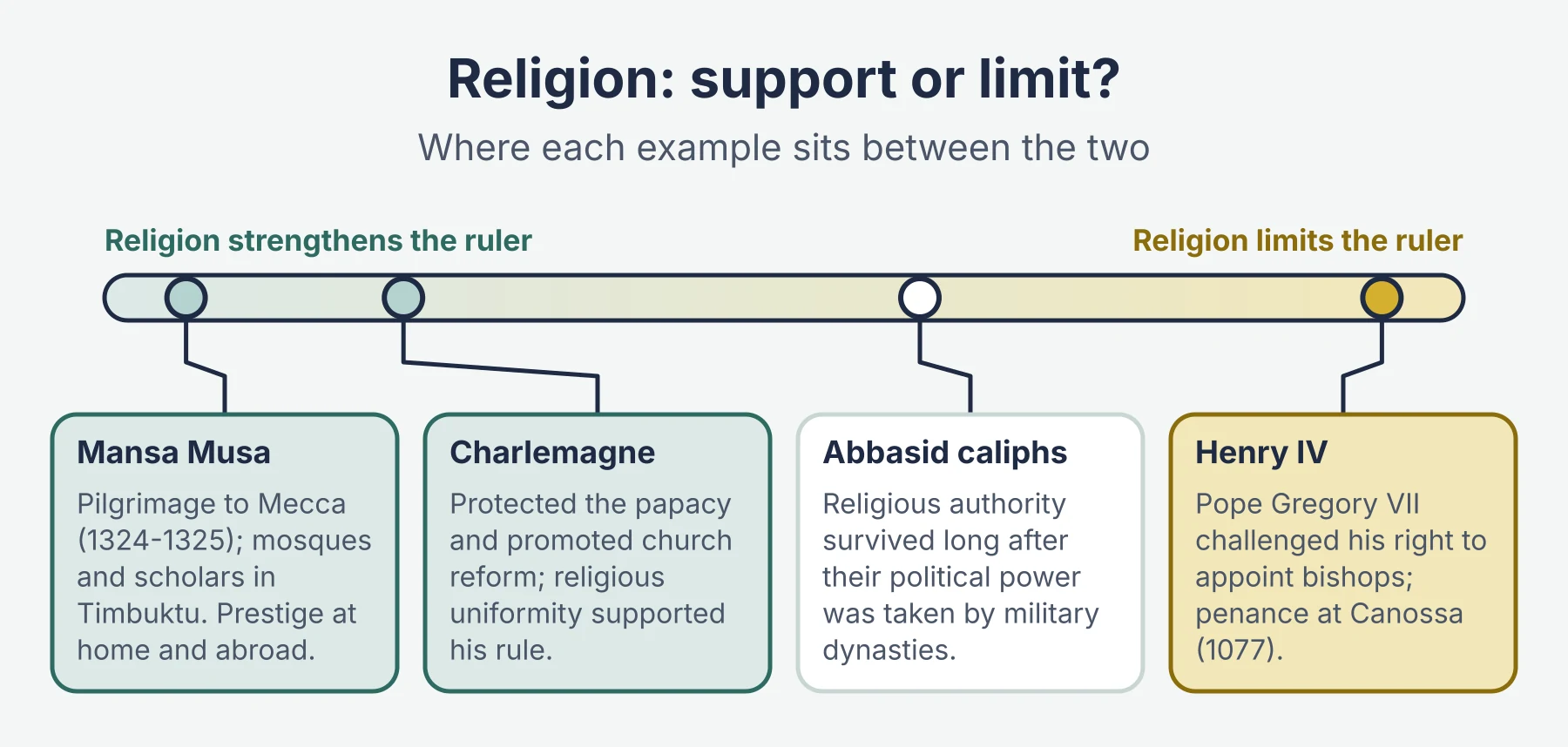
Religion could strengthen or limit rulers. Charlemagne protected the papacy and promoted church reform, and religious uniformity supported his rule. In the Investiture Contest, Pope Gregory VII challenged the emperor Henry IV’s right to appoint bishops; Henry’s penance at Canossa (1077) showed that a ruler could be humbled by religious authority. Mansa Musa’s pilgrimage to Mecca (1324-1325) and his patronage of mosques and scholars in Timbuktu linked his rule to the wider Islamic world, strengthening his prestige at home and abroad. Under the Abbasids, the caliphs’ religious authority survived long after their political power was taken over by military dynasties.
Expansion, succession and decline
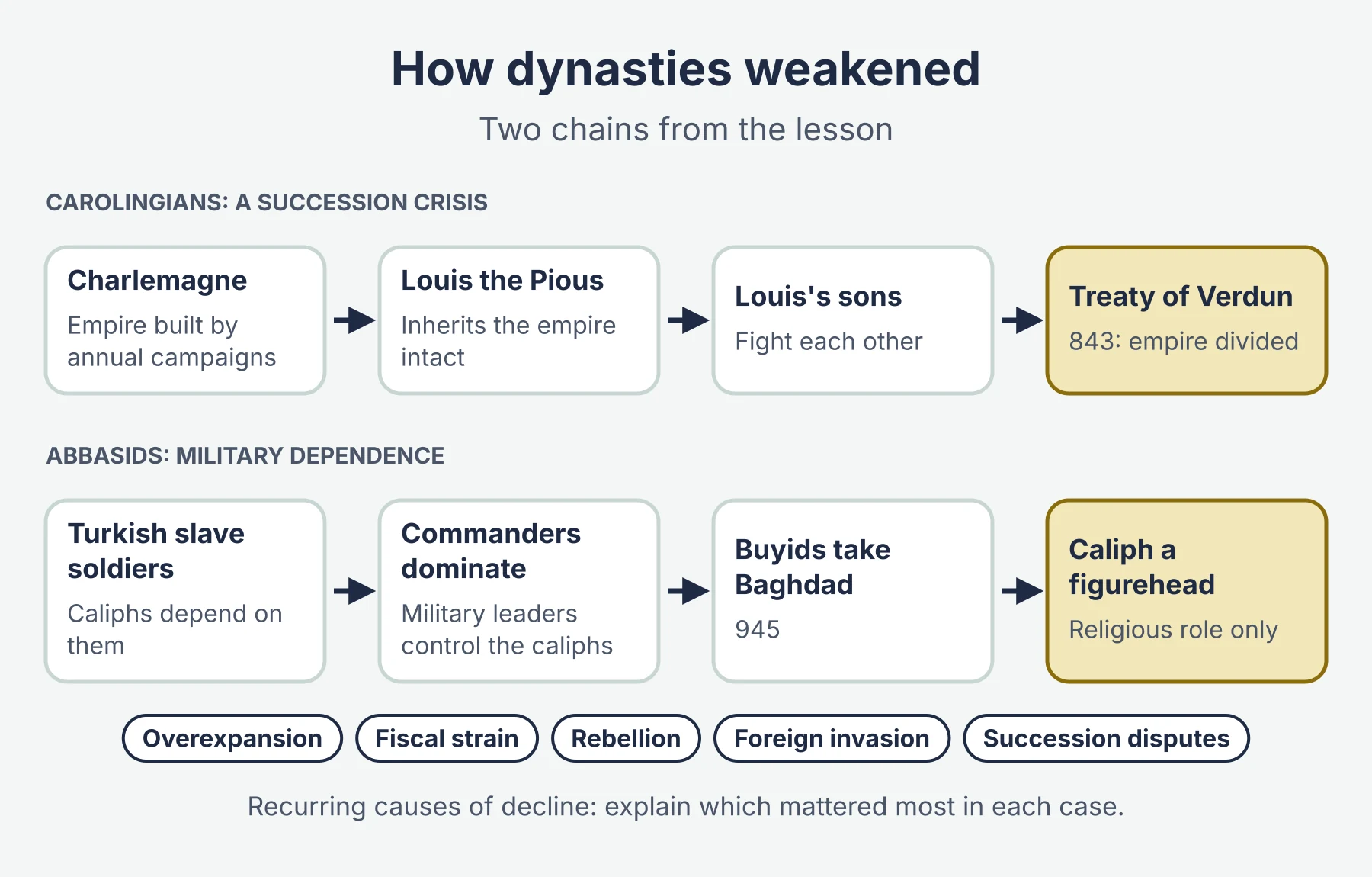
Succession was the most dangerous moment for any dynasty. Charlemagne’s empire passed intact to Louis the Pious, but Louis’s sons fought each other and divided it by the Treaty of Verdun (843). The Abbasids’ dependence on Turkish slave soldiers allowed military commanders to dominate the caliphs, and in 945 the Buyids took control of Baghdad, leaving the caliph a religious figurehead. Overexpansion, fiscal strain, rebellion and foreign invasion appear repeatedly, but you should explain which mattered most in each case.
Worked example: a comparative essay plan
Question: “Compare and contrast the methods used by two rulers, each chosen from a different region, to consolidate their power.”
Examples: William I of England (Europe) and Song Taizu (Asia and Oceania).
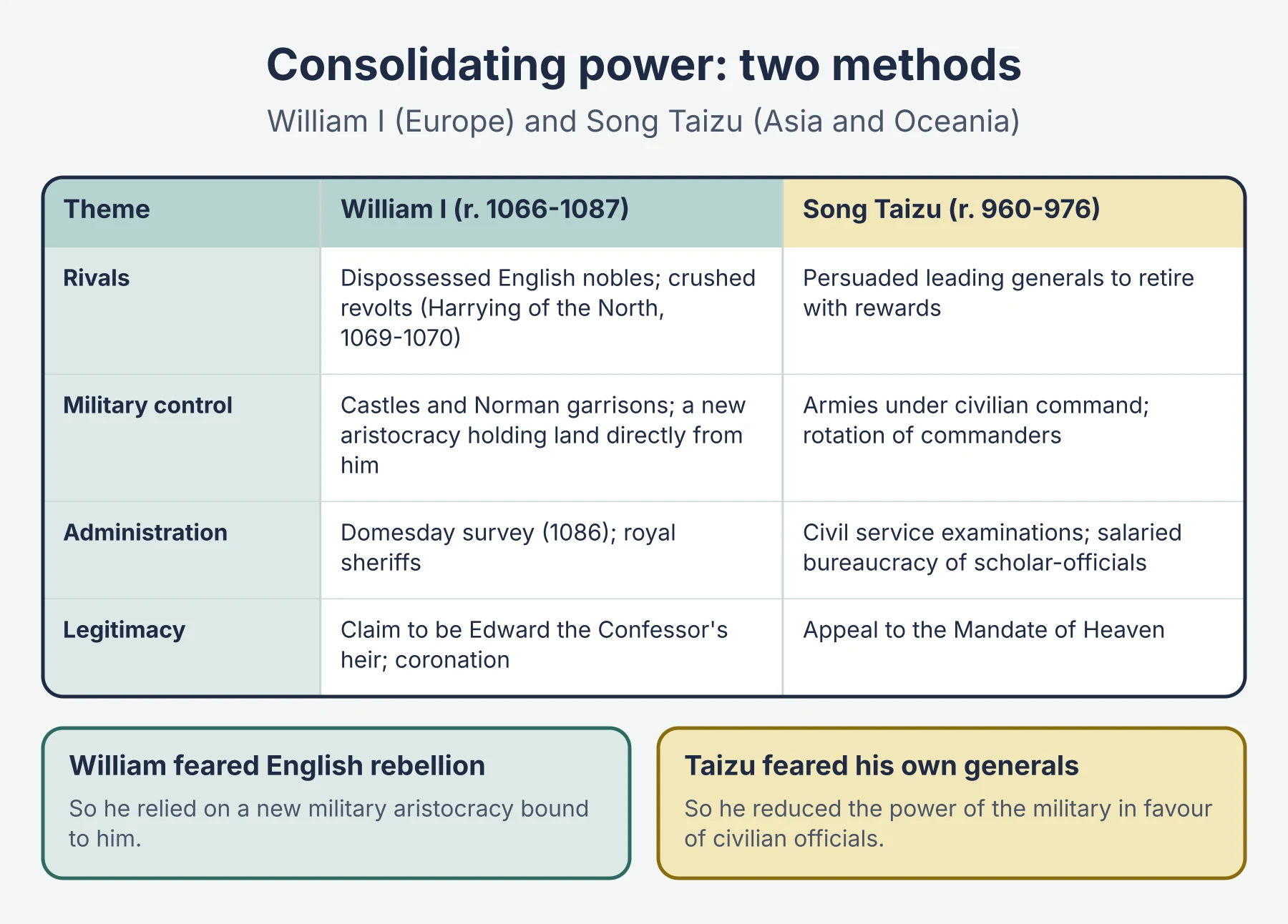
Thesis: both rulers, having taken power by force, sought to prevent further challenges to their rule, but William relied on a new military aristocracy bound to him, whereas Taizu deliberately reduced the power of the military in favour of civilian officials.
Paragraphs:
- Dealing with potential rivals. William dispossessed English nobles and crushed revolts; Taizu persuaded his generals to retire with honours.
- Military control. Castles and Norman garrisons in England; armies under civilian command and rotation of commanders in Song China.
- Administration and information. The Domesday survey and royal sheriffs; the examination system and a salaried bureaucracy.
- Legitimacy. William’s claims to be Edward the Confessor’s heir and his coronation; Taizu’s appeal to the Mandate of Heaven.
Conclusion: both consolidated power successfully, but their methods reflected the threats they faced: William feared English rebellion, Taizu feared his own generals.
Criteria for judging a ruler
Paper 2 questions on rulers are often evaluative, so decide your criteria before you write. Four work for most examples:
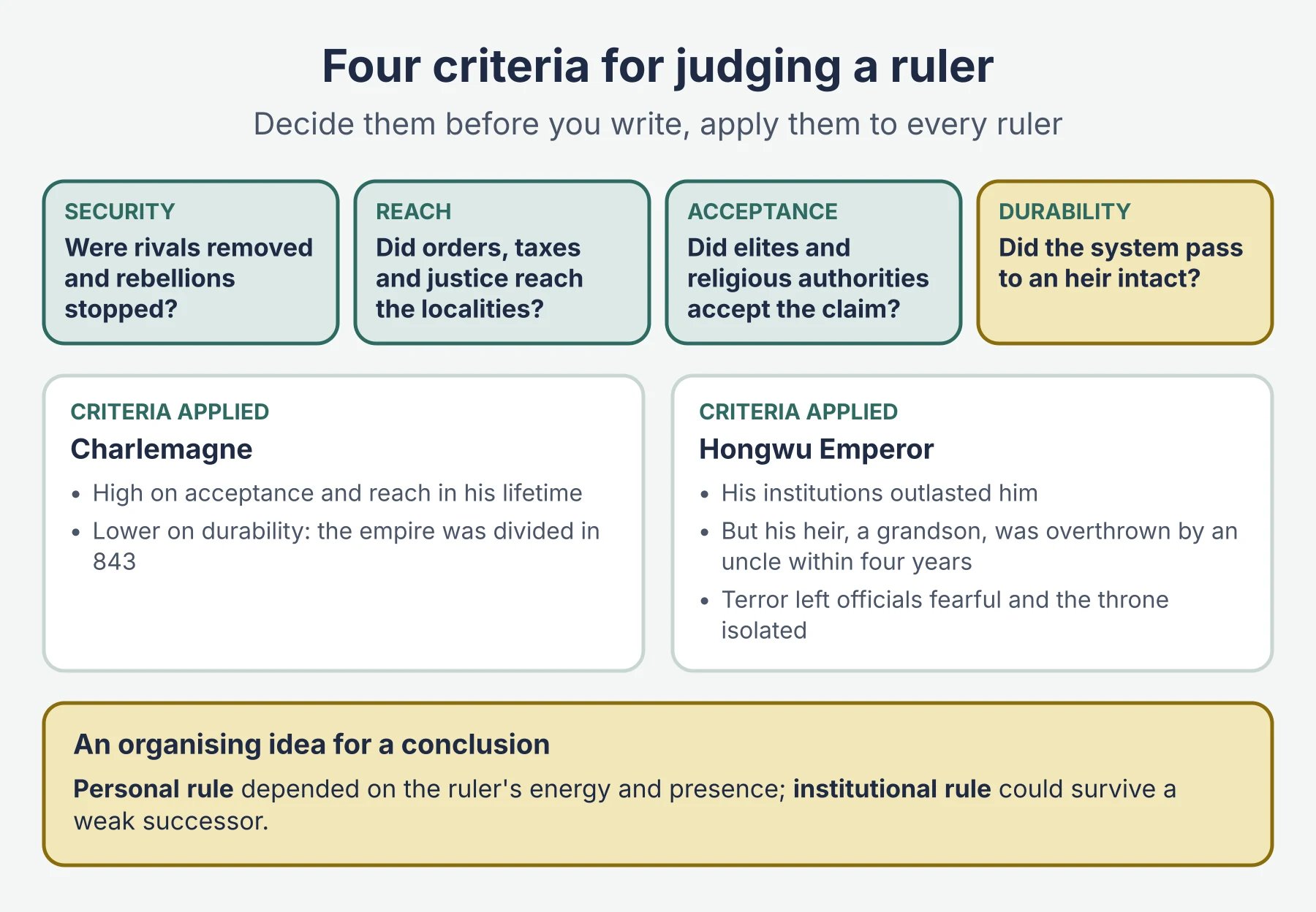
- Security: did the ruler remove or neutralise rivals, and did rebellions stop?
- Reach: did royal orders, taxes and justice extend into the localities, and through what institutions?
- Acceptance: did elites and religious authorities accept the ruler’s claim, and why?
- Durability: did the system survive the ruler’s death and pass to an heir intact?
Applied consistently, these criteria let you compare very different rulers. Charlemagne scores highly on acceptance and reach in his lifetime but less on durability; the Hongwu Emperor’s institutions outlasted him, although his chosen heir, his grandson, was overthrown by an uncle within four years, and his reliance on terror left officials fearful and the throne isolated. Historians often contrast personal rule, which depended on the ruler’s energy and presence, with institutional rule, which could survive a weak successor. That distinction is a strong organising idea for a conclusion.
Common mistakes
- Describing a reign in chronological order instead of answering on methods or reasons.
- Treating legitimacy as automatic: show what rulers did to win acceptance.
- Ignoring the limits on power, such as nobles, religious authorities and distance.
- Pairing two rulers from the same region in a regional comparison.
- Running past 1500, for example into the reign of Suleiman the Magnificent.
Exam technique
Questions on rulers often ask you to evaluate methods or success, to examine the reasons for a dynasty’s decline, or to judge the extent to which a ruler depended on one factor such as religion or the army. Set criteria for success early (security, stability, expansion, survival of the dynasty) and return to them in your conclusion.
Revise with the Dynasties and rulers revision notes and practise with the Dynasties and rulers practice questions.
Get free revision emails (optional)
Occasional emails with practice questions, worked explanations and links to free resources for the qualification and subjects you choose. No spam, and you can unsubscribe from any email. The free tools on this site never need an email.
Related resources
-
Practice questions
IB DP History: The Six Key Concepts – Practice Questions
Original practice questions with worked answers on the six key concepts of IB DP History (first assessed 2017), from spotting the concept to essay plans.
World History · International Baccalaureate · IB
Try questions -
Practice questions
IB DP History (DP History): Dynasties and rulers (750-1500) – Practice Questions
Twelve original IB History practice questions on Dynasties and rulers 750-1500, from short recall to full Paper 2 essays, with mark-scheme answers.
World History · International Baccalaureate · IB
Try questions -
Revision notes
IB DP History (DP History): Dynasties and rulers (750-1500) – Revision Notes
Revision notes for IB History Paper 2 Dynasties and rulers 750-1500: ruler profiles, legitimacy and methods grids, key terms, exam traps and a self-test.
World History · International Baccalaureate · IB
Revise topic
Related articles
-
teaching
A Level tuition in Dubai: Cambridge or Pearson Edexcel International A Level?
Schools in Dubai and Abu Dhabi teach either Cambridge International AS & A Level or Pearson Edexcel International A Level. How the two are structured, why it matters for tuition, and how online classes from Lahore work.
9 October 2026
-
curriculum guides
Choosing subjects at IGCSE and A Level
How subject choices at 14 and 16 affect university options later, and how to keep pathways open without overloading a timetable.
28 July 2026
Studying this with a teacher
Working through World History IB?
This page is free and stays free. If you would rather be taught it, Marlbridge runs World History classes one-to-one, online in your own time zone. The first trial class is free. WhatsApp replies within an hour (8am–11pm Pakistan time, every day); email the same day.
IB World History teachers at Marlbridge
