
Revision Notes
IB DP History (DP History): Dynasties and rulers (750-1500) – Revision Notes
Revision notes for IB History Paper 2 Dynasties and rulers 750-1500: ruler profiles, legitimacy and methods grids, key terms, exam traps and a self-test.
- Subject
- World History
- Level
- IB
- Topic
- Topic 2: World history topics
- Author
- Marlbridge Academic Team
- Updated
- Reviewed by
- Azam Siddique (what this means)
Aligned to International Baccalaureate IB Diploma Programme World History (DP History), First assessment 2017. Official specification .
Syllabus page (what it covers and how it is assessed): IB Diploma Programme World History.
Syllabus points this page covers
DP History
- 3 Dynasties and rulers (750-1500)
Found an error? Report a correction.
Need help with this topic? Request a free trial class for IB Diploma Programme World History (DP History).
Dynasties and rulers (750-1500) is world history topic 3 for Paper 2. Revise at least two rulers or dynasties from different regions under four themes: legitimacy, gaining and consolidating power, rulers and religion, and expansion, succession and decline.
Related: Dynasties and rulers study guide and Dynasties and rulers practice questions.
Ruler profiles
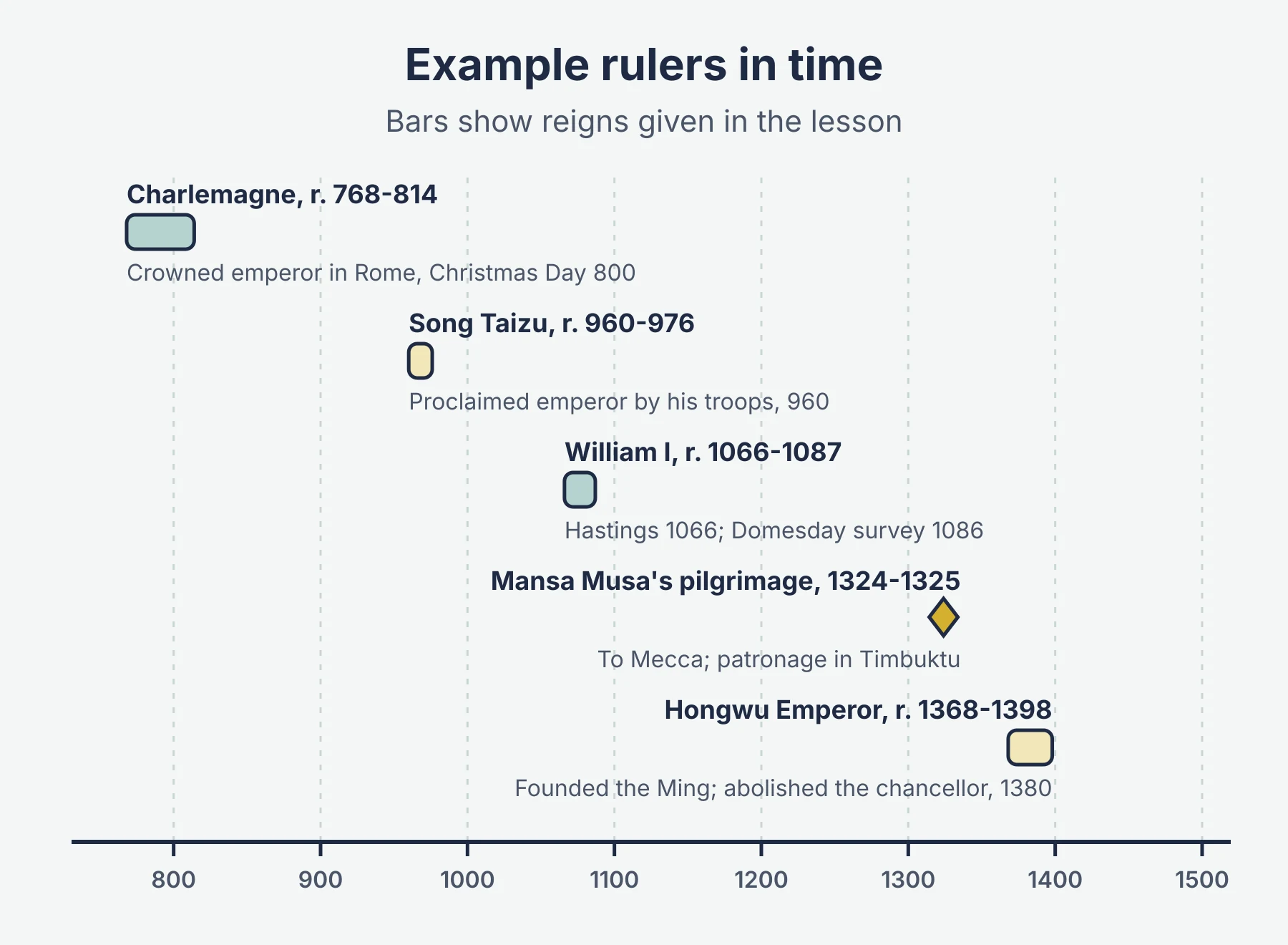
Charlemagne (r. 768-814), Franks: Europe
- Gained: inherited with his brother Carloman (sole ruler from 771).
- Methods: annual campaigns; counts and missi dominici; capitularies; oaths of loyalty; patronage of learning (Alcuin).
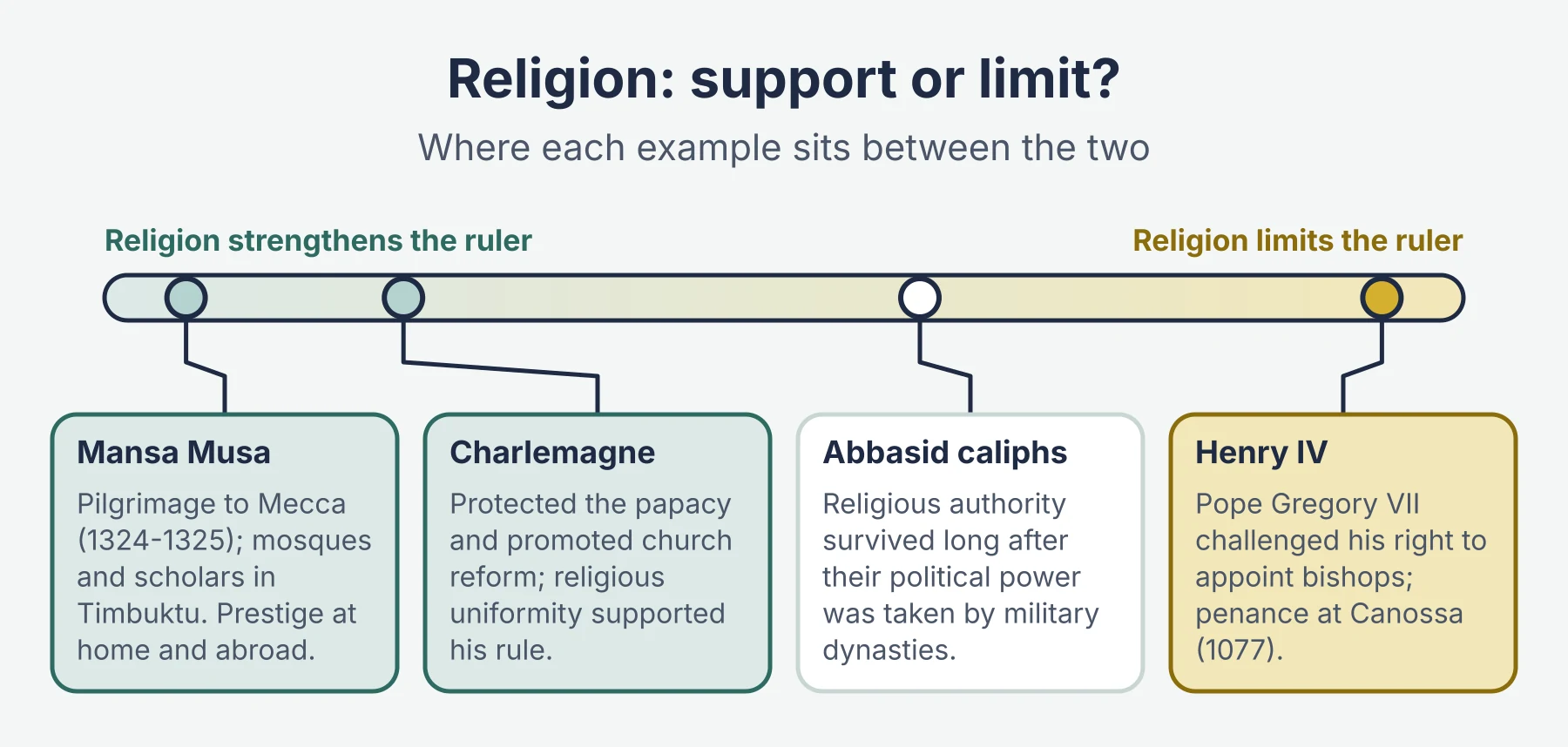
- Religion: alliance with the papacy; imperial coronation by Leo III (800); forced conversion of the Saxons.
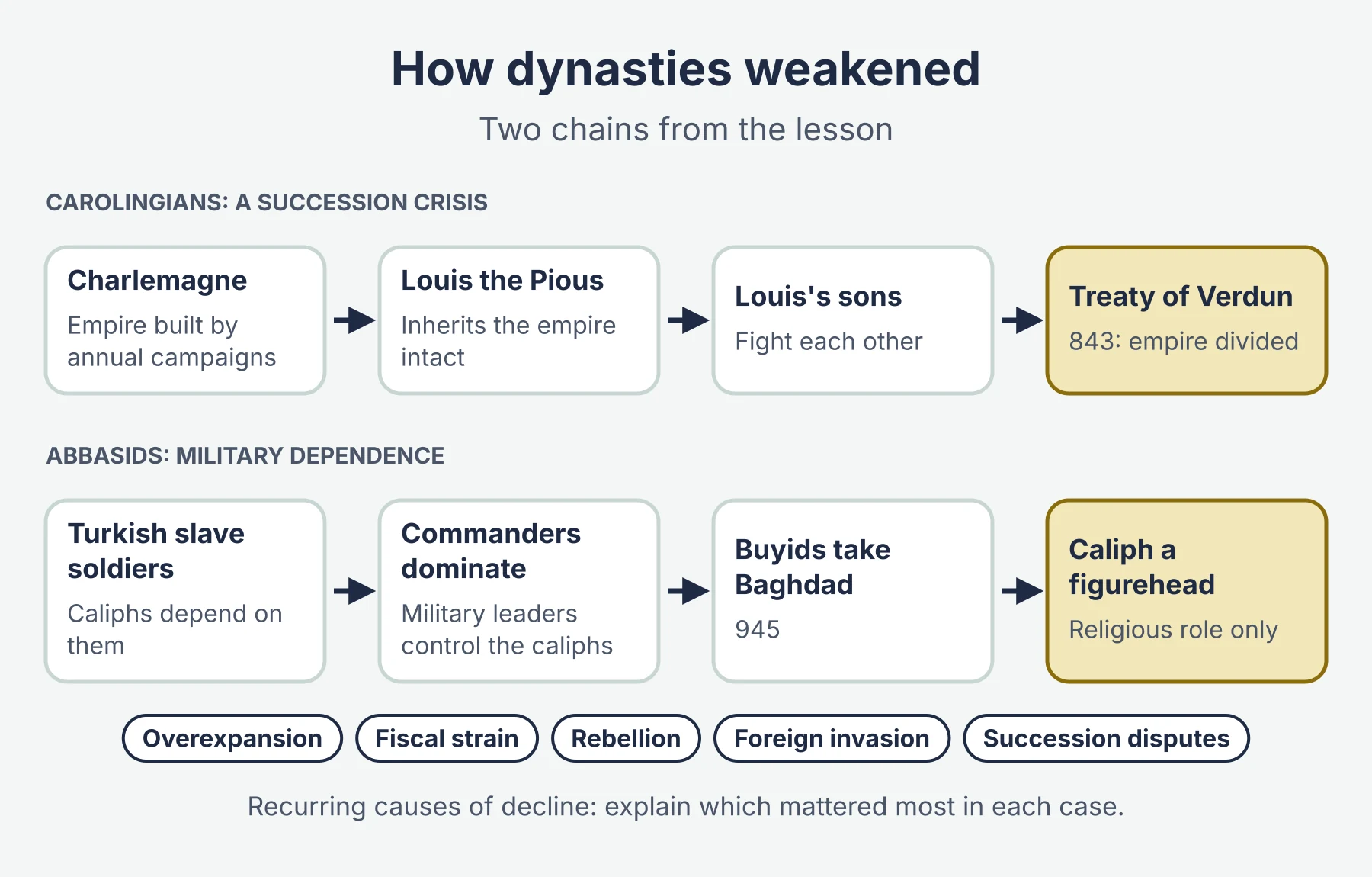
- Legacy: empire divided among his grandsons at Verdun (843).
Song Taizu (r. 960-976), Song dynasty: Asia and Oceania
- Gained: proclaimed emperor by his troops in 960.
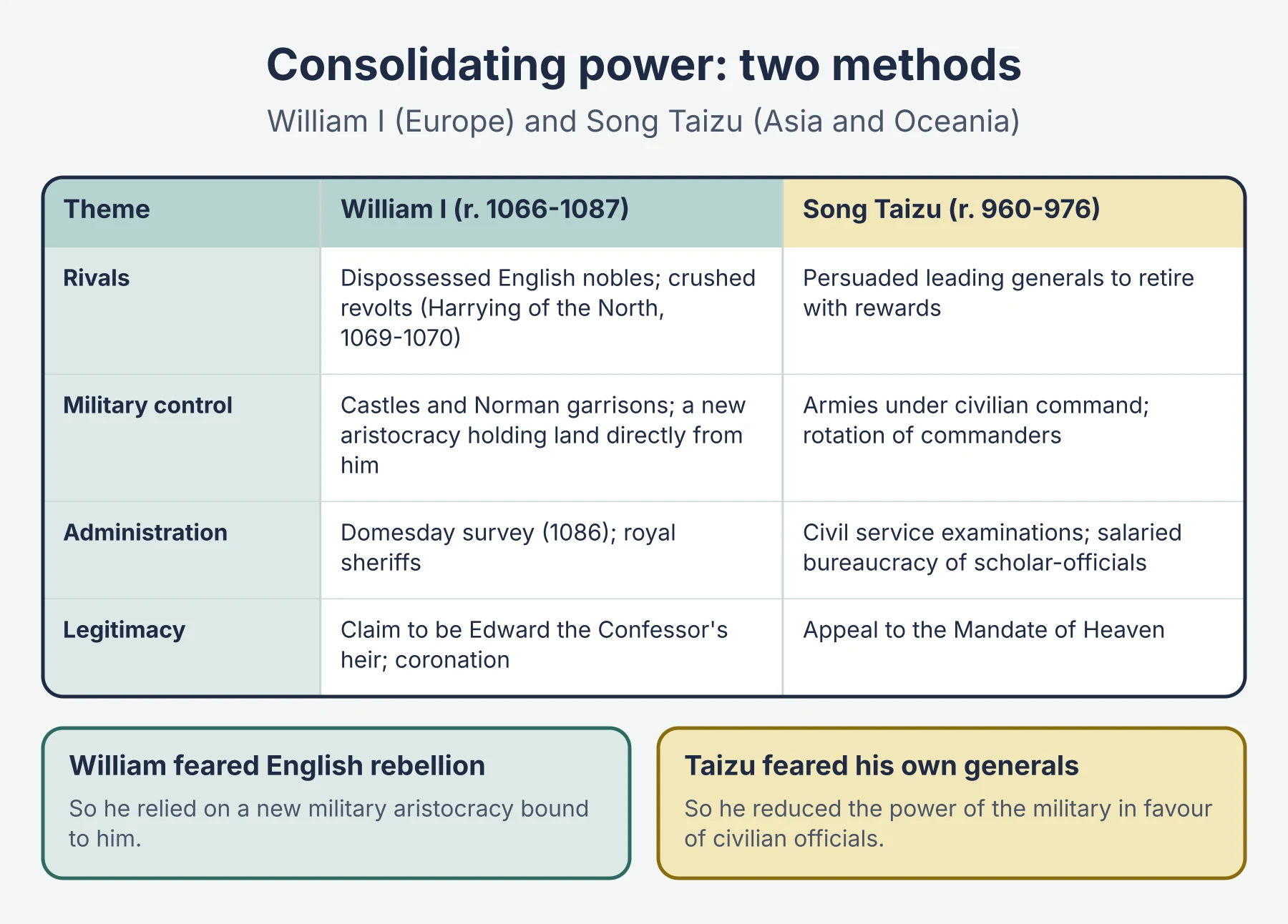
- Methods: retired leading generals with rewards; civilian control of armies; expanded civil service examinations; centralised revenue.
- Legitimacy: Mandate of Heaven; reunification of most of China.
- Legacy: stable civilian government; recurring weakness against northern states such as the Liao, Xi Xia and Jin.
William I (r. 1066-1087), England: Europe
- Gained: conquest at Hastings (1066), with a claim to be Edward the Confessor’s heir.
- Methods: castles; Harrying of the North (1069-1070); a new Norman aristocracy; Domesday survey (1086); the oath of Salisbury (1086).
- Religion: papal banner for the invasion; Lanfranc as Archbishop of Canterbury; reform of the English Church.
- Legacy: a strong, centralised monarchy; the Anglo-Norman realm.
Mansa Musa (r. c.1312-c.1337), Mali: Africa and the Middle East
- Gained: succeeded as mansa within the ruling dynasty.
- Methods: control of gold trade and trade towns, including Timbuktu and Gao; provincial governors.
- Religion: pilgrimage to Mecca (1324-1325); mosques and Islamic learning in Timbuktu.
- Legacy: Mali’s fame across the Islamic world and Europe; later decline under weaker successors.
The Hongwu Emperor (r. 1368-1398), Ming: Asia and Oceania
- Gained: rose through the rebellions against the Mongol Yuan; founded the Ming (1368).
- Methods: abolished the chancellorship (1380); direct control of ministries; purges; the Embroidered Uniform Guard as secret police; household registration.
- Legitimacy: Mandate of Heaven; restoration of Chinese rule after the Mongols.
- Legacy: a highly centralised autocracy.
Sources of legitimacy
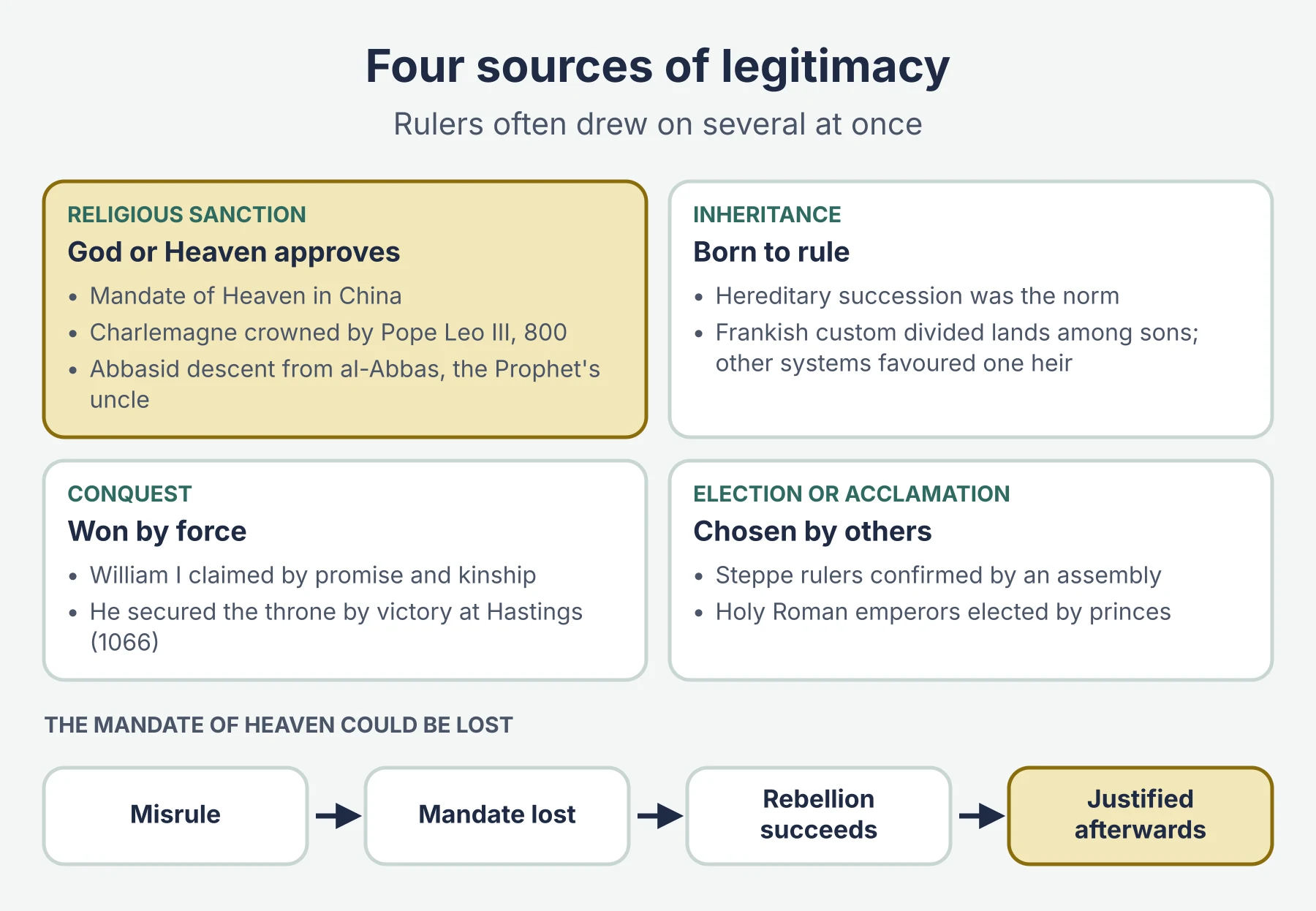
| Source | Explanation | Example |
|---|---|---|
| Divine sanction | Authority granted by God or Heaven | Mandate of Heaven; papal coronation of Charlemagne |
| Descent | Membership of a ruling lineage | Abbasid descent from al-Abbas |
| Designation | Named by a predecessor | William’s claim through Edward the Confessor |
| Conquest | Victory as proof of right | Hastings (1066) |
| Election or acclamation | Chosen by an assembly or army | Song Taizu proclaimed by troops; Holy Roman Emperor chosen by princes |
Methods of consolidation
| Method | Purpose | Examples |
|---|---|---|
| Military force | Suppress rivals and rebels | Harrying of the North; Charlemagne’s Saxon wars |
| Patronage and reward | Bind elites to the ruler | Land grants to Norman followers; honours for retired Song generals |
| Bureaucracy | Extend reach and gather revenue | Song examinations; missi dominici; Domesday |
| Law | Standardise rule and project justice | Capitularies; Ming legal code |
| Religion | Win acceptance and divine backing | Coronation in 800; Mansa Musa’s pilgrimage |
| Terror and surveillance | Deter opposition | Hongwu purges |
Key terms
| Term | Meaning |
|---|---|
| Dynasty | A succession of rulers from the same family |
| Mandate of Heaven | Chinese idea that Heaven grants the right to rule to a just ruler and withdraws it from an unjust one |
| Missi dominici | “Envoys of the lord”: Charlemagne’s royal inspectors |
| Capitulary | A royal decree of the Carolingian rulers |
| Tenant-in-chief | A lord holding land directly from the king |
| Investiture Contest | Dispute over who should appoint bishops, the pope or secular rulers |
| Caliph | Successor of the Prophet as leader of the Muslim community |
| Mansa | Title of the ruler of Mali |
| Partible inheritance | Dividing lands among several heirs |
Exam traps
- Biography instead of analysis. Organise by theme: legitimacy, methods, religion, decline.
- Success without criteria. Define success: security, expansion, stability, dynastic survival.
- Personal power only. Show the institutions and elites that rulers relied on.
- Wrong period. Mehmed II’s reign extends to 1481, but Suleiman and Akbar are outside this topic.
- Region rules. William I and Charlemagne are both Europe.
- Legend as fact. Stories of Mansa Musa’s gold or Charlemagne’s learning need careful wording.
Self-test
- Who crowned Charlemagne emperor, and when? Pope Leo III, on Christmas Day 800.
- What were the missi dominici? Royal agents sent in pairs to inspect local government for Charlemagne.
- Which treaty divided the Carolingian empire in 843? The Treaty of Verdun.
- How did Song Taizu reduce the threat from his generals? He persuaded them to retire with rewards and placed the armies under civilian control.
- What was the Mandate of Heaven? The idea that Heaven granted the right to rule to a just emperor and could withdraw it from an unjust one.
- What was the purpose of the Domesday survey of 1086? To record landholding and resources, mainly for taxation and royal control.
- What was the Harrying of the North? William I’s devastation of northern England in 1069-1070 to crush rebellion.
- How did Mansa Musa’s pilgrimage strengthen his rule? It displayed Mali’s wealth and linked his authority to the Islamic world, raising his prestige at home and abroad.
- Which office did the Hongwu Emperor abolish in 1380? The chancellorship.
- What happened at Canossa in 1077? Emperor Henry IV did penance before Pope Gregory VII during the Investiture Contest.
- Who took control of Baghdad in 945, and what did this mean for the Abbasid caliph? The Buyids; the caliph kept religious authority but lost political power.
- Give one reason why succession was dangerous for medieval dynasties. Disputes among heirs, or division of lands among sons, could break up a realm, as after Louis the Pious.
Get free revision emails (optional)
Occasional emails with practice questions, worked explanations and links to free resources for the qualification and subjects you choose. No spam, and you can unsubscribe from any email. The free tools on this site never need an email.
Related resources
-
Practice questions
IB DP History: The Six Key Concepts – Practice Questions
Original practice questions with worked answers on the six key concepts of IB DP History (first assessed 2017), from spotting the concept to essay plans.
World History · International Baccalaureate · IB
Try questions -
Study guides
IB DP History (DP History): Societies in transition (1400-1700)
IB History Paper 2 world history topic 4, Societies in transition 1400-1700: religious, intellectual, economic and social change, with a worked essay plan.
World History · International Baccalaureate · IB
Read guide -
Practice questions
IB DP History (DP History): Societies in transition (1400-1700) – Practice Questions
Twelve original IB History practice questions on Societies in transition 1400-1700, from short recall to full Paper 2 essays, with mark-scheme answers.
World History · International Baccalaureate · IB
Try questions
Related articles
-
teaching
A Level tuition in Dubai: Cambridge or Pearson Edexcel International A Level?
Schools in Dubai and Abu Dhabi teach either Cambridge International AS & A Level or Pearson Edexcel International A Level. How the two are structured, why it matters for tuition, and how online classes from Lahore work.
9 October 2026
-
curriculum guides
Choosing subjects at IGCSE and A Level
How subject choices at 14 and 16 affect university options later, and how to keep pathways open without overloading a timetable.
28 July 2026
Studying this with a teacher
Working through World History IB?
This page is free and stays free. If you would rather be taught it, Marlbridge runs World History classes one-to-one, online in your own time zone. The first trial class is free. WhatsApp replies within an hour (8am–11pm Pakistan time, every day); email the same day.
IB World History teachers at Marlbridge
