
Study Guides
IB DP History (DP History): Societies in transition (1400-1700)
IB History Paper 2 world history topic 4, Societies in transition 1400-1700: religious, intellectual, economic and social change, with a worked essay plan.
- Subject
- World History
- Level
- IB
- Topic
- Topic 2: World history topics
- Author
- Marlbridge Academic Team
- Updated
- Reviewed by
- Azam Siddique (what this means)
Aligned to International Baccalaureate IB Diploma Programme World History (DP History), First assessment 2017. Official specification .
Syllabus page (what it covers and how it is assessed): IB Diploma Programme World History.
Syllabus points this page covers
DP History
- 4 Societies in transition (1400-1700)
Found an error? Report a correction.
Need help with this topic? Request a free trial class for IB Diploma Programme World History (DP History).
World history topic 4, Societies in transition (1400-1700), studies a period when religious division, new ideas, oceanic voyages and flows of silver and people changed societies across the world. Paper 2 essays ask you to assess the causes and extent of change, usually in one or two societies from different regions. The world history topics overview introduces Paper 2; this guide develops the topic’s content and arguments.
What the topic covers
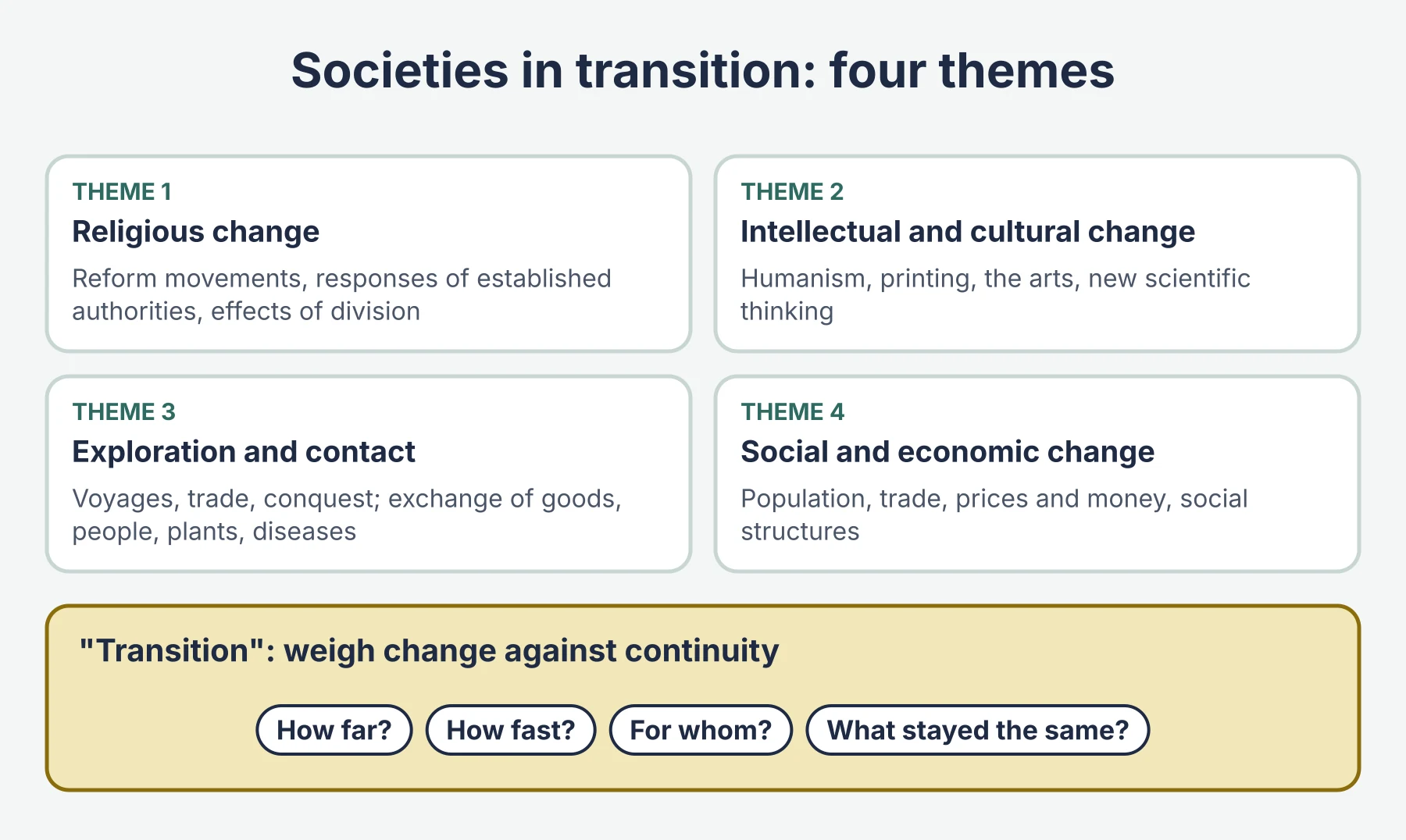
The content can be grouped into four themes:
- Social and economic change: population, trade, prices and money, and changes in social structures and in the lives of particular groups.
- Intellectual, cultural and artistic change: humanism, printing, the arts and new scientific thinking.
- Religious change: reform movements, the responses of established religious authorities and the effects of religious division on society and states.
- Exploration and contact: voyages, trade and conquest, and the exchange of goods, people, plants and diseases between continents.
“Transition” is the key word. Questions test how far societies changed, how fast, for whom, and what stayed the same. A good answer always weighs change against continuity.
Theme 1: religious change
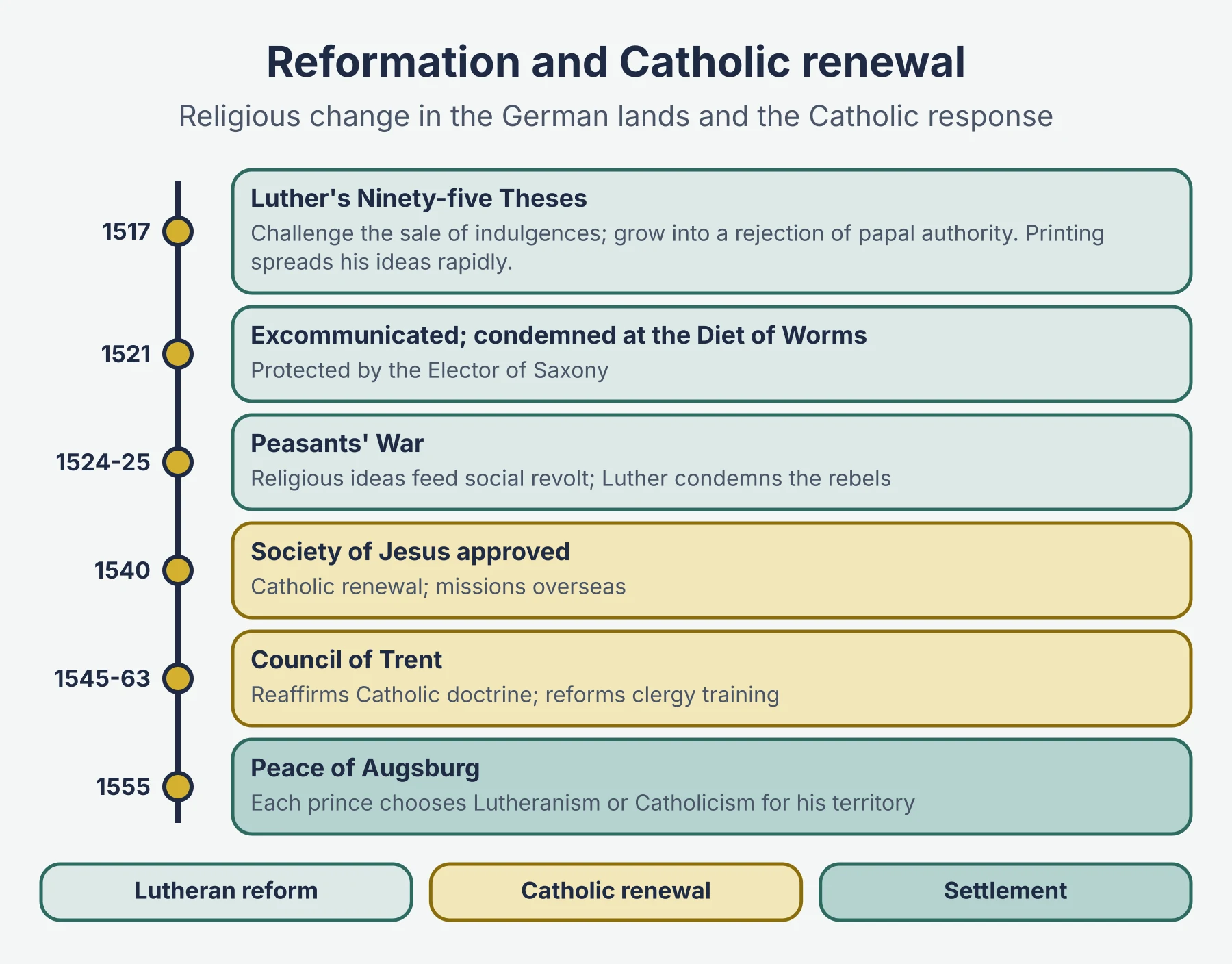
The Reformation in the German lands. Martin Luther’s Ninety-five Theses (1517) challenged the sale of indulgences and developed into a rejection of papal authority and of much Catholic doctrine. Excommunicated in 1521 and condemned at the Diet of Worms, Luther was protected by the Elector of Saxony. Printing spread his ideas rapidly. The Peasants’ War (1524-1525) showed how religious ideas could feed social revolt; Luther condemned the rebels. The Peace of Augsburg (1555) allowed each prince to choose Lutheranism or Catholicism for his territory.
Catholic renewal. The Society of Jesus (approved 1540) and the Council of Trent (1545-1563) reaffirmed Catholic doctrine, reformed clergy training and launched missions overseas.
Religious policy elsewhere. The Mughal emperor Akbar (r. 1556-1605) abolished the jizya tax on non-Muslims, held religious debates at his court and pursued a policy of sulh-i kul (“peace with all”). In Japan, Christianity spread after the arrival of Jesuit missionaries in 1549 and was then banned and persecuted under the Tokugawa from the early seventeenth century.
Theme 2: intellectual and cultural change
Humanism and the Renaissance. Italian humanists studied classical texts and promoted education in rhetoric, history and moral philosophy. Wealthy patrons such as the Medici in Florence commissioned art and architecture.
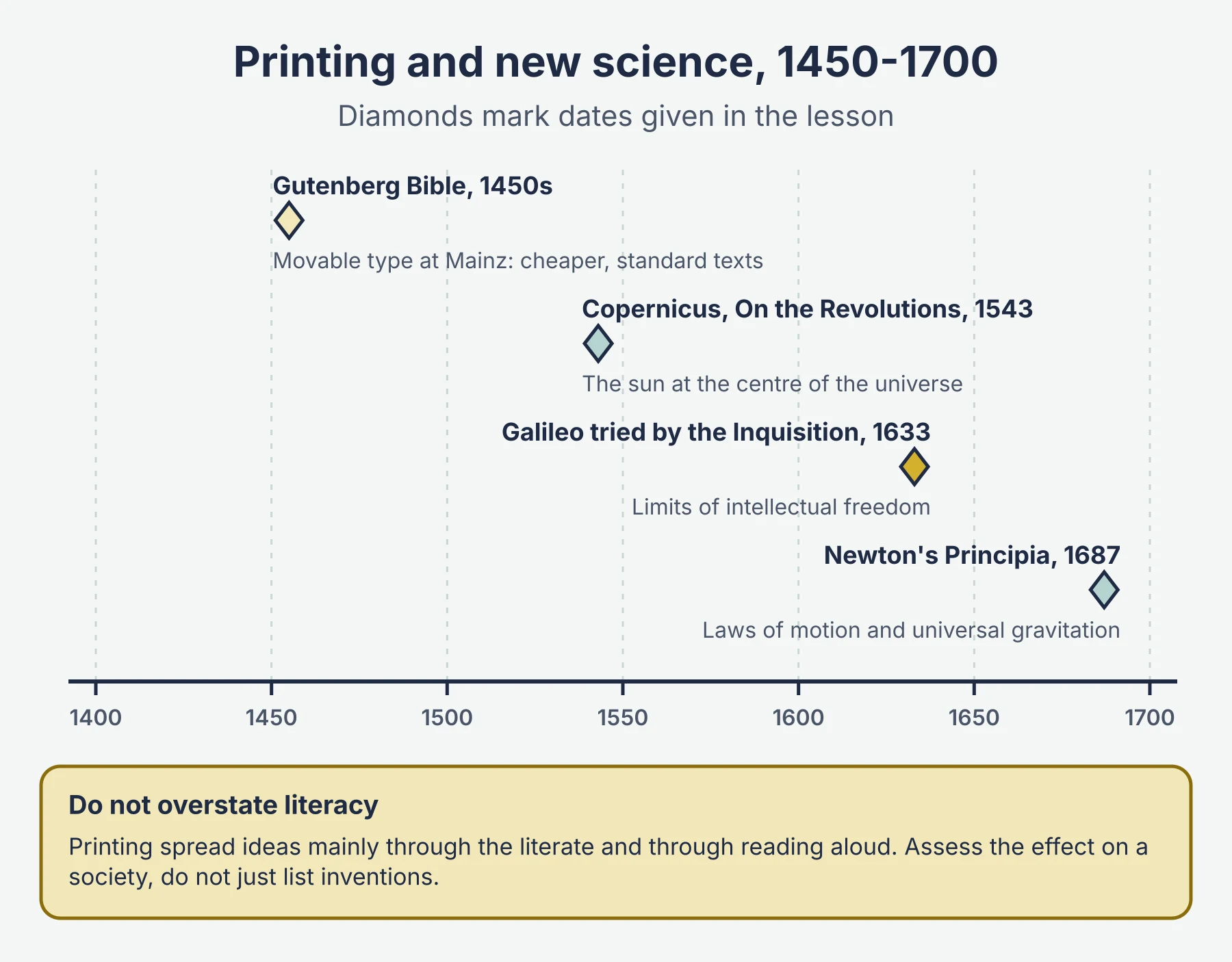
Printing. Johannes Gutenberg’s movable-type press at Mainz produced the Gutenberg Bible in the 1450s. Printing reduced the cost of books, standardised texts, spread religious controversy and supported the growth of literacy.
New science. Copernicus’s On the Revolutions of the Heavenly Spheres (1543) placed the sun at the centre of the universe. Galileo’s telescopic observations supported Copernicus, and his trial by the Inquisition (1633) showed the limits of intellectual freedom. Newton’s Principia (1687) set out laws of motion and universal gravitation.
Theme 3: exploration and contact
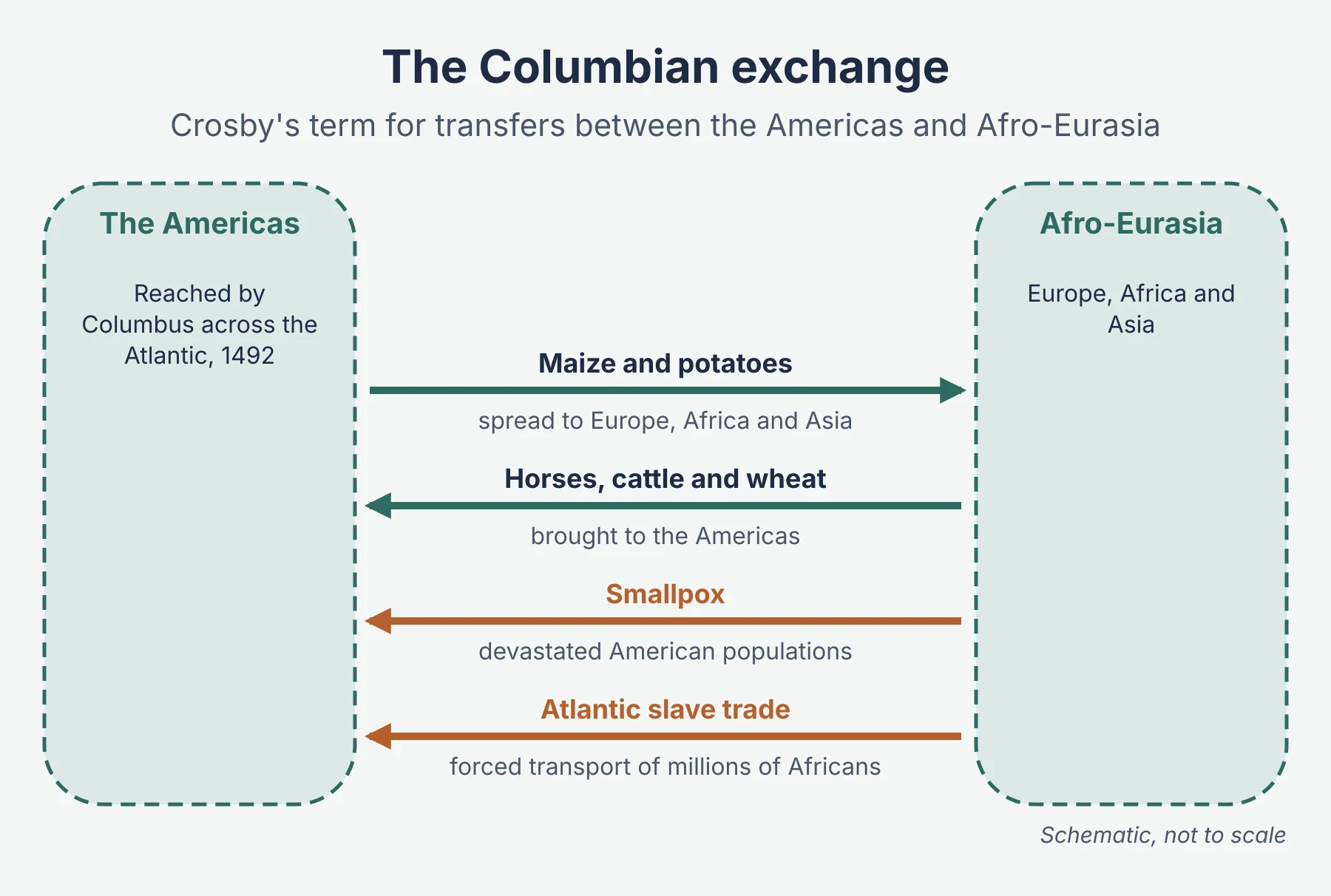
Between 1405 and 1433 the Ming admiral Zheng He led seven great voyages into the Indian Ocean as far as East Africa, displaying Ming power and collecting tribute; the court then ended them. Portuguese voyages reached India by sea under Vasco da Gama (1498), and Columbus crossed the Atlantic in 1492. Alfred Crosby coined the term “Columbian exchange” for the transfer of crops, animals and diseases between the Americas and Afro-Eurasia: maize and potatoes spread to Europe, Africa and Asia; horses, cattle and wheat to the Americas; smallpox devastated American populations. The Atlantic slave trade forcibly transported millions of Africans to the Americas.
Theme 4: social and economic change
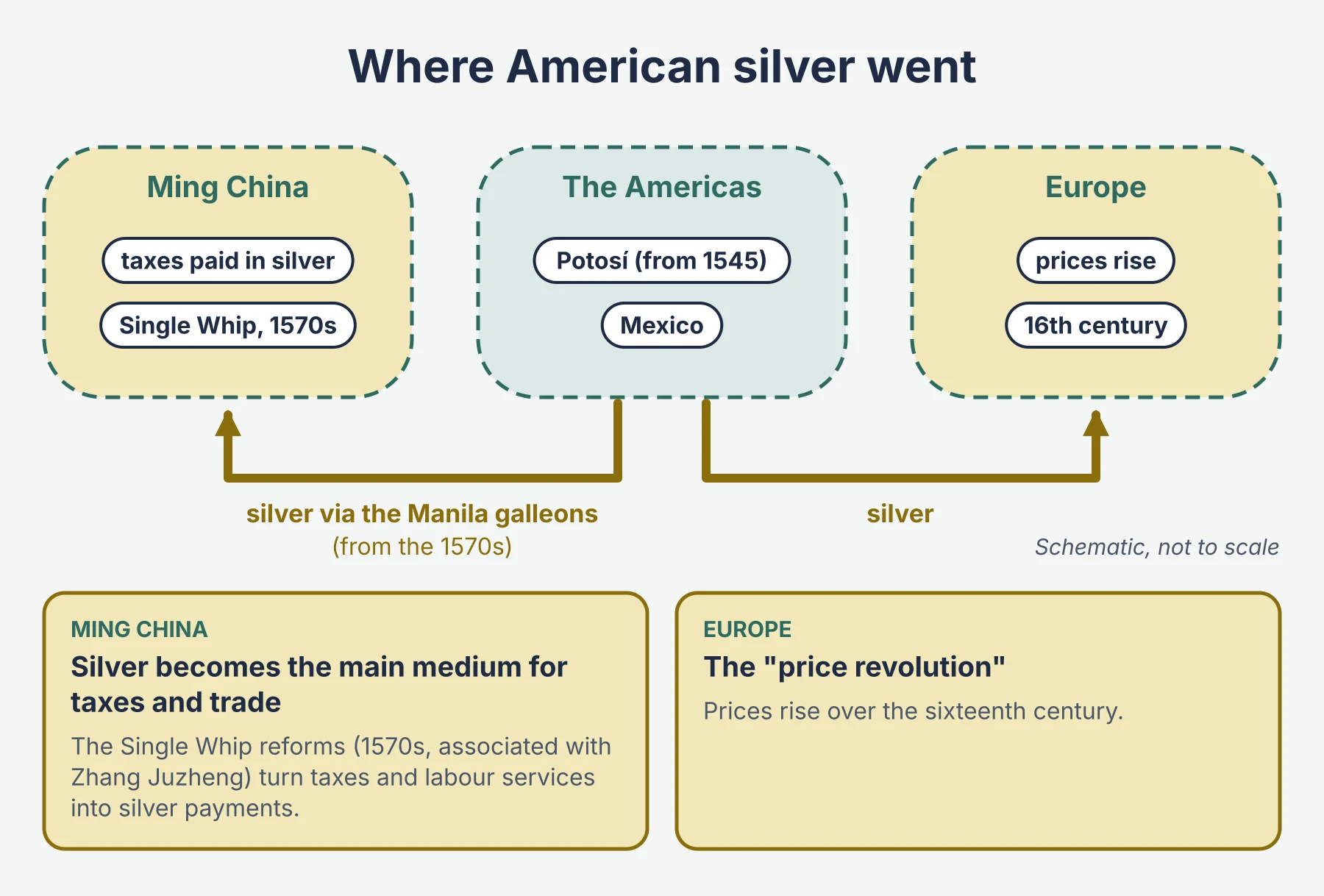
Silver and prices. Silver from Potosí (from 1545) and Mexico flowed to Europe and, through the Manila galleons (from the 1570s), to China. In Europe, prices rose over the sixteenth century, the “price revolution”. In Ming China, silver became the main medium for taxes and trade; the Single Whip reforms, associated with Zhang Juzheng in the 1570s, consolidated taxes and labour services into payments in silver.
Social structures. Landed elites remained dominant almost everywhere, but merchants and professional groups grew in wealth and influence in commercial cities. Enclosure in parts of England turned common land into private farms. In Ming China, commercial wealth allowed some merchant families to buy land and educate sons for the examinations.
Worked example: a comparative essay plan
Question: “Compare and contrast the impact of American silver on two societies, each chosen from a different region.”
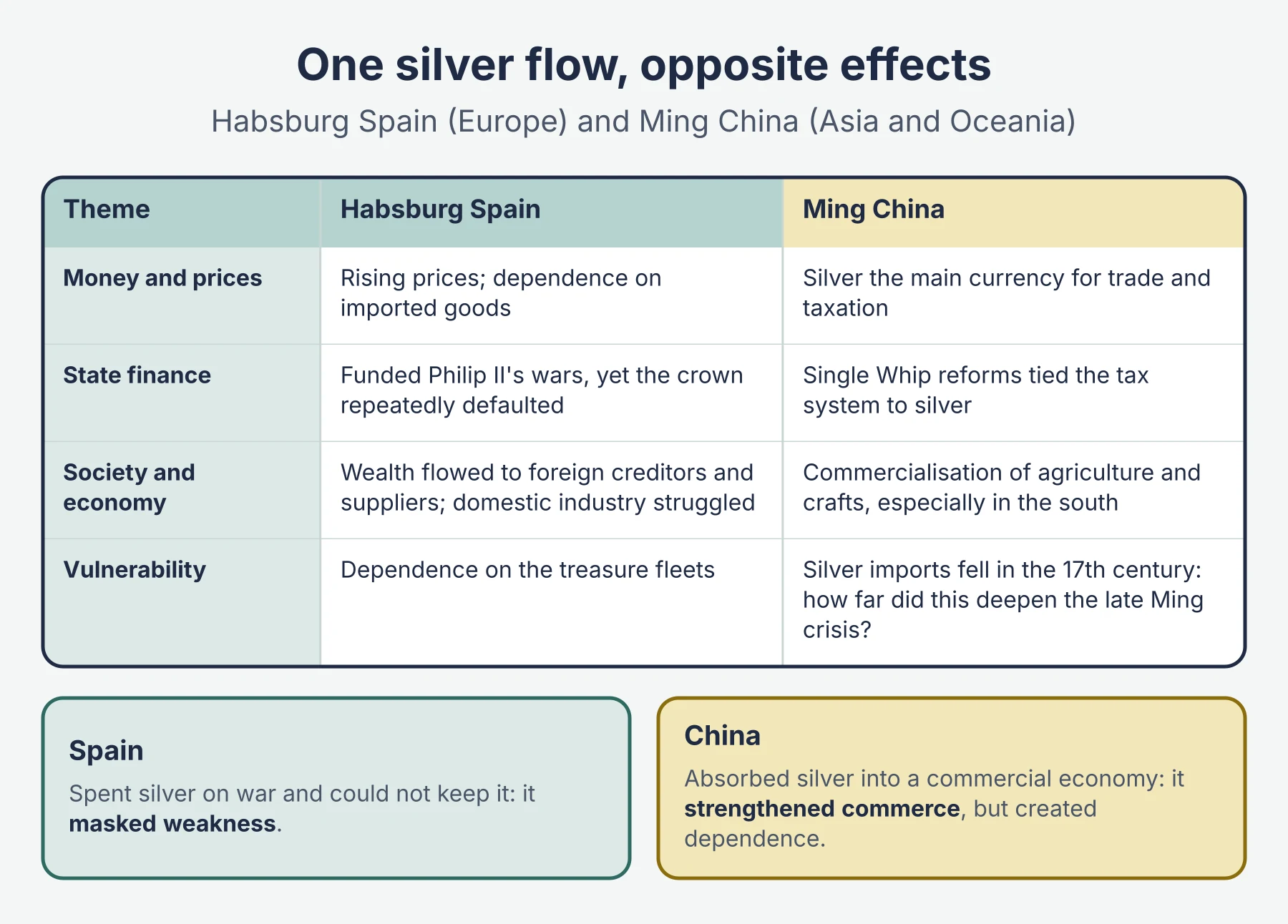
Examples: Habsburg Spain (Europe) and Ming China (Asia and Oceania).
Thesis: in both societies silver transformed money and state finance, but Spain spent it on war and could not keep it, while China absorbed it into a commercial economy and became dependent on its continued arrival.
Paragraphs:
- Money and prices. Spain: rising prices and dependence on imported goods; China: silver as the main currency for trade and taxation.
- State finance. Spain: silver funded Philip II’s wars, yet the crown repeatedly defaulted on its debts; China: the Single Whip reforms tied the tax system to silver.
- Society and economy. Spain: wealth flowed to foreign creditors and suppliers, and domestic industry struggled; China: commercialisation of agriculture and crafts, especially in the south.
- Vulnerability. Spain: dependence on the treasure fleets; China: when silver imports fell in the seventeenth century, debate continues over how far this deepened the late Ming crisis.
Conclusion: the same silver had opposite effects: it strengthened Chinese commerce while it masked Spanish weakness.
A second region: Tokugawa Japan
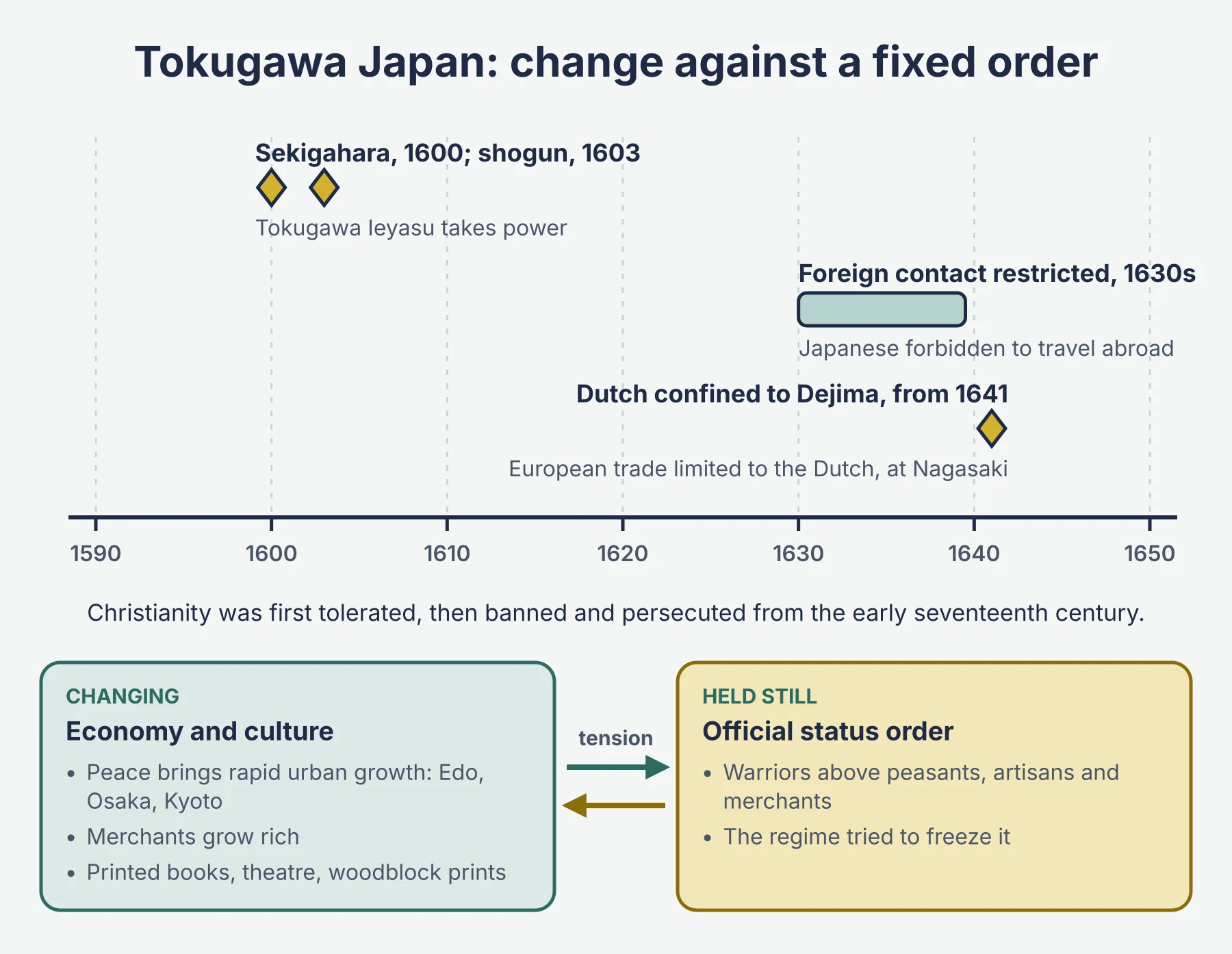
Japan shows transition shaped by deliberate state policy. After Tokugawa Ieyasu’s victory at Sekigahara (1600) and his appointment as shogun (1603), the regime first tolerated, then banned Christianity, and in the 1630s restricted foreign contact: Japanese were forbidden to travel abroad, and European trade was confined to the Dutch, who from 1641 were restricted to the island of Dejima at Nagasaki. Peace brought rapid urban growth: Edo, Osaka and Kyoto became great cities, merchants grew rich, and a lively urban culture of printed books, theatre and woodblock prints developed. Yet the official status order placed warriors above peasants, artisans and merchants, and the regime tried to freeze it. Japan therefore lets you argue that economic and cultural change could run ahead of, and in tension with, a deliberately conservative political order.
Interpretations
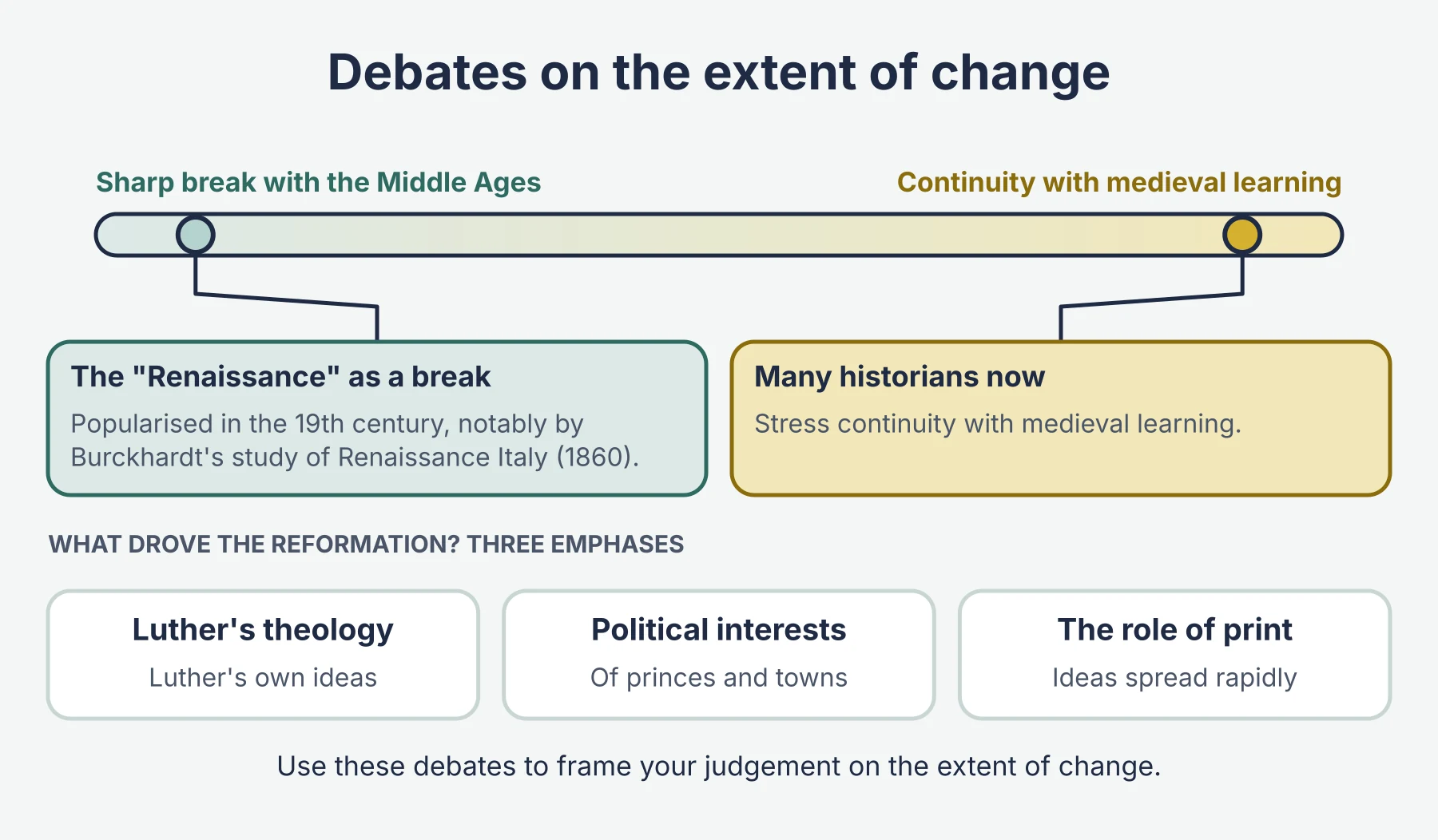
The idea of a “Renaissance” as a sharp break with the Middle Ages was popularised in the nineteenth century, notably by Jacob Burckhardt’s study of Renaissance Italy (1860); many historians now stress continuity with medieval learning. On the Reformation, some historians emphasise Luther’s theology, others the political interests of princes and towns, and others the role of print. Use such debates to frame your judgement on the extent of change.
Common mistakes
- Treating “transition” as total transformation and ignoring continuity.
- Writing only about Europe; the topic is global and many questions require two regions.
- Listing inventions or discoveries without assessing their effect on a society.
- Overstating literacy: printing spread ideas mainly through the literate and through reading aloud.
- Running past 1700, for example into the Enlightenment.
Exam technique
Questions often ask to what extent a society changed, or invite you to examine the causes or evaluate the impact of one development. Set out what changed, for whom, how quickly and how far, and give explicit continuity. Use dates to show change over time, and keep a regional pairing ready for comparative questions.
Revise with the Societies in transition revision notes and practise with the Societies in transition practice questions.
Get free revision emails (optional)
Occasional emails with practice questions, worked explanations and links to free resources for the qualification and subjects you choose. No spam, and you can unsubscribe from any email. The free tools on this site never need an email.
Related resources
-
Practice questions
IB DP History: The Six Key Concepts – Practice Questions
Original practice questions with worked answers on the six key concepts of IB DP History (first assessed 2017), from spotting the concept to essay plans.
World History · International Baccalaureate · IB
Try questions -
Practice questions
IB DP History (DP History): Societies in transition (1400-1700) – Practice Questions
Twelve original IB History practice questions on Societies in transition 1400-1700, from short recall to full Paper 2 essays, with mark-scheme answers.
World History · International Baccalaureate · IB
Try questions -
Revision notes
IB DP History (DP History): Societies in transition (1400-1700) – Revision Notes
Revision notes for IB History Paper 2 Societies in transition 1400-1700: timelines, change and continuity grids, key terms, exam traps and a self-test.
World History · International Baccalaureate · IB
Revise topic
Related articles
-
teaching
A Level tuition in Dubai: Cambridge or Pearson Edexcel International A Level?
Schools in Dubai and Abu Dhabi teach either Cambridge International AS & A Level or Pearson Edexcel International A Level. How the two are structured, why it matters for tuition, and how online classes from Lahore work.
9 October 2026
-
curriculum guides
Choosing subjects at IGCSE and A Level
How subject choices at 14 and 16 affect university options later, and how to keep pathways open without overloading a timetable.
28 July 2026
Studying this with a teacher
Working through World History IB?
This page is free and stays free. If you would rather be taught it, Marlbridge runs World History classes one-to-one, online in your own time zone. The first trial class is free. WhatsApp replies within an hour (8am–11pm Pakistan time, every day); email the same day.
IB World History teachers at Marlbridge
