
Revision Notes
IB DP History (DP History): Societies in transition (1400-1700) – Revision Notes
Revision notes for IB History Paper 2 Societies in transition 1400-1700: timelines, change and continuity grids, key terms, exam traps and a self-test.
- Subject
- World History
- Level
- IB
- Topic
- Topic 2: World history topics
- Author
- Marlbridge Academic Team
- Updated
- Reviewed by
- Azam Siddique (what this means)
Aligned to International Baccalaureate IB Diploma Programme World History (DP History), First assessment 2017. Official specification .
Syllabus page (what it covers and how it is assessed): IB Diploma Programme World History.
Syllabus points this page covers
DP History
- 4 Societies in transition (1400-1700)
Found an error? Report a correction.
Need help with this topic? Request a free trial class for IB Diploma Programme World History (DP History).
Societies in transition (1400-1700) is world history topic 4 for Paper 2. Revise four themes (religious change, intellectual and cultural change, exploration and contact, social and economic change) in at least two societies from different regions, always weighing change against continuity.
Related: Societies in transition study guide and Societies in transition practice questions.
Timeline of key changes
| Date | Event | Theme |
|---|---|---|
| 1405-1433 | Zheng He’s seven voyages | Contact |
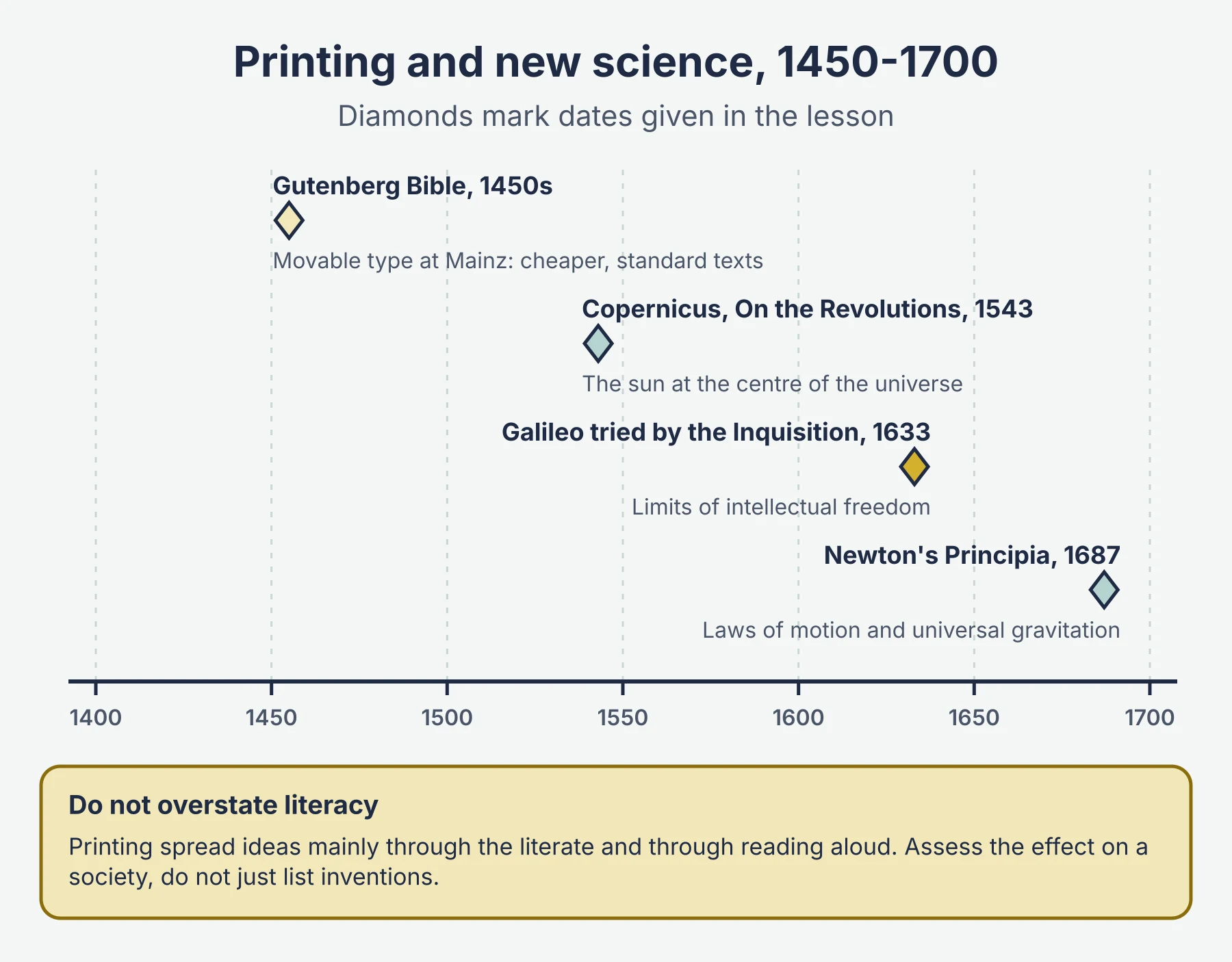
| 1450s | Gutenberg Bible printed at Mainz | Ideas |
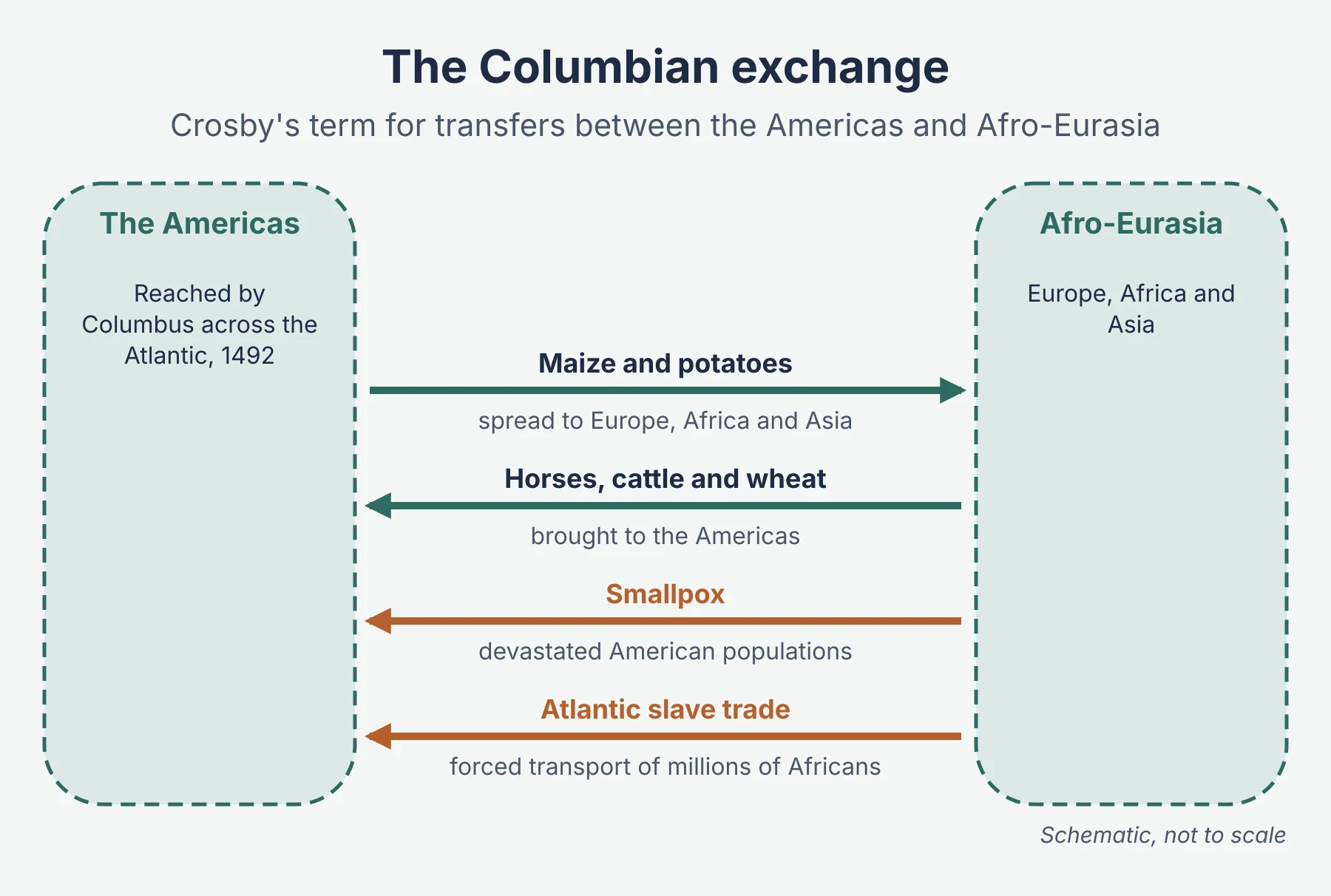
| 1492 | Columbus reaches the Caribbean | Contact |
| 1498 | Vasco da Gama reaches India | Contact |
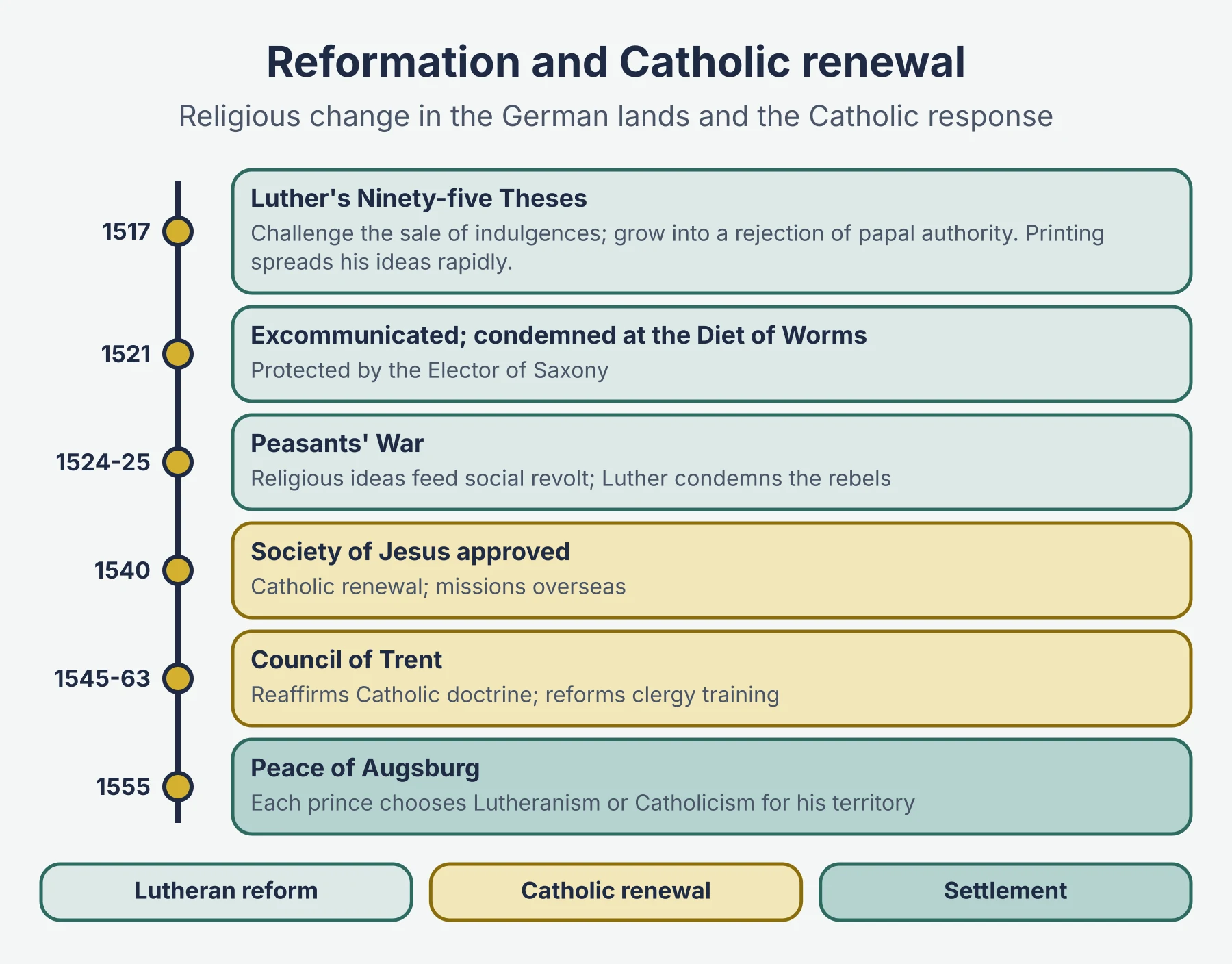
| 1517 | Luther’s Ninety-five Theses | Religion |
| 1521 | Diet of Worms | Religion |
| 1524-1525 | Peasants’ War in Germany | Society |
| 1540 | Jesuit order approved | Religion |
| 1543 | Copernicus publishes his heliocentric theory | Ideas |
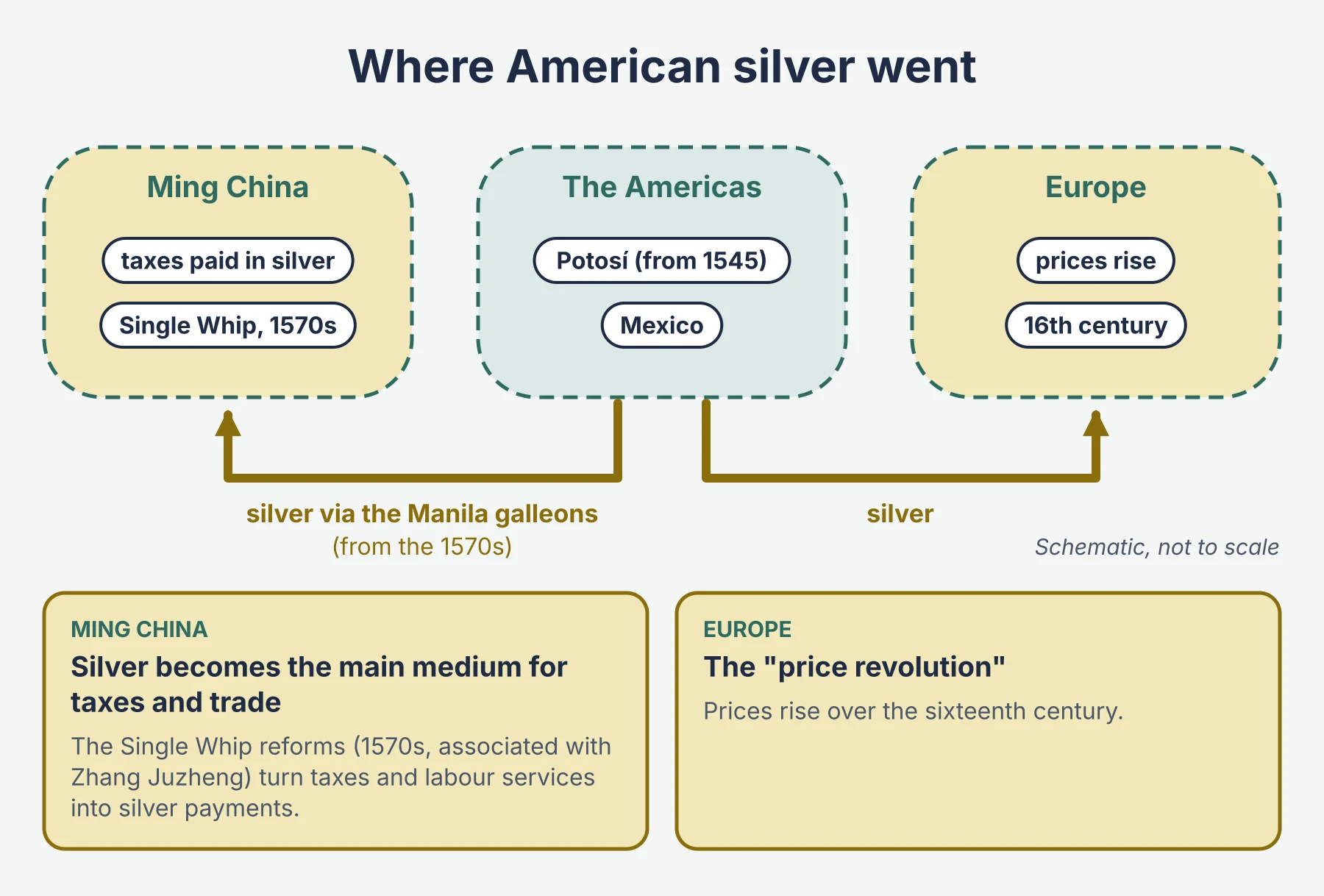
| 1545 | Silver mining begins at Potosí | Economy |
| 1545-1563 | Council of Trent | Religion |
| 1549 | Jesuit mission arrives in Japan | Religion and contact |
| 1555 | Peace of Augsburg | Religion |
| 1556-1605 | Reign of Akbar | Religion and state |
| 1570s | Manila galleon trade begins; Single Whip reforms extended under Zhang Juzheng | Economy |
| 1633 | Galileo’s trial | Ideas |
| 1687 | Newton’s Principia | Ideas |
Change and continuity: German lands, c.1500-1600
| Area | Change | Continuity |
|---|---|---|
| Religion | Lutheran churches; end of papal authority in Protestant states | Catholicism survived in the south and in Habsburg lands |
| Church property | Monasteries dissolved in Protestant territories | Bishoprics and abbeys survived in Catholic areas |
| Politics | Princes controlled their territory’s church (cuius regio, eius religio) | The Holy Roman Empire and its institutions remained |
| Society | Clergy could marry; new schools and catechisms | Social hierarchy intact; the peasants’ demands defeated in 1525 |
| Culture | Vernacular Bible; pamphlets and print | Latin remained the language of learning |
Change and continuity: Ming China, c.1400-1644
| Area | Change | Continuity |
|---|---|---|
| Economy | Silver economy; commercial crops; growth of market towns | Agriculture the base; the state still taxed land |
| Foreign contact | Zheng He’s voyages; lifting of the maritime ban (1567); Jesuits at court (Ricci in Beijing from 1601) | Tribute system and suspicion of foreign influence |
| Society | Merchant wealth bought land and education | Scholar-officials at the top; examination system unchanged in principle |
| Ideas | Wang Yangming’s challenge to orthodox Neo-Confucianism | Confucian classics remained the basis of education |
Key terms
| Term | Meaning |
|---|---|
| Humanism | Study of classical texts to promote eloquence and civic virtue |
| Indulgence | Remission of punishment for sin granted by the Church, sometimes in return for payment |
| Cuius regio, eius religio | “Whose realm, his religion”: the principle of the Peace of Augsburg |
| Counter-Reformation | The Catholic Church’s response to Protestantism, including Trent and the Jesuits |
| Heliocentrism | Theory that the earth orbits the sun |
| Columbian exchange | The transfer of plants, animals, people and diseases between the Americas and Afro-Eurasia |
| Price revolution | Sustained rise in European prices in the sixteenth century |
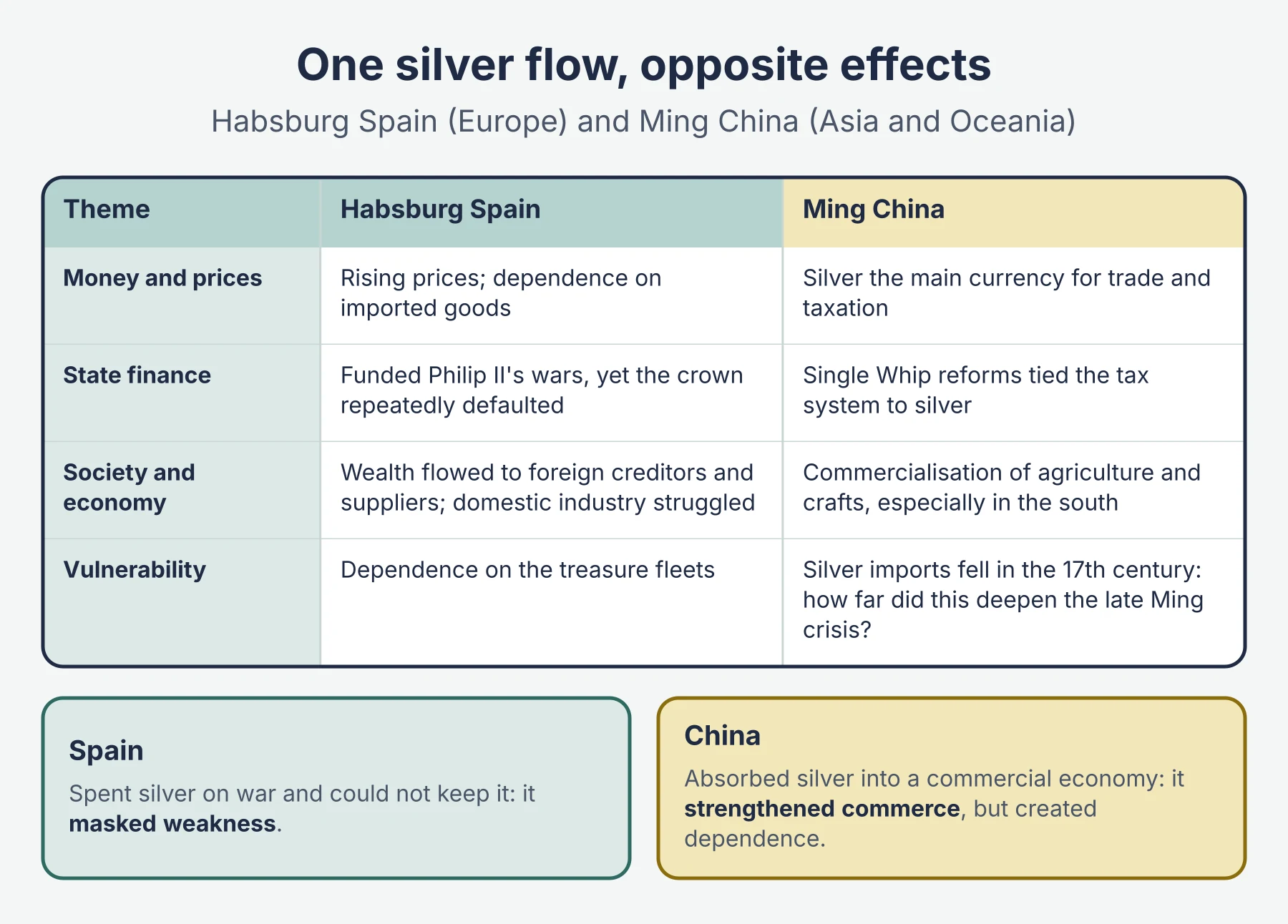
| Single Whip reform | Ming consolidation of taxes and labour services into silver payments |
| Sulh-i kul | “Peace with all”: Akbar’s policy of religious toleration |
| Enclosure | Turning open fields or common land into private holdings |
Causes of change: linking factors
- Print and Reformation: print made Luther’s ideas available far faster than manuscript copying could; reform movements created demand for print.
- Silver and state power: American silver funded Spanish wars and fed China’s monetised economy.
- Contact and disease: epidemics made conquest easier and transformed American societies; new crops later supported population growth in Asia and Europe.
- Religion and politics: princes adopted reform partly for control over church lands and appointments; rulers such as Akbar used toleration to bind diverse elites.
Judgement lines for conclusions
- “Change was rapid among elites and in cities, but slow in the countryside where most people lived.”
- “Religious reform changed who controlled the church more than it changed the social order.”
- “Global contact transformed the Americas but was absorbed by strong states such as Ming China.”
Exam traps
- Everything changed. Always give continuity, especially in social hierarchy and rural life.
- Europe-only answers. Ready a second region: Ming China, Mughal India, Tokugawa Japan or the Ottoman empire.
- “The Renaissance caused the Reformation.” Show the link (humanist study of scripture, print) without making it automatic.
- Inventions without effects. Explain who used a development and what it changed.
- Wrong end date. The topic ends in 1700, before the Enlightenment’s peak.
Self-test
- What did Luther attack in the Ninety-five Theses? The sale of indulgences and the abuses associated with them.
- What principle did the Peace of Augsburg establish? Each prince could choose Lutheranism or Catholicism for his territory.
- Name two features of the Catholic response to the Reformation. The Council of Trent and the Jesuit order.
- What was Akbar’s policy of sulh-i kul? A policy of “peace with all”, tolerating different religions.
- Between which years did Zheng He’s voyages take place? 1405 and 1433.
- Which historian coined the term “Columbian exchange”? Alfred Crosby.
- Give one crop that moved from the Americas to Afro-Eurasia. Maize, potatoes, tomatoes or chillies.
- Where was the great silver mine opened in 1545? Potosí.
- What did the Single Whip reform do? It consolidated taxes and labour services into payments in silver.
- Why was Galileo tried in 1633? For supporting the heliocentric theory against Church teaching.
- Give one way printing changed European society. It reduced the cost of books, standardised texts and spread religious and political ideas quickly.
- Give one continuity in German society after the Reformation. Social hierarchy and princely power remained, or Catholicism survived in many areas.
Get free revision emails (optional)
Occasional emails with practice questions, worked explanations and links to free resources for the qualification and subjects you choose. No spam, and you can unsubscribe from any email. The free tools on this site never need an email.
Related resources
-
Practice questions
IB DP History: The Six Key Concepts – Practice Questions
Original practice questions with worked answers on the six key concepts of IB DP History (first assessed 2017), from spotting the concept to essay plans.
World History · International Baccalaureate · IB
Try questions -
Study guides
IB DP History (DP History): Early Modern states (1450-1789)
IB History Paper 2 world history topic 5, Early Modern states 1450-1789: building, ruling and limiting states across regions, with a worked comparative plan.
World History · International Baccalaureate · IB
Read guide -
Practice questions
IB DP History (DP History): Early Modern states (1450-1789) – Practice Questions
Twelve original IB History practice questions on Early Modern states 1450-1789, from short recall to full Paper 2 essays, with mark-scheme answers.
World History · International Baccalaureate · IB
Try questions
Related articles
-
teaching
A Level tuition in Dubai: Cambridge or Pearson Edexcel International A Level?
Schools in Dubai and Abu Dhabi teach either Cambridge International AS & A Level or Pearson Edexcel International A Level. How the two are structured, why it matters for tuition, and how online classes from Lahore work.
9 October 2026
-
curriculum guides
Choosing subjects at IGCSE and A Level
How subject choices at 14 and 16 affect university options later, and how to keep pathways open without overloading a timetable.
28 July 2026
Studying this with a teacher
Working through World History IB?
This page is free and stays free. If you would rather be taught it, Marlbridge runs World History classes one-to-one, online in your own time zone. The first trial class is free. WhatsApp replies within an hour (8am–11pm Pakistan time, every day); email the same day.
IB World History teachers at Marlbridge
