
Study Guides
IB DP History (DP History): Early Modern states (1450-1789)
IB History Paper 2 world history topic 5, Early Modern states 1450-1789: building, ruling and limiting states across regions, with a worked comparative plan.
- Subject
- World History
- Level
- IB
- Topic
- Topic 2: World history topics
- Author
- Marlbridge Academic Team
- Updated
- Reviewed by
- Azam Siddique (what this means)
Aligned to International Baccalaureate IB Diploma Programme World History (DP History), First assessment 2017. Official specification .
Syllabus page (what it covers and how it is assessed): IB Diploma Programme World History.
Syllabus points this page covers
DP History
- 5 Early Modern states (1450-1789)
Found an error? Report a correction.
Need help with this topic? Request a free trial class for IB Diploma Programme World History (DP History).
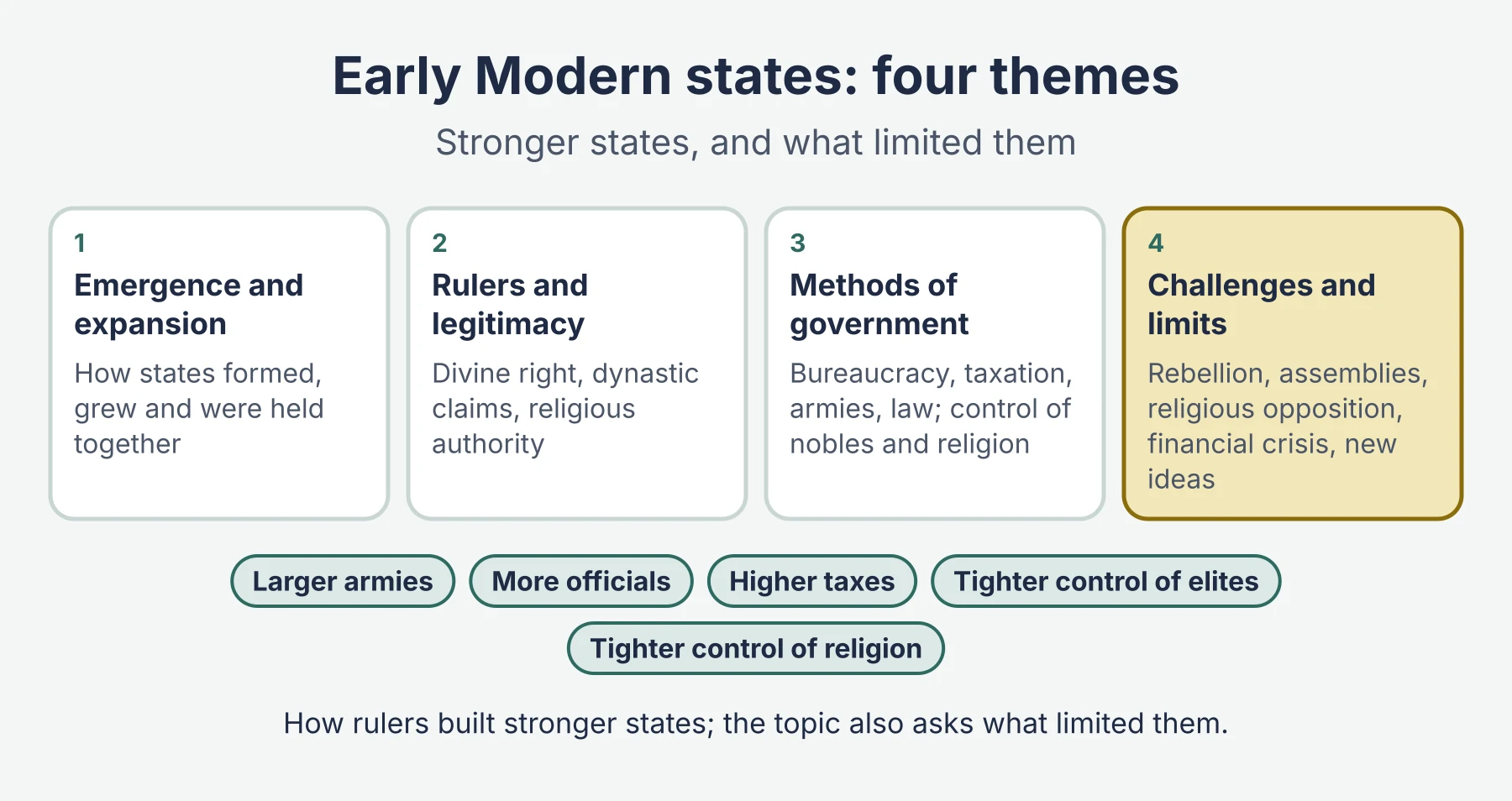
World history topic 5, Early Modern states (1450-1789), examines how rulers across the world built stronger states: larger armies, more officials, higher taxes and tighter control of elites and religion. It also asks what limited them. Paper 2 essays usually ask you to evaluate one ruler’s success or compare two states from different regions. The world history topics overview explains Paper 2; this guide develops this topic.
What the topic covers
The content can be organised into four themes:
- The emergence and expansion of states: how states formed, grew and were held together.
- Rulers and legitimacy: the ideas that justified power, including divine right, dynastic claims and religious authority.
- Methods of government: bureaucracy, taxation, armies, law and the control of nobles and religious institutions.
- Challenges and limits: rebellion, representative assemblies, religious opposition, financial crisis and new political ideas.
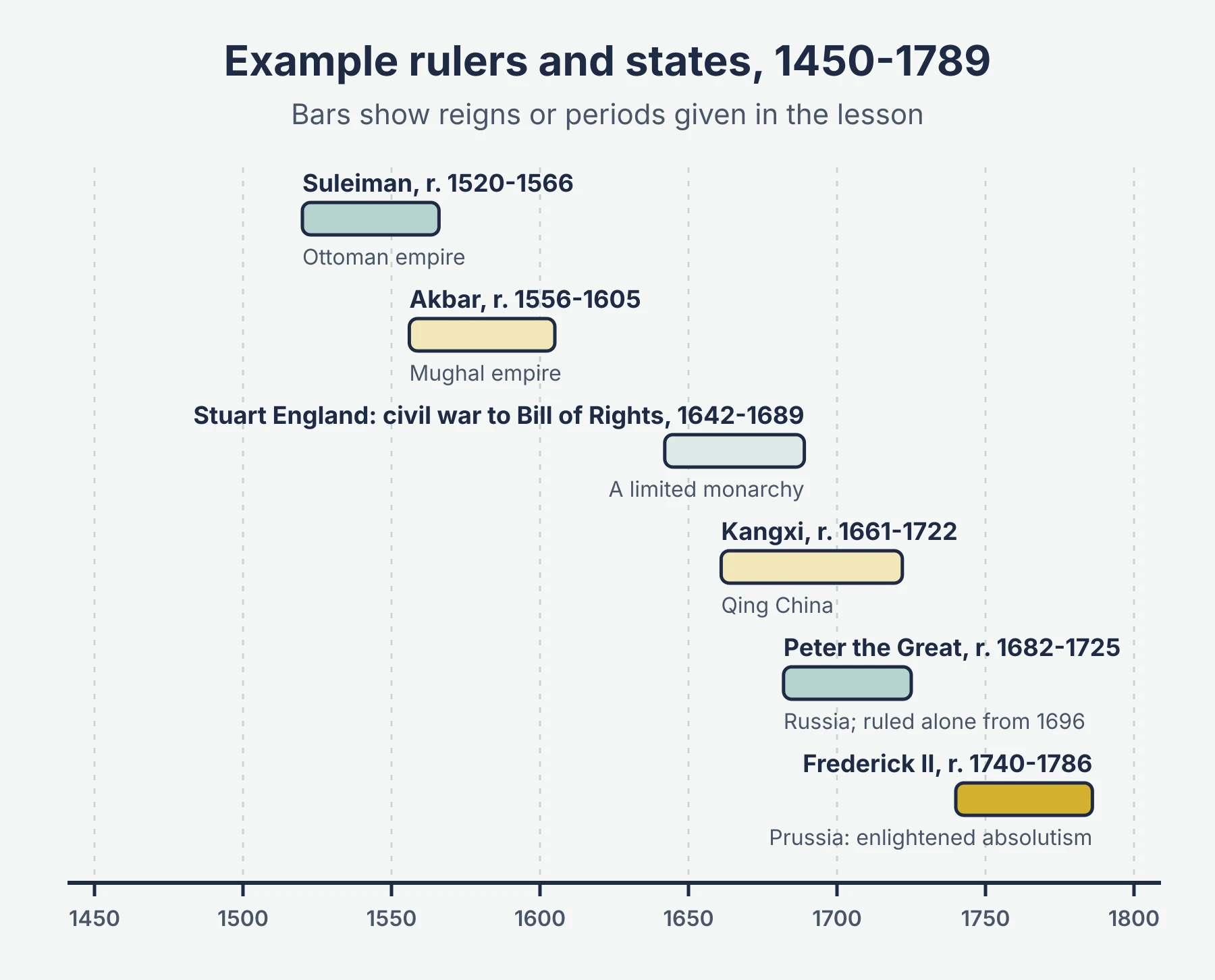
Typical examples include Louis XIV’s France, Peter the Great’s Russia, the Ottoman empire under Mehmed II and Suleiman, Akbar’s Mughal empire, Tokugawa Japan, the Qing under Kangxi, Prussia under Frederick II, and Stuart England, where royal power was limited.
Absolutism and its limits
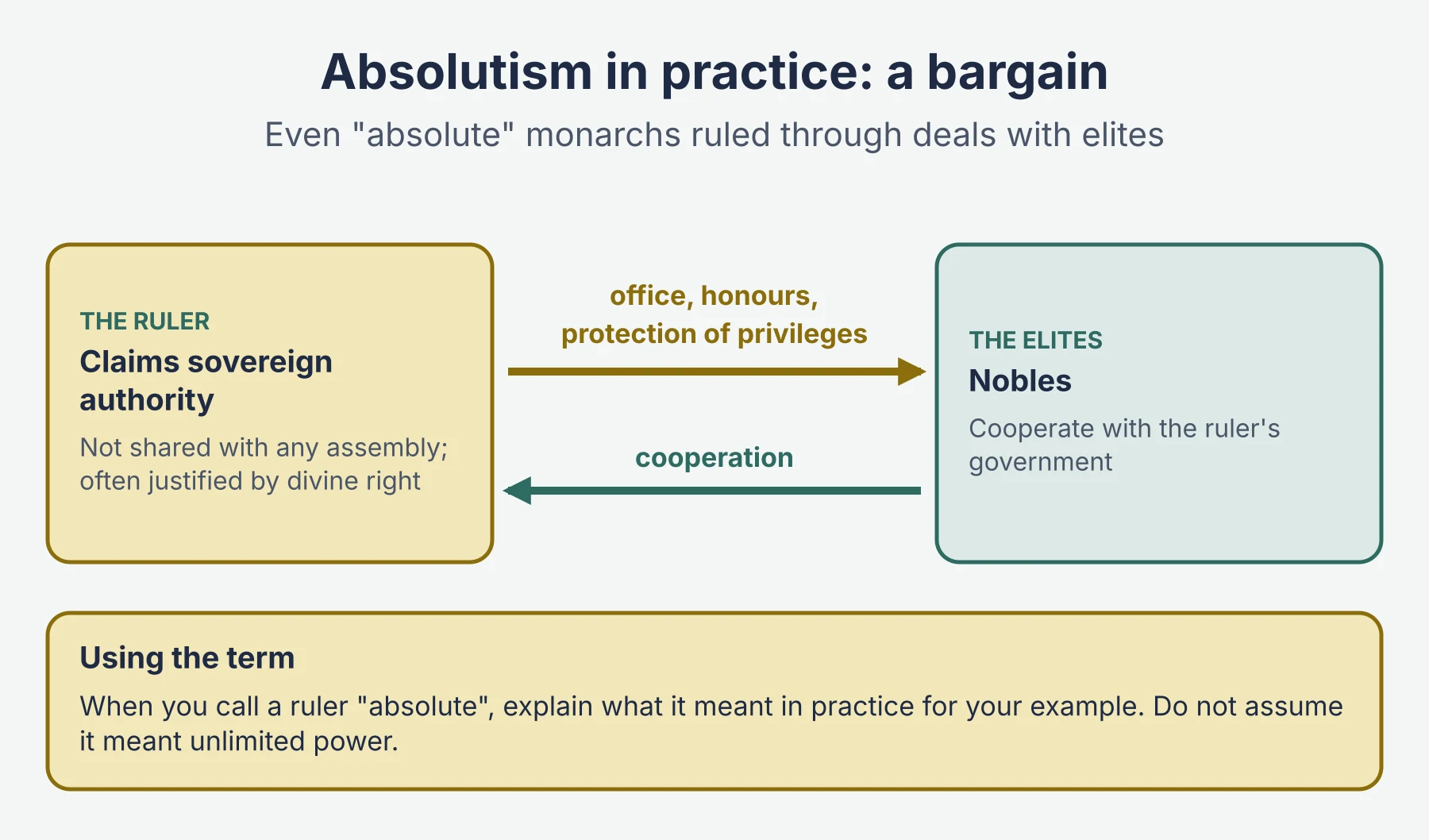
“Absolutism” describes rulers who claimed sovereign authority not shared with any assembly, often justified by divine right. Historians now stress that even “absolute” monarchs ruled through bargains with elites: they rewarded nobles with office, honours and protection of their privileges in return for cooperation. When you use the term, explain what it meant in practice for your example.
Peter the Great’s Russia (r. 1682-1725)
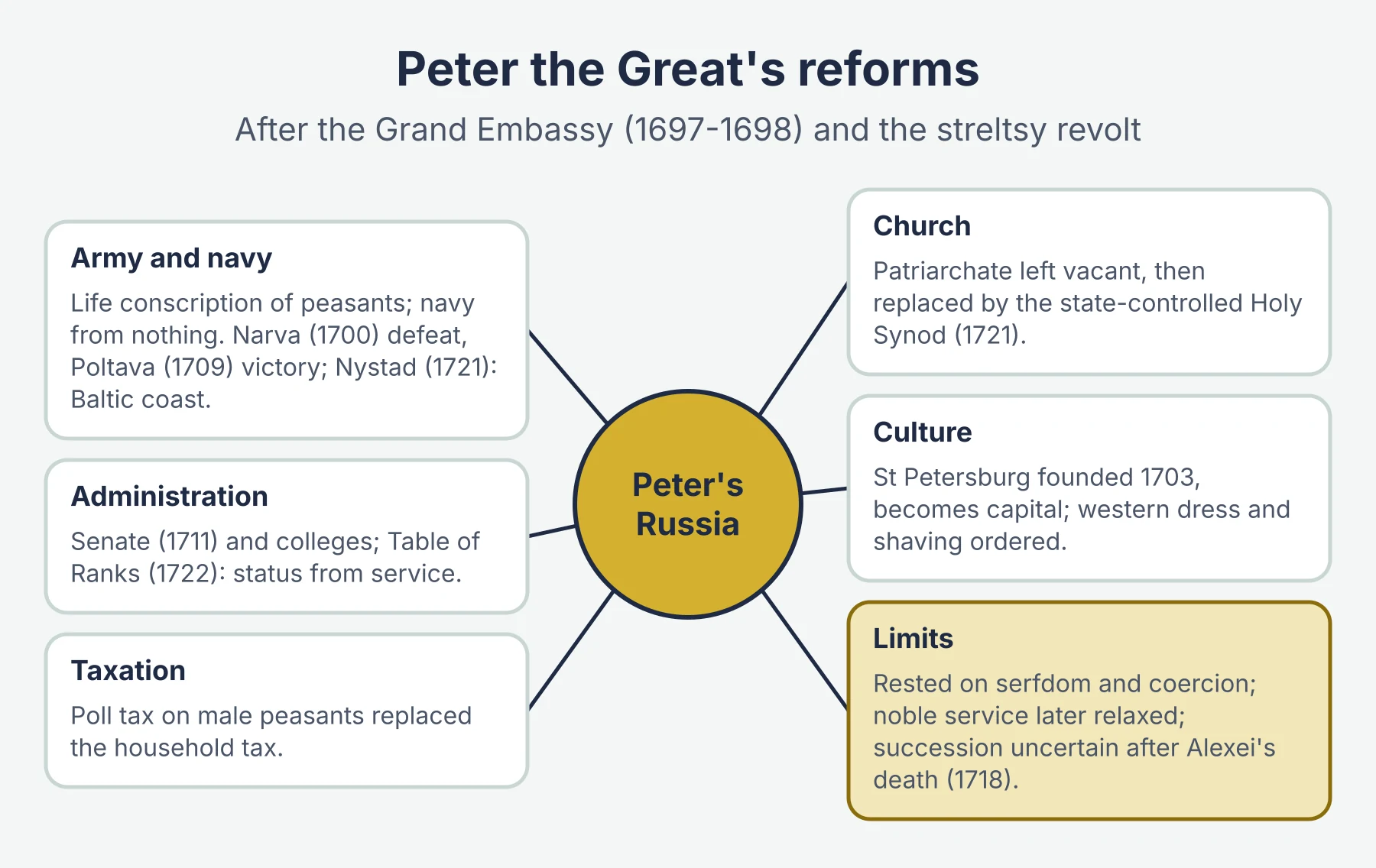
Peter shared the throne at first and ruled alone from 1696. After the Grand Embassy to western Europe (1697-1698) he crushed a revolt of the streltsy musketeers and began sweeping reforms.
- Army and navy: conscription of peasants for life service; a navy built from nothing; defeat at Narva (1700) followed by victory over Sweden at Poltava (1709). The Treaty of Nystad (1721) gave Russia the Baltic coast.
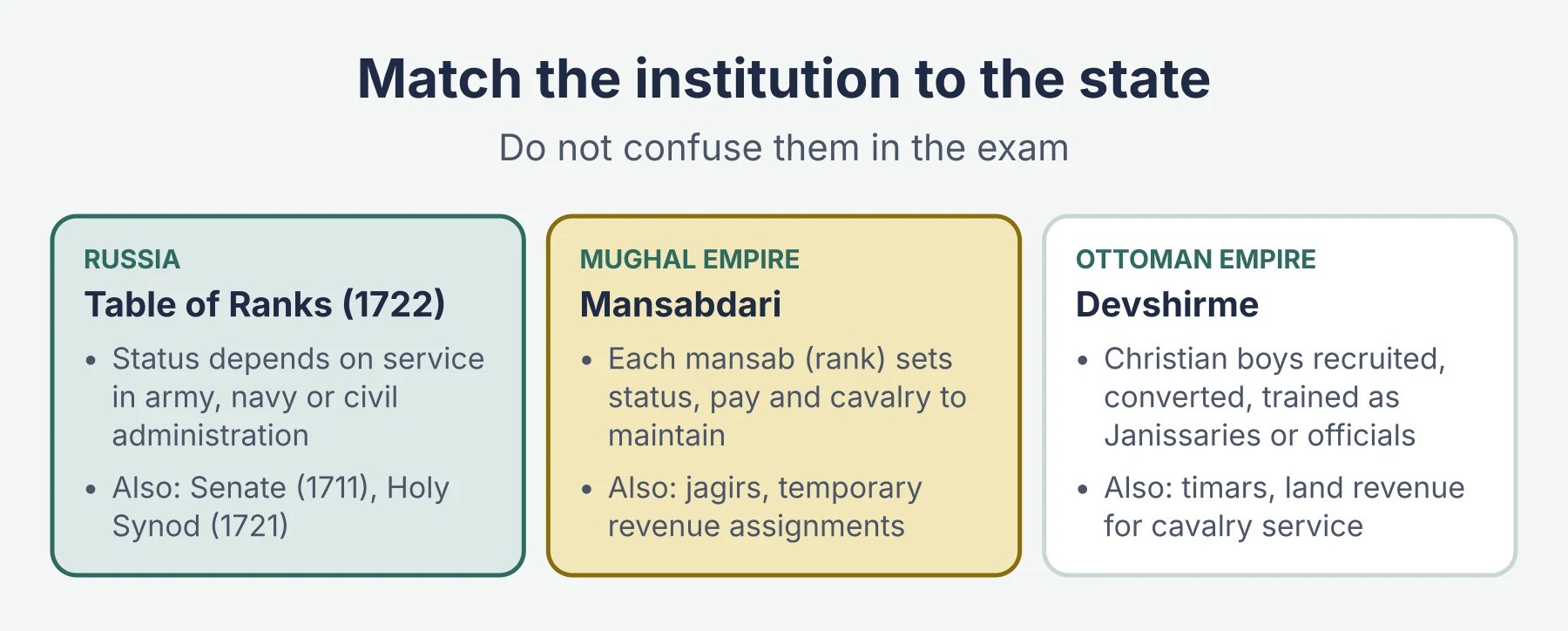
- Administration: a Senate (1711) and administrative colleges replaced the old offices; the Table of Ranks (1722) made status depend on service in the army, navy or civil administration.
- Taxation: a poll tax on male peasants replaced the household tax.
- Church: the patriarchate was left vacant and then replaced by the Holy Synod (1721), a state-controlled council.
- Culture: St Petersburg, founded in 1703, became the capital; nobles were ordered to shave and dress in western style.
Limits: reforms rested on serfdom and coercion; the nobility’s service obligations were later relaxed; the succession was left uncertain after the death of his son Alexei in 1718.
The Ottoman empire under Suleiman (r. 1520-1566)
The Ottoman state recruited Christian boys through the devshirme, converted them and trained them as Janissary infantry or palace officials, creating a service elite loyal only to the sultan. Cavalrymen held timars, grants of revenue from land, in return for military service. Suleiman, known in Turkish as Kanuni (“the Lawgiver”), issued legal codes harmonising sultanic law with Islamic law. Victories at Mohács (1526) and the siege of Vienna (1529) marked the furthest reach of Ottoman power in central Europe. Religious communities were allowed to run many of their own affairs under their leaders.
The Mughal empire under Akbar (r. 1556-1605)
Akbar ranked his nobles in the mansabdari system: each mansab (rank) set the holder’s status, pay and the number of cavalry he must maintain. Nobles were often paid with temporary revenue assignments (jagirs), and transferred regularly so that they could not build local power bases. Revenue reforms associated with his minister Todar Mal assessed land tax on measured land and average yields. Akbar incorporated Rajput princes into the nobility, abolished the jizya on non-Muslims and pursued religious toleration, binding a diverse elite to the dynasty.
Limits on rulers: Stuart England
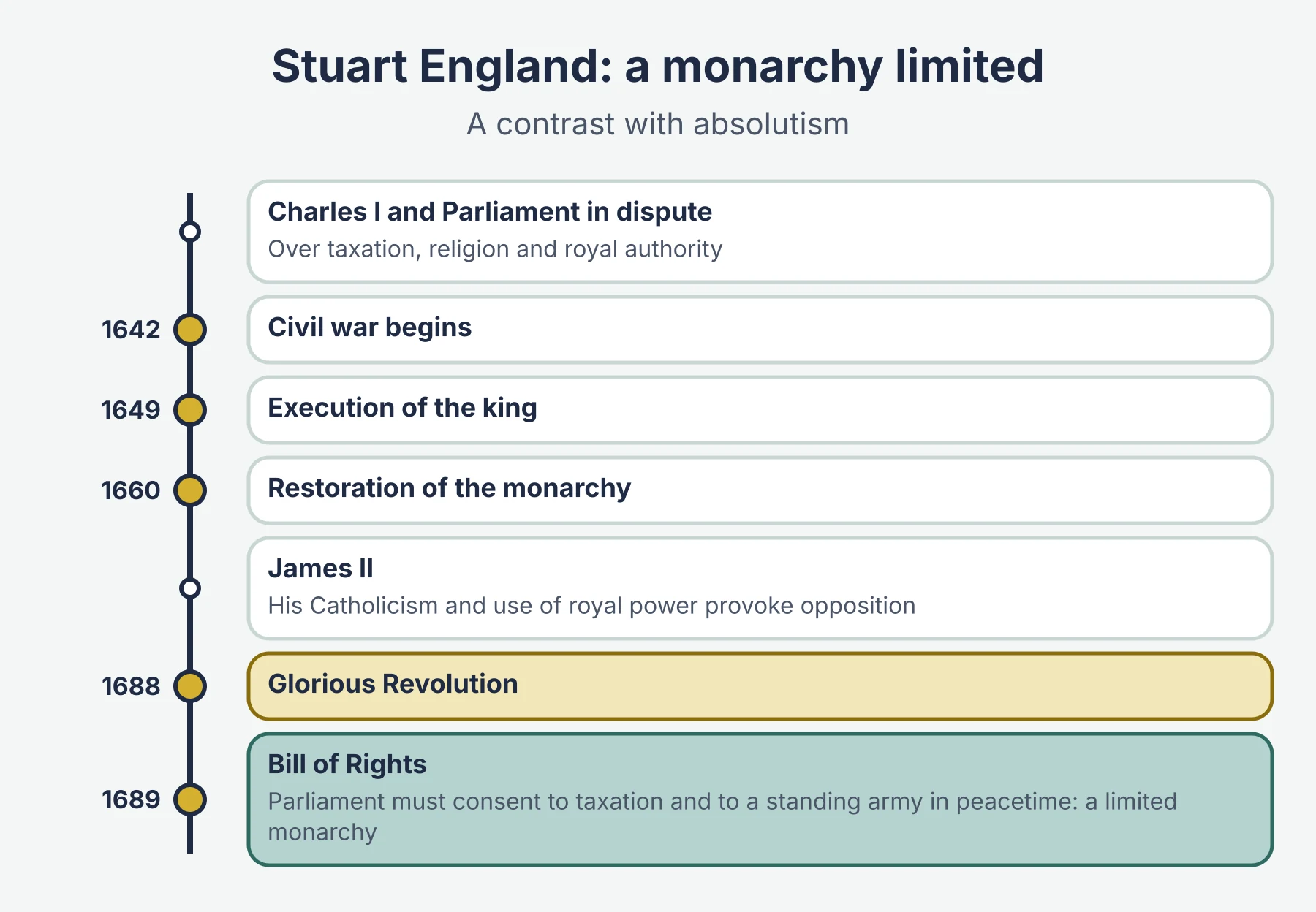
England offers a contrast. Disputes between Charles I and Parliament over taxation, religion and royal authority led to civil war (from 1642) and the king’s execution (1649). After the restoration of the monarchy (1660), James II’s Catholicism and his use of royal power provoked the Glorious Revolution (1688). The Bill of Rights (1689) required parliamentary consent for taxation and a standing army in peacetime, establishing a limited monarchy.
Enlightened absolutism: Prussia under Frederick II (r. 1740-1786)
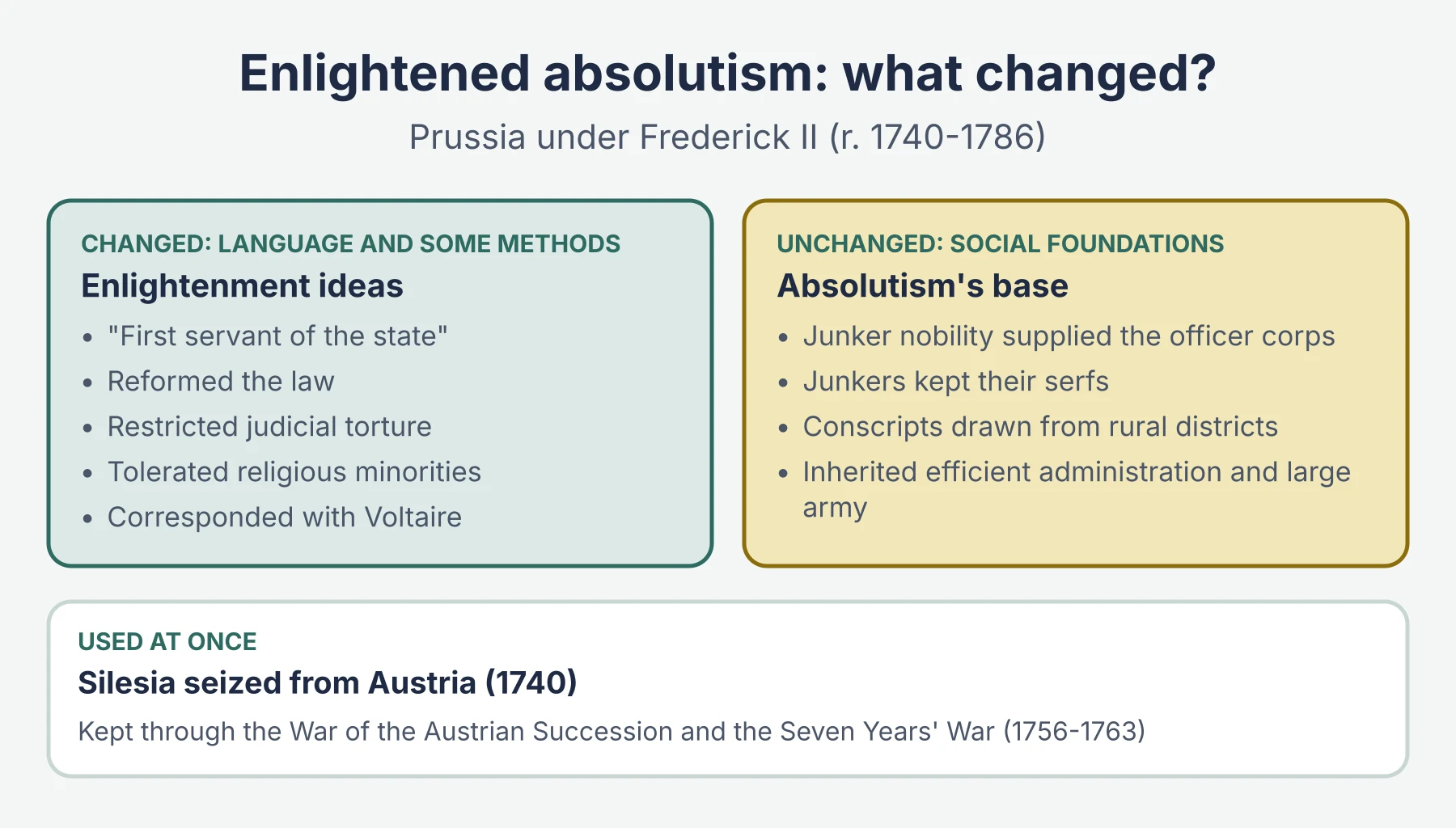
Frederick II inherited from his father an efficient administration and a large army, and used them at once, seizing Silesia from Austria in 1740. He kept it through the War of the Austrian Succession and the Seven Years’ War (1756-1763). He described himself as the “first servant of the state”, reformed the law, restricted judicial torture, tolerated religious minorities and corresponded with Voltaire. Yet his state rested on the Junker nobility, who supplied the officer corps and kept their serfs, and on a military system that drew conscripts from rural districts. Frederick shows that Enlightenment ideas could change the language and some methods of rule while leaving the social foundations of absolutism intact.
The Qing under Kangxi (r. 1661-1722)
The Kangxi Emperor consolidated a Manchu conquest dynasty over a vast Han Chinese population. He crushed the Revolt of the Three Feudatories (1673-1681), annexed Taiwan (1683) and agreed the Treaty of Nerchinsk with Russia (1689). He won the cooperation of Han scholar-officials by patronising Confucian learning, holding the examinations and sponsoring great scholarly projects such as an official dictionary, while keeping key military power in Manchu hands. His reign illustrates legitimacy built by adopting the traditions of the conquered.
Worked example: a comparative essay plan
Question: “Compare and contrast the methods used by two rulers, each chosen from a different region, to control their nobilities.”
Examples: Peter the Great (Europe) and Akbar (Asia and Oceania).
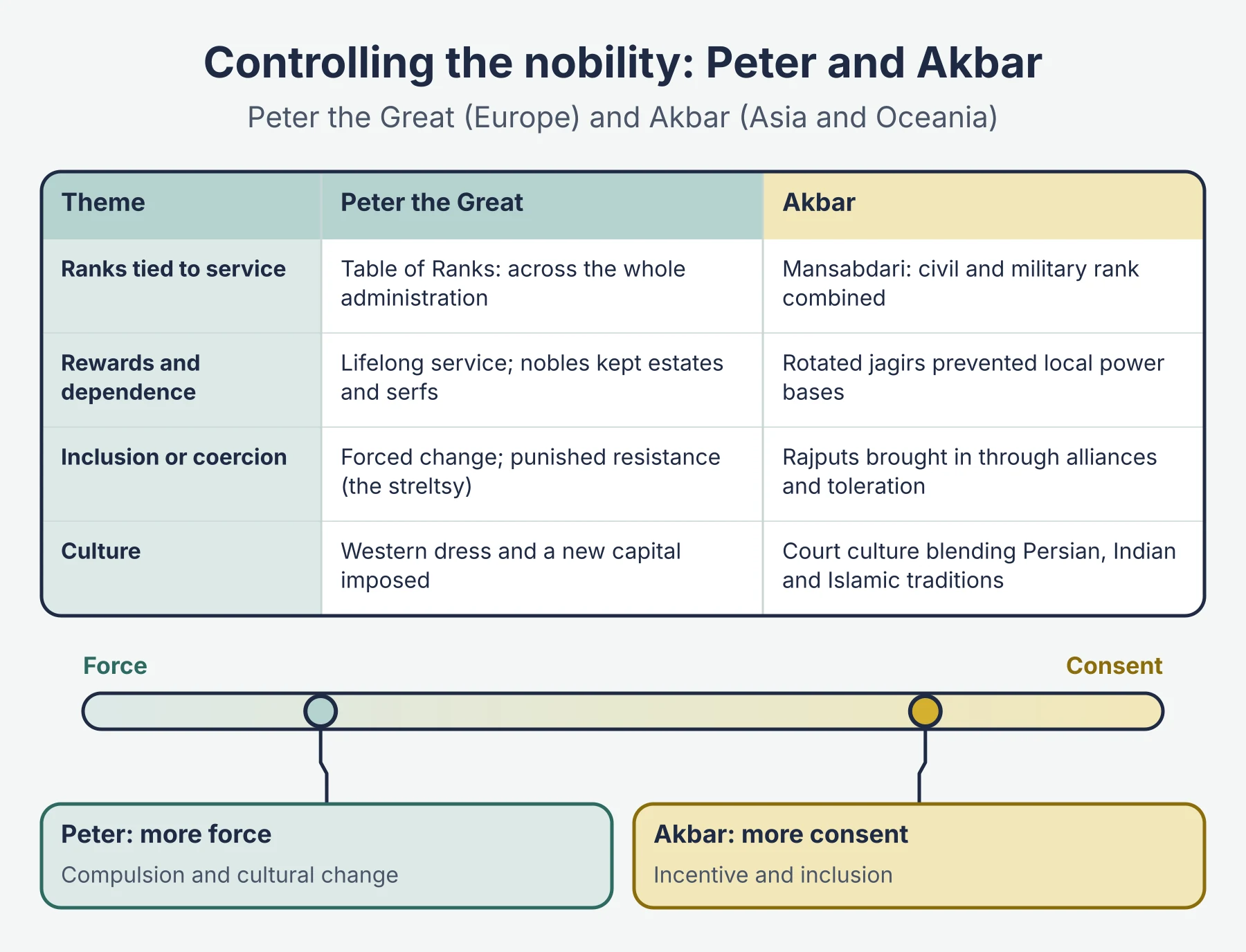
Thesis: both rulers turned their nobilities into a service elite whose status depended on the state, but Peter used compulsion and cultural change, while Akbar relied more on incentive and inclusion.
Paragraphs:
- Ranks tied to service. The Table of Ranks and the mansabdari system both linked status to service; Peter’s applied to the whole administration, Akbar’s combined civil and military rank.
- Rewards and dependence. Akbar’s rotated jagirs prevented local power; Peter’s nobles owed lifelong service and kept their estates and serfs.
- Inclusion and coercion. Akbar brought Rajputs into the elite through alliances and toleration; Peter forced change and punished resistance, as with the streltsy.
- Culture. Peter imposed western dress and a new capital; Akbar built a court culture blending Persian, Indian and Islamic traditions.
Conclusion: both created durable systems of control, but Akbar’s rested more on consent and Peter’s more on force, which reflected the different elites and resources each ruler faced.
Common mistakes
- Assuming “absolute” meant unlimited power.
- Describing reforms without judging their success or limits.
- Using Louis XIV for everything; prepare at least one example from another region.
- Confusing institutions: the Table of Ranks is Russian, the mansabdari Mughal, the devshirme Ottoman.
- Running past 1789 into the French Revolution.
Exam technique
Evaluate and to what extent questions need criteria: centralisation, revenue, military power, control of elites and religion, durability. Examine questions on reasons for a state’s growth need ranked factors. In comparisons, keep both examples in every paragraph and explain why they differ.
Revise with the Early Modern states revision notes and practise with the Early Modern states practice questions.
Get free revision emails (optional)
Occasional emails with practice questions, worked explanations and links to free resources for the qualification and subjects you choose. No spam, and you can unsubscribe from any email. The free tools on this site never need an email.
Related resources
-
Practice questions
IB DP History: The Six Key Concepts – Practice Questions
Original practice questions with worked answers on the six key concepts of IB DP History (first assessed 2017), from spotting the concept to essay plans.
World History · International Baccalaureate · IB
Try questions -
Practice questions
IB DP History (DP History): Early Modern states (1450-1789) – Practice Questions
Twelve original IB History practice questions on Early Modern states 1450-1789, from short recall to full Paper 2 essays, with mark-scheme answers.
World History · International Baccalaureate · IB
Try questions -
Revision notes
IB DP History (DP History): Early Modern states (1450-1789) – Revision Notes
Revision notes for IB History Paper 2 Early Modern states 1450-1789: state profiles, methods and limits grids, key terms, exam traps and a self-test.
World History · International Baccalaureate · IB
Revise topic
Related articles
-
teaching
A Level tuition in Dubai: Cambridge or Pearson Edexcel International A Level?
Schools in Dubai and Abu Dhabi teach either Cambridge International AS & A Level or Pearson Edexcel International A Level. How the two are structured, why it matters for tuition, and how online classes from Lahore work.
9 October 2026
-
curriculum guides
Choosing subjects at IGCSE and A Level
How subject choices at 14 and 16 affect university options later, and how to keep pathways open without overloading a timetable.
28 July 2026
Studying this with a teacher
Working through World History IB?
This page is free and stays free. If you would rather be taught it, Marlbridge runs World History classes one-to-one, online in your own time zone. The first trial class is free. WhatsApp replies within an hour (8am–11pm Pakistan time, every day); email the same day.
IB World History teachers at Marlbridge
