
Revision Notes
IB DP History (DP History): Early Modern states (1450-1789) – Revision Notes
Revision notes for IB History Paper 2 Early Modern states 1450-1789: state profiles, methods and limits grids, key terms, exam traps and a self-test.
- Subject
- World History
- Level
- IB
- Topic
- Topic 2: World history topics
- Author
- Marlbridge Academic Team
- Updated
- Reviewed by
- Azam Siddique (what this means)
Aligned to International Baccalaureate IB Diploma Programme World History (DP History), First assessment 2017. Official specification .
Syllabus page (what it covers and how it is assessed): IB Diploma Programme World History.
Syllabus points this page covers
DP History
- 5 Early Modern states (1450-1789)
Found an error? Report a correction.
Need help with this topic? Request a free trial class for IB Diploma Programme World History (DP History).
Early Modern states (1450-1789) is world history topic 5 for Paper 2. Revise at least two states from different regions under four themes: emergence and expansion, legitimacy, methods of government, and challenges and limits.
Related: Early Modern states study guide and Early Modern states practice questions.
State profiles
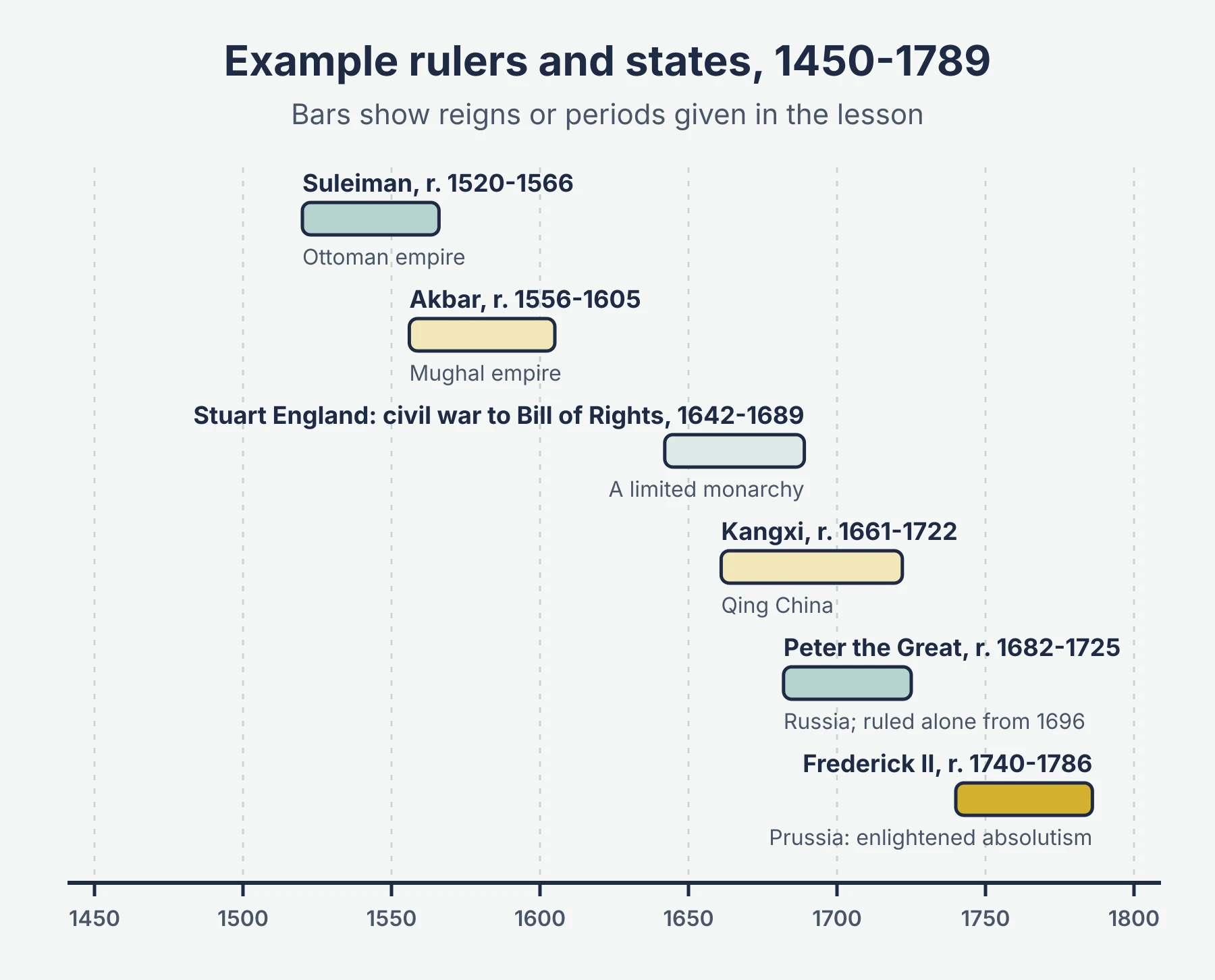
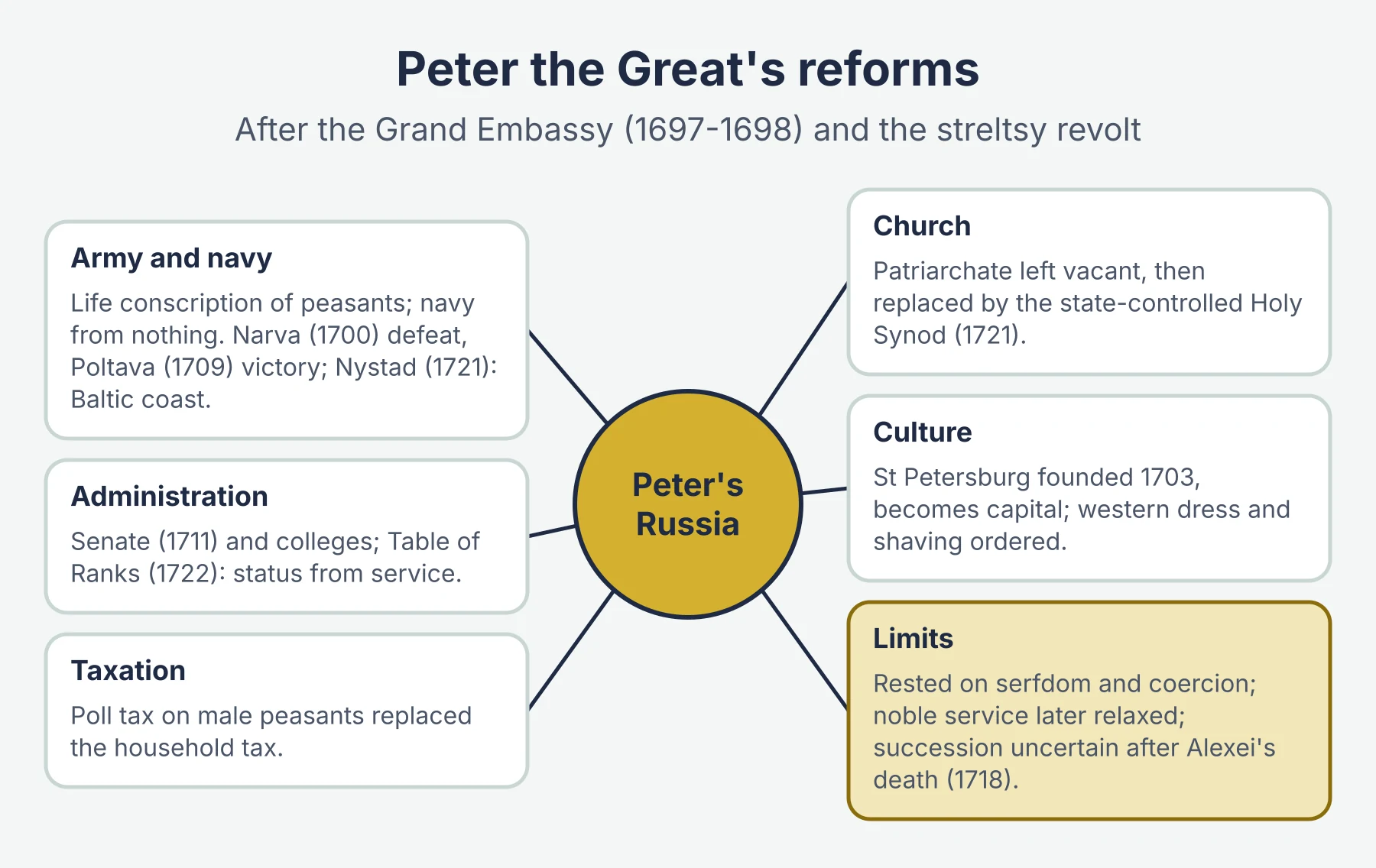
Russia under Peter the Great (1682-1725): Europe
- Legitimacy: Romanov dynasty; tsar as autocrat; title of Emperor (1721).
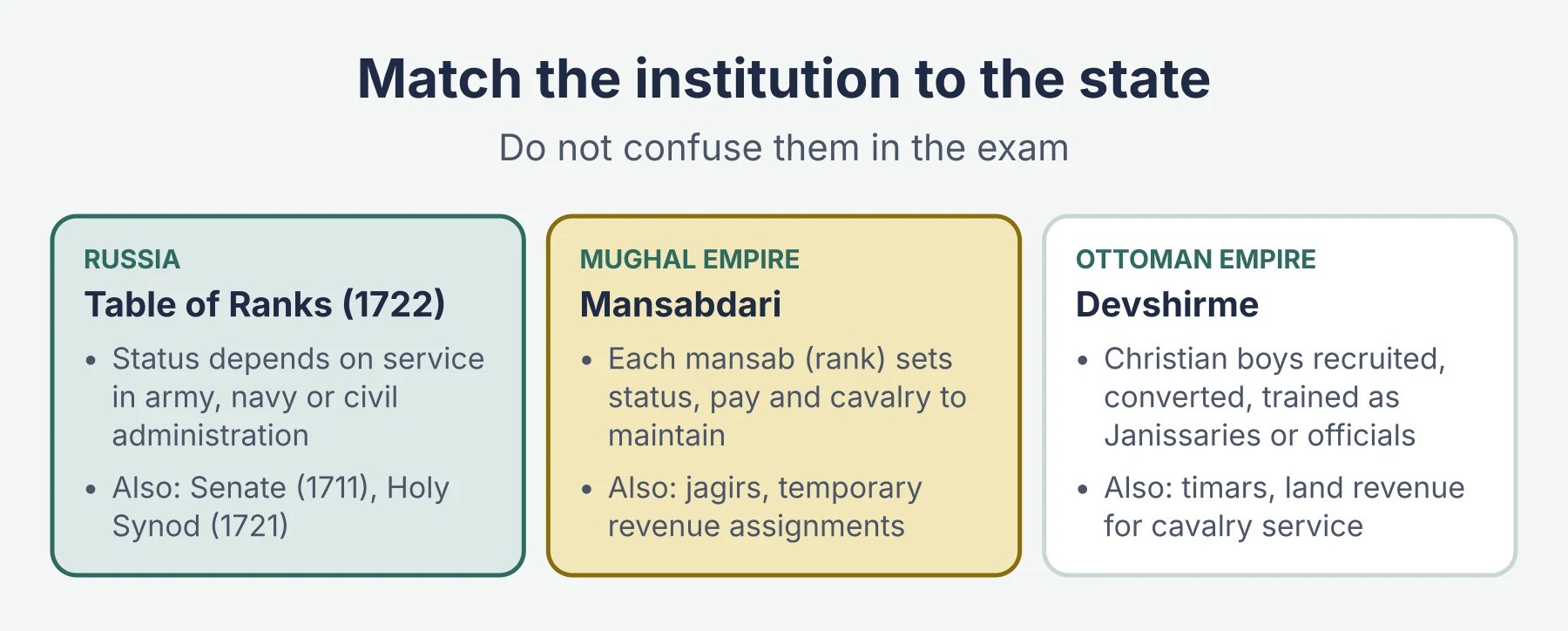
- Methods: conscript army and new navy; Senate (1711); colleges; Table of Ranks (1722); poll tax; Holy Synod (1721).
- Expansion: Great Northern War (1700-1721); Poltava (1709); Nystad (1721).
- Limits: dependence on serfdom; resistance from traditionalists; uncertain succession after Alexei’s death (1718).
Ottoman empire under Suleiman (1520-1566): Europe and the Middle East
- Legitimacy: Ottoman dynasty; sultan as protector of Islam; conquest.
- Methods: devshirme and Janissaries; timar cavalry; grand vizier and imperial council; legal codes (kanun).
- Expansion: Belgrade (1521), Rhodes (1522), Mohács (1526), siege of Vienna (1529), Baghdad (1534).
- Limits: distance and supply; later Janissary power; dependence on continued conquest for revenue and reward.
Mughal empire under Akbar (1556-1605): Asia and Oceania
- Legitimacy: Timurid descent; Islamic and Persian kingship; a court ideology placing the emperor above religious divisions.
- Methods: mansabdari ranks; rotated jagirs; measured land revenue (Todar Mal); Rajput alliances.
- Religion: abolished the jizya (1564); debates in the house of worship at Fatehpur Sikri; sulh-i kul.
- Limits: the system depended on expansion and on the emperor’s personal authority.
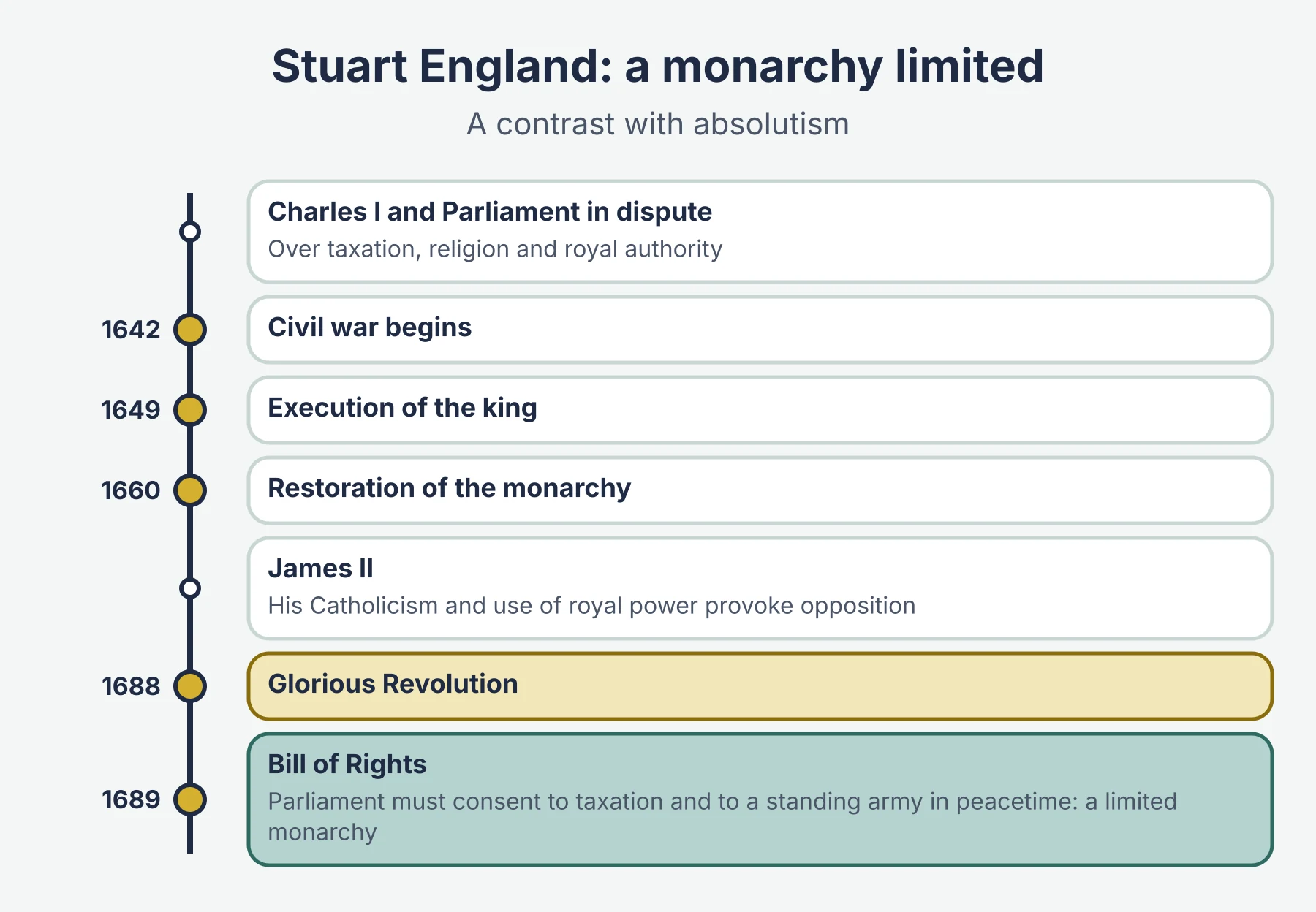
Stuart England (1603-1689): Europe
- Legitimacy: hereditary monarchy; claims to divine right under James I and Charles I.
- Conflict: disputes over taxation and religion; civil war (1642-1651); execution of Charles I (1649).
- Outcome: Restoration (1660); Glorious Revolution (1688); Bill of Rights (1689).
- Significance: the clearest example of limits on a ruler, through Parliament.
Qing China under Kangxi (1661-1722): Asia and Oceania
- Legitimacy: Manchu conquest dynasty presenting itself as holder of the Mandate of Heaven; patron of Confucian learning.
- Methods: suppressed the Revolt of the Three Feudatories (1673-1681); took Taiwan (1683); Treaty of Nerchinsk with Russia (1689).
- Limits: tension between Manchu and Han elites; scale of the empire.
Methods of government compared
| Method | Russia | Ottoman empire | Mughal empire |
|---|---|---|---|
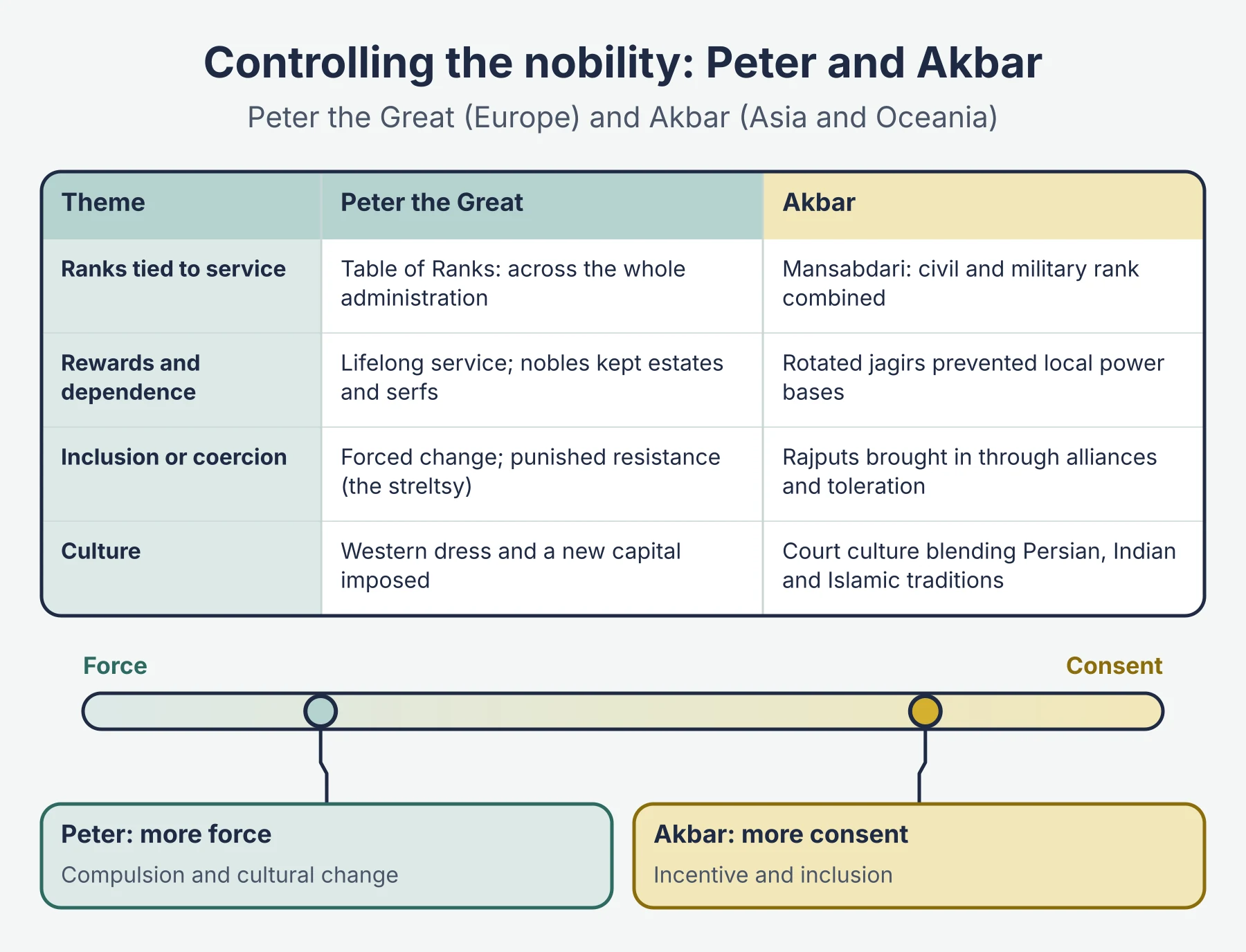
| Elite control | Table of Ranks; compulsory service | Devshirme elite loyal to the sultan | Mansabdari ranks; rotated jagirs |
| Army | Conscript standing army | Janissaries and timar cavalry | Cavalry provided by mansabdars |
| Revenue | Poll tax on male peasants | Taxes from timars, trade and tribute | Land revenue on measured land |
| Religion | Church under the Holy Synod | Sultan as protector of Islam; religious communities under their own leaders | Toleration and sulh-i kul |
| Capital | St Petersburg (1703) | Istanbul | Agra, Fatehpur Sikri, Lahore |
Challenges to Early Modern rulers
| Challenge | Example |
|---|---|
| Noble revolt | The Fronde in France (1648-1653) |
| Representative assemblies | English Parliament against Charles I and James II |
| Military revolt | The streltsy revolt against Peter (1698) |
| Regional power | Revolt of the Three Feudatories against Kangxi |
| Religious opposition | Old Believers in Russia; Huguenots in France |
| Financial crisis | French debts by the 1780s, leading to the calling of the Estates-General (1789) |
Key terms
| Term | Meaning |
|---|---|
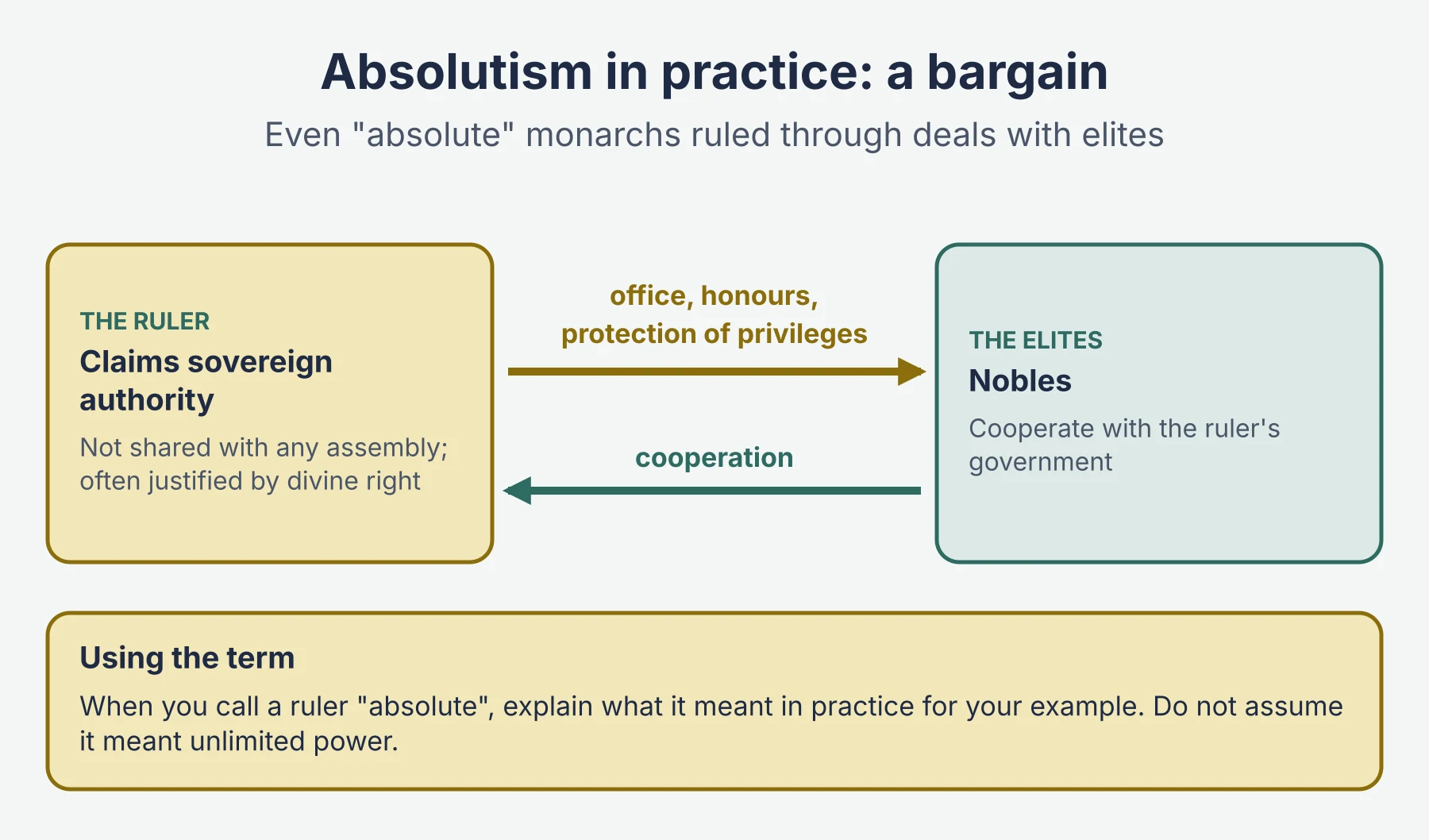
| Absolutism | Claim to sovereign power not shared with any assembly |
| Divine right | Belief that a king’s authority came directly from God |
| Table of Ranks | Peter’s 1722 hierarchy of service ranks |
| Holy Synod | State-controlled council replacing the Russian patriarchate |
| Devshirme | Ottoman levy of Christian boys trained for military and palace service |
| Timar | Ottoman revenue grant in return for cavalry service |
| Mansabdari | Mughal system of ranks determining status, pay and troops |
| Jagir | Mughal revenue assignment granted to a noble |
| Bill of Rights | 1689 English act limiting royal power |
| Enlightened absolutism | Rule by absolute monarchs influenced by Enlightenment ideas, such as Frederick II |
Judgement lines for conclusions
- “Absolute monarchy worked through bargains with elites, not in spite of them.”
- “Service ranks bound nobles to the state, but only while the ruler could reward them.”
- “Limits on rulers came from money as often as from assemblies.”
Exam traps
- “Absolute” means unlimited. Show the bargains and limits.
- One example for everything. Prepare two or three states from different regions.
- Reform lists. Judge which reforms worked, why, and for how long.
- Wrong region. The Ottoman empire spans Europe and the Middle East; if a question requires two regions, pair it with a clearly different one, such as Mughal India.
- Dates. The topic runs to 1789; avoid the French Revolution itself.
Self-test
- What did the Table of Ranks link status to? Service in the army, navy or civil administration.
- Which battle of 1709 marked Peter’s victory over Sweden? Poltava.
- What replaced the Russian patriarchate in 1721? The Holy Synod.
- What was the devshirme? The Ottoman levy of Christian boys, converted and trained as Janissaries or officials.
- Why was Suleiman called Kanuni? For his legal codes; the name means “the Lawgiver”.
- What determined a Mughal noble’s place in the mansabdari system? His rank, which set his status, pay and the cavalry he had to maintain.
- Why were jagirs rotated? To stop nobles building local power bases.
- Name one way Akbar bound Hindu elites to Mughal rule. Rajput alliances and marriages, or abolishing the jizya.
- What did the Bill of Rights (1689) require? Parliamentary consent for taxation and for a standing army in peacetime.
- Which revolt did Kangxi suppress between 1673 and 1681? The Revolt of the Three Feudatories.
- What was the Fronde? A series of revolts against the French crown, involving nobles and the Paris parlement, in 1648-1653.
- Give one limit on Peter the Great’s reforms. They depended on serfdom and coercion, or the succession was left uncertain.
Get free revision emails (optional)
Occasional emails with practice questions, worked explanations and links to free resources for the qualification and subjects you choose. No spam, and you can unsubscribe from any email. The free tools on this site never need an email.
Related resources
-
Practice questions
IB DP History: The Six Key Concepts – Practice Questions
Original practice questions with worked answers on the six key concepts of IB DP History (first assessed 2017), from spotting the concept to essay plans.
World History · International Baccalaureate · IB
Try questions -
Study guides
IB DP History (DP History): Causes and effects of Early Modern wars (1500-1750)
IB History Paper 2 world history topic 6, Early Modern wars 1500-1750: causes, practices and effects, the military revolution debate and a worked essay plan.
World History · International Baccalaureate · IB
Read guide -
Practice questions
IB DP History (DP History): Causes and effects of Early Modern wars (1500-1750) – Practice Questions
Twelve original IB History practice questions on Early Modern wars 1500-1750, from short recall to full Paper 2 essays, with mark-scheme answers.
World History · International Baccalaureate · IB
Try questions
Related articles
-
teaching
A Level tuition in Dubai: Cambridge or Pearson Edexcel International A Level?
Schools in Dubai and Abu Dhabi teach either Cambridge International AS & A Level or Pearson Edexcel International A Level. How the two are structured, why it matters for tuition, and how online classes from Lahore work.
9 October 2026
-
curriculum guides
Choosing subjects at IGCSE and A Level
How subject choices at 14 and 16 affect university options later, and how to keep pathways open without overloading a timetable.
28 July 2026
Studying this with a teacher
Working through World History IB?
This page is free and stays free. If you would rather be taught it, Marlbridge runs World History classes one-to-one, online in your own time zone. The first trial class is free. WhatsApp replies within an hour (8am–11pm Pakistan time, every day); email the same day.
IB World History teachers at Marlbridge
