
Study Guides
IB DP History (DP History): Causes and effects of Early Modern wars (1500-1750)
IB History Paper 2 world history topic 6, Early Modern wars 1500-1750: causes, practices and effects, the military revolution debate and a worked essay plan.
- Subject
- World History
- Level
- IB
- Topic
- Topic 2: World history topics
- Author
- Marlbridge Academic Team
- Updated
- Reviewed by
- Azam Siddique (what this means)
Aligned to International Baccalaureate IB Diploma Programme World History (DP History), First assessment 2017. Official specification .
Syllabus page (what it covers and how it is assessed): IB Diploma Programme World History.
Syllabus points this page covers
DP History
- 6 Causes and effects of Early Modern wars (1500-1750)
Found an error? Report a correction.
Need help with this topic? Request a free trial class for IB Diploma Programme World History (DP History).
World history topic 6, Causes and effects of Early Modern wars (1500-1750), studies wars fought in an age of gunpowder, religious division and growing states. Paper 2 essays ask about the causes of wars, the reasons for their outcomes and their effects, often comparing two wars from different regions. The world history topics overview explains the paper; this guide covers the topic in depth.
What the topic covers
The content falls under three headings, as in the course’s other war topics:
- Causes of war: religious, dynastic, territorial, economic and political causes, long-term and short-term.
- Practices of war and their impact on the outcome: types of war (civil, dynastic, religious, wars of expansion), changes in weapons, tactics and fortification, the mobilisation of men and money, and leadership.
- Effects of war: peace settlements, territorial and political change, economic, social and demographic consequences, and the effect on states and their institutions.
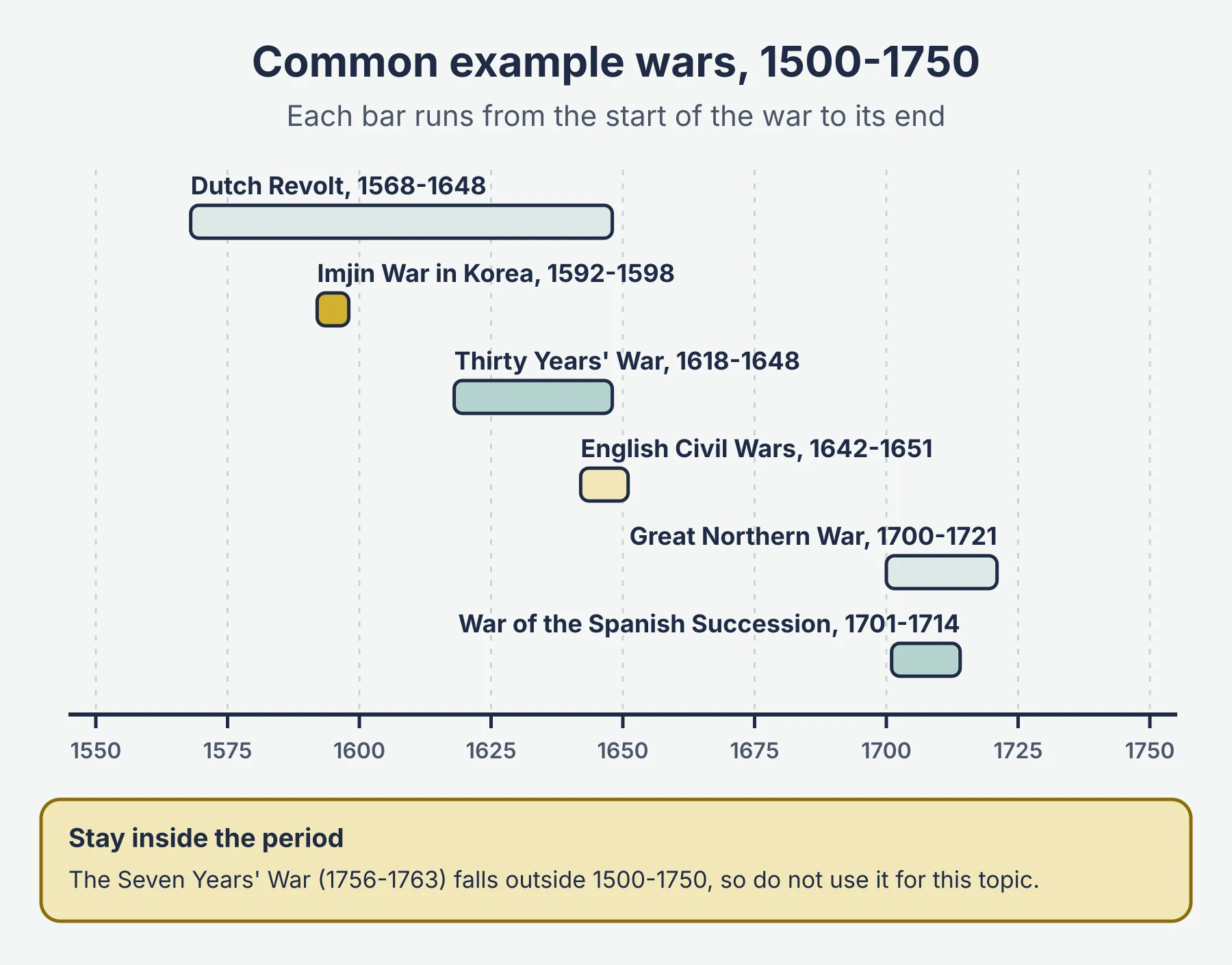
Common examples are the Thirty Years’ War (1618-1648), the Imjin War in Korea (1592-1598), the English Civil Wars (1642-1651), the Dutch Revolt (1568-1648), the War of the Spanish Succession (1701-1714) and the Great Northern War (1700-1721).
Causes
The Thirty Years’ War
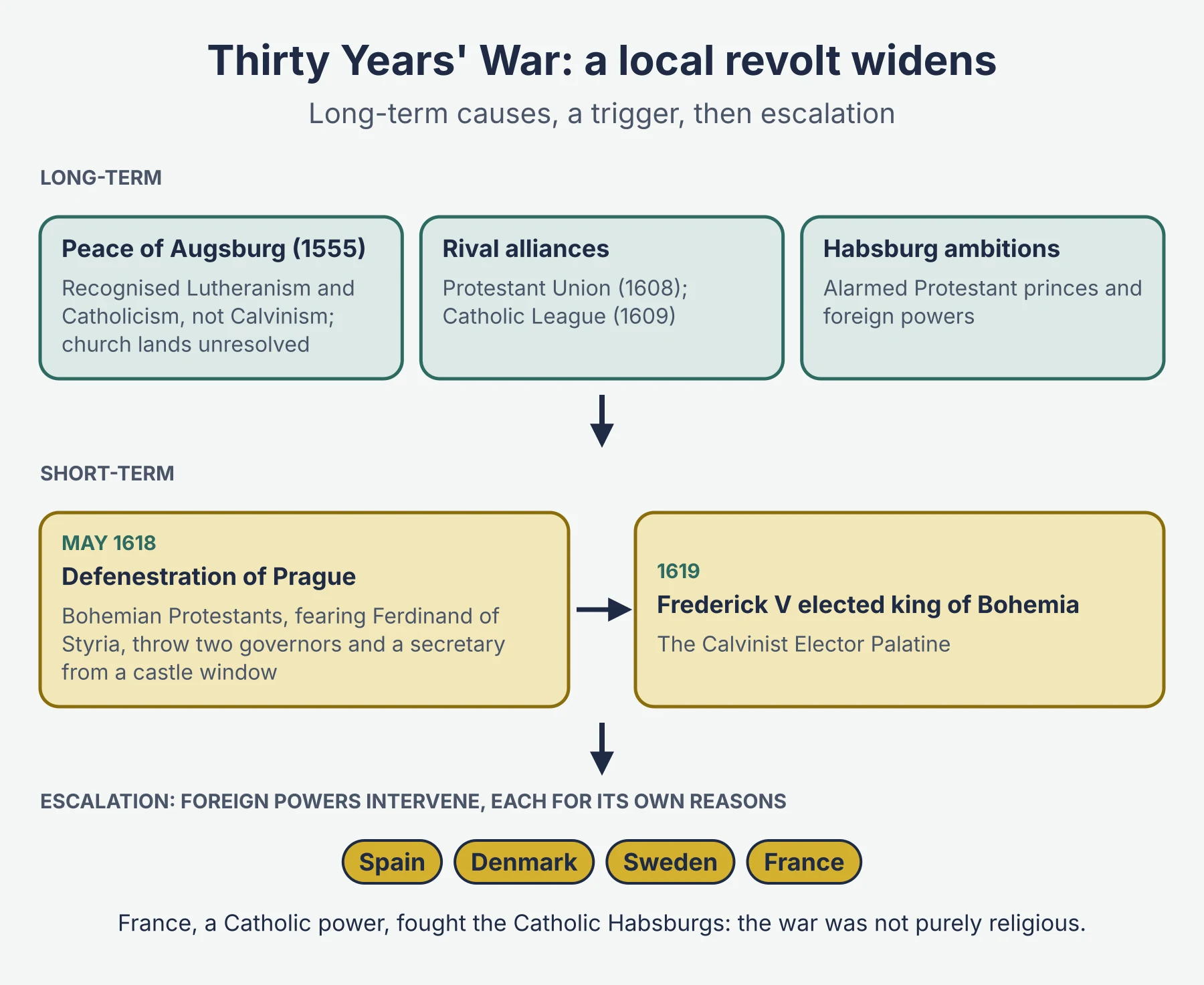
Long-term: the Peace of Augsburg (1555) recognised Lutheranism and Catholicism but not Calvinism, and left disputes over church lands unresolved. Rival confessional alliances formed: the Protestant Union (1608) and the Catholic League (1609). Habsburg ambitions alarmed Protestant princes and foreign powers.
Short-term: Bohemian Protestants, fearing the Catholic Ferdinand of Styria, threw two royal governors and their secretary from a window of Prague Castle in May 1618. They then elected the Calvinist Elector Palatine, Frederick V, as king of Bohemia (1619). A local revolt became a European war as Spain, Denmark, Sweden and France intervened, each for its own reasons.
The Imjin War
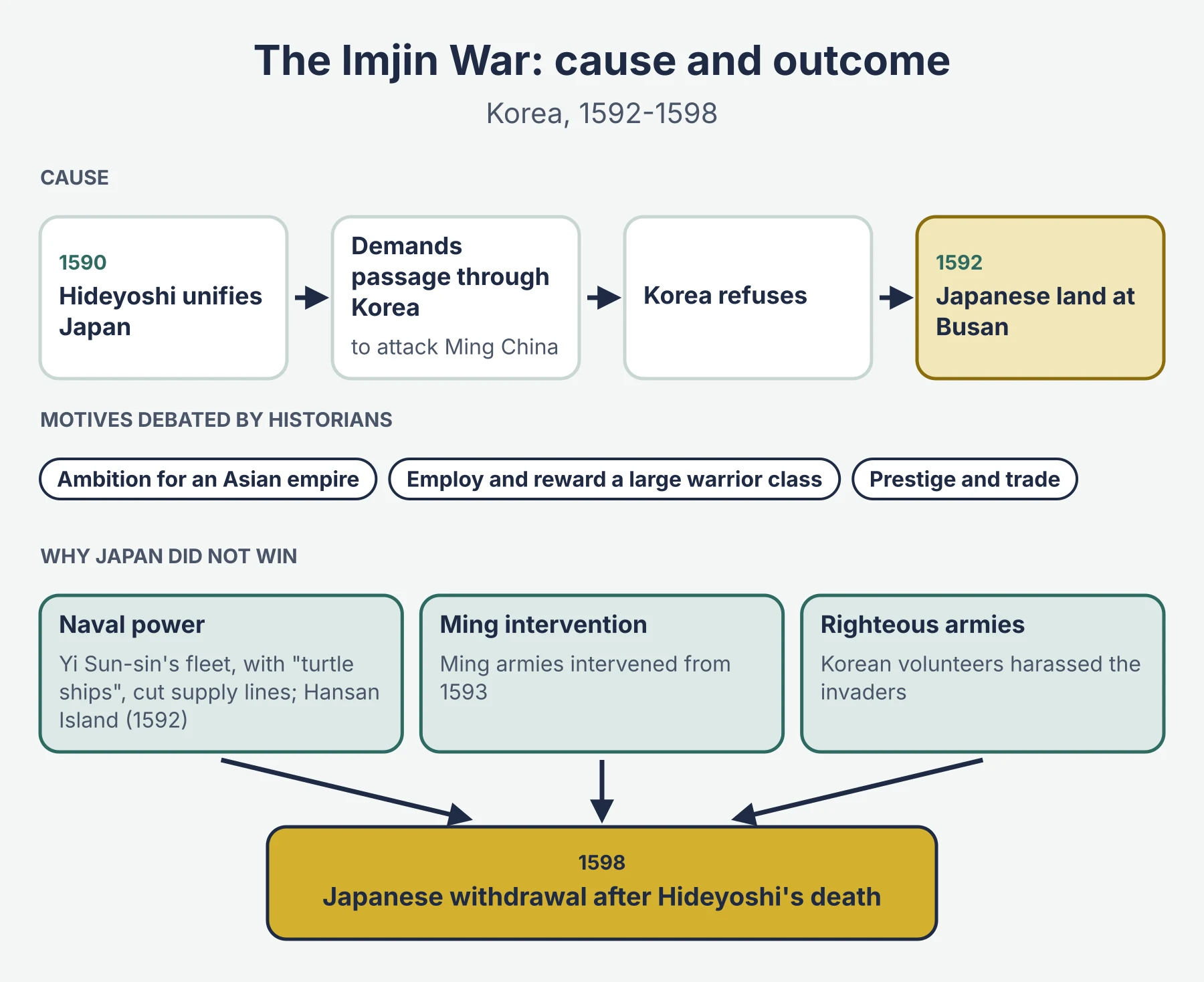
Toyotomi Hideyoshi completed the unification of Japan in 1590. He then demanded passage through Korea to attack Ming China. When Korea refused, Japanese armies landed at Busan in 1592. Historians debate his motives: ambition for an Asian empire, the need to employ and reward a large warrior class after unification, and the search for prestige and trade.
The War of the Spanish Succession
When the childless Charles II of Spain died in 1700, he left his empire to Philip of Anjou, grandson of Louis XIV. The other powers feared a union of France and Spain that would dominate Europe and its colonial trade. Louis’s recognition of the exiled Stuart claimant as king of England, and French moves in the Spanish Netherlands, helped turn fear into war, with Britain, the Dutch Republic and Austria forming the Grand Alliance.
Practices of war
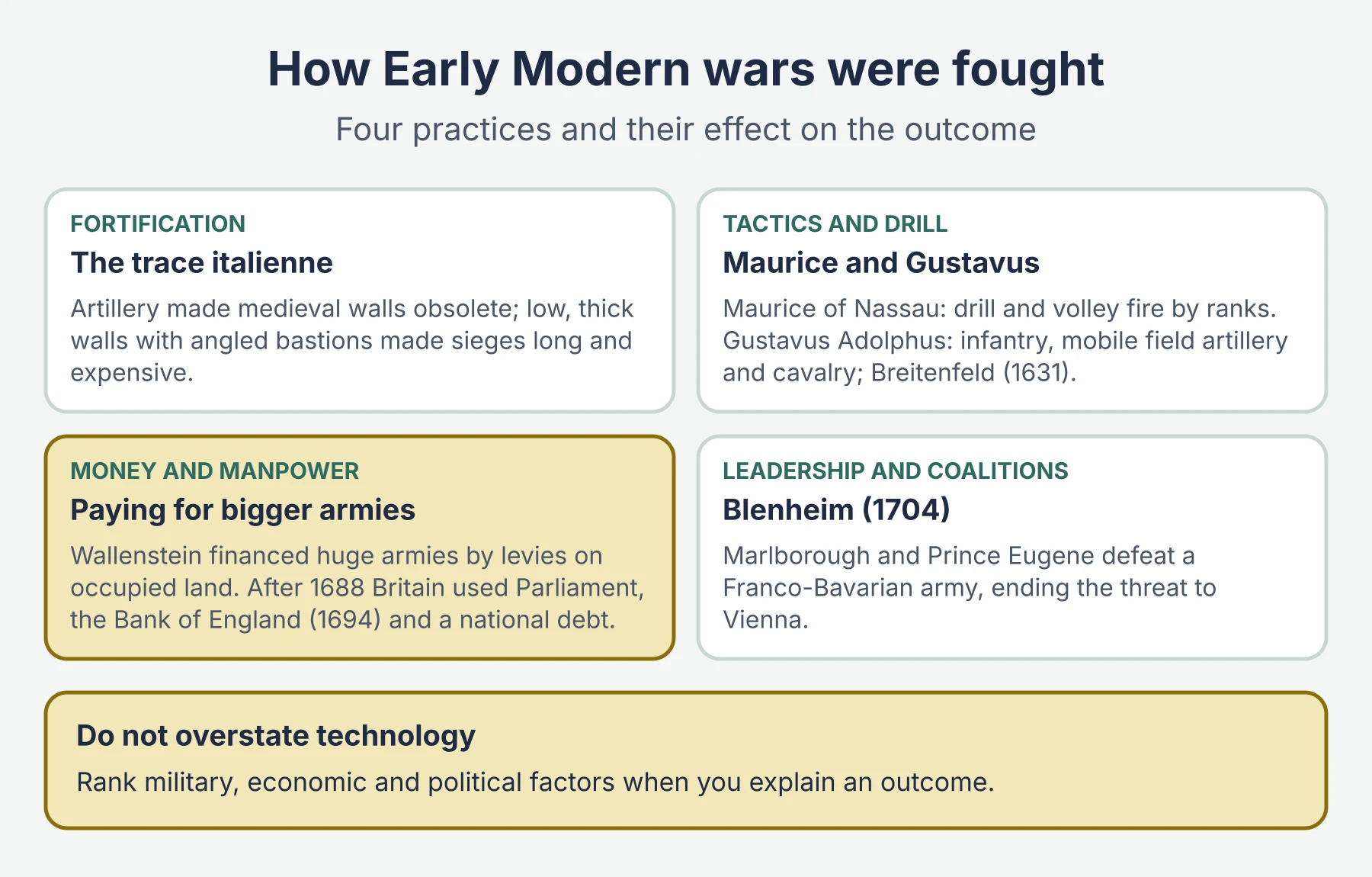
Gunpowder and fortification. Artillery made medieval walls obsolete. Italian engineers developed the trace italienne, low, thick walls with angled bastions, which made sieges long and expensive.
Tactics and drill. Maurice of Nassau in the Dutch Republic developed drill and volley fire by ranks. Gustavus Adolphus of Sweden combined disciplined infantry, mobile field artillery and aggressive cavalry, winning at Breitenfeld (1631); he was killed at Lützen (1632).
Naval power. In the Imjin War, Admiral Yi Sun-sin’s fleet, including armoured “turtle ships”, cut Japanese supply lines by sea; victories such as Hansan Island (1592) left Japanese armies in Korea short of reinforcements. Ming armies intervened from 1593, and Korean “righteous armies” of volunteers harassed the invaders.
Money and manpower. Armies grew and had to be fed, paid and equipped. During the Thirty Years’ War, commanders such as Wallenstein raised huge armies financed by levies on occupied territory, spreading devastation. Britain financed its wars after 1688 through Parliament, the Bank of England (1694) and a national debt.
Leadership and coalitions. At Blenheim (1704) the allied commanders Marlborough and Prince Eugene defeated a Franco-Bavarian army, ending the threat to Vienna.
Effects
| War | Settlement | Political effects | Economic and social effects |
|---|---|---|---|
| Thirty Years’ War | Peace of Westphalia (1648) | Calvinism recognised; German princes gained the right to make alliances with foreign powers; Swedish and French gains; Dutch independence recognised | Severe loss of population and wealth in parts of Germany |
| Imjin War | Japanese withdrawal after Hideyoshi’s death (1598) | Toyotomi power weakened, opening the way for Tokugawa Ieyasu’s victory at Sekigahara (1600); Ming finances strained | Devastation of Korea; Korean artisans, including potters, taken to Japan |
| War of the Spanish Succession | Utrecht (1713) and Rastatt (1714) | Philip V kept Spain but renounced the French throne; Austria gained the Spanish Netherlands and Italian lands | Britain gained Gibraltar, Minorca and the asiento to supply enslaved Africans to Spanish America |
A civil war example: the English Civil Wars
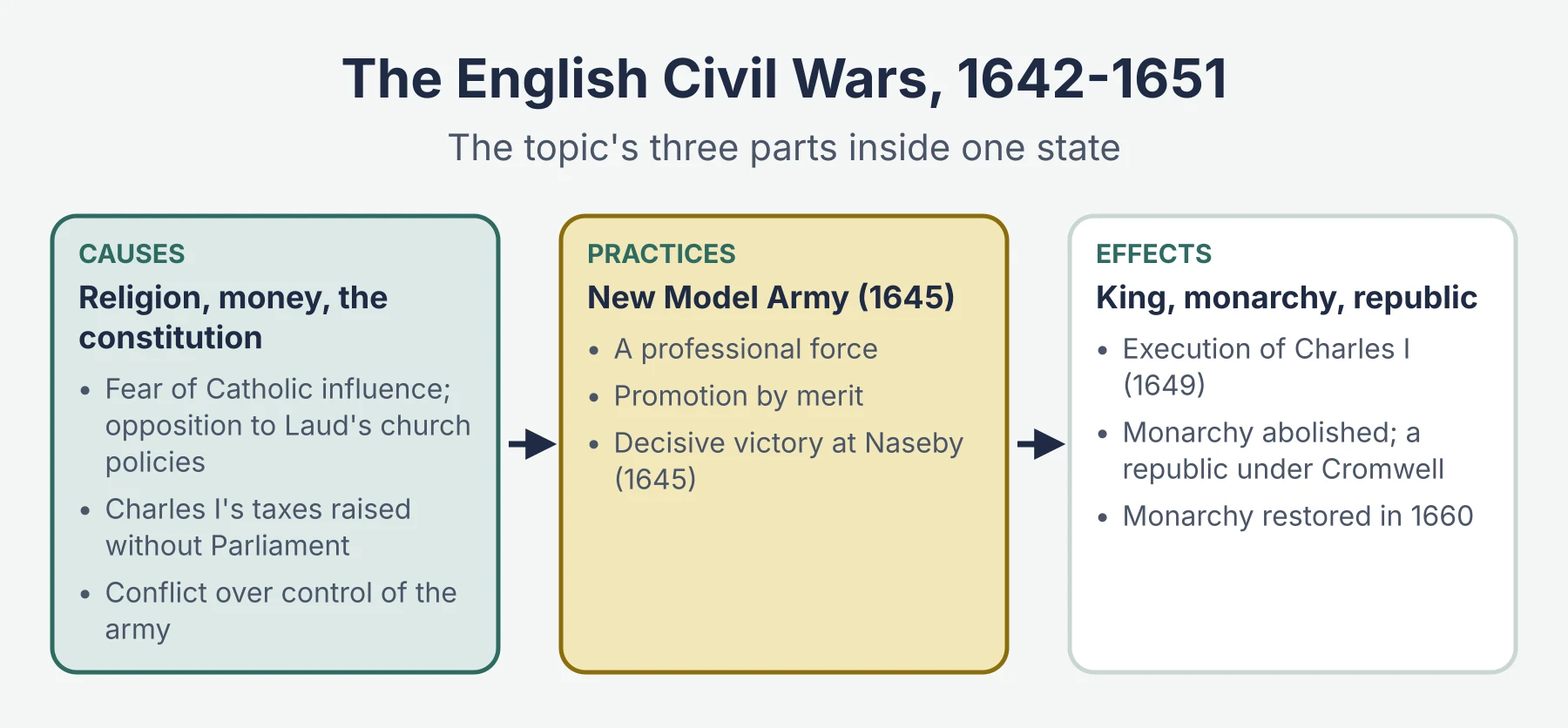
The English Civil Wars (1642-1651) show the topic’s themes inside one state. Causes combined religion (fear of Catholic influence and opposition to Archbishop Laud’s church policies), money (Charles I’s taxes raised without Parliament) and constitutional conflict over control of the army. Practices included the creation of Parliament’s New Model Army (1645), a professional force with promotion by merit, which won decisively at Naseby (1645). Effects were dramatic: the execution of Charles I (1649), the abolition of the monarchy and a republic under Oliver Cromwell, although the monarchy was restored in 1660.
The military revolution debate
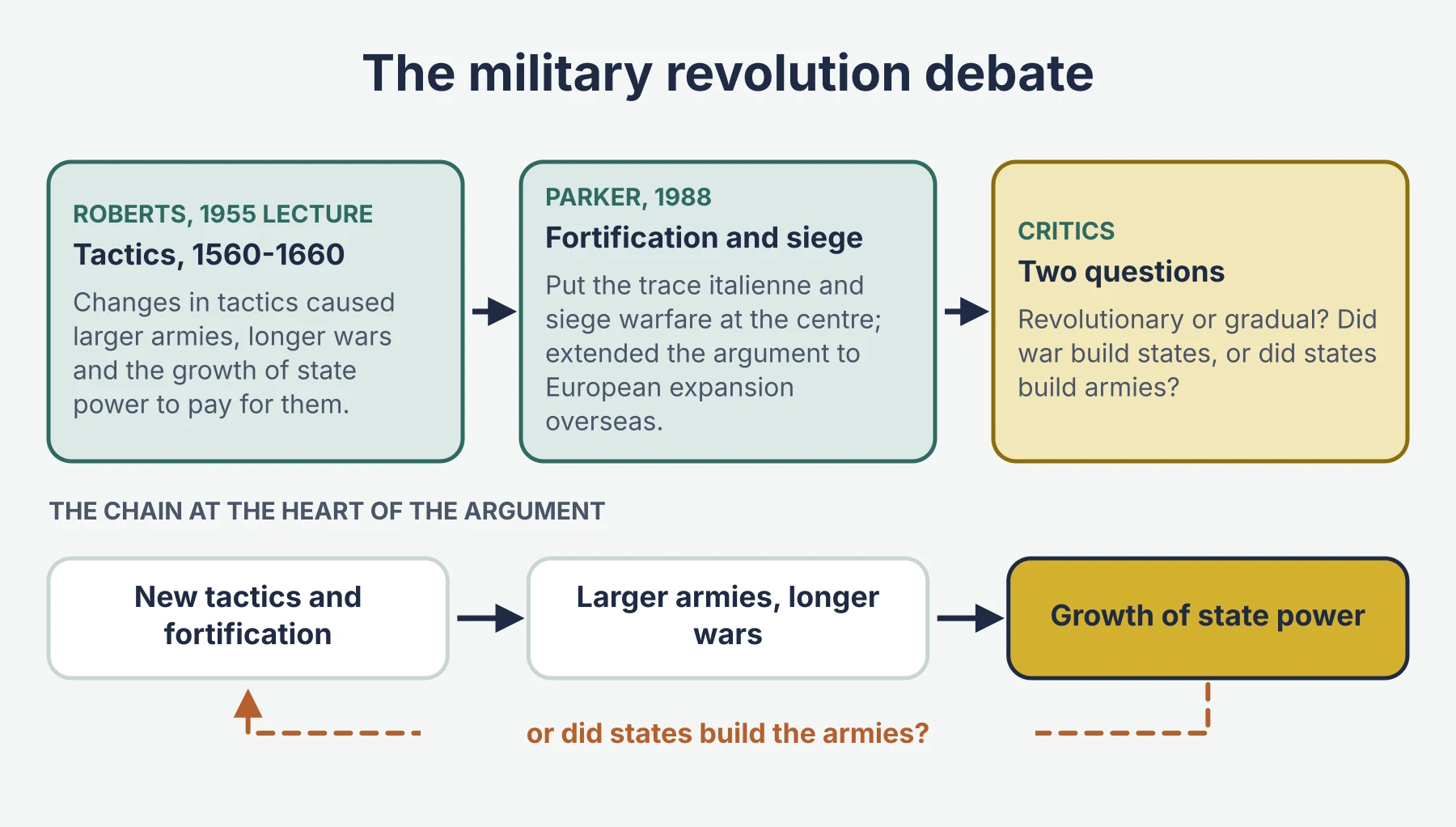
In a 1955 lecture, Michael Roberts argued that changes in tactics between 1560 and 1660 caused a “military revolution”: larger armies, longer wars and the growth of state power to pay for them. Geoffrey Parker’s The Military Revolution (1988) placed the trace italienne and siege warfare at the centre and extended the argument to explain European expansion overseas. Critics question whether change was revolutionary or gradual, and whether war built states or states built armies. The debate is useful for questions on practices and effects: it links how wars were fought to what they did to governments.
Worked example: a comparative essay plan
Question: “Compare and contrast the causes of two Early Modern wars, each chosen from a different region.”
Examples: the Thirty Years’ War (Europe) and the Imjin War (Asia and Oceania).
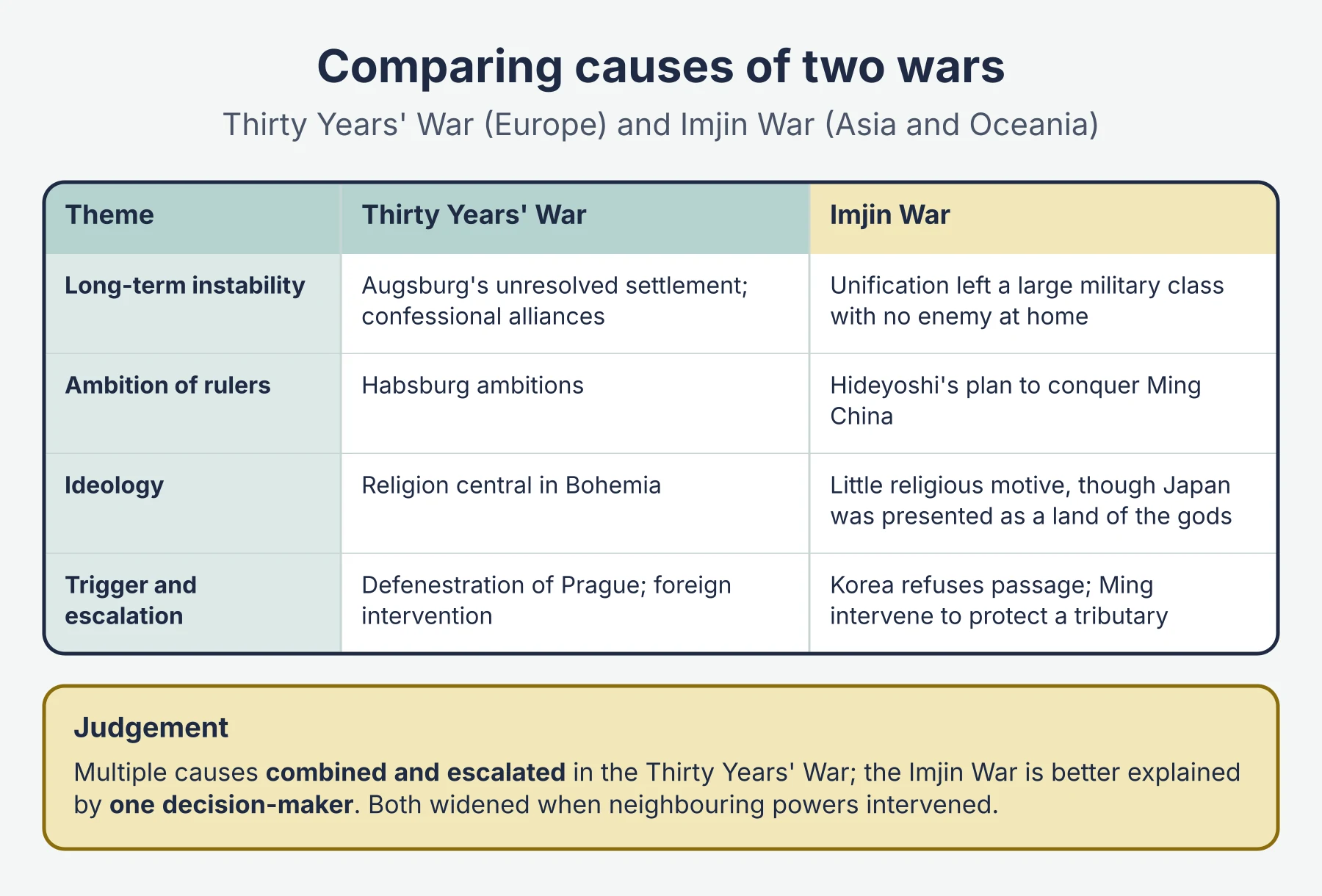
Thesis: both wars arose from the ambitions of powerful rulers in unstable international systems, but religious division was central to the Thirty Years’ War and largely absent from the Imjin War, which was driven by one ruler’s imperial plans.
Paragraphs:
- Long-term instability. Augsburg’s unresolved settlement and confessional alliances; Japan’s unification creating a large military class with no enemy at home.
- Ambition of rulers. Habsburg ambitions; Hideyoshi’s plan to conquer Ming China.
- Ideology. Religion central in Bohemia; little religious motive in Korea, though Hideyoshi presented Japan as a land of the gods.
- Triggers and escalation. The Defenestration of Prague and foreign intervention; Korea’s refusal of passage and Ming intervention to protect a tributary.
Conclusion: the Thirty Years’ War had multiple causes that combined and escalated, while the Imjin War is better explained by one decision-maker; both widened when neighbouring powers intervened.
Common mistakes
- Treating the Thirty Years’ War as purely religious; France, a Catholic power, fought the Catholic Habsburgs.
- Narrating campaigns rather than explaining causes or outcomes.
- Overstating technology: the outcome of the Imjin War owed as much to supply, naval power and Ming intervention.
- Using a war outside 1500-1750, such as the Seven Years’ War (1756-1763).
Exam technique
Examine and evaluate questions on outcomes need you to rank military, economic and political factors. For effects, distinguish short- from long-term and settlement terms from wider consequences. Comparative questions demand both wars in each paragraph.
Revise with the Early Modern wars revision notes and practise with the Early Modern wars practice questions.
Get free revision emails (optional)
Occasional emails with practice questions, worked explanations and links to free resources for the qualification and subjects you choose. No spam, and you can unsubscribe from any email. The free tools on this site never need an email.
Related resources
-
Practice questions
IB DP History: The Six Key Concepts – Practice Questions
Original practice questions with worked answers on the six key concepts of IB DP History (first assessed 2017), from spotting the concept to essay plans.
World History · International Baccalaureate · IB
Try questions -
Practice questions
IB DP History (DP History): Causes and effects of Early Modern wars (1500-1750) – Practice Questions
Twelve original IB History practice questions on Early Modern wars 1500-1750, from short recall to full Paper 2 essays, with mark-scheme answers.
World History · International Baccalaureate · IB
Try questions -
Revision notes
IB DP History (DP History): Causes and effects of Early Modern wars (1500-1750) – Revision Notes
Revision notes for IB History Paper 2 Early Modern wars 1500-1750: war profiles, causes and effects grids, key terms, exam traps and a self-test.
World History · International Baccalaureate · IB
Revise topic
Related articles
-
teaching
A Level tuition in Dubai: Cambridge or Pearson Edexcel International A Level?
Schools in Dubai and Abu Dhabi teach either Cambridge International AS & A Level or Pearson Edexcel International A Level. How the two are structured, why it matters for tuition, and how online classes from Lahore work.
9 October 2026
-
curriculum guides
Choosing subjects at IGCSE and A Level
How subject choices at 14 and 16 affect university options later, and how to keep pathways open without overloading a timetable.
28 July 2026
Studying this with a teacher
Working through World History IB?
This page is free and stays free. If you would rather be taught it, Marlbridge runs World History classes one-to-one, online in your own time zone. The first trial class is free. WhatsApp replies within an hour (8am–11pm Pakistan time, every day); email the same day.
IB World History teachers at Marlbridge
