
Revision Notes
IB DP History (DP History): Causes and effects of Early Modern wars (1500-1750) – Revision Notes
Revision notes for IB History Paper 2 Early Modern wars 1500-1750: war profiles, causes and effects grids, key terms, exam traps and a self-test.
- Subject
- World History
- Level
- IB
- Topic
- Topic 2: World history topics
- Author
- Marlbridge Academic Team
- Updated
- Reviewed by
- Azam Siddique (what this means)
Aligned to International Baccalaureate IB Diploma Programme World History (DP History), First assessment 2017. Official specification .
Syllabus page (what it covers and how it is assessed): IB Diploma Programme World History.
Syllabus points this page covers
DP History
- 6 Causes and effects of Early Modern wars (1500-1750)
Found an error? Report a correction.
Need help with this topic? Request a free trial class for IB Diploma Programme World History (DP History).
Causes and effects of Early Modern wars (1500-1750) is world history topic 6 for Paper 2. Revise at least two wars from different regions under causes, practices of war and their impact on the outcome, and effects.
Related: Early Modern wars study guide and Early Modern wars practice questions.
War profiles
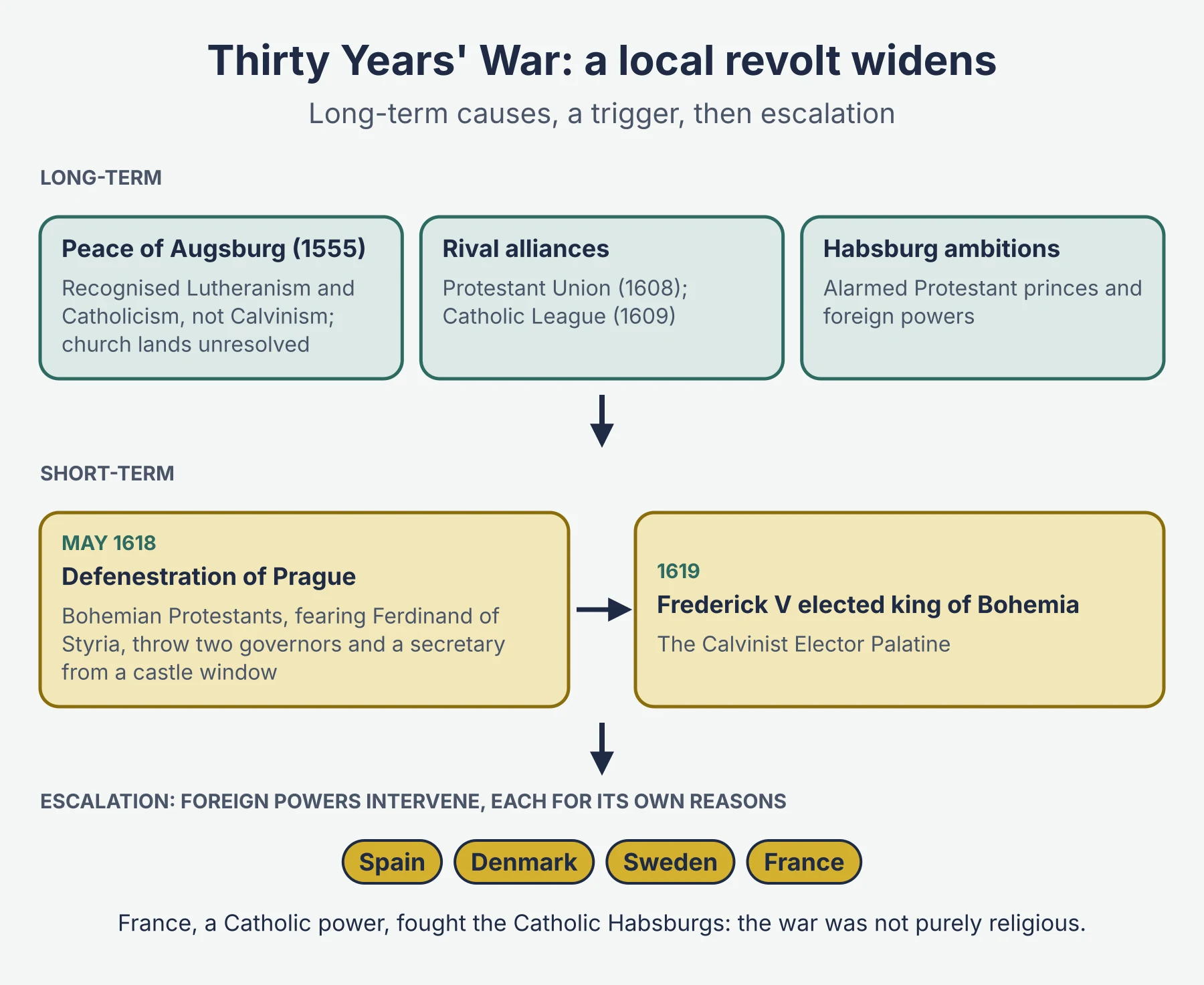
Thirty Years’ War (1618-1648): Europe
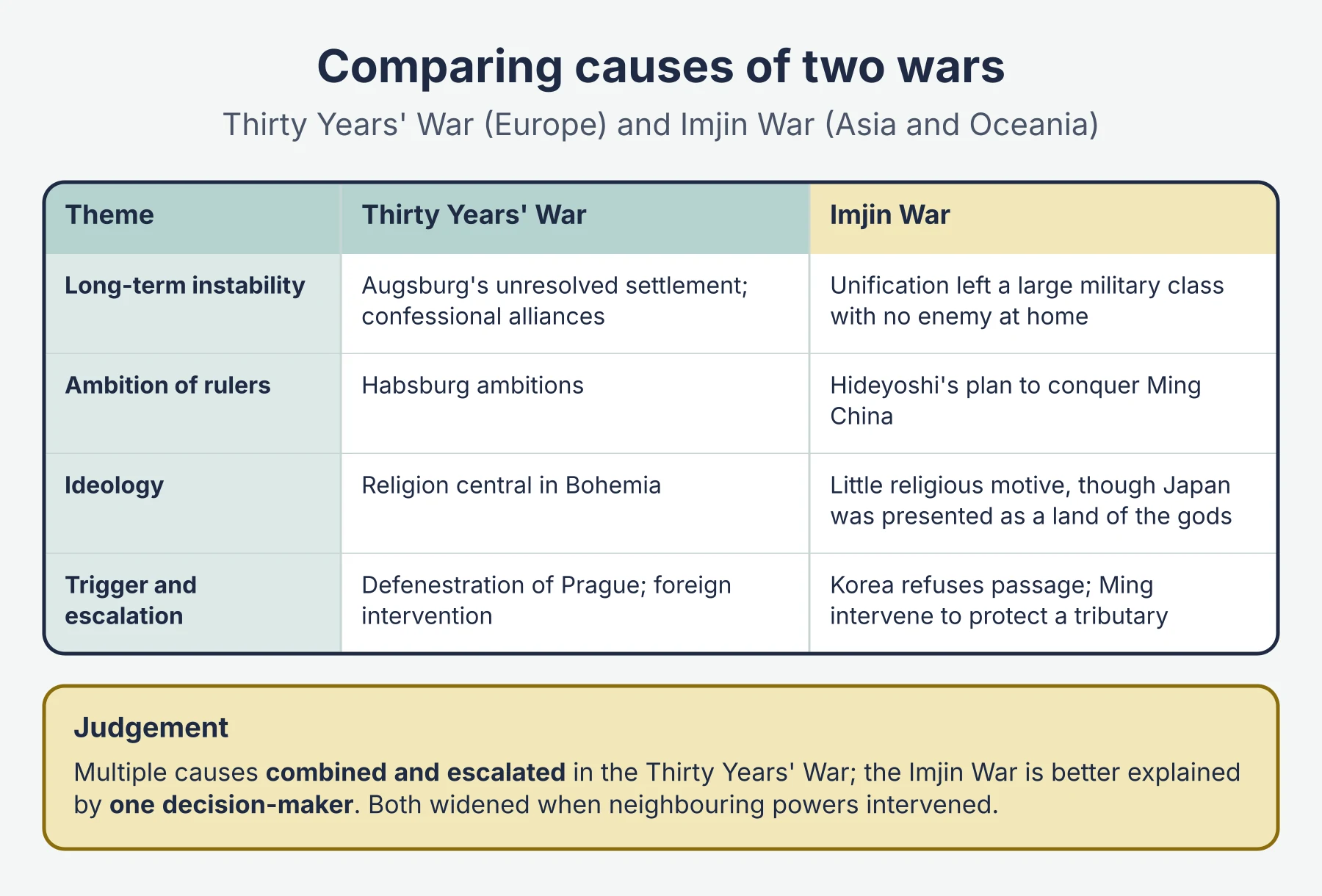
- Causes: limits of Augsburg (1555); Protestant Union (1608) and Catholic League (1609); Habsburg ambitions; Bohemian revolt and the Defenestration of Prague (1618); election of Frederick V (1619).
- Phases: Bohemian (White Mountain, 1620); Danish (to 1629); Edict of Restitution (1629); Swedish (Breitenfeld 1631, Lützen 1632); Peace of Prague (1635); French entry (1635).
- Practices: mercenary armies; Wallenstein’s contribution system; Gustavus Adolphus’s tactics; plunder and sieges, including the sack of Magdeburg (1631).
- Effects: Westphalia (1648); Calvinism recognised; princes’ right to make alliances; Sweden and France gain territory; Dutch and Swiss independence recognised; heavy population losses in parts of Germany.
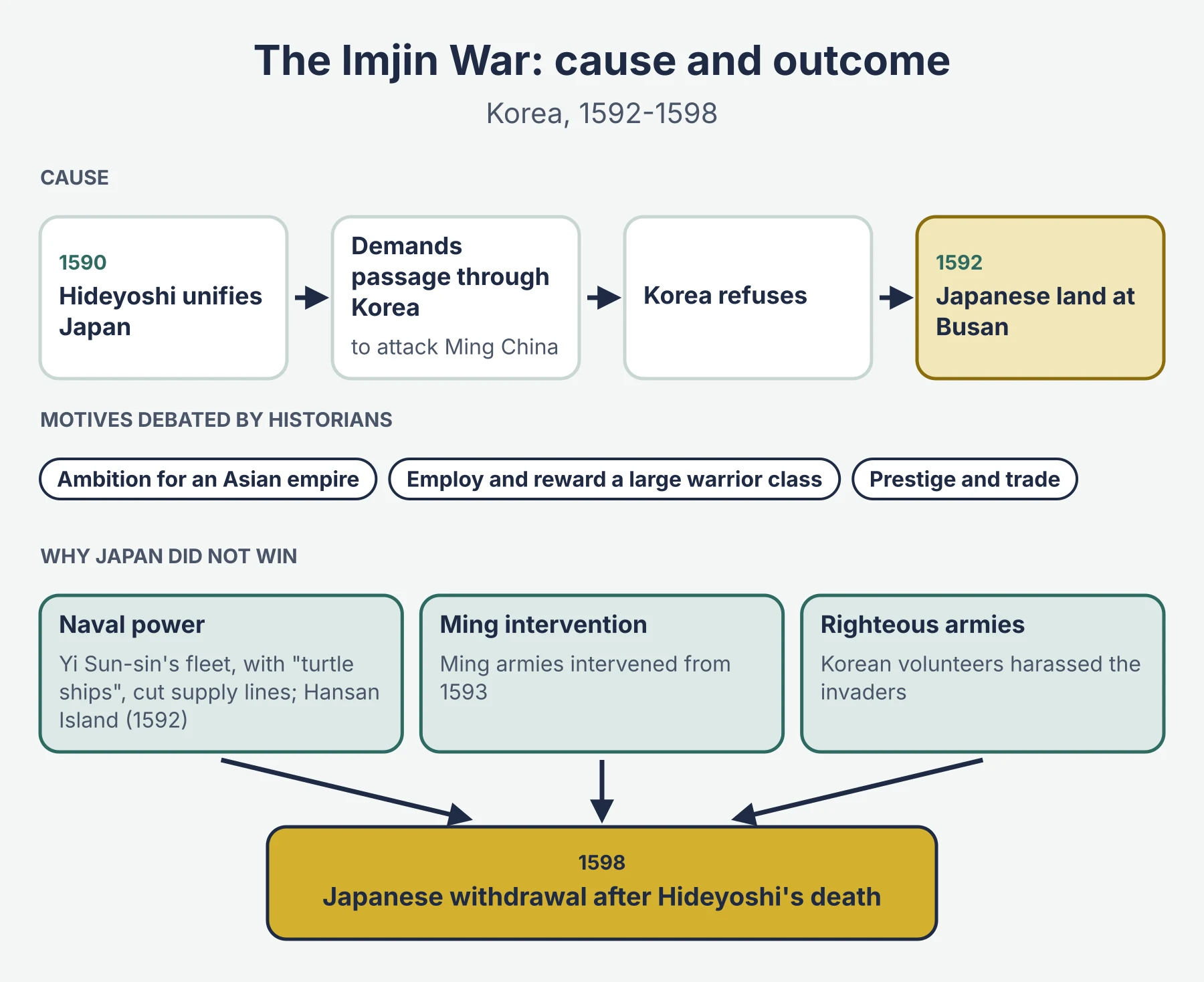
Imjin War (1592-1598): Asia and Oceania
- Causes: Hideyoshi’s unification (1590) and ambition to conquer Ming China; Korea’s refusal of passage; need to reward warriors.
- Practices: Japanese arquebusiers and rapid advance to Seoul and Pyongyang (1592); Yi Sun-sin’s navy and turtle ships (Hansan Island 1592, Myeongnyang 1597, Noryang 1598); Korean righteous armies; Ming intervention (from 1593); truce talks; second invasion (1597).
- Effects: Japanese withdrawal after Hideyoshi’s death (1598); Korea devastated; Ming finances strained; Tokugawa Ieyasu’s rise (Sekigahara 1600); Korean artisans taken to Japan.
War of the Spanish Succession (1701-1714): Europe and the Americas
- Causes: will of Charles II leaving Spain to Philip of Anjou; fear of French dominance; colonial trade; Louis XIV’s recognition of the Stuart claimant (1701).
- Practices: coalition warfare; Marlborough and Eugene (Blenheim 1704, Ramillies 1706, Oudenaarde 1708, Malplaquet 1709); war finance through public debt.
- Effects: Utrecht (1713) and Rastatt (1714); Philip V keeps Spain, renounces France; Austria gains the Spanish Netherlands, Milan and Naples; Britain gains Gibraltar, Minorca, Newfoundland, Nova Scotia and the asiento.
Great Northern War (1700-1721): Europe
- Causes: Swedish dominance of the Baltic; Russia, Denmark and Saxony seek to exploit the accession of the young Charles XII.
- Practices: Swedish victory at Narva (1700); Russian army and navy rebuilt; Charles XII’s invasion of Russia; Poltava (1709).
- Effects: Treaty of Nystad (1721); Russia gains the Baltic coast and becomes a European great power; Swedish decline.
Types of war
| Type | Definition | Example |
|---|---|---|
| Religious war | War in which confessional difference is a central cause | The early phases of the Thirty Years’ War |
| Dynastic war | War over succession to a throne | War of the Spanish Succession |
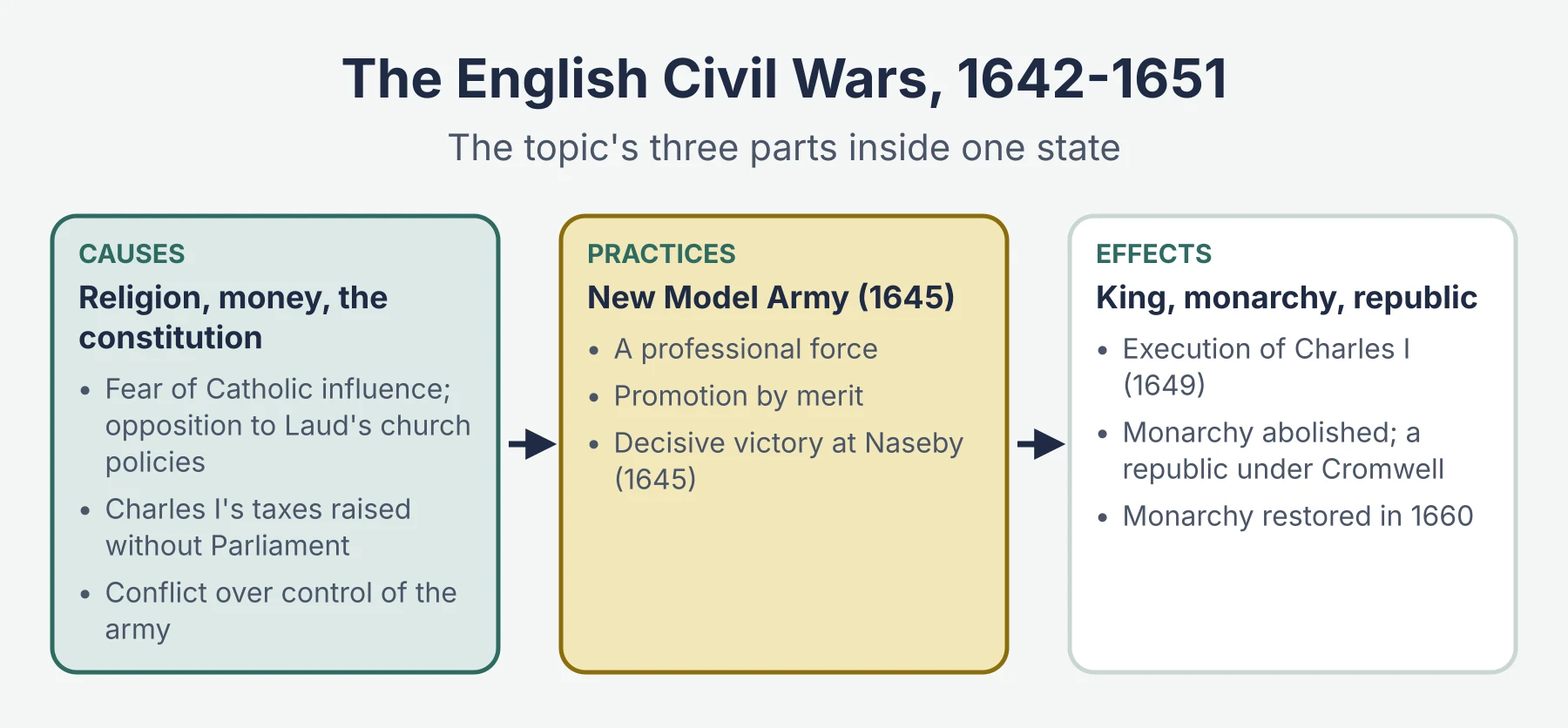
| Civil war | War between groups within one state | English Civil Wars (1642-1651) |
| War of independence | War to break free of a ruling power | Dutch Revolt against Spain |
| War of expansion | War to conquer territory | Hideyoshi’s invasions of Korea |
Practices: what changed
| Development | Description | Effect |
|---|---|---|
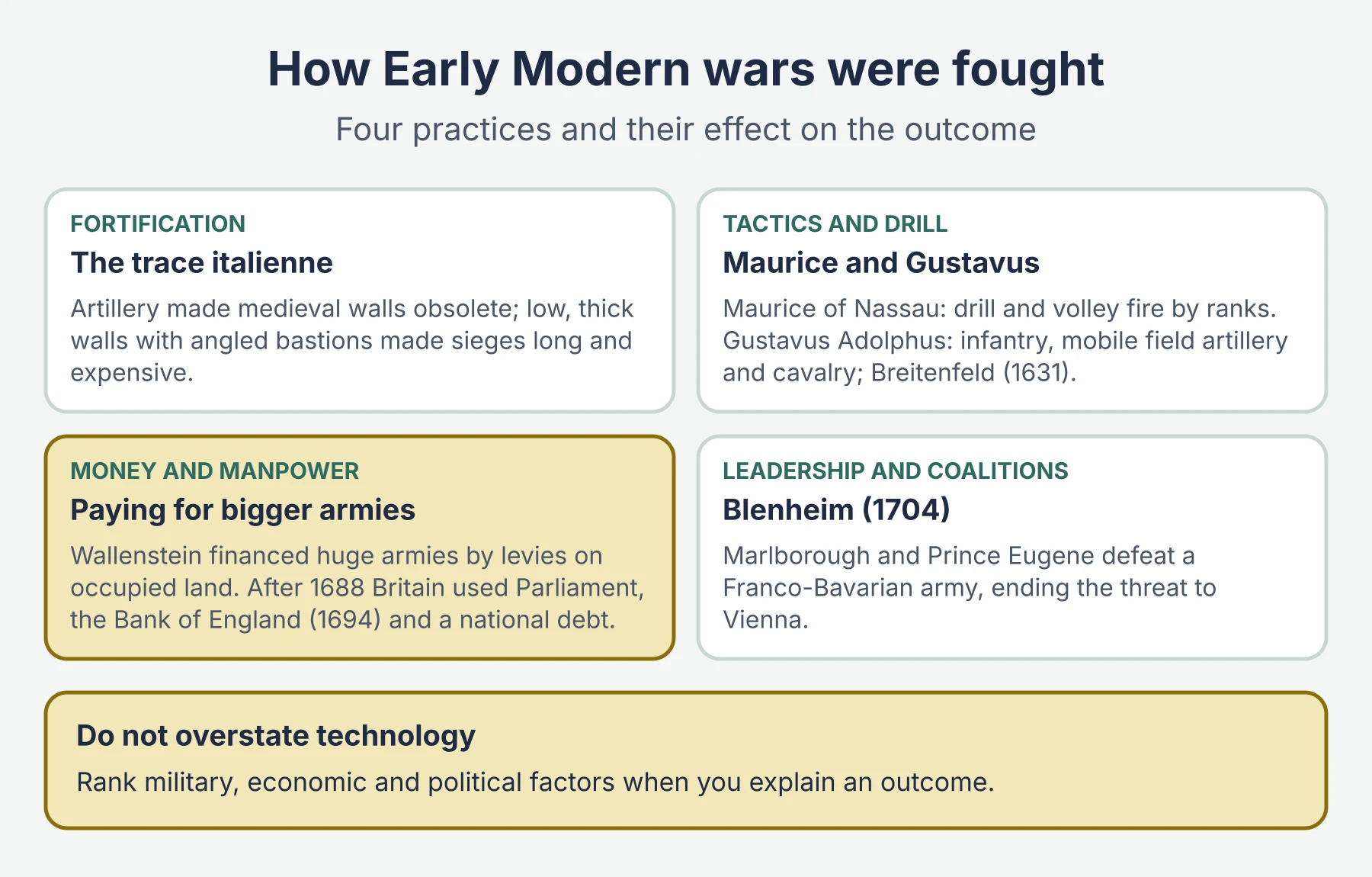
| Trace italienne | Fortifications with angled bastions and low, thick walls | Long, costly sieges |
| Volley fire and drill | Ranks firing in turn, developed under Maurice of Nassau | Sustained firepower from infantry |
| Field artillery | Lighter guns moved with the army, used by Gustavus Adolphus | Firepower on the battlefield |
| Standing armies | Permanent, paid forces | Higher taxes and larger bureaucracies |
| Public debt | State borrowing backed by taxation, as in Britain after 1688 | Ability to sustain long wars |
| Naval innovation | Armoured “turtle ships” and cannon-armed fleets | Control of supply lines in the Imjin War |
Key terms
| Term | Meaning |
|---|---|
| Defenestration of Prague | The 1618 act of throwing royal officials from a window, starting the Bohemian revolt |
| Edict of Restitution | 1629 imperial order to return church lands taken by Protestants since 1552 |
| Contribution system | Funding an army by levies on occupied territory |
| Peace of Westphalia | The 1648 treaties of Münster and Osnabrück ending the Thirty Years’ War |
| Righteous armies | Korean volunteer militias that fought the Japanese |
| Turtle ship | Armoured Korean warship associated with Yi Sun-sin |
| Asiento | Contract to supply enslaved Africans to Spanish America |
| Balance of power | Principle that no state should dominate the others |
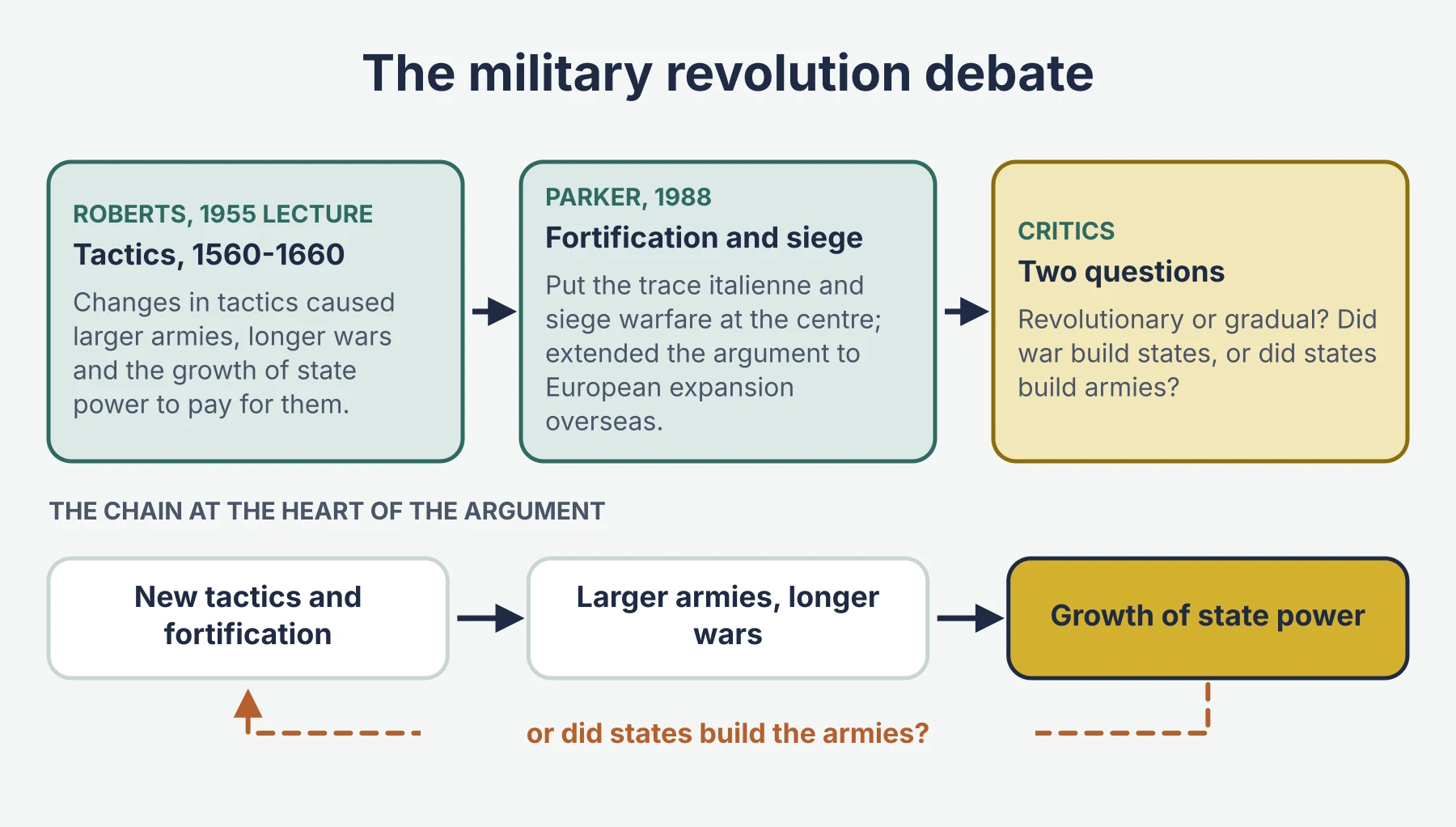
| Military revolution | Debate on whether changes in warfare between about 1560 and 1660 transformed states |
Exam traps
- “Religious war” without qualification. Catholic France fought the Catholic Habsburgs; explain the shift from religion to power politics.
- Narrative of phases. Use the phases only as evidence for an argument.
- Ignoring non-European wars. Prepare one Asian, African or American example for regional questions.
- Effects beyond the war. Say whether an effect came from the war itself or from later developments.
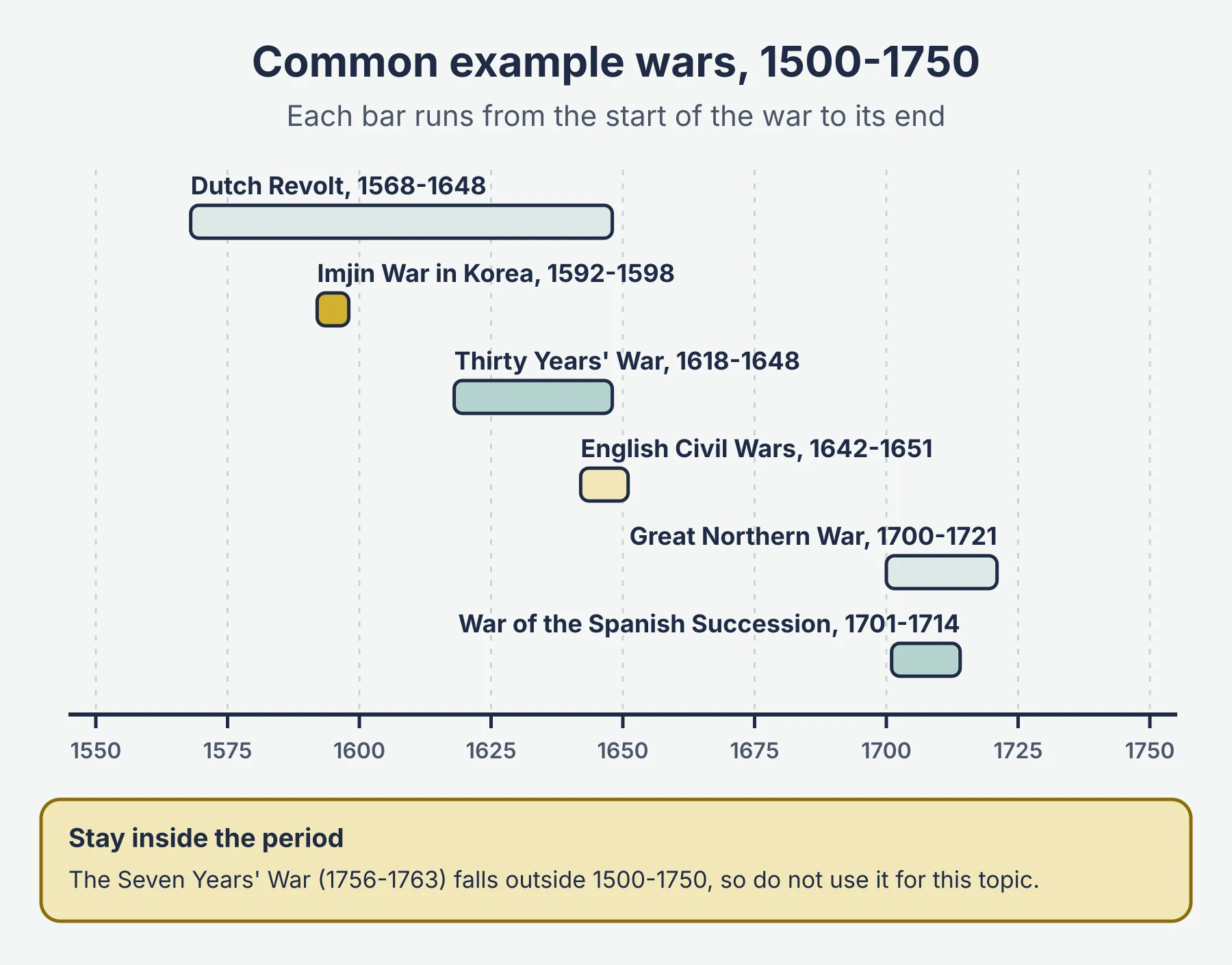
- Dates. The Seven Years’ War (1756-1763) lies outside the topic.
Self-test
- What did the Peace of Augsburg fail to recognise, which later fed conflict? Calvinism.
- What event of May 1618 began the Bohemian revolt? The Defenestration of Prague.
- Who was elected king of Bohemia in 1619? Frederick V, the Elector Palatine.
- What did the Edict of Restitution (1629) order? The return of church lands taken by Protestants since 1552.
- Which Swedish king won at Breitenfeld and was killed at Lützen? Gustavus Adolphus.
- Why did France join the war in 1635? To weaken the Habsburgs, despite being Catholic.
- Who ordered the invasion of Korea in 1592, and what was his wider aim? Toyotomi Hideyoshi, aiming to conquer Ming China.
- Which Korean admiral’s fleet cut Japanese supply lines? Yi Sun-sin.
- How did the Imjin War affect politics in Japan? It weakened Toyotomi power and opened the way for Tokugawa Ieyasu’s victory at Sekigahara in 1600.
- Whose inheritance caused the War of the Spanish Succession? Charles II of Spain, who left his empire to Philip of Anjou.
- Name two gains Britain made at Utrecht. Any two of Gibraltar, Minorca, Newfoundland, Nova Scotia and the asiento.
- Which historian first argued for a “military revolution” between 1560 and 1660? Michael Roberts.
Get free revision emails (optional)
Occasional emails with practice questions, worked explanations and links to free resources for the qualification and subjects you choose. No spam, and you can unsubscribe from any email. The free tools on this site never need an email.
Related resources
-
Practice questions
IB DP History: The Six Key Concepts – Practice Questions
Original practice questions with worked answers on the six key concepts of IB DP History (first assessed 2017), from spotting the concept to essay plans.
World History · International Baccalaureate · IB
Try questions -
Study guides
IB DP History (DP History): Origins, development and impact of industrialization (1750-2005)
Why industrialization began where it did, how it spread and what it changed, with Britain, Japan, Germany and Russia as cases for IB History Paper 2 essays.
World History · International Baccalaureate · IB
Read guide -
Practice questions
IB DP History (DP History): Origins, development and impact of industrialization (1750-2005) – Practice Questions
Twelve original IB History practice questions on industrialization 1750-2005, from short recall to a full Paper 2 essay, with mark-scheme answers.
World History · International Baccalaureate · IB
Try questions
Related articles
-
teaching
A Level tuition in Dubai: Cambridge or Pearson Edexcel International A Level?
Schools in Dubai and Abu Dhabi teach either Cambridge International AS & A Level or Pearson Edexcel International A Level. How the two are structured, why it matters for tuition, and how online classes from Lahore work.
9 October 2026
-
curriculum guides
Choosing subjects at IGCSE and A Level
How subject choices at 14 and 16 affect university options later, and how to keep pathways open without overloading a timetable.
28 July 2026
Studying this with a teacher
Working through World History IB?
This page is free and stays free. If you would rather be taught it, Marlbridge runs World History classes one-to-one, online in your own time zone. The first trial class is free. WhatsApp replies within an hour (8am–11pm Pakistan time, every day); email the same day.
IB World History teachers at Marlbridge
