
Study Guides
IB DP History (DP History): Origins, development and impact of industrialization (1750-2005)
Why industrialization began where it did, how it spread and what it changed, with Britain, Japan, Germany and Russia as cases for IB History Paper 2 essays.
- Subject
- World History
- Level
- IB
- Topic
- Topic 2: World history topics
- Author
- Marlbridge Academic Team
- Updated
- Reviewed by
- Azam Siddique (what this means)
Aligned to International Baccalaureate IB Diploma Programme World History (DP History), First assessment 2017. Official specification .
Syllabus page (what it covers and how it is assessed): IB Diploma Programme World History.
Syllabus points this page covers
DP History
- 7 Origins, development and impact of industrialization (1750-2005)
Found an error? Report a correction.
Need help with this topic? Request a free trial class for IB Diploma Programme World History (DP History).
World history topic 7 asks why some societies industrialized, how industrial economies grew and changed, and what industrialization did to people, politics and the environment. The period is unusually long, 1750 to 2005, so you can choose cases from the first British factories to late twentieth-century state planning. Most schools teach it through two or three countries from different IB regions, because Paper 2 questions on this topic regularly ask for examples “each chosen from a different region”.
What the topic covers
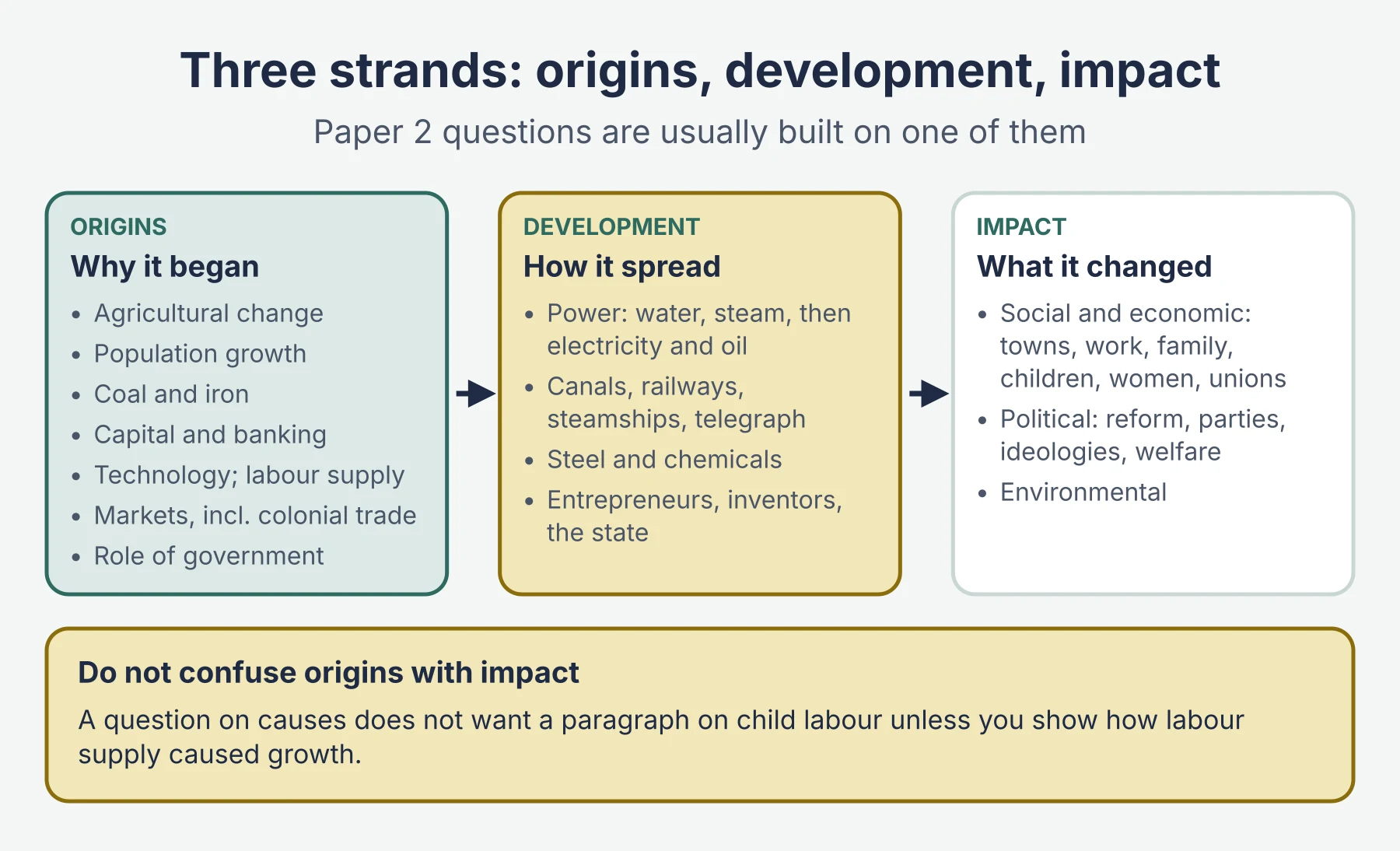
The topic title gives the three strands that organise the content, and Paper 2 questions are usually built on one of them.
- Origins. The conditions and causes of industrialization: agricultural change, population growth, resources such as coal and iron, capital and banking, technology, labour supply, markets (including colonial trade) and the role of government.
- Development. How industrialization spread and deepened: new power sources (water, steam, then electricity and oil), transport and communications (canals, railways, steamships, the telegraph), new industries such as steel and chemicals, and the role of entrepreneurs, inventors and the state.
- Impact. Social and economic effects (urbanization, working and living conditions, the family, child labour, the position of women, labour organizations and trade unions), political effects (reform, new parties and ideologies, state welfare) and environmental effects.
Check the precise sub-headings your teacher uses against the IB History guide; the strands above are the framework the topic is examined on.
Key ideas
Why Britain first?
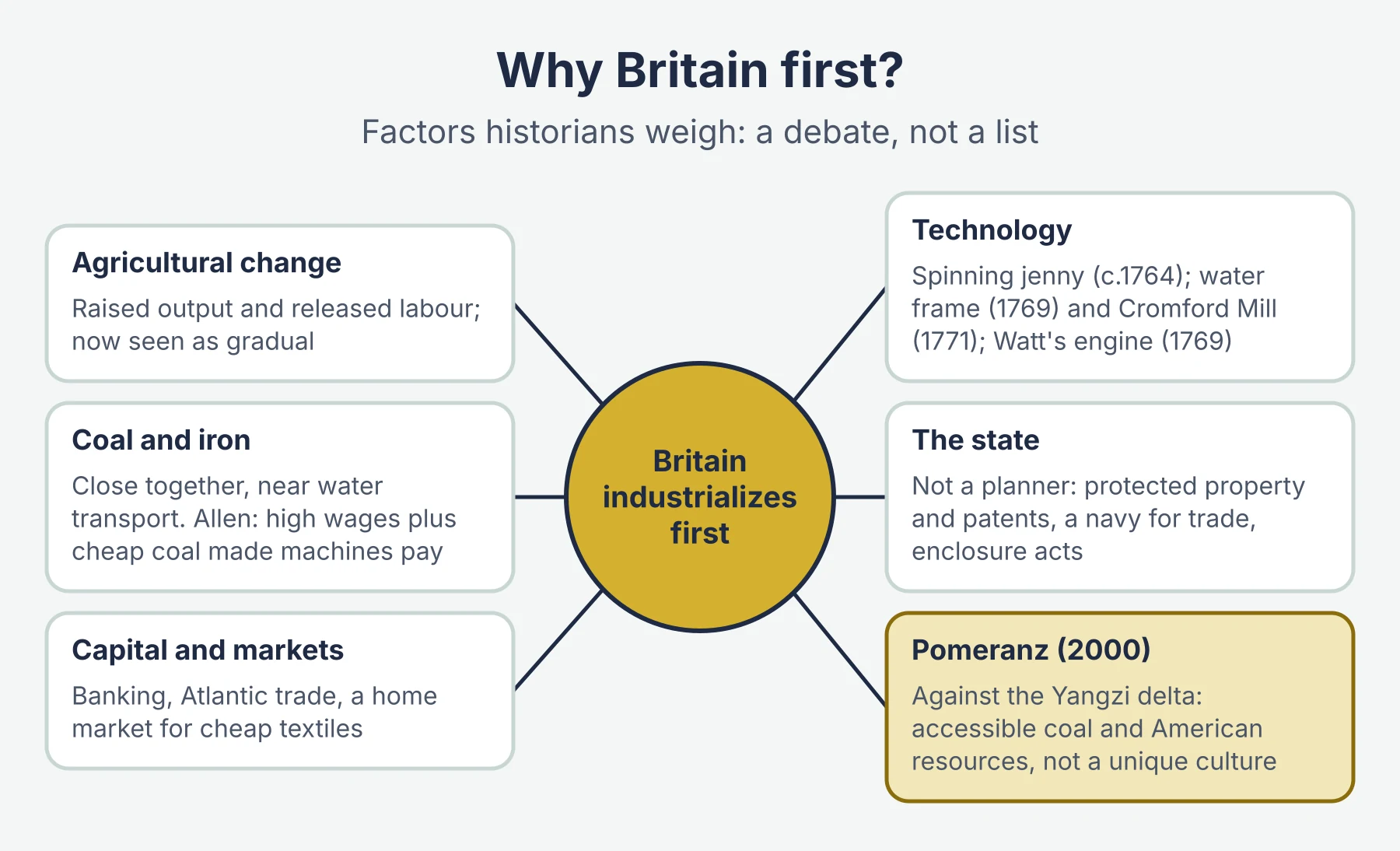
Historians still argue about this, which makes it good essay material. Arguments you can use:
- Agricultural change raised output and released labour, although historians now see this as gradual rather than a sudden “revolution”.
- Coal and iron were close together and near water transport. Robert Allen argues that Britain’s combination of high wages and cheap coal made labour-saving machines profitable there before anywhere else.
- Capital and markets. A developed banking system, Atlantic trade and a growing domestic market for cheap textiles.
- Technology. Hargreaves’s spinning jenny (c.1764), Arkwright’s water frame (patented 1769) and Cromford Mill (1771), and Watt’s improved steam engine with its separate condenser (patented 1769).
- The state. Not a planner, but it protected property and patents, built a navy that defended trade, and passed enclosure acts.
Kenneth Pomeranz, in The Great Divergence (2000), compared Britain with the Yangzi delta in China and argued that accessible coal and the resources of the Americas, rather than any unique European culture, explain why Britain broke away. Use this kind of debate to show evaluation, not as a list of names.
Late industrializers and the state
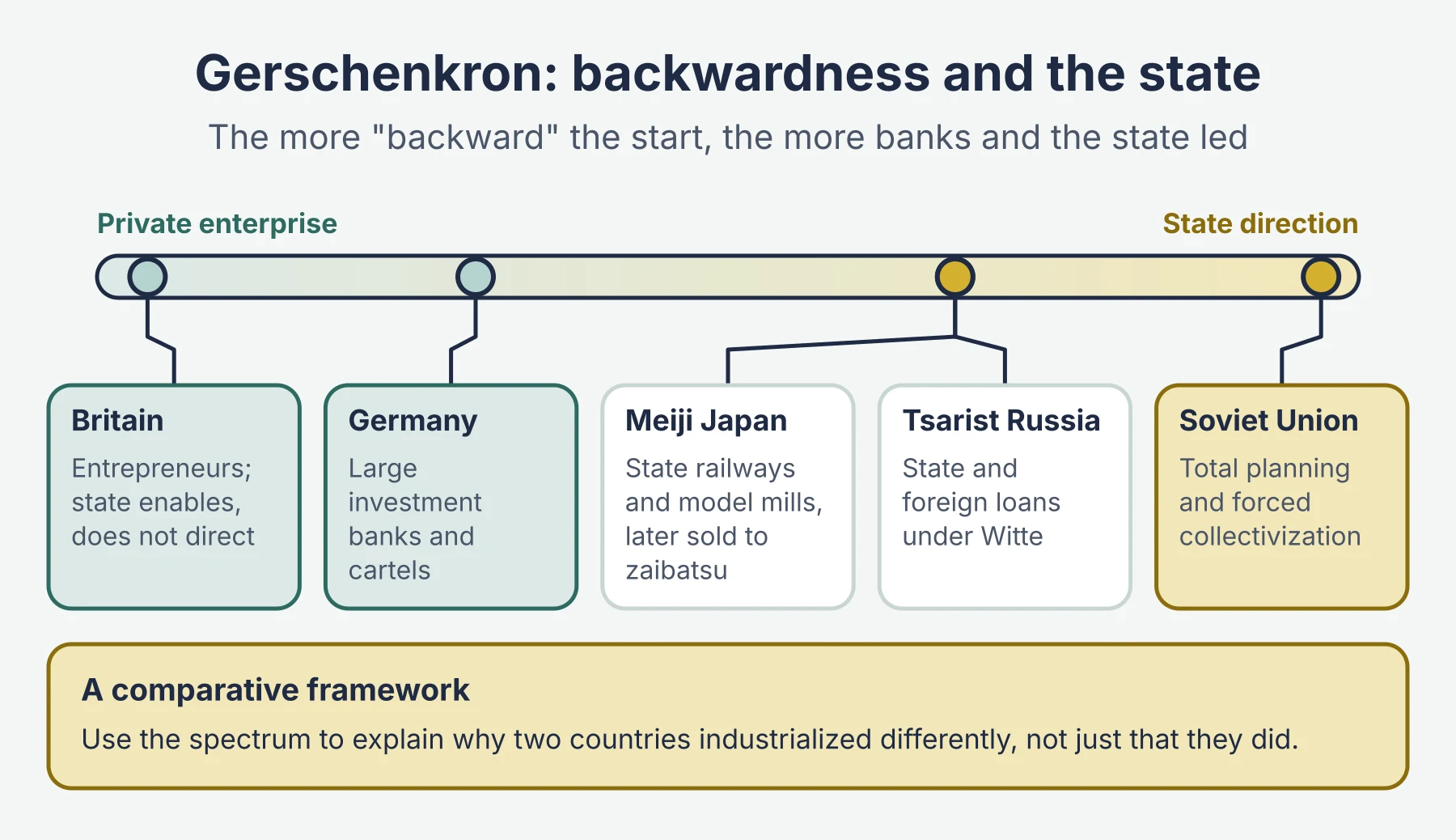
Alexander Gerschenkron argued that the more “backward” a country was when it began to industrialize, the more it relied on banks and the state to supply capital and direction. This gives you a strong comparative framework:
| Country | Starting point | Who drove industrialization |
|---|---|---|
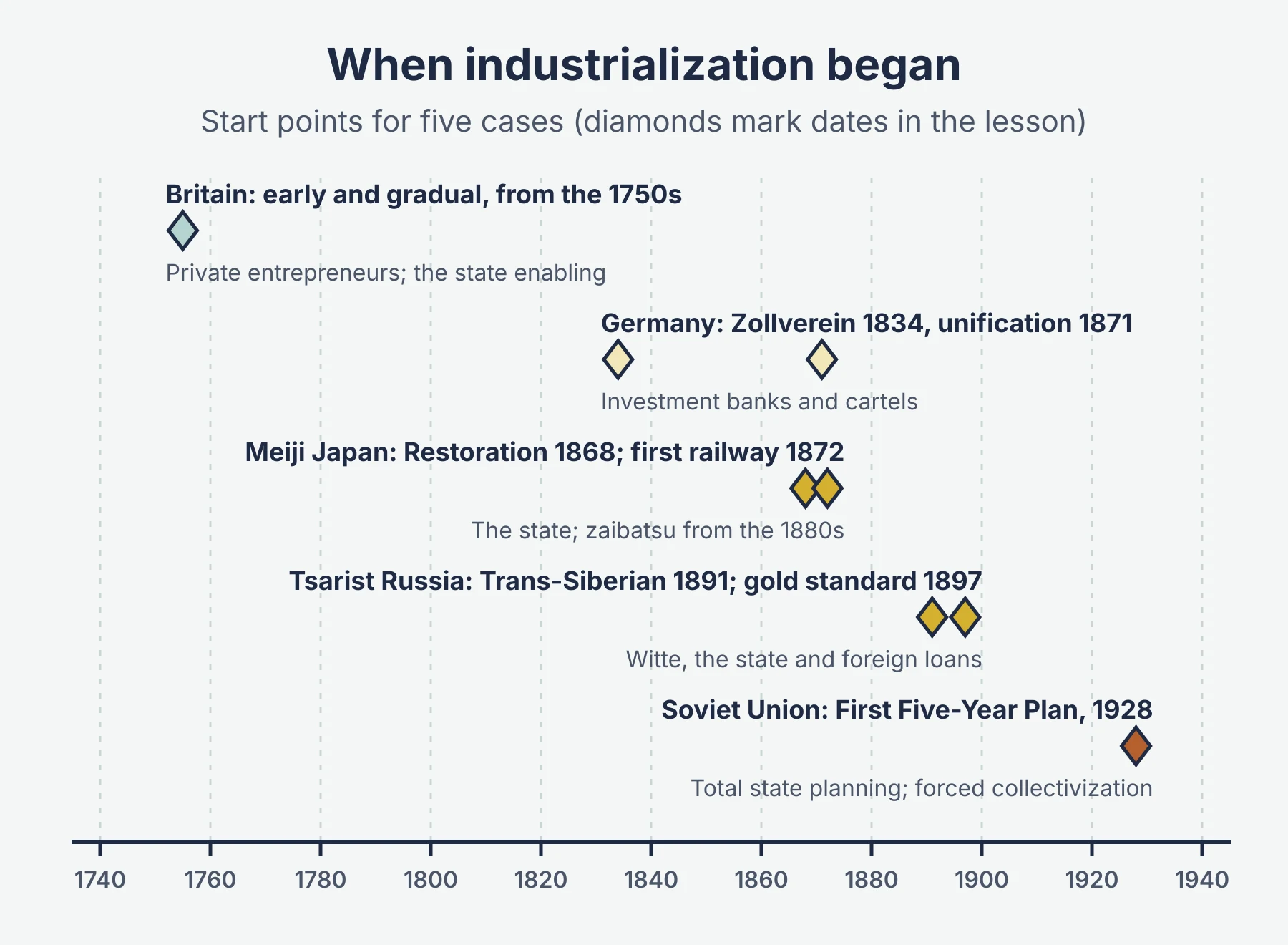
| Britain | Early, gradual, from the 1750s | Private entrepreneurs; state enabling, not directing |
| Germany | After the Zollverein (customs union, 1834) and unification (1871) | Large investment banks and cartels; strong in steel, chemicals and electricals |
| Meiji Japan | After the 1868 Restoration | The state: railways (Tokyo-Yokohama, 1872), the Tomioka silk mill (1872), then sale of state enterprises to zaibatsu in the 1880s |
| Tsarist Russia | 1890s under Witte | The state and foreign loans: Trans-Siberian Railway (begun 1891), gold standard (1897) |
| Soviet Union | First Five-Year Plan from 1928 | Total state planning and forced collectivization |
Impact: change, but uneven
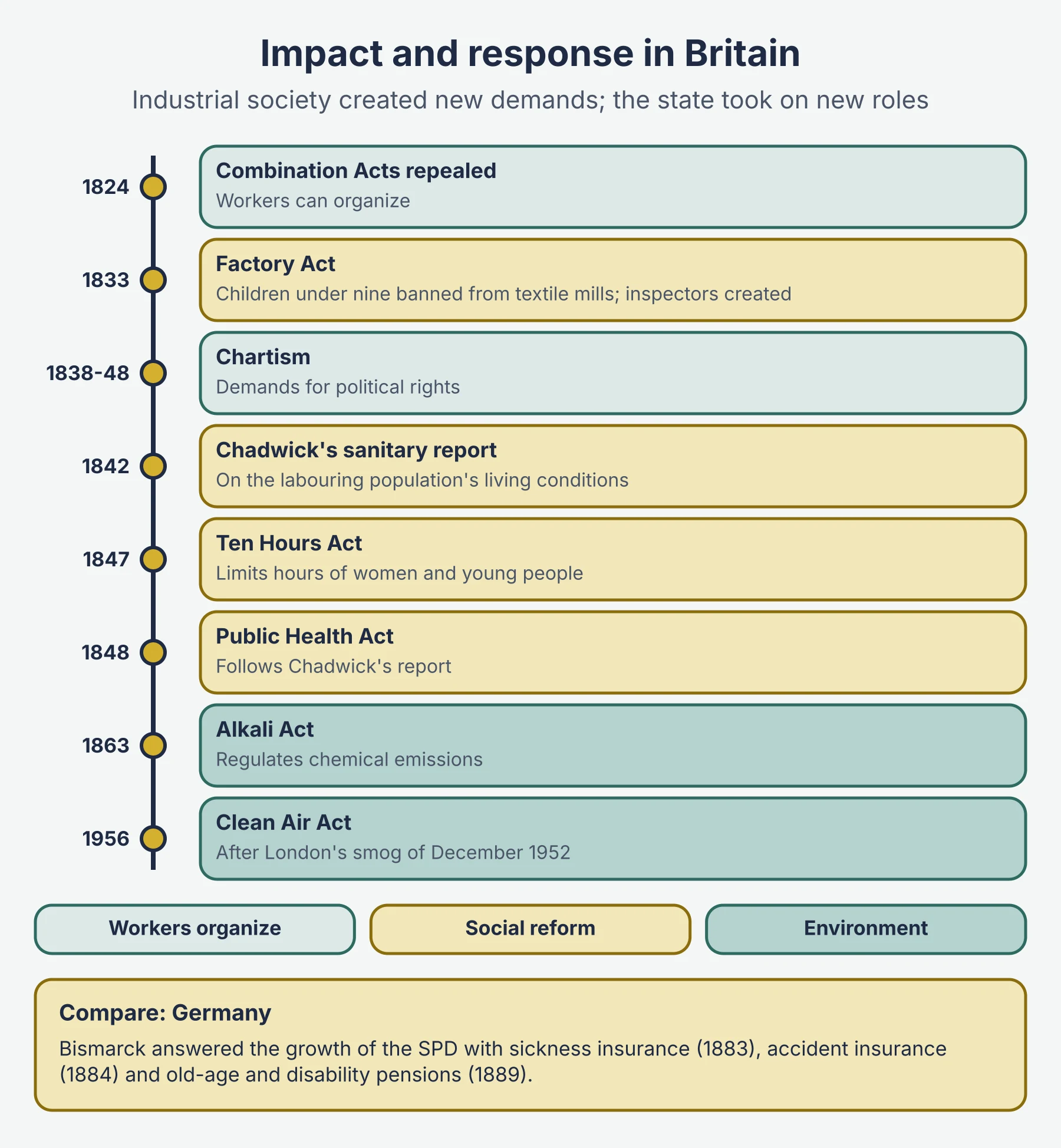
The impact strand rewards precision about who was affected and when. In Britain, the early factory workforce in cotton included many children; the Factory Act of 1833 banned children under nine from textile mills and created inspectors, and the Ten Hours Act of 1847 limited the hours of women and young people. Edwin Chadwick’s Report on the Sanitary Condition of the Labouring Population (1842) led to the Public Health Act of 1848. Workers organized: the Combination Acts were repealed in 1824, and Chartism (1838 to 1848) demanded political rights. In Germany, Bismarck answered the growth of the socialist SPD with sickness insurance (1883), accident insurance (1884) and old-age and disability pensions (1889). These are examples of the political impact of industrialization: the state took on new roles because industrial society created new demands.
Environmental impact is part of the topic and is often neglected. Britain’s Alkali Act of 1863 regulated chemical emissions; London’s smog of December 1952 led to the Clean Air Act of 1956. Soviet planning gives later examples of environmental damage from industrial targets.
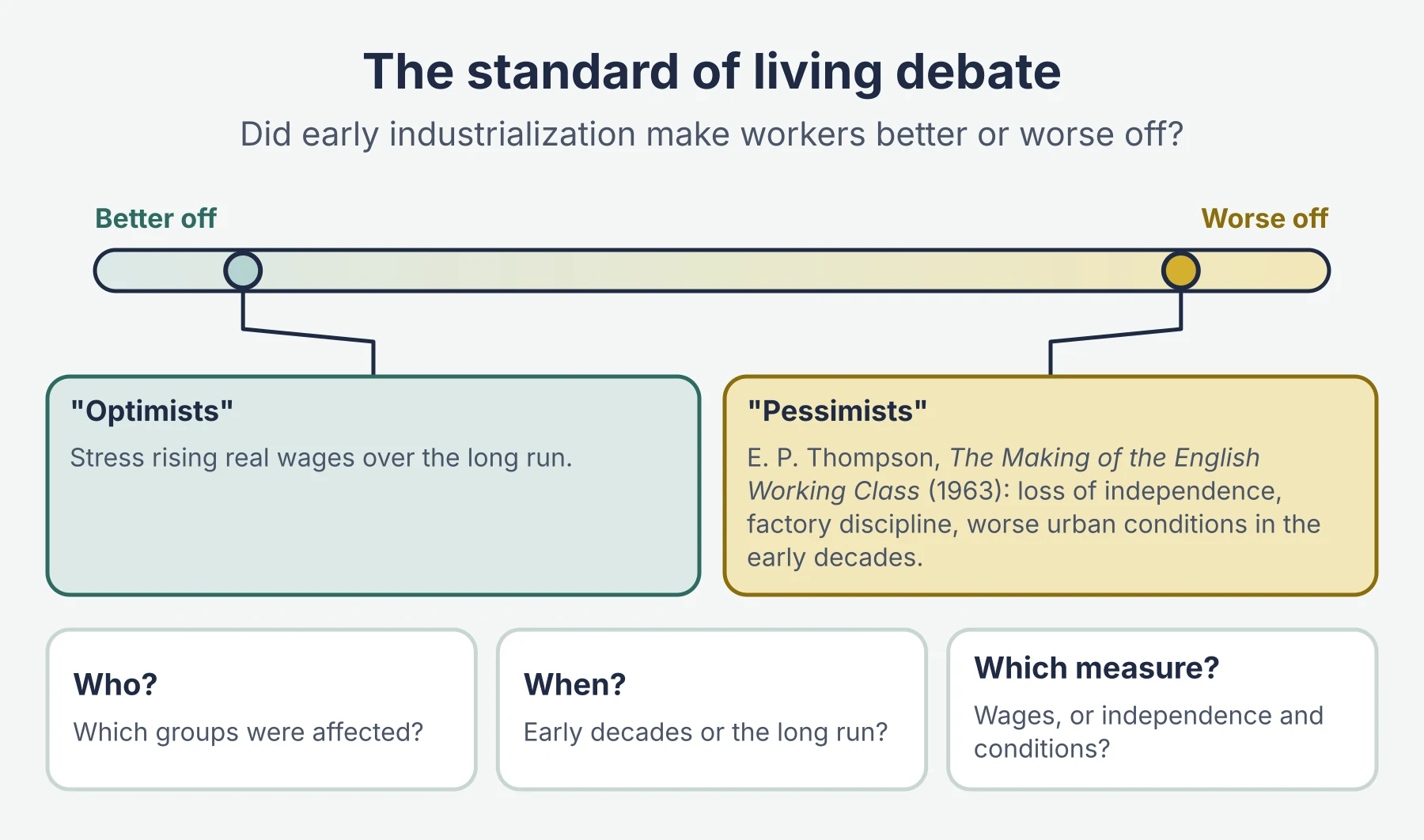
The standard of living debate is a classic perspective: “optimists” stress rising real wages over the long run, while “pessimists” such as E. P. Thompson in The Making of the English Working Class (1963) stress the loss of independence, discipline of the factory and worsening urban conditions in the early decades.
Worked example: planning a Paper 2 essay
Question: “To what extent was the availability of natural resources the main reason why industrialization took place in two countries, each chosen from a different region?”
Choose examples: Britain (Europe) and Japan (Asia and Oceania). This pairing is effective because the answer differs: resources mattered greatly in Britain, but Japan industrialized with few resources.
Thesis: “Natural resources were a major cause of British industrialization, where coal underpinned steam power, but in Japan, which lacked coal and iron in quantity, state policy and the transfer of foreign technology were decisive; resources were therefore important but not the main reason in both cases.”
Paragraph plan (comparative, by factor):
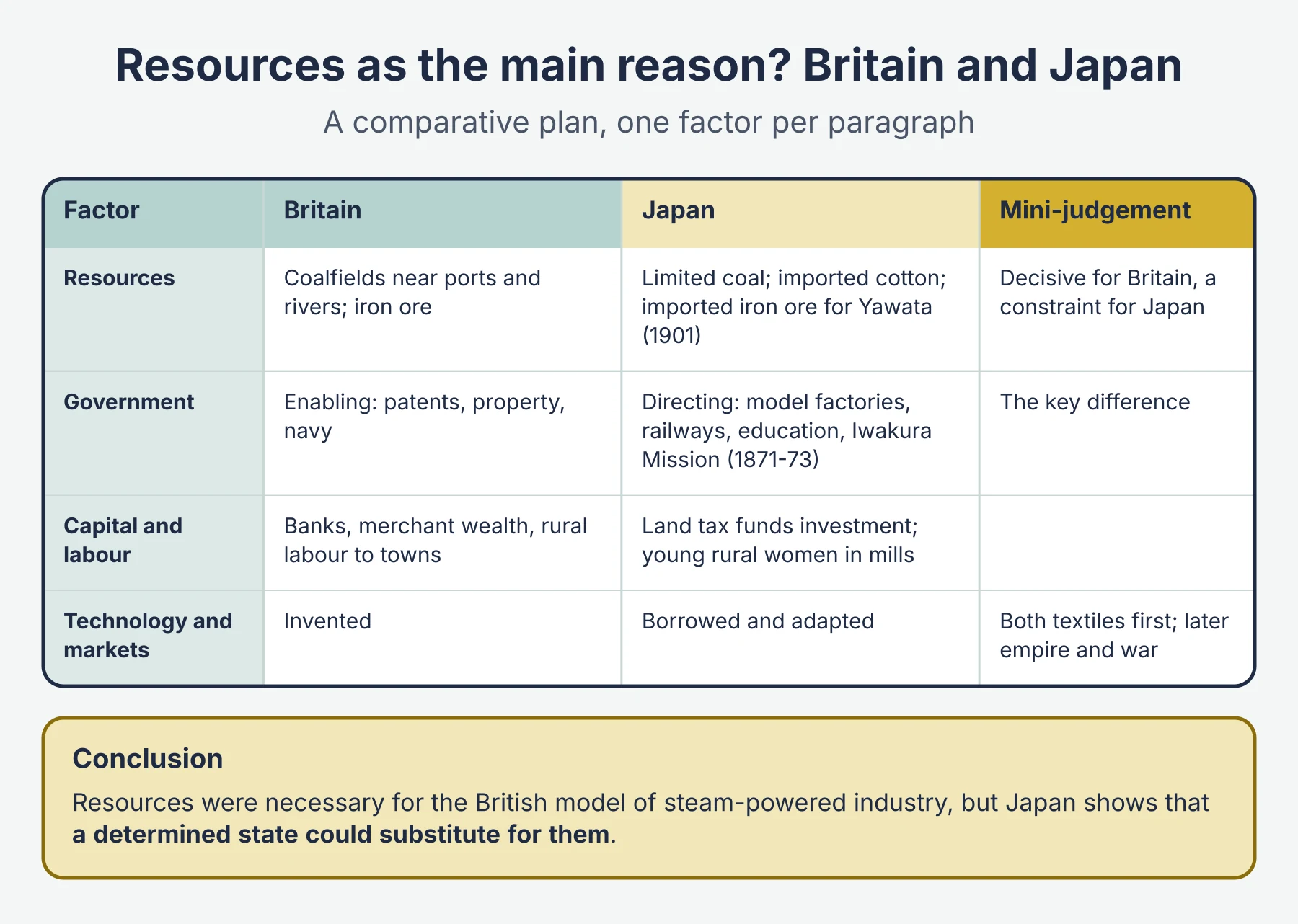
- Resources. Britain: coalfields near ports and rivers; iron ore. Japan: limited coal, imported raw cotton, later reliance on imported iron ore for the Yawata works (opened 1901). Mini-judgement: decisive for Britain, a constraint for Japan.
- Government. Britain: enabling (patents, property rights, navy). Japan: directing (model factories, railways, education, the Iwakura Mission’s study of Western industry, 1871 to 1873). Mini-judgement: the key difference between the cases.
- Capital and labour. Britain: banks, merchant wealth, rural labour moving to towns. Japan: land tax revenue funded investment; young women from rural families staffed the silk and cotton mills.
- Technology and markets. Britain invented; Japan borrowed and adapted. Both relied on textiles first, and both later used empire and war to secure markets and materials.
Conclusion: Weigh the factors: resources were necessary for the British model of steam-powered industry, but the Japanese case shows that a determined state could substitute for them.
Annotation. This plan earns the higher markbands because every paragraph treats both countries, ends with a judgement on the question’s factor, and uses specific dates and policies.
Common mistakes
- Treating “industrialization” as only Britain. The period runs to 2005; use the cases your class studied, from different regions where required.
- Listing inventions. Machines matter only when you explain why they were adopted and what they changed.
- Confusing origins with impact. A question on causes does not want a paragraph on child labour unless you show how labour supply caused growth.
- Ignoring the state in Britain. “Laissez-faire Britain” is too simple; the state enabled growth and later regulated its effects.
- One-sided impact essays. Show who gained and who lost, and how conditions changed over time.
- Vague chronology. “In the 1800s” is weak; name the decade and the law, plan or event.
Exam technique
Paper 2 essays on this topic are marked out of 15 using the five markbands described in the world history topics study guide. Read the command term closely:
- To what extent / how far: decide your answer to the claim in the question and argue it throughout, with a counter-argument.
- Compare and contrast: organise by theme, with both countries in every paragraph.
- Evaluate: weigh strengths and limitations, for example of state-led industrialization, and reach a judgement.
- Discuss / examine: consider a range of factors or effects and show how they interact.
If a question names a factor (resources, government, technology), make that factor your first paragraph and return to it in the conclusion.
Use with the other pages
Test recall with the industrialization revision notes, then write timed answers using the industrialization practice questions.
Check your understanding
- What are the three strands of this topic? Origins, development and impact of industrialization.
- What did Gerschenkron argue about late industrializers? That the more backward a country was at the start, the more it relied on banks and the state.
- Give one Meiji state enterprise and its date. The Tomioka silk mill (1872), or the Tokyo-Yokohama railway (1872).
- What did the 1833 Factory Act do? Banned children under nine from textile mills and appointed inspectors.
- Why is Japan a useful contrast with Britain on resources? It industrialized with limited coal and iron, showing the state and imported technology could compensate.
- Give one example of environmental impact with a date. London’s 1952 smog, which led to the Clean Air Act of 1956.
Get free revision emails (optional)
Occasional emails with practice questions, worked explanations and links to free resources for the qualification and subjects you choose. No spam, and you can unsubscribe from any email. The free tools on this site never need an email.
Related resources
-
Practice questions
IB DP History: The Six Key Concepts – Practice Questions
Original practice questions with worked answers on the six key concepts of IB DP History (first assessed 2017), from spotting the concept to essay plans.
World History · International Baccalaureate · IB
Try questions -
Practice questions
IB DP History (DP History): Origins, development and impact of industrialization (1750-2005) – Practice Questions
Twelve original IB History practice questions on industrialization 1750-2005, from short recall to a full Paper 2 essay, with mark-scheme answers.
World History · International Baccalaureate · IB
Try questions -
Revision notes
IB DP History (DP History): Origins, development and impact of industrialization (1750-2005) – Revision Notes
Condensed IB History notes on industrialization 1750-2005: causes, technology, the state, social and political impact, key terms, exam traps and a self-test.
World History · International Baccalaureate · IB
Revise topic
Related articles
-
teaching
A Level tuition in Dubai: Cambridge or Pearson Edexcel International A Level?
Schools in Dubai and Abu Dhabi teach either Cambridge International AS & A Level or Pearson Edexcel International A Level. How the two are structured, why it matters for tuition, and how online classes from Lahore work.
9 October 2026
-
curriculum guides
Choosing subjects at IGCSE and A Level
How subject choices at 14 and 16 affect university options later, and how to keep pathways open without overloading a timetable.
28 July 2026
Studying this with a teacher
Working through World History IB?
This page is free and stays free. If you would rather be taught it, Marlbridge runs World History classes one-to-one, online in your own time zone. The first trial class is free. WhatsApp replies within an hour (8am–11pm Pakistan time, every day); email the same day.
IB World History teachers at Marlbridge
