
Revision Notes
IB DP History (DP History): Origins, development and impact of industrialization (1750-2005) – Revision Notes
Condensed IB History notes on industrialization 1750-2005: causes, technology, the state, social and political impact, key terms, exam traps and a self-test.
- Subject
- World History
- Level
- IB
- Topic
- Topic 2: World history topics
- Author
- Marlbridge Academic Team
- Updated
- Reviewed by
- Azam Siddique (what this means)
Aligned to International Baccalaureate IB Diploma Programme World History (DP History), First assessment 2017. Official specification .
Syllabus page (what it covers and how it is assessed): IB Diploma Programme World History.
Syllabus points this page covers
DP History
- 7 Origins, development and impact of industrialization (1750-2005)
Found an error? Report a correction.
Need help with this topic? Request a free trial class for IB Diploma Programme World History (DP History).
These notes condense world history topic 7 for Paper 2: why industrialization began, how it developed, and what it changed between 1750 and 2005. Use them after the industrialization study guide and before the industrialization practice questions.
The topic on one page
| Strand | What you must be able to explain | Typical evidence |
|---|---|---|
| Origins | Causes: agriculture, population, resources, capital, technology, labour, markets, government | British coal and Atlantic trade; Meiji state investment; the Zollverein (1834) |
| Development | Spread of power, transport and new industries; roles of entrepreneurs and the state | Steam, railways, Bessemer steel (1856), electricity, the assembly line |
| Impact | Social, economic, political and environmental effects | Factory Acts, trade unions, Chartism, Bismarck’s insurance laws, urban public health, smog |
Origins: causes to rank
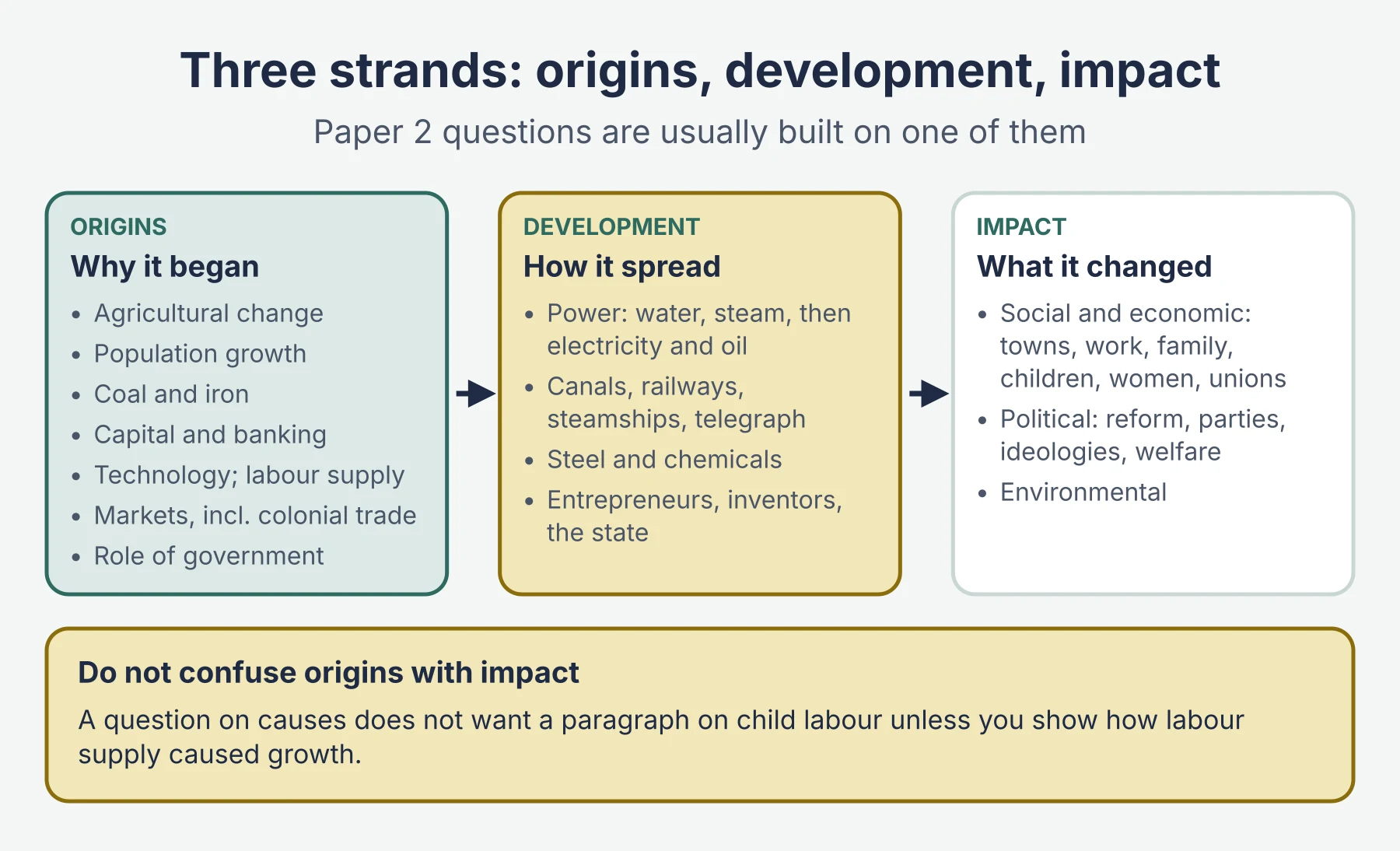
- Agricultural change: higher yields, enclosure, labour released for industry. Treat as gradual.
- Population growth: labour supply and demand for cheap goods.
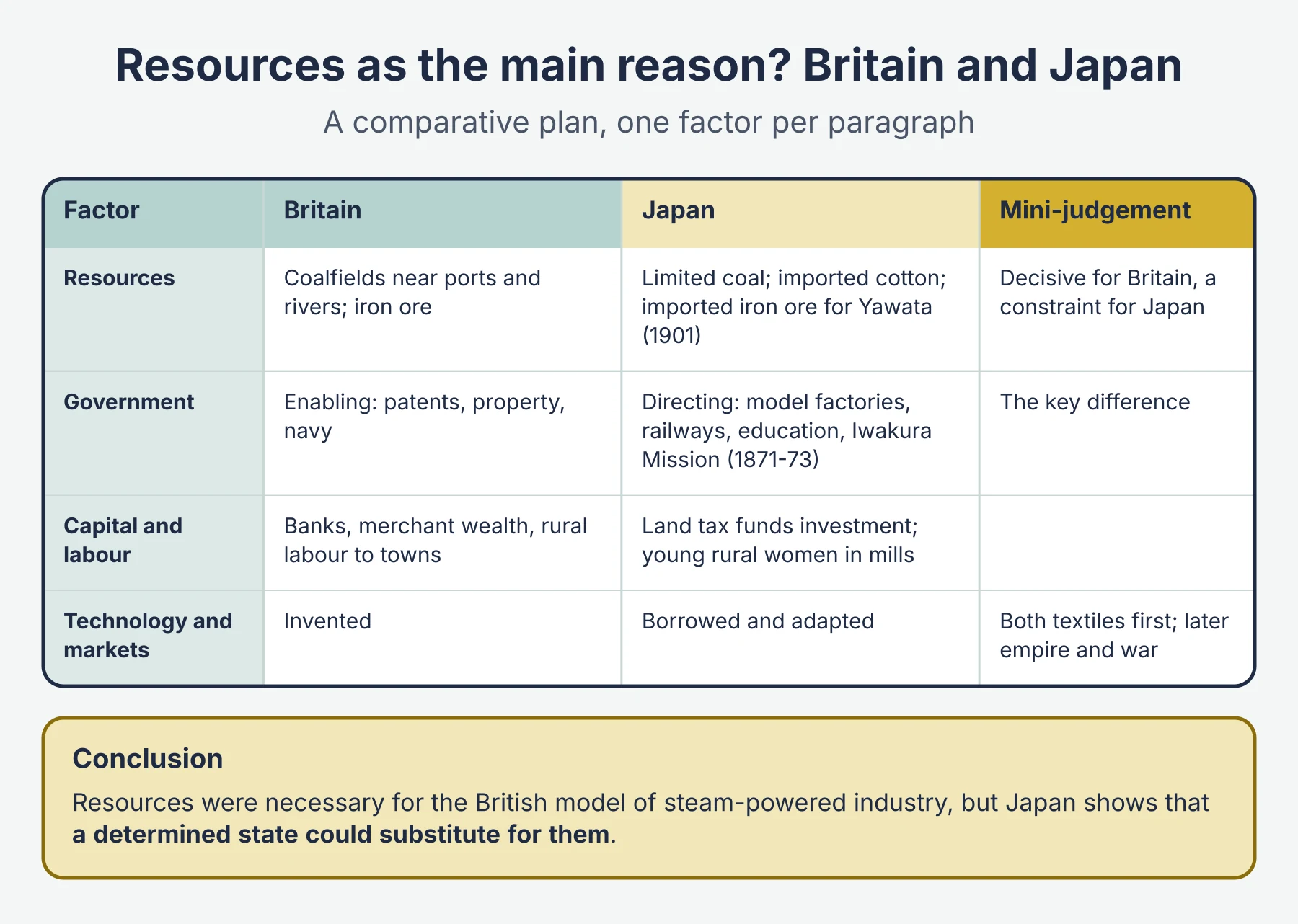
- Resources: coal for steam power; iron for machines, rails and ships.
- Capital: merchant profits, banks, later joint-stock companies; in late industrializers, state budgets and foreign loans.
- Technology: textile machinery and steam engines first, then steel, chemicals and electricity.
- Markets: domestic demand, colonies and overseas trade.
- Government: from enabling (property rights, patents, tariffs, infrastructure) to directing (Meiji Japan, Witte’s Russia, Stalin’s Five-Year Plans).
Ranking tip: decide whether a factor was necessary (industrialization could not happen without it) or decisive (it explains why it happened then and there).
Development: stages and technologies
| Stage | Features | Examples |
|---|---|---|
| Early (c.1750-1830s) | Textiles, water then steam power, canals | Arkwright’s Cromford Mill (1771); Watt’s engine (patented 1769) |
| Railway age (1830s-1870s) | Railways and iron, steam at sea, the telegraph | Liverpool and Manchester Railway (1830) |
| “Second” industrial revolution (c.1870-1914) | Steel, chemicals, electricity, oil; large firms | Germany and the USA overtaking Britain in steel output by about 1900 |
| Twentieth century | Mass production, state planning, later services and new technology | Ford’s moving assembly line (1913); Soviet Five-Year Plans from 1928 |
Comparative case summary
| Britain | Germany | Meiji Japan | Russia / USSR | |
|---|---|---|---|---|
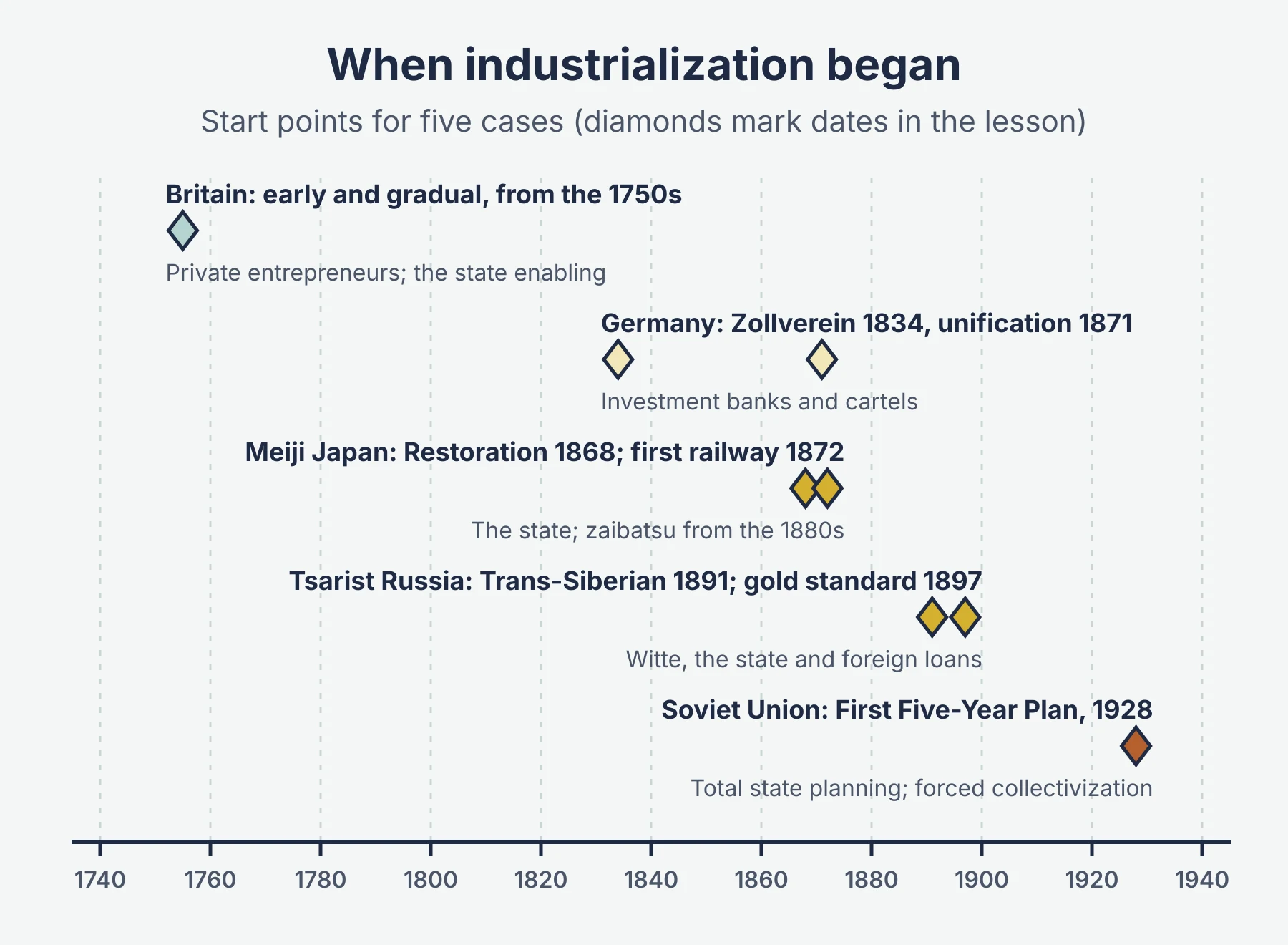
| Start | From the 1750s | Accelerated after 1871 | After 1868 | 1890s; again from 1928 |
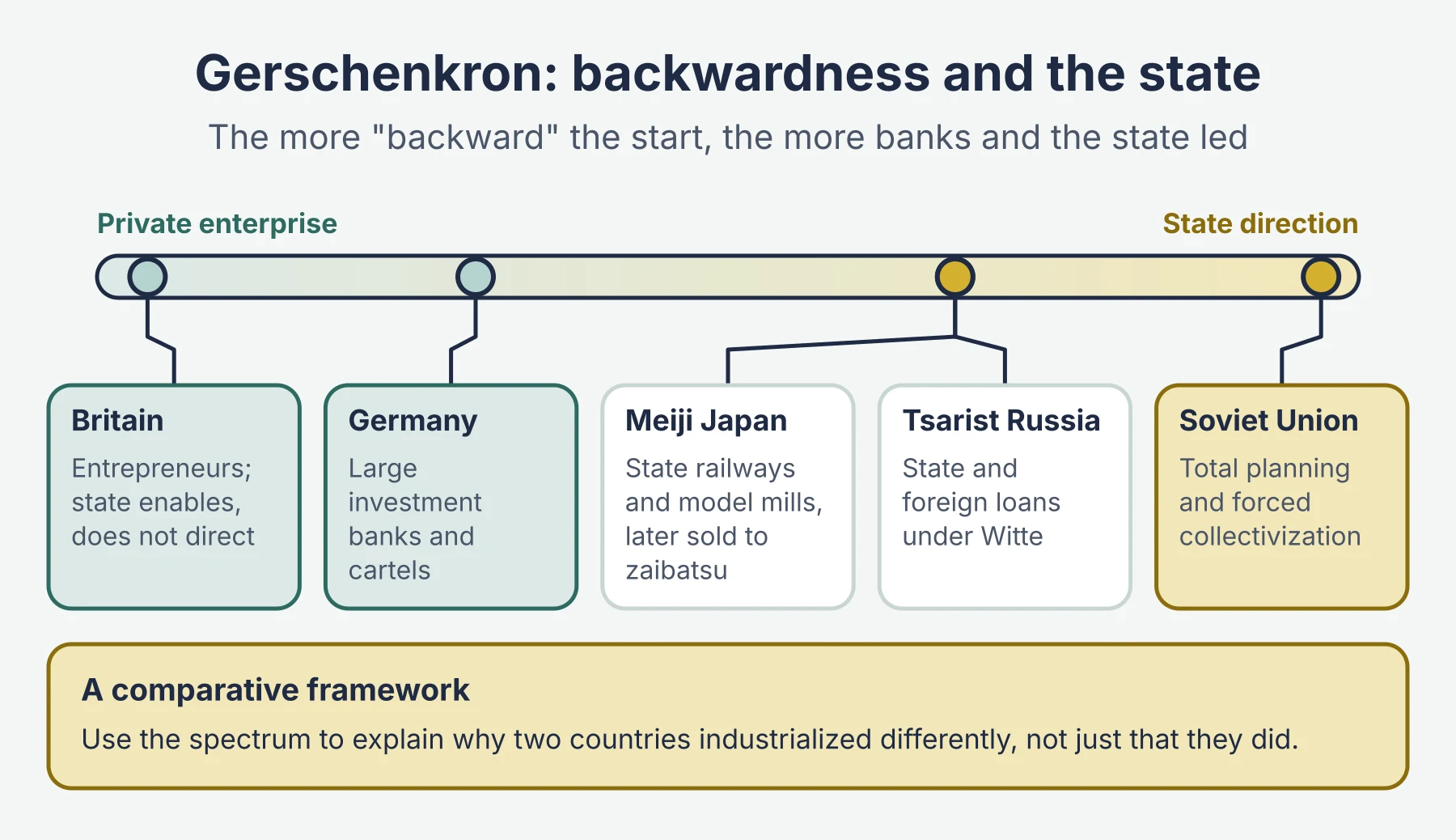
| Driver | Private enterprise | Banks, cartels, state support | State, then zaibatsu | State and foreign capital; then the party-state |
| Leading sectors | Cotton, coal, iron | Steel, chemicals, electricals | Silk, cotton, then heavy industry | Railways, coal, steel |
| Political response | Reform Acts, Factory Acts | Social insurance (1883-89) to weaken the SPD | Oligarchic control; Meiji Constitution (1889) | Repression; 1905 Revolution |
Impact: key evidence
- Urbanization: rapid growth of industrial towns; overcrowding, cholera, poor sanitation.
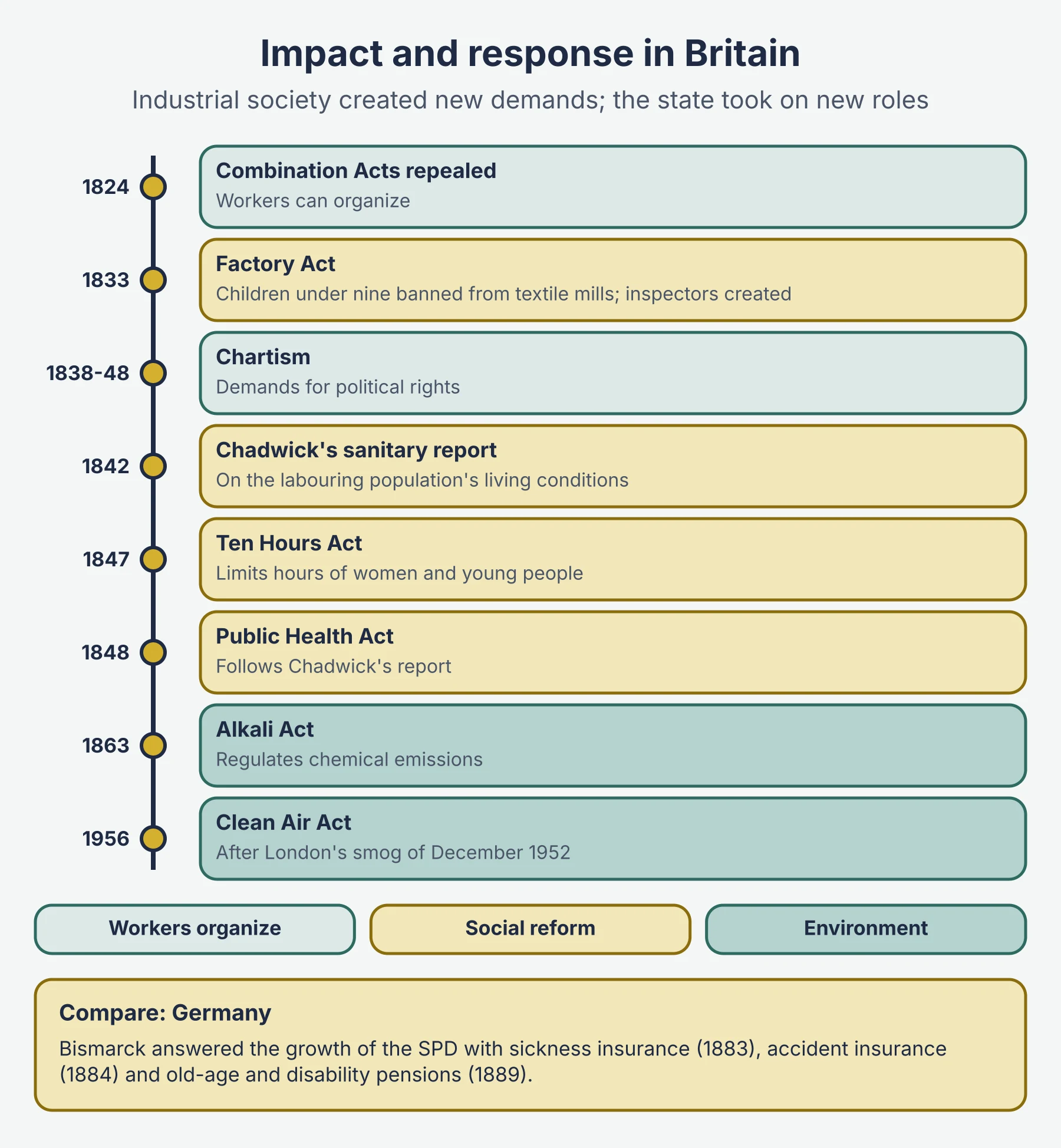
- Public health: Chadwick’s report (1842) and the Public Health Act (1848) in Britain.
- Work: factory discipline, long hours, child labour; Factory Act 1833 (no children under nine in textile mills; inspectors); Ten Hours Act 1847.
- Labour organizations: Combination Acts repealed (1824); Tolpuddle Martyrs transported (1834); growth of skilled unions, then mass unions.
- Political change: Chartism (1838-48); new socialist and labour parties; state welfare.
- Women: paid factory work (especially textiles), but lower pay and legal limits on hours.
- Environment: Alkali Act 1863; London smog (1952) and the Clean Air Act (1956).
Key terms
| Term | Meaning |
|---|---|
| Proto-industrialization | Rural, household-based production for distant markets before factories |
| Factory system | Production concentrated in one building, with powered machines and timed labour |
| Urbanization | Growth in the share of people living in towns |
| Laissez-faire | The idea that the state should not interfere in the economy |
| Zaibatsu | Large Japanese family-controlled business groups such as Mitsui and Mitsubishi |
| Cartel | Firms agreeing to fix prices or output; common in German heavy industry |
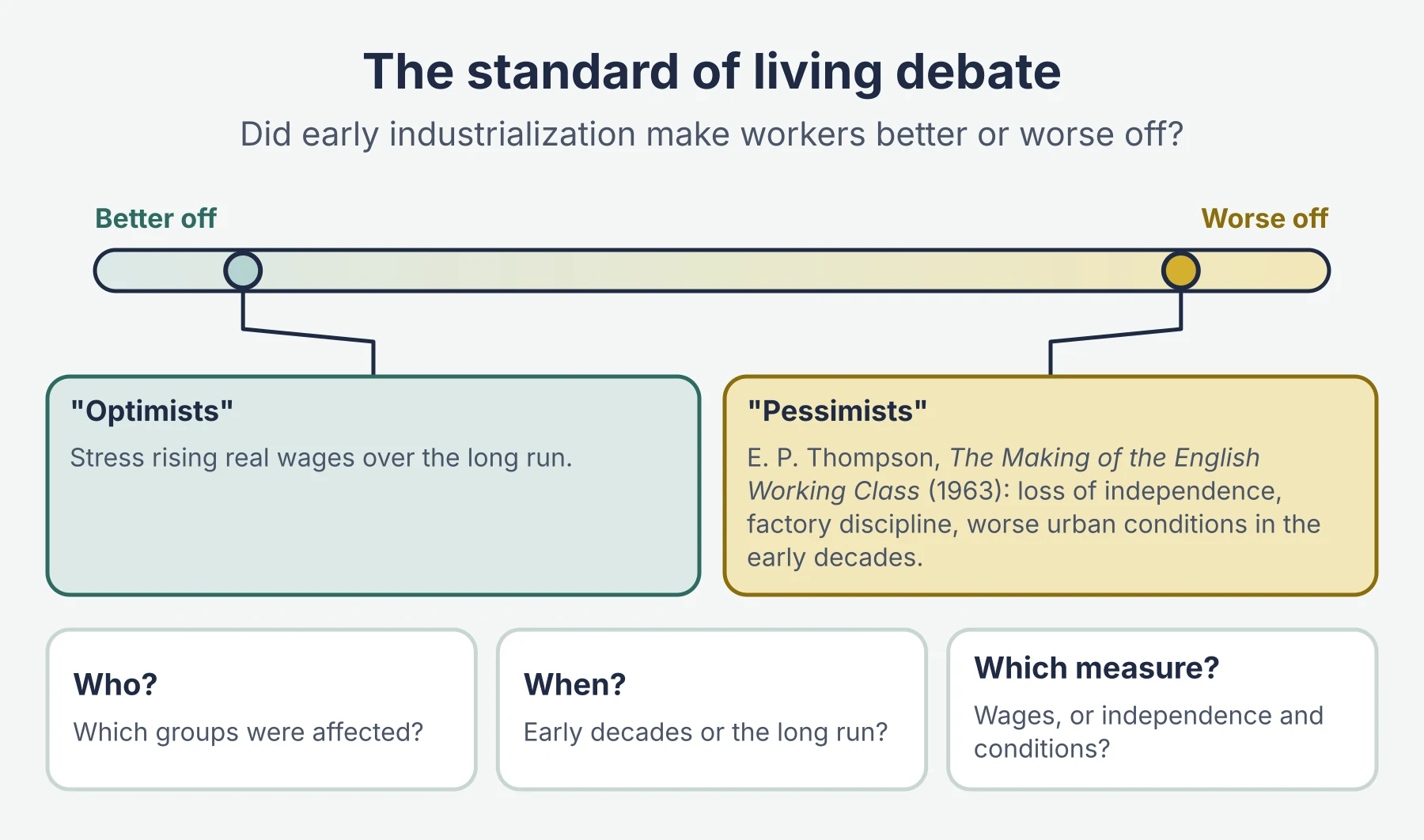
| Standard of living debate | Argument over whether early industrialization made workers better or worse off |
| Economic backwardness thesis | Gerschenkron’s view that late industrializers relied more on banks and the state |
| Second industrial revolution | The phase after about 1870 based on steel, chemicals, electricity and oil |
Historians’ perspectives to use accurately
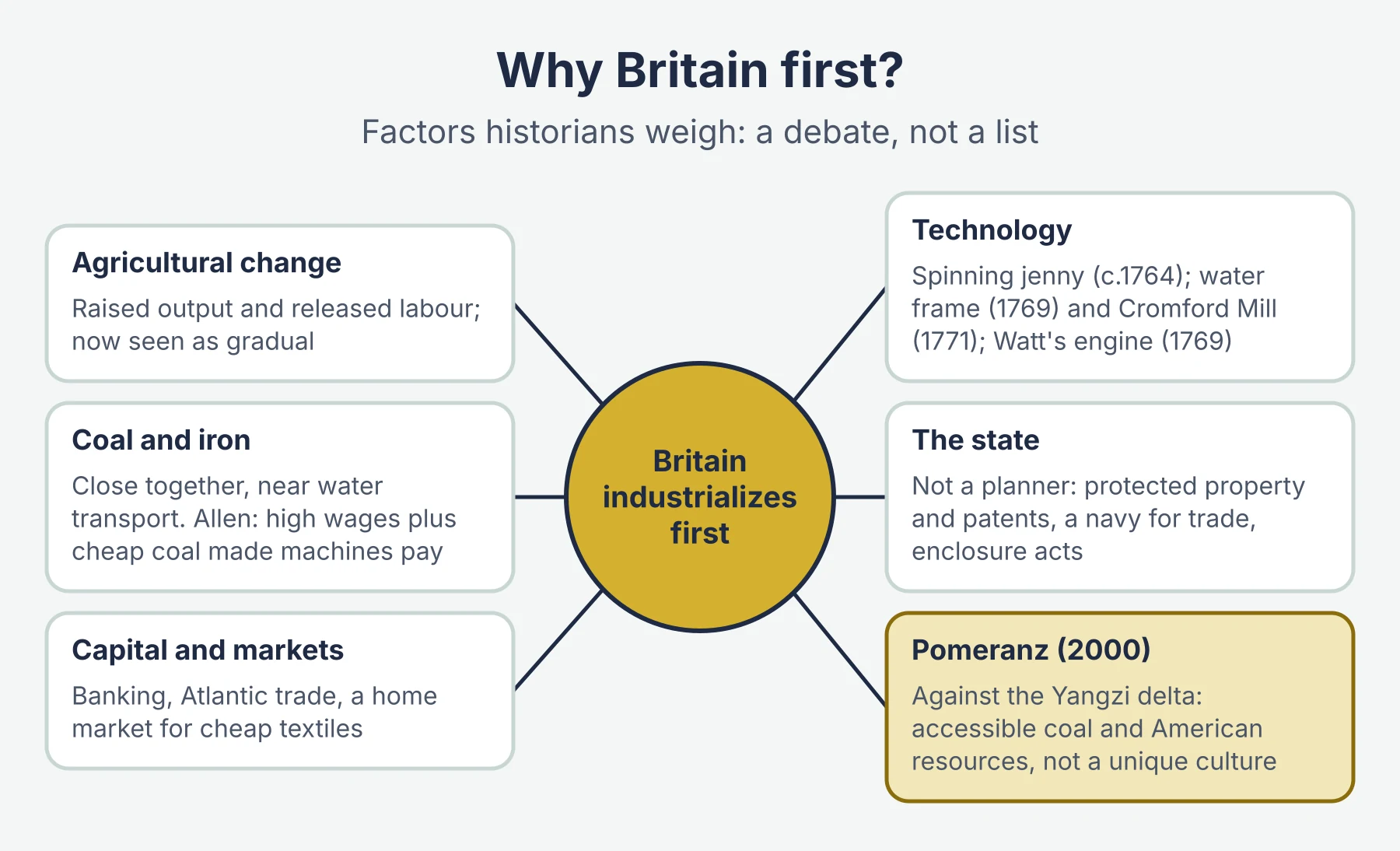
- Robert Allen: high wages and cheap coal made mechanization profitable in Britain.
- Kenneth Pomeranz: coal and the resources of the Americas explain why Britain diverged from advanced regions of China.
- E. P. Thompson: a “pessimist” on working-class experience in early industrial England.
- Alexander Gerschenkron: the state and banks substitute for missing prerequisites in late industrializers.
Exam traps
- Answering on “impact” with only social effects. Political and environmental effects are part of the topic; one paragraph on each strengthens range.
- Assuming a revolution happened overnight. Show change over decades.
- Same-region pairs. Britain and Germany are both in Europe; check whether the question requires different regions.
- Forgetting the end date. The topic runs to 2005, so later cases such as state-led growth in the twentieth century are valid if studied.
- Unsupported judgement. Each paragraph needs a mini-judgement that links back to the question.
Self-test
- Name four causes of industrialization. Any four from agricultural change, population, resources, capital, technology, labour, markets, government.
- When was the Zollverein formed? 1834.
- Which invention is linked to Watt and what did it improve? The separate condenser, which made steam engines far more fuel-efficient.
- Who led Russian industrialization in the 1890s? Sergei Witte, as finance minister.
- What were zaibatsu? Large family-controlled Japanese business groups.
- What did the Ten Hours Act of 1847 do? Limited the working hours of women and young people in textile mills.
- What were Bismarck’s three social insurance laws and dates? Sickness (1883), accident (1884), old age and disability (1889).
- Which report led to the Public Health Act of 1848? Chadwick’s 1842 report on the sanitary condition of the labouring population.
- What is the difference between “necessary” and “decisive” causes? Necessary causes had to be present; decisive causes explain why industrialization happened when and where it did.
- What was the argument of Pomeranz’s The Great Divergence? That coal and the resources of the Americas, not a unique European culture, explain Britain’s breakthrough.
- Give one environmental law and its trigger. The Clean Air Act (1956), after the London smog of 1952.
- Why is Britain and Japan a strong comparative pair? They are in different regions and show contrasting roles of resources and the state.
Get free revision emails (optional)
Occasional emails with practice questions, worked explanations and links to free resources for the qualification and subjects you choose. No spam, and you can unsubscribe from any email. The free tools on this site never need an email.
Related resources
-
Practice questions
IB DP History: The Six Key Concepts – Practice Questions
Original practice questions with worked answers on the six key concepts of IB DP History (first assessed 2017), from spotting the concept to essay plans.
World History · International Baccalaureate · IB
Try questions -
Study guides
IB DP History (DP History): Independence movements (1800-2000)
Origins, methods, leaders and post-independence challenges of independence movements 1800-2000, using India, Algeria, Ghana and Vietnam for Paper 2 essays.
World History · International Baccalaureate · IB
Read guide -
Practice questions
IB DP History (DP History): Independence movements (1800-2000) – Practice Questions
Twelve original IB History practice questions on independence movements 1800-2000, from short recall to a full Paper 2 essay, with mark-scheme answers.
World History · International Baccalaureate · IB
Try questions
Related articles
-
teaching
A Level tuition in Dubai: Cambridge or Pearson Edexcel International A Level?
Schools in Dubai and Abu Dhabi teach either Cambridge International AS & A Level or Pearson Edexcel International A Level. How the two are structured, why it matters for tuition, and how online classes from Lahore work.
9 October 2026
-
curriculum guides
Choosing subjects at IGCSE and A Level
How subject choices at 14 and 16 affect university options later, and how to keep pathways open without overloading a timetable.
28 July 2026
Studying this with a teacher
Working through World History IB?
This page is free and stays free. If you would rather be taught it, Marlbridge runs World History classes one-to-one, online in your own time zone. The first trial class is free. WhatsApp replies within an hour (8am–11pm Pakistan time, every day); email the same day.
IB World History teachers at Marlbridge
