
Study Guides
IB DP History (DP History): Independence movements (1800-2000)
Origins, methods, leaders and post-independence challenges of independence movements 1800-2000, using India, Algeria, Ghana and Vietnam for Paper 2 essays.
- Subject
- World History
- Level
- IB
- Topic
- Topic 2: World history topics
- Author
- Marlbridge Academic Team
- Updated
- Reviewed by
- Azam Siddique (what this means)
Aligned to International Baccalaureate IB Diploma Programme World History (DP History), First assessment 2017. Official specification .
Syllabus page (what it covers and how it is assessed): IB Diploma Programme World History.
Syllabus points this page covers
DP History
- 8 Independence movements (1800-2000)
Found an error? Report a correction.
Need help with this topic? Request a free trial class for IB Diploma Programme World History (DP History).
World history topic 8 asks how peoples under colonial or imperial rule won independent statehood, and what they did with it. It spans two centuries, from the Latin American wars of independence after 1800 to the end of empire in Africa and Asia, so your class will usually study two or three movements from different IB regions. The essays this topic produces reward clear thinking about causes, methods and consequences, and the ability to compare movements whose circumstances were very different.
What the topic covers
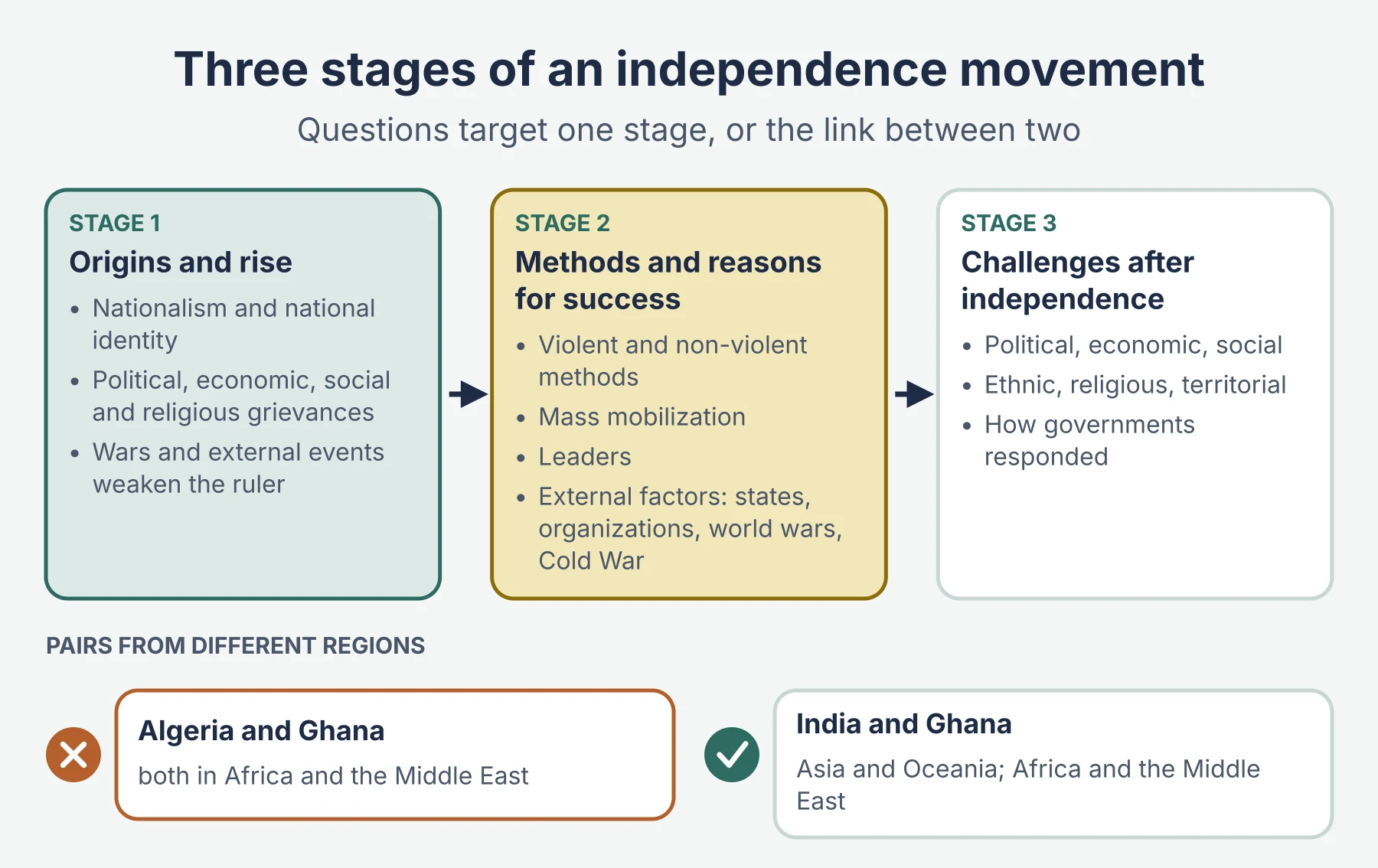
The content falls into three stages, and questions are normally built on one stage or on the link between two.
- Origins and rise of the movement. The growth of nationalism and national identity; political, economic, social and religious grievances under colonial or imperial rule; the effect of wars and other external events in weakening the ruling power.
- Methods and reasons for success. Violent and non-violent methods; mass mobilization; the role and importance of leaders; the part played by external factors such as other states, international organizations, world wars and the Cold War.
- Challenges after independence. The problems facing new states in their early years (political, economic, social, ethnic, religious and territorial) and how governments responded to them.
Check the exact wording of each heading, and the time limit on the post-independence stage, against the IB History guide.
Key ideas
Nationalism has to be explained, not assumed
Independence movements did not simply express a nation that already existed. Leaders built national identity through education, newspapers, religion, language and shared grievances. In India, the Indian National Congress (founded 1885) began as a forum of Western-educated professionals; only after 1919, under Gandhi, did it become a mass movement. In Algeria, reformist movements before 1954 sought rights within the French system before the FLN turned to armed struggle. Ask: who were the nationalists, what did they want, and when did they gain mass support?
War is the most powerful external factor
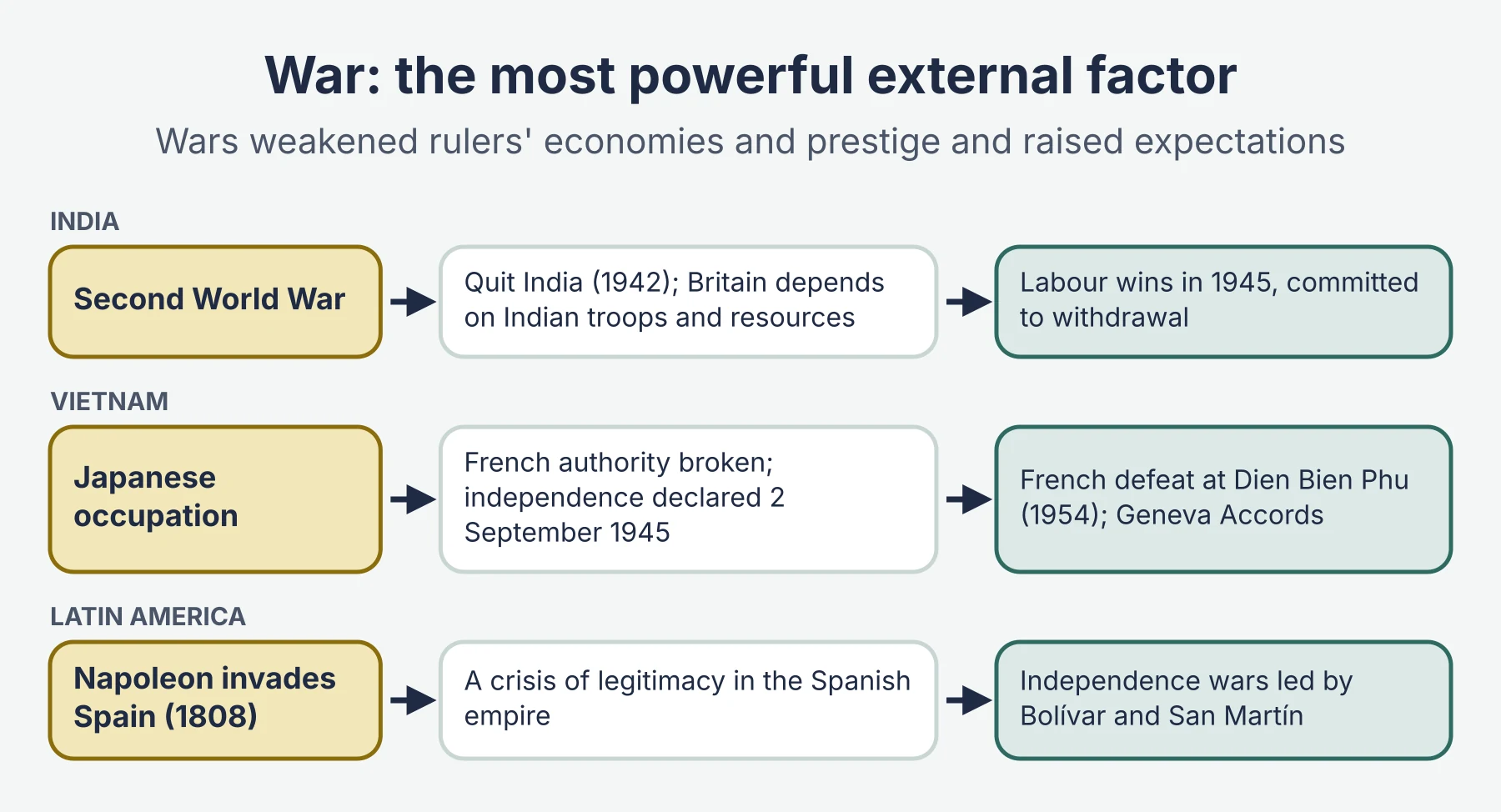
World wars weakened colonial powers economically, damaged their prestige and created new expectations among colonized peoples.
- India: the Quit India campaign (1942) and British dependence on Indian troops and resources made post-war rule unsustainable; Labour’s victory in 1945 brought a government committed to withdrawal.
- Vietnam: Japanese occupation broke French authority; Ho Chi Minh declared independence on 2 September 1945; French defeat at Dien Bien Phu (1954) led to the Geneva Accords.
- Latin America: Napoleon’s invasion of Spain (1808) created a crisis of legitimacy in the Spanish empire that opened the way to the independence wars led by Bolívar and San Martín.
Methods: a spectrum, not a choice
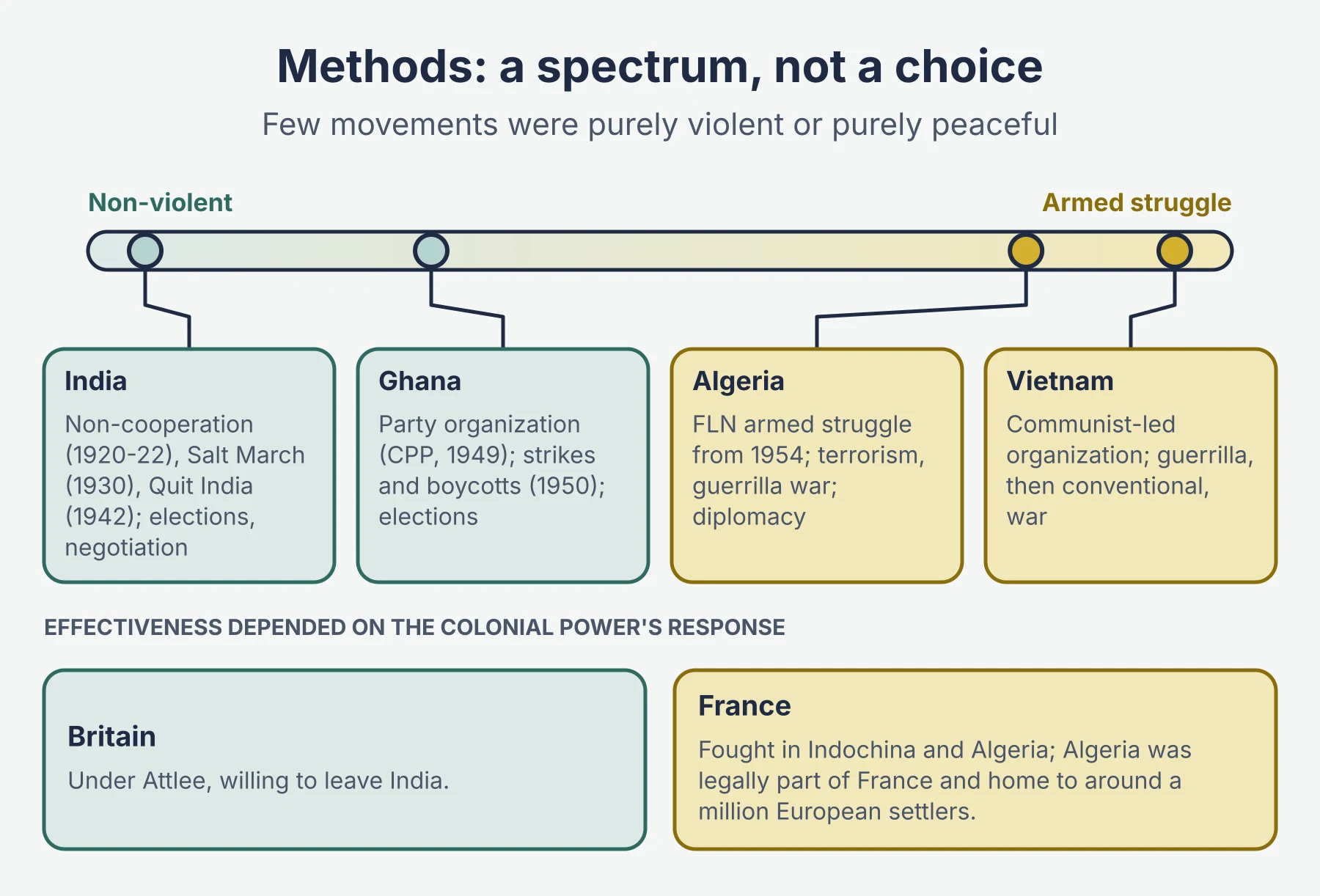
Few movements were purely violent or purely peaceful. Compare along a spectrum:
| Movement | Main methods | Independence |
|---|---|---|
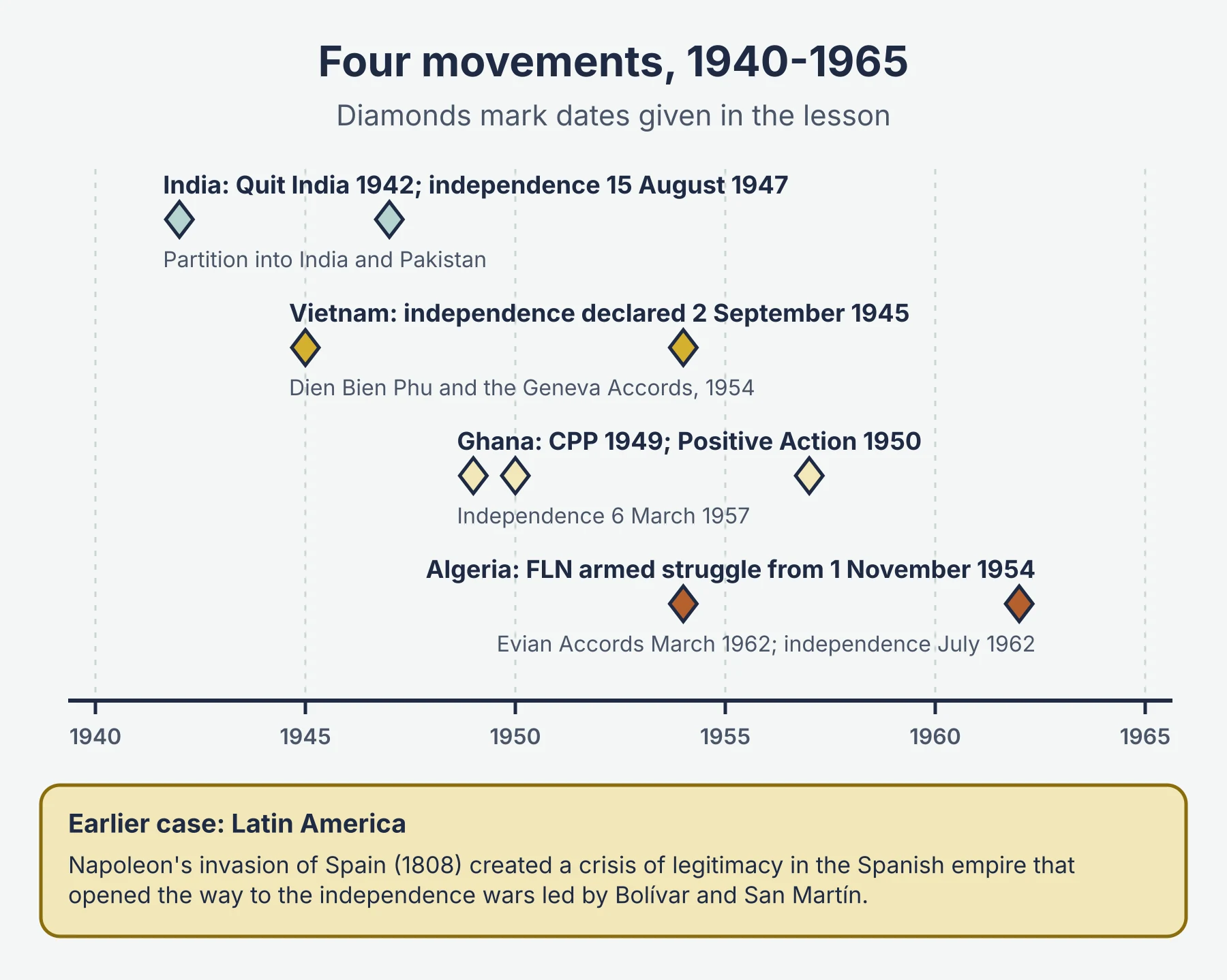
| India | Mass non-violent protest (non-cooperation 1920-22; Salt March 1930; Quit India 1942), elections and negotiation | 15 August 1947, with partition into India and Pakistan |
| Ghana (Gold Coast) | Party organization by Nkrumah’s Convention People’s Party (1949), strikes and boycotts (“Positive Action”, 1950), elections | 6 March 1957 |
| Algeria | Armed struggle by the FLN from 1 November 1954, terrorism and guerrilla war, international diplomacy | July 1962, after the Evian Accords (March 1962) |
| Vietnam | Communist-led political organization and guerrilla, then conventional, war (Viet Minh) | Geneva Accords (1954) left the Viet Minh in control of the North |
Effectiveness depended on the colonial power’s response: Britain under Attlee was willing to leave India; France fought in Indochina and Algeria, partly because Algeria was legally part of France and home to around a million European settlers.
Leaders matter, but within limits
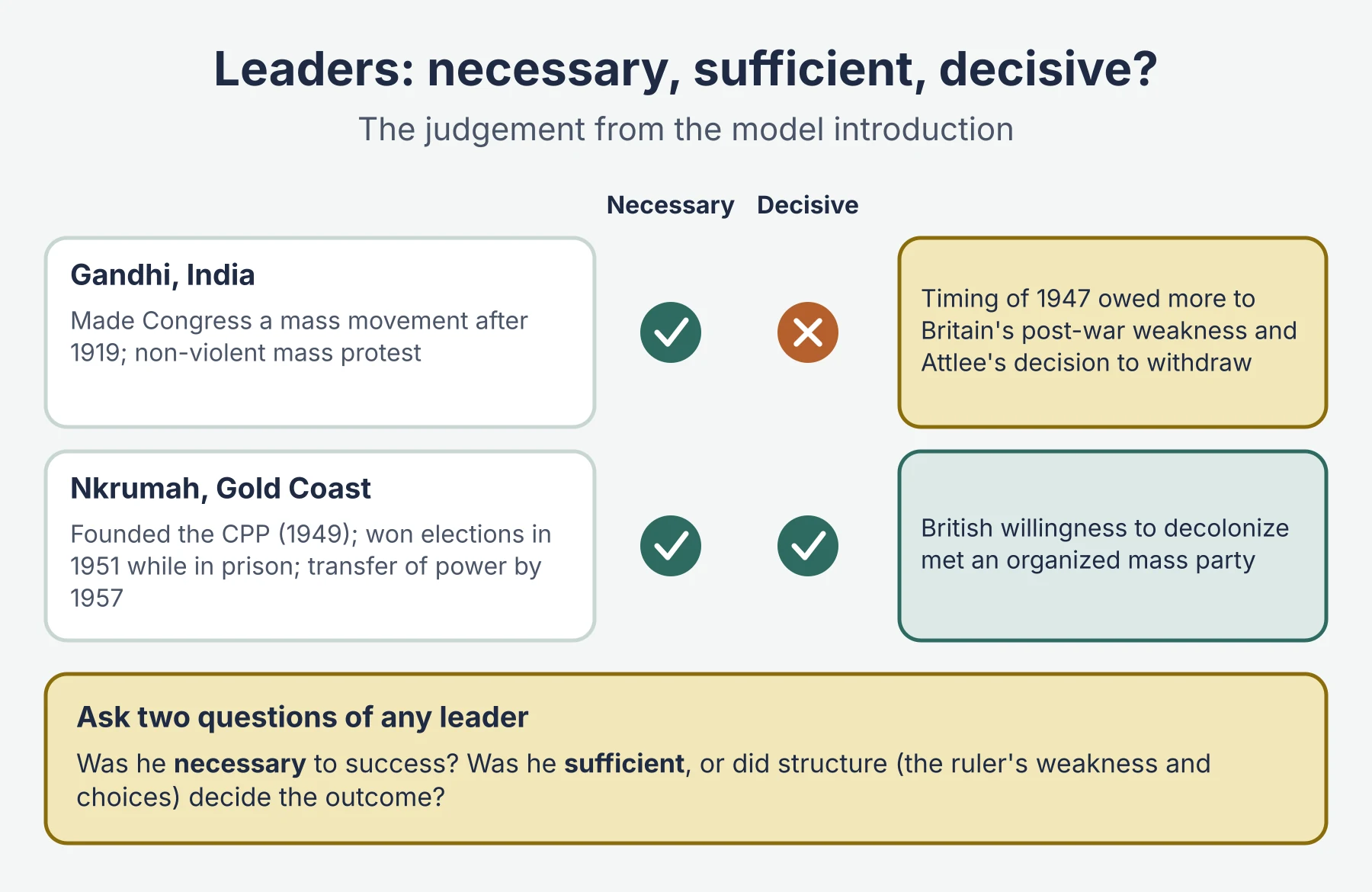
Gandhi, Nkrumah and Ho Chi Minh each gave their movements strategy and international recognition. But leadership interacted with structure: Gandhi’s campaigns were suspended or contained, and the timing of independence owed much to British weakness after 1945. A strong essay asks whether a leader was necessary, and whether he was sufficient.
After independence: the hardest stage
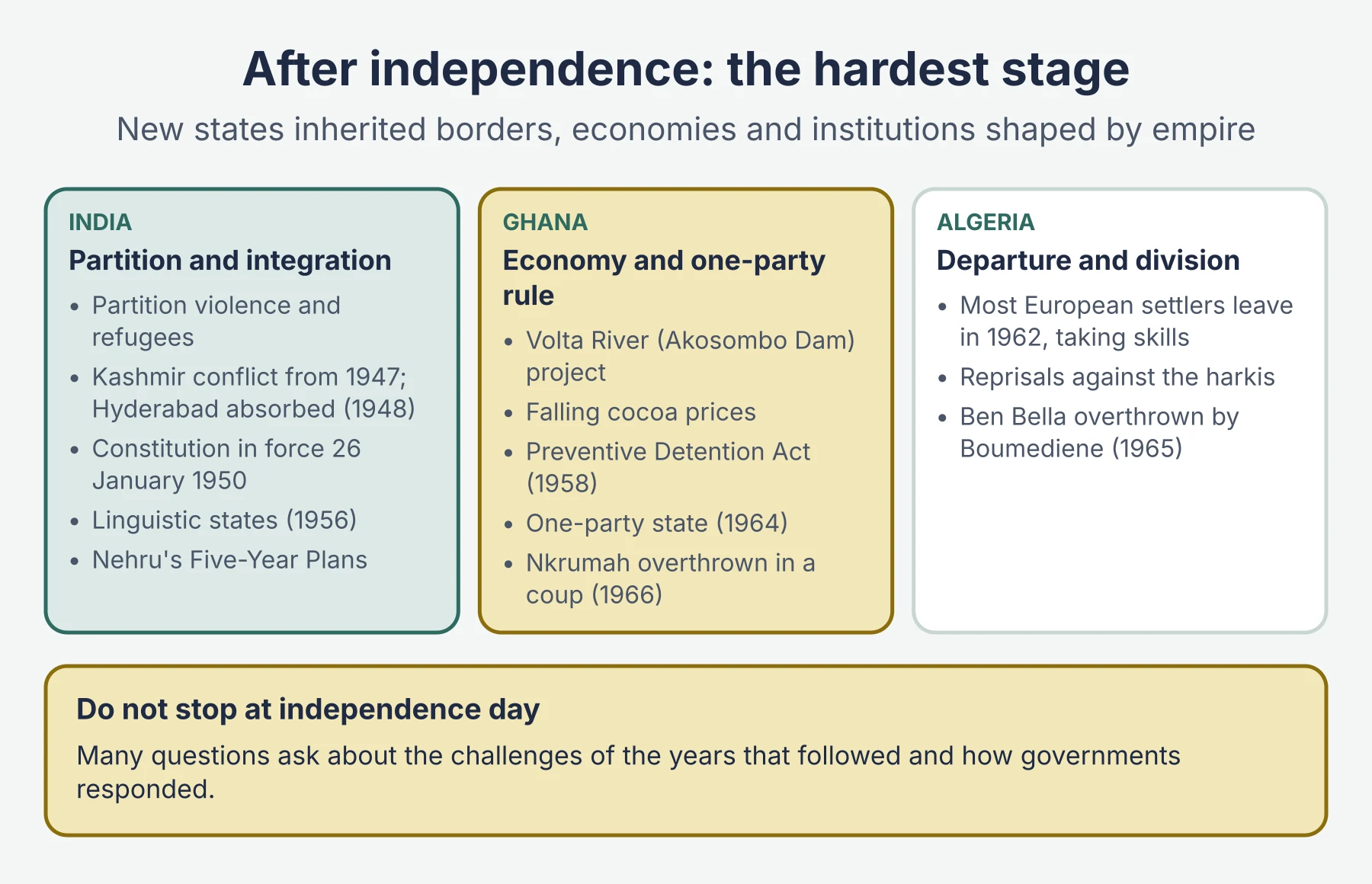
New states inherited borders, economies and institutions shaped by empire.
- India: partition violence and refugee movements; the integration of the princely states, including the conflict over Kashmir from 1947 and the absorption of Hyderabad (1948); a constitution in force from 26 January 1950; reorganization of states on linguistic lines (1956); Nehru’s Five-Year Plans.
- Ghana: the Volta River (Akosombo Dam) project; falling cocoa prices; the Preventive Detention Act (1958); a one-party state (1964); Nkrumah overthrown in a coup (1966).
- Algeria: the departure of most European settlers in 1962 removed skilled workers; reprisals against the harkis who had fought for France; Ben Bella overthrown by Boumediene (1965).
Worked example: an annotated model introduction
Question: “Evaluate the importance of leadership in the success of two independence movements, each chosen from a different region.”
“Both the Indian and Ghanaian independence movements were shaped by leaders of unusual ability, but leadership mattered in different ways. Gandhi transformed Congress into a mass movement after 1919 and gave it a method, non-violent mass protest, that challenged British claims to rule by consent; yet the timing of independence in 1947 owed more to Britain’s post-war weakness and the decision of the Attlee government to withdraw. Nkrumah’s leadership was more decisive: he founded the Convention People’s Party in 1949, won elections in 1951 while still in prison, and negotiated a rapid transfer of power by 1957. This essay argues that leadership was a necessary condition in both cases but was decisive only in the Gold Coast, where British willingness to decolonize met an organized mass party.”
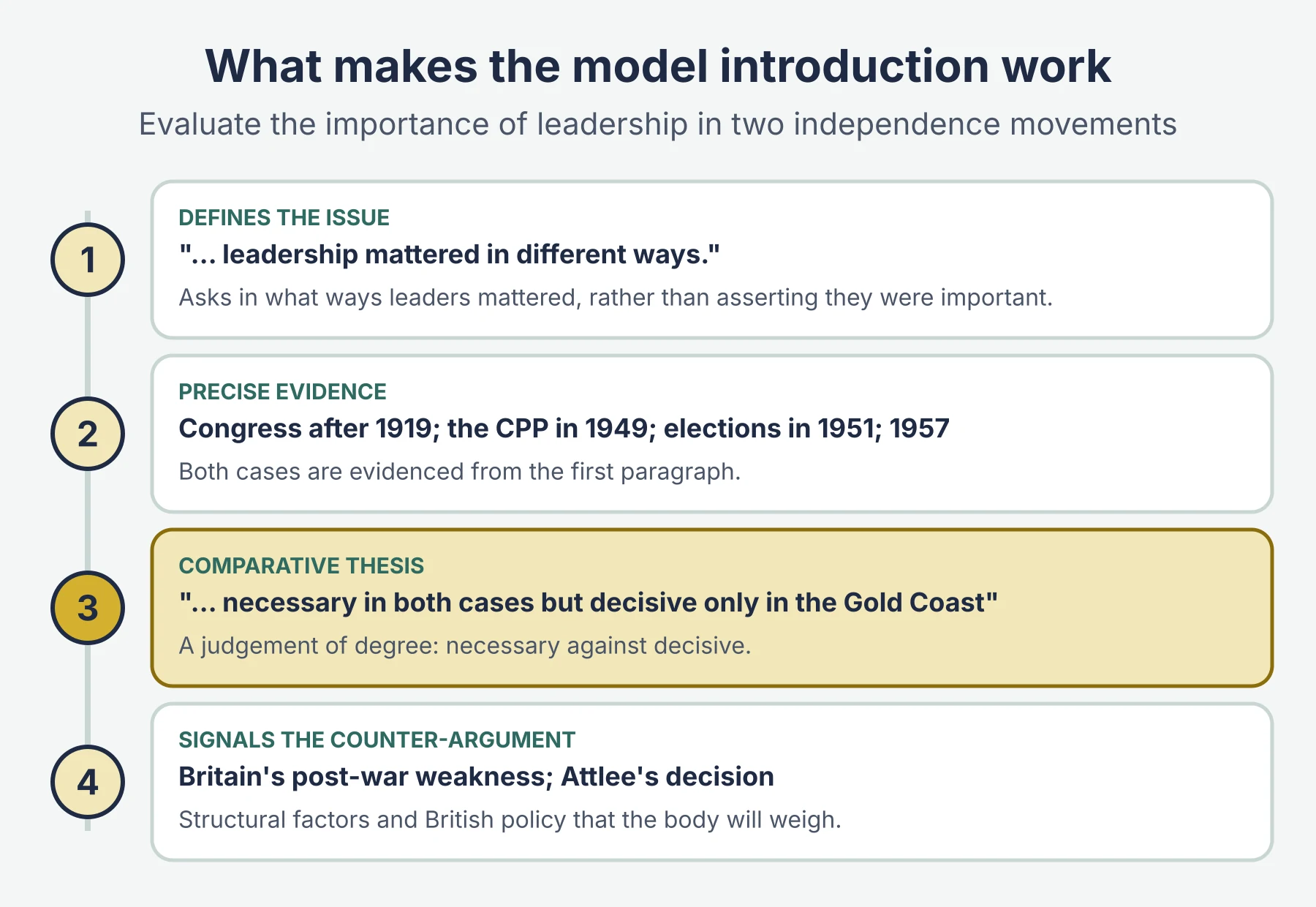
Why this works:
- It defines the issue (in what ways leaders mattered) instead of asserting “leaders were important”.
- It uses precise evidence for both cases in the introduction.
- It gives a comparative thesis with a judgement of degree (“necessary” against “decisive”).
- It signals the counter-argument (structural factors, British policy) that the body will weigh.
Common mistakes
- Narrating the road to independence. Paper 2 rewards analysis by theme, not a chronology from 1885 to 1947.
- Treating methods as morally ranked. The question is usually effectiveness, not whether a method was right.
- Ignoring the colonial power. Independence was negotiated or conceded as well as won; explain the ruler’s choices.
- Stopping at independence day. Many questions ask about challenges in the years that followed.
- Same-region examples. Algeria and Ghana are both in Africa and the Middle East; India is in Asia and Oceania.
- Loose terms. Distinguish independence, decolonization, partition and self-government.
Exam technique
- Compare and contrast: use themes such as origins, methods, leadership, external factors and outcome, with both movements in every paragraph.
- To what extent: if the question names a factor (“non-violent methods”, “the Second World War”), make it your first paragraph, then weigh alternatives and return to it in the conclusion.
- Evaluate: set criteria for success (speed, unity, cost in lives, stability afterwards) and apply them.
- Discuss: offer a range of factors with balance, and make your judgement explicit.
Each essay is marked out of 15 using the markbands outlined in the world history topics study guide; about 45 minutes, including five minutes of planning, is a sensible allocation.
Use with the other pages
Consolidate the chronologies with the independence movements revision notes, then practise with the independence movements practice questions.
Check your understanding
- What are the three stages of the topic? Origins and rise; methods and reasons for success; challenges after independence.
- When did Congress become a mass movement, and under whom? After 1919, under Gandhi.
- Why did France resist Algerian independence more than Britain resisted Indian independence? Algeria was legally part of France and had around a million European settlers.
- What external event weakened Spanish rule in Latin America in 1808? Napoleon’s invasion of Spain.
- Give two challenges Ghana faced after 1957. Any two: falling cocoa prices, the cost of the Volta River project, opposition and the move to a one-party state, the 1966 coup.
- Why is it weak to rank violent and non-violent methods morally in an essay? The question normally asks about effectiveness, which depends on context and the colonial power’s response.
Get free revision emails (optional)
Occasional emails with practice questions, worked explanations and links to free resources for the qualification and subjects you choose. No spam, and you can unsubscribe from any email. The free tools on this site never need an email.
Related resources
-
Practice questions
IB DP History: The Six Key Concepts – Practice Questions
Original practice questions with worked answers on the six key concepts of IB DP History (first assessed 2017), from spotting the concept to essay plans.
World History · International Baccalaureate · IB
Try questions -
Practice questions
IB DP History (DP History): Independence movements (1800-2000) – Practice Questions
Twelve original IB History practice questions on independence movements 1800-2000, from short recall to a full Paper 2 essay, with mark-scheme answers.
World History · International Baccalaureate · IB
Try questions -
Revision notes
IB DP History (DP History): Independence movements (1800-2000) – Revision Notes
Condensed IB History notes on independence movements 1800-2000: origins, methods, leaders, challenges after independence, key terms and a self-test.
World History · International Baccalaureate · IB
Revise topic
Related articles
-
teaching
A Level tuition in Dubai: Cambridge or Pearson Edexcel International A Level?
Schools in Dubai and Abu Dhabi teach either Cambridge International AS & A Level or Pearson Edexcel International A Level. How the two are structured, why it matters for tuition, and how online classes from Lahore work.
9 October 2026
-
curriculum guides
Choosing subjects at IGCSE and A Level
How subject choices at 14 and 16 affect university options later, and how to keep pathways open without overloading a timetable.
28 July 2026
Studying this with a teacher
Working through World History IB?
This page is free and stays free. If you would rather be taught it, Marlbridge runs World History classes one-to-one, online in your own time zone. The first trial class is free. WhatsApp replies within an hour (8am–11pm Pakistan time, every day); email the same day.
IB World History teachers at Marlbridge
