
Revision Notes
IB DP History (DP History): Independence movements (1800-2000) – Revision Notes
Condensed IB History notes on independence movements 1800-2000: origins, methods, leaders, challenges after independence, key terms and a self-test.
- Subject
- World History
- Level
- IB
- Topic
- Topic 2: World history topics
- Author
- Marlbridge Academic Team
- Updated
- Reviewed by
- Azam Siddique (what this means)
Aligned to International Baccalaureate IB Diploma Programme World History (DP History), First assessment 2017. Official specification .
Syllabus page (what it covers and how it is assessed): IB Diploma Programme World History.
Syllabus points this page covers
DP History
- 8 Independence movements (1800-2000)
Found an error? Report a correction.
Need help with this topic? Request a free trial class for IB Diploma Programme World History (DP History).
These notes condense world history topic 8 for Paper 2: why independence movements arose, how they won, and what new states faced afterwards. Read the independence movements study guide first for the arguments; test yourself afterwards with the independence movements practice questions.
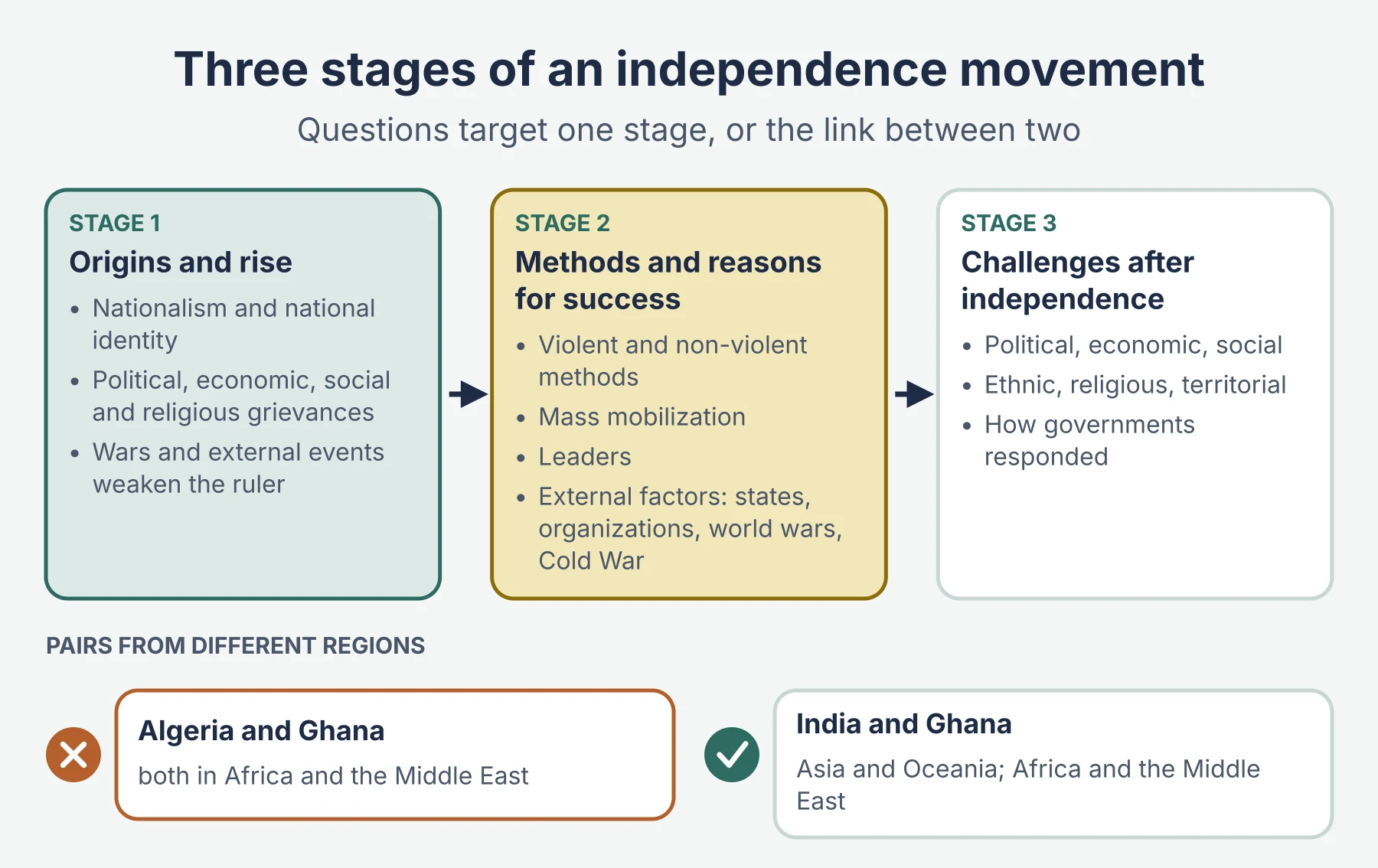
Three stages to revise for every case
| Stage | Questions to answer for each movement |
|---|---|
| Origins and rise | What grievances? Who led early nationalism? When did it gain mass support? What external events helped? |
| Methods and success | Violent, non-violent or both? How important were leaders? What did other states, organizations or wars contribute? |
| After independence | What political, economic, social, ethnic or territorial problems arose? How did the government respond? With what success? |
Case chronologies
India (Asia and Oceania)
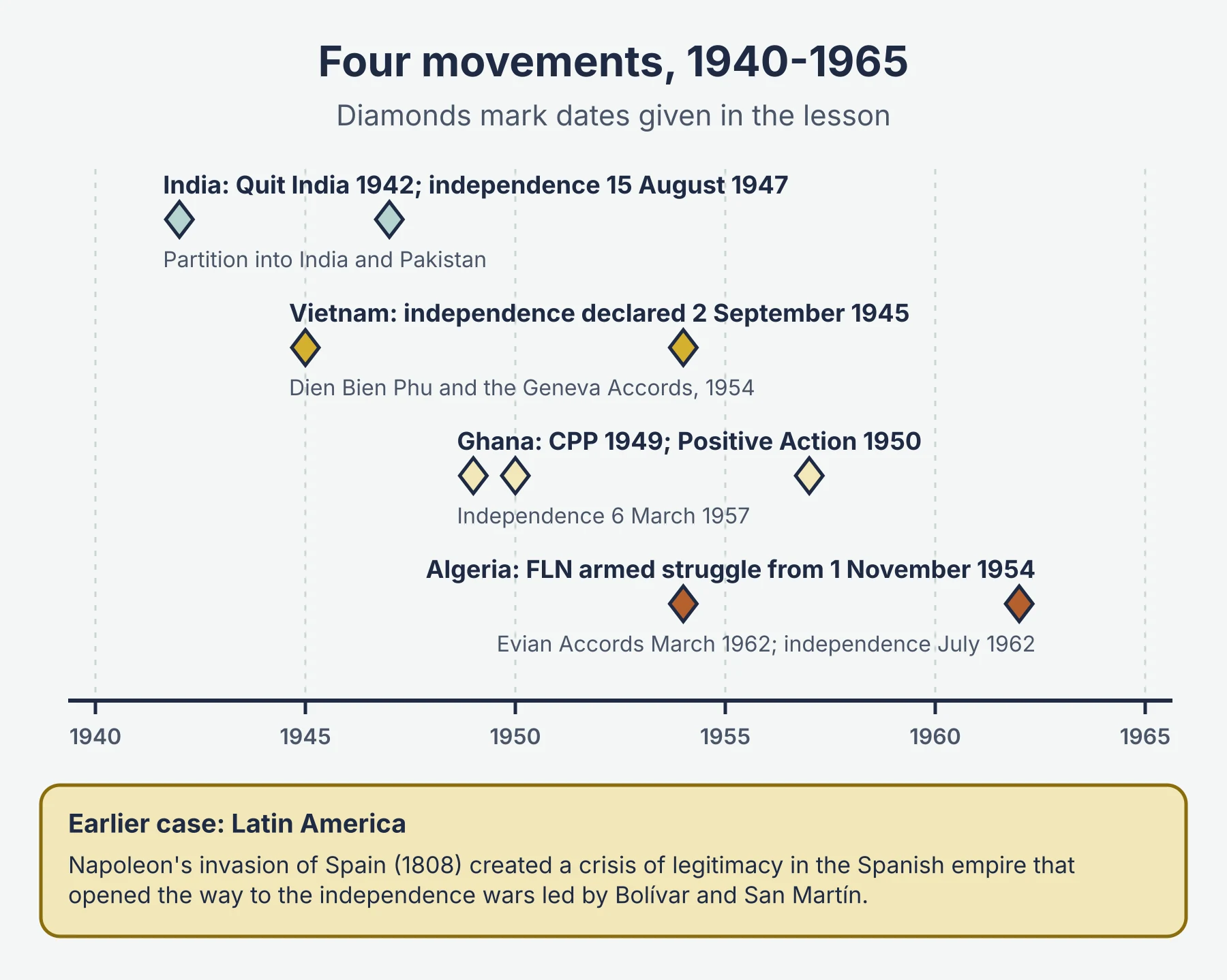
- 1885: Indian National Congress founded.
- 1906: All-India Muslim League founded.
- 1919: Amritsar massacre; Government of India Act.
- 1920-22: Non-cooperation movement; called off by Gandhi after violence at Chauri Chaura (1922).
- 1930: Salt March; civil disobedience.
- 1935: Government of India Act; provincial elections 1937.
- 1940: Lahore Resolution (Muslim League demand for Pakistan).
- 1942: Quit India; Congress leaders imprisoned.
- 1946: Cabinet Mission fails; Direct Action Day in Calcutta.
- 15 August 1947: independence and partition.
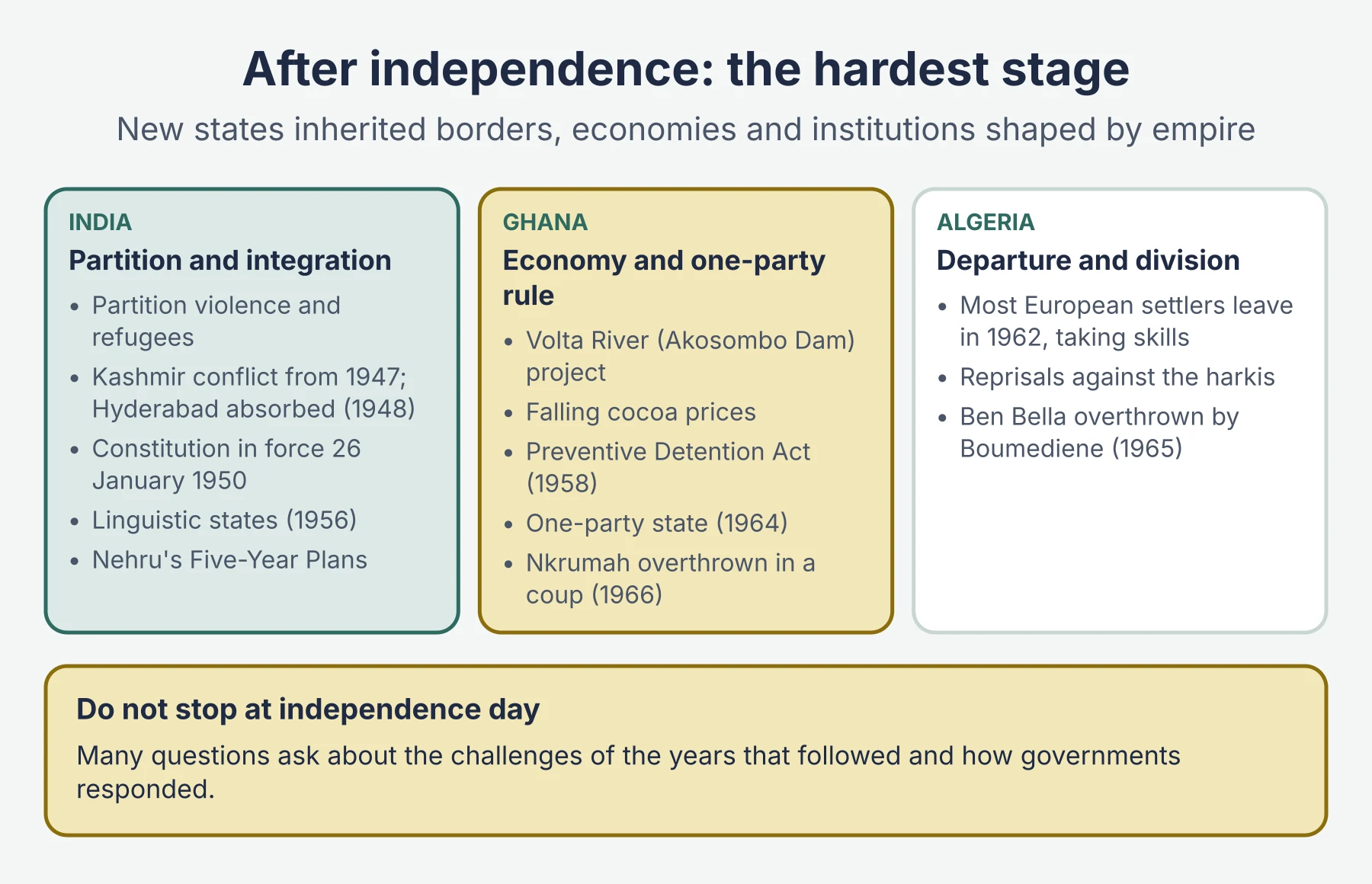
- After: Kashmir conflict from 1947; Gandhi assassinated January 1948; Hyderabad absorbed 1948; constitution in force 26 January 1950; States Reorganisation 1956.
Algeria (Africa and the Middle East)
- 1830: French conquest begins; later organized as part of France.
- 8 May 1945: Sétif uprising and severe French repression.
- 1 November 1954: FLN launches armed struggle.
- 1957: Battle of Algiers; use of torture by the French army exposed.
- 1958: crisis in Algeria brings de Gaulle back to power; Fifth Republic.
- 1961: OAS settler terrorism against a settlement.
- March 1962: Evian Accords; July 1962: independence after a referendum.
- After: exodus of most European settlers; reprisals against harkis; Ben Bella president; overthrown by Boumediene, 1965.
Ghana (Africa and the Middle East)
- 1948: Accra riots after an ex-servicemen’s march.
- 1949: Nkrumah founds the Convention People’s Party (CPP).
- 1950: “Positive Action” campaign; Nkrumah imprisoned.
- 1951: CPP wins election; Nkrumah released to lead the government.
- 6 March 1957: independence.
- After: Preventive Detention Act 1958; republic 1960; one-party state 1964; Volta River project; coup 1966.
Spanish America (the Americas)
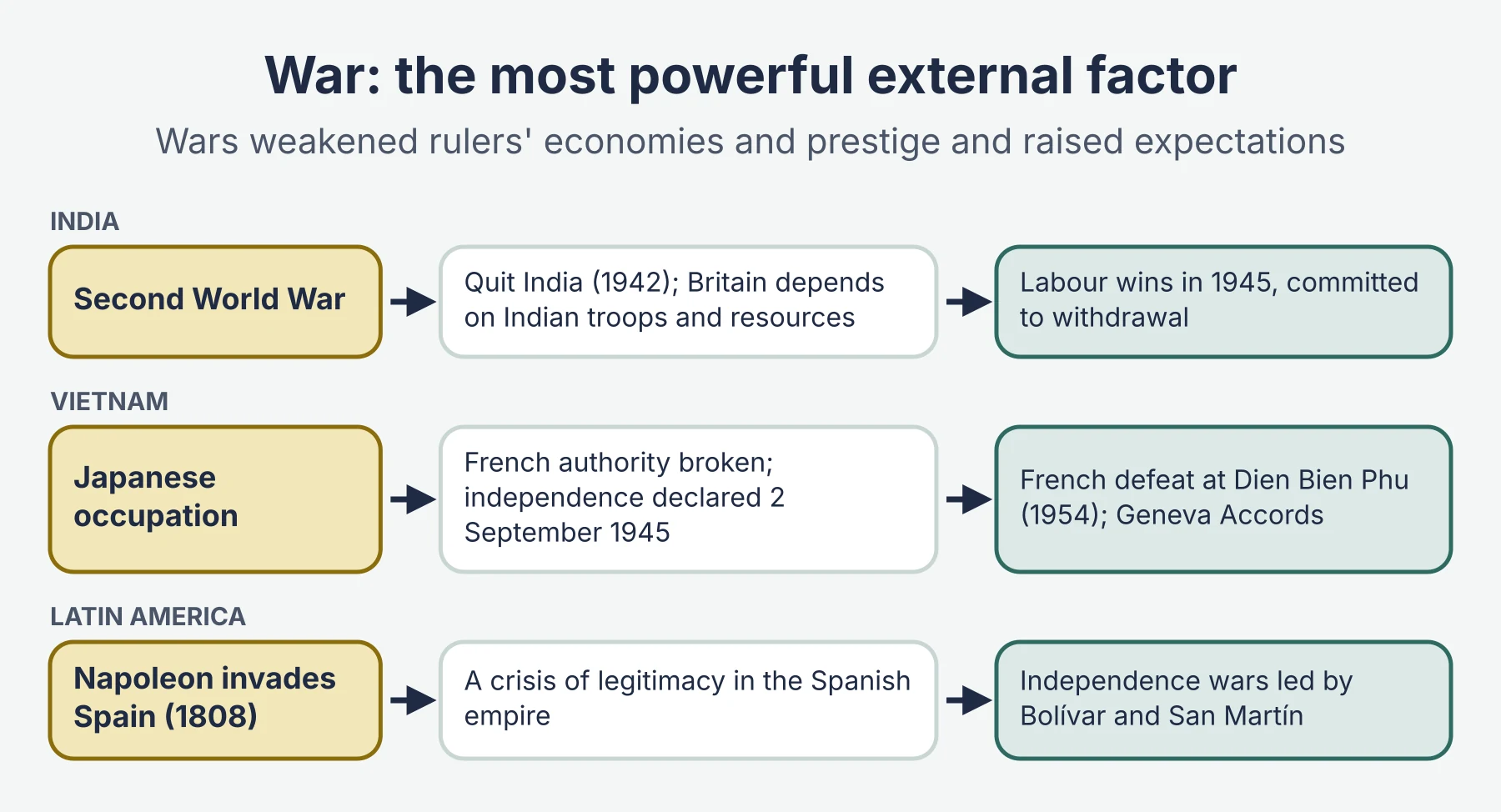
- 1808: Napoleon invades Spain; crisis of royal authority.
- 1810: Hidalgo’s revolt in Mexico; juntas in South America.
- 1810s-1820s: wars led by Bolívar in the north and San Martín in the south.
- 1821: Mexican independence.
- 1824: Battle of Ayacucho effectively ends Spanish rule in South America.
- After: caudillo rule, regional division (Gran Colombia breaks up by 1831), economic disruption.
Factor checklist for causes and success
- Nationalism and identity: education, press, religion, language.
- Economic grievances: land loss, taxation, exploitation of resources, colonial trade rules.
- Political exclusion: lack of representation; broken promises after wars.
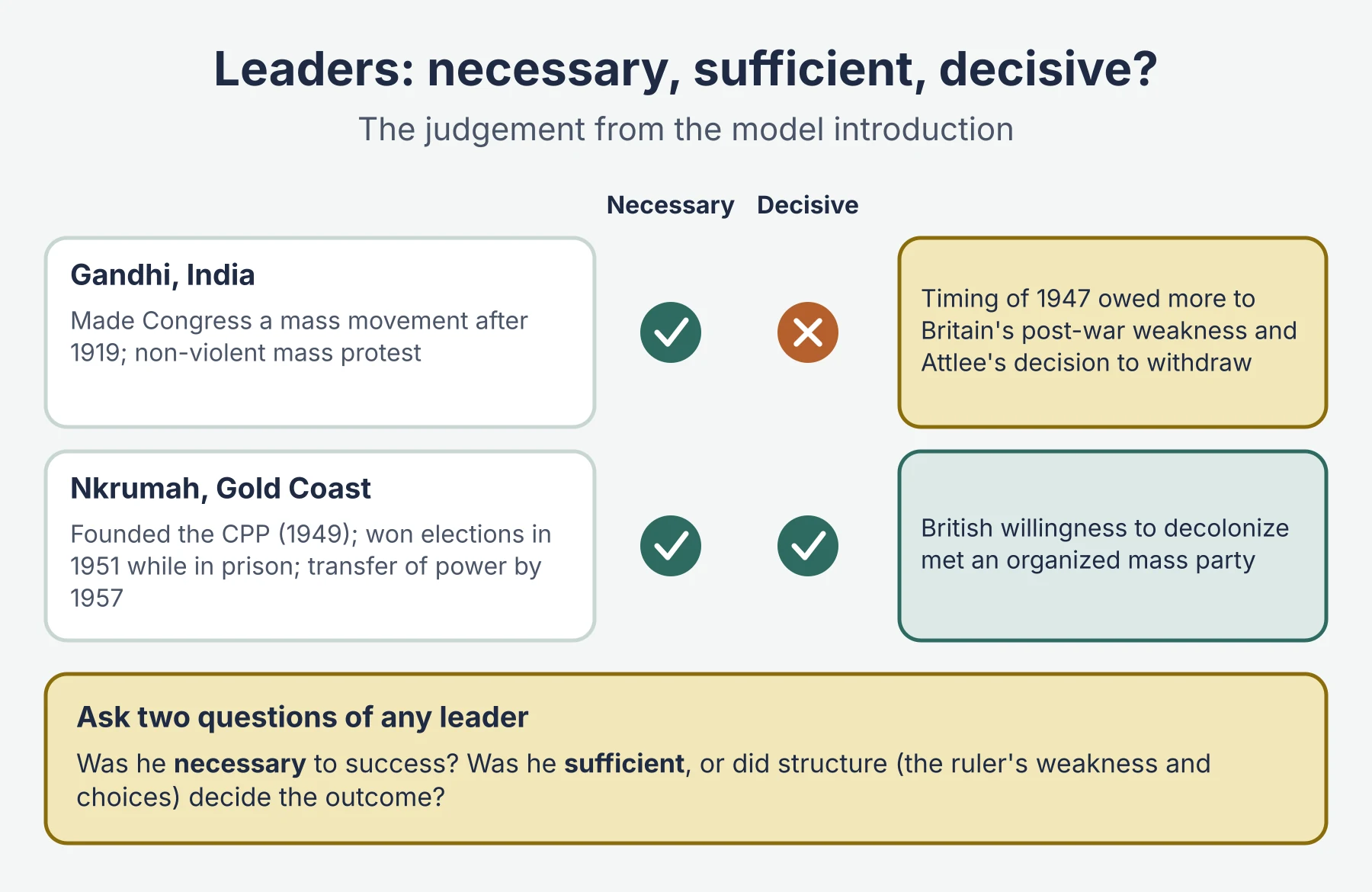
- Leadership: Gandhi, Nehru, Jinnah, Nkrumah, Ho Chi Minh, Bolívar.
- Organization: mass parties, trade unions, armed fronts.
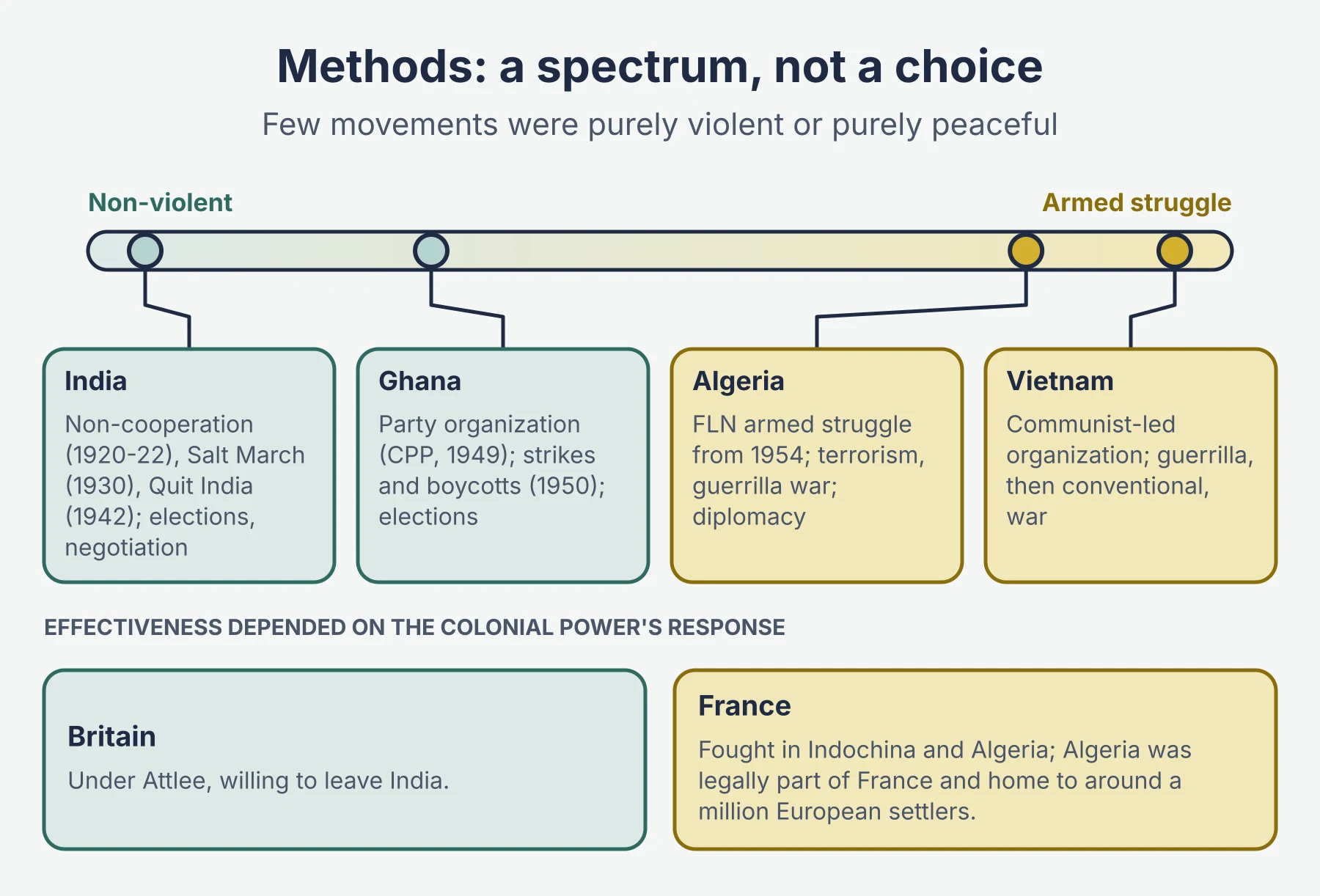
- Methods: non-violent mass protest, elections and negotiation, strikes, guerrilla war, terrorism, diplomacy.
- External factors: world wars, the Cold War, the United Nations, support from neighbouring states, the colonial power’s own politics.
Key terms
| Term | Meaning |
|---|---|
| Decolonization | The end of colonial rule, whether won, negotiated or granted |
| Nationalism | Belief that a nation should have its own state; a movement to achieve it |
| Mass mobilization | Drawing large numbers of ordinary people into political action |
| Satyagraha | Gandhi’s method of non-violent resistance (“truth force”) |
| Civil disobedience | Deliberately breaking unjust laws peacefully |
| Guerrilla war | Irregular warfare by small mobile units against a stronger army |
| Partition | Division of a territory into separate states |
| Settler colony | A colony with a large European population, which made decolonization harder |
| Pieds-noirs | European settlers in French Algeria |
| Harkis | Algerian Muslims who fought for France |
| One-party state | A state in which only one political party is permitted to rule |
Exam traps
- Writing “Gandhi won independence”. Weigh him against British weakness, Labour policy, the Second World War and the Muslim League.
- Algeria and Ghana as a different-region pair. Both are in Africa and the Middle East.
- Forgetting the colonial power’s choices. British willingness to leave the Gold Coast and French refusal in Algeria explain much of the difference in methods.
- No criteria for “success”. Speed, cost, unity and stability are all possible measures; say which you use.
- Neglecting stage three. Questions on post-independence challenges are common and need their own revision.
Self-test
- When was the Indian National Congress founded? 1885.
- Why did Gandhi call off non-cooperation in 1922? Because of violence at Chauri Chaura, where police were killed.
- What did the Lahore Resolution of 1940 demand? A separate homeland, later Pakistan, for Muslims of the subcontinent.
- When did the FLN begin its armed struggle? 1 November 1954.
- How did the Algerian war affect French politics? The 1958 crisis brought de Gaulle back and led to the Fifth Republic.
- What did the Evian Accords of 1962 achieve? A ceasefire and the terms for Algerian independence after a referendum.
- Which party did Nkrumah found, and when? The Convention People’s Party, 1949.
- Give two signs of authoritarian drift in Ghana after 1957. The Preventive Detention Act (1958) and the one-party state (1964).
- What event in 1808 opened the way to Spanish American independence? Napoleon’s invasion of Spain.
- Name two challenges India faced in the first years after 1947. Any two: partition violence and refugees, Kashmir, integrating princely states, framing the constitution, linguistic demands, poverty.
- Who were the harkis? Algerian Muslims who fought on the French side.
- Name one external factor that helped independence movements after 1945. Any one: weakened colonial powers, the UN and its support for self-determination, Cold War pressures, support from newly independent states.
Get free revision emails (optional)
Occasional emails with practice questions, worked explanations and links to free resources for the qualification and subjects you choose. No spam, and you can unsubscribe from any email. The free tools on this site never need an email.
Related resources
-
Practice questions
IB DP History: The Six Key Concepts – Practice Questions
Original practice questions with worked answers on the six key concepts of IB DP History (first assessed 2017), from spotting the concept to essay plans.
World History · International Baccalaureate · IB
Try questions -
Study guides
IB DP History (DP History): Emergence and development of democratic states (1848-2000)
How democratic states emerged, met challenges and made policy 1848-2000, using Weimar Germany, India and South Africa as cases for IB History Paper 2.
World History · International Baccalaureate · IB
Read guide -
Practice questions
IB DP History (DP History): Emergence and development of democratic states (1848-2000) – Practice Questions
Twelve original IB History practice questions on democratic states 1848-2000, from short recall to a full Paper 2 essay, with mark-scheme answers.
World History · International Baccalaureate · IB
Try questions
Related articles
-
teaching
A Level tuition in Dubai: Cambridge or Pearson Edexcel International A Level?
Schools in Dubai and Abu Dhabi teach either Cambridge International AS & A Level or Pearson Edexcel International A Level. How the two are structured, why it matters for tuition, and how online classes from Lahore work.
9 October 2026
-
curriculum guides
Choosing subjects at IGCSE and A Level
How subject choices at 14 and 16 affect university options later, and how to keep pathways open without overloading a timetable.
28 July 2026
Studying this with a teacher
Working through World History IB?
This page is free and stays free. If you would rather be taught it, Marlbridge runs World History classes one-to-one, online in your own time zone. The first trial class is free. WhatsApp replies within an hour (8am–11pm Pakistan time, every day); email the same day.
IB World History teachers at Marlbridge
