
Study Guides
IB DP History (DP History): Emergence and development of democratic states (1848-2000)
How democratic states emerged, met challenges and made policy 1848-2000, using Weimar Germany, India and South Africa as cases for IB History Paper 2.
- Subject
- World History
- Level
- IB
- Topic
- Topic 2: World history topics
- Author
- Marlbridge Academic Team
- Updated
- Reviewed by
- Azam Siddique (what this means)
Aligned to International Baccalaureate IB Diploma Programme World History (DP History), First assessment 2017. Official specification .
Syllabus page (what it covers and how it is assessed): IB Diploma Programme World History.
Syllabus points this page covers
DP History
- 9 Emergence and development of democratic states (1848-2000)
Found an error? Report a correction.
Need help with this topic? Request a free trial class for IB Diploma Programme World History (DP History).
World history topic 9 studies democracy as something built, tested and sometimes lost. It runs from the revolutions of 1848 to the end of the twentieth century, so cases range from the widening of the vote in nineteenth-century Europe to new democracies such as India after 1947 and South Africa after 1994. Questions ask why democracies emerged, how they coped with crises and how far their policies achieved what they promised.
What the topic covers
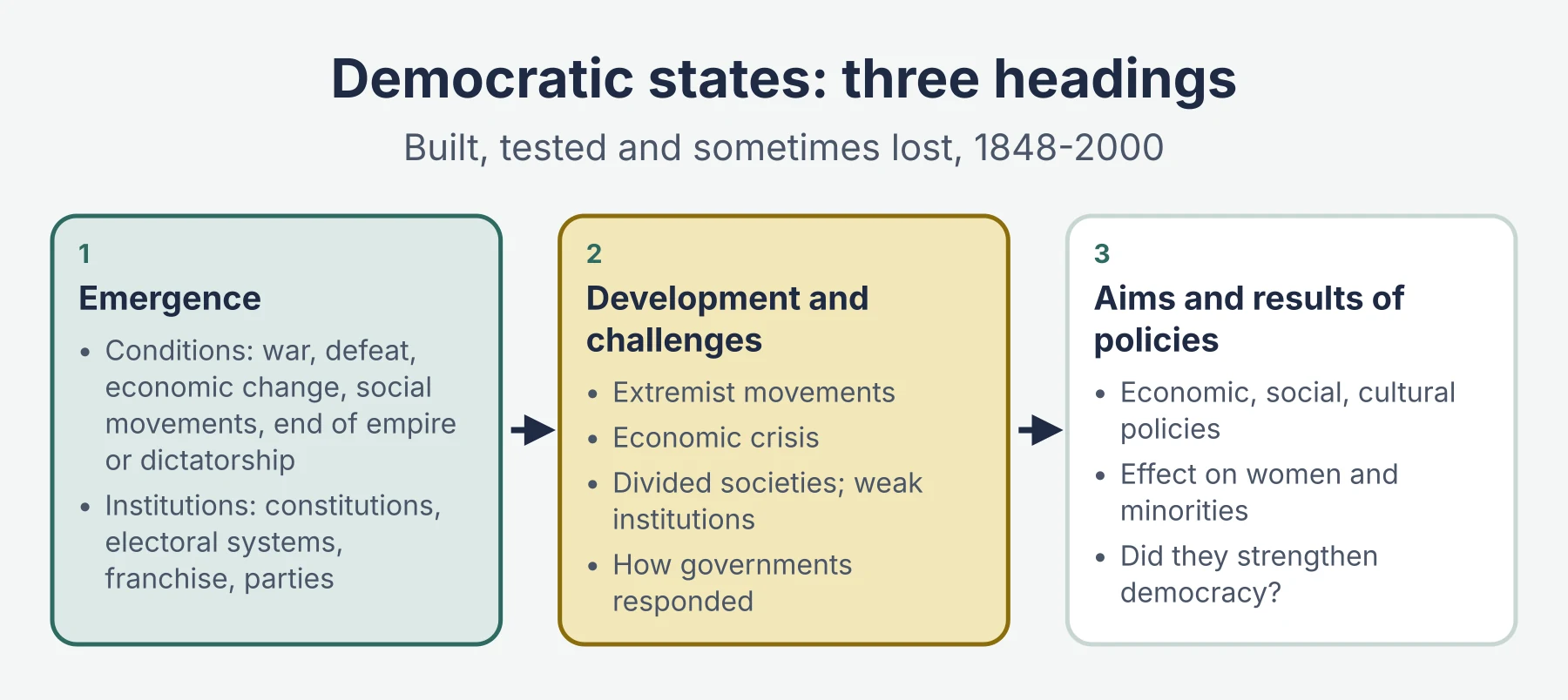
The content can be organized under three headings, which match the way Paper 2 questions are framed.
- Emergence of democratic states. The conditions that encouraged demands for democracy (war, defeat, economic change, social movements, the end of empire or dictatorship) and how democratic institutions were set up: constitutions, electoral systems, the franchise and political parties.
- Development and challenges. Political, economic and social challenges such as extremist movements, economic crisis, divided societies and weak institutions, and how governments responded.
- Aims and results of policies. Economic, social and cultural policies, including their effect on women and minorities, and how far they strengthened democracy.
Confirm the exact headings and any bullet wording your teacher uses against the IB History guide.
Key ideas
Define democracy before you measure it
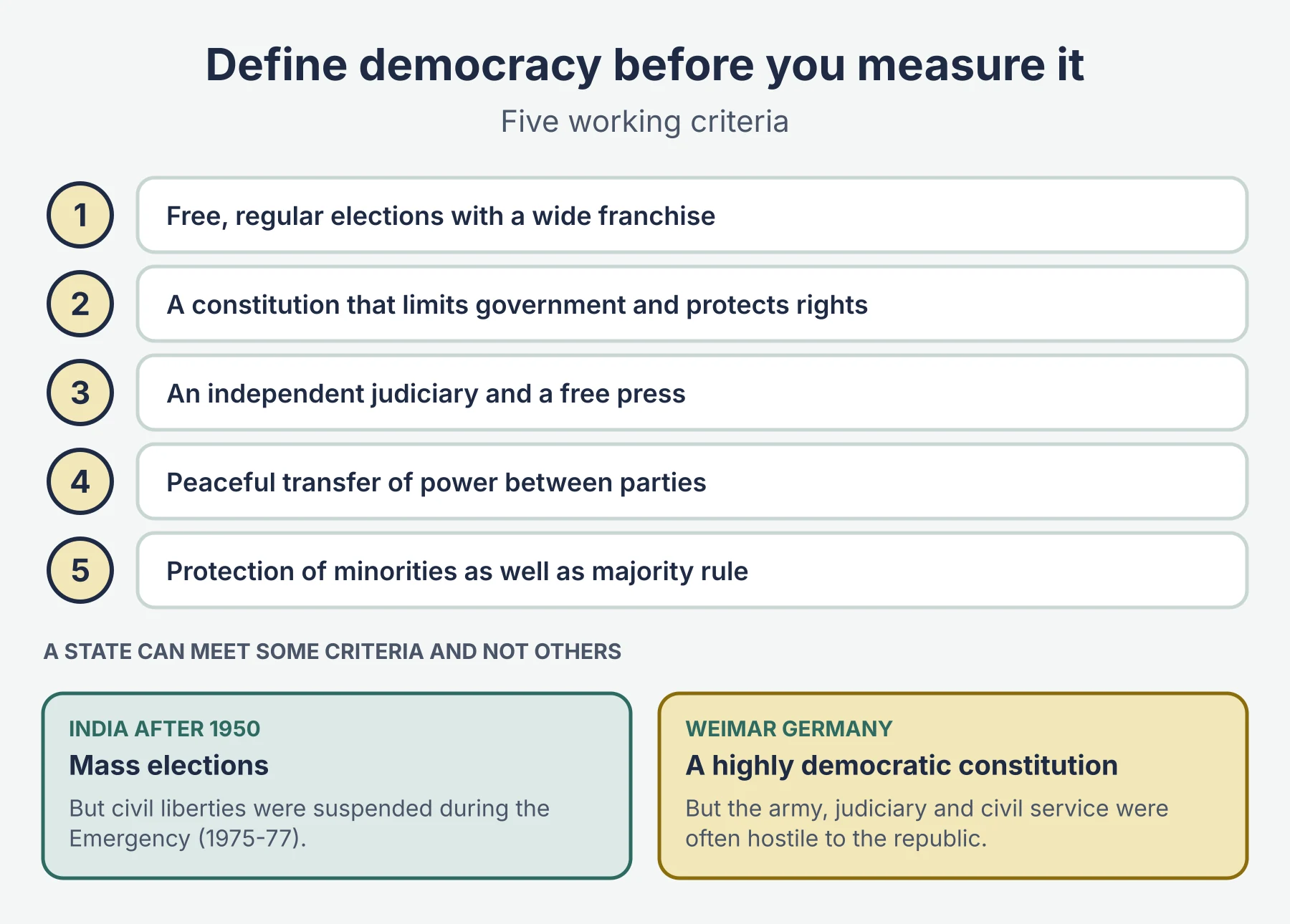
Many weak essays never say what democracy means, so they cannot judge whether a state was democratic or successful. Use working criteria:
- free and regular elections with a wide franchise;
- a constitution that limits government and protects rights;
- an independent judiciary and free press;
- peaceful transfer of power between parties;
- protection of minorities as well as majority rule.
A state can meet some criteria and not others. India after 1950 had mass elections but suspended civil liberties during the Emergency (1975-77); Weimar Germany had a highly democratic constitution but an army, judiciary and civil service often hostile to the republic.
Emergence: why and how
| Case | Conditions for emergence | Institutions created |
|---|---|---|
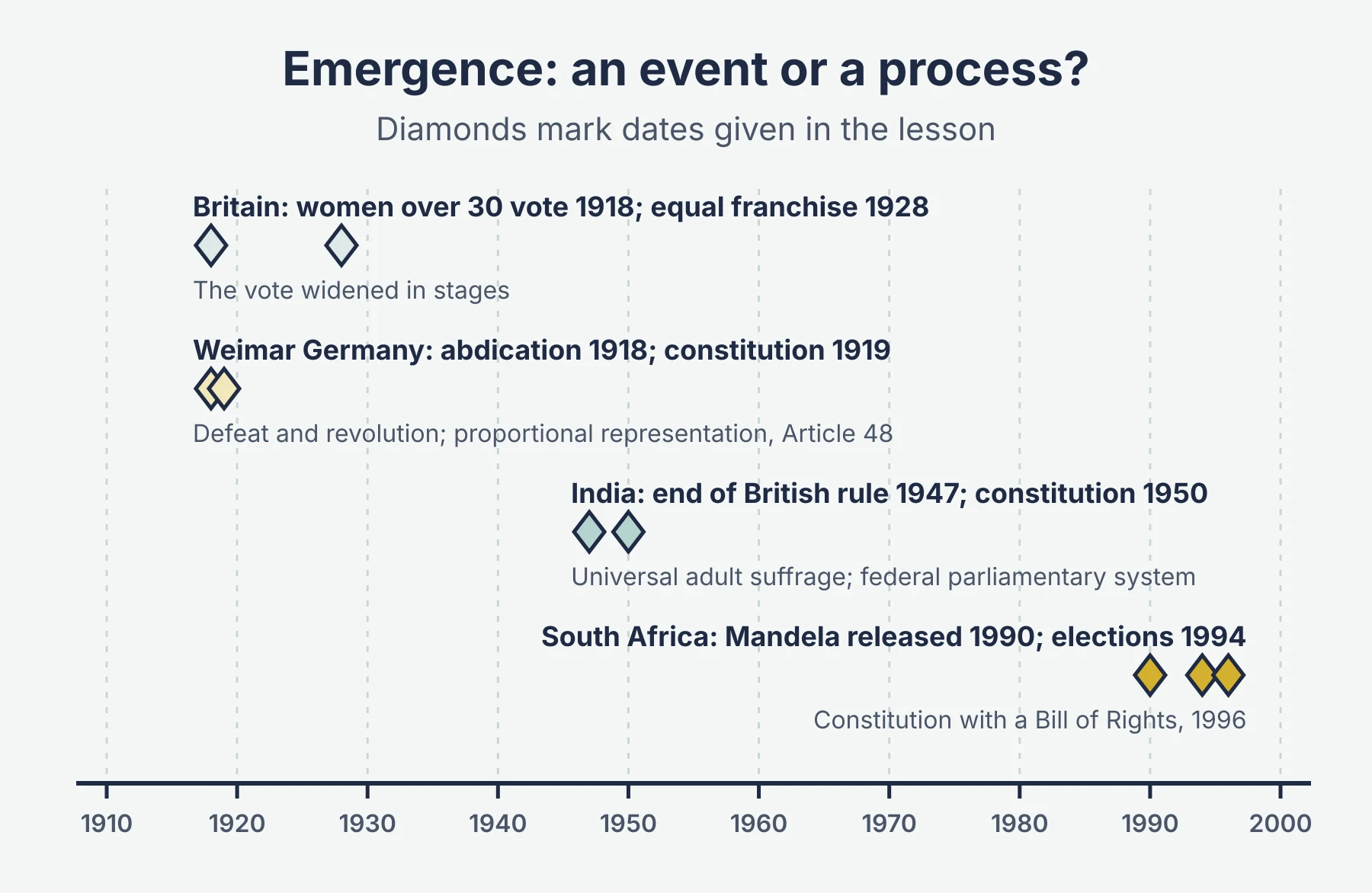
| Weimar Germany | Military defeat, the Kaiser’s abdication (9 November 1918), revolution | Constitution of 1919: proportional representation, votes for women, a powerful president with emergency powers under Article 48 |
| India | End of British rule (1947) and a long nationalist movement that had contested elections | Constitution in force 26 January 1950, drafted under B. R. Ambedkar’s chairmanship; universal adult suffrage; federal parliamentary system |
| South Africa | Collapse of apartheid; negotiations after Mandela’s release (February 1990) | First universal elections (27 April 1994); Government of National Unity; constitution of 1996 with a Bill of Rights |
Challenges and responses
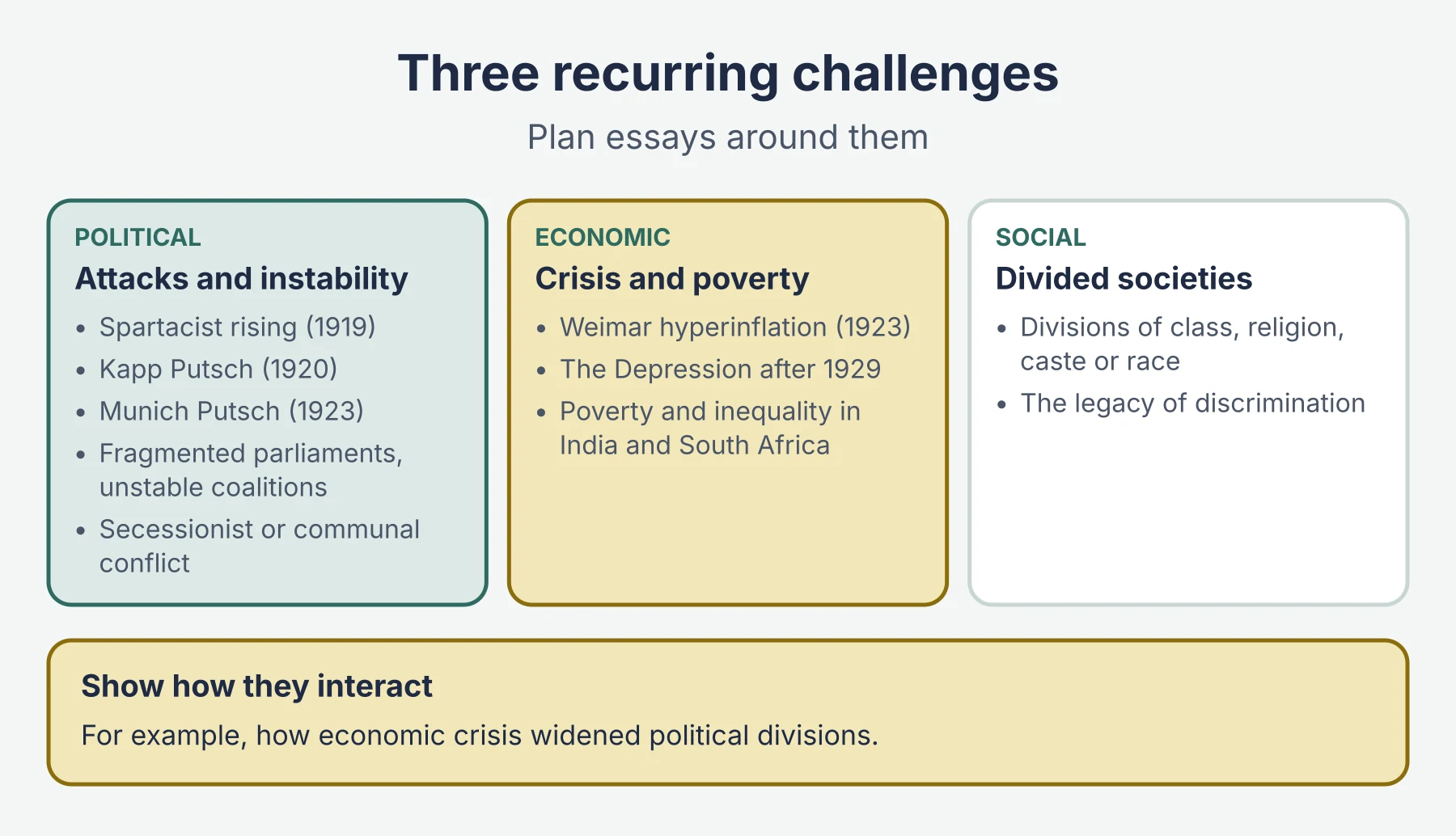
Democracies face three recurring types of challenge. Plan essays around them.
- Political: attacks from left and right (the Spartacist rising of 1919, the Kapp Putsch of 1920, Hitler’s Munich Putsch of 1923); fragmented parliaments and unstable coalitions; secessionist or communal conflict.
- Economic: Weimar’s hyperinflation (1923) and the Depression after 1929; poverty and inequality in India and South Africa.
- Social: divided societies by class, religion, caste or race; the legacy of discrimination.
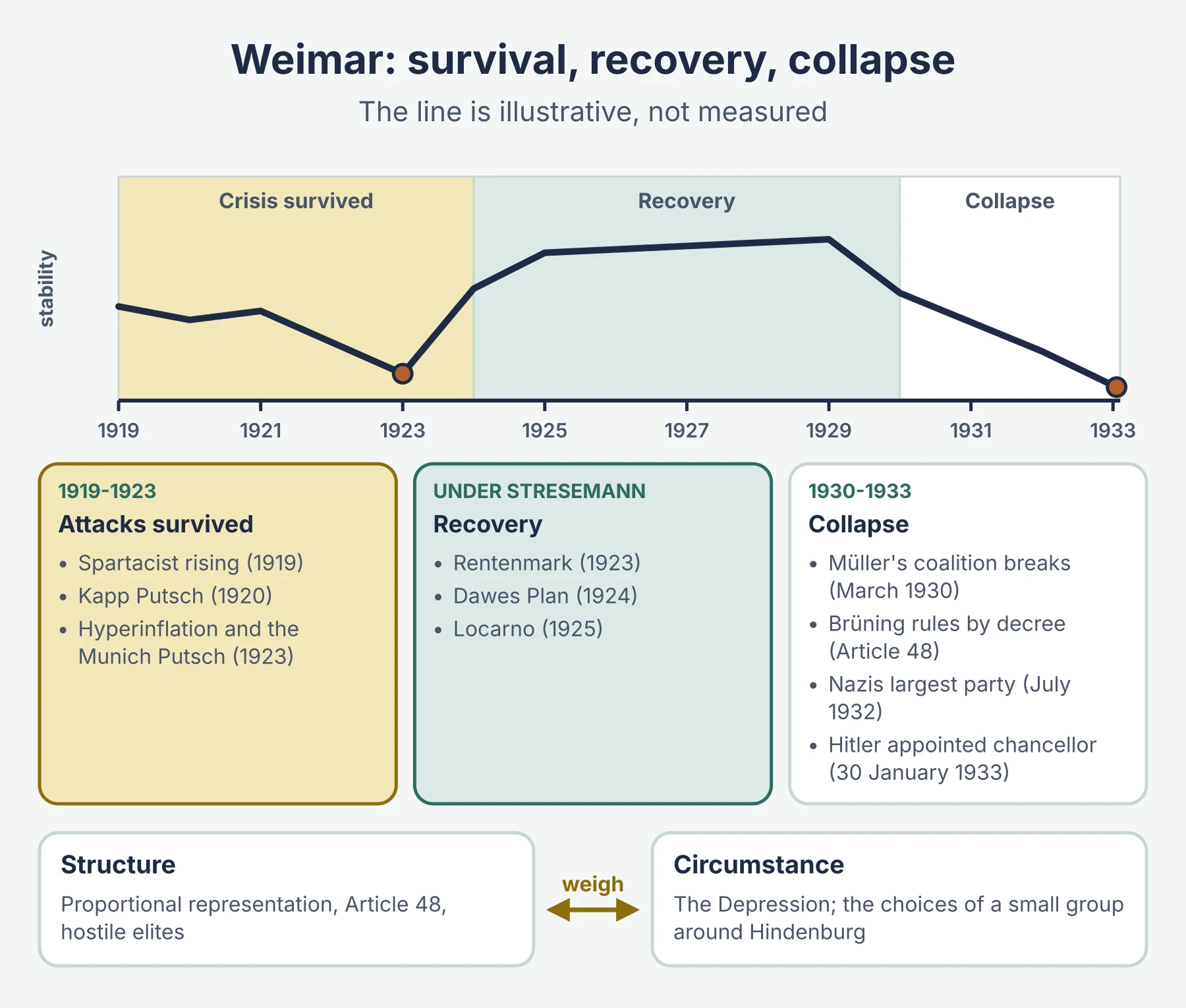
Weimar as a case of failure. The republic survived 1919-23 and recovered under Stresemann (the Rentenmark in 1923, the Dawes Plan in 1924, Locarno in 1925). But the Depression broke Müller’s grand coalition in March 1930; Brüning then governed through presidential decree under Article 48; the Nazis became the largest party in the Reichstag in July 1932; and Hindenburg appointed Hitler chancellor on 30 January 1933. Weigh structure (proportional representation, Article 48, hostile elites) against circumstance (the Depression, the choices of a small group around Hindenburg).
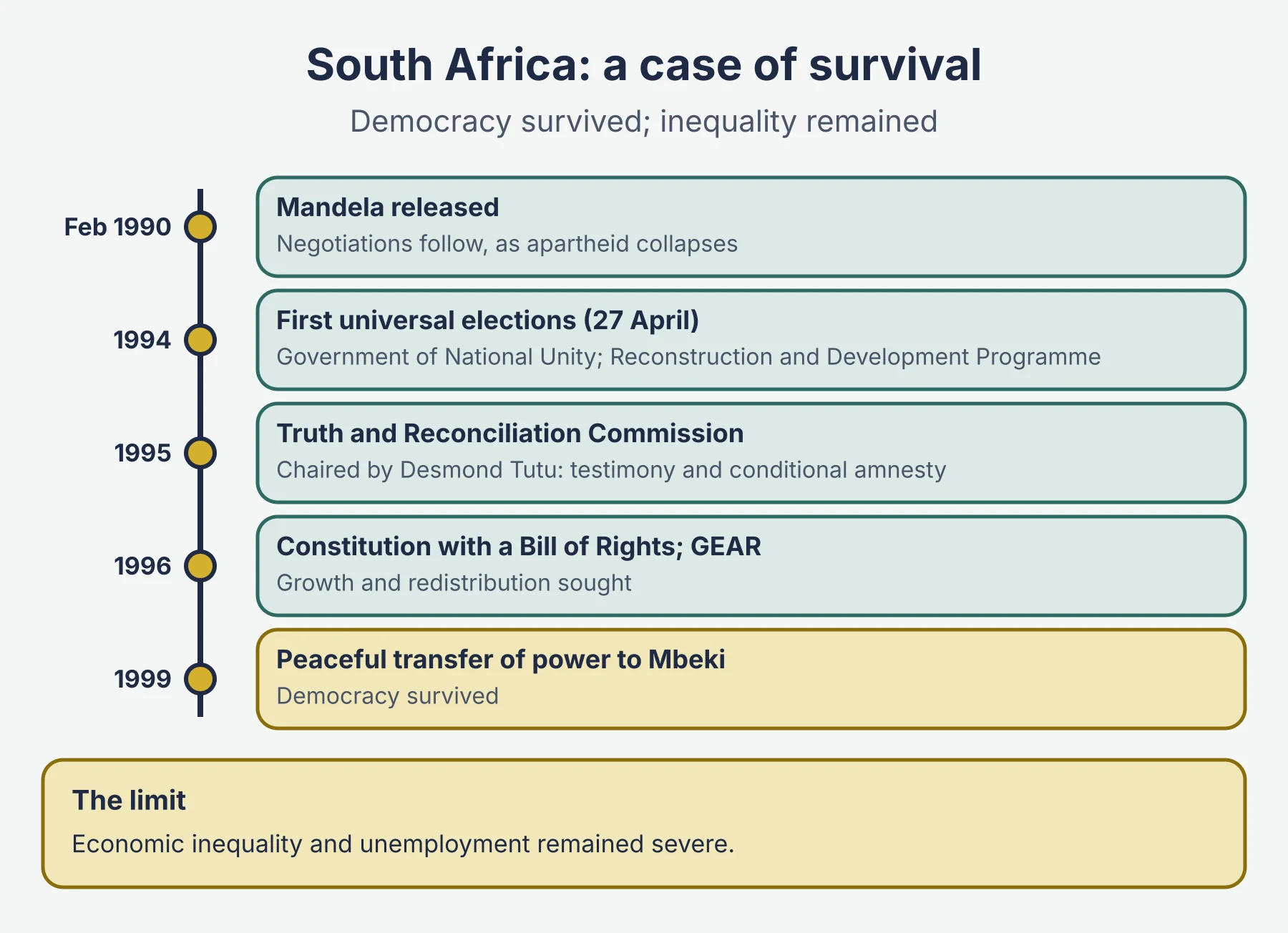
South Africa as a case of survival. The Truth and Reconciliation Commission (established 1995, chaired by Desmond Tutu) addressed apartheid crimes through testimony and conditional amnesty; the Reconstruction and Development Programme (1994) and then GEAR (1996) sought growth and redistribution. Democracy survived, with peaceful transfers to Mbeki (1999), but economic inequality and unemployment remained severe.
Policies, women and minorities
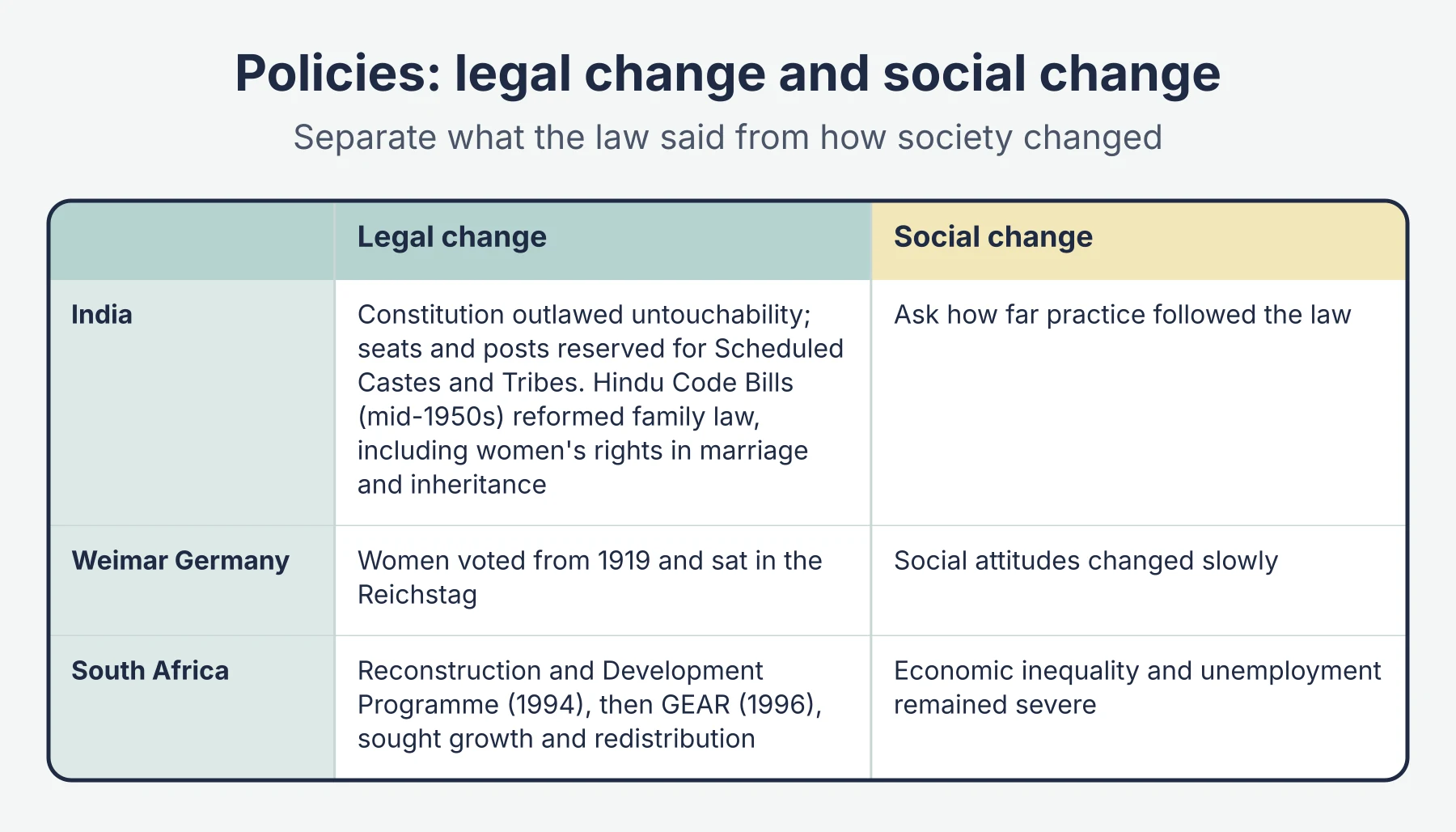
Policy questions ask about aims and results. In India, the constitution outlawed untouchability and reserved seats and posts for Scheduled Castes and Tribes; the Hindu Code Bills of the mid-1950s reformed Hindu family law, including women’s rights in marriage and inheritance. In Weimar, women voted from 1919 and sat in the Reichstag, but social attitudes changed slowly. A good answer separates legal change from social change.
Worked example: an annotated paragraph
Question: “Evaluate the success of one democratic state in responding to economic challenges.”
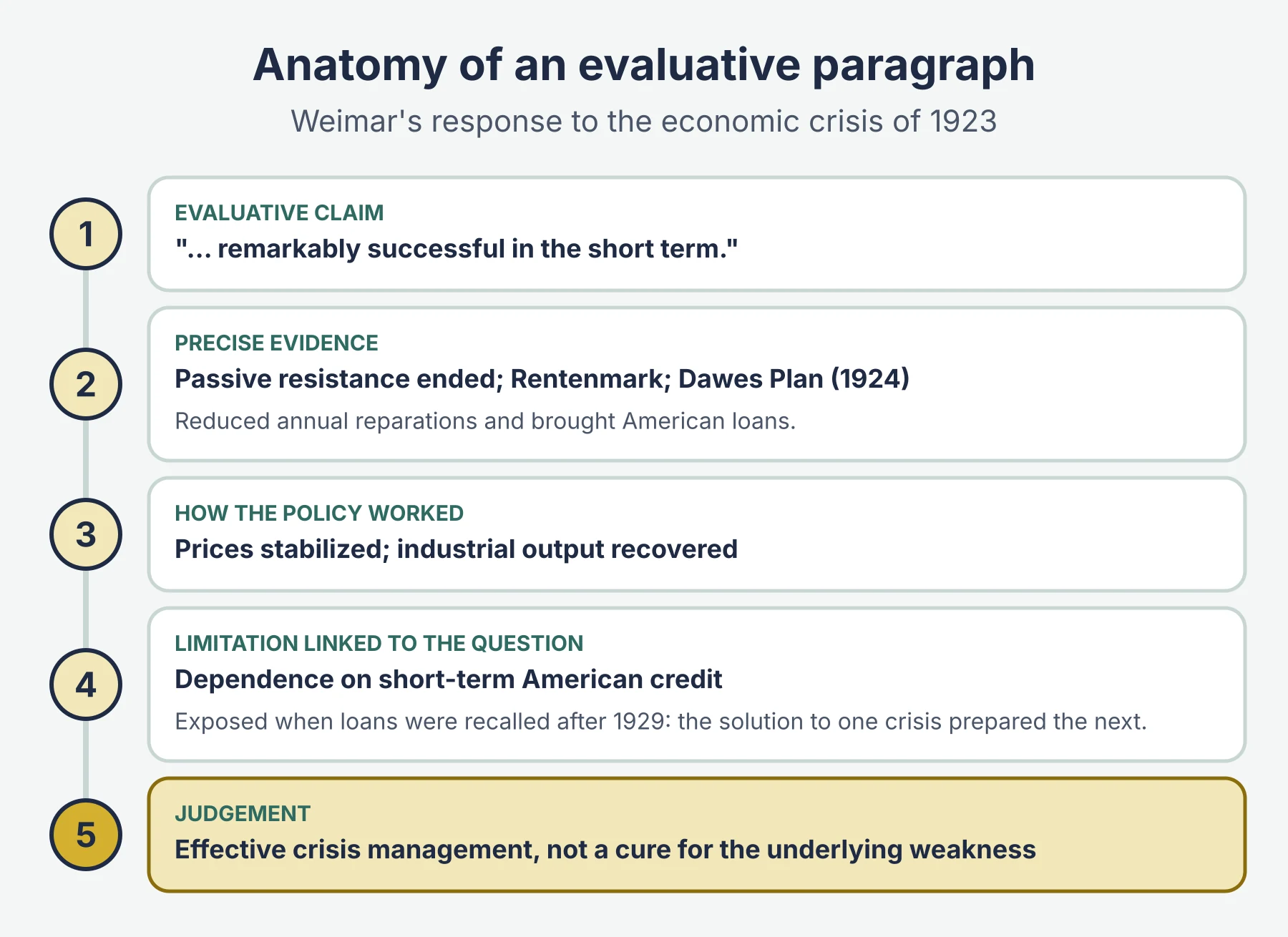
“The Weimar Republic’s response to the economic crisis of 1923 was remarkably successful in the short term. Hyperinflation had destroyed savings and confidence, and the currency had become worthless by November. Stresemann ended passive resistance in the Ruhr, introduced the Rentenmark backed by land and industrial assets, and secured the Dawes Plan of 1924, which reduced annual reparations and brought American loans. Prices stabilized and industrial output recovered. Yet this success built a dependence on short-term American credit that left Germany exposed when loans were recalled after 1929, so the solution to one crisis prepared the next. The response in 1923 therefore shows a democracy capable of effective crisis management, but not one that removed the underlying weakness of its economy.”
What earns credit here: a clear evaluative opening claim; precise, accurate evidence; an explanation of how the policy worked; and a closing judgement that adds a limitation linked to the question, rather than ending on description.
Common mistakes
- Assuming democracy is a single event. Show emergence as a process, often extending the franchise in stages; in Britain, women over 30 (with property qualifications) gained the vote in 1918, and equal franchise came in 1928.
- Writing the rise of Hitler. In a democracy question the focus is the republic, its challenges and responses, not Nazi methods.
- No criteria for success. Decide whether success means survival, stability, prosperity, equality or the protection of rights.
- Treating constitutions as proof of democracy. Consider how they worked in practice.
- Confusing regions. Weimar Germany (Europe), India (Asia and Oceania), South Africa (Africa and the Middle East) and Argentina after 1983 (the Americas) give pairs from different regions.
Exam technique
- Evaluate: set criteria, apply them to each challenge, and balance success against limitation.
- To what extent: for a claim such as “economic factors were the main challenge”, argue for and against, then reach a judgement on degree.
- Compare and contrast: compare two states theme by theme: emergence, challenges, responses, outcomes.
- Discuss / examine: explore several factors and how they interacted, for example how economic crisis widened political divisions.
Each essay is worth 15 marks under the markbands outlined in the world history topics study guide. Plan for about 45 minutes per essay.
Use with the other pages
Fix the chronologies in your memory with the democratic states revision notes, then apply them in the democratic states practice questions.
Check your understanding
- Give three criteria for judging whether a state was democratic. Any three: free elections with a wide franchise, constitutional limits, independent courts and press, peaceful transfers of power, protection of minorities.
- What did Article 48 of the Weimar constitution allow? The president to rule by emergency decree.
- When did India’s constitution come into force? 26 January 1950.
- What was the purpose of South Africa’s Truth and Reconciliation Commission? To investigate apartheid-era abuses through testimony and grant conditional amnesty, supporting reconciliation.
- Why is the 1923 recovery in Germany a double-edged success? It stabilized the currency but made Germany dependent on short-term American loans.
- Why should you distinguish legal change from social change in policy questions? Laws granting rights did not always change attitudes or conditions in practice.
Get free revision emails (optional)
Occasional emails with practice questions, worked explanations and links to free resources for the qualification and subjects you choose. No spam, and you can unsubscribe from any email. The free tools on this site never need an email.
Related resources
-
Practice questions
IB DP History: The Six Key Concepts – Practice Questions
Original practice questions with worked answers on the six key concepts of IB DP History (first assessed 2017), from spotting the concept to essay plans.
World History · International Baccalaureate · IB
Try questions -
Practice questions
IB DP History (DP History): Emergence and development of democratic states (1848-2000) – Practice Questions
Twelve original IB History practice questions on democratic states 1848-2000, from short recall to a full Paper 2 essay, with mark-scheme answers.
World History · International Baccalaureate · IB
Try questions -
Revision notes
IB DP History (DP History): Emergence and development of democratic states (1848-2000) – Revision Notes
Condensed IB History notes on democratic states 1848-2000: emergence, challenges, responses and policies in Weimar, India and South Africa, with a self-test.
World History · International Baccalaureate · IB
Revise topic
Related articles
-
teaching
A Level tuition in Dubai: Cambridge or Pearson Edexcel International A Level?
Schools in Dubai and Abu Dhabi teach either Cambridge International AS & A Level or Pearson Edexcel International A Level. How the two are structured, why it matters for tuition, and how online classes from Lahore work.
9 October 2026
-
curriculum guides
Choosing subjects at IGCSE and A Level
How subject choices at 14 and 16 affect university options later, and how to keep pathways open without overloading a timetable.
28 July 2026
Studying this with a teacher
Working through World History IB?
This page is free and stays free. If you would rather be taught it, Marlbridge runs World History classes one-to-one, online in your own time zone. The first trial class is free. WhatsApp replies within an hour (8am–11pm Pakistan time, every day); email the same day.
IB World History teachers at Marlbridge
