
Revision Notes
IB DP History (DP History): Emergence and development of democratic states (1848-2000) – Revision Notes
Condensed IB History notes on democratic states 1848-2000: emergence, challenges, responses and policies in Weimar, India and South Africa, with a self-test.
- Subject
- World History
- Level
- IB
- Topic
- Topic 2: World history topics
- Author
- Marlbridge Academic Team
- Updated
- Reviewed by
- Azam Siddique (what this means)
Aligned to International Baccalaureate IB Diploma Programme World History (DP History), First assessment 2017. Official specification .
Syllabus page (what it covers and how it is assessed): IB Diploma Programme World History.
Syllabus points this page covers
DP History
- 9 Emergence and development of democratic states (1848-2000)
Found an error? Report a correction.
Need help with this topic? Request a free trial class for IB Diploma Programme World History (DP History).
These notes condense world history topic 9 for Paper 2: how democratic states emerged between 1848 and 2000, what threatened them and how their governments responded. The arguments are developed in the democratic states study guide; practise using them with the democratic states practice questions.
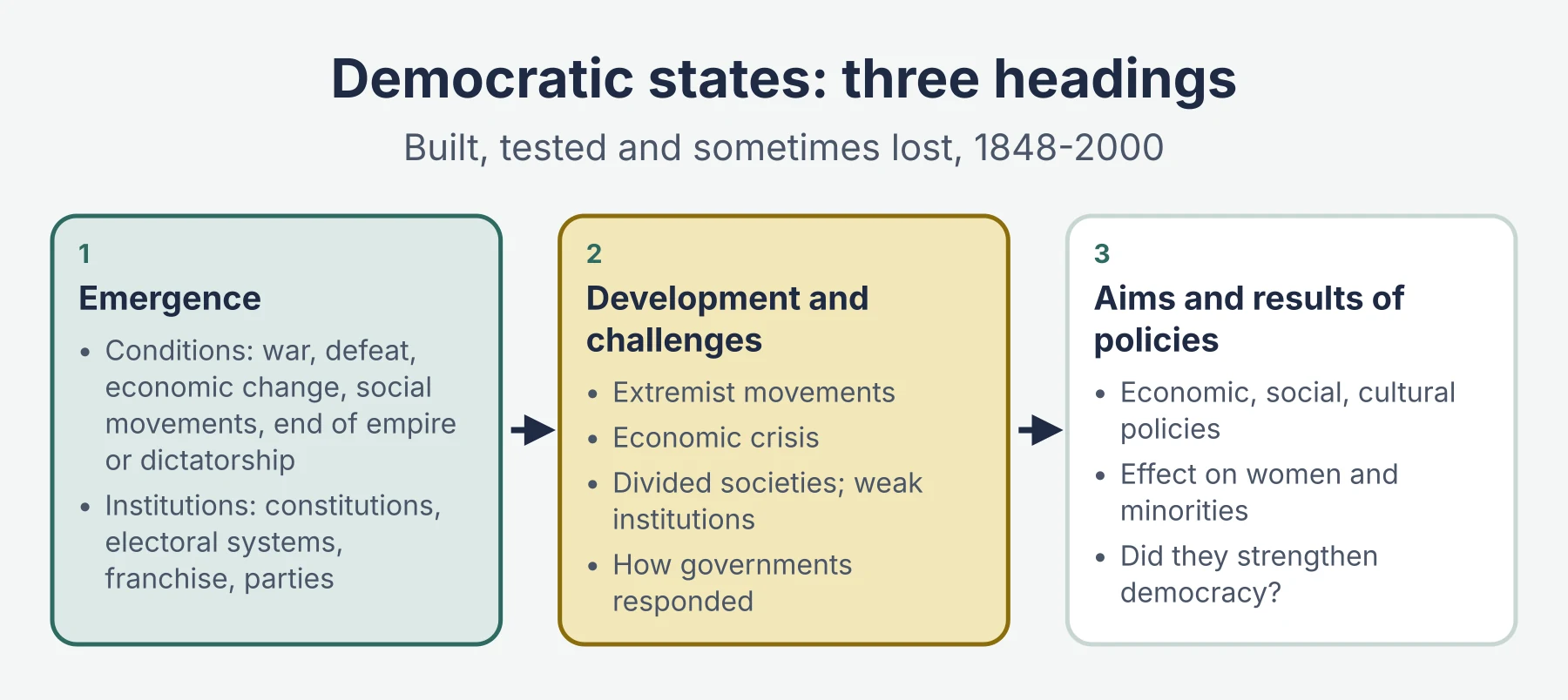
The topic in three questions
| Strand | Ask of every case |
|---|---|
| Emergence | What conditions produced demands for democracy? What institutions were created, and how democratic were they? |
| Challenges and responses | What political, economic and social threats arose? What did governments do, and did it work? |
| Policies | What were the aims and results of economic, social and cultural policies, including for women and minorities? |
Case 1: Weimar Germany, 1918-1933 (Europe)
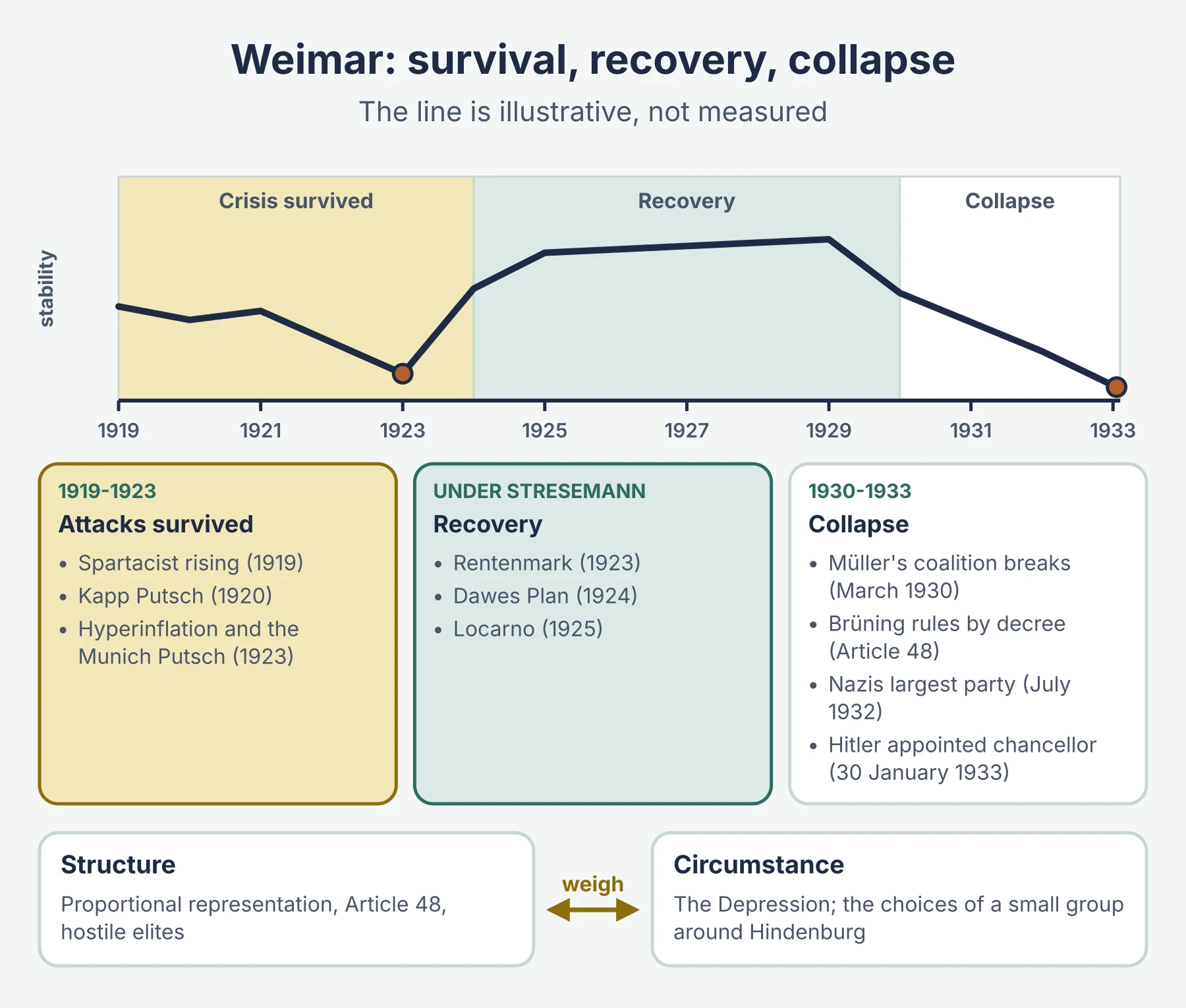
- 9 November 1918: Kaiser abdicates; republic proclaimed. 11 November: armistice.
- January 1919: Spartacist rising crushed with help from the Freikorps.
- 1919: constitution adopted at Weimar; proportional representation, women vote, Article 48.
- June 1919: Treaty of Versailles signed; the republic blamed by nationalists (“stab in the back” myth).
- March 1920: Kapp Putsch defeated by a general strike.
- 1923: French and Belgian occupation of the Ruhr; hyperinflation; Munich Putsch (November).
- 1923-29: Stresemann era: Rentenmark (1923), Dawes Plan (1924), Locarno (1925), League of Nations (1926), Young Plan (1929).
- 1929 onwards: Depression; mass unemployment.
- March 1930: grand coalition collapses; Brüning governs by presidential decree.
- July 1932: Nazis become the largest party in the Reichstag.
- 30 January 1933: Hitler appointed chancellor.
Verdict to argue: survived the early crises but collapsed when economic disaster met structural weakness and elite hostility.
Case 2: India, 1947-1977 (Asia and Oceania)
- 1947: independence and partition.
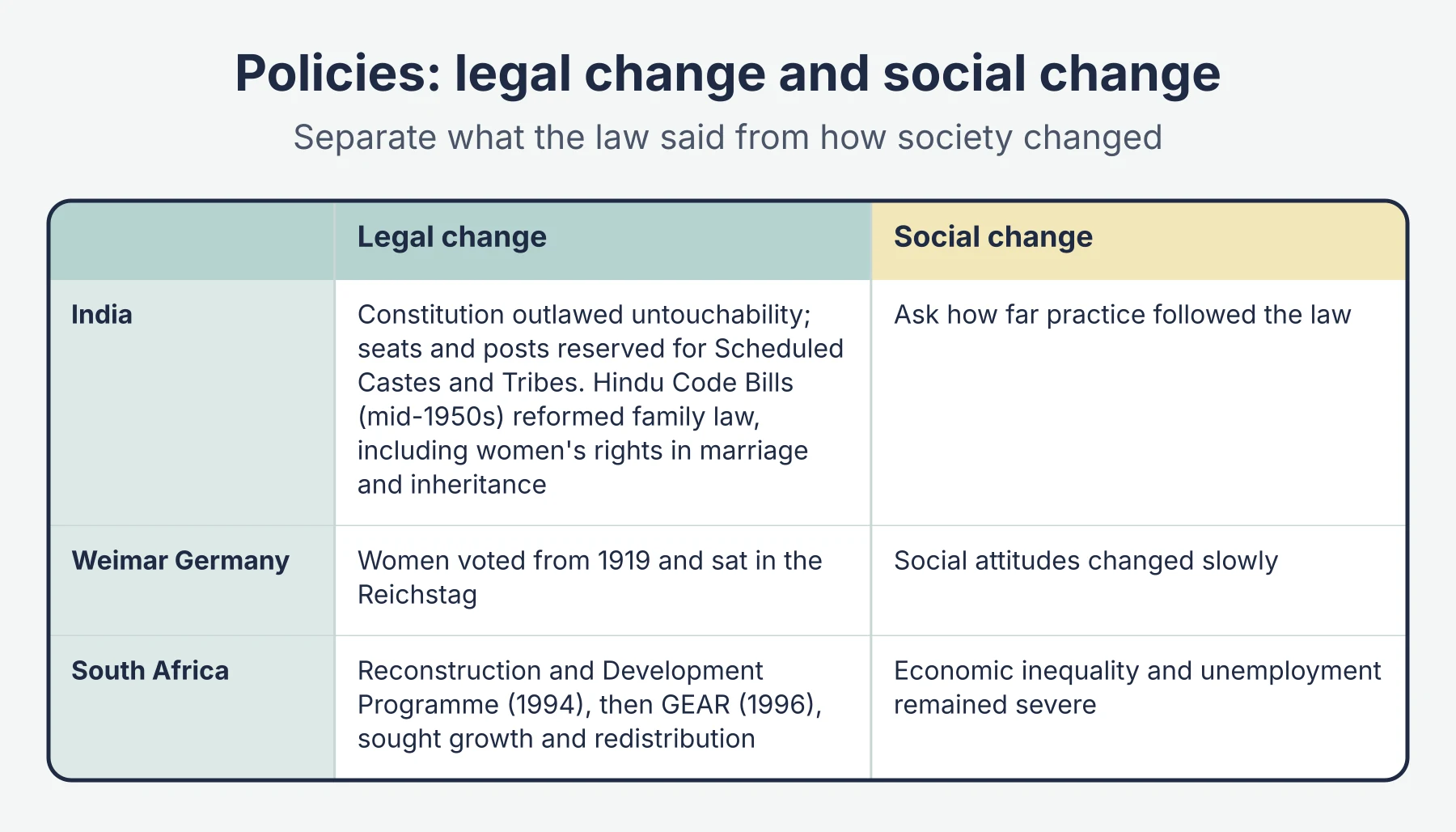
- 26 January 1950: constitution in force (drafting committee chaired by B. R. Ambedkar); universal adult suffrage; untouchability abolished; reservations for Scheduled Castes and Tribes.
- 1951-52: first general election; Congress wins under Nehru.
- Mid-1950s: Hindu Code Bills reform family law.
- 1956: states reorganized on linguistic lines.
- June 1975-March 1977: the Emergency under Indira Gandhi; civil liberties suspended, opponents jailed, press censored.
- 1977: Congress loses the election to the Janata Party.
Verdict to argue: a durable democracy in a poor, diverse society; the 1977 election showed that voters could remove a government that had suspended liberties.
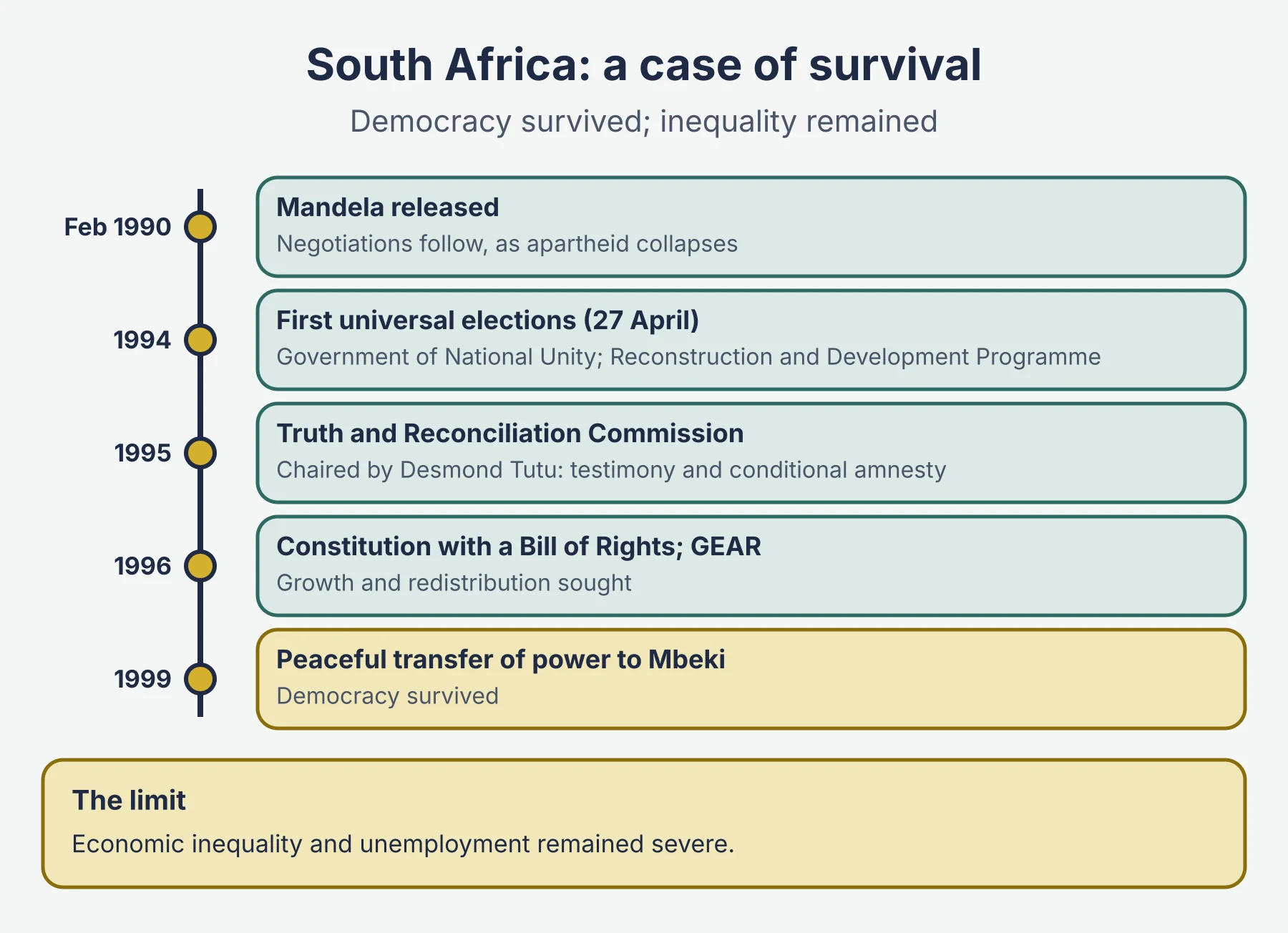
Case 3: South Africa, 1990-2000s (Africa and the Middle East)
- February 1990: Mandela released; ANC unbanned.
- 1993: interim constitution agreed in negotiations.
- 27 April 1994: first universal elections; Mandela president; Government of National Unity.
- 1994: Reconstruction and Development Programme (RDP).
- 1995: Truth and Reconciliation Commission established (chair: Desmond Tutu).
- 1996: final constitution with a Bill of Rights; GEAR economic strategy.
- 1999: Mbeki succeeds Mandela after elections.
Verdict to argue: a peaceful political transition and strong constitution, but deep inequality and unemployment limited social and economic change.
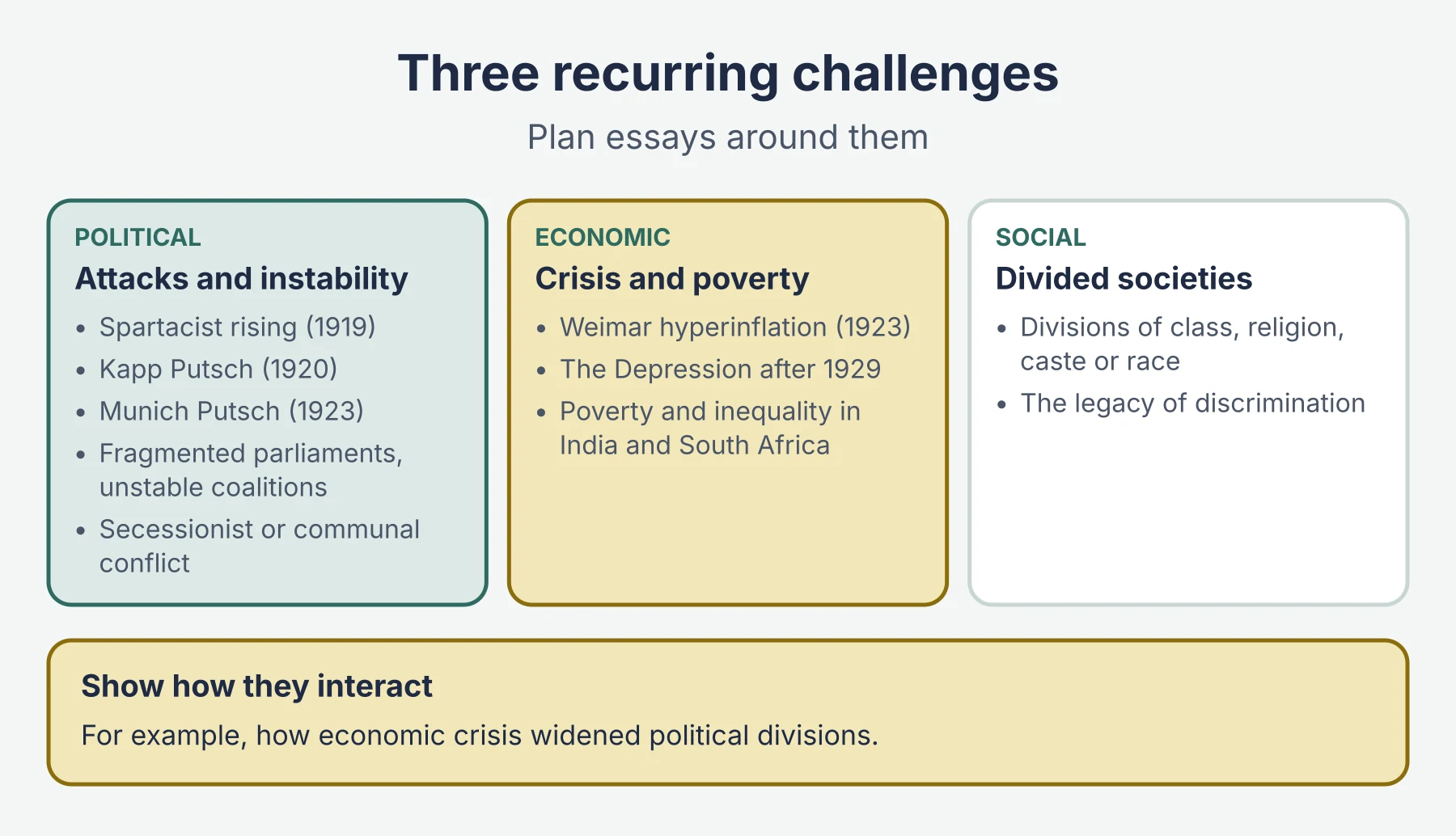
Challenge types and examples
| Challenge | Example | Response |
|---|---|---|
| Armed attacks on the state | Kapp Putsch (1920) | Workers’ general strike; the army refused to fire on the putschists |
| Economic collapse | Hyperinflation (1923) | Rentenmark, Dawes Plan |
| Economic depression | 1929 onwards in Germany | Austerity and rule by decree under Brüning |
| Religious or communal division | Partition and its aftermath in India | Secular constitution; protection of minority rights |
| Legacy of racial discrimination | Apartheid in South Africa | TRC; Bill of Rights; affirmative action and Black Economic Empowerment |
| Leaders undermining democracy | The Emergency (1975-77) in India | Elections of 1977 removed the government |
Key terms
| Term | Meaning |
|---|---|
| Franchise | The right to vote |
| Proportional representation | Seats allocated in proportion to votes; can fragment parliament |
| Coalition | A government formed by more than one party |
| Constitution | The fundamental rules that set out how a state is governed and what rights citizens have |
| Separation of powers | Division of authority between legislature, executive and judiciary |
| Civil society | Organizations independent of the state, such as unions, churches and the press |
| Emergency powers | Constitutional powers to suspend normal procedures in a crisis (Weimar’s Article 48) |
| Reservation | Seats or posts set aside for disadvantaged groups (India) |
| Transitional justice | Ways of dealing with past abuses during a move to democracy, such as truth commissions |
Exam traps
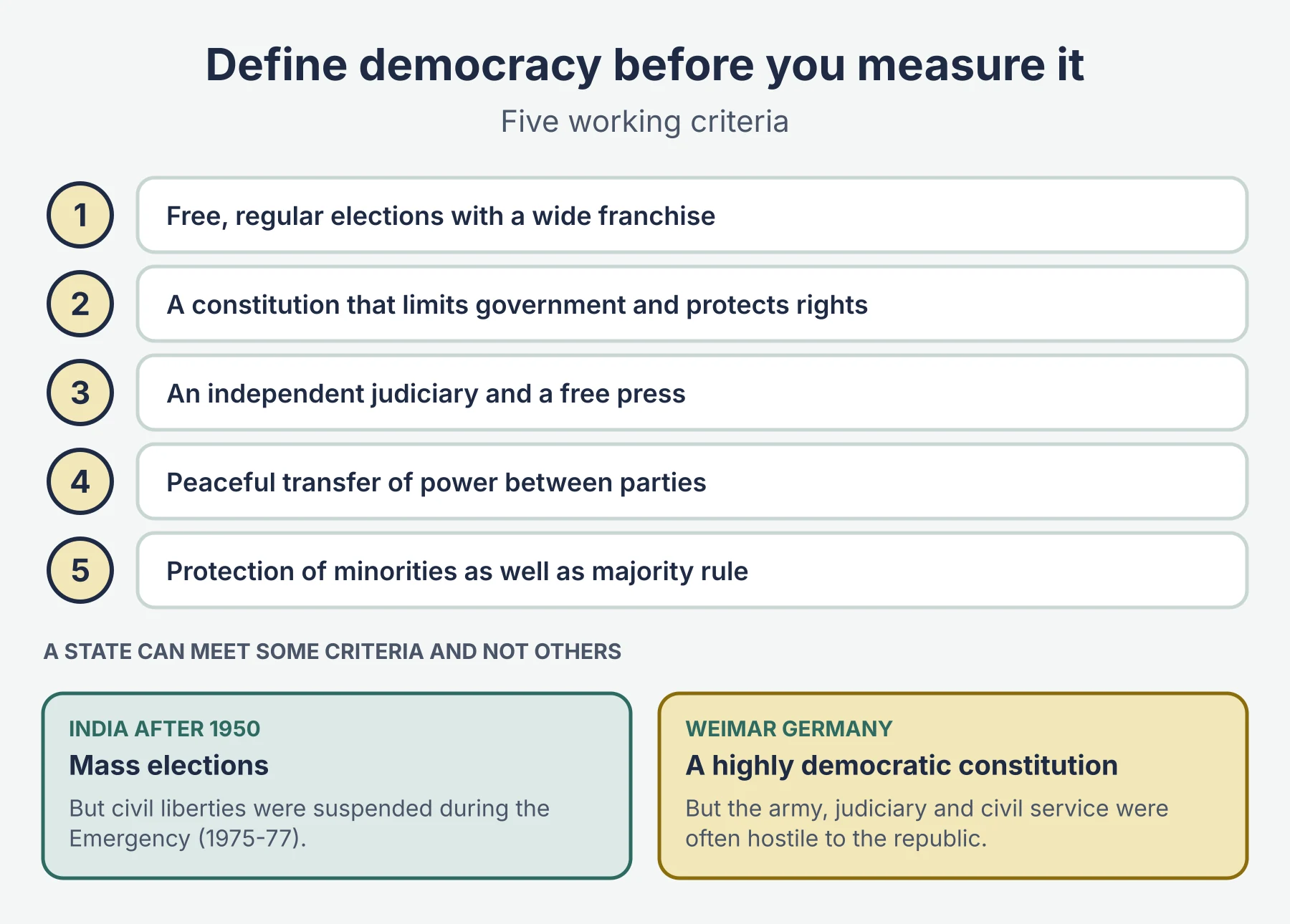
- No definition of democracy. Set criteria in the introduction and use them.
- Telling the story of the Nazi rise. Keep the focus on the democracy and why it failed to defend itself.
- Equating “survived” with “successful”. India survived the Emergency only after civil liberties were suspended; South Africa’s democracy survived but inequality persisted.
- One-sided policy answers. Separate aims from results, and legal change from social change.
- Ignoring the date limits. The topic begins in 1848; cases before that date are outside it.
Self-test
- What was Article 48? The emergency decree power of the Weimar president.
- Name two features of the Weimar constitution. Any two: proportional representation, votes for women, an elected president, Article 48, a bill of rights.
- How was the Kapp Putsch defeated? By a general strike, after the army refused to act against it.
- List three achievements of the Stresemann era. Any three: Rentenmark, Dawes Plan, Locarno, League membership, Young Plan.
- When did Brüning begin governing by presidential decree? From 1930, after the grand coalition collapsed in March.
- Who chaired India’s constitution drafting committee? B. R. Ambedkar.
- What was the Emergency? A period from 1975 to 1977 when Indira Gandhi suspended civil liberties and ruled by decree.
- What did the 1977 Indian election show? That voters could remove a government peacefully; Congress lost to the Janata Party.
- When were South Africa’s first universal elections? 27 April 1994.
- What was the difference between the RDP and GEAR? The RDP (1994) stressed redistribution and basic services; GEAR (1996) stressed growth, fiscal discipline and market reform.
- Who chaired the Truth and Reconciliation Commission? Desmond Tutu.
- Why is proportional representation a debated factor in Weimar’s collapse? It allowed many small parties and unstable coalitions, but other democracies used it without collapsing, so its importance must be weighed against the Depression and elite choices.
Get free revision emails (optional)
Occasional emails with practice questions, worked explanations and links to free resources for the qualification and subjects you choose. No spam, and you can unsubscribe from any email. The free tools on this site never need an email.
Related resources
-
Practice questions
IB DP History: The Six Key Concepts – Practice Questions
Original practice questions with worked answers on the six key concepts of IB DP History (first assessed 2017), from spotting the concept to essay plans.
World History · International Baccalaureate · IB
Try questions -
Practice questions
IB DP History (DP History): World history topics – Practice Questions
Twelve original IB DP History Paper 2-style essay questions, one per world history topic, with indicative content and the 15-mark markbands, 2017 syllabus.
World History · International Baccalaureate · IB
Try questions -
Revision notes
IB DP History (DP History): World history topics – Revision Notes
Revision notes for IB DP History Paper 2: the twelve world history topics, example pairs from different regions, essay markbands and the traps examiners report.
World History · International Baccalaureate · IB
Revise topic
Related articles
-
teaching
A Level tuition in Dubai: Cambridge or Pearson Edexcel International A Level?
Schools in Dubai and Abu Dhabi teach either Cambridge International AS & A Level or Pearson Edexcel International A Level. How the two are structured, why it matters for tuition, and how online classes from Lahore work.
9 October 2026
-
curriculum guides
Choosing subjects at IGCSE and A Level
How subject choices at 14 and 16 affect university options later, and how to keep pathways open without overloading a timetable.
28 July 2026
Studying this with a teacher
Working through World History IB?
This page is free and stays free. If you would rather be taught it, Marlbridge runs World History classes one-to-one, online in your own time zone. The first trial class is free. WhatsApp replies within an hour (8am–11pm Pakistan time, every day); email the same day.
IB World History teachers at Marlbridge
