
Study Guides
IB DP History (DP History): Authoritarian states (20th century)
Emergence, consolidation and policies of 20th-century authoritarian states, with Stalin, Hitler, Mao and Castro compared for IB History Paper 2 essays.
- Subject
- World History
- Level
- IB
- Topic
- Topic 2: World history topics
- Author
- Marlbridge Academic Team
- Updated
- Reviewed by
- Azam Siddique (what this means)
Aligned to International Baccalaureate IB Diploma Programme World History (DP History), First assessment 2017. Official specification .
Syllabus page (what it covers and how it is assessed): IB Diploma Programme World History.
Syllabus points this page covers
DP History
- 10 Authoritarian states (20th century)
Found an error? Report a correction.
Need help with this topic? Request a free trial class for IB Diploma Programme World History (DP History).
World history topic 10 is one of the most widely taught in IB History. It asks how authoritarian leaders came to power, how they kept it, and what their policies did to the societies they ruled. You will usually study at least two single-party or authoritarian states from different regions, so that you can compare them, and the topic rewards thematic notes far more than a separate narrative for each leader.
What the topic covers
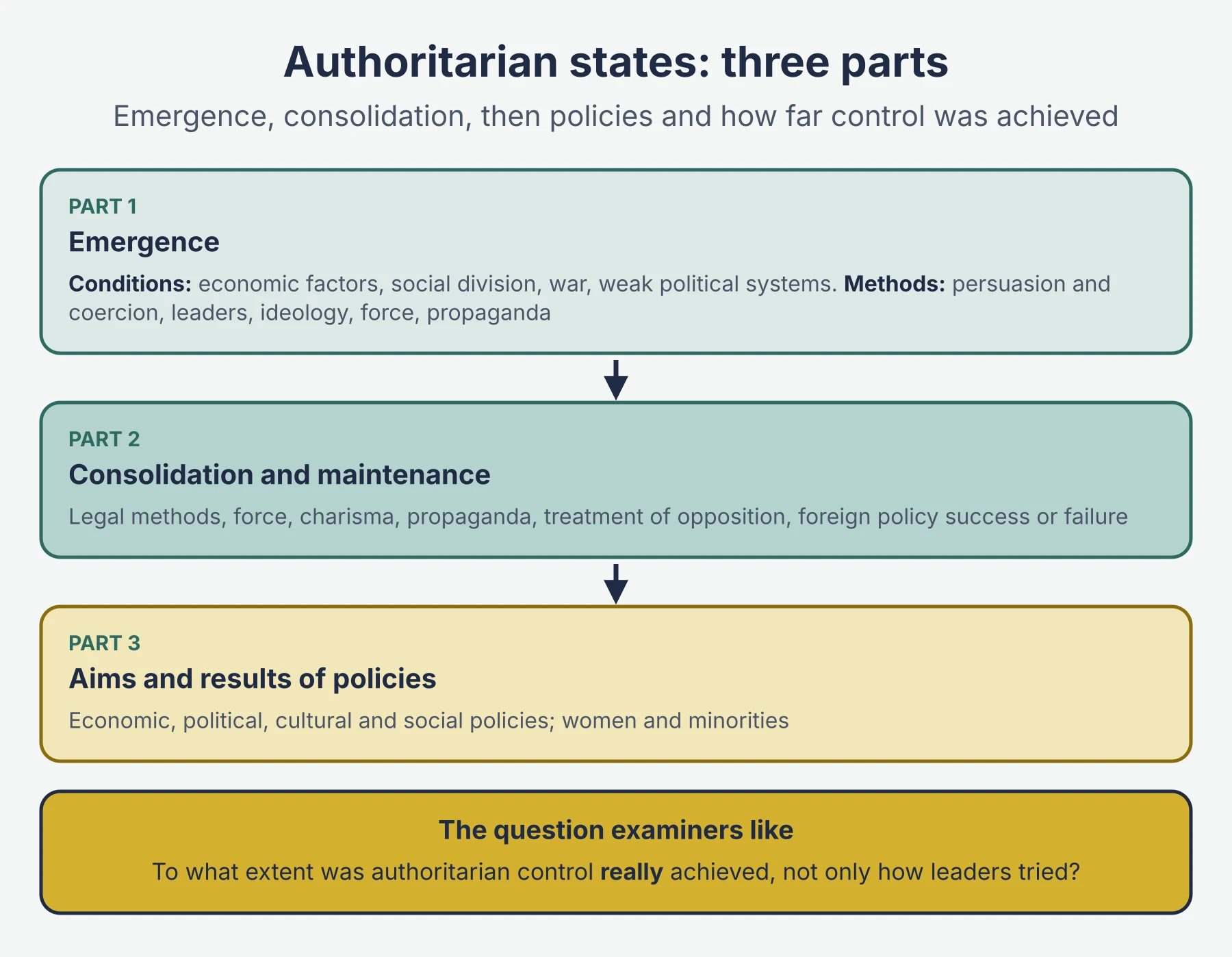
The IB History guide organizes the content in three parts.
- Emergence of authoritarian states. The conditions in which they emerged: economic factors, social division, the impact of war, and weakness of the political system. The methods used to establish them: persuasion and coercion, the role of leaders, ideology, the use of force and propaganda.
- Consolidation and maintenance of power. The use of legal methods, the use of force, charismatic leadership, the dissemination of propaganda, the nature, extent and treatment of opposition, and the impact of the success or failure of foreign policy on the maintenance of power.
- Aims and results of policies. The aims and impact of domestic economic, political, cultural and social policies; the impact of policies on women and minorities; and the extent to which authoritarian control was achieved.
Notice the last bullet: questions can ask how far control was really achieved, not only how leaders tried.
Key ideas
Emergence: conditions and methods are different questions
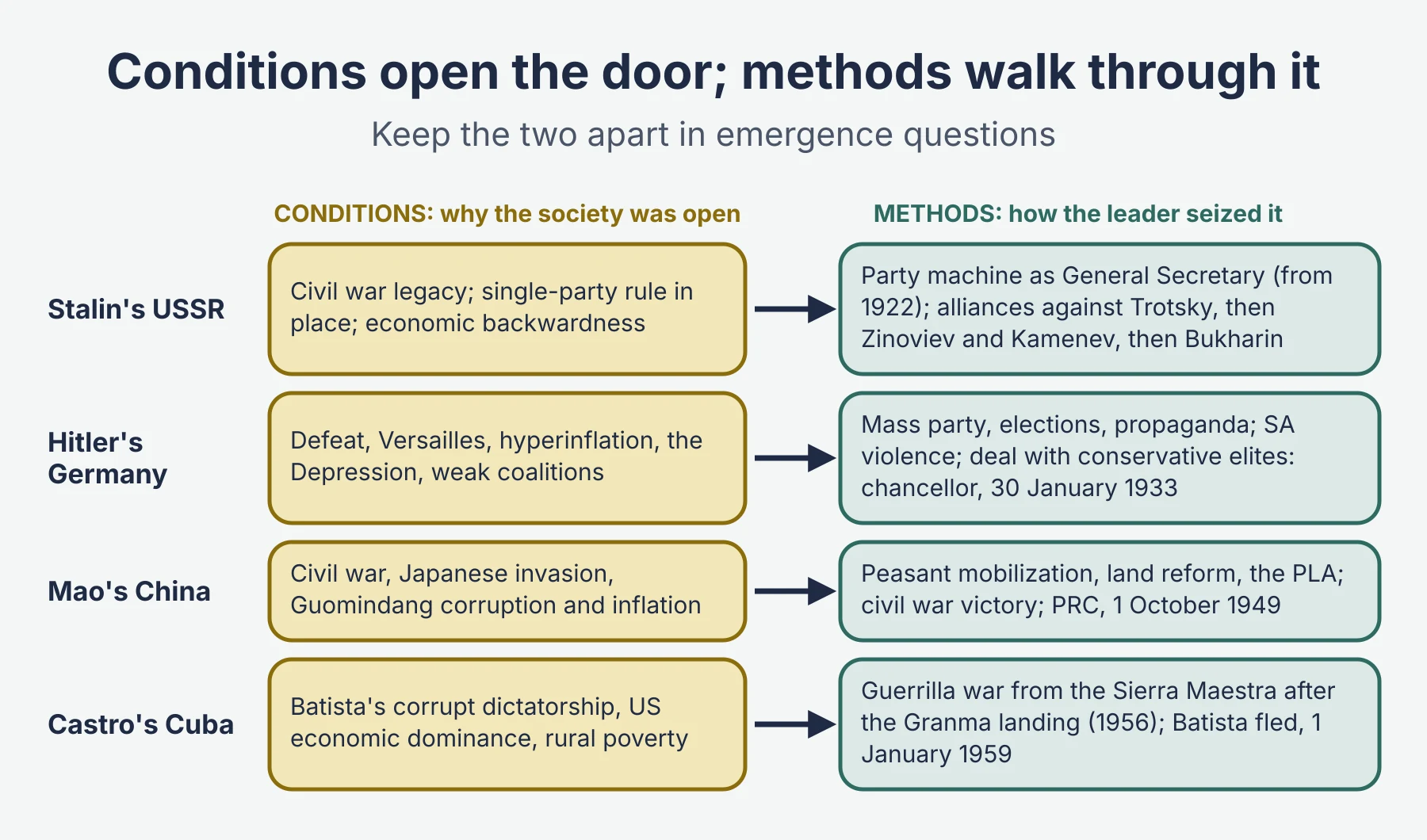
Conditions explain why a society was open to authoritarian rule; methods explain how a particular leader seized the opportunity. Keep them apart.
| State | Conditions | Methods of coming to power |
|---|---|---|
| Stalin’s USSR | Civil war legacy, single-party rule already in place, economic backwardness | Control of the party machine as General Secretary (from 1922); alliances against Trotsky, then against Zinoviev and Kamenev, then against Bukharin |
| Hitler’s Germany | Defeat, Versailles, hyperinflation, the Depression, a weak coalition system | Mass party, elections and propaganda; SA violence; a deal with conservative elites leading to appointment as chancellor (30 January 1933) |
| Mao’s China | Decades of civil war, Japanese invasion, Guomindang corruption and inflation | Peasant mobilization, land reform in communist areas, the People’s Liberation Army; victory in the civil war; PRC proclaimed 1 October 1949 |
| Castro’s Cuba | Batista’s corrupt dictatorship, US economic dominance, rural poverty | Guerrilla war from the Sierra Maestra after the Granma landing (1956); Batista fled on 1 January 1959 |
Consolidation: legal methods and force together
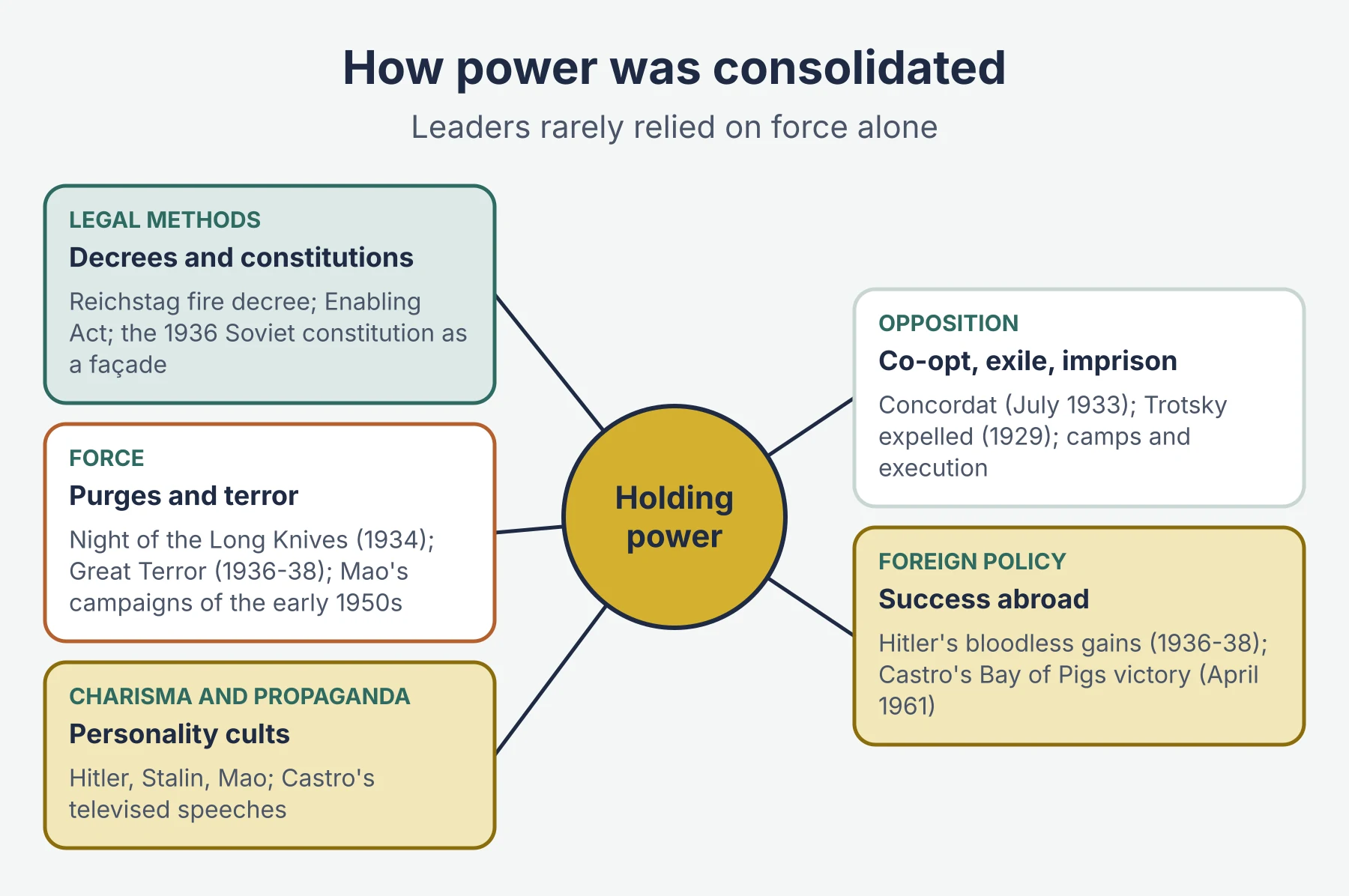
Authoritarian leaders rarely relied on force alone.
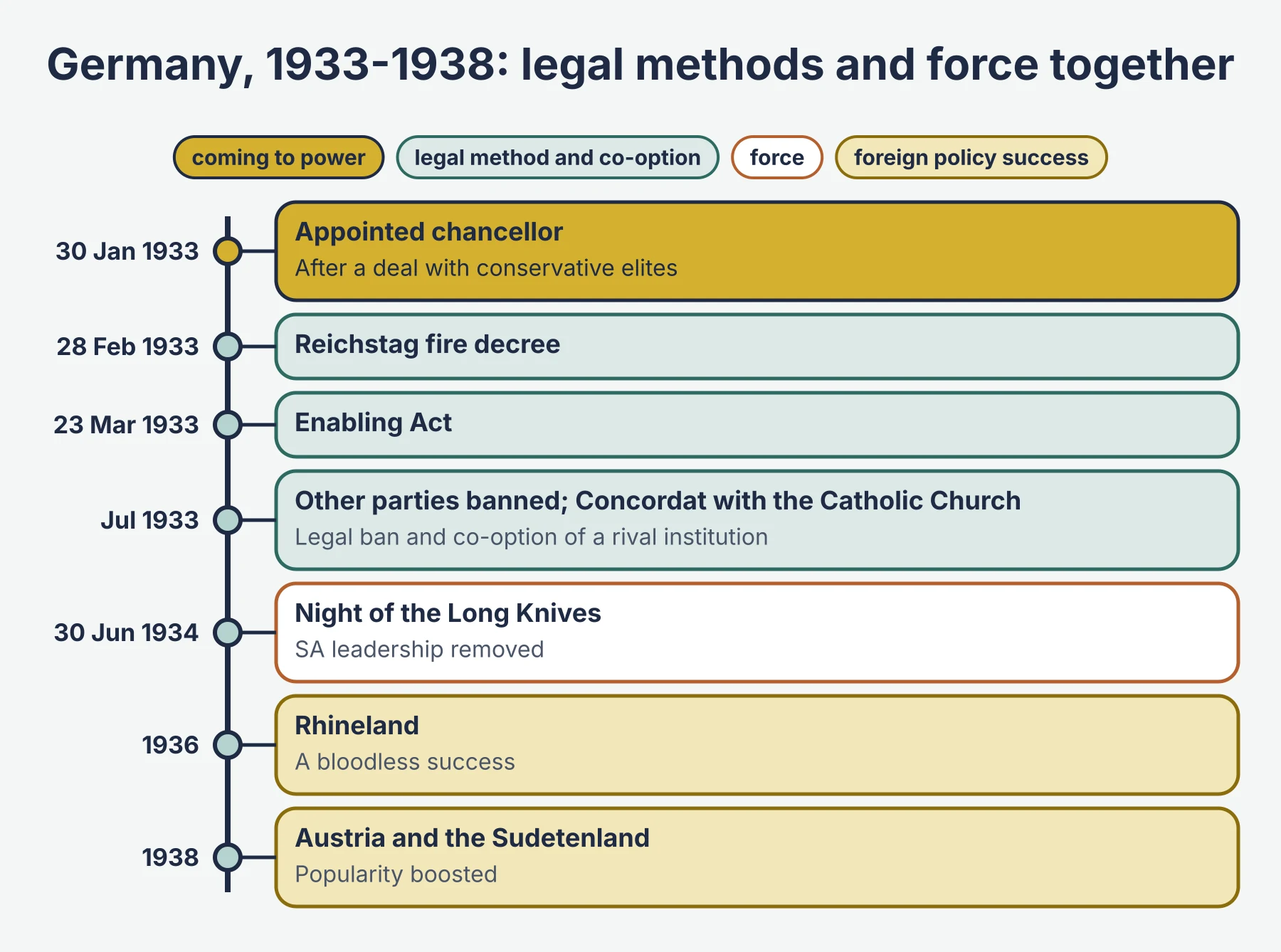
- Legal methods: Hitler used the Reichstag fire decree (28 February 1933) and the Enabling Act (23 March 1933), then banned other parties (July 1933). Stalin used party rules and the 1936 constitution as a façade.
- Force: the Night of the Long Knives (30 June 1934) removed the SA leadership; Stalin’s Great Terror (1936-38) used show trials and mass arrests by the NKVD; Mao’s campaigns against “counter-revolutionaries” and landlords in the early 1950s killed very large numbers.
- Charisma and propaganda: personality cults around Hitler, Stalin and Mao; Castro’s long televised speeches.
- Treatment of opposition: from co-option (the Concordat with the Catholic Church, July 1933) to exile (Trotsky, expelled from the USSR in 1929) to imprisonment, labour camps and execution.
- Foreign policy: Hitler’s bloodless successes (the Rhineland in 1936, Austria and the Sudetenland in 1938) boosted his popularity; Castro’s defeat of the Bay of Pigs invasion (April 1961) strengthened his regime.
Policies: aims against results
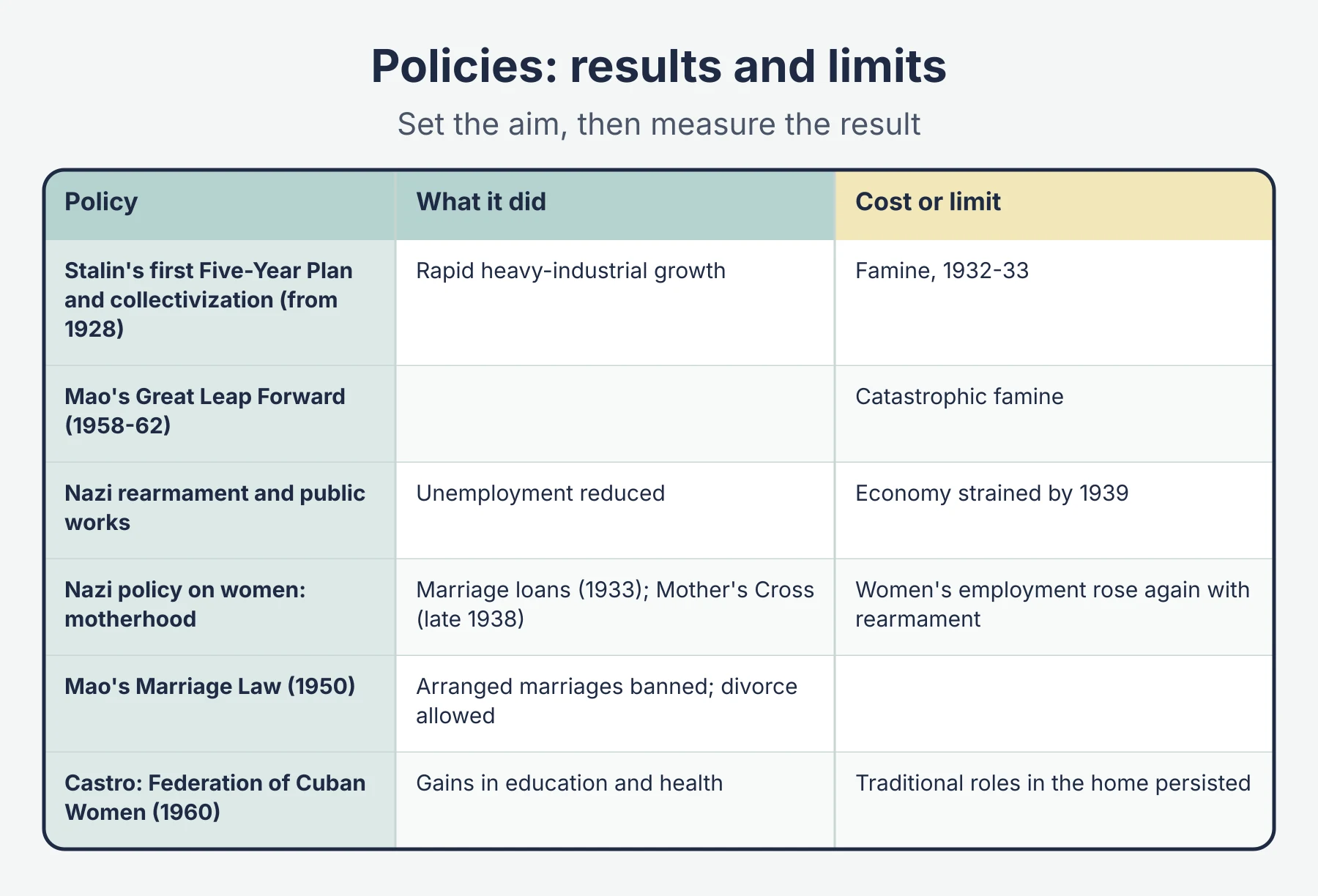
The strongest essays test whether policies achieved what leaders intended.
- Economic: Stalin’s first Five-Year Plan (from 1928) and forced collectivization produced rapid heavy-industrial growth but famine in 1932-33; Mao’s Great Leap Forward (1958-62) ended in catastrophic famine; Nazi rearmament and public works reduced unemployment but strained the economy by 1939.
- Women: Nazi policy emphasized motherhood (marriage loans from 1933; the Mother’s Cross from late 1938), yet women’s employment rose again with rearmament. Mao’s Marriage Law (1950) banned arranged marriages and allowed divorce. Castro’s regime founded the Federation of Cuban Women (1960) and made gains in education and health, while traditional roles in the home persisted.
- Minorities: Nazi persecution of Jews (the Nuremberg Laws, 1935; Kristallnacht, November 1938) leading to genocide; Stalin’s deportation of whole nationalities during the Second World War.
- Culture and religion: socialist realism in the USSR; the destruction of “old” culture in China’s Cultural Revolution (from 1966); state control of the arts and media in all four.
How total was control?
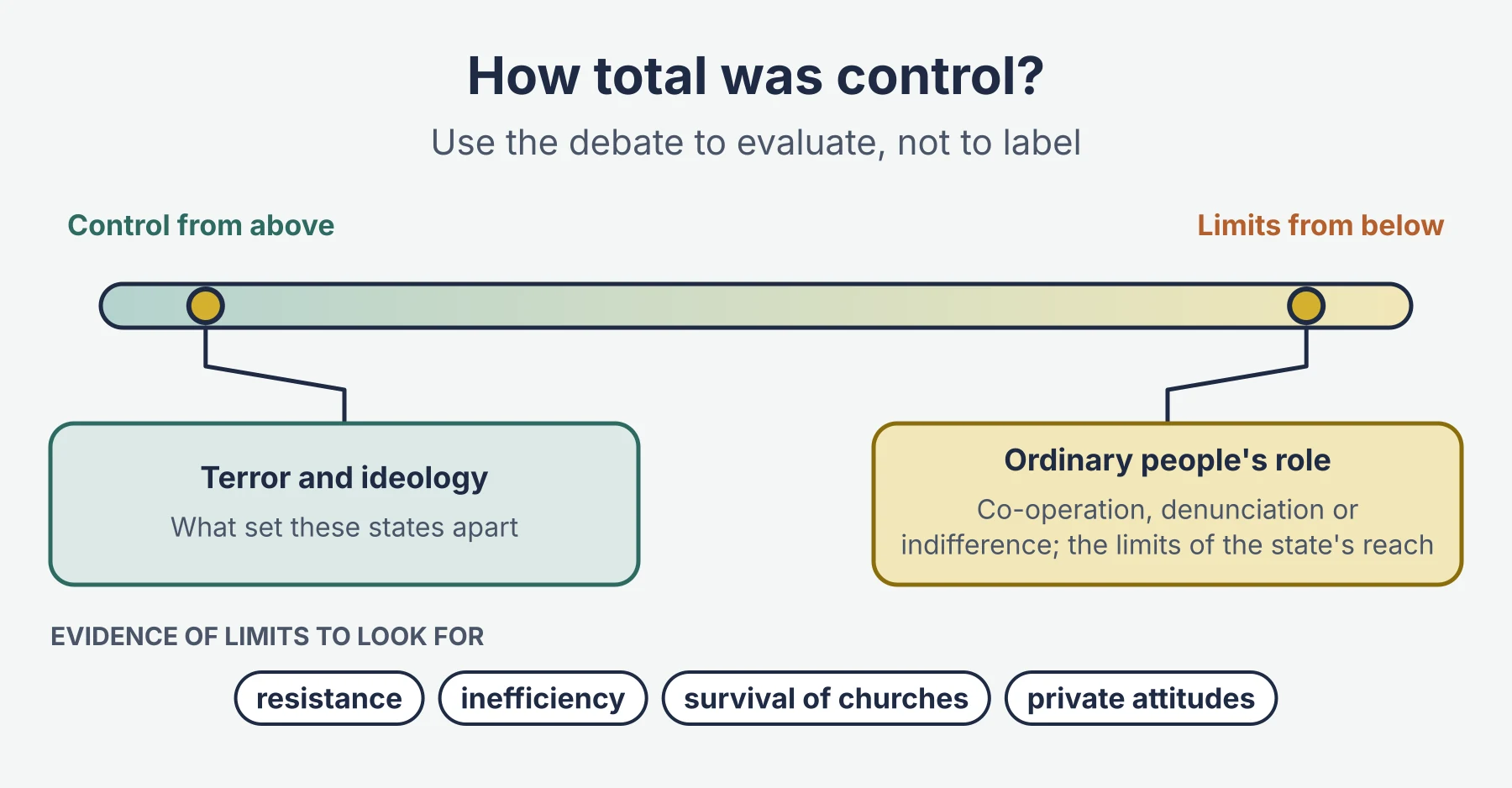
Historians have long debated the concept of “totalitarianism”. Some stress the terror and ideology that set these states apart; others show how much depended on ordinary people’s co-operation, denunciation or indifference, and on the limits of the state’s reach. Use the debate to evaluate the third bullet of the topic, not as a list of labels.
Worked example: a comparative plan
Question: “Compare and contrast the methods used by two authoritarian leaders, each from a different region, to consolidate their power.”
Choose: Stalin (Europe) and Castro (the Americas).
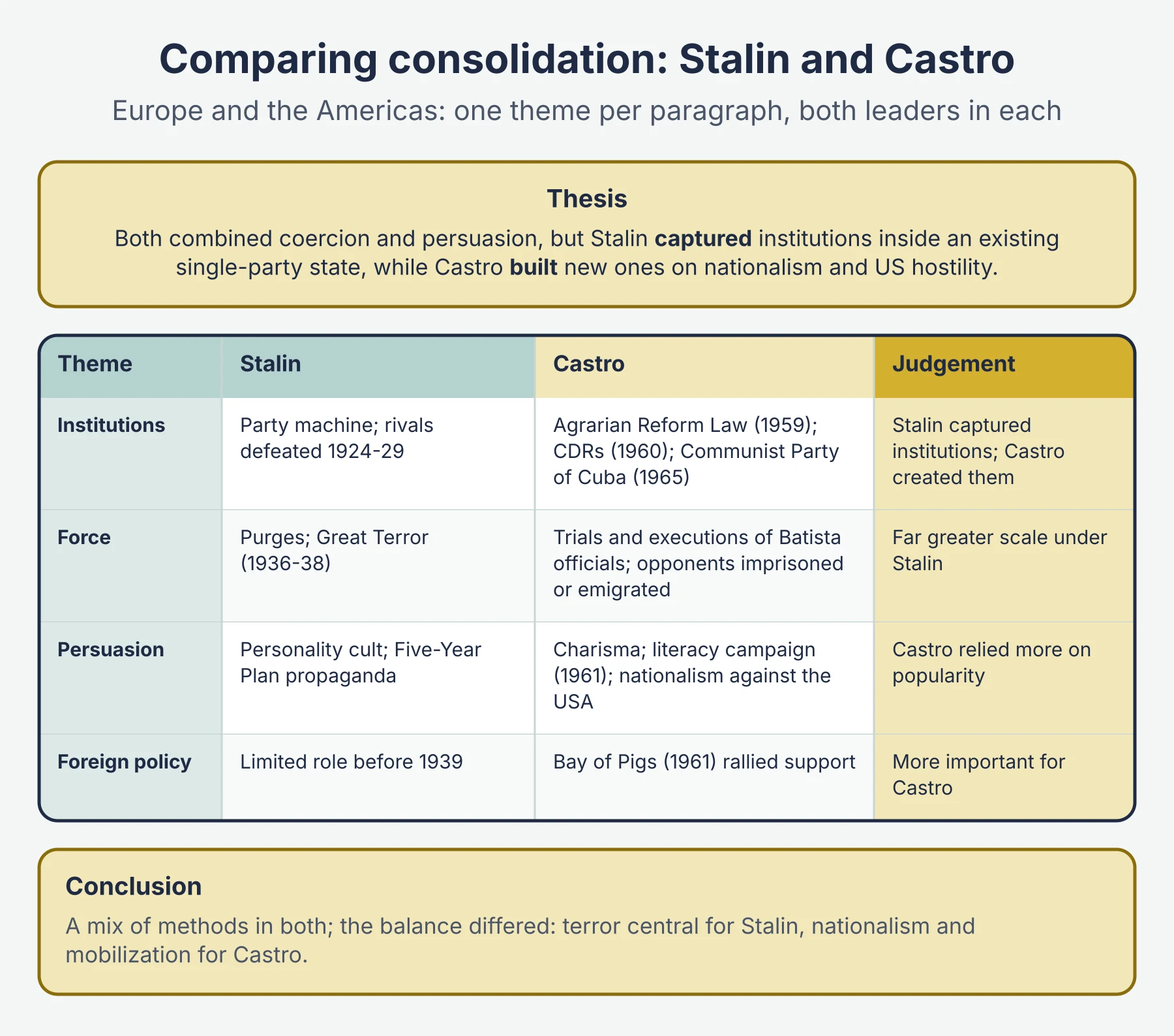
Thesis: “Both leaders combined coercion with persuasion, but Stalin consolidated power inside an existing single-party state by manipulating its institutions, whereas Castro, coming to power through revolution, built new institutions and drew on popular nationalism and US hostility.”
| Theme | Stalin | Castro | Judgement |
|---|---|---|---|
| Institutions | Party machine; defeat of rivals 1924-29 | Agrarian Reform Law (1959); Committees for the Defence of the Revolution (1960); a single Communist Party of Cuba (1965) | Stalin captured institutions; Castro created them |
| Force | Purges and Great Terror (1936-38) | Trials and executions of Batista officials; imprisonment of opponents; emigration of opponents | Far greater scale under Stalin |
| Persuasion | Personality cult; Five-Year Plan propaganda | Charisma; literacy campaign (1961); nationalism against the USA | Castro relied more on genuine popularity |
| Foreign policy | Limited role before 1939 | Bay of Pigs (1961) rallied support | More important for Castro |
Conclusion: both regimes were consolidated by a mix of methods, but the balance differed: terror was central for Stalin, nationalism and mobilization for Castro.
Common mistakes
- Mixing up conditions and methods in emergence questions.
- Narrating biography. A leader’s early life is relevant only if it explains how he gained or kept power.
- Overstating control. Show limits: resistance, inefficiency, survival of churches, private attitudes.
- Policy answers that only describe. Set aims, then measure results.
- Ignoring women and minorities, which the guide names explicitly.
- Same-region pairs when the question asks for different regions; Hitler and Stalin are both in Europe.
Exam technique
Paper 2 essays are marked out of 15 using the markbands explained in the world history topics study guide. Common forms on this topic:
- “Discuss the conditions that led to the emergence of…”: rank conditions and show how they interacted.
- “To what extent was force the main method…”: weigh force against legal methods, propaganda and popularity.
- “Evaluate the success of the economic (or social) policies of…”: set criteria and judge results against aims.
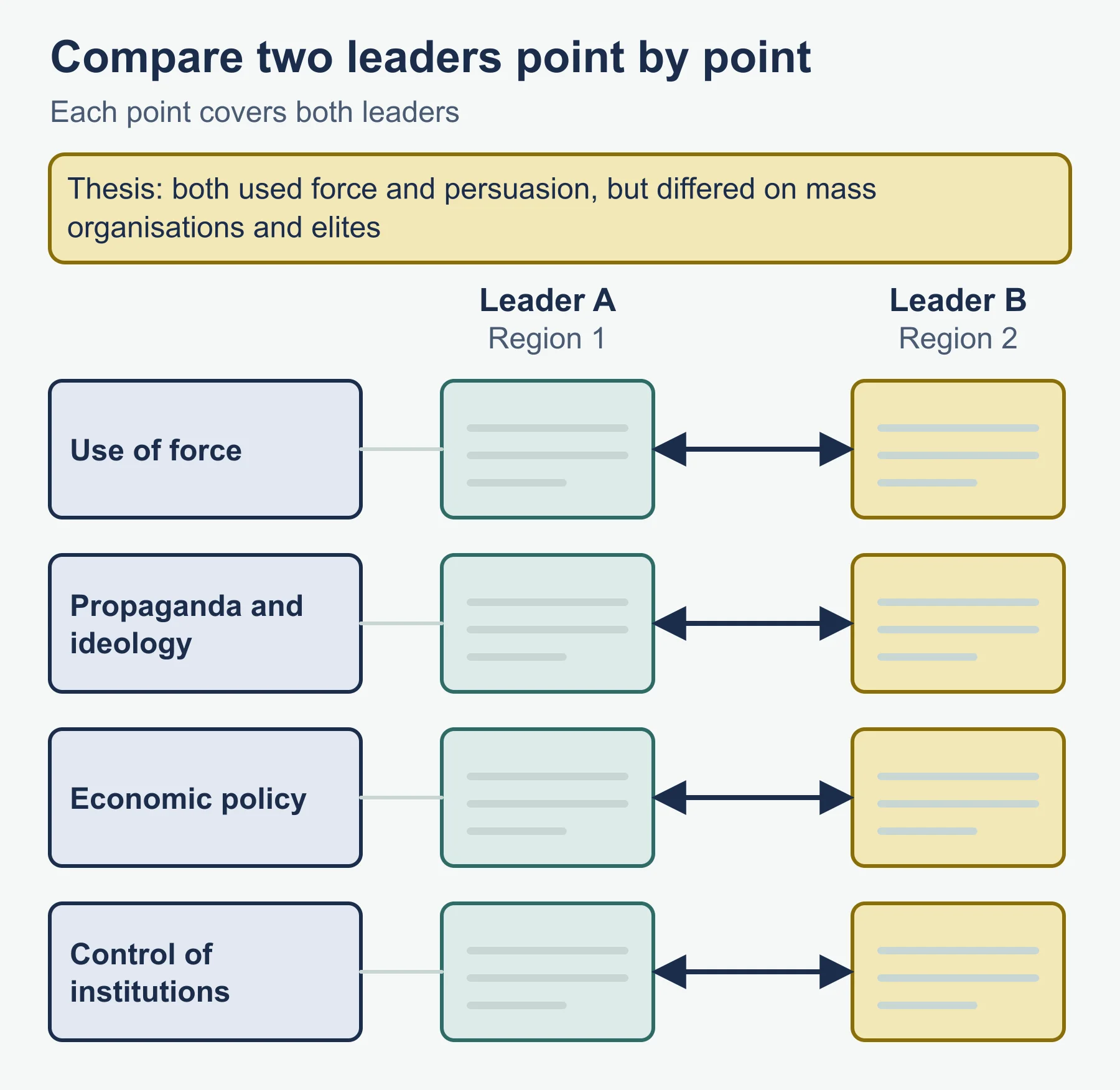
- “Compare and contrast…”: organize by theme, both leaders in every paragraph.
Use with the other pages
Learn the chronologies with the authoritarian states revision notes and test yourself with the authoritarian states practice questions.
Check your understanding
- What are the three parts of the topic? Emergence; consolidation and maintenance of power; aims and results of policies.
- Give two legal methods Hitler used in 1933. The Reichstag fire decree and the Enabling Act (also the ban on other parties).
- What was Stalin’s main advantage in the power struggle after 1924? His control of party appointments as General Secretary.
- How did the Bay of Pigs affect Castro’s position? It strengthened his regime by rallying nationalist support against the USA.
- Give one example of a gap between aims and results in Nazi policy on women. Motherhood was promoted, but women’s employment rose again with rearmament.
- What does the third part of the topic ask you to judge? The extent to which authoritarian control was actually achieved.
Get free revision emails (optional)
Occasional emails with practice questions, worked explanations and links to free resources for the qualification and subjects you choose. No spam, and you can unsubscribe from any email. The free tools on this site never need an email.
Related resources
-
Practice questions
IB DP History: The Six Key Concepts – Practice Questions
Original practice questions with worked answers on the six key concepts of IB DP History (first assessed 2017), from spotting the concept to essay plans.
World History · International Baccalaureate · IB
Try questions -
Practice questions
IB DP History (DP History): Authoritarian states (20th century) – Practice Questions
Twelve original IB History practice questions on 20th-century authoritarian states, from short recall to a full Paper 2 essay, with mark-scheme answers.
World History · International Baccalaureate · IB
Try questions -
Revision notes
IB DP History (DP History): Authoritarian states (20th century) – Revision Notes
Condensed IB History notes on authoritarian states: emergence, consolidation, policies on women and minorities, four case timelines and a self-test.
World History · International Baccalaureate · IB
Revise topic
Related articles
-
teaching
A Level tuition in Dubai: Cambridge or Pearson Edexcel International A Level?
Schools in Dubai and Abu Dhabi teach either Cambridge International AS & A Level or Pearson Edexcel International A Level. How the two are structured, why it matters for tuition, and how online classes from Lahore work.
9 October 2026
-
curriculum guides
Choosing subjects at IGCSE and A Level
How subject choices at 14 and 16 affect university options later, and how to keep pathways open without overloading a timetable.
28 July 2026
Studying this with a teacher
Working through World History IB?
This page is free and stays free. If you would rather be taught it, Marlbridge runs World History classes one-to-one, online in your own time zone. The first trial class is free. WhatsApp replies within an hour (8am–11pm Pakistan time, every day); email the same day.
IB World History teachers at Marlbridge
