
Revision Notes
IB DP History (DP History): Authoritarian states (20th century) – Revision Notes
Condensed IB History notes on authoritarian states: emergence, consolidation, policies on women and minorities, four case timelines and a self-test.
- Subject
- World History
- Level
- IB
- Topic
- Topic 2: World history topics
- Author
- Marlbridge Academic Team
- Updated
- Reviewed by
- Azam Siddique (what this means)
Aligned to International Baccalaureate IB Diploma Programme World History (DP History), First assessment 2017. Official specification .
Syllabus page (what it covers and how it is assessed): IB Diploma Programme World History.
Syllabus points this page covers
DP History
- 10 Authoritarian states (20th century)
Found an error? Report a correction.
Need help with this topic? Request a free trial class for IB Diploma Programme World History (DP History).
These notes condense world history topic 10 for Paper 2: how authoritarian states emerged, how leaders consolidated and kept power, and what their policies achieved. The comparative arguments are set out in the authoritarian states study guide; test yourself afterwards with the authoritarian states practice questions.
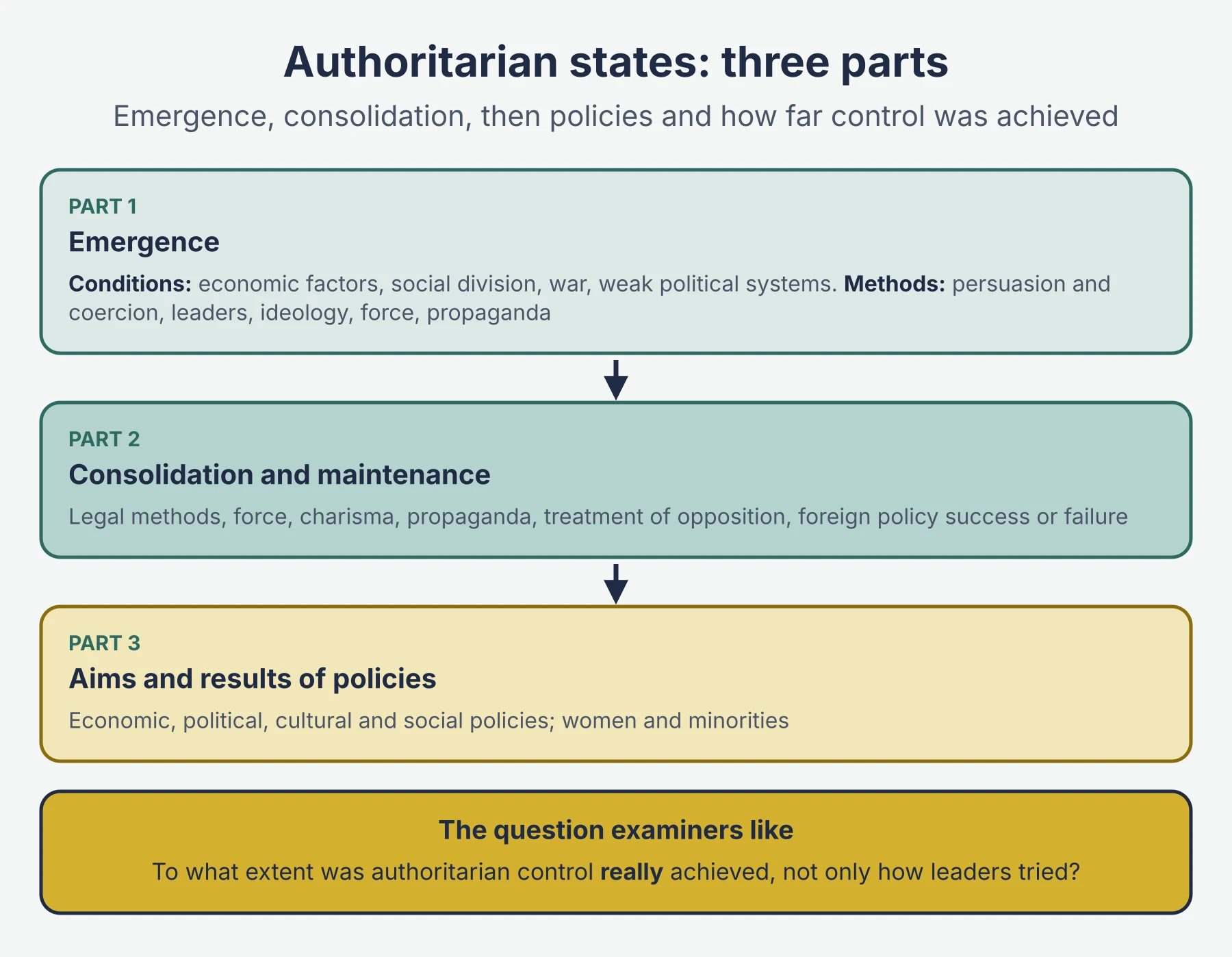
The three parts of the topic
| Part | Content headings in the guide |
|---|---|
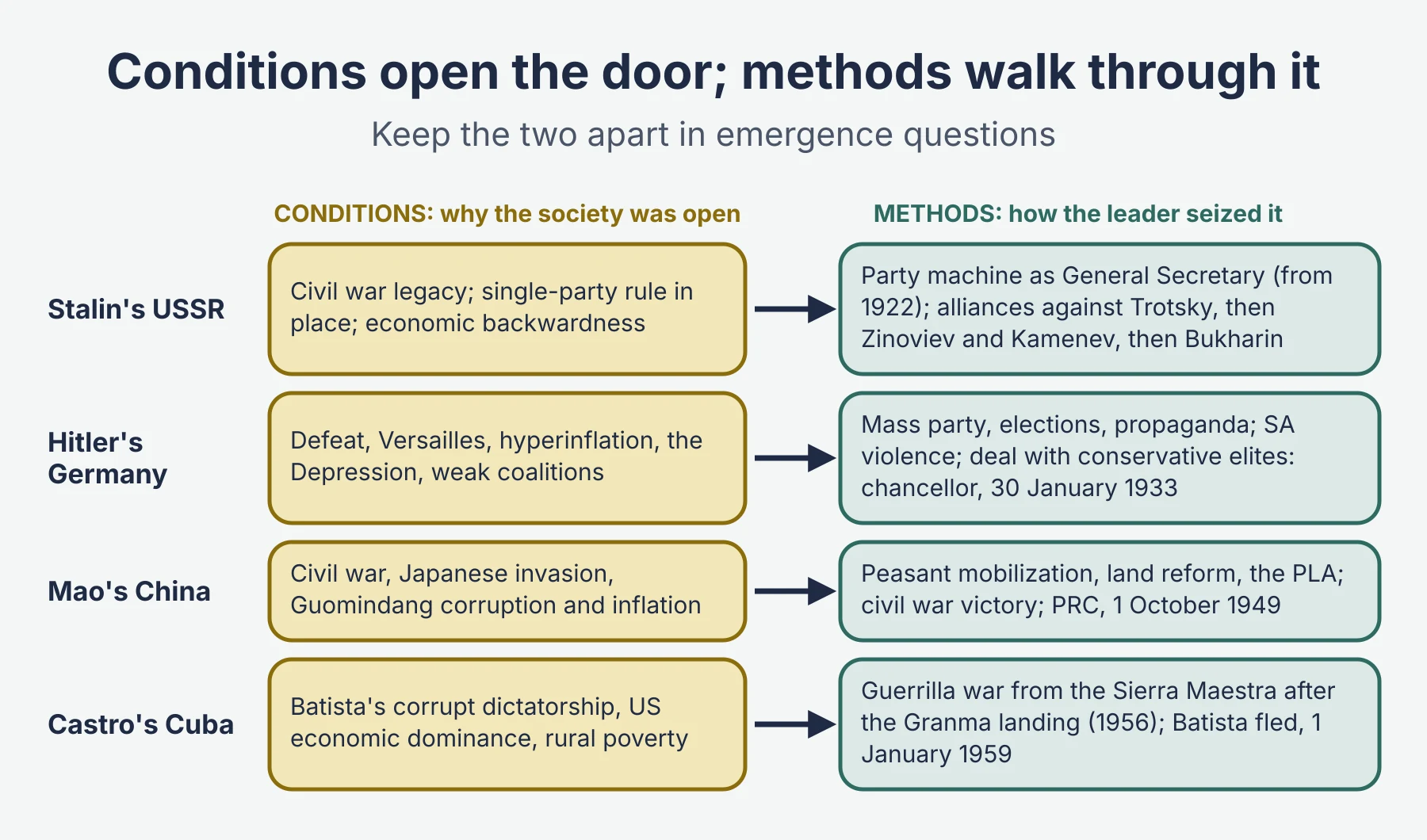
| Emergence | Conditions: economic factors, social division, impact of war, weakness of the political system. Methods: persuasion and coercion, role of leaders, ideology, use of force, propaganda |
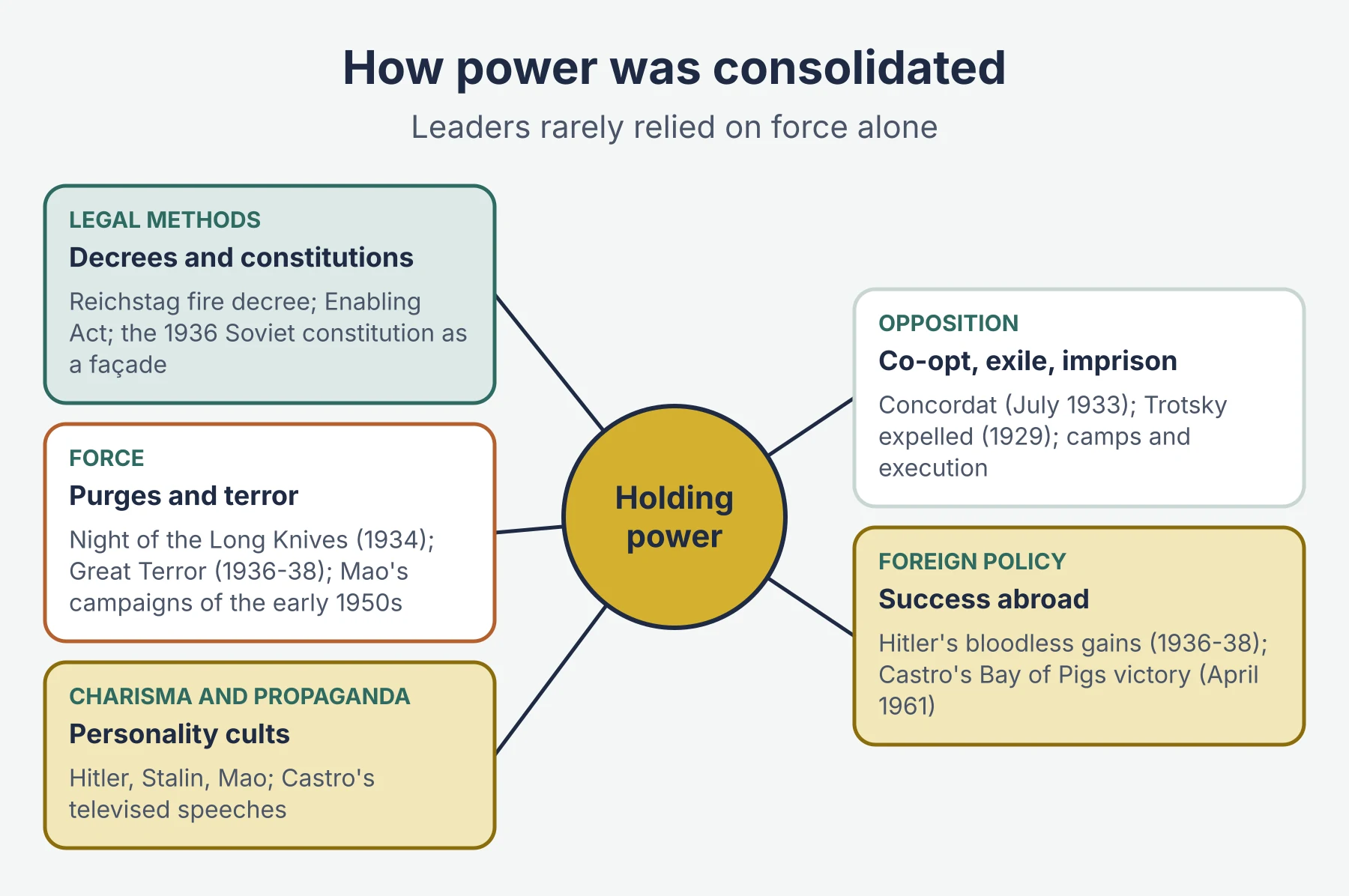
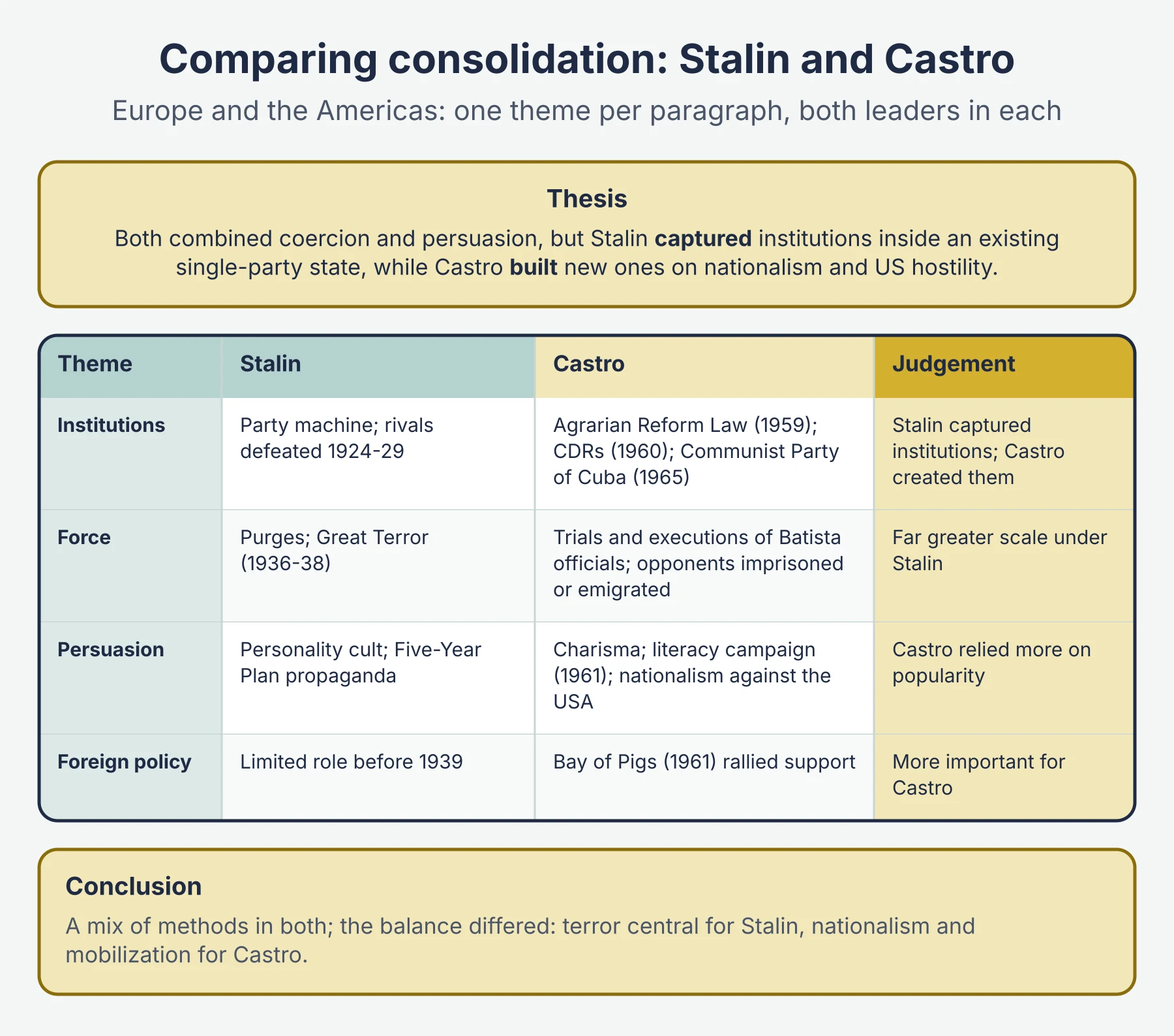
| Consolidation and maintenance | Legal methods; use of force; charismatic leadership; propaganda; nature, extent and treatment of opposition; impact of foreign policy success or failure |
| Aims and results of policies | Economic, political, cultural and social policies; impact on women and minorities; extent to which control was achieved |
Case timelines
Stalin’s USSR (Europe)
- 1922: Stalin becomes General Secretary.
- January 1924: Lenin dies.
- 1924-29: Stalin defeats Trotsky (exiled from the USSR 1929), then Zinoviev and Kamenev, then Bukharin and the “Right”.
- 1928: first Five-Year Plan begins; collectivization from 1929.
- 1932-33: famine, especially in Ukraine and Kazakhstan.
- December 1934: Kirov murdered; used to justify purges.
- 1936-38: show trials and the Great Terror.
- 1936: new constitution; abortion banned.
Hitler’s Germany (Europe)
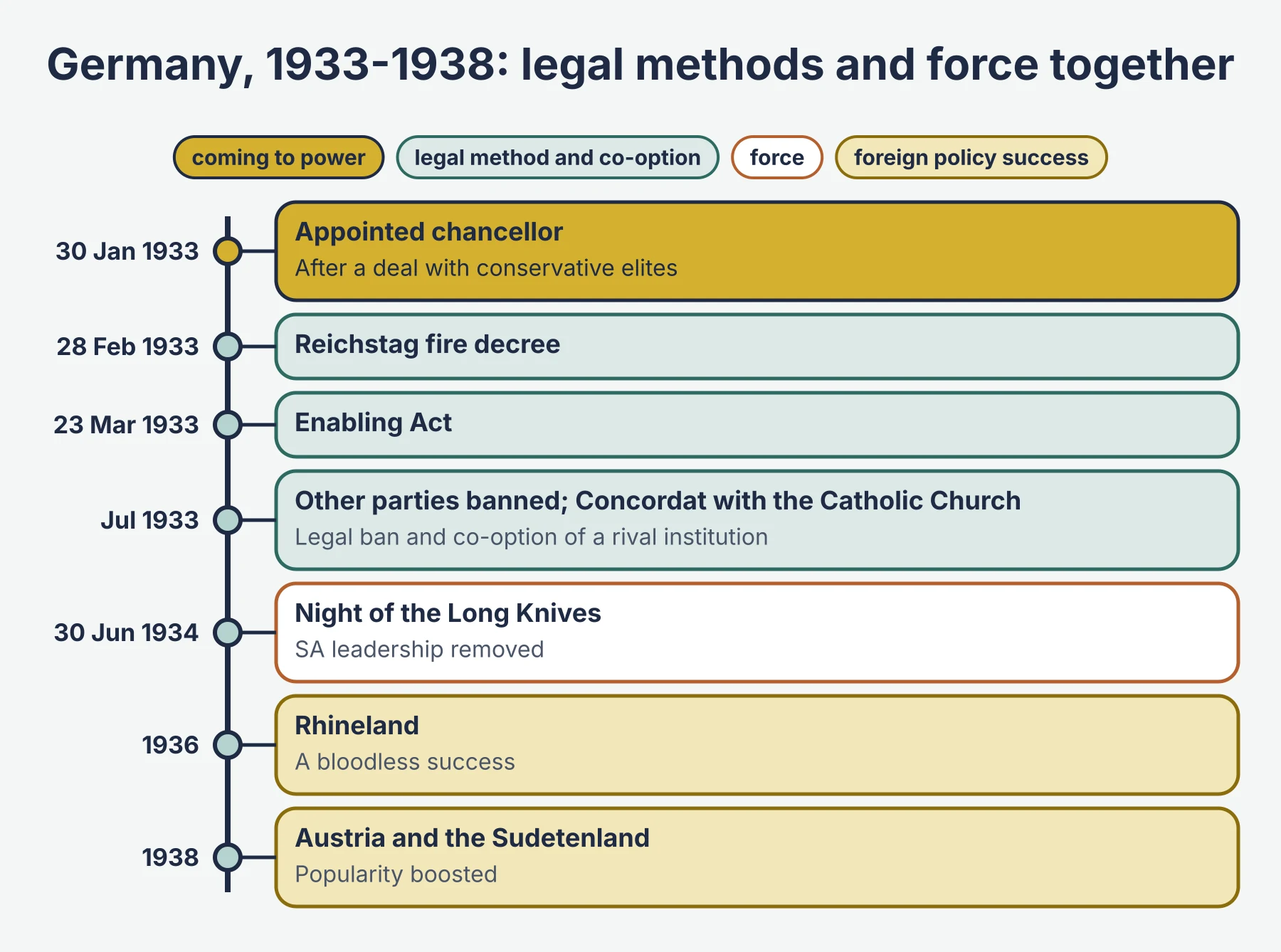
- 30 January 1933: appointed chancellor.
- 28 February 1933: Reichstag fire decree suspends civil liberties.
- 23 March 1933: Enabling Act.
- May 1933: trade unions abolished; German Labour Front created.
- July 1933: Nazis the only legal party; Concordat with the Vatican.
- 30 June 1934: Night of the Long Knives.
- August 1934: Hindenburg dies; Hitler becomes Führer; army oath.
- 1935: Nuremberg Laws.
- 1936: Four-Year Plan under Göring.
- November 1938: Kristallnacht.
Mao’s China (Asia and Oceania)
- 1 October 1949: People’s Republic of China proclaimed.
- 1950: Agrarian Reform Law; Marriage Law.
- 1951-52: Three-Anti and Five-Anti campaigns.
- 1953-57: first Five-Year Plan.
- 1956-57: Hundred Flowers campaign; then the Anti-Rightist campaign (1957).
- 1958-62: Great Leap Forward; famine.
- 1959: Lushan Conference; Peng Dehuai dismissed.
- 1966: Cultural Revolution begins; Red Guards.
- 1976: Mao dies.
Castro’s Cuba (the Americas)
- 26 July 1953: attack on the Moncada barracks.
- December 1956: Granma landing; guerrilla war in the Sierra Maestra.
- 1 January 1959: Batista flees.
- May 1959: Agrarian Reform Law.
- 1960: Committees for the Defence of the Revolution; Federation of Cuban Women; nationalization of US-owned businesses.
- April 1961: Bay of Pigs invasion defeated; revolution declared socialist.
- 1961: literacy campaign.
- October 1962: missile crisis.
- 1965: Communist Party of Cuba formed.
Comparison grid
| Theme | Stalin | Hitler | Mao | Castro |
|---|---|---|---|---|
| Ideology | Marxism-Leninism; “socialism in one country” | Racial nationalism; Volksgemeinschaft | Marxism-Leninism adapted to a peasant society | Nationalism, anti-imperialism, then Marxism-Leninism |
| Main coercive tools | NKVD, Gulag | SS, Gestapo, concentration camps | Mass campaigns, laogai labour camps | Trials, imprisonment, CDR surveillance |
| Propaganda | Personality cult, socialist realism | Goebbels’ ministry, rallies, radio | Mass campaigns, Little Red Book | Speeches, mass rallies, revolutionary heroes |
| Economic policy | Five-Year Plans, collectivization | Public works, rearmament, autarky | Five-Year Plan, Great Leap Forward | Land reform, nationalization, sugar and Soviet aid |
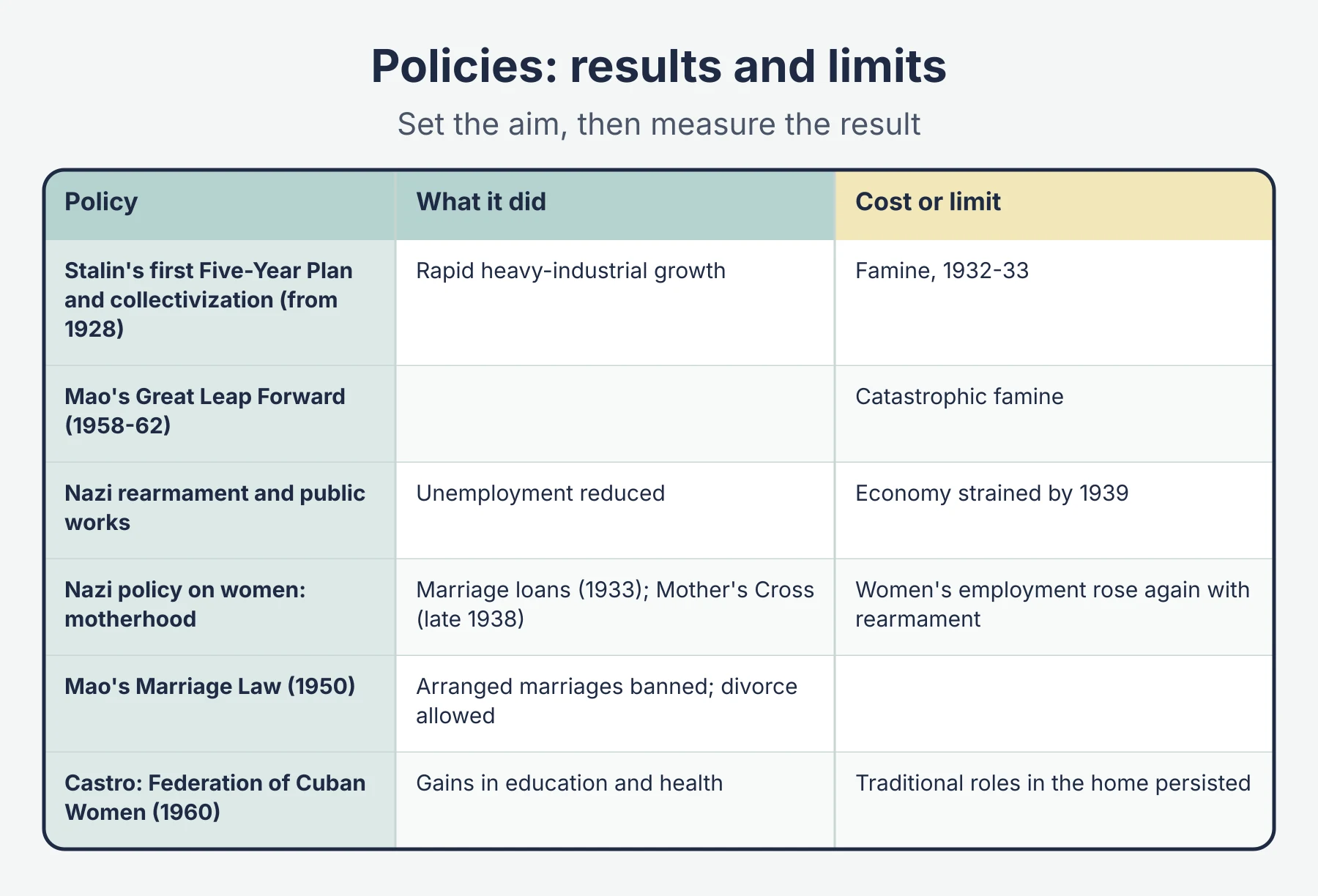
| Women | Equal rights in law; “double burden” of work and home | Motherhood ideal; employment rose with rearmament | Marriage Law 1950; labour mobilization | Education and health gains; Family Code (1975) |
Key terms
| Term | Meaning |
|---|---|
| Authoritarian state | A state where power is concentrated in a leader or party not accountable to free elections |
| Single-party state | A state in which only one party is legally allowed |
| Totalitarianism | A contested concept describing regimes that seek total control of public and private life |
| Cult of personality | Propaganda that glorifies a leader as infallible |
| Gleichschaltung | “Co-ordination”: bringing all German institutions under Nazi control |
| Collectivization | Merging private farms into state or collective farms |
| Purge | Removal of opponents or suspected opponents from party or state |
| Autarky | Economic self-sufficiency |
| Socialist realism | Soviet art and literature required to glorify socialism and its heroes |
| Mass mobilization | Drawing the population into campaigns organized by the regime |
Exam traps
- Conditions versus methods. “Why did X emerge?” and “How did X gain power?” need different answers.
- “Control” as a given. The guide asks how far control was achieved; include resistance, non-conformity and inefficiency.
- Hitler and Stalin as a “different region” pair. Both are in Europe.
- Policy without results. Every policy paragraph needs an effect and a judgement.
- Outside the date limits. Topic 10 is twentieth century; check that a regime falls within it.
Self-test
- Name the four conditions for emergence in the guide. Economic factors, social division, impact of war, weakness of the political system.
- What post gave Stalin control of party appointments? General Secretary (from 1922).
- What did the Enabling Act allow? The government to make laws without the Reichstag for four years.
- Why was the Night of the Long Knives important? It removed the SA leadership and won the army’s support for Hitler.
- What was the Hundred Flowers campaign, and what followed? An invitation to criticize the party (1956-57), followed by the Anti-Rightist campaign against critics.
- Give two results of the Great Leap Forward. Any two: famine with tens of millions of deaths, falsified statistics, Mao’s temporary retreat from day-to-day policy, economic disruption.
- When did Batista flee Cuba? 1 January 1959.
- What were the CDRs? Committees for the Defence of the Revolution: neighbourhood organizations for surveillance and mobilization in Cuba.
- Give one way foreign policy strengthened an authoritarian leader. Hitler’s remilitarization of the Rhineland (1936) or Castro’s defeat of the Bay of Pigs invasion (1961).
- What were the Nuremberg Laws? 1935 laws that stripped Jews of German citizenship and banned marriage between Jews and non-Jewish Germans.
- What did Mao’s Marriage Law of 1950 do? Banned arranged marriages and concubinage and allowed divorce.
- Why is “totalitarianism” a debated term? Historians disagree on how far regimes achieved total control, given the role of ordinary people’s co-operation and the limits of state power.
Get free revision emails (optional)
Occasional emails with practice questions, worked explanations and links to free resources for the qualification and subjects you choose. No spam, and you can unsubscribe from any email. The free tools on this site never need an email.
Related resources
-
Practice questions
IB DP History: The Six Key Concepts – Practice Questions
Original practice questions with worked answers on the six key concepts of IB DP History (first assessed 2017), from spotting the concept to essay plans.
World History · International Baccalaureate · IB
Try questions -
Study guides
IB DP History (DP History): Causes and effects of 20th-century wars
Causes, practices and effects of 20th-century wars, with the First World War, the Spanish Civil War, the Falklands and Iran-Iraq wars as cases for Paper 2.
World History · International Baccalaureate · IB
Read guide -
Practice questions
IB DP History (DP History): Causes and effects of 20th-century wars – Practice Questions
Twelve original IB History practice questions on the causes, practices and effects of 20th-century wars, with mark-scheme answers and a full Paper 2 essay.
World History · International Baccalaureate · IB
Try questions
Related articles
-
teaching
A Level tuition in Dubai: Cambridge or Pearson Edexcel International A Level?
Schools in Dubai and Abu Dhabi teach either Cambridge International AS & A Level or Pearson Edexcel International A Level. How the two are structured, why it matters for tuition, and how online classes from Lahore work.
9 October 2026
-
curriculum guides
Choosing subjects at IGCSE and A Level
How subject choices at 14 and 16 affect university options later, and how to keep pathways open without overloading a timetable.
28 July 2026
Studying this with a teacher
Working through World History IB?
This page is free and stays free. If you would rather be taught it, Marlbridge runs World History classes one-to-one, online in your own time zone. The first trial class is free. WhatsApp replies within an hour (8am–11pm Pakistan time, every day); email the same day.
IB World History teachers at Marlbridge
