
Study Guides
IB DP History (DP History): Causes and effects of 20th-century wars
Causes, practices and effects of 20th-century wars, with the First World War, the Spanish Civil War, the Falklands and Iran-Iraq wars as cases for Paper 2.
- Subject
- World History
- Level
- IB
- Topic
- Topic 2: World history topics
- Author
- Marlbridge Academic Team
- Updated
- Reviewed by
- Azam Siddique (what this means)
Aligned to International Baccalaureate IB Diploma Programme World History (DP History), First assessment 2017. Official specification .
Syllabus page (what it covers and how it is assessed): IB Diploma Programme World History.
Syllabus points this page covers
DP History
- 11 Causes and effects of 20th-century wars
Found an error? Report a correction.
Need help with this topic? Request a free trial class for IB Diploma Programme World History (DP History).
World history topic 11 studies war as a historical process: why wars began, how they were fought and why they ended as they did, and what they changed. It covers the whole twentieth century and every kind of conflict, from world wars to civil wars and short limited wars. Your class will usually study at least two wars from different regions, often one total war and one civil or limited war, so that you can compare different types.
What the topic covers
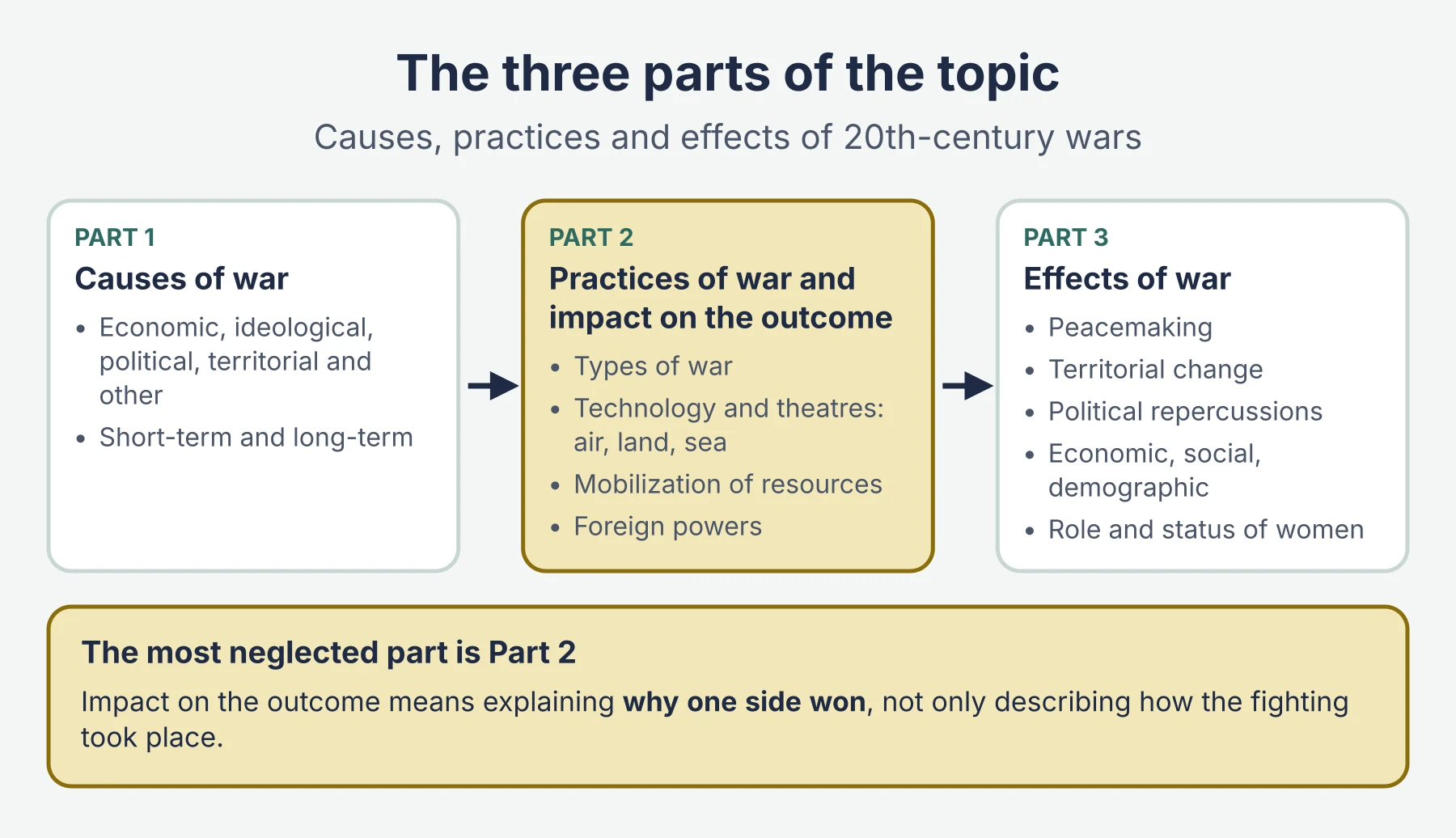
The IB History guide divides the content into three parts.
- Causes of war. Economic, ideological, political, territorial and other causes; short-term and long-term causes.
- Practices of war and their impact on the outcome. Types of war (civil war, guerrilla war, limited war, total war); technological developments and theatres of war (air, land and sea); the extent of the mobilization of human and economic resources; the influence or involvement of foreign powers.
- Effects of war. The successes and failures of peacemaking; territorial changes; political repercussions; economic, social and demographic impact; changes in the role and status of women.
The middle part is the one students most often neglect. “Practices of war and their impact on the outcome” means you must explain why one side won, not only describe how fighting took place.
Key ideas
Causes: categorize, then rank
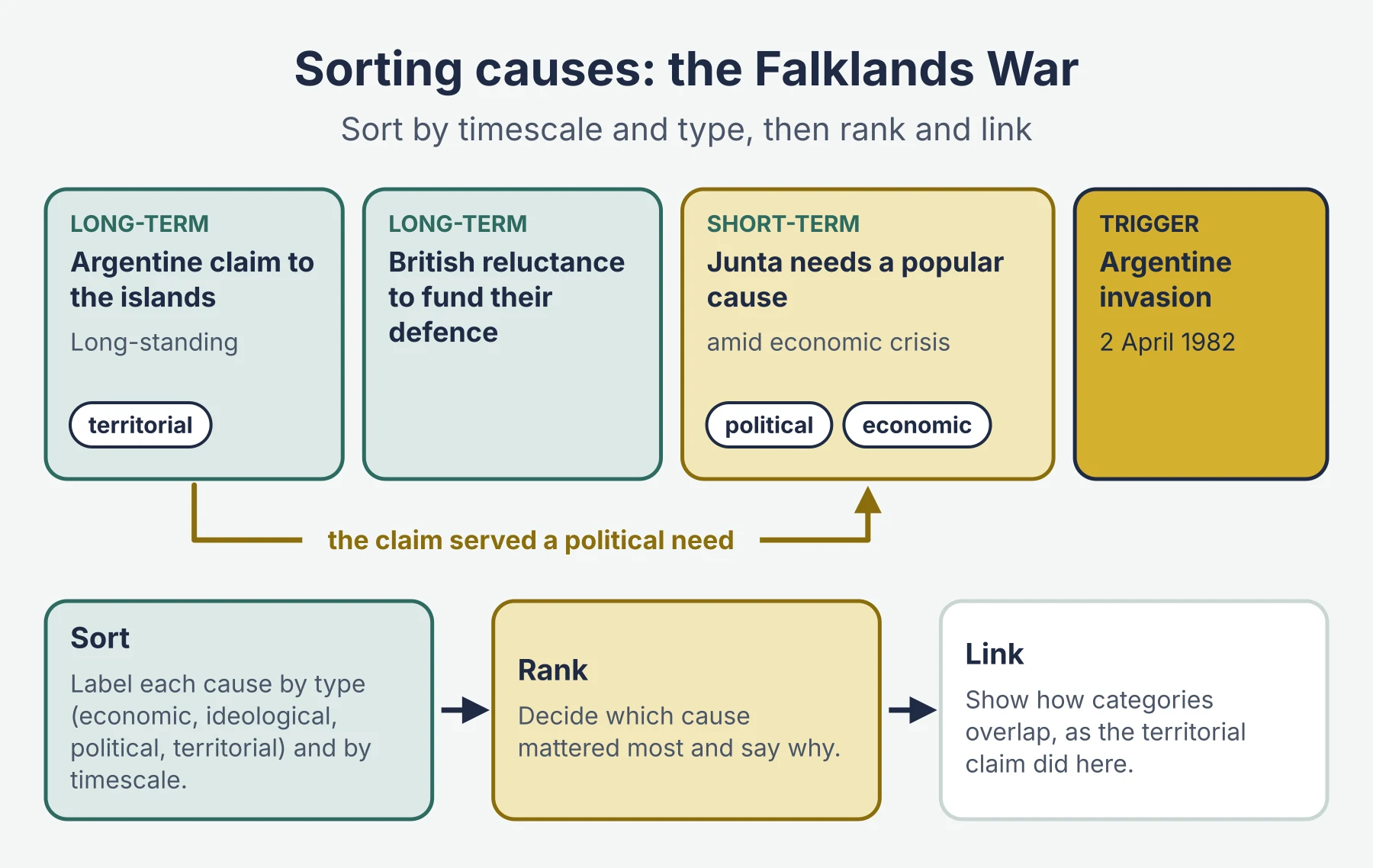
Sort causes by type and by timescale, then decide which mattered most.
| War | Long-term causes | Short-term causes and trigger |
|---|---|---|
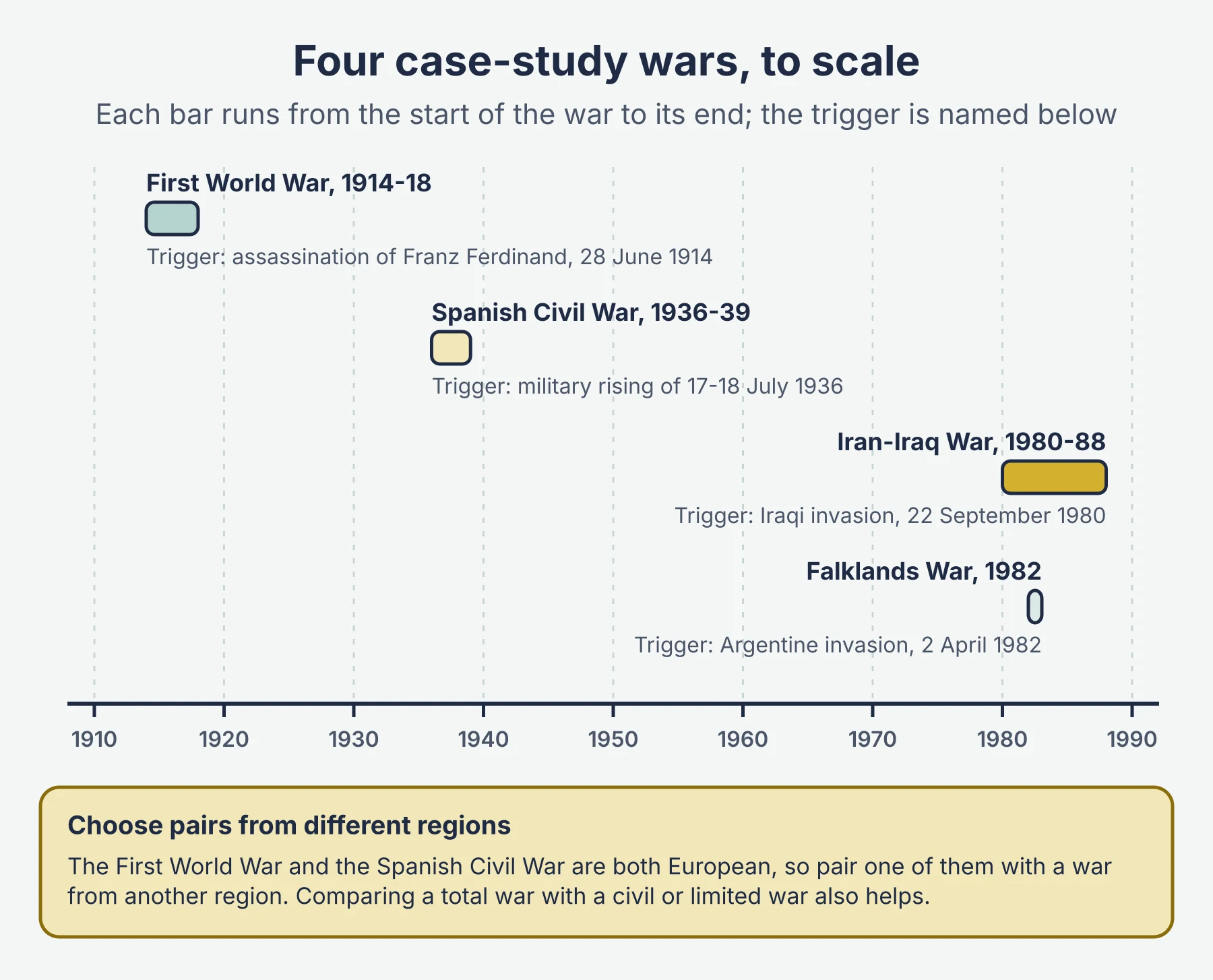
| First World War (1914-18) | Alliance system; imperial and naval rivalry; nationalism in the Balkans; militarism and war plans | Assassination of Franz Ferdinand (28 June 1914); Austrian ultimatum to Serbia; Russian mobilization; the Schlieffen Plan’s invasion of Belgium |
| Spanish Civil War (1936-39) | Land inequality; regional nationalism (Catalonia, the Basque Country); conflict over the Church and the army; polarized politics | Popular Front victory (February 1936); political violence; murder of Calvo Sotelo; military rising of 17-18 July 1936 |
| Falklands War (1982) | Long-standing Argentine claim to the islands; British reluctance to fund their defence | The junta’s need for a popular cause amid economic crisis; Argentine invasion (2 April 1982) |
| Iran-Iraq War (1980-88) | Border disputes, especially over the Shatt al-Arab waterway; Arab-Persian rivalry | Fear in Baghdad of Iran’s Islamic revolution spreading to Iraq’s Shia majority; Iraqi invasion (22 September 1980) |
The “ideological” category matters most in civil wars and in the Second World War; “territorial” in interstate wars such as the Falklands. Show how categories overlap: the junta’s territorial claim served a political need.
Practices: why the winner won
Link each practice to the outcome.
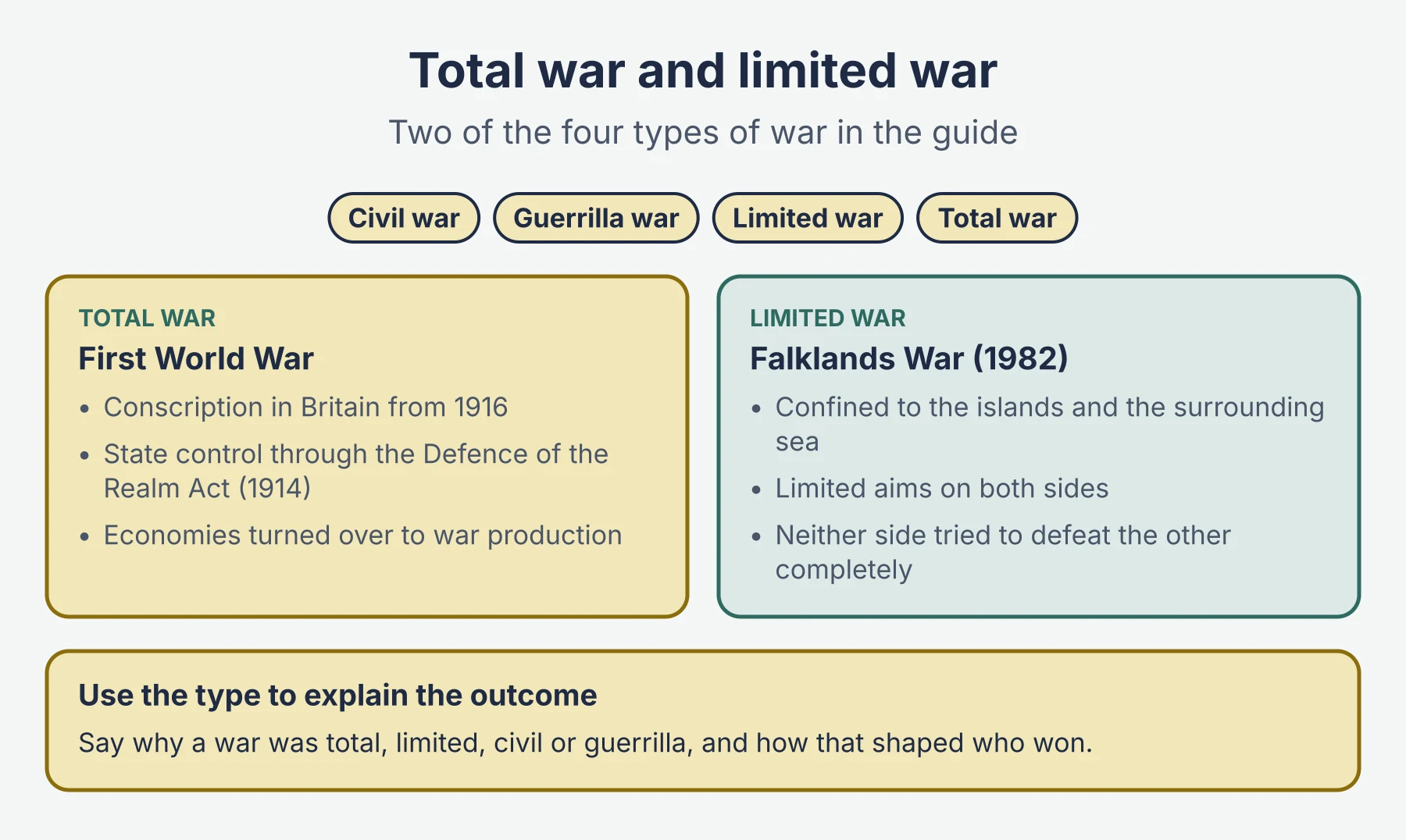
- Type of war. The First World War became a total war: conscription in Britain from 1916, state control through the Defence of the Realm Act (1914), economies turned over to war production. The Falklands was a limited war: confined to the islands and surrounding sea, with limited aims on both sides.
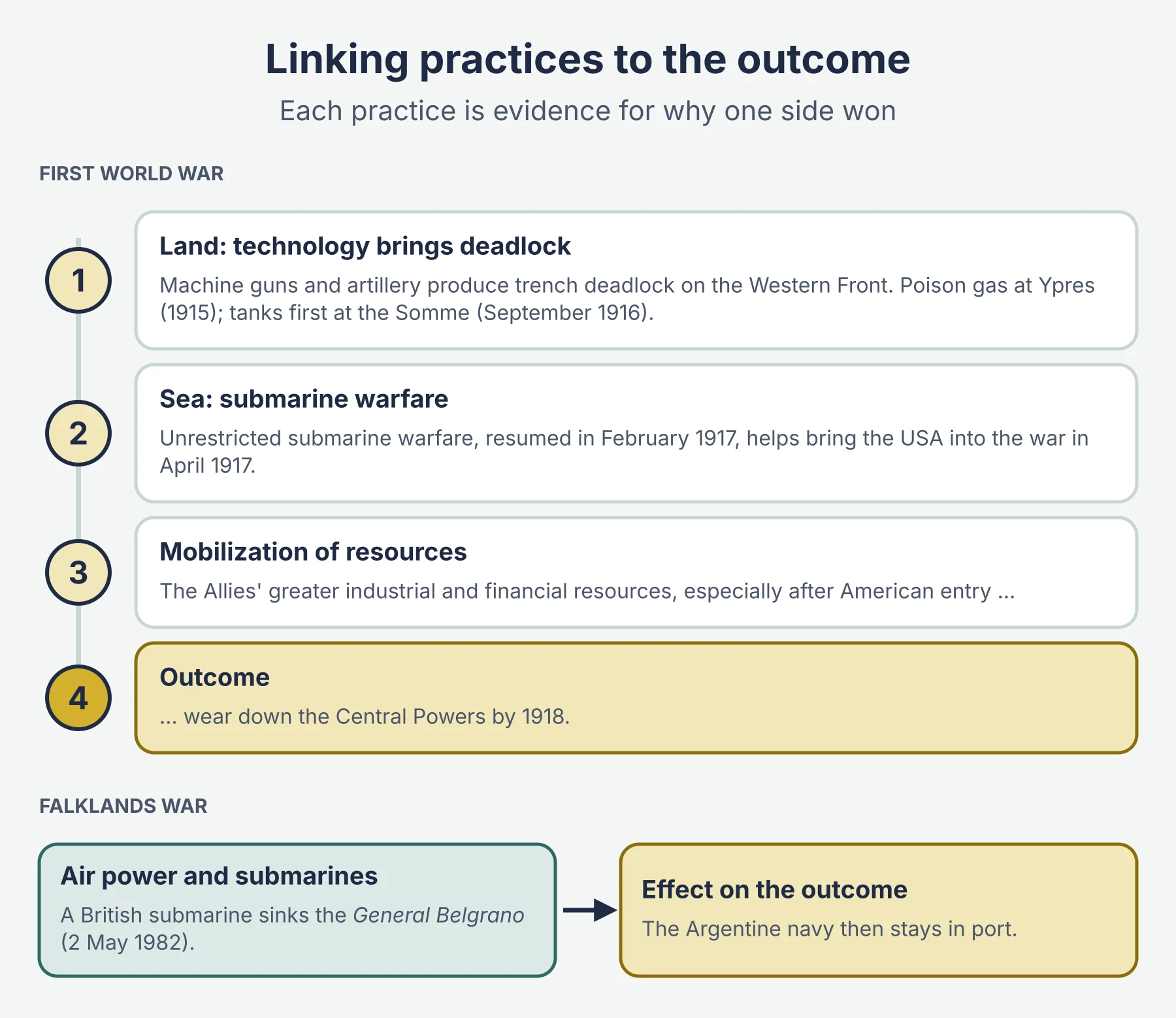
- Technology and theatres. Machine guns and artillery produced trench deadlock on the Western Front; poison gas was used at Ypres (1915) and tanks first appeared at the Somme (September 1916). At sea, unrestricted submarine warfare (resumed in February 1917) helped bring the USA into the war in April 1917. In the Falklands, air power and submarines were decisive: a British submarine sank the General Belgrano (2 May 1982), and the Argentine navy then stayed in port.
- Mobilization of resources. The Allies’ greater industrial and financial resources, especially after American entry, wore down the Central Powers by 1918.
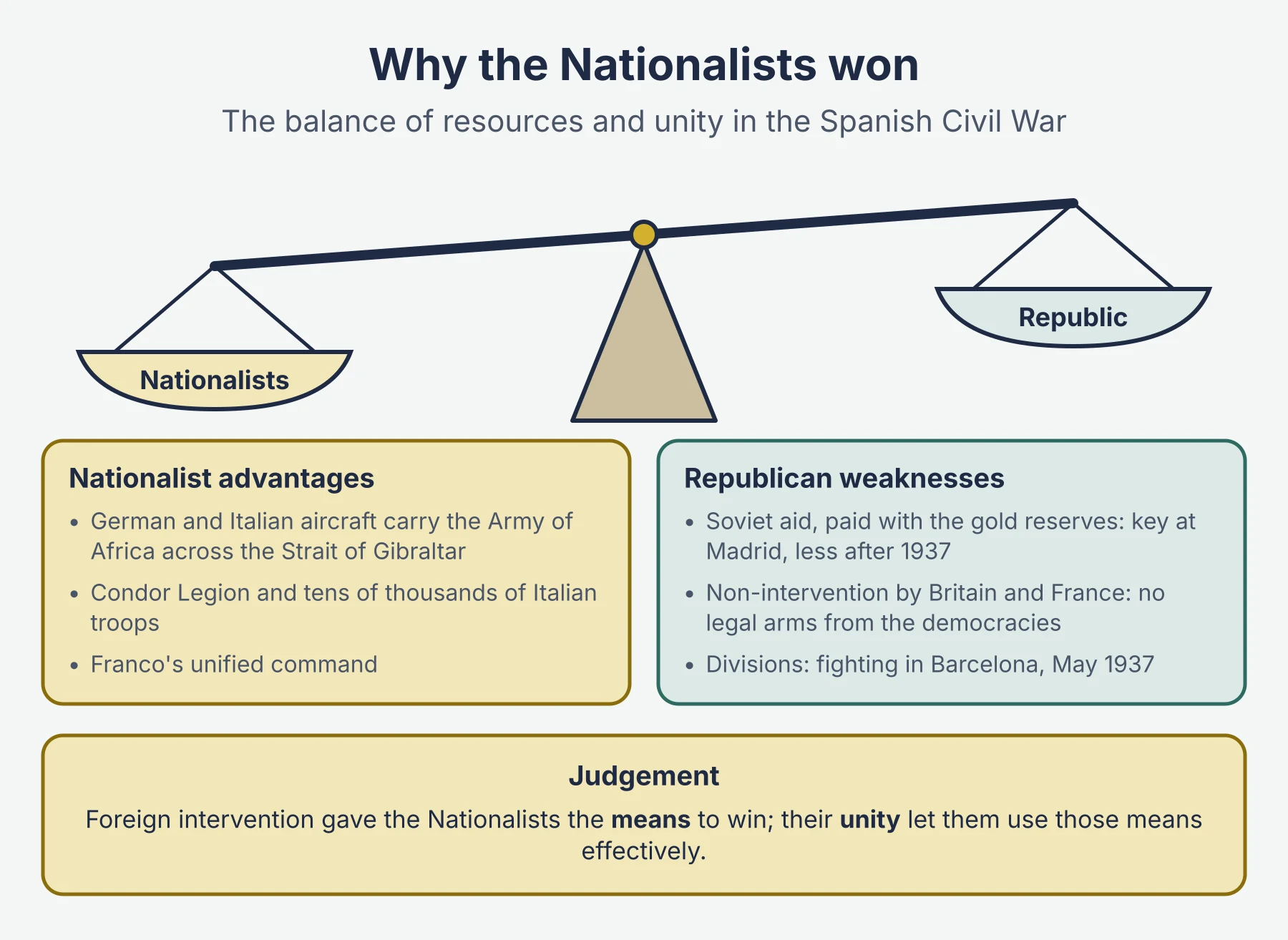
- Foreign involvement. In Spain, German and Italian aid to the Nationalists (including the Condor Legion that bombed Guernica on 26 April 1937) outweighed Soviet aid to the Republic, while Britain and France pursued non-intervention.
Effects: wider than the peace treaty
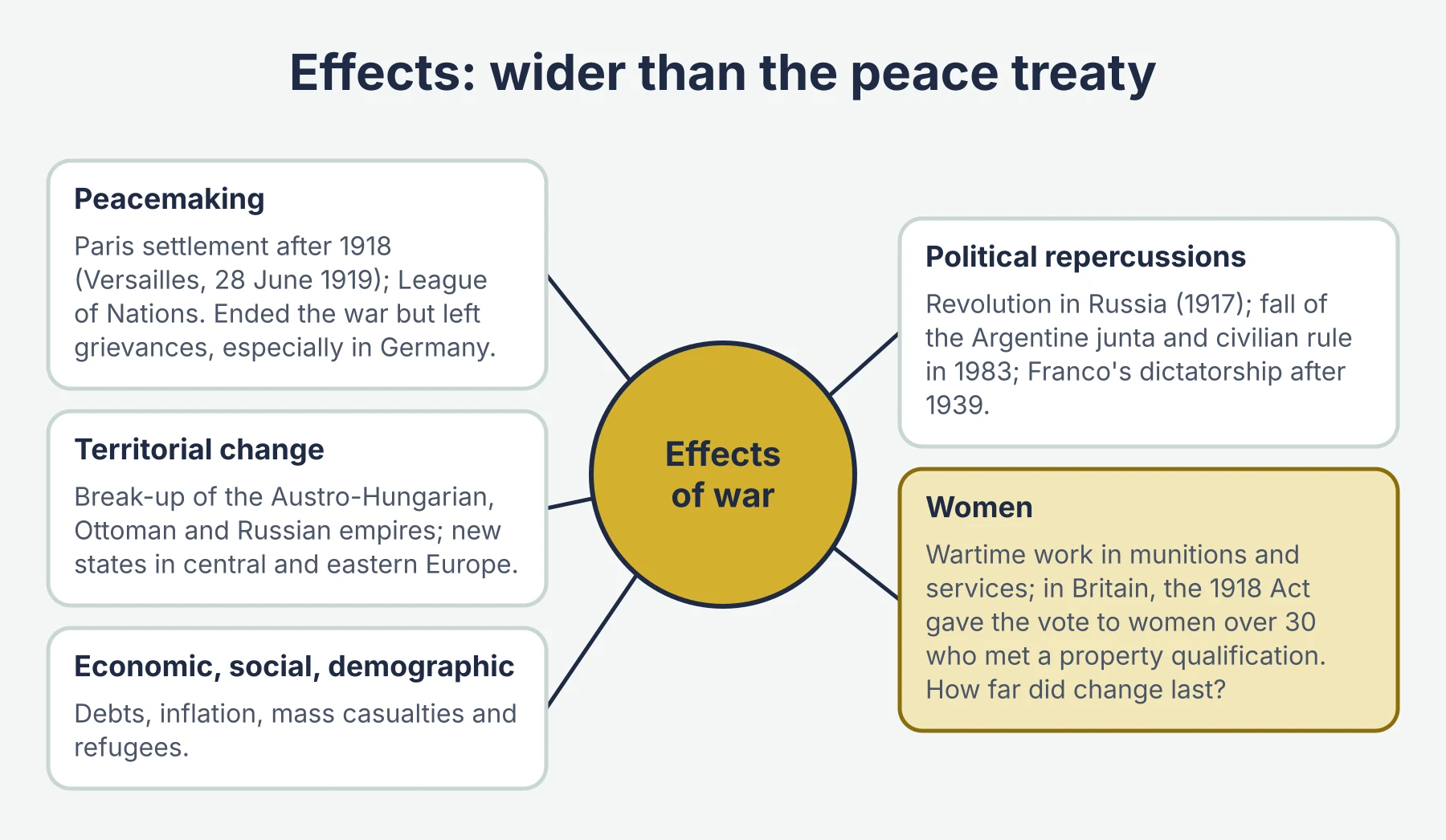
- Peacemaking: the Paris peace settlement after 1918 (Versailles, signed 28 June 1919, and the other treaties); the League of Nations. Evaluate success: it ended the war but left grievances, particularly in Germany.
- Territorial change: the break-up of the Austro-Hungarian, Ottoman and Russian empires; new states in central and eastern Europe.
- Political repercussions: revolution in Russia (1917); the fall of the Argentine junta after the Falklands defeat and the return to civilian rule in 1983; Franco’s dictatorship after 1939.
- Economic, social and demographic impact: debts, inflation, mass casualties and refugees.
- Women: wartime work in munitions and services; in Britain, the Representation of the People Act (1918) gave the vote to women over 30 who met a property qualification. Ask how far change lasted after demobilization.
Worked example: an annotated paragraph on outcome
Question: “Examine the reasons for the Nationalist victory in the Spanish Civil War.”
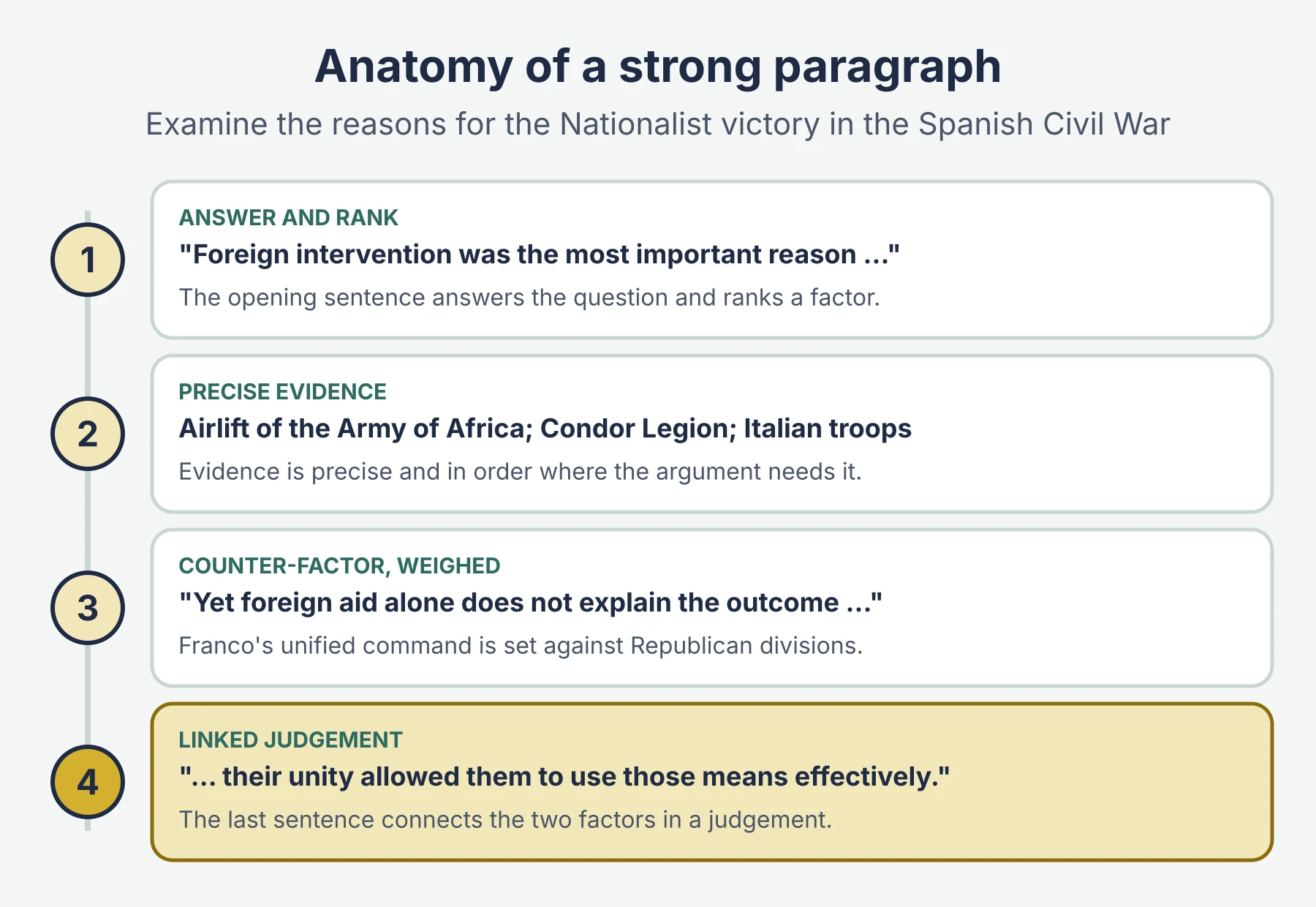
“Foreign intervention was the most important reason for the Nationalist victory because it determined the balance of military resources at each stage of the war. German and Italian transport aircraft carried Franco’s Army of Africa across the Strait of Gibraltar in the first weeks of the war, when the Republican navy blocked the sea route, giving the Nationalists their most effective troops on the mainland. Thereafter, the Condor Legion and tens of thousands of Italian troops supplied air power and equipment that the Republic could not match, since Britain and France’s policy of non-intervention denied it legal arms purchases from the democracies. Soviet aid, paid for with the Spanish gold reserves, was significant in the defence of Madrid but diminished after 1937. Yet foreign aid alone does not explain the outcome: Franco’s unified command contrasted with the Republic’s divisions, which erupted in fighting between Republican factions in Barcelona in May 1937. Foreign intervention gave the Nationalists the means to win; their unity allowed them to use those means effectively.”
Why it works: the opening sentence answers the question and ranks a factor; the evidence is precise and chronological where the argument needs it; a counter-factor is introduced and weighed; the final sentence connects the two factors in a judgement.
Common mistakes
- Describing battles. Battles matter only as evidence for why one side won or what the war changed.
- Mixing up causes of war and causes of victory. Read the question carefully.
- Ignoring the type of war. Explain why a war was total, limited, civil or guerrilla, and how this shaped the outcome.
- Treating “effects” as only the peace treaty. Political, economic, social and demographic effects and the role of women are all in the guide.
- Unsupported numbers. Use casualty figures only if you are certain of them; otherwise describe the scale.
- Same-region pairs. The First World War and the Spanish Civil War are both European.
Exam technique
- “Discuss the causes of…”: categorize by type and timescale, rank, and show links.
- “Examine the reasons for the outcome of…”: weigh strategy, resources, leadership, foreign involvement and the opponent’s weaknesses.
- “To what extent did X change the role of women?”: separate wartime change from lasting change.
- “Compare and contrast the effects of two wars…”: theme by theme, with both wars in every paragraph.
Each essay is marked out of 15 under the markbands set out in the world history topics study guide.
Use with the other pages
Learn the timelines with the 20th-century wars revision notes, then apply them in the 20th-century wars practice questions.
Check your understanding
- What are the three parts of the topic? Causes; practices of war and their impact on the outcome; effects.
- Name the four types of war listed in the guide. Civil, guerrilla, limited and total war.
- What does “impact on the outcome” require you to explain? Why one side won and the other lost.
- Why was the Falklands War a limited war? It was confined to a small area and both sides had limited aims; neither tried to defeat the other completely.
- Give one reason the Nationalists won the Spanish Civil War. German and Italian aid, the effect of non-intervention, Franco’s unified command, or Republican divisions.
- What political effect did the Falklands War have in Argentina? The junta fell and civilian rule returned in 1983.
Get free revision emails (optional)
Occasional emails with practice questions, worked explanations and links to free resources for the qualification and subjects you choose. No spam, and you can unsubscribe from any email. The free tools on this site never need an email.
Related resources
-
Practice questions
IB DP History: The Six Key Concepts – Practice Questions
Original practice questions with worked answers on the six key concepts of IB DP History (first assessed 2017), from spotting the concept to essay plans.
World History · International Baccalaureate · IB
Try questions -
Practice questions
IB DP History (DP History): Causes and effects of 20th-century wars – Practice Questions
Twelve original IB History practice questions on the causes, practices and effects of 20th-century wars, with mark-scheme answers and a full Paper 2 essay.
World History · International Baccalaureate · IB
Try questions -
Revision notes
IB DP History (DP History): Causes and effects of 20th-century wars – Revision Notes
Condensed IB History notes on 20th-century wars: causes, types of war, reasons for outcomes, effects including on women, key terms and a self-test.
World History · International Baccalaureate · IB
Revise topic
Related articles
-
teaching
A Level tuition in Dubai: Cambridge or Pearson Edexcel International A Level?
Schools in Dubai and Abu Dhabi teach either Cambridge International AS & A Level or Pearson Edexcel International A Level. How the two are structured, why it matters for tuition, and how online classes from Lahore work.
9 October 2026
-
curriculum guides
Choosing subjects at IGCSE and A Level
How subject choices at 14 and 16 affect university options later, and how to keep pathways open without overloading a timetable.
28 July 2026
Studying this with a teacher
Working through World History IB?
This page is free and stays free. If you would rather be taught it, Marlbridge runs World History classes one-to-one, online in your own time zone. The first trial class is free. WhatsApp replies within an hour (8am–11pm Pakistan time, every day); email the same day.
IB World History teachers at Marlbridge
