
Revision Notes
IB DP History (DP History): Causes and effects of 20th-century wars – Revision Notes
Condensed IB History notes on 20th-century wars: causes, types of war, reasons for outcomes, effects including on women, key terms and a self-test.
- Subject
- World History
- Level
- IB
- Topic
- Topic 2: World history topics
- Author
- Marlbridge Academic Team
- Updated
- Reviewed by
- Azam Siddique (what this means)
Aligned to International Baccalaureate IB Diploma Programme World History (DP History), First assessment 2017. Official specification .
Syllabus page (what it covers and how it is assessed): IB Diploma Programme World History.
Syllabus points this page covers
DP History
- 11 Causes and effects of 20th-century wars
Found an error? Report a correction.
Need help with this topic? Request a free trial class for IB Diploma Programme World History (DP History).
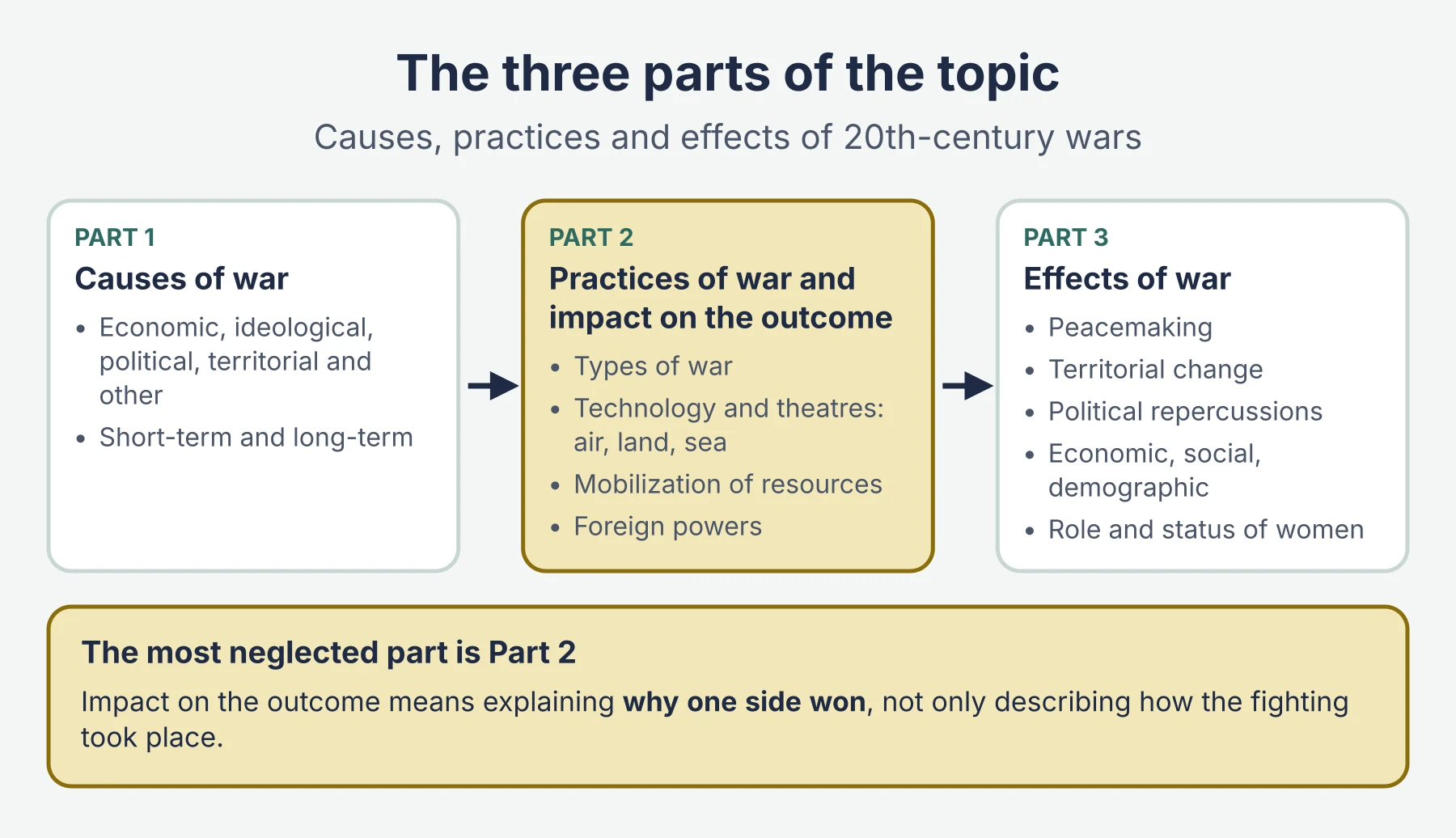
These notes condense world history topic 11 for Paper 2: the causes of twentieth-century wars, how they were fought and why they ended as they did, and their effects. The analysis behind them is in the 20th-century wars study guide; practise applying them with the 20th-century wars practice questions.
The guide’s three parts
| Part | Headings |
|---|---|
| Causes | Economic, ideological, political, territorial and other causes; short- and long-term causes |
| Practices and impact on outcome | Types of war (civil, guerrilla, limited, total); technology; theatres of war (air, land, sea); mobilization of human and economic resources; influence or involvement of foreign powers |
| Effects | Peacemaking; territorial changes; political repercussions; economic, social and demographic impact; role and status of women |
Four types of war
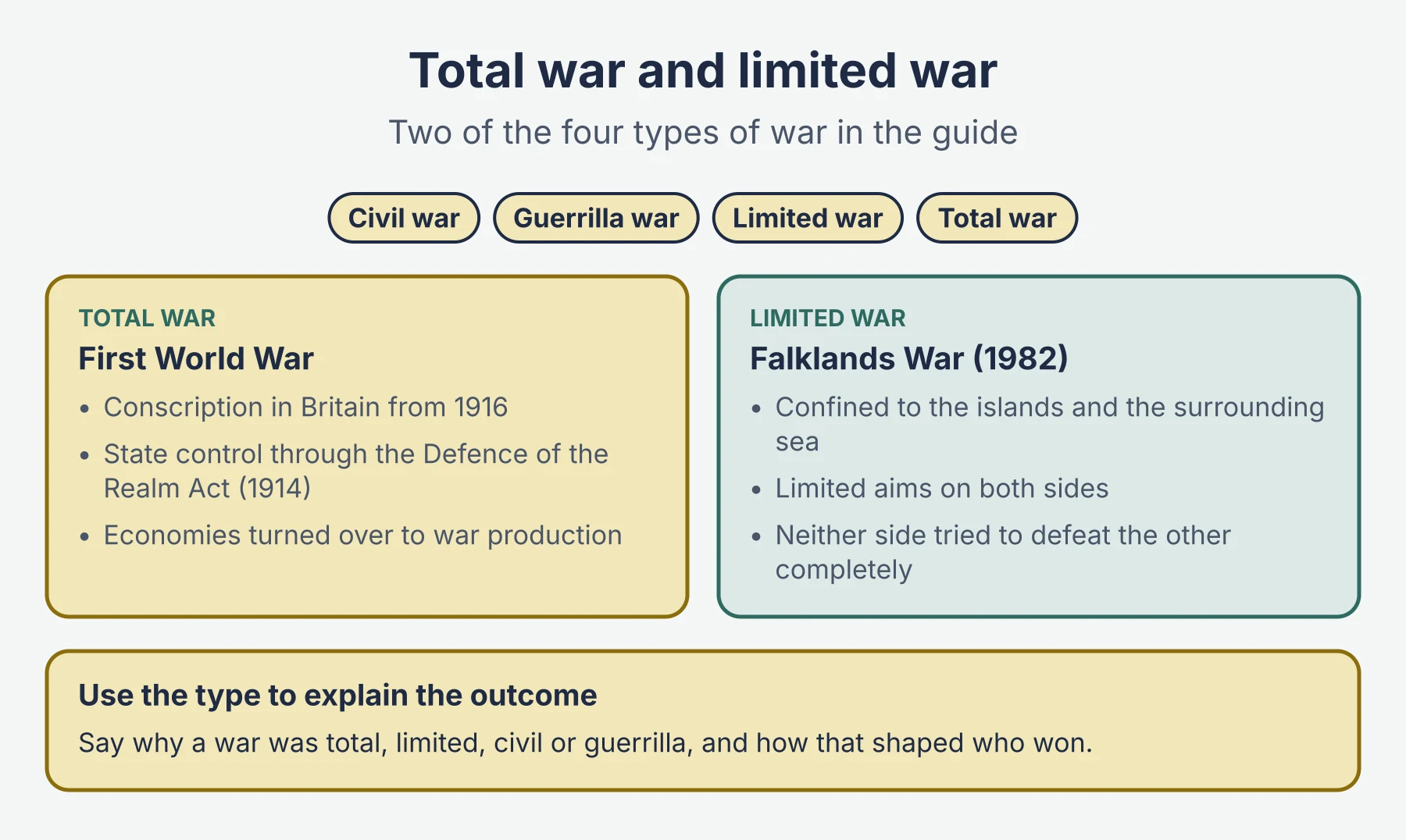
| Type | Definition | Example |
|---|---|---|
| Total war | The whole society and economy mobilized; civilians become targets | First and Second World Wars |
| Limited war | Restricted aims, area or means | Falklands War (1982) |
| Civil war | War between groups within one state | Spanish Civil War (1936-39); Chinese Civil War (1946-49) |
| Guerrilla war | Irregular forces avoid open battle, rely on mobility and local support | Communist forces in China before 1946; the FLN in Algeria |
A single conflict can combine types: the Chinese Civil War began with guerrilla methods and ended with large conventional battles.
Case notes
First World War (1914-1918)
- Causes: alliances (Triple Alliance, Triple Entente); Anglo-German naval race; imperial rivalry; Balkan nationalism; war plans that made mobilization mean war.
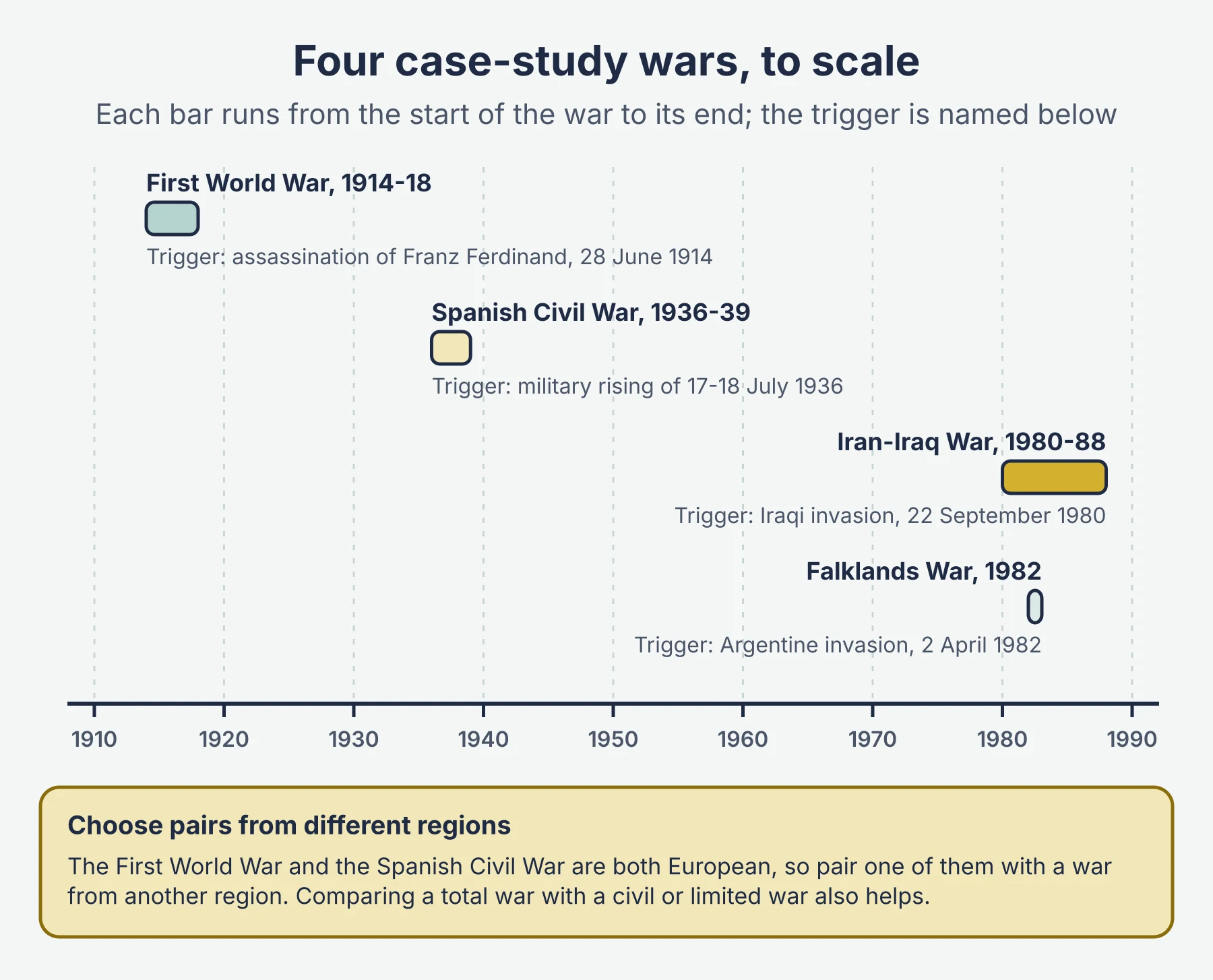
- Trigger: assassination of Franz Ferdinand in Sarajevo, 28 June 1914.
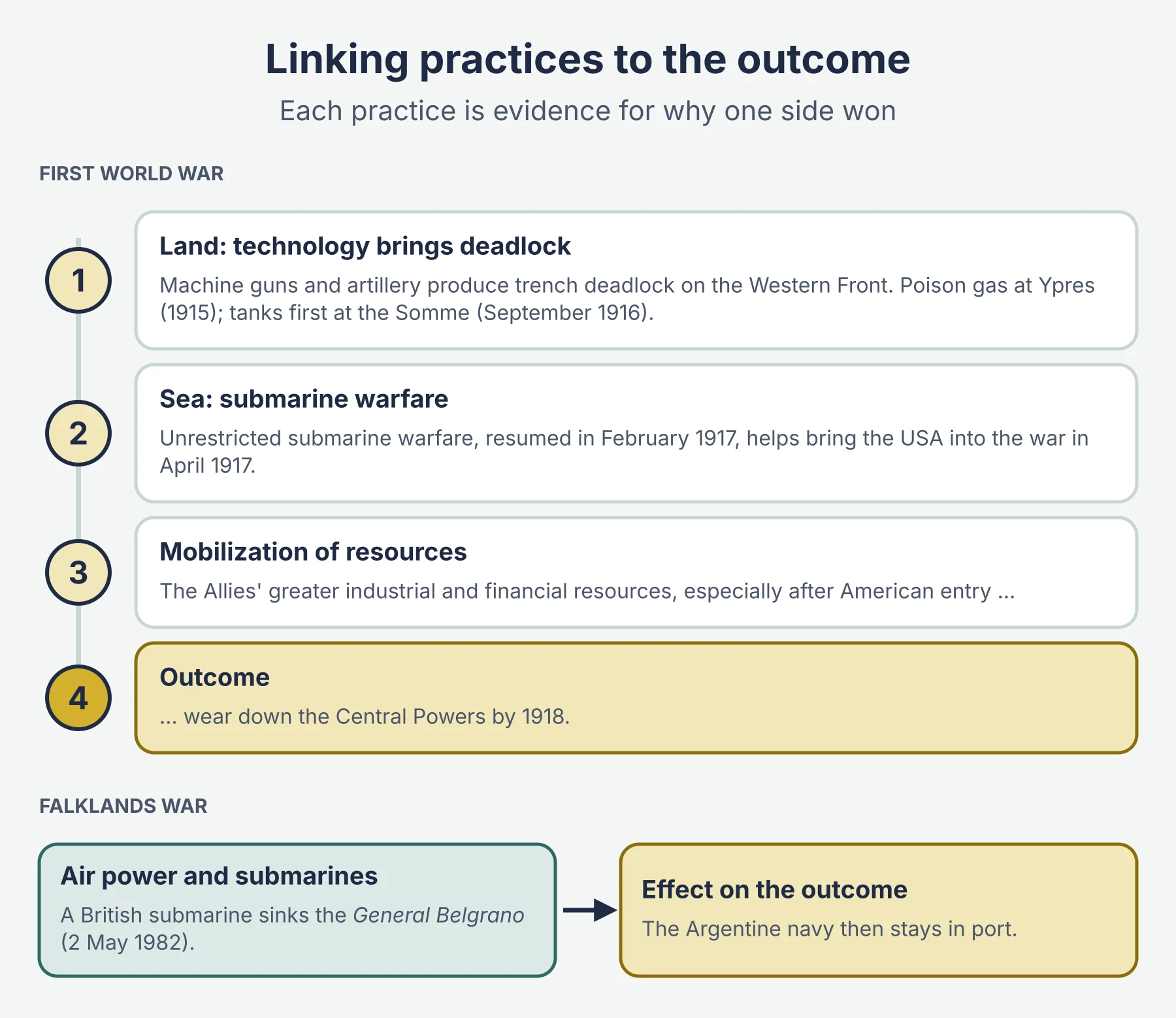
- Practices: trench warfare; gas (Ypres, 1915); tanks (the Somme, 1916); unrestricted submarine warfare (resumed February 1917); conscription in Britain from 1916; Defence of the Realm Act (1914).
- Outcome: US entry (April 1917); failure of the German spring offensive (1918); Allied advance; armistice 11 November 1918.
- Effects: Versailles (28 June 1919) and the other Paris treaties; the League of Nations; collapse of four empires (German, Austro-Hungarian, Russian, Ottoman); revolution in Russia; women’s suffrage in several countries.
Spanish Civil War (1936-1939)
- Causes: land inequality; Church and army against reformers; regional nationalism; polarization after the Popular Front victory (February 1936).
- Trigger: military rising, 17-18 July 1936.
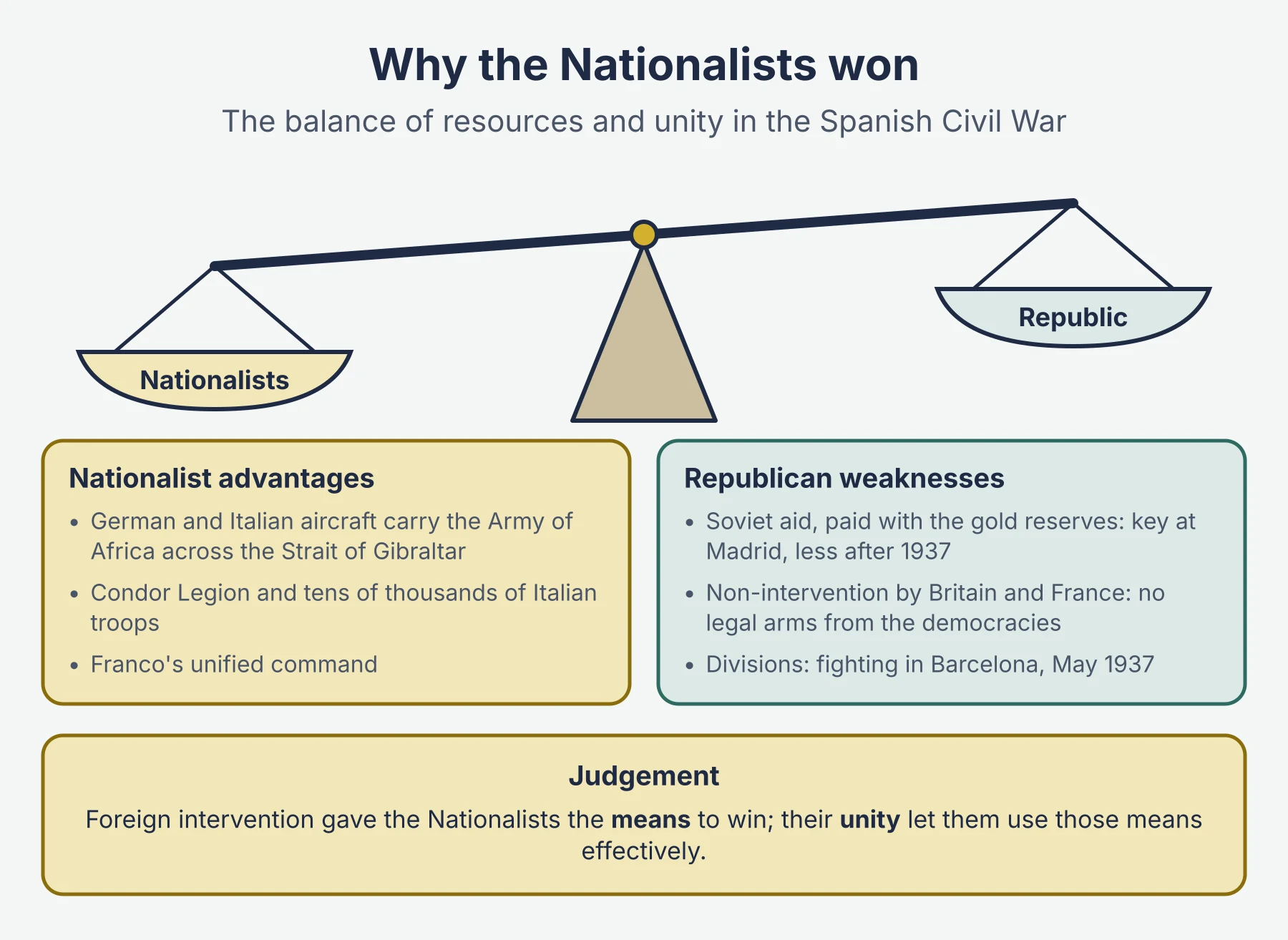
- Practices: German and Italian aid to the Nationalists; Soviet aid and the International Brigades for the Republic; Non-Intervention Agreement; bombing of Guernica (26 April 1937); Battle of the Ebro (1938).
- Outcome: Nationalist victory, 1 April 1939: foreign aid, unified command under Franco, Republican divisions (May Days, Barcelona, 1937).
- Effects: Franco’s dictatorship; repression and exile of Republicans; economic ruin.
Falklands War (1982)
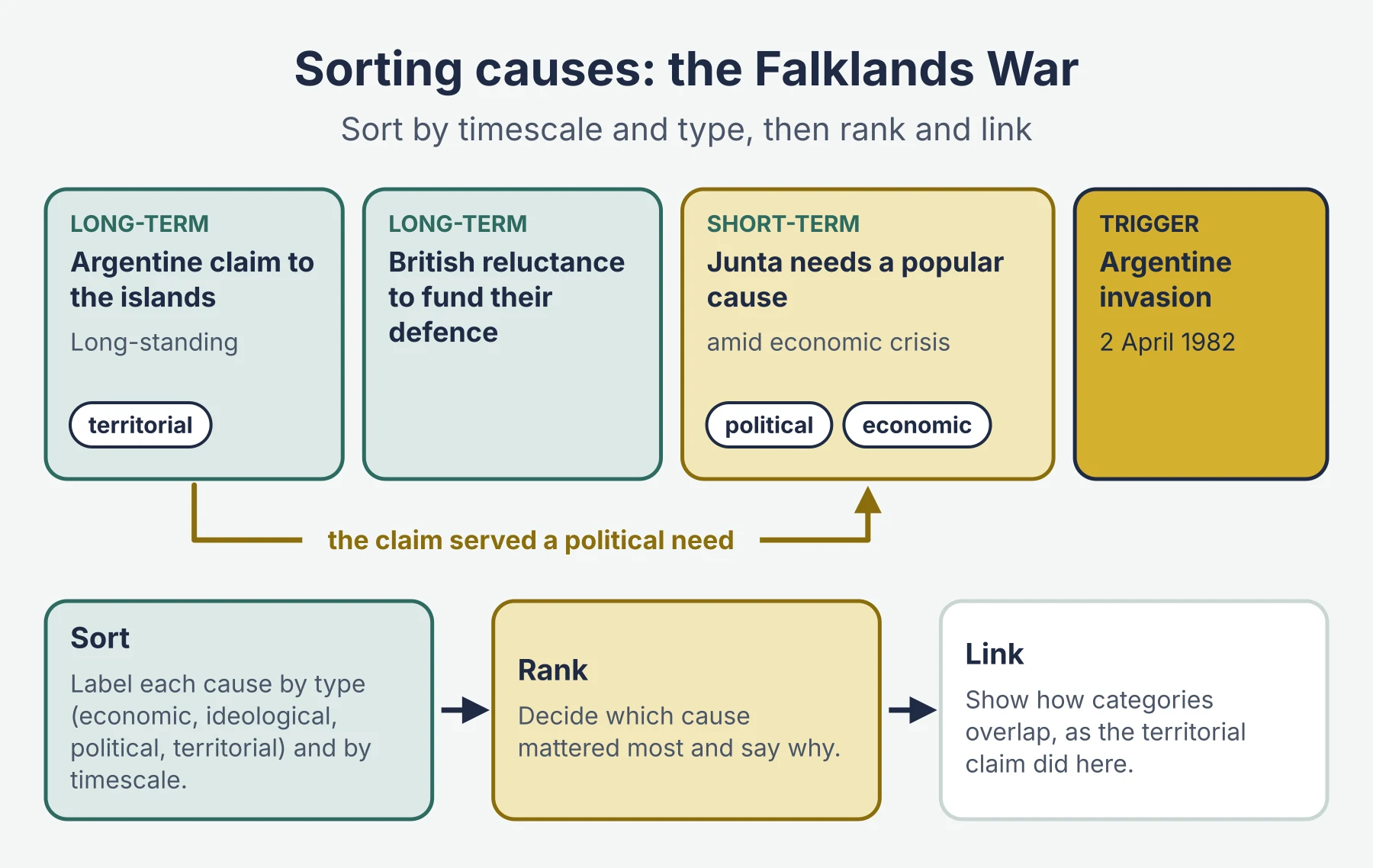
- Causes: Argentine sovereignty claim; the junta’s economic and political crisis; British signals of reduced commitment.
- Trigger: Argentine invasion, 2 April 1982.
- Practices: British naval task force; sinking of the General Belgrano (2 May); Argentine air attacks on British ships; landings at San Carlos; Argentine surrender at Stanley (14 June).
- Effects: fall of the junta and return to civilian rule in Argentina (1983); boost to Thatcher’s government.
Iran-Iraq War (1980-1988)
- Causes: dispute over the Shatt al-Arab; Saddam Hussein’s ambition for regional leadership; fear of revolutionary Iran.
- Practices: trench warfare and mass infantry offensives; Iraqi use of chemical weapons; attacks on cities and on oil tankers in the Gulf; foreign arms supplies to both sides.
- Outcome: stalemate; ceasefire under UN Security Council Resolution 598, accepted by Iran in 1988.
- Effects: huge casualties and economic damage with no territorial gain; Iraqi debts that formed part of the background to the invasion of Kuwait (1990).
Key terms
| Term | Meaning |
|---|---|
| Mobilization | Organizing armed forces and the economy for war |
| Attrition | Wearing the enemy down through continuous losses |
| Home front | The civilian population and economy in wartime |
| Conscription | Compulsory military service |
| Non-intervention | Policy of not taking sides in another state’s war (Britain and France in Spain) |
| Armistice | An agreement to stop fighting, before a peace treaty |
| Self-determination | The right of peoples to choose their own state |
| Demographic impact | Effects on population: deaths, births, migration and refugees |
Exam traps
- Causes of war versus causes of victory. Different questions; different essays.
- Narrating campaigns. Use battles as evidence for an argument about outcome or effects.
- Short-term effects only. Show which effects lasted.
- Women as a footnote. The guide names the role and status of women; prepare a paragraph for each war you study.
- Same-region examples when two regions are required.
Self-test
- Name the five categories of cause in the guide. Economic, ideological, political, territorial and other.
- What triggered the First World War? The assassination of Franz Ferdinand on 28 June 1914.
- What was the Defence of the Realm Act? A 1914 British law giving the government wide powers over the economy and civilian life in wartime.
- Why was the resumption of unrestricted submarine warfare significant? It helped bring the USA into the war in April 1917.
- What began the Spanish Civil War? The military rising of 17-18 July 1936.
- What was the Condor Legion? The German air and military unit that fought for the Nationalists, which bombed Guernica.
- Give two reasons for Nationalist victory. Any two: German and Italian aid, non-intervention, Franco’s unified command, Republican divisions.
- When did Argentina invade the Falklands, and when did its forces surrender? 2 April and 14 June 1982.
- What political effect did defeat have in Argentina? The junta fell and civilian rule returned in 1983.
- What was the main territorial cause of the Iran-Iraq War? The dispute over the Shatt al-Arab waterway.
- How did the Iran-Iraq War end? In a ceasefire under UN Resolution 598, accepted by Iran in 1988.
- Give one change in the status of women after the First World War. The vote for women over 30 meeting a property qualification in Britain (1918), or women’s suffrage in Germany (1918-19).
Get free revision emails (optional)
Occasional emails with practice questions, worked explanations and links to free resources for the qualification and subjects you choose. No spam, and you can unsubscribe from any email. The free tools on this site never need an email.
Related resources
-
Practice questions
IB DP History: The Six Key Concepts – Practice Questions
Original practice questions with worked answers on the six key concepts of IB DP History (first assessed 2017), from spotting the concept to essay plans.
World History · International Baccalaureate · IB
Try questions -
Study guides
IB DP History (DP History): The Cold War: Superpower tensions and rivalries (20th century)
The Cold War for IB History Paper 2: superpower rivalry 1943-1991, the role of China, leaders and nations, crises compared, and the historians' debate.
World History · International Baccalaureate · IB
Read guide -
Practice questions
IB DP History (DP History): The Cold War: Superpower tensions and rivalries (20th century) – Practice Questions
Twelve original IB History Cold War practice questions on origins, China, leaders, nations, crises and the end of the Cold War, with mark-scheme answers.
World History · International Baccalaureate · IB
Try questions
Related articles
-
teaching
A Level tuition in Dubai: Cambridge or Pearson Edexcel International A Level?
Schools in Dubai and Abu Dhabi teach either Cambridge International AS & A Level or Pearson Edexcel International A Level. How the two are structured, why it matters for tuition, and how online classes from Lahore work.
9 October 2026
-
curriculum guides
Choosing subjects at IGCSE and A Level
How subject choices at 14 and 16 affect university options later, and how to keep pathways open without overloading a timetable.
28 July 2026
Studying this with a teacher
Working through World History IB?
This page is free and stays free. If you would rather be taught it, Marlbridge runs World History classes one-to-one, online in your own time zone. The first trial class is free. WhatsApp replies within an hour (8am–11pm Pakistan time, every day); email the same day.
IB World History teachers at Marlbridge
