
Study Guides
IB DP History (DP History): The Cold War: Superpower tensions and rivalries (20th century)
The Cold War for IB History Paper 2: superpower rivalry 1943-1991, the role of China, leaders and nations, crises compared, and the historians' debate.
- Subject
- World History
- Level
- IB
- Topic
- Topic 2: World history topics
- Author
- Marlbridge Academic Team
- Updated
- Reviewed by
- Azam Siddique (what this means)
Aligned to International Baccalaureate IB Diploma Programme World History (DP History), First assessment 2017. Official specification .
Syllabus page (what it covers and how it is assessed): IB Diploma Programme World History.
Syllabus points this page covers
DP History
- 12 The Cold War: Superpower tensions and rivalries (20th century)
Found an error? Report a correction.
Need help with this topic? Request a free trial class for IB Diploma Programme World History (DP History).
World history topic 12 studies the rivalry between the USA and the USSR, with China as a third major power, from the last years of the Second World War to the collapse of the Soviet Union in 1991. It is a global topic: the Cold War was fought in Europe, Asia, the Middle East, Africa and the Americas. You will study the overall development of superpower relations, the role of particular leaders and countries, and individual crises in depth.
What the topic covers
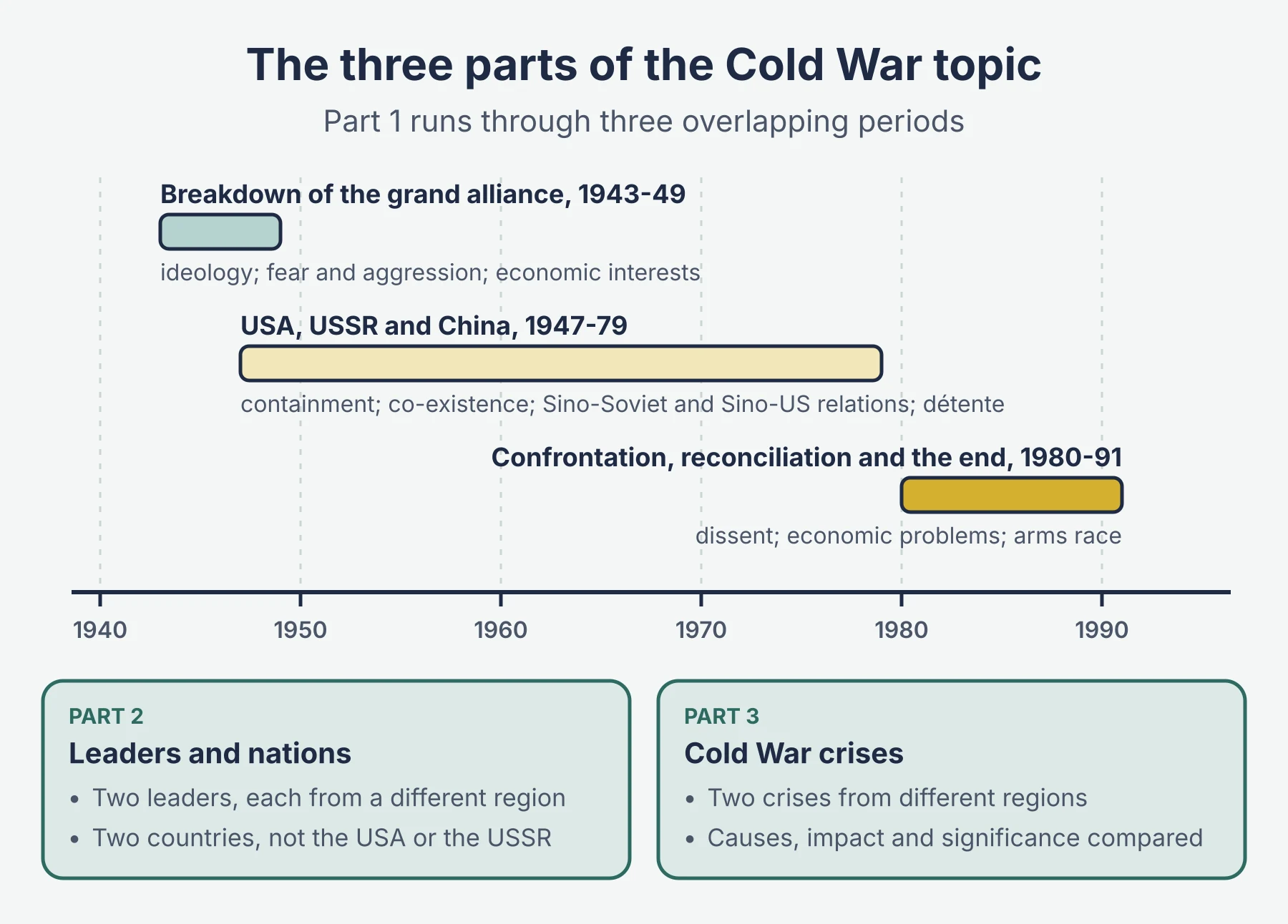
The IB History guide arranges the content in three parts.
- Rivalry, mistrust and accord.
- The breakdown of the grand alliance and the emergence of superpower rivalry in Europe and Asia (1943-1949): the role of ideology; fear and aggression; economic interests; a comparison of the roles of the USA and the USSR.
- The USA, USSR and China: superpower relations (1947-1979): containment; peaceful co-existence; Sino-Soviet and Sino-US relations; détente.
- Confrontation and reconciliation; reasons for the end of the Cold War (1980-1991): ideological challenges and dissent; economic problems; arms race.
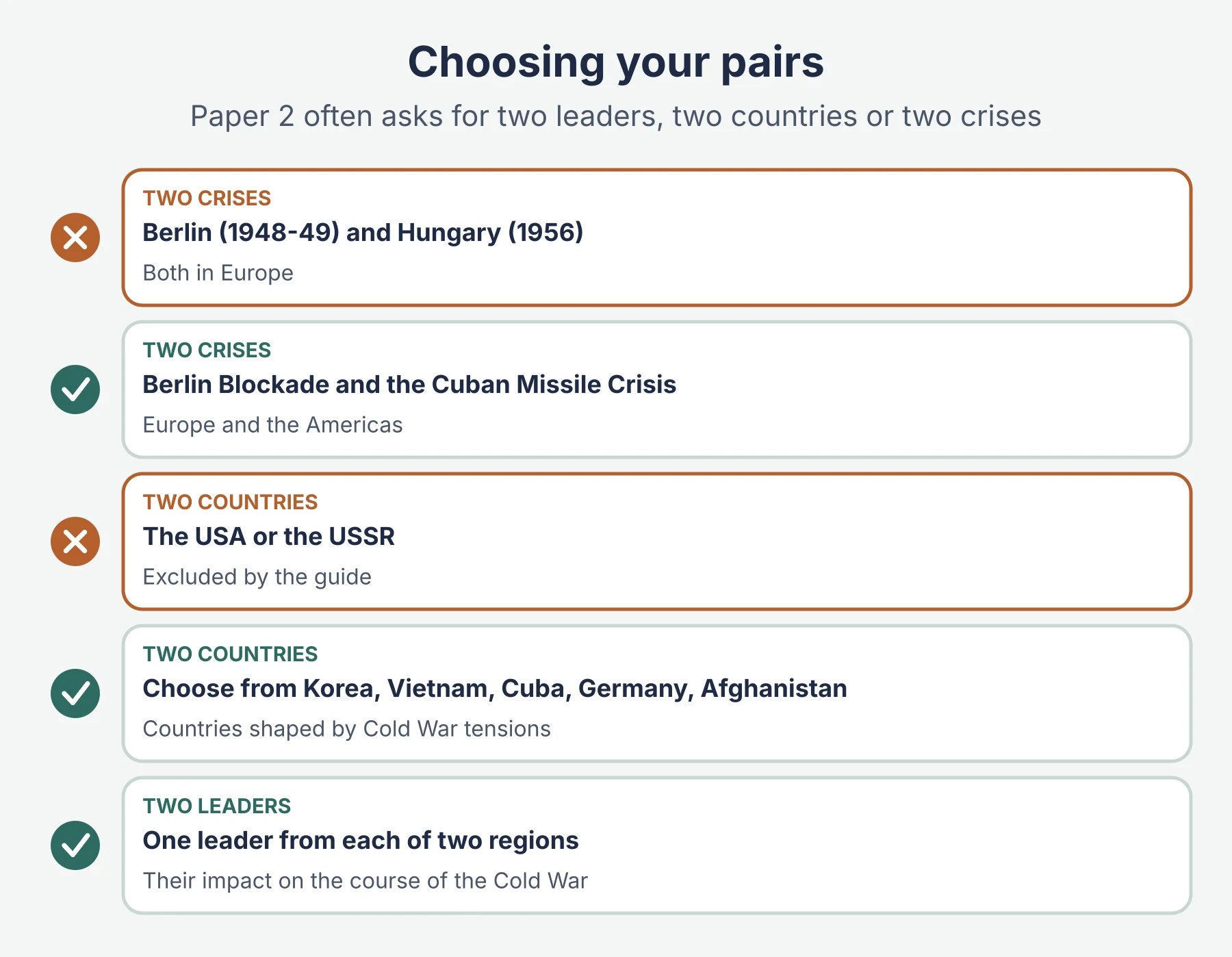
- Leaders and nations. The impact of two leaders, each chosen from a different region, on the course and development of the Cold War; the impact of Cold War tensions on two countries (excluding the USA and the USSR).
- Cold War crises. Detailed study of two Cold War crises from different regions: examination and comparison of their causes, impact and significance.
The second and third parts explain why Paper 2 questions on this topic often say “two leaders”, “two countries” or “two crises”, each chosen from a different region.
Key ideas
Origins: why the alliance broke down
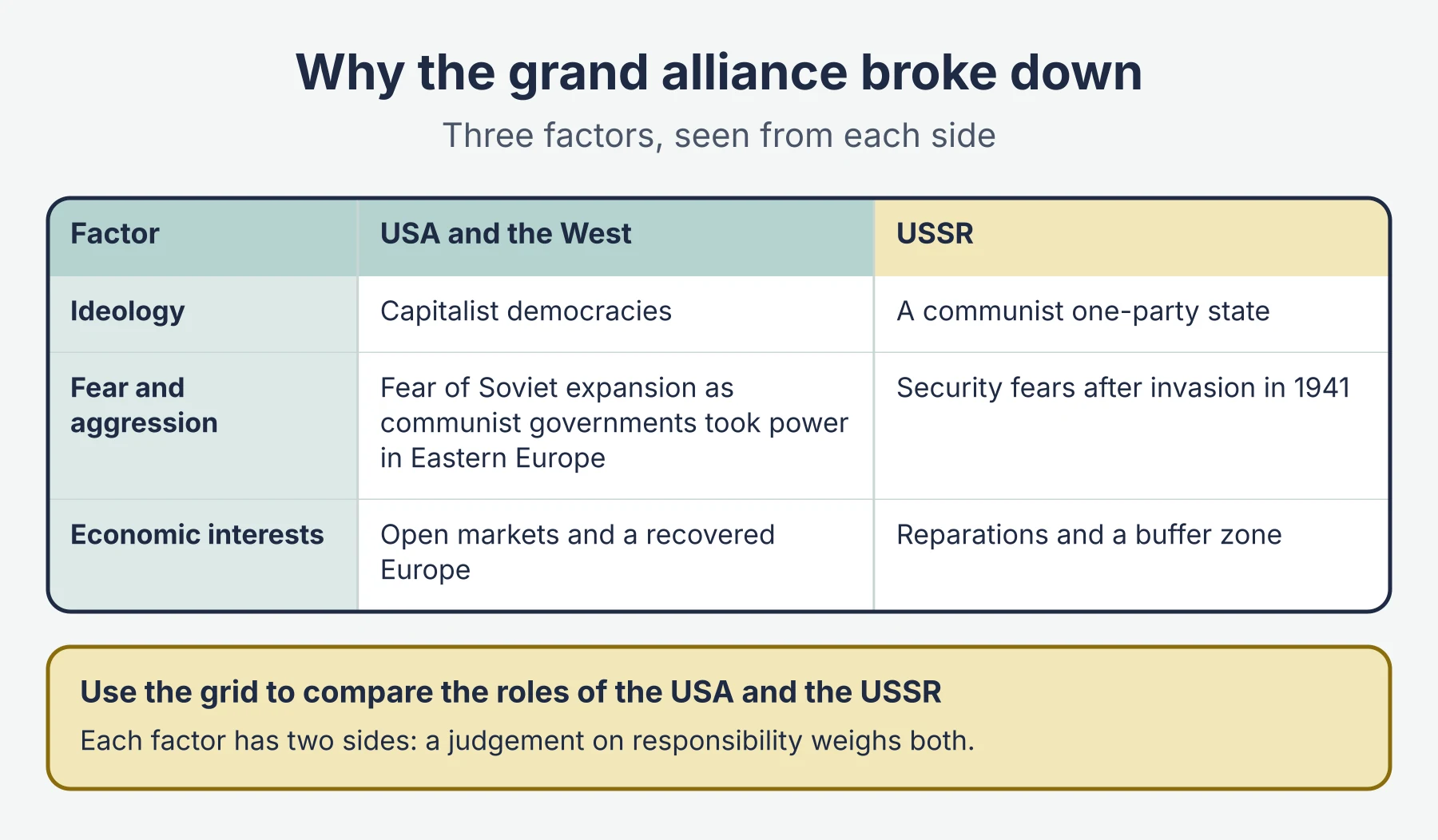
- Ideology: a communist one-party state against capitalist democracies.
- Fear and aggression: Soviet security fears after invasion in 1941; Western fears of Soviet expansion as communist governments took power in Eastern Europe.
- Economic interests: the USA wanted open markets and a recovered Europe; the USSR wanted reparations and a buffer zone.
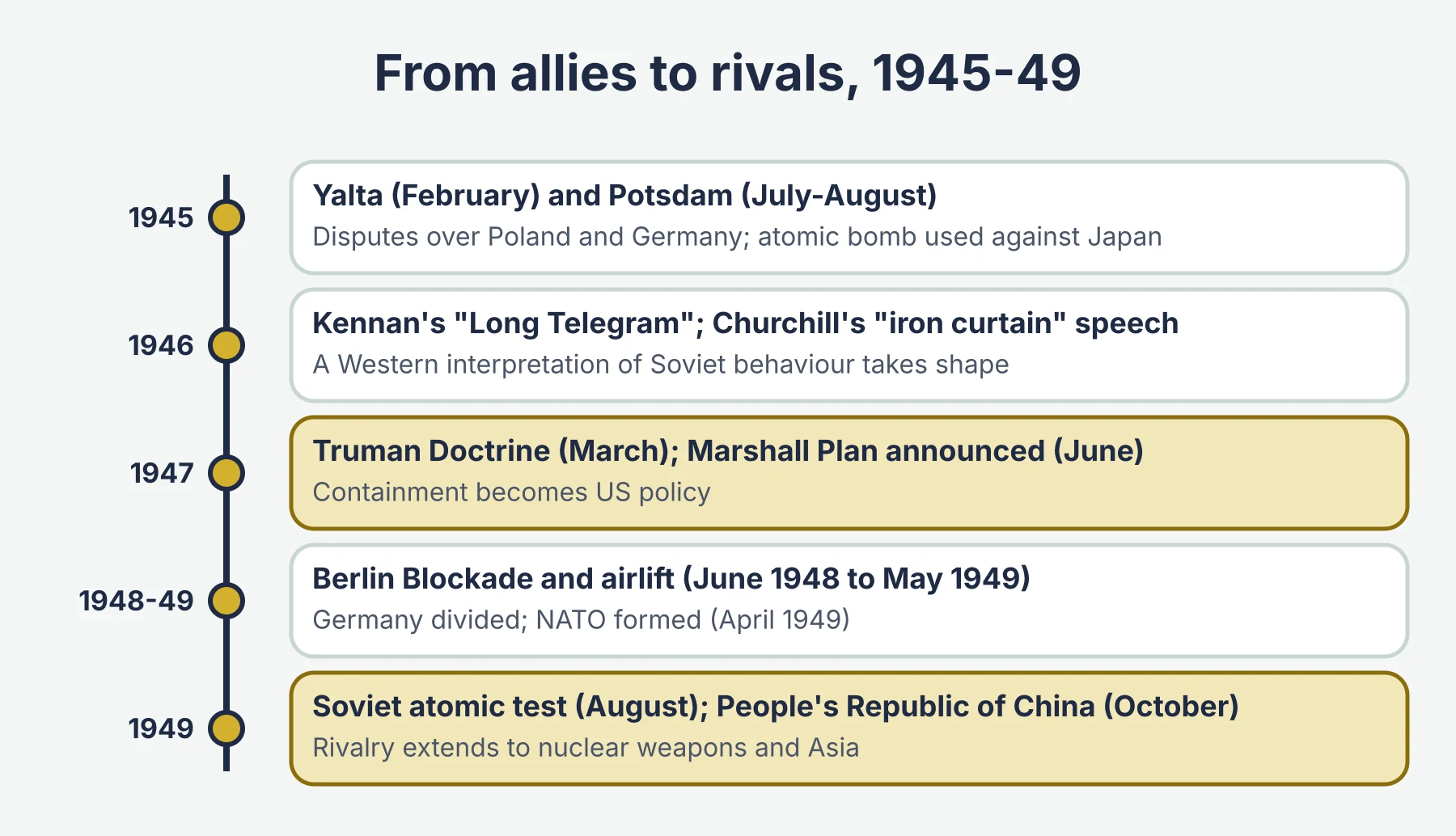
| Year | Event | Significance |
|---|---|---|
| 1945 | Yalta (February) and Potsdam (July-August) conferences | Disputes over Poland and Germany; atomic bomb used against Japan |
| 1946 | Kennan’s “Long Telegram”; Churchill’s “iron curtain” speech | A Western interpretation of Soviet behaviour takes shape |
| 1947 | Truman Doctrine (March); Marshall Plan announced (June) | Containment becomes US policy |
| 1948-49 | Berlin Blockade and airlift (June 1948 to May 1949) | Germany divided; NATO formed (April 1949) |
| 1949 | Soviet atomic test (August); People’s Republic of China (October) | Rivalry extends to nuclear weapons and Asia |
Containment, co-existence and détente
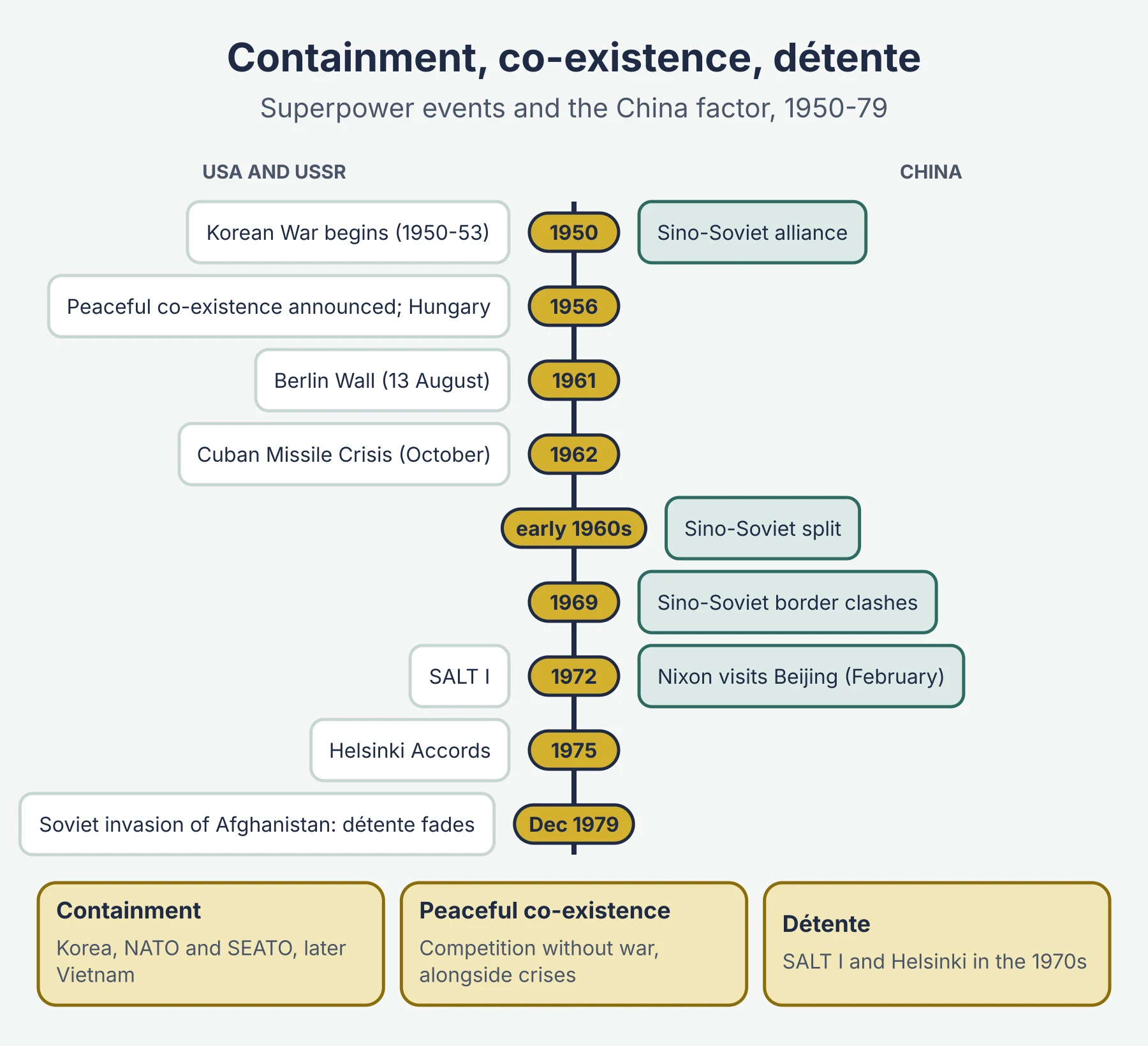
- Containment led to the Korean War (1950-53), alliances such as NATO and SEATO, and later Vietnam.
- Peaceful co-existence, announced by Khrushchev in 1956, accepted competition without war, but sat alongside crises over Hungary (1956), Berlin (the wall, 13 August 1961) and Cuba (October 1962).
- China changed the balance: the Sino-Soviet alliance (1950) gave way to the Sino-Soviet split by the early 1960s and border clashes in 1969; Nixon’s visit to Beijing (February 1972) opened Sino-US relations.
- Détente in the 1970s: SALT I (1972) and the Helsinki Accords (1975). It faded after the Soviet invasion of Afghanistan (December 1979).
The end of the Cold War
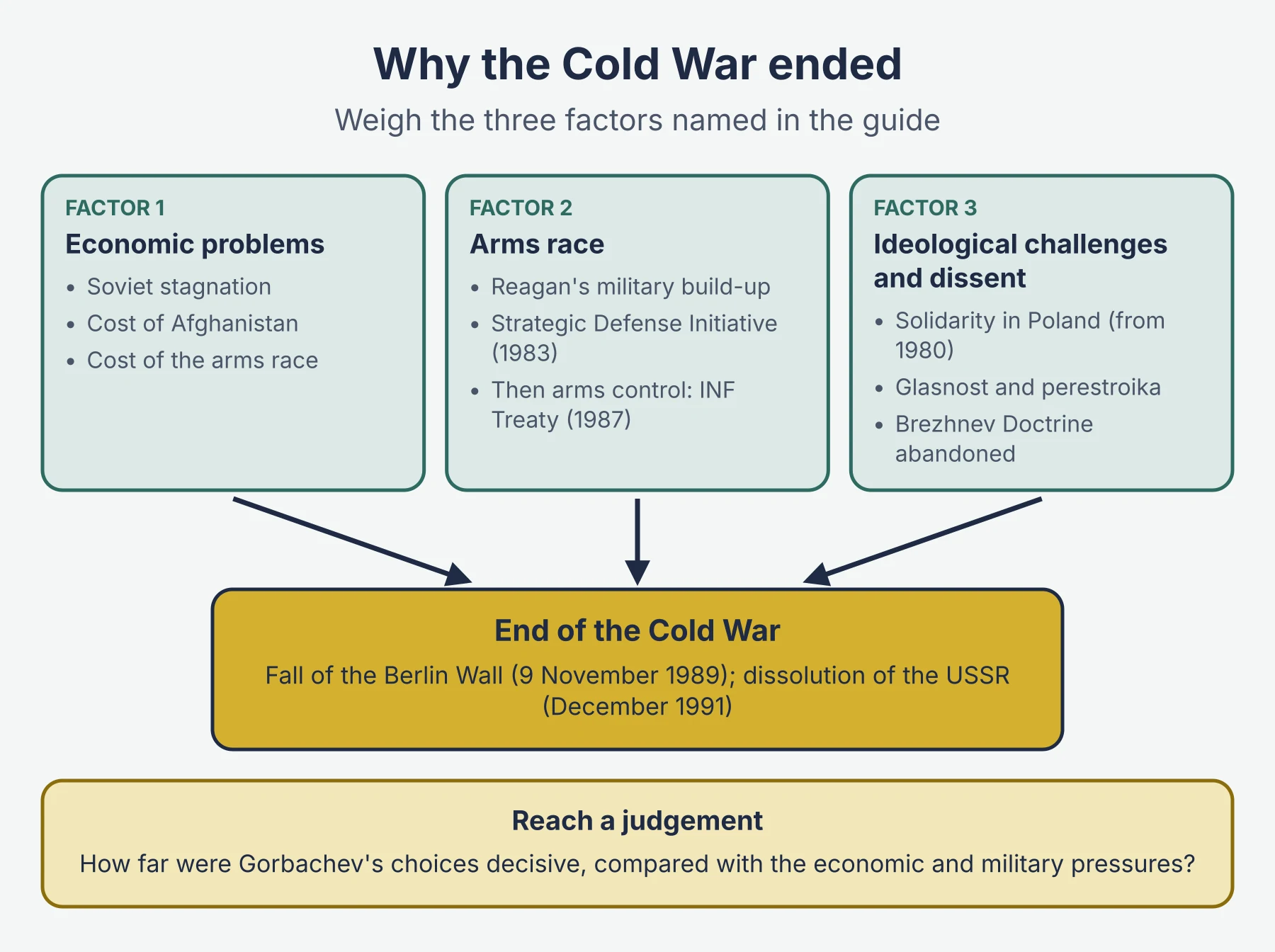
Weigh three factors from the guide:
- Economic problems: Soviet stagnation, the cost of Afghanistan and of the arms race.
- Arms race: Reagan’s military build-up and the Strategic Defense Initiative (announced 1983); then arms control, the INF Treaty (1987).
- Ideological challenges and dissent: Solidarity in Poland (from 1980); Gorbachev’s glasnost and perestroika; his abandonment of the Brezhnev Doctrine; the fall of the Berlin Wall (9 November 1989); the dissolution of the USSR (December 1991).
The historians’ debate
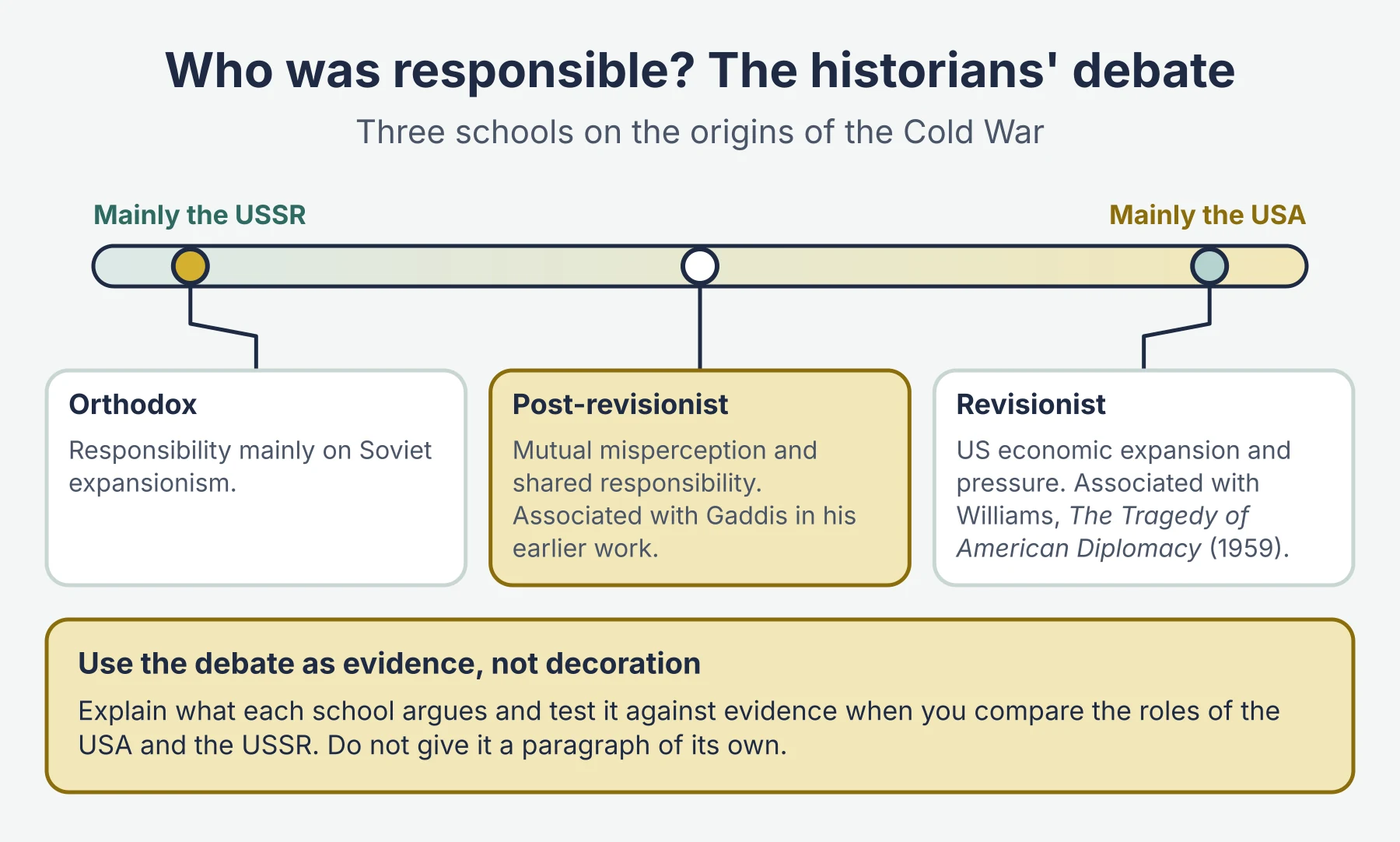
- Orthodox accounts placed responsibility mainly on Soviet expansionism.
- Revisionist accounts, associated with William Appleman Williams’s The Tragedy of American Diplomacy (1959), stressed US economic expansion and pressure.
- Post-revisionist accounts, associated with John Lewis Gaddis in his earlier work, emphasized mutual misperception and shared responsibility.
Use the debate to evaluate the “comparison of the roles of the USA and the USSR”, not as a paragraph on its own.
Worked example: comparing two crises
Question: “Compare and contrast the causes and significance of two Cold War crises, each chosen from a different region.”
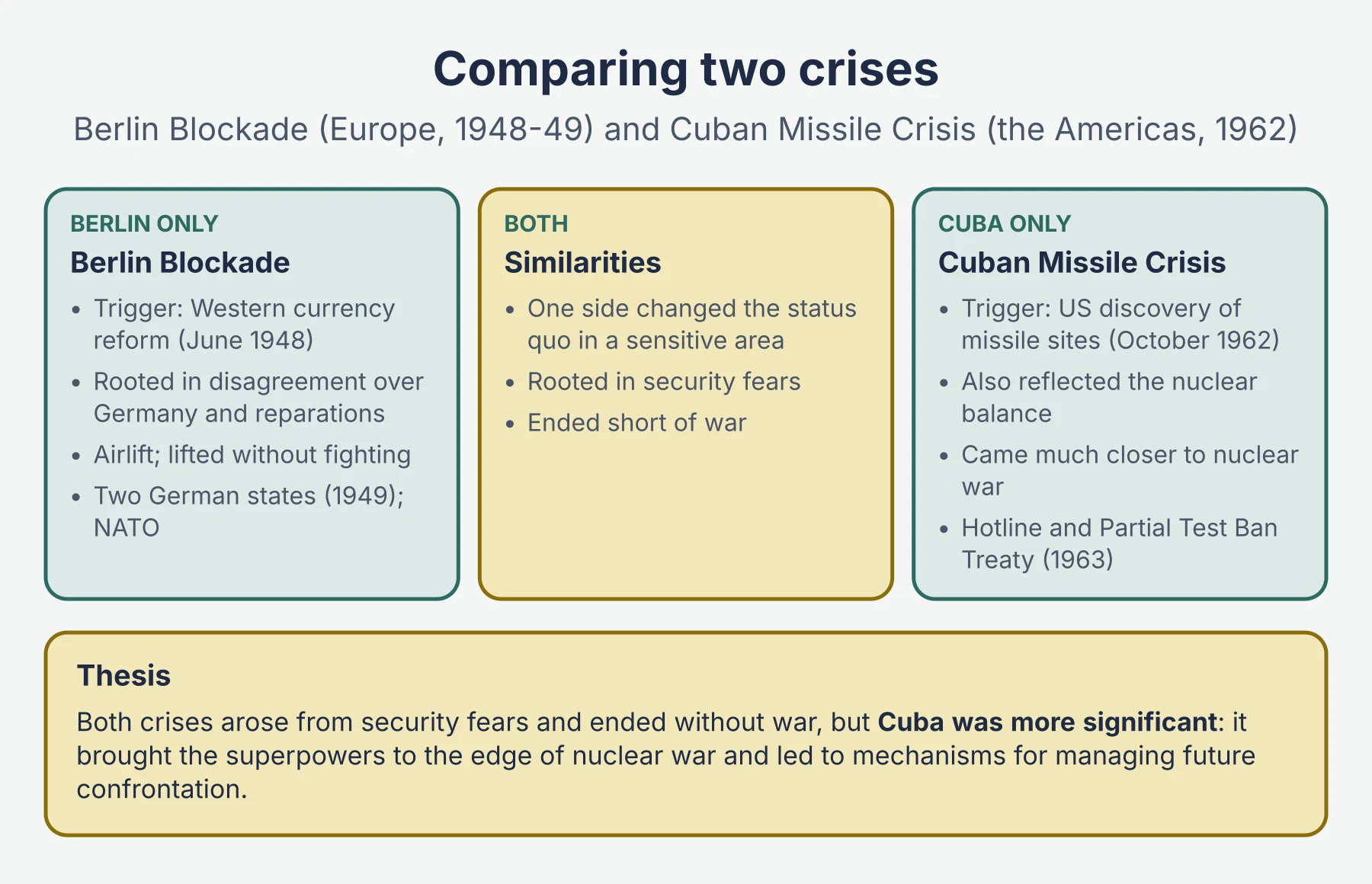
Choose: the Berlin Blockade (Europe, 1948-49) and the Cuban Missile Crisis (the Americas, 1962).
| Theme | Berlin Blockade | Cuban Missile Crisis | Comparative judgement |
|---|---|---|---|
| Immediate cause | Western currency reform in their zones (June 1948) | US discovery of Soviet missile sites in Cuba (October 1962) | Both were triggered by one side changing the status quo in a sensitive area |
| Underlying cause | Disagreement over Germany’s future and reparations | Soviet weakness in long-range missiles; the defence of Castro after the Bay of Pigs; US missiles in Turkey | Both rooted in security fears, but Cuba also reflected the nuclear balance |
| Method of resolution | Airlift; the blockade was lifted without fighting | Naval “quarantine”; secret diplomacy; missiles withdrawn in return for a US pledge not to invade Cuba and a secret undertaking to remove missiles from Turkey | Both ended short of war, but Cuba came much closer to nuclear conflict |
| Significance | Division of Germany (two states in 1949); formation of NATO | Hotline (1963); Partial Test Ban Treaty (1963); a step towards managed rivalry | Berlin hardened the division of Europe; Cuba led to arms control |
Thesis: “Both crises arose from security fears in areas of symbolic importance and were resolved without war, but the Cuban crisis was more significant because it brought the superpowers to the edge of nuclear war and led them to build mechanisms for managing future confrontation.”
Common mistakes
- Writing a narrative from 1945 to 1991. Questions target a part of the topic; select.
- Forgetting China. The guide names Sino-Soviet and Sino-US relations explicitly.
- Using the USA or USSR for “two countries”. The guide excludes them from that bullet; choose countries such as Korea, Vietnam, Cuba, Germany or Afghanistan.
- Crises from the same region. Berlin (1948-49) and Hungary (1956) are both in Europe.
- Name-dropping schools of thought. Explain what each argues and test it against evidence.
Exam technique
- “Evaluate the impact of [leader] on the Cold War”: set out what the leader did, assess the effect on superpower relations, and weigh it against structural factors.
- “Discuss the reasons for the end of the Cold War”: weigh economic problems, the arms race and dissent, and decide how far Gorbachev’s choices were decisive.
- “To what extent was the USA responsible for the origins of the Cold War?”: use the historiography, compare the roles of both superpowers and reach a judgement.
- “Compare and contrast…”: organize by theme, as in the crisis grid above.
Essays are marked out of 15 using the markbands outlined in the world history topics study guide.
Use with the other pages
Consolidate the chronology with the Cold War revision notes and practise with the Cold War practice questions.
Check your understanding
- What are the three parts of the topic? Rivalry, mistrust and accord; leaders and nations; Cold War crises.
- Which countries are excluded from the “two countries” bullet? The USA and the USSR.
- When did Nixon visit China? February 1972.
- What triggered the Berlin Blockade? Western currency reform in their zones of Germany in June 1948.
- Name two results of the Cuban Missile Crisis. The hotline and the Partial Test Ban Treaty, both in 1963.
- What did the revisionist school argue? That US economic expansion and pressure were a major cause of the Cold War.
Get free revision emails (optional)
Occasional emails with practice questions, worked explanations and links to free resources for the qualification and subjects you choose. No spam, and you can unsubscribe from any email. The free tools on this site never need an email.
Related resources
-
Practice questions
IB DP History: The Six Key Concepts – Practice Questions
Original practice questions with worked answers on the six key concepts of IB DP History (first assessed 2017), from spotting the concept to essay plans.
World History · International Baccalaureate · IB
Try questions -
Practice questions
IB DP History (DP History): The Cold War: Superpower tensions and rivalries (20th century) – Practice Questions
Twelve original IB History Cold War practice questions on origins, China, leaders, nations, crises and the end of the Cold War, with mark-scheme answers.
World History · International Baccalaureate · IB
Try questions -
Revision notes
IB DP History (DP History): The Cold War: Superpower tensions and rivalries (20th century) – Revision Notes
Condensed IB History Cold War notes: origins 1943-49, superpowers and China 1947-79, the end of the Cold War, leaders, nations and crises, with a self-test.
World History · International Baccalaureate · IB
Revise topic
Related articles
-
teaching
A Level tuition in Dubai: Cambridge or Pearson Edexcel International A Level?
Schools in Dubai and Abu Dhabi teach either Cambridge International AS & A Level or Pearson Edexcel International A Level. How the two are structured, why it matters for tuition, and how online classes from Lahore work.
9 October 2026
-
curriculum guides
Choosing subjects at IGCSE and A Level
How subject choices at 14 and 16 affect university options later, and how to keep pathways open without overloading a timetable.
28 July 2026
Studying this with a teacher
Working through World History IB?
This page is free and stays free. If you would rather be taught it, Marlbridge runs World History classes one-to-one, online in your own time zone. The first trial class is free. WhatsApp replies within an hour (8am–11pm Pakistan time, every day); email the same day.
IB World History teachers at Marlbridge
