
Study Guides
IGCSE Accounting: Financial statements of sole traders (Cambridge 0452)
A worked guide to sole trader statements of profit or loss and financial position, with adjustments, for Cambridge IGCSE Accounting 0452 section 5.1.
- Subject
- Accounting
- Level
- IGCSE, O LEVELS
- Topic
- Preparation of financial statements
- Author
- Marlbridge Academic Team
- Updated
- Reviewed by
- Javaid Iqbal Sabri (what this means)
Aligned to Cambridge IGCSE O Level Accounting (0452, 7707), 2027-2029. Official specification (IGCSE) ; Official specification (O Level) .
Syllabus page (what it covers and how it is assessed): Cambridge IGCSE Accounting; Cambridge O Level Accounting.
Syllabus points this page covers
0452
- 5.1 Sole traders
7707
- 5.1 Sole traders
Found an error? Report a correction.
Want a teacher for this? Marlbridge teaches Accounting online. Request a free trial class.
Syllabus edition note. This resource follows the Cambridge IGCSE Accounting 0452 syllabus (and Cambridge O Level Accounting 7707, which has the same subject content for the same series) for exams in 2027, 2028 and 2029 (version 1), first examined in the March 2027 series in India and the June 2027 series elsewhere. If you sit 0452 in November 2026, you sit the 2026 syllabus (version 2), which differs: Paper 1 has 35 multiple-choice marks in 1 hour 15 minutes, not 40 marks in 1 hour 30 minutes; Topic 7 is “Accounting principles and policies”, without 7.2 Ethical considerations or 7.3 Technology and sustainability; 4.4 is “Irrecoverable debts and provision for doubtful debts”; income statements are named instead of statements of profit or loss; three-column running balance accounts are not required; Clubs and societies is 5.4 and Manufacturing accounts 5.5; and 6.3 is “Inter-firm comparison”. For this topic, the 2026 syllabus covers only trading and service businesses in 5.1 and limits drawings adjustments to goods taken by the owner for own use; for limited companies it excludes cumulative and non-cumulative preference shares, rights issues, share premium and capital redemption reserve but requires the difference between redeemable and non-redeemable preference shares (the 2027-2029 syllabus lists none of these); and for incomplete records it does not ask why businesses keep them or what their advantages are. If you sit in November 2026, work from the 2026 syllabus on the Cambridge International website.
This guide covers syllabus section 5.1 Sole traders, part of Topic 5 Preparation of financial statements, for Cambridge IGCSE Accounting (0452), syllabus for exams in 2027, 2028 and 2029 (version 1).
The course hub is Cambridge IGCSE Accounting, the printable checklist and the free diagnostics. The topic-wide guide, Preparation of Financial Statements, has its own worked example and covers 5.2 to 5.6. Pair it with the revision notes and the practice questions.
What 5.1 asks for
| 5.1 point | Where it is taught here |
|---|---|
| Advantages and disadvantages of being a sole trader | Section 1 |
| Trading, service, manufacturing or combined businesses | Section 2 |
| Importance of the two statements | Section 3 |
| Content of the statement of financial position | Section 4 |
| Adjustments: depreciation, accruals and prepayments, irrecoverable debts, drawings | Section 5 |
| Preparing both statements for each type of business | Sections 6 and 7 |
| Effect of a change in one balance on others | Section 8 |
1 Operating as a sole trader
One person owns the business and the business is not a separate legal person from them.
- Advantages: all profit belongs to the owner; decisions need no one else’s agreement; few legal formalities, so it is cheap to start; accounts need not be shared widely.
- Disadvantages: unlimited liability, so debts the business cannot pay may be met from the owner’s private assets; only one person’s savings and borrowing power funds growth; illness can stop trading; one person carries every loss and every task.
Apply each point to the case given: “unlimited liability” is only a label, while “unpaid supplier debts could force a sale of the owner’s private car” explains it.
2 Types of sole trader business
| Type | Earns revenue by | Statement of profit or loss shows | Example |
|---|---|---|---|
| Trading | Buying and reselling goods | Cost of sales, gross profit | Cycle shop |
| Service | Selling skills or time | Fees less expenses, no gross profit | Driving instructor |
| Manufacturing | Making the goods it sells | Manufacturing account, then cost of sales | Joiner |
| Combination | More than one of the above | Gross profit on the trading side, other income added below it | Garage that sells parts and charges for labour |
3 Why the two statements matter
The statement of profit or loss reports what the business earned or lost over a period. The owner uses it to compare years, judge whether drawings are affordable and show lenders or tax authorities how the business performed.
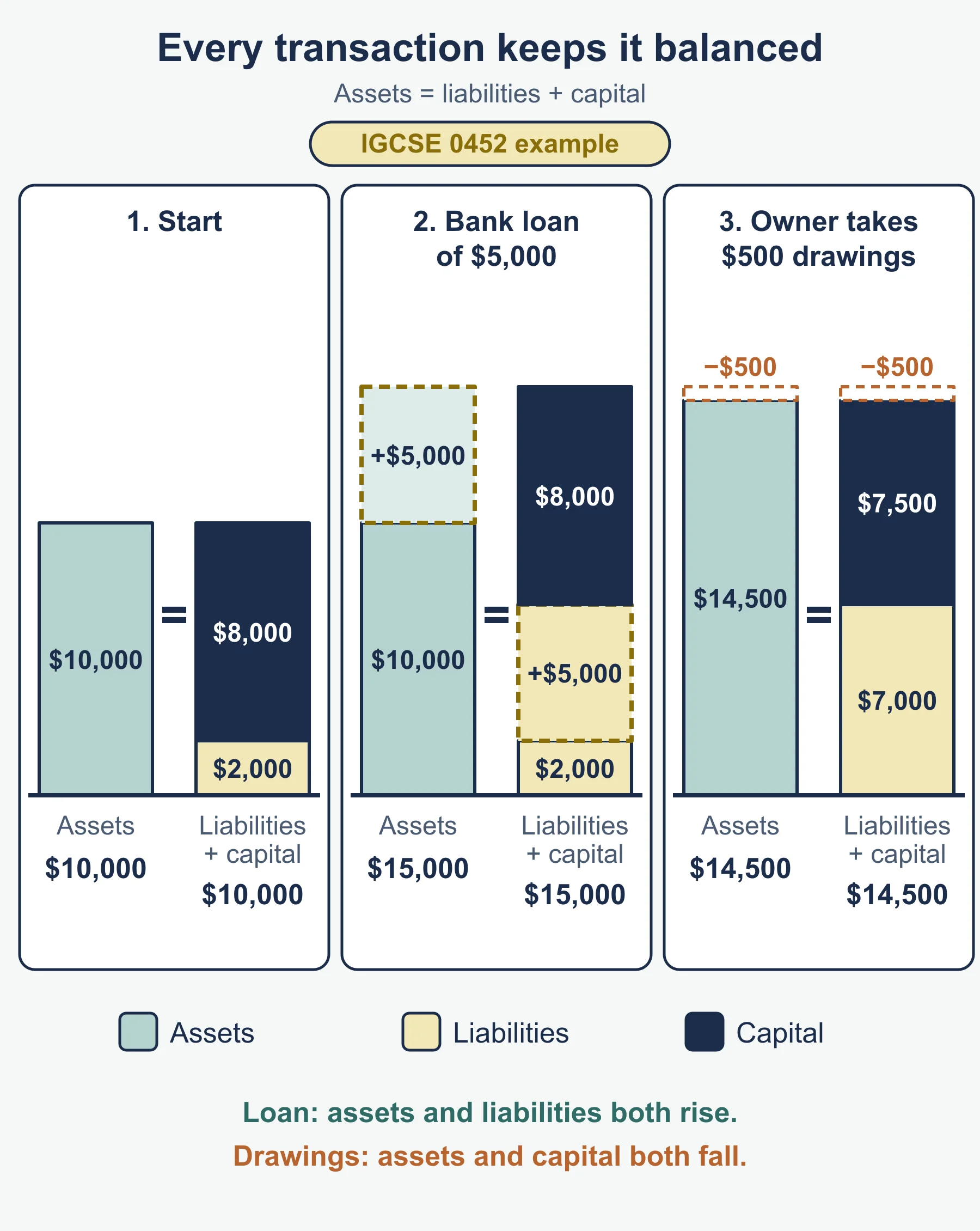
The statement of financial position lists assets, liabilities and capital on a specified date. It shows what the business owns and owes at that moment, and how much of the funding is the owner’s. A profit figure alone cannot show whether the business can pay its debts.
4 Content of the statement of financial position
| Heading | Test | Examples |
|---|---|---|
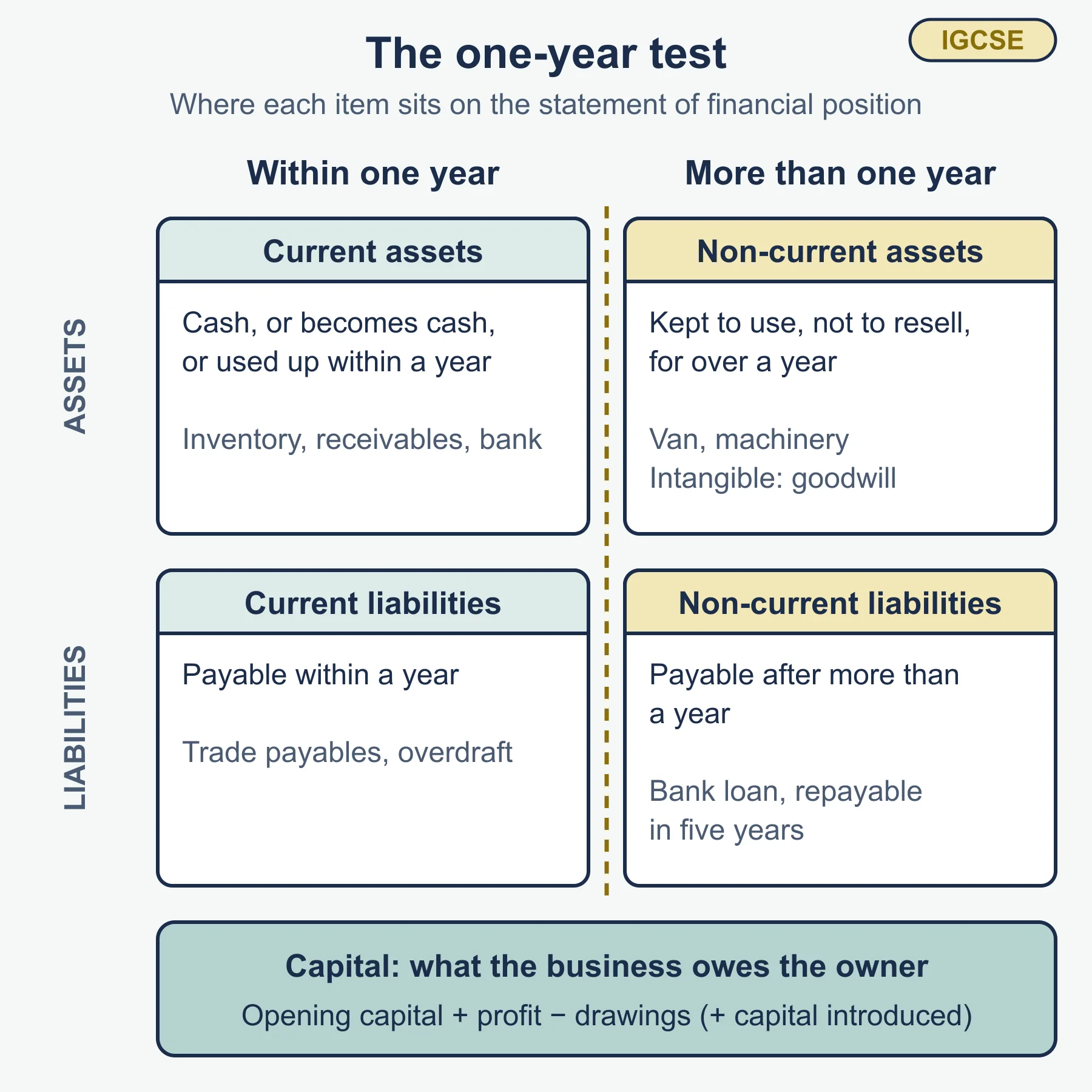
| Non-current assets | Kept to use, not to resell, for over a year | Van, machinery |
| Intangible assets | Non-current, with no physical form | Goodwill |
| Current assets | Cash, or likely to become cash or be used up within a year | Inventory, trade receivables, other receivables, bank |
| Current liabilities | Payable within a year | Trade payables, other payables, overdraft |
| Non-current liabilities | Payable after more than a year | Bank loan repayable in five years |
| Capital | Amount owed to the owner | Opening capital + profit - drawings (+ any capital introduced) |
5 Year-end adjustments
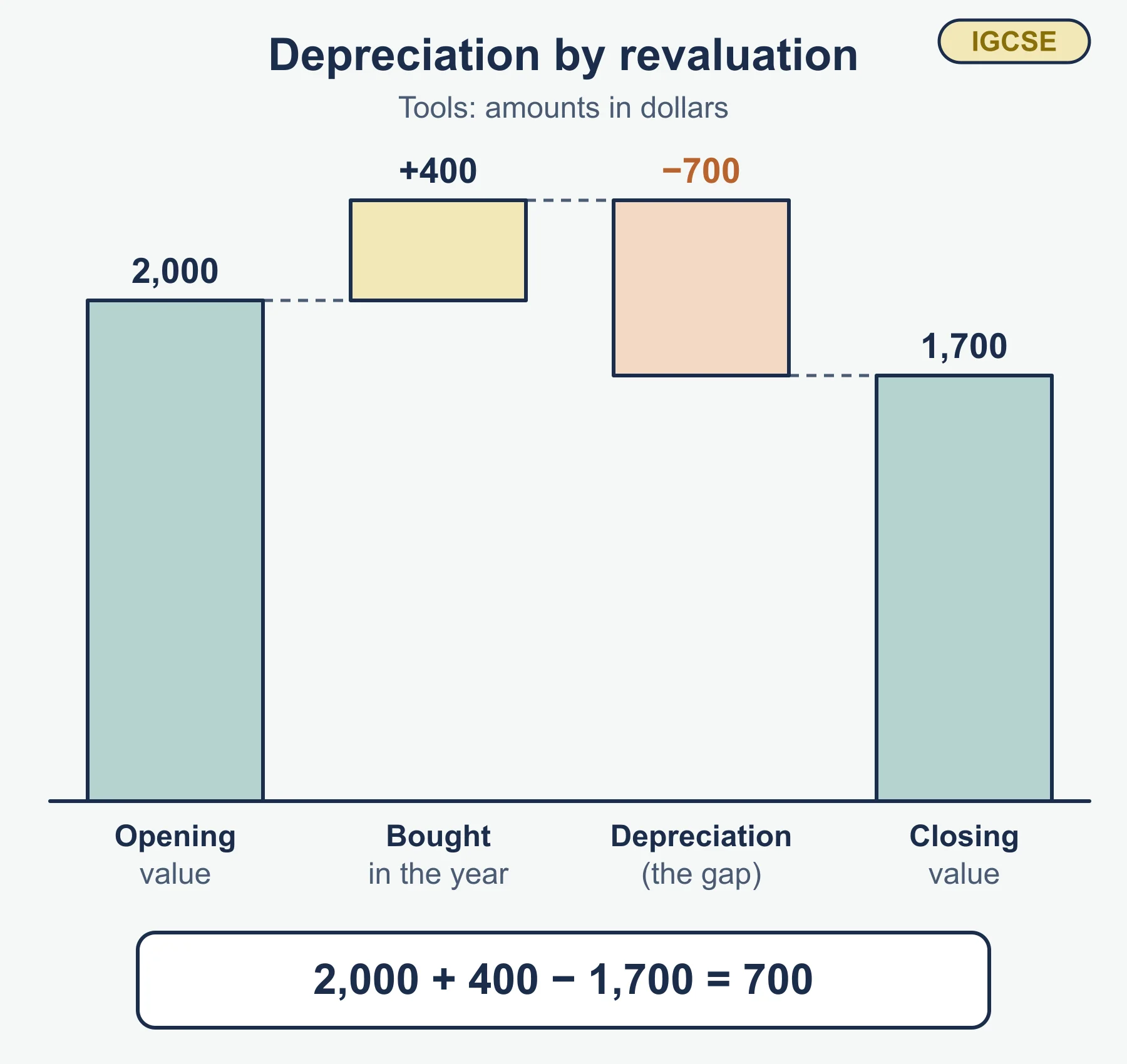
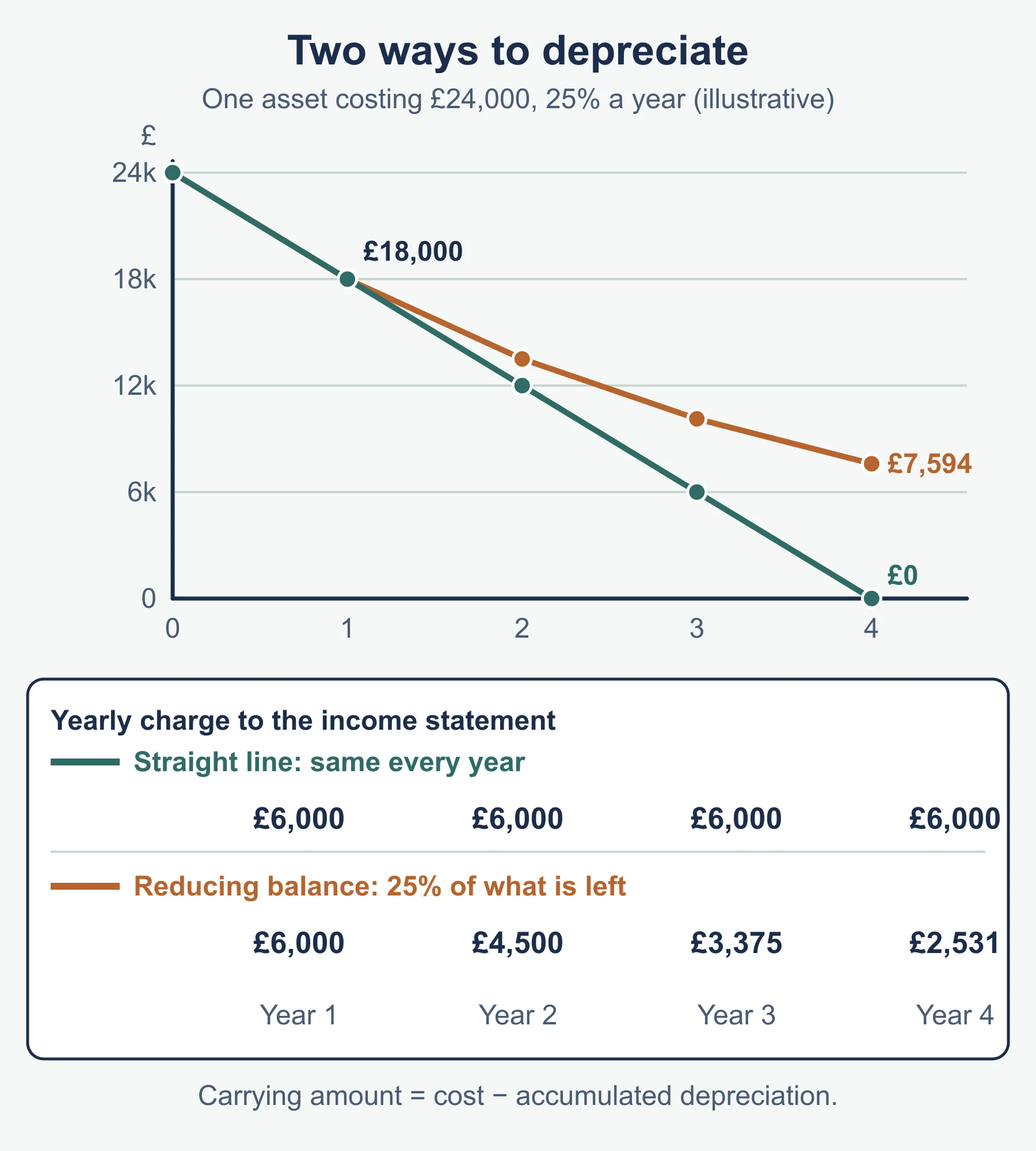
Depreciation. Straight line: cost x rate, the same every year. Reducing balance: rate x carrying value at the start of the year (cost less accumulated depreciation). Revaluation: opening value + additions - closing value. Example: a trailer costing 14,000 at 10% straight line costs 1,400 a year; a machine with carrying value 9,000 at 30% reducing balance costs 2,700; tools valued 2,000, plus 400 bought, valued 1,700 at the end, give 700.
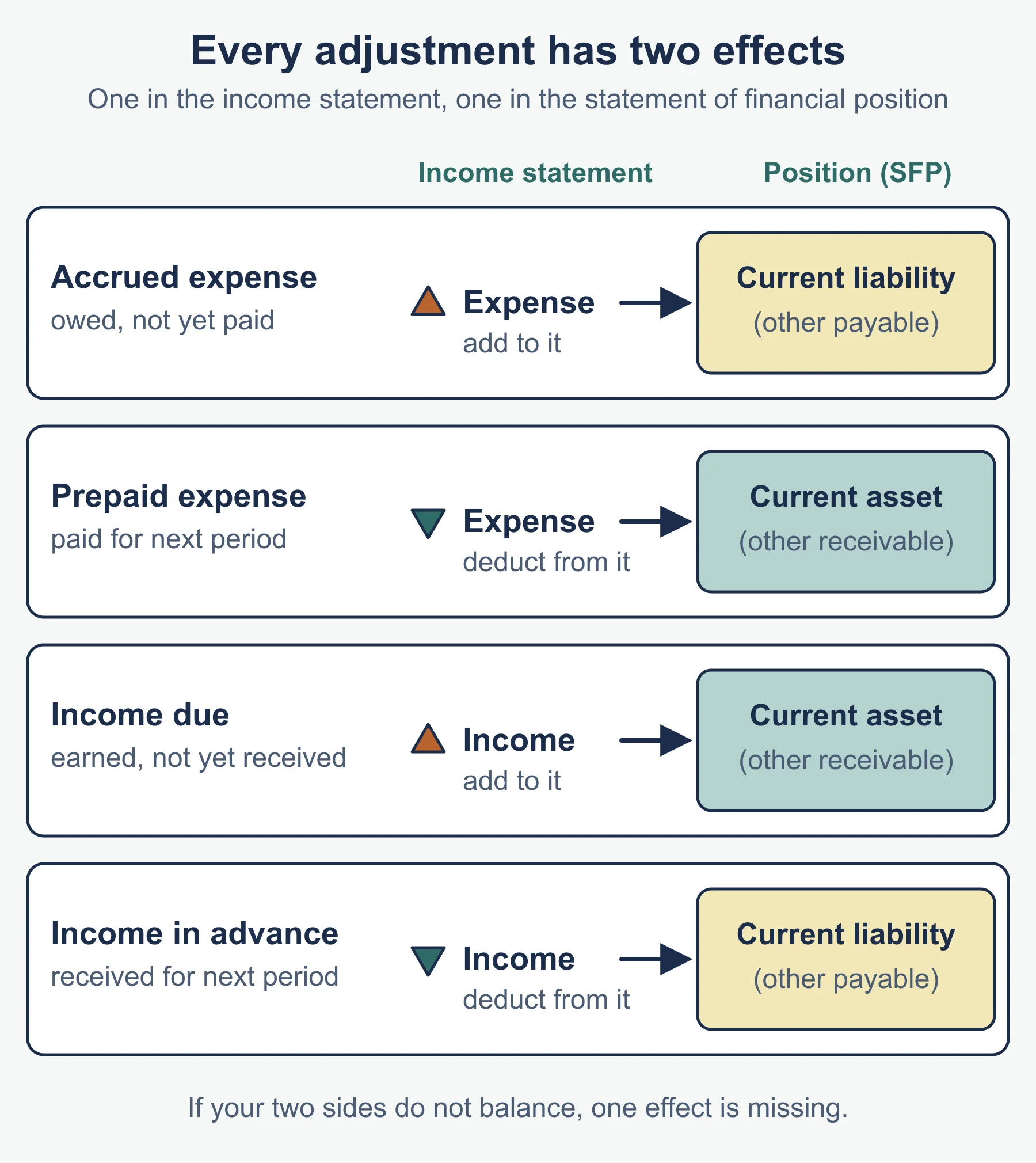
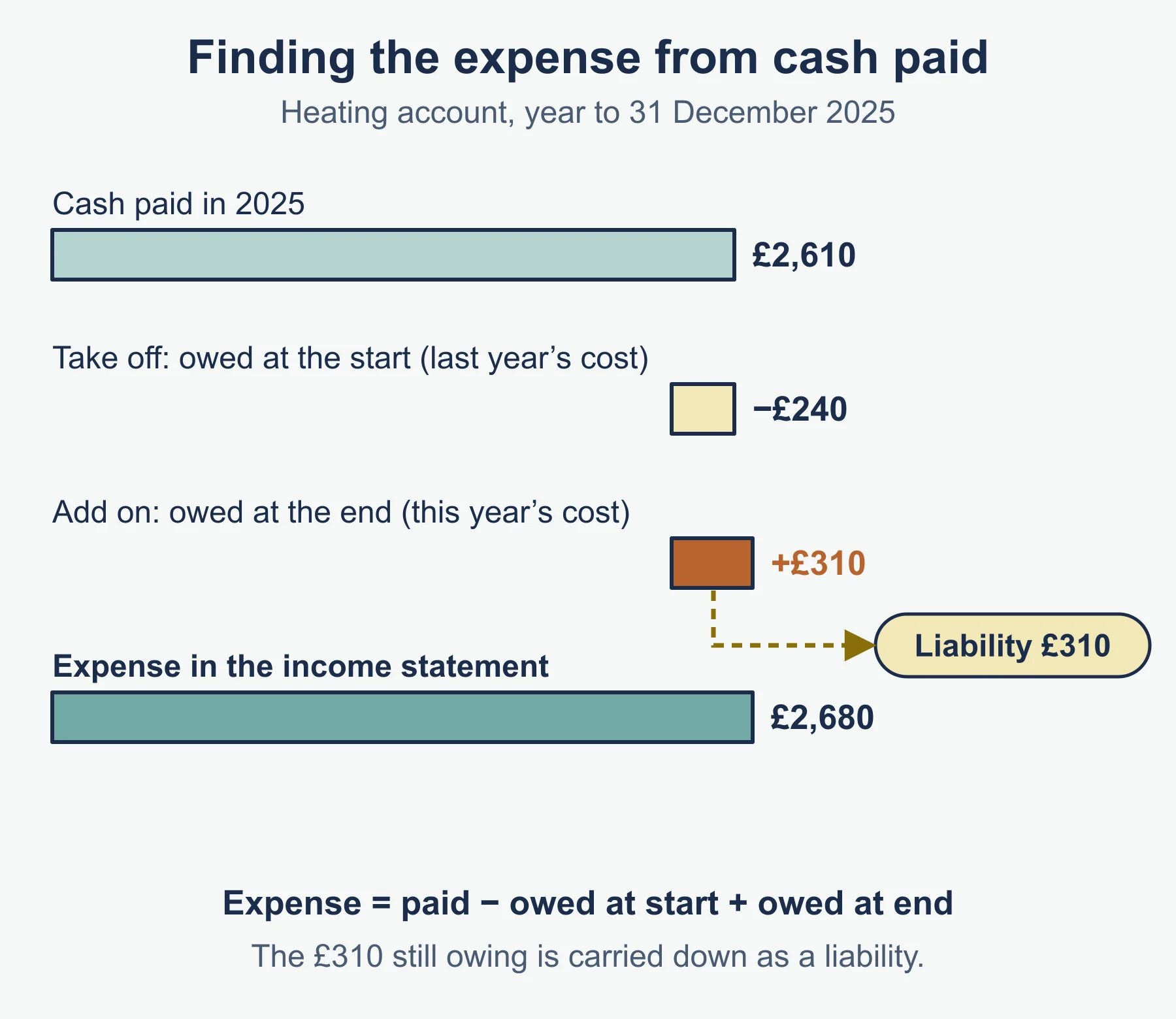
Accruals and prepayments. Match each item to the year it relates to.
| Item | Statement of profit or loss | Statement of financial position |
|---|---|---|
| Expense owing (accrued) | Add | Other payables |
| Expense paid in advance | Deduct | Other receivables |
| Income earned, not received (accrued) | Add | Other receivables |
| Income received in advance | Deduct | Other payables |
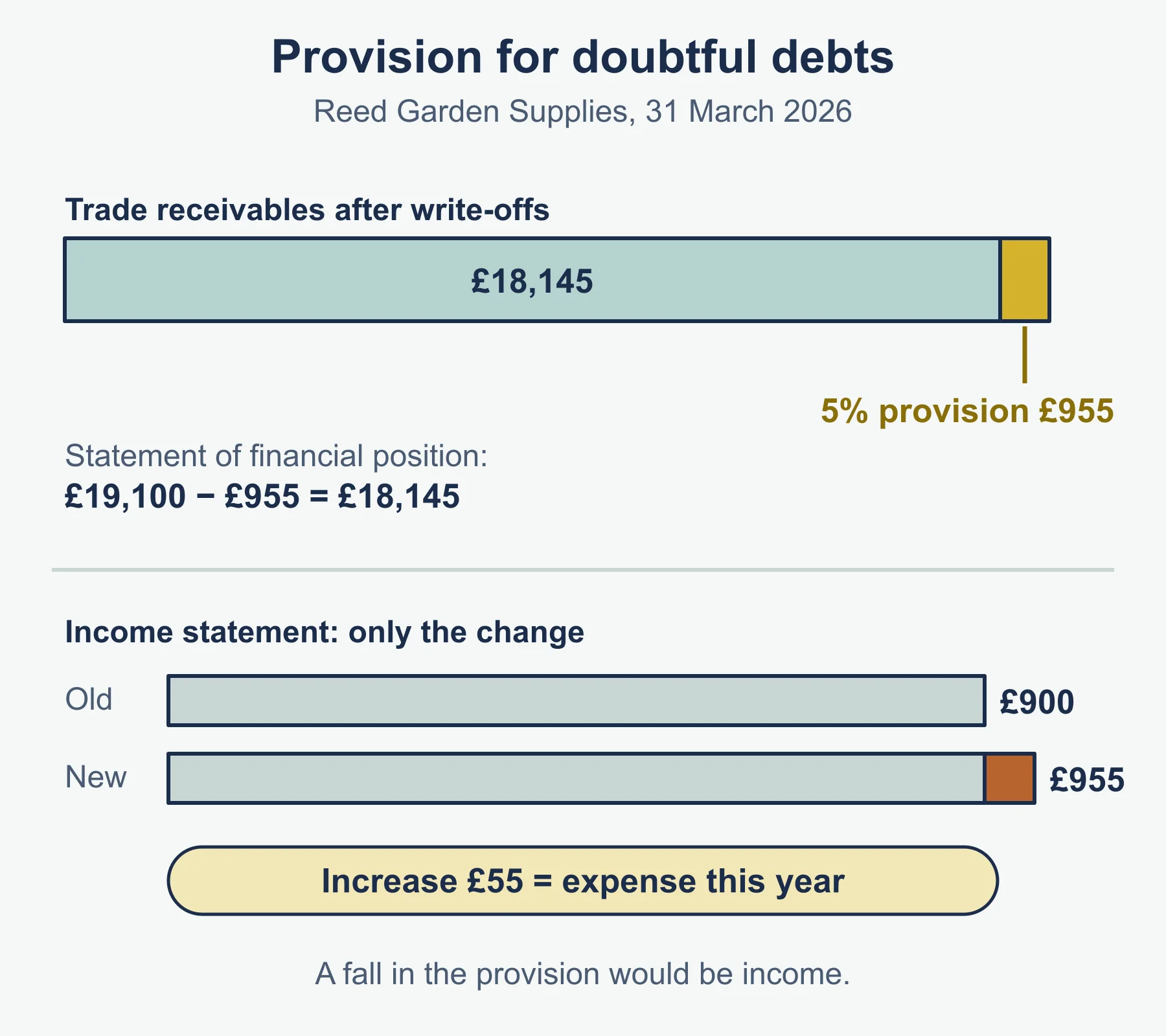
Irrecoverable debts. Step 1: write the debt off (an expense) and deduct it from trade receivables. Step 2: allowance = percentage x remaining trade receivables. Step 3: the statement of profit or loss takes just the movement in the allowance, an expense if it rises and income if it falls. The statement of financial position deducts the whole allowance from trade receivables.
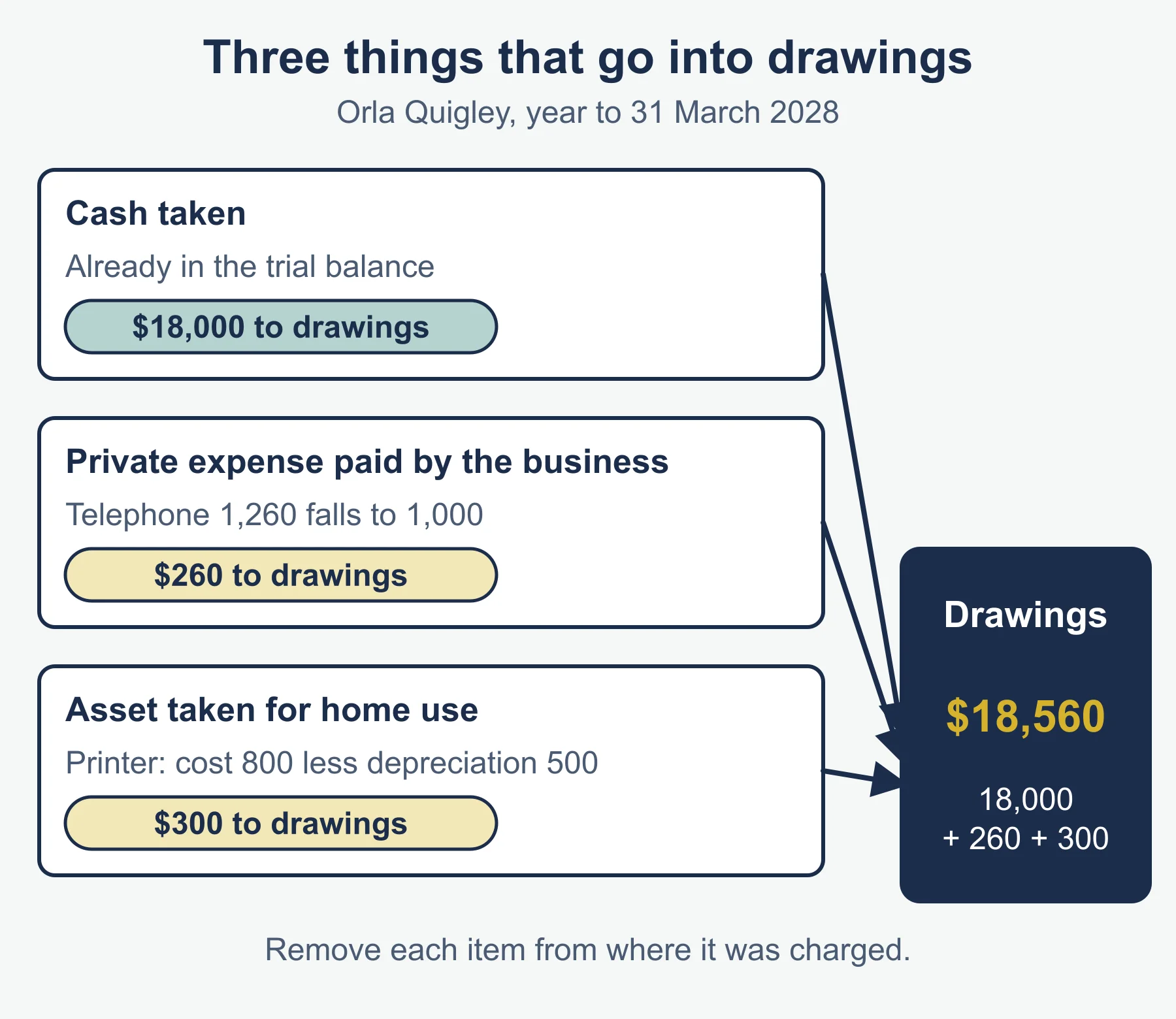
Drawings. Add to drawings (and remove from where it was charged): goods taken by the owner, valued at cost and deducted from purchases; other assets taken, at carrying value and deducted from that asset’s cost and accumulated depreciation; private expenses the business paid, deducted from the expense.
6 Worked example: a service business
Orla Quigley runs a driving school. All figures are in dollars. Trial balance at 31 March 2028:
                                        Debit      Credit
Cars (cost)                             36,000
Accumulated depreciation: cars                      9,000
Equipment (cost)                         5,000
Accumulated depreciation: equipment                 2,000
Teaching aids (valuation 1 April 2027)   1,100
Teaching aids bought                       300
Lesson fees                                        58,400
Test booking commission                             2,100
Fuel 6,200; Insurance 3,600; Wages 14,400; Advertising 1,750;
Telephone 1,260; Rent 4,800               32,010
Trade receivables                        5,240
Allowance for irrecoverable debts                     150
Trade payables                                      1,850
Bank 3,900; Cash 150                     4,050
Drawings                                18,000
Bank loan (repayable 2031)                         12,000
Capital 1 April 2027                               16,200
                                       101,700    101,700
Further information:
- Insurance of 900 relates to the following year.
- Rent of 400 is owing.
- Commission of 300 earned in March was received in April.
- Telephone includes 260 of Orla’s private calls.
- On 1 April 2027 she took a printer (cost 800, accumulated depreciation 500) for home use; no depreciation is charged on it.
- A debt of 240 is irrecoverable. The allowance becomes 4% of remaining trade receivables.
- Cars: 25% reducing balance. Equipment: 20% straight line on cost. Teaching aids valued at 1,000.
Workings: cars 25% x (36,000 - 9,000) = 6,750; equipment 20% x (5,000 - 800) = 840; teaching aids 1,100 + 300 - 1,000 = 400; receivables 5,240 - 240 = 5,000; allowance 200, increase 50; drawings 18,000 + 260 + (800 - 500) = 18,560.
Orla's statement of profit or loss, year to 31 March 2028
Revenue: lesson fees                              58,400
Add Test booking commission (2,100 + 300)          2,400
                                                  60,800
Less Expenses
 Fuel                                    6,200
 Insurance (3,600 - 900)                 2,700
 Wages                                  14,400
 Advertising                             1,750
 Telephone (1,260 - 260)                 1,000
 Rent (4,800 + 400)                      5,200
 Irrecoverable debts                       240
 Increase in allowance                      50
 Depreciation: cars                      6,750
 Depreciation: equipment                   840
 Depreciation: teaching aids               400   39,530
Profit for the year                               21,270
Orla's statement of financial position, 31 March 2028
Cost Acc. dep. Carrying value
Non-current assets
Cars 36,000 15,750 20,250
Equipment 4,200 2,340 1,860
Teaching aids (valuation) 1,000
23,110
Current assets
Trade receivables 5,000
Less Allowance 200 4,800
Other receivables (900 + 300) 1,200
Bank 3,900
Cash 150 10,050
Total assets 33,160
Capital: opening 16,200
Add Profit 21,270
37,470
Less Drawings 18,560
18,910
Non-current liability: bank loan 12,000
Current liabilities
Trade payables 1,850
Other payables 400 2,250
Total capital and liabilities 33,160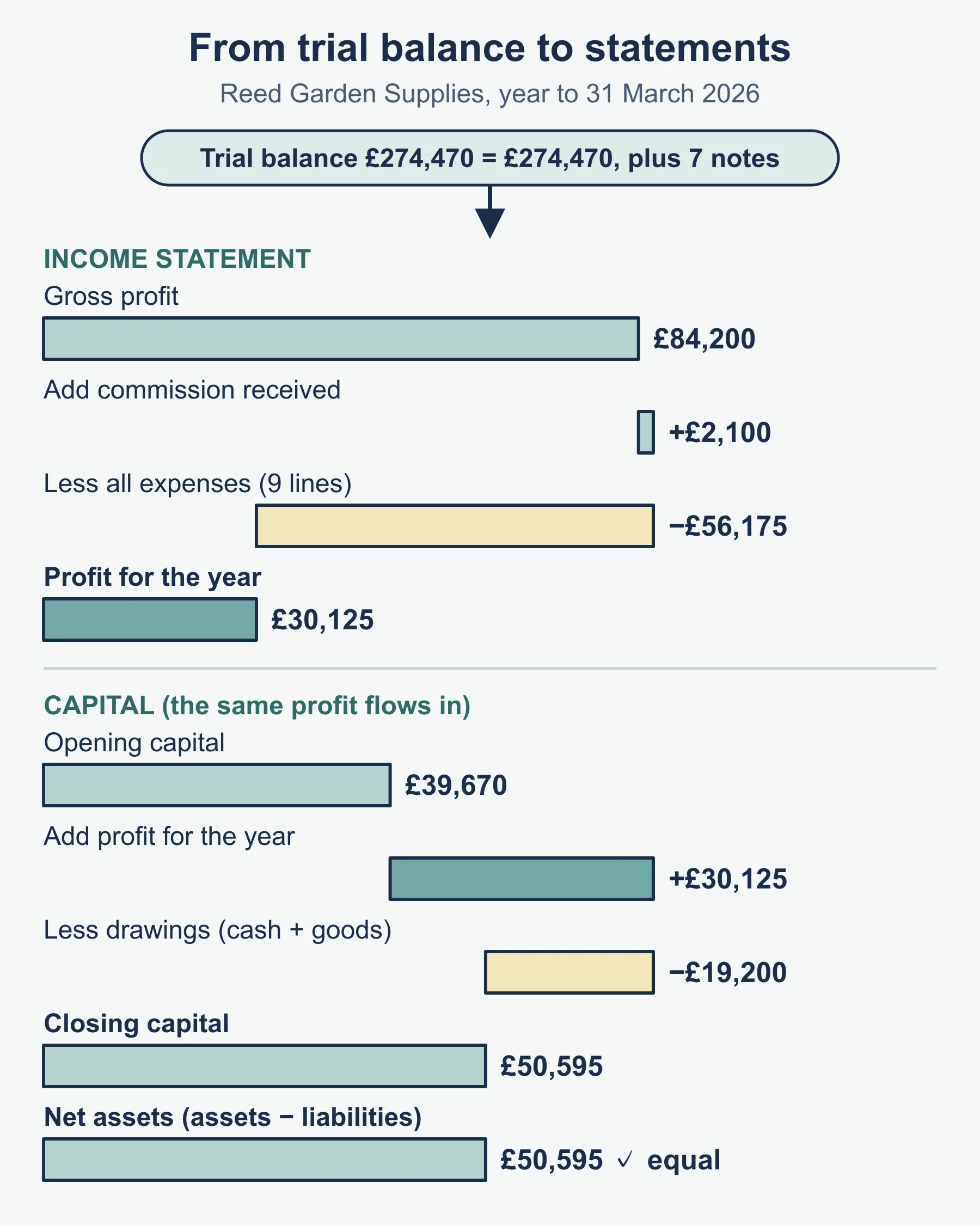
7 Worked example: a manufacturing business
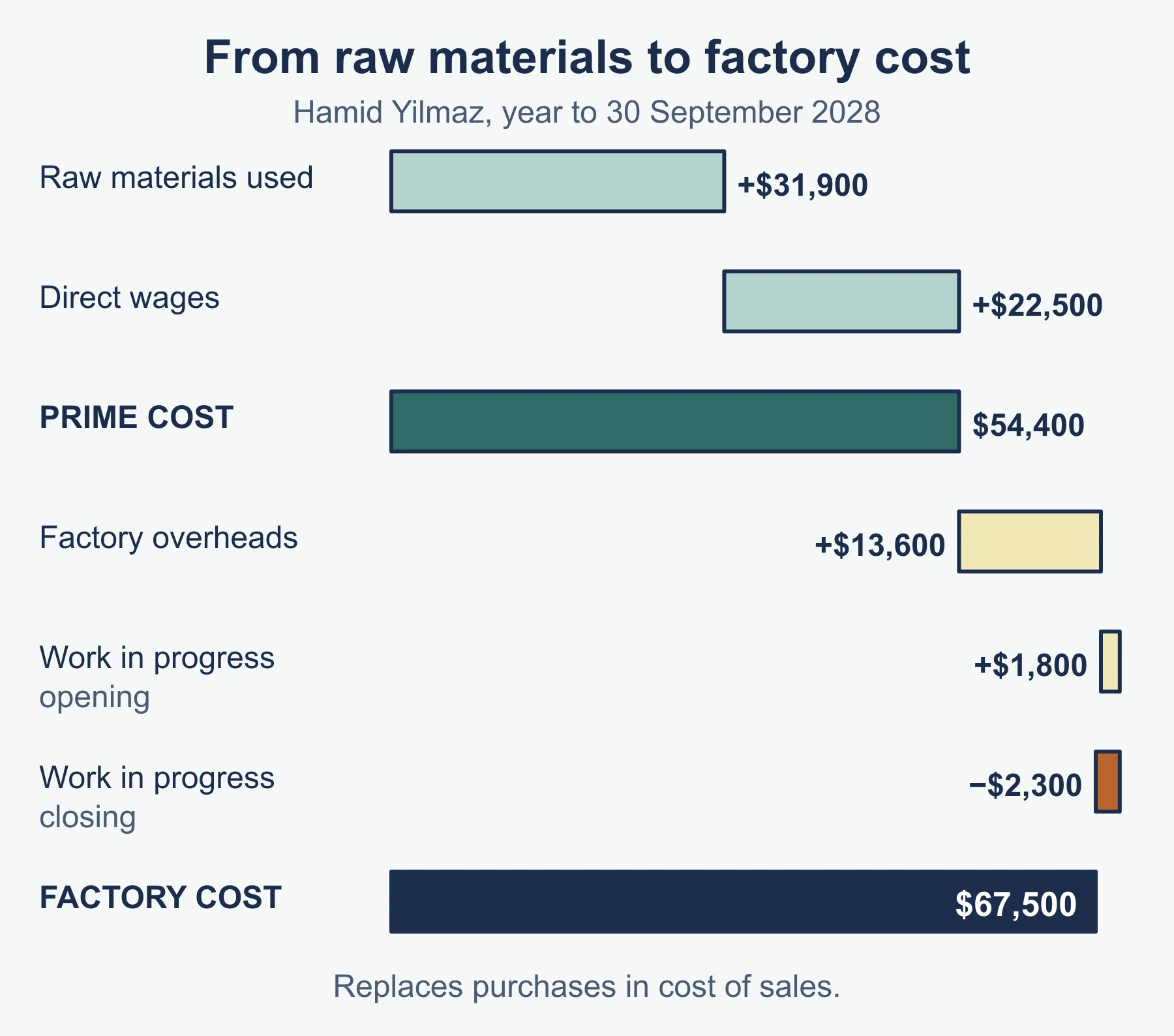
Hamid Yilmaz makes kitchen units. Year ended 30 September 2028. Balances before adjustment: raw materials 4,200, work in progress 1,800 and finished goods 6,500 (all at 1 October 2027); purchases of raw materials 31,000; carriage inwards 600; direct wages 22,500; factory rent 6,000; factory power 3,400; office salaries 9,200; vehicle expenses 2,500; sales returns 1,000; machinery cost 40,000 (accumulated depreciation 12,000); van cost 15,000 (accumulated depreciation 3,000); trade receivables 7,400; bank 5,100; drawings 16,000; revenue 98,000; rent received 700; trade payables 5,200; loan (repayable 2033) 8,000; capital 1 October 2027 45,300.
At 30 September 2028: raw materials 3,900, work in progress 2,300, finished goods 7,200; power owing 200. Machinery 10% straight line on cost, van 20% reducing balance.
Manufacturing account for the year ended 30 September 2028
Raw materials: opening                 4,200
 Purchases                            31,000
 Carriage inwards                        600
                                      35,800
 Less Closing                          3,900
Cost of raw materials used                     31,900
Direct wages                                   22,500
Prime cost                                     54,400
Factory overheads: rent                6,000
 Power (3,400 + 200)                   3,600
 Depreciation: machinery               4,000   13,600
                                               68,000
Add Opening work in progress                    1,800
Less Closing work in progress                   2,300
Factory cost of production                     67,500

Statement of profit or loss
Revenue 98,000 less returns 1,000                97,000
Opening finished goods                 6,500
Add Factory cost of production        67,500
                                      74,000
Less Closing finished goods            7,200
Cost of sales                                  66,800
Gross profit                                   30,200
Add Rent received                                 700
                                               30,900
Less Office salaries 9,200; vehicle expenses 2,500;
 depreciation of van 2,400                     14,100
Profit for the year                            16,800
Statement of financial position: machinery 40,000 - 16,000 = 24,000; van 15,000 - 5,400 = 9,600 (non-current assets 33,600). Inventories are shown in three parts: raw materials 3,900, work in progress 2,300 and finished goods 7,200 (13,400), plus trade receivables 7,400 and bank 5,100: current assets 25,900, total assets 59,500. Capital 45,300 + 16,800 - 16,000 = 46,100; loan 8,000; current liabilities 5,400 (trade payables 5,200, other payables 200). Total 59,500.
8 The effect of a change in one balance
Every change reaches at least two places. Suppose Orla ignored the 900 prepaid insurance. Insurance would be 900 too high, so profit would be 900 too low (20,370). Other receivables, and so assets, would be 900 too low, and so would capital. The statement of financial position still balances while being wrong.
Other chains: higher closing inventory lowers cost of sales and raises profit and capital; a bigger depreciation charge lowers profit and carrying value; a larger allowance lowers profit and net trade receivables.
Common errors
- Adding a prepayment to the expense instead of deducting it.
- Deducting the whole allowance, not just the increase, in the statement of profit or loss.
- Applying the reducing balance rate to cost rather than carrying value.
- Taking an asset into drawings at cost, not carrying value.
- Leaving a manufacturing business’s three inventories out of current assets.
- Forgetting that every adjustment needs a place in both statements.
Test yourself with the practice questions.
Frequently asked questions
What are the advantages and disadvantages of being a sole trader in Cambridge IGCSE Accounting 0452? A sole trader keeps all the profit, makes decisions alone and faces few legal formalities. The disadvantages include unlimited liability, limited funds from one person’s savings and borrowing, and the risk that illness stops trading.
Why does a sole trader need both a statement of profit or loss and a statement of financial position? The statement of profit or loss reports what the business earned or lost over a period. The statement of financial position lists assets, liabilities and capital on a specified date, showing what the business owns and owes and how much of the funding is the owner’s.
How are goods taken by the owner treated? Goods taken by the owner are added to drawings at cost and deducted from purchases. Other assets taken for private use are added to drawings at their carrying value.
How do you calculate depreciation by revaluation? Depreciation by revaluation is the opening value plus additions minus the closing value. It is used for items such as small tools or teaching aids.
What happens if a prepayment is ignored in the final accounts? The expense would be too high, so profit would be too low, and other receivables and capital in the statement of financial position would also be too low. Every adjustment affects both statements.
Official syllabus
Cambridge International Education, Cambridge IGCSE Accounting 0452 syllabus for exams in 2027, 2028 and 2029 (version 1), section 5.1 Sole traders.
Get free revision emails (optional)
Occasional emails with practice questions, worked explanations and links to free resources for the qualification and subjects you choose. No spam, and you can unsubscribe from any email. The free tools on this site never need an email.
Related resources
-
Revision notes
IGCSE Accounting: Analysis and Interpretation — Revision Notes
Quick recall for Cambridge IGCSE Accounting 0452 Topic 6: ten ratios, reading them, profit versus cash, comparing businesses, users and statement limits.
Accounting · Cambridge · IGCSE, O Level
Revise topic -
Practice questions
IGCSE Accounting: Financial statements of sole traders (Cambridge 0452) – Practice Questions
Original practice questions with worked answers on sole trader statements and year-end adjustments for Cambridge IGCSE Accounting 0452 section 5.1.
Accounting · Cambridge · IGCSE, O Level
Try questions -
Revision notes
IGCSE Accounting: Financial statements of sole traders (Cambridge 0452) – Revision Notes
Condensed revision notes on sole trader statements, adjustments and drawings for Cambridge IGCSE Accounting 0452 section 5.1, with a self-test.
Accounting · Cambridge · IGCSE, O Level
Revise topic
Related articles
-
teaching
A Level tuition in Dubai: Cambridge or Pearson Edexcel International A Level?
Schools in Dubai and Abu Dhabi teach either Cambridge International AS & A Level or Pearson Edexcel International A Level. How the two are structured, why it matters for tuition, and how online classes from Lahore work.
9 October 2026
-
curriculum guides
Choosing subjects at IGCSE and A Level
How subject choices at 14 and 16 affect university options later, and how to keep pathways open without overloading a timetable.
28 July 2026
Studying this with a teacher
Working through Accounting IGCSE, O LEVELS?
This page is free and stays free. If you would rather be taught it, Marlbridge runs Accounting classes one-to-one and in small groups of up to 15, online in your own time zone. The first trial class is free. WhatsApp replies within an hour (8am–11pm Pakistan time, every day); email the same day.
Cambridge Accounting teachers at Marlbridge

