
Study Guides
IGCSE Business: Business finance (Cambridge 0264)
Study guide to Cambridge IGCSE Business 0264 section 5.1: why businesses need finance, working capital, sources of finance and choosing between them.
- Subject
- Business
- Level
- IGCSE
- Topic
- Financial information and decisions
- Author
- Marlbridge Academic Team
- Updated
- Reviewed by
- Salman Ahmad (what this means)
Aligned to Cambridge IGCSE Business (0264), For examination in 2027, 2028 and 2029. Official specification .
Syllabus page (what it covers and how it is assessed): Cambridge IGCSE Business.
Syllabus points this page covers
0264
- 5.1 Business finance
Found an error? Report a correction.
Need help with this topic? Request a free trial class for IGCSE Business (0450 / 0264).
This guide covers section 5.1, Business finance, of the Cambridge IGCSE Business 0264 syllabus for examination in 2027, 2028 and 2029. It follows the syllabus order: 5.1.1 The need for business finance and 5.1.2 The main sources of finance. For quick recall use the revision notes, then test yourself with the practice questions. The course hub and the printable checklist track what you have covered, and the free diagnostics show where to start.
All businesses in this guide are invented.
What this section covers
| Syllabus point | What you must be able to do |
|---|---|
| 5.1.1 | Give the main reasons businesses need finance: start-up capital, capital for expansion or growth, replacing existing non-current assets, investing in new technology and working capital |
| 5.1.1 | Separate short-term and long-term finance needs |
| 5.1.1 | Explain the concept and importance of working capital |
| 5.1.2 | Describe internal sources: owners’ investment, retained profit, sale of unwanted assets and working capital |
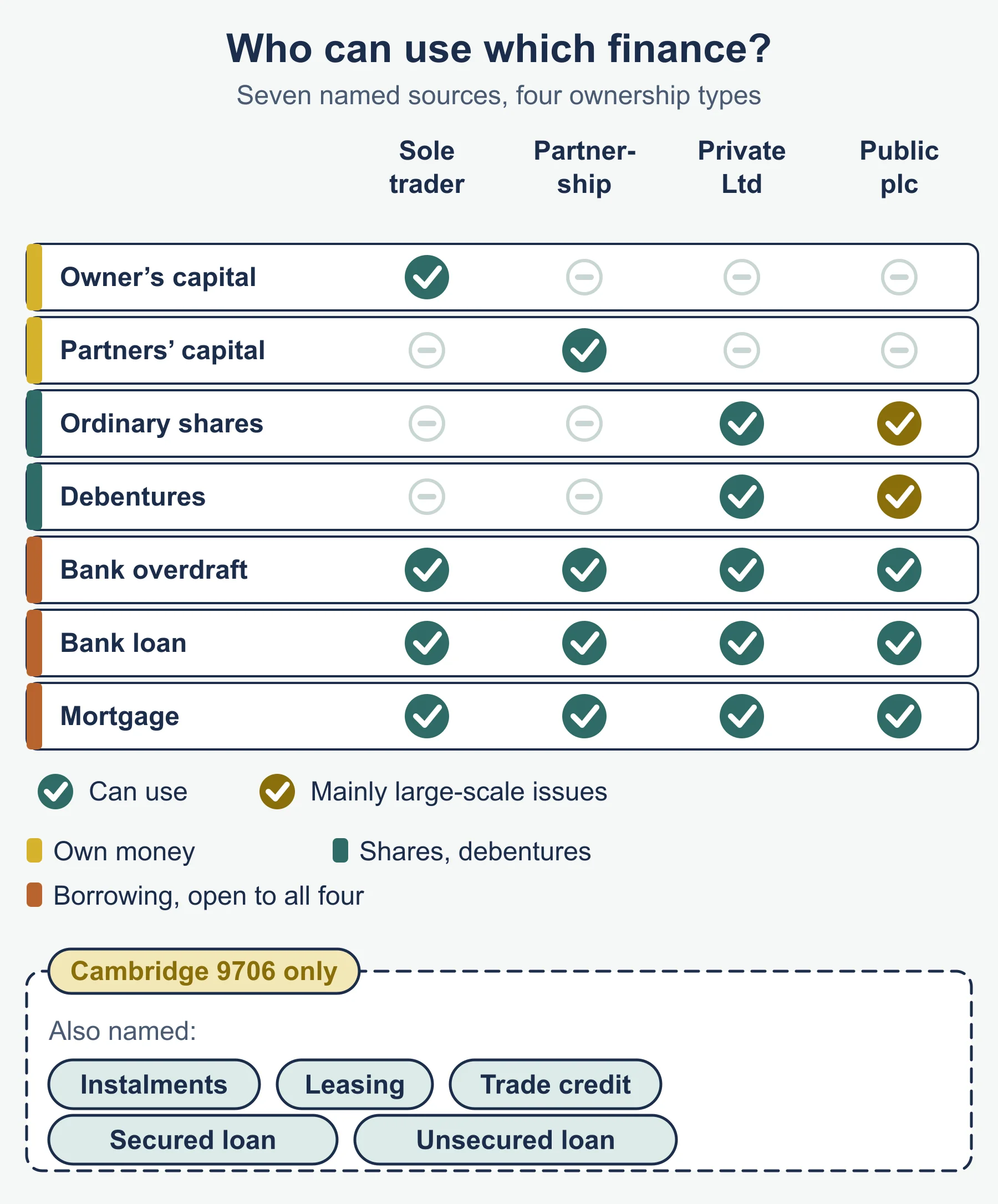
| 5.1.2 | Describe external sources: share capital or issuing shares, venture capital, bank overdrafts, leasing, hire purchase, bank loans, trade credit, government grants and crowdfunding |
| 5.1.2 | Give advantages and disadvantages of internal and external sources |
| 5.1.2 | Use the factors in choosing a source: size of business, legal form of business, amount required, length of time, existing loans, cost and purpose |
| 5.1.2 | Recommend and justify an appropriate source of finance for a given situation |
5.1.1 The need for business finance
Business finance is the money a business needs to start, to operate and to grow. Money used to buy things that last is often called capital. The syllabus lists five main reasons why a business needs it.
Start-up capital. Before a new business sells anything it must pay for premises, equipment, first stocks and licences. This is the money needed to get going. A new business has no sales revenue yet, so it cannot pay for these costs from trading.
Capital for expansion or growth. An existing business may want a second site, a larger workshop or a new product range. These plans cost money before they earn any.
Replacing existing non-current assets. Non-current assets are items a business keeps for more than one year, such as machinery, vehicles and buildings. They wear out or become unreliable, so they must be replaced.
Investing in new technology. A business may buy faster equipment, new software or automated machines to cut costs or improve quality. The spending comes first and the benefits come later.
Working capital. A business needs money for its everyday costs: wages, materials, electricity and rent.
Short-term and long-term needs
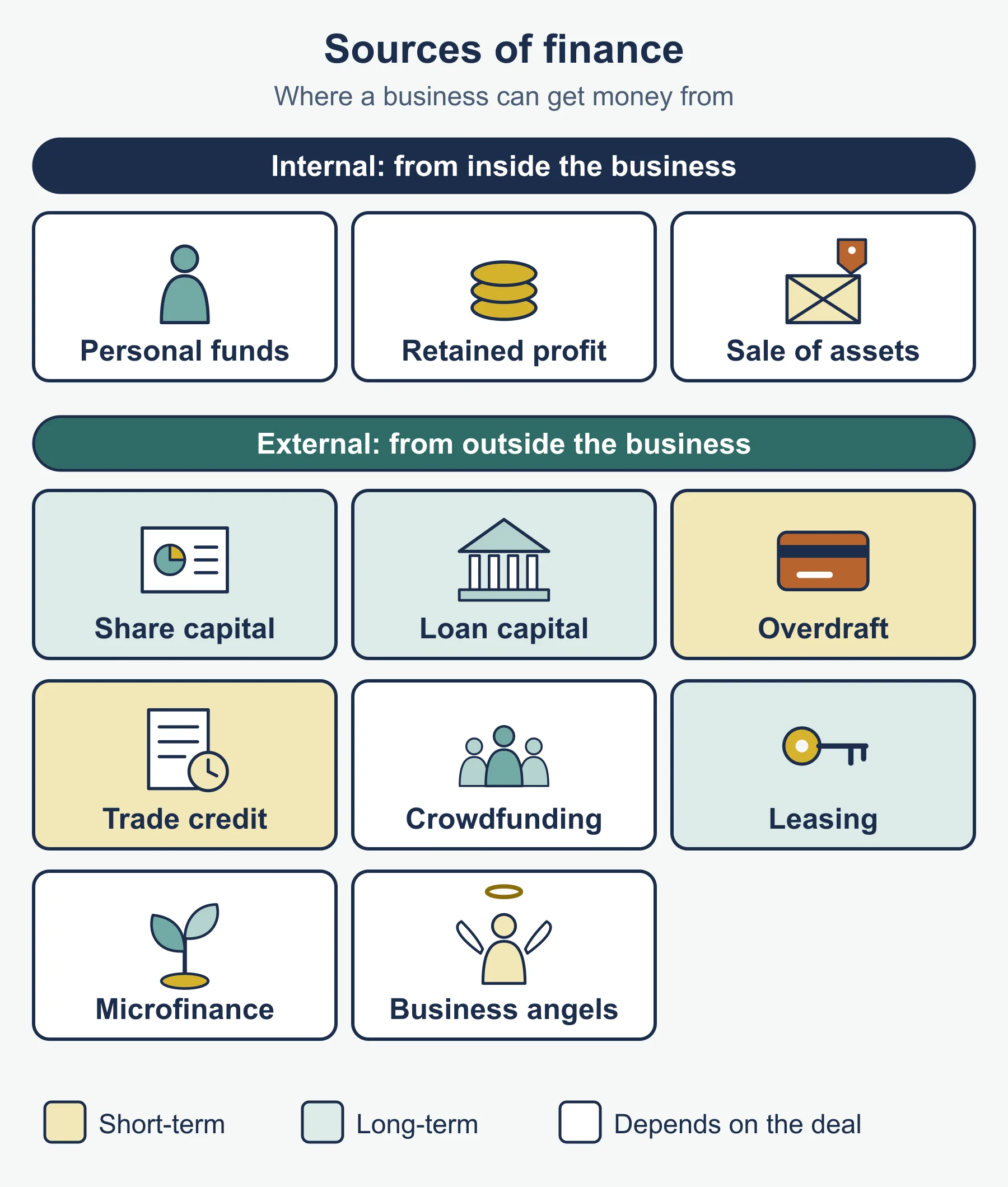
A short-term finance need is for a period of up to about a year. It covers day-to-day running costs, paying suppliers on time or bridging a gap before customers pay. A long-term finance need lasts for several years and is linked to non-current assets, expansion or start-up. Match the length of the finance to the length of the need. A bank overdraft is quick and flexible, which suits a short gap. It is poorly suited to paying for a building that will be used for twenty years.
Working capital
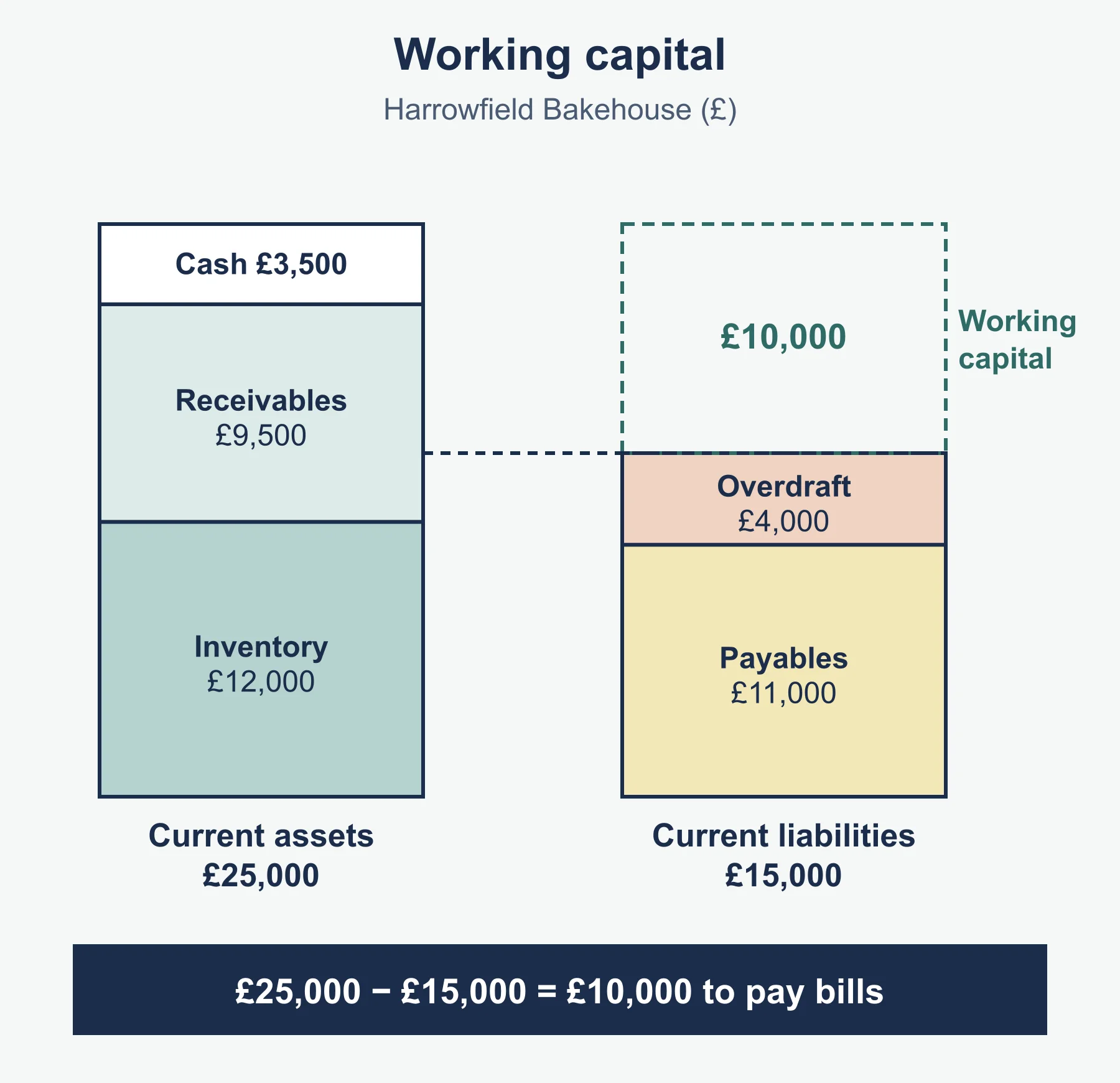
Working capital is the money a business has on hand to meet its day-to-day costs. In the syllabus it is a simple calculation from the statement of financial position:
Working capital = current assets - current liabilities
Current assets are items that are cash or will become cash within twelve months (inventory, trade receivables and cash). Current liabilities are amounts the business must pay within twelve months (trade payables and an overdraft).
Worked example. Harrowfield Bakehouse has inventory of £12,000, trade receivables of £9,500 and cash of £3,500. It owes trade payables of £11,000 and has an overdraft of £4,000.
- Current assets = 12,000 + 9,500 + 3,500 = £25,000
- Current liabilities = 11,000 + 4,000 = £15,000
- Working capital = 25,000 - 15,000 = £10,000
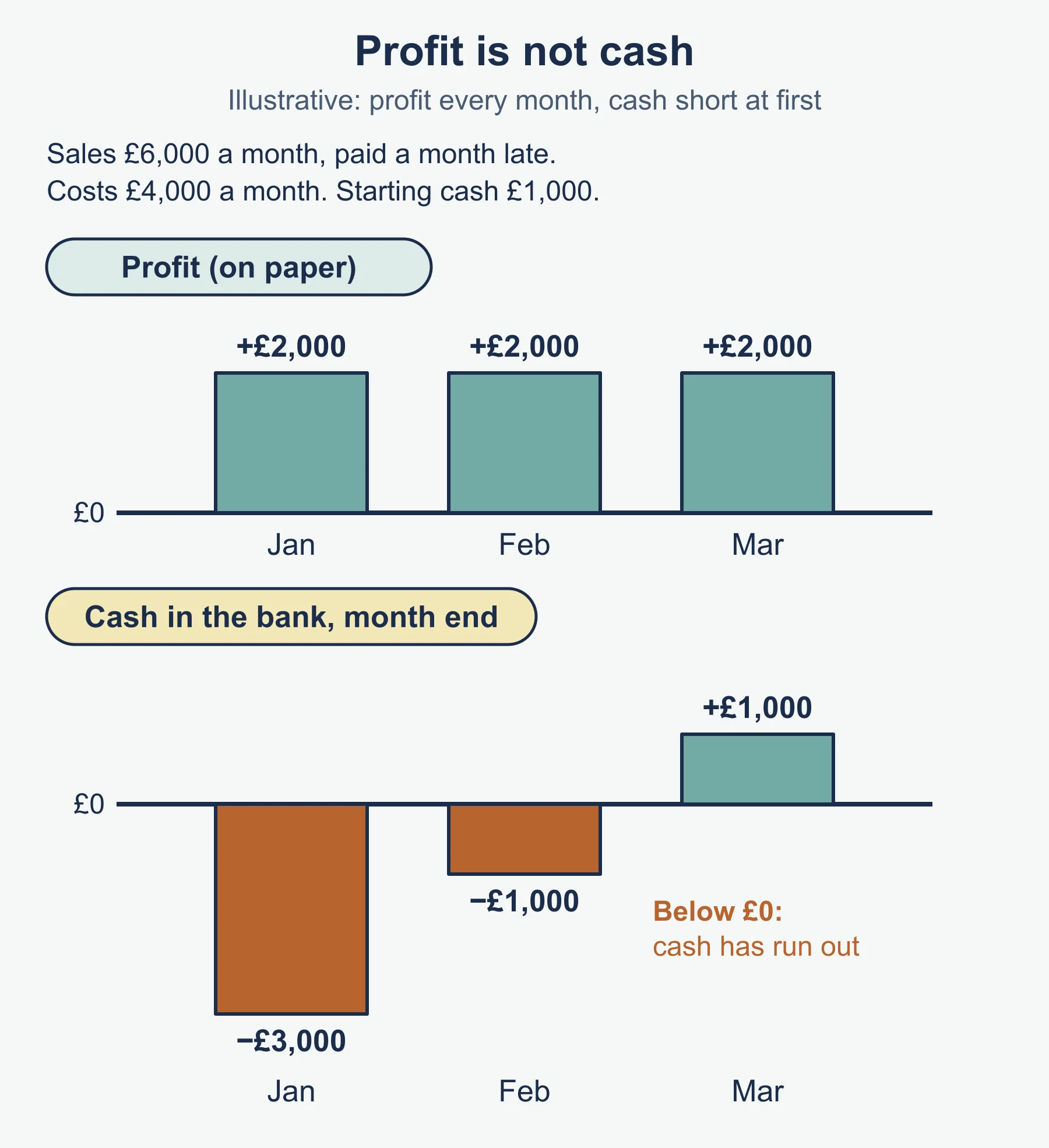
Why it matters. Working capital is how a business pays bills as they fall due. A profitable business can still fail if its cash is tied up in inventory and unpaid invoices when wages are due. Too little working capital means missed payments, lost supplier trust and possible insolvency. Too much can mean money sits idle that could have been used to grow. Working capital is also itself a source of finance, as section 5.1.2 explains.
5.1.2 The main sources of finance
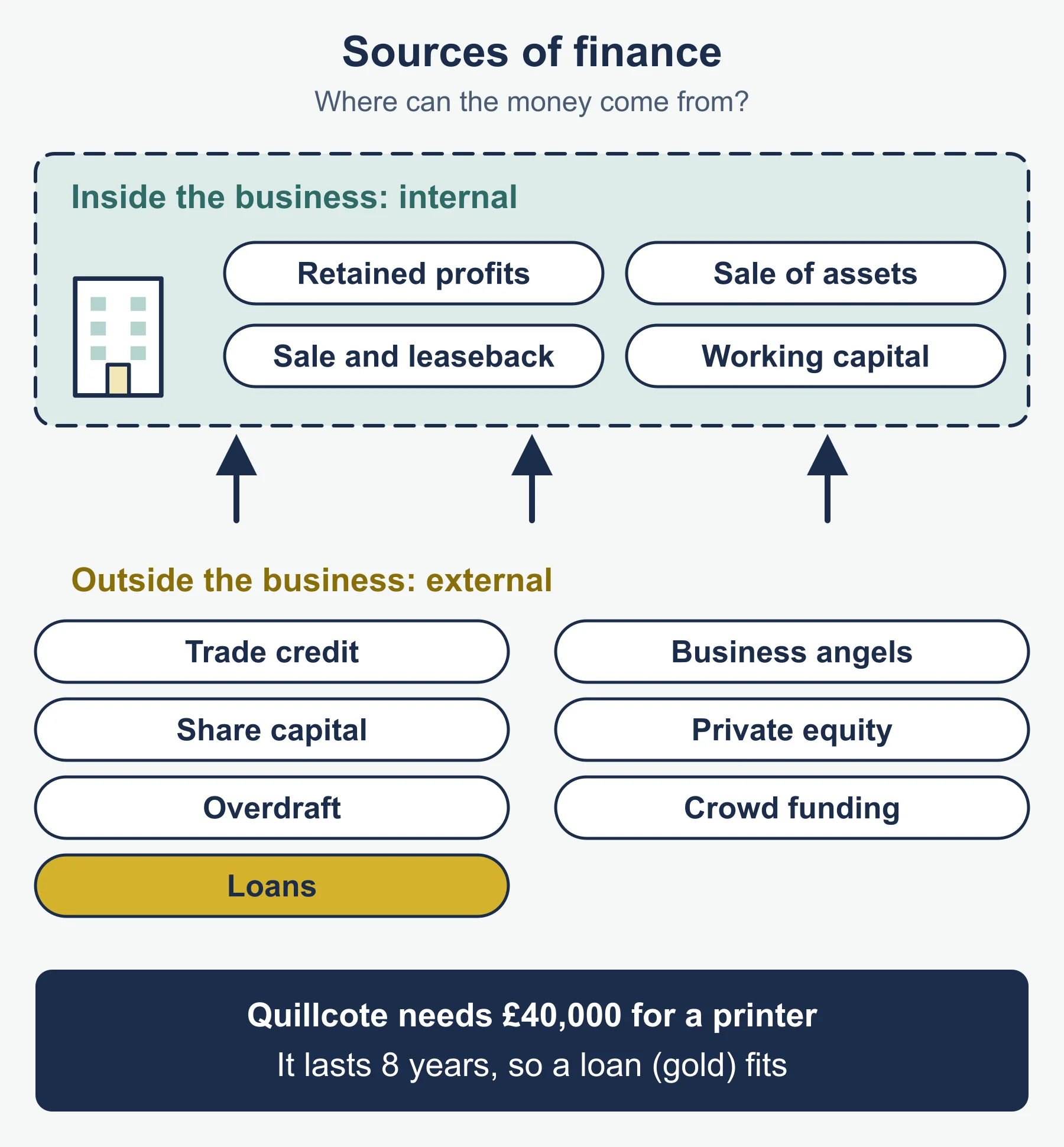
Sources are split into internal (from inside the business) and external (from outside it).
Internal sources
Owners’ investment. The owner puts in personal savings. There is no interest and no outside control. It is limited by what the owner can afford, and the owner’s personal money is put at risk.
Retained profit. The part of profit that the owners leave in the business instead of taking it out. If Ludlowe Print makes a profit of £36,000 and the owners take £14,000, then £22,000 is retained. It is cheap and quick because there is no repayment. It is only available to a business that is already making profit, and the owners receive less now.
Sale of unwanted assets. A business sells equipment, vehicles or property it no longer needs. Harrowfield Bakehouse might sell a spare van for £6,500. This raises cash without borrowing. It can be a one-off, and the price may be below what the asset is worth if the business needs money quickly.
Working capital. A business can free up cash by running its working capital down. Examples are selling off excess inventory or collecting money from customers sooner. This keeps costs low, but leaves less cushion for everyday bills.
External sources
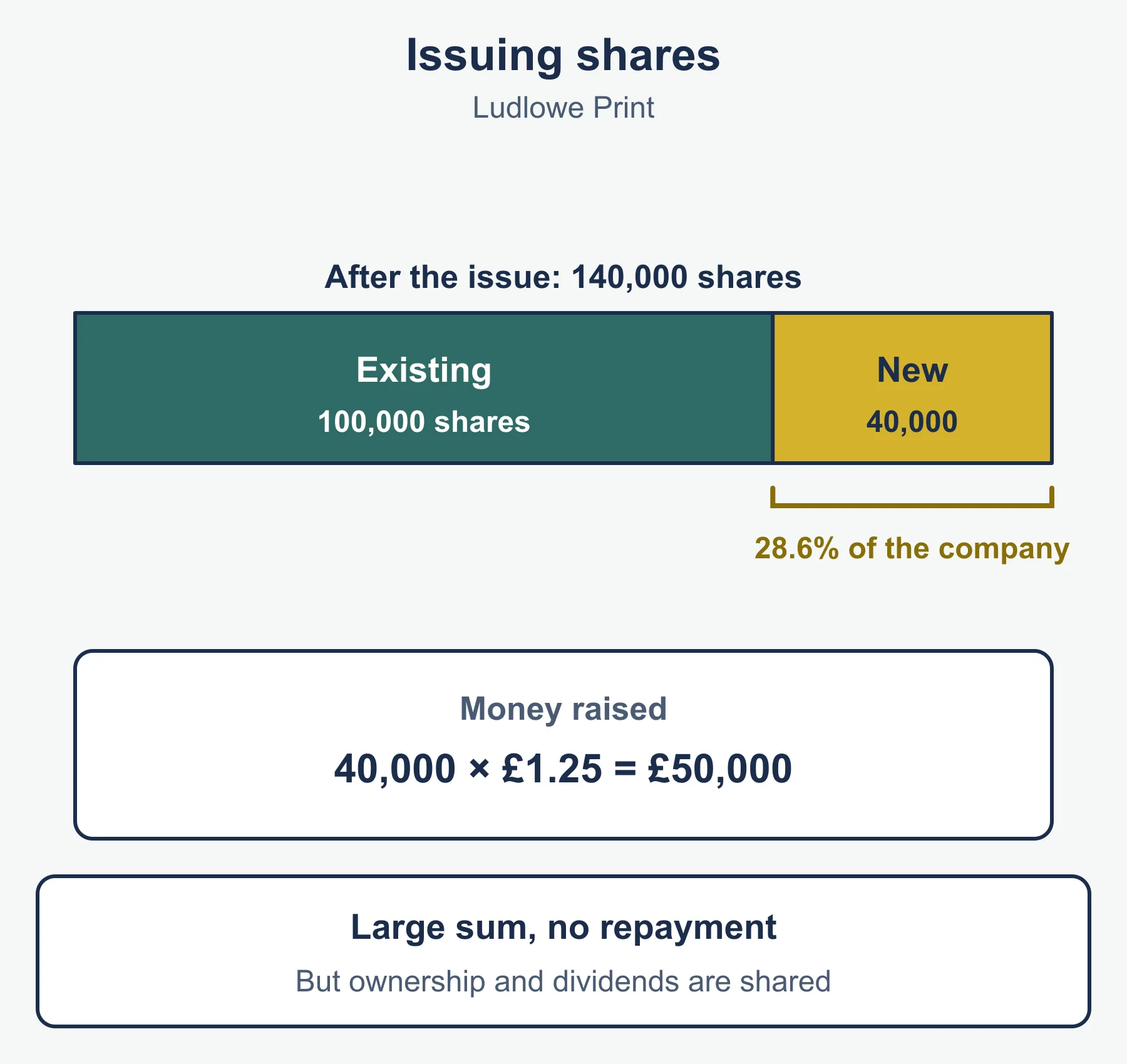
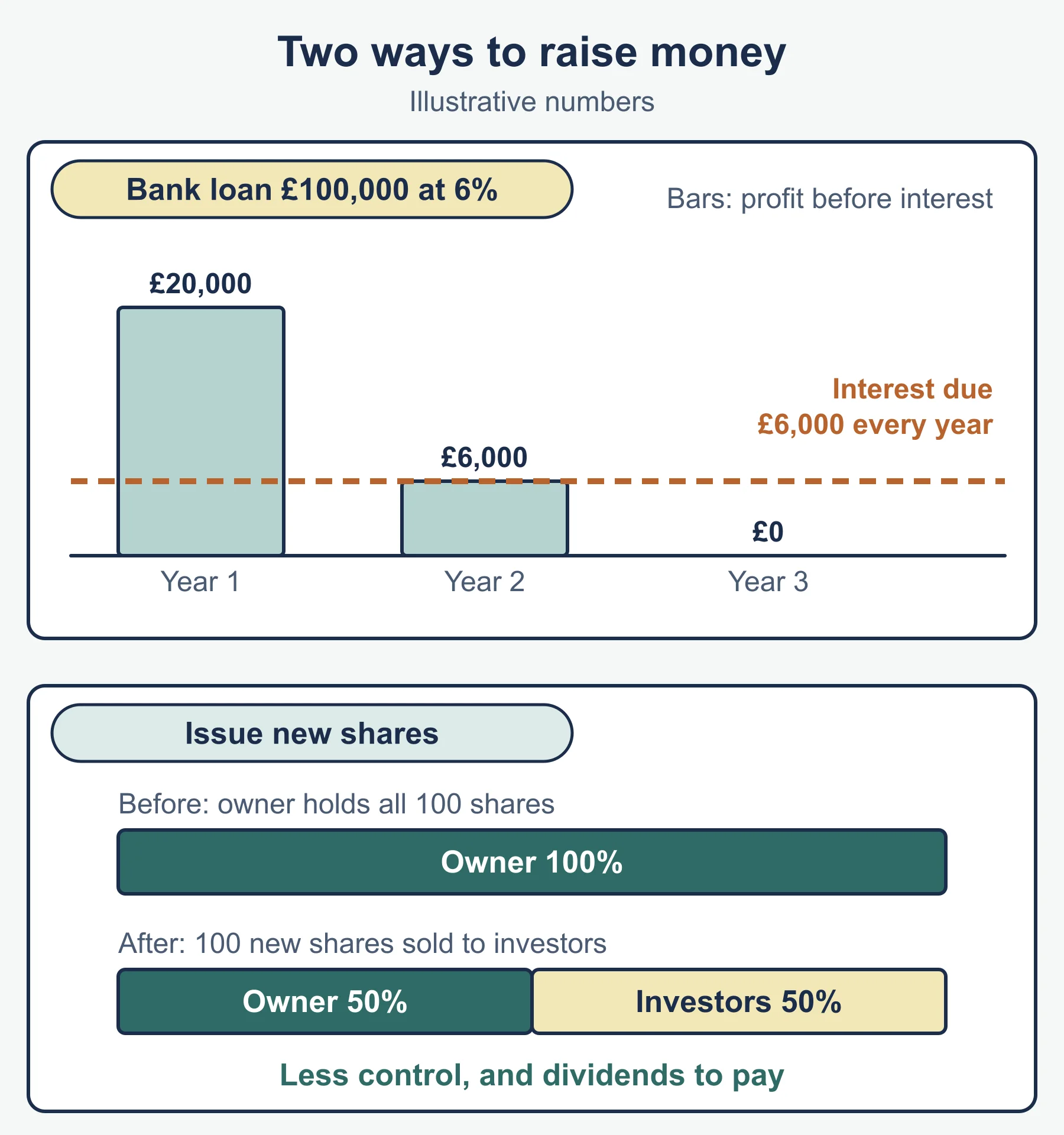
Share capital (issuing shares). A company raises money by selling shares to investors. This is a source for companies (limited companies), not for sole traders or partnerships. Ludlowe Print has 100,000 shares and issues 40,000 more at £1.25 each.
- Money raised = 40,000 x £1.25 = £50,000
- New shareholders hold 40,000 / 140,000 = 28.6% (to one decimal place)
Advantages: large sums, no repayment and no interest. Disadvantages: ownership is shared, profits are shared through dividends, and control may be diluted. Issuing shares also takes time and effort.
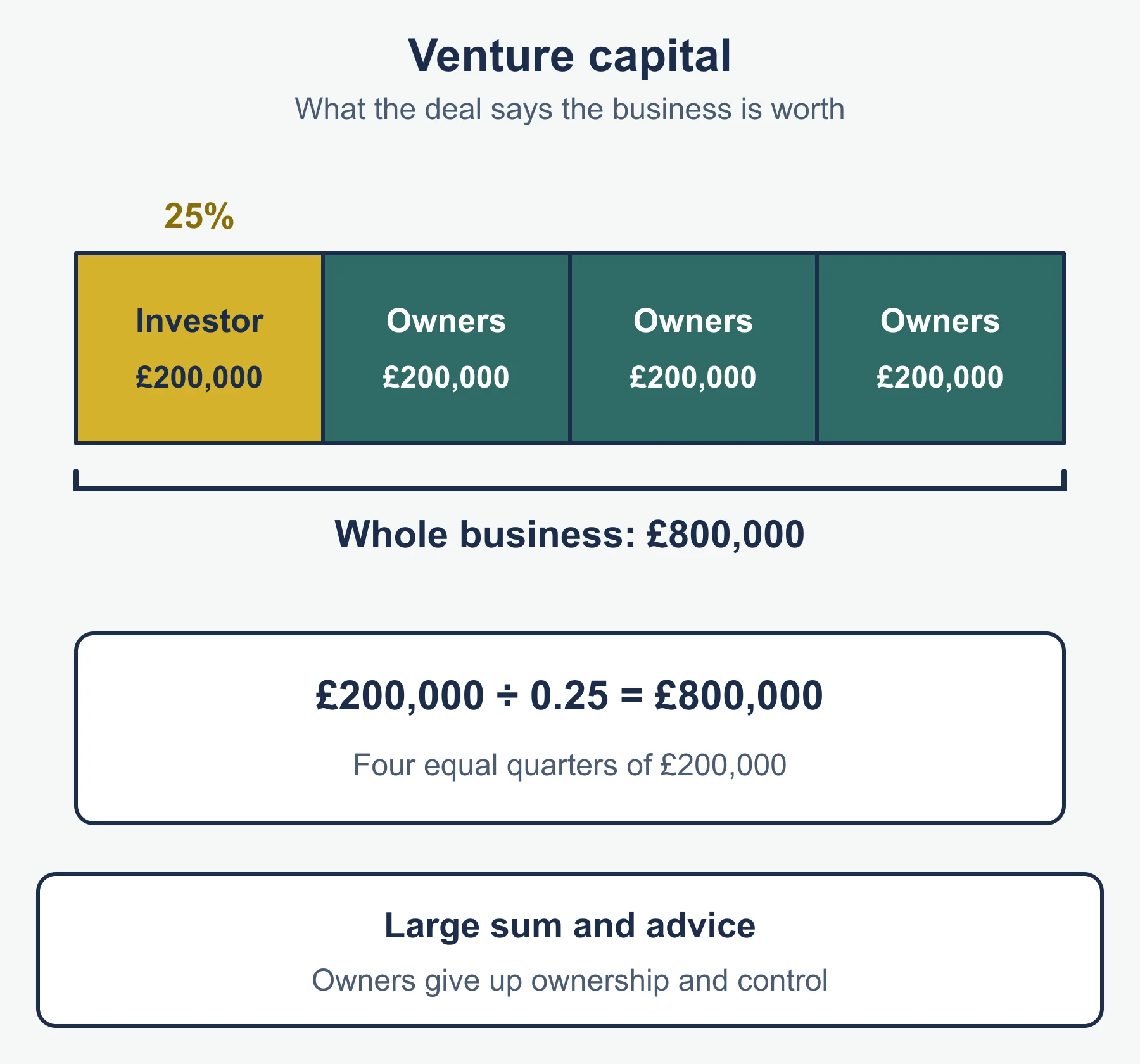
Venture capital. Specialist investors put money into a small or new business with high growth potential, usually in exchange for a share of ownership. If a venture capital firm invests £200,000 for 25% of a business, the business is being valued at 200,000 / 0.25 = £800,000. It brings large sums and often advice, but the owners give up some ownership and control.
Bank overdraft. The bank lets the business spend more than is in its account, up to an agreed limit. Borrowing can rise and fall as needed, and interest is paid only on the sum actually used. It is meant for short-term gaps. Interest rates can be high, and the bank can ask for the money back at short notice.
Leasing. The business pays regular rent for using an asset, such as a machine, and does not own it. There is no large payment at the start and repairs may be included. In total, payments can cost more than buying, and the business never owns the asset. For example, a lease of £330 a month for 36 months costs £11,880.
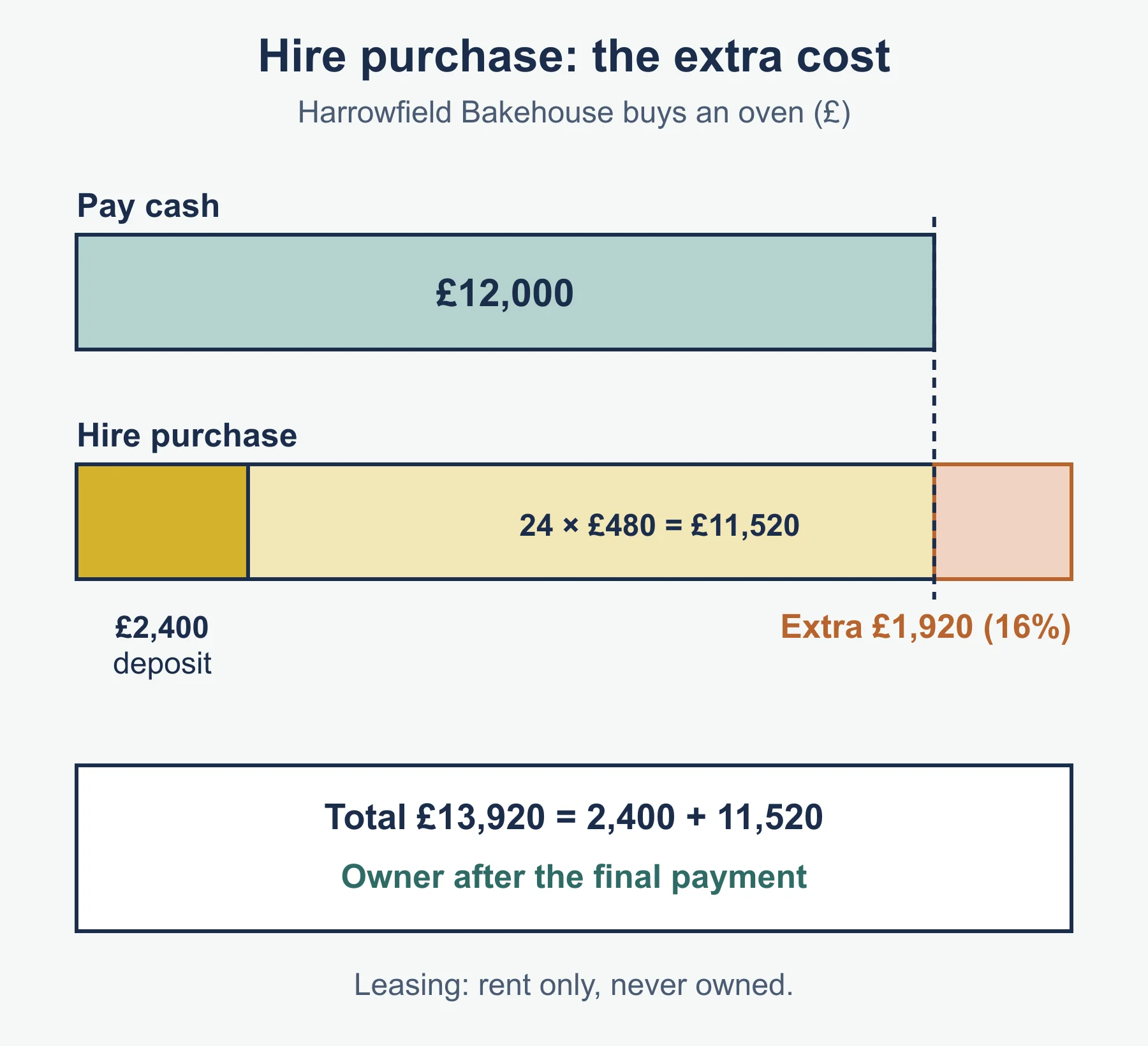
Hire purchase. The business pays a deposit and then regular instalments, and becomes the owner once the final payment is made. Harrowfield Bakehouse buys an oven with a cash price of £12,000.
- Deposit of 20% = £2,400
- 24 monthly payments of £480 = £11,520
- Total paid = 2,400 + 11,520 = £13,920
- Extra cost over the cash price = 13,920 - 12,000 = £1,920 (16% more)
It spreads the cost and gives ownership at the end, but it costs more overall.
Bank loan. A fixed sum is borrowed and repaid, with interest, over an agreed period. Repayments are predictable, which helps planning. The business must keep paying even if profit is low, and the bank may ask for security. As a simple illustration, interest of 8% a year on £20,000 is £1,600 each year.
Trade credit. A supplier allows the business to pay later, often after 30 days. It costs nothing if paid on time and improves cash flow. Suppliers may withdraw credit if payments are late, and the business might miss early-payment discounts.
Government grants. Money given by the government, often to support new businesses or particular regions, which does not have to be repaid. A grant of £8,000 towards a £40,000 project covers 20% of its cost. There are usually conditions, and the application takes time.
Crowdfunding. A large number of people each give a small amount, usually through an online platform. If 300 backers each give an average of £50, the business raises £15,000. It can also test demand and build a customer base. It may not reach its target, and the business must usually promise a reward or share.
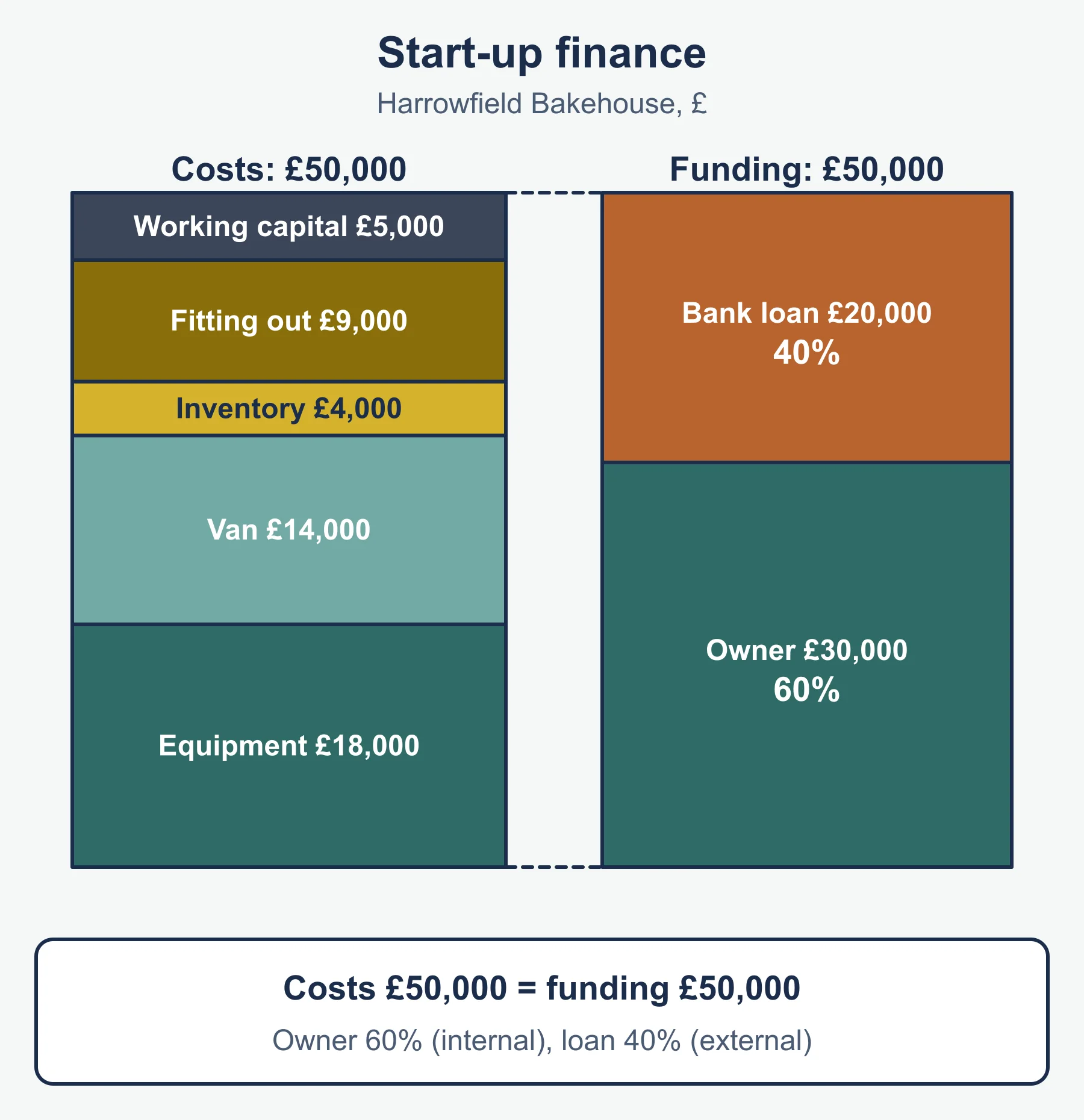
Start-up finance for Harrowfield Bakehouse
| Item | Cost |
|---|---|
| Equipment | £18,000 |
| Van | £14,000 |
| First inventory | £4,000 |
| Fitting out and rent deposit | £9,000 |
| Working capital | £5,000 |
| Total start-up capital | £50,000 |
The owner invests £30,000 (60%) and takes a bank loan for £20,000 (40%).
Internal and external sources compared
| Internal | External | |
|---|---|---|
| Cost | Usually no interest | Interest, fees or shared profit |
| Speed | Often quick | Application and checks take time |
| Control | Owners keep full control | Lenders or new owners may gain influence |
| Amount | Limited by what the business has | Can be much larger |
| Risk | Owners’ own money at risk | Repayment pressure or lost ownership |
Choosing a source of finance
The syllabus lists the factors to consider. For each one, ask what it changes.
- Size of business. A small firm may struggle to get a large loan or issue shares. A large company has more choices.
- Legal form of business. Only a company can issue shares. A sole trader cannot.
- Amount required. Small amounts suit trade credit or an overdraft. Large sums point to shares, venture capital or long-term loans.
- Length of time. Short-term need: overdraft or trade credit. Long-term need: loan, shares or retained profit.
- Existing loans. If a business already has heavy debt, a lender may refuse more, and extra interest may be hard to pay.
- Cost. Compare interest, fees and what is given up in ownership.
- Purpose. Match the source to the use: a machine suits leasing or hire purchase, and a gap in cash suits an overdraft.
Recommend and justify
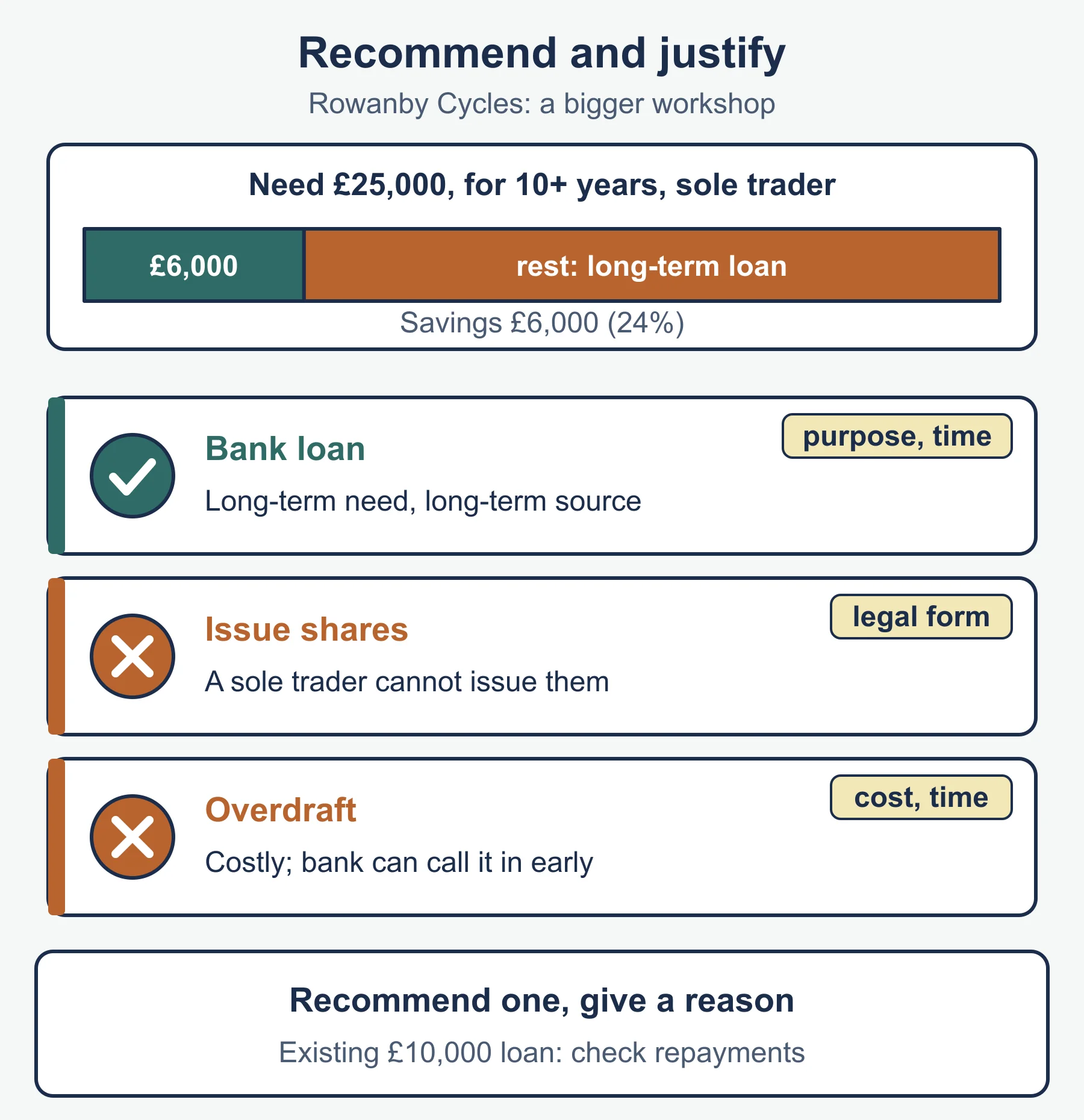
Worked example. Rowanby Cycles is a sole trader. The owner wants £25,000 to build a bigger workshop, and expects to use it for at least ten years. Savings are £6,000 and there is an existing loan of £10,000.
Recommendation: a long-term bank loan, topped up with the owner’s savings. Justification: the purpose is long-term, so a long-term source matches it (purpose, length of time). A sole trader cannot issue shares (legal form). An overdraft would be expensive and could be called in early. Because there is already a loan, the business should check repayments are affordable (existing loans).
A strong answer recommends one source, applies the facts in the case, and gives a reason why a different source is less suitable.
Common errors
- Writing that working capital is the same as cash. It is current assets less current liabilities.
- Saying a sole trader can issue shares.
- Calling a bank overdraft a long-term source.
- Mixing up leasing (no ownership) and hire purchase (ownership at the end).
- Listing advantages and disadvantages with no link to the business in the question.
- Treating retained profit as cash in the bank. It may already have been spent on assets.
Frequently asked questions
Why do businesses need finance? The syllabus gives start-up capital, capital for expansion or growth, replacing existing non-current assets, investing in new technology, and working capital for everyday costs.
How do you calculate working capital? Working capital is current assets (inventory, trade receivables and cash) minus current liabilities (such as trade payables and an overdraft). A profitable business can still run short of working capital and fail.
What are internal sources of finance? Internal sources come from inside the business: owners’ investment, retained profit, sale of unwanted assets, and freeing up working capital. They are usually cheaper and keep control with the owners, but the amount is limited.
What factors affect the choice of a source of finance? The factors to consider are the size of the business, its legal form, the amount required, the length of time, existing loans, cost and purpose. Match the length of the finance to the length of the need.
Official syllabus
This guide follows the Cambridge IGCSE Business 0264 syllabus for examination in 2027, 2028 and 2029, published by Cambridge University Press & Assessment, section 5.1 Business finance.
Get free revision emails (optional)
Occasional emails with practice questions, worked explanations and links to free resources for the qualification and subjects you choose. No spam, and you can unsubscribe from any email. The free tools on this site never need an email.
Related resources
-
Practice questions
IGCSE Business: Business finance (Cambridge 0264) – Practice Questions
Original practice questions with worked answers for Cambridge IGCSE Business 0264 section 5.1: needs for finance, working capital and sources of finance.
Business · Cambridge · IGCSE
Try questions -
Revision notes
IGCSE Business: Business finance (Cambridge 0264) – Revision Notes
Revision notes for Cambridge IGCSE Business 0264 section 5.1: finance needs, working capital, sources of finance, choosing a source, and a self-test.
Business · Cambridge · IGCSE
Revise topic -
Study guides
IGCSE Business: Cash flow forecast (Cambridge 0264)
Study guide to cash and cash flow forecasts for Cambridge IGCSE Business 0264: features, completing and interpreting forecasts, and fixing cash problems.
Business · Cambridge · IGCSE
Read guide
Related articles
-
teaching
A Level tuition in Dubai: Cambridge or Pearson Edexcel International A Level?
Schools in Dubai and Abu Dhabi teach either Cambridge International AS & A Level or Pearson Edexcel International A Level. How the two are structured, why it matters for tuition, and how online classes from Lahore work.
9 October 2026
-
curriculum guides
Choosing subjects at IGCSE and A Level
How subject choices at 14 and 16 affect university options later, and how to keep pathways open without overloading a timetable.
28 July 2026
Studying this with a teacher
Working through Business IGCSE?
This page is free and stays free. If you would rather be taught it, Marlbridge runs Business classes one-to-one and in small groups of up to 15, online in your own time zone. The first trial class is free. WhatsApp replies within an hour (8am–11pm Pakistan time, every day); email the same day.
Cambridge Business teachers at Marlbridge

