
Revision Notes
IGCSE Business: Business finance (Cambridge 0264) – Revision Notes
Revision notes for Cambridge IGCSE Business 0264 section 5.1: finance needs, working capital, sources of finance, choosing a source, and a self-test.
- Subject
- Business
- Level
- IGCSE
- Topic
- Financial information and decisions
- Author
- Marlbridge Academic Team
- Updated
- Reviewed by
- Salman Ahmad (what this means)
Aligned to Cambridge IGCSE Business (0264), For examination in 2027, 2028 and 2029. Official specification .
Syllabus page (what it covers and how it is assessed): Cambridge IGCSE Business.
Syllabus points this page covers
0264
- 5.1 Business finance
Found an error? Report a correction.
Need help with this topic? Request a free trial class for IGCSE Business (0450 / 0264).
These notes condense section 5.1, Business finance, of the Cambridge IGCSE Business 0264 syllabus for examination in 2027, 2028 and 2029 (5.1.1 The need for business finance and 5.1.2 The main sources of finance). For full explanations read the study guide, then try the practice questions. The course hub and the printable checklist track progress, and the free diagnostics show your weak spots. All businesses named are invented.
Why businesses need finance (5.1.1)
| Reason | Meaning in one line |
|---|---|
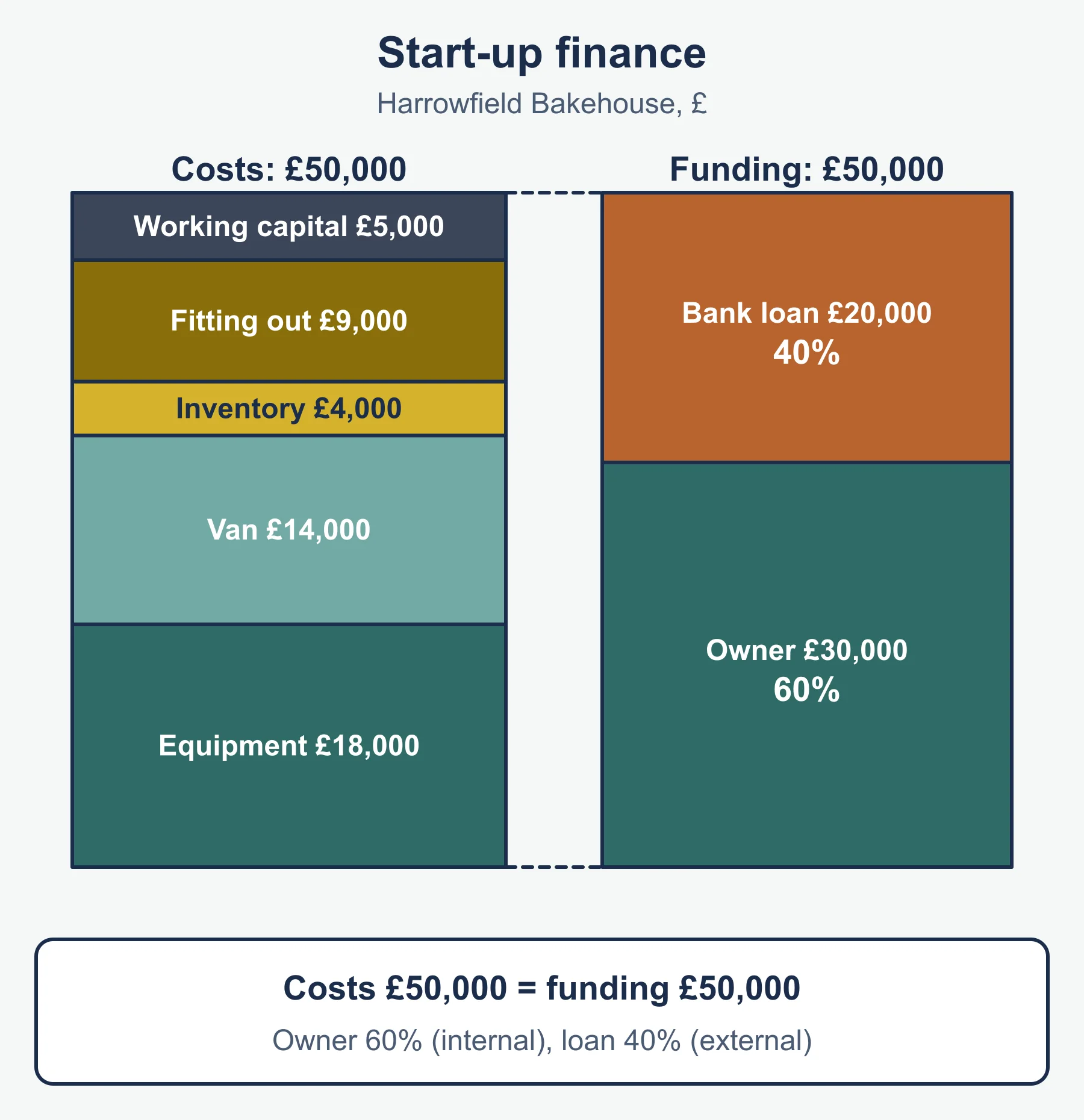
| Start-up capital | Money to open: premises, equipment, first inventory |
| Expansion or growth | Money for new sites, products or markets |
| Replacing non-current assets | Worn-out machinery, vehicles or buildings must be renewed |
| New technology | Spending now for lower costs or better quality later |
| Working capital | Money for everyday costs such as wages and materials |
Short-term need: about a year or less, for running costs or a gap before customers pay. Long-term need: several years, for non-current assets, growth or start-up.
Rule: match the length of the finance to the length of the need.
Working capital
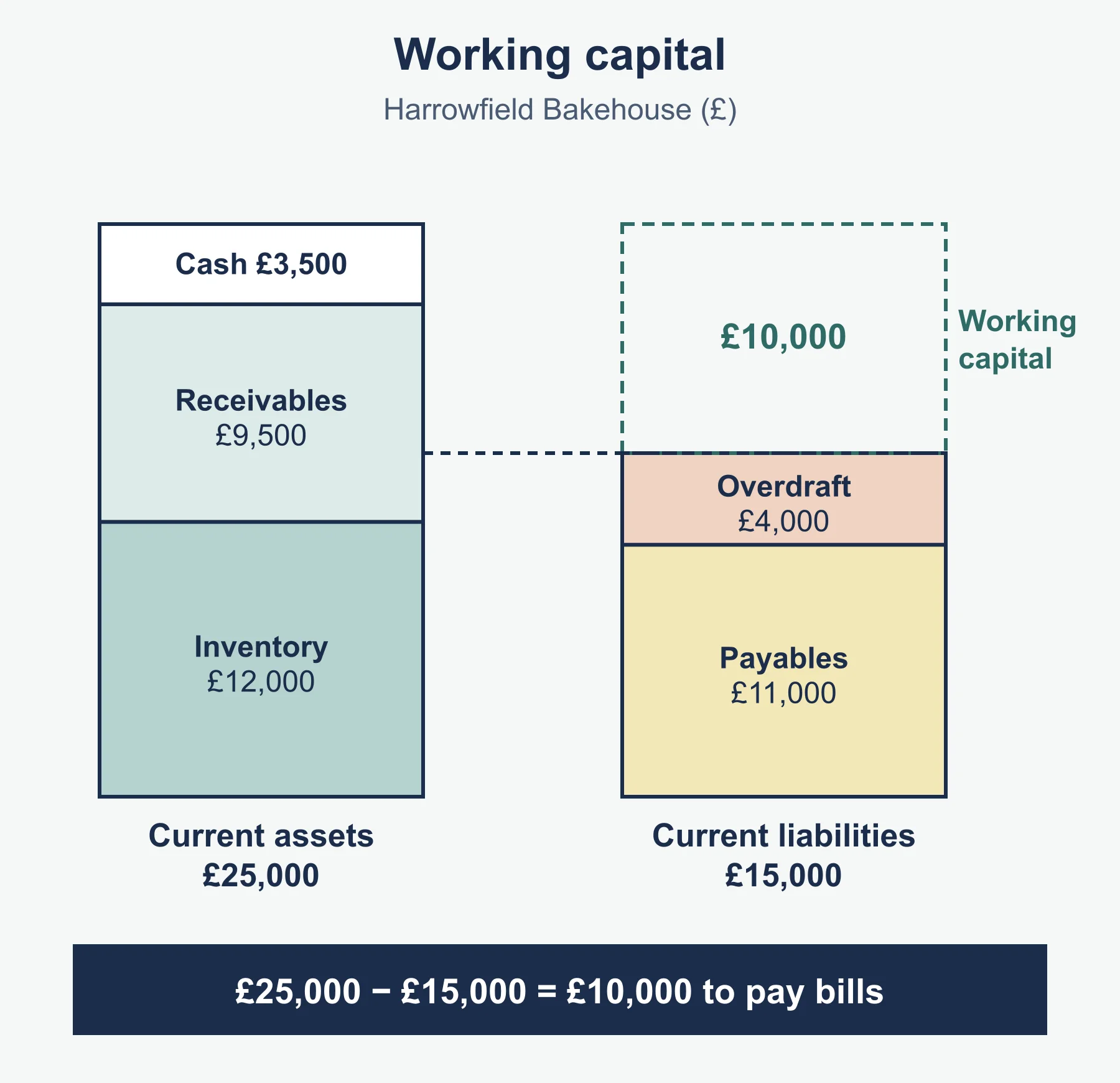
- Working capital = current assets - current liabilities.
- Current assets: inventory, trade receivables, cash.
- Current liabilities: trade payables, overdraft.
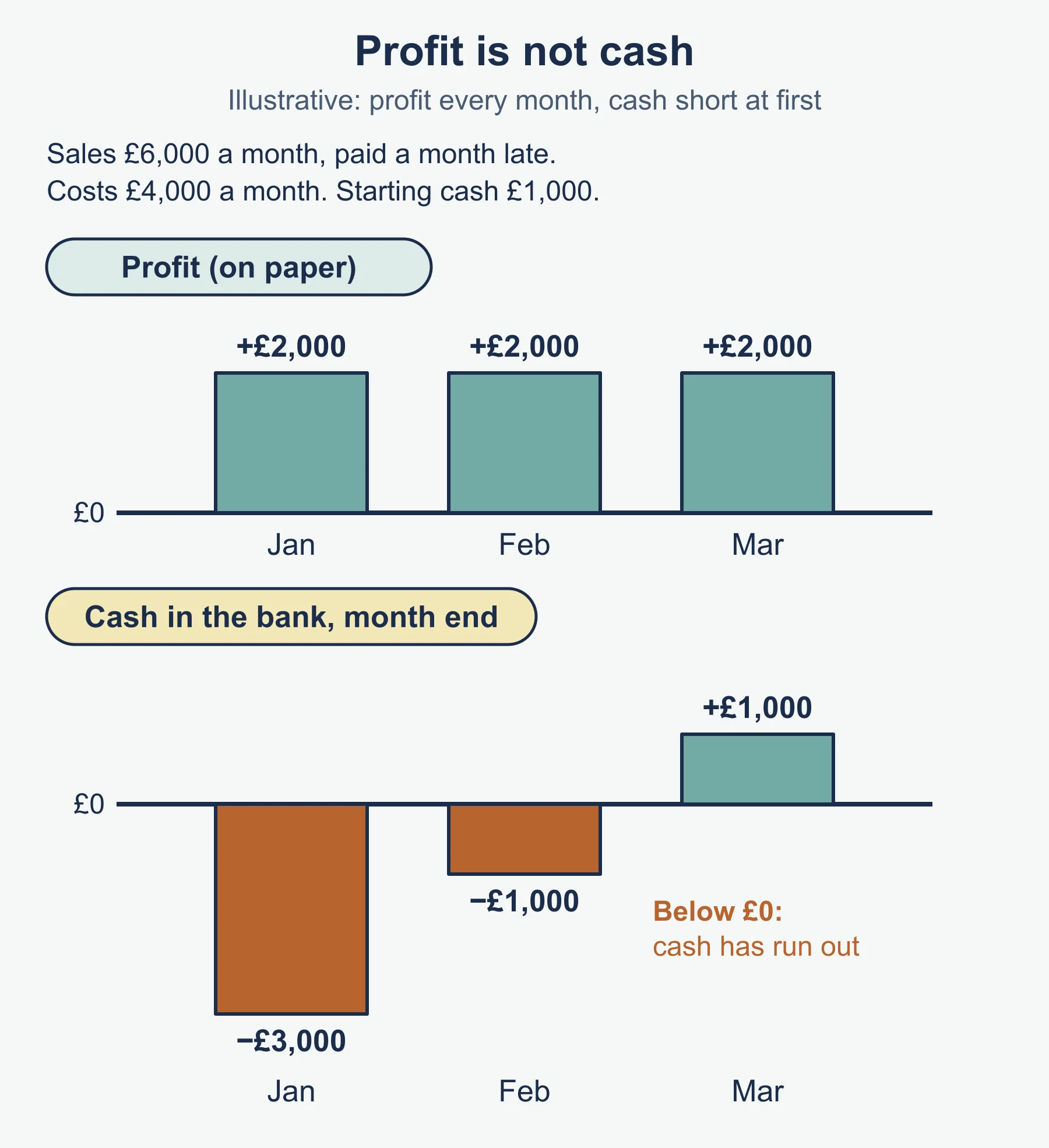
- It pays everyday bills. A profitable business can still run out of working capital and fail.
- Too little: late payments, lost supplier trust, possible insolvency.
- Too much: idle money that could earn more if invested.
Small reminder: current assets £12,200 and current liabilities £7,700 give working capital of £4,500.
Sources of finance (5.1.2)
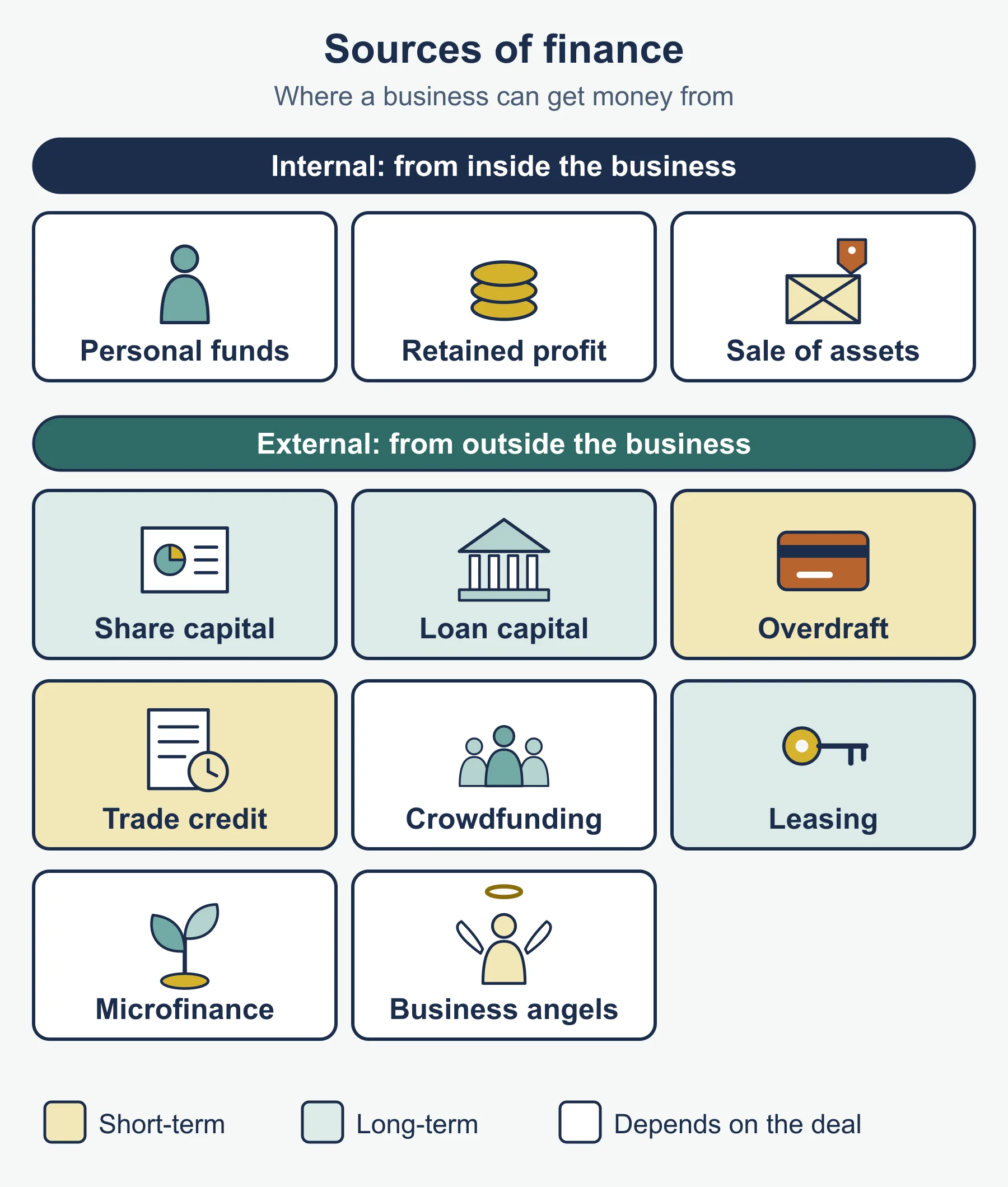
Internal sources
| Source | For | Against |
|---|---|---|
| Owners’ investment | No interest, no outside control | Limited by savings, personal money at risk |
| Retained profit | Cheap, no repayment | Only when profitable, less paid to owners |
| Sale of unwanted assets | Cash without borrowing | One-off, may sell below value |
| Working capital | Frees cash already in the business | Leaves less cushion for bills |
External sources
| Source | What it is | For | Against |
|---|---|---|---|
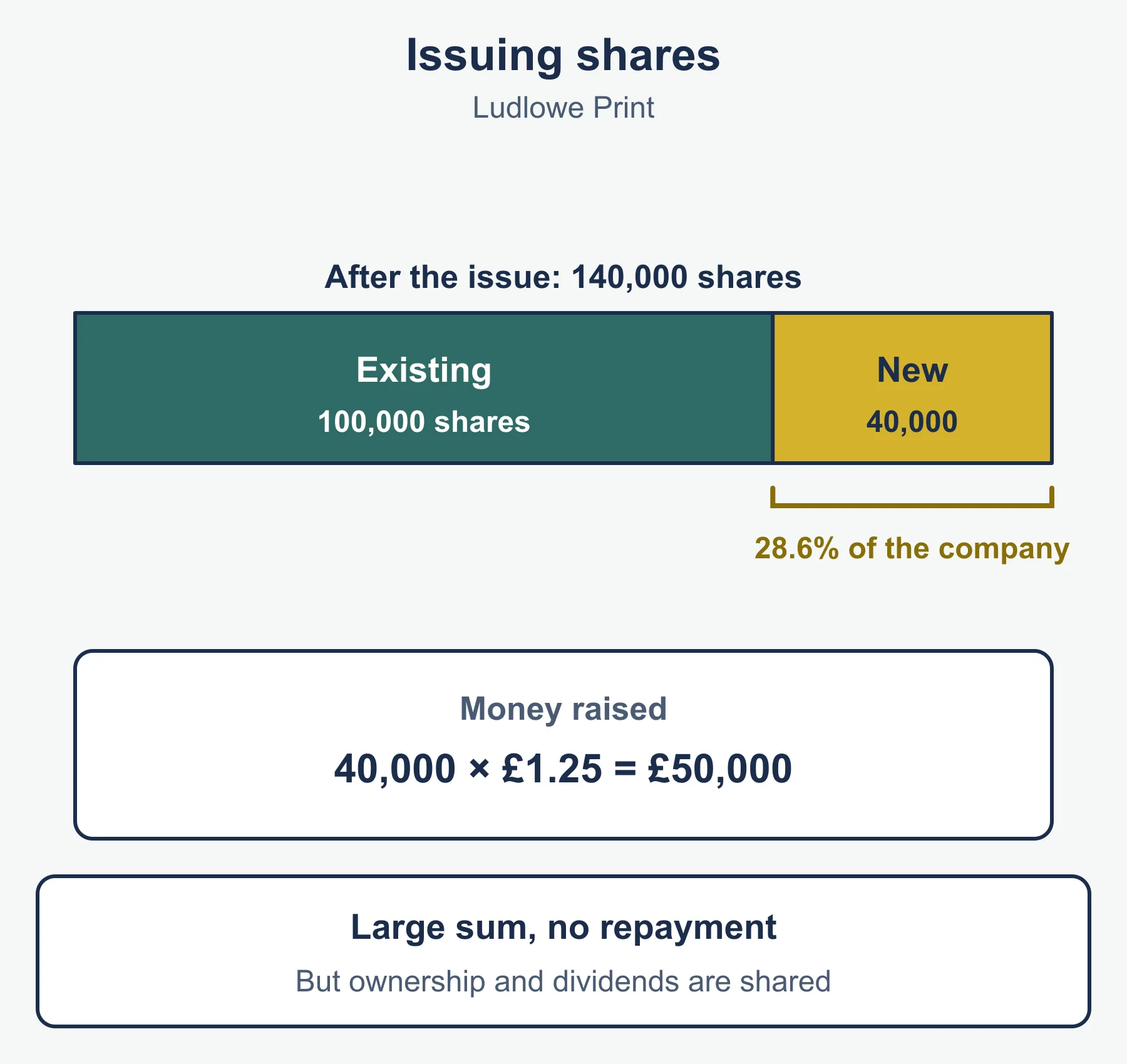
| Share capital | Company sells shares | Large sums, no repayment | Shared ownership and profits |
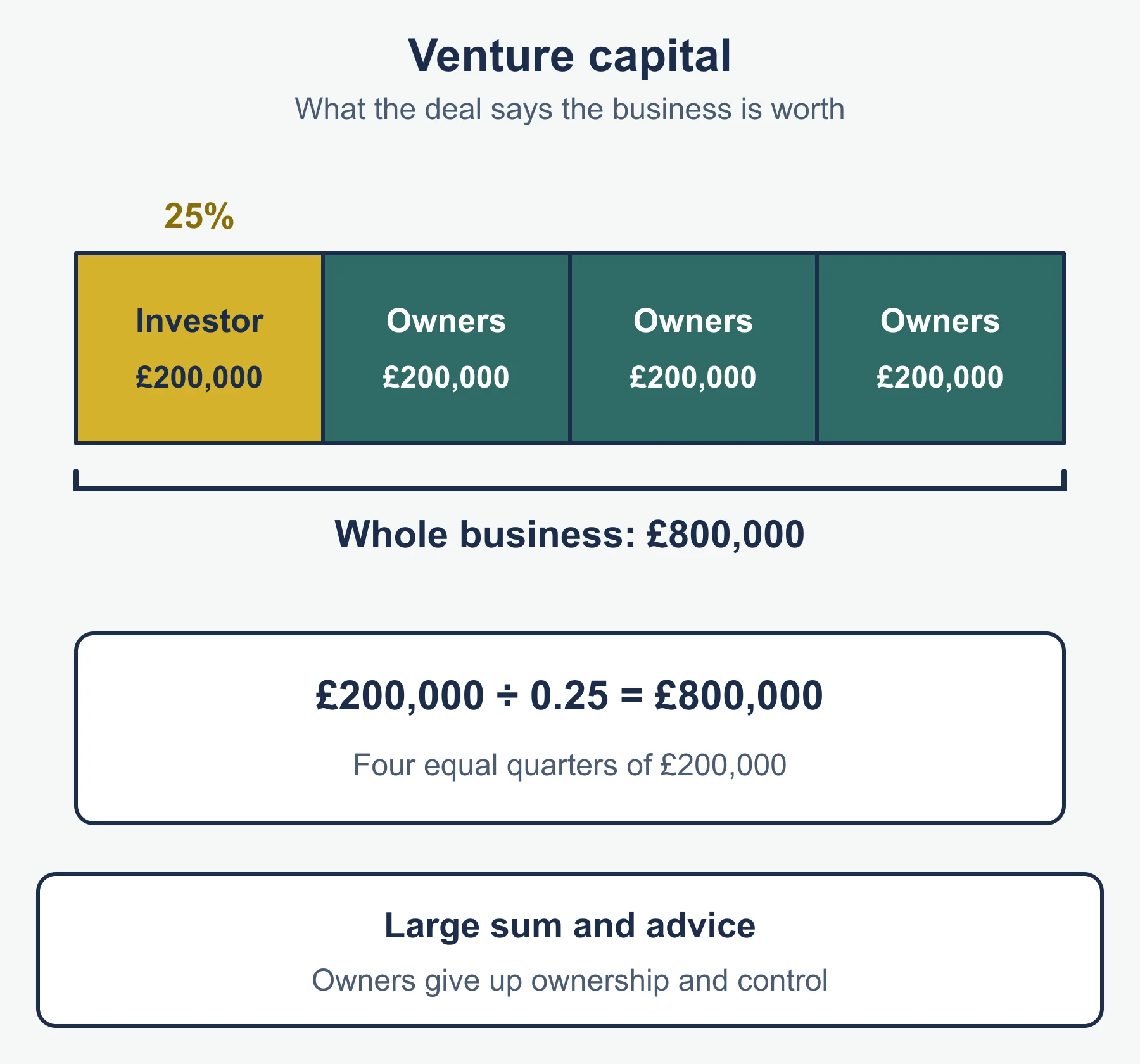
| Venture capital | Specialist investor takes a stake | Big sums, advice | Owners lose some control |
| Bank overdraft | Spend beyond account balance up to a limit | Flexible, interest only on amount used | Dear if kept long, can be recalled |
| Leasing | Rent an asset | Low start cost, no ownership worry | Never owned, dearer in total |
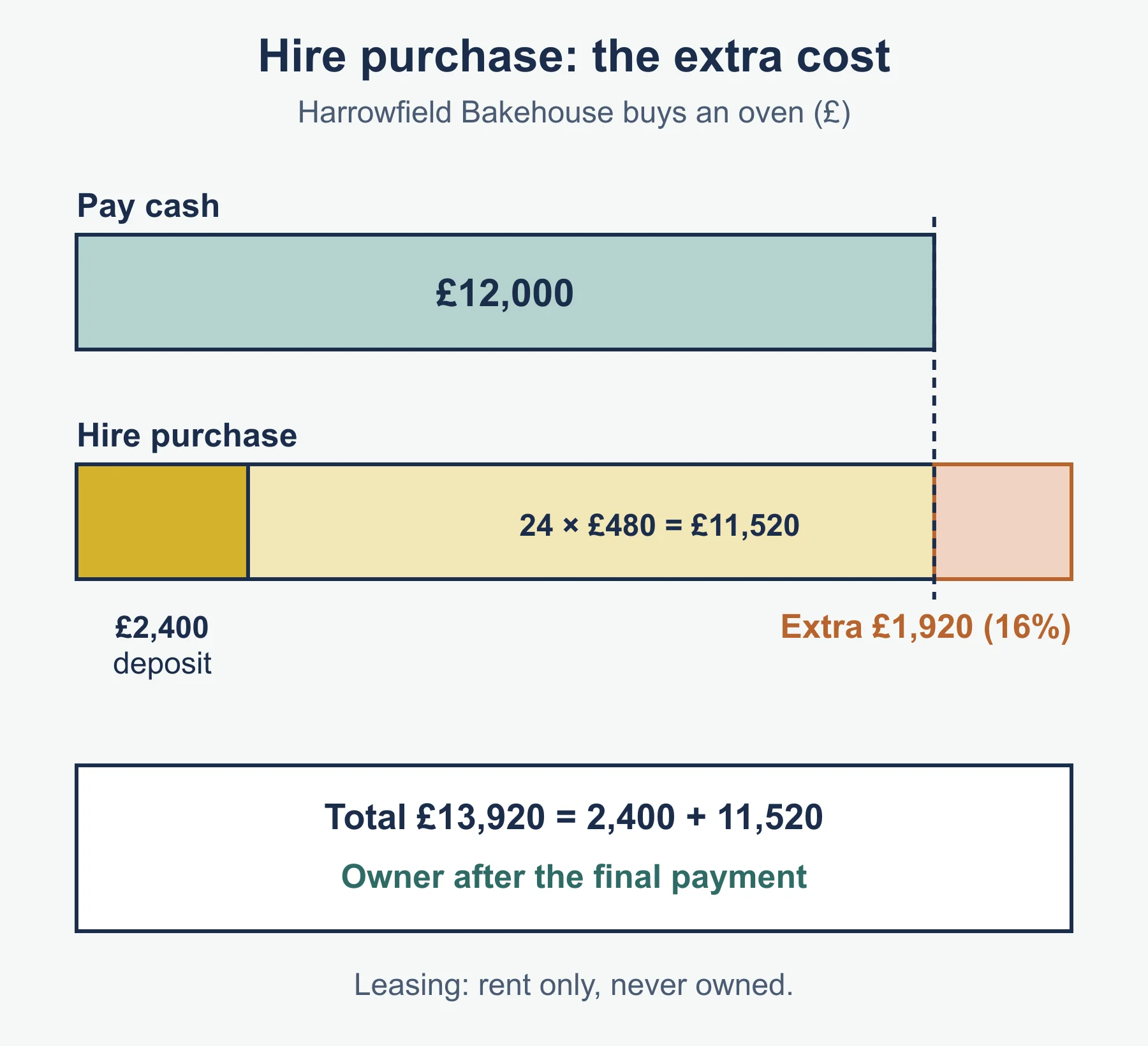
| Hire purchase | Deposit then instalments | Spread cost, own at the end | Dearer than paying cash |
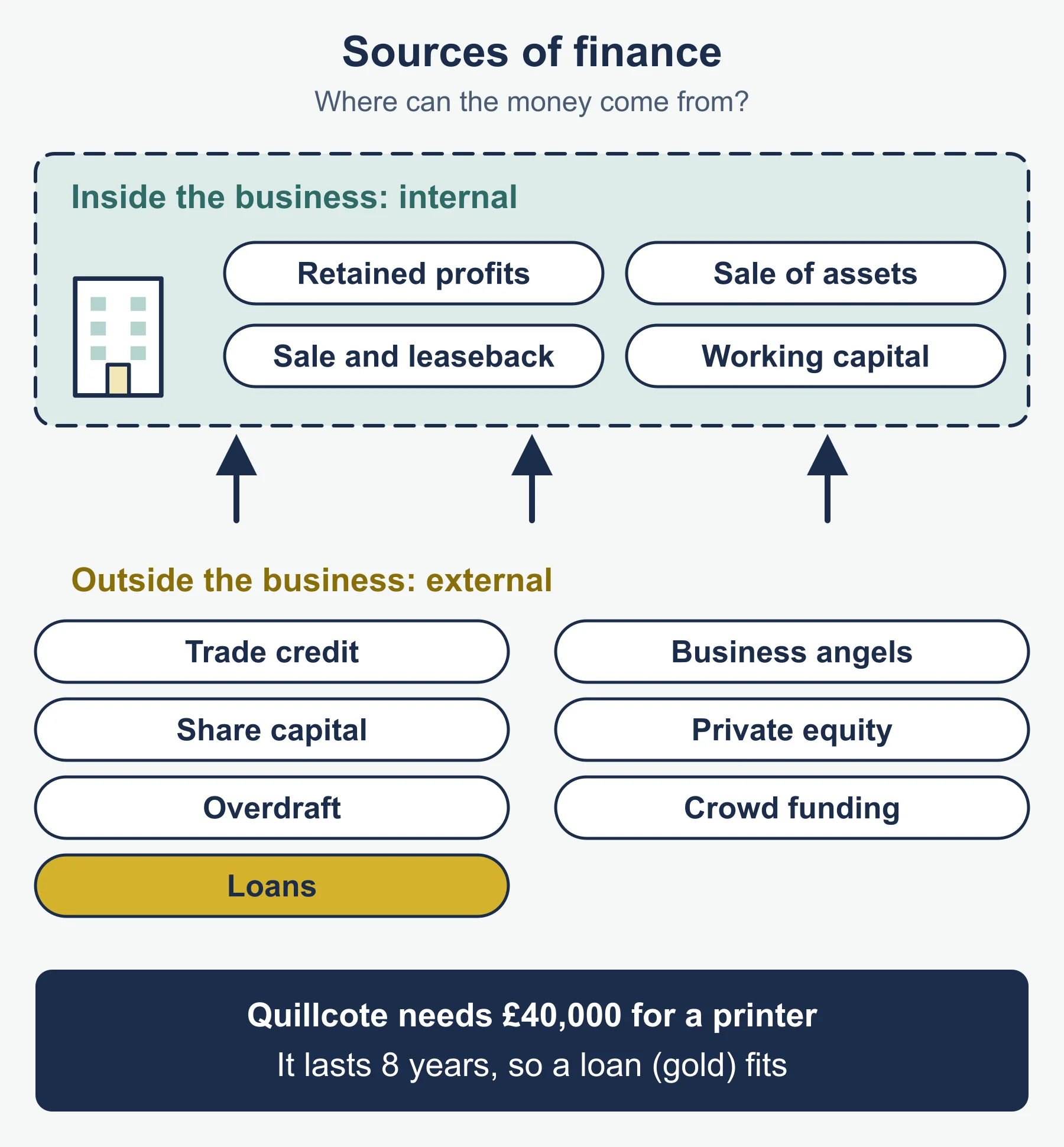
| Bank loan | Fixed sum repaid with interest | Predictable repayments | Repay even in a bad year, may need security |
| Trade credit | Pay supplier later | Free if on time | Supplier may refuse future credit |
| Government grants | Money given, not repaid | No repayment | Conditions, slow to obtain |
| Crowdfunding | Many small contributions online | Tests demand, builds followers | May miss target |
Internal against external
- Internal: cheaper and quicker, owners keep control, but the amount is limited.
- External: larger amounts, but costs, repayment pressure or lost control.
Must-know distinctions
- Leasing and hire purchase. Leasing is renting with no ownership. Hire purchase ends with the business owning the asset.
- Overdraft and loan. An overdraft is flexible and short-term. A loan is a fixed sum for a set period.
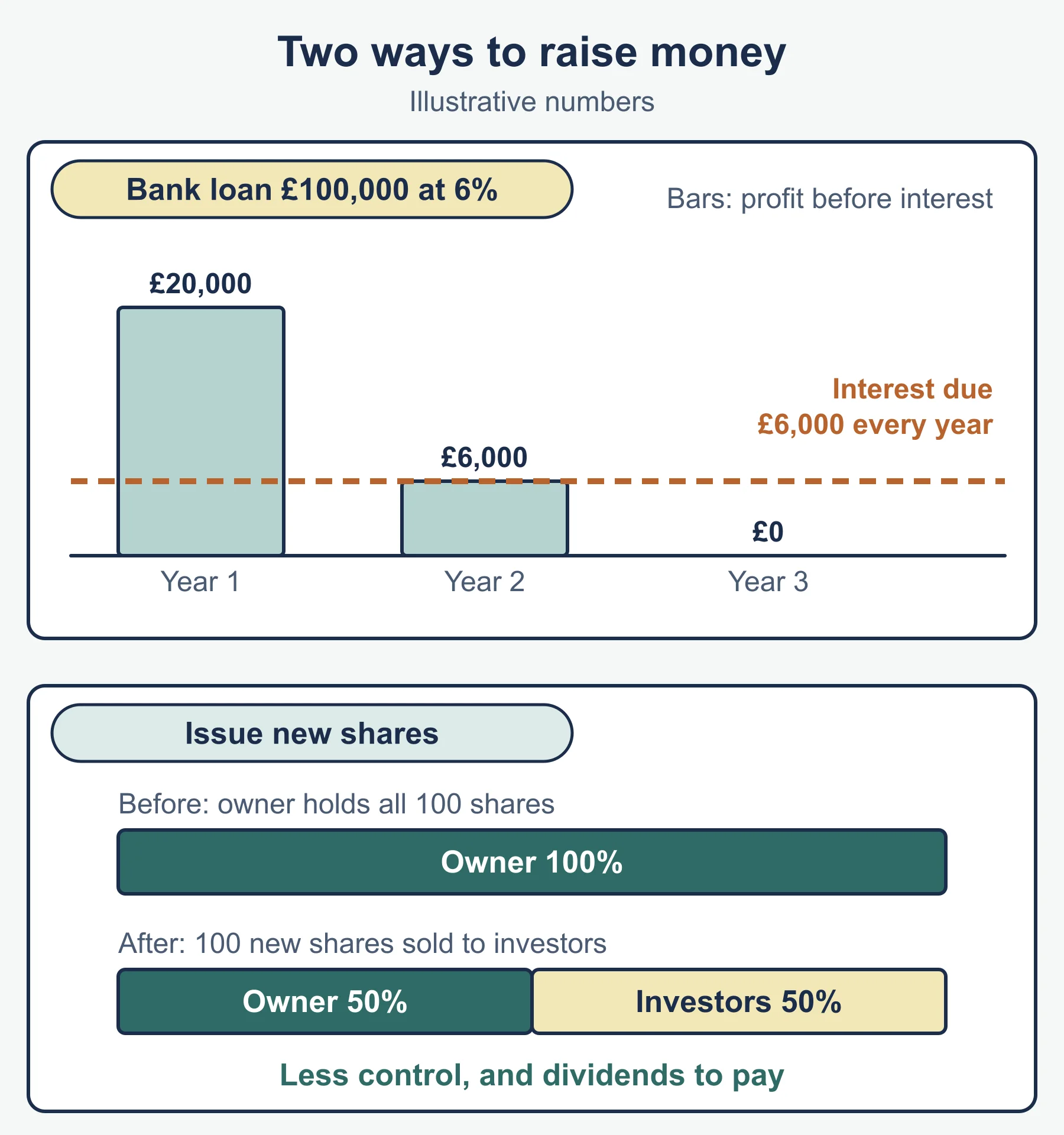
- Shares and loans. Shares need no repayment but share ownership. Loans keep ownership but must be repaid with interest.
- Grant and loan. A grant is not repaid. A loan is.
- Working capital and cash. Working capital includes inventory and receivables, not only cash.
- Retained profit and cash. Retained profit may already be spent on assets.
Choosing a source of finance
Method in steps:
- Say what the money is for (purpose) and how long it is needed (length of time).
- Check the amount required.
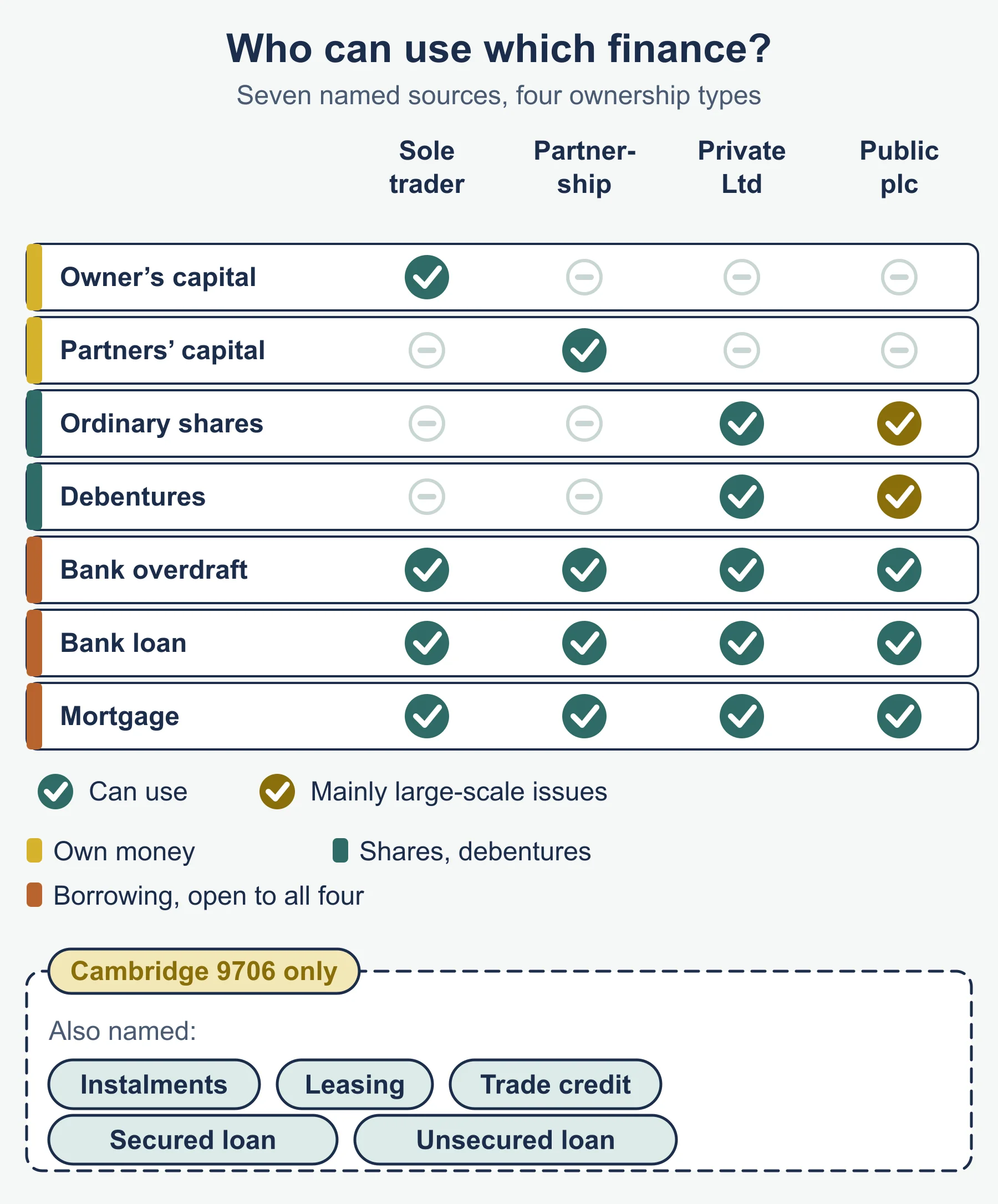
- Check the legal form: only a company can issue shares.
- Check size of business and existing loans: can it borrow more?
- Compare the cost of each option.
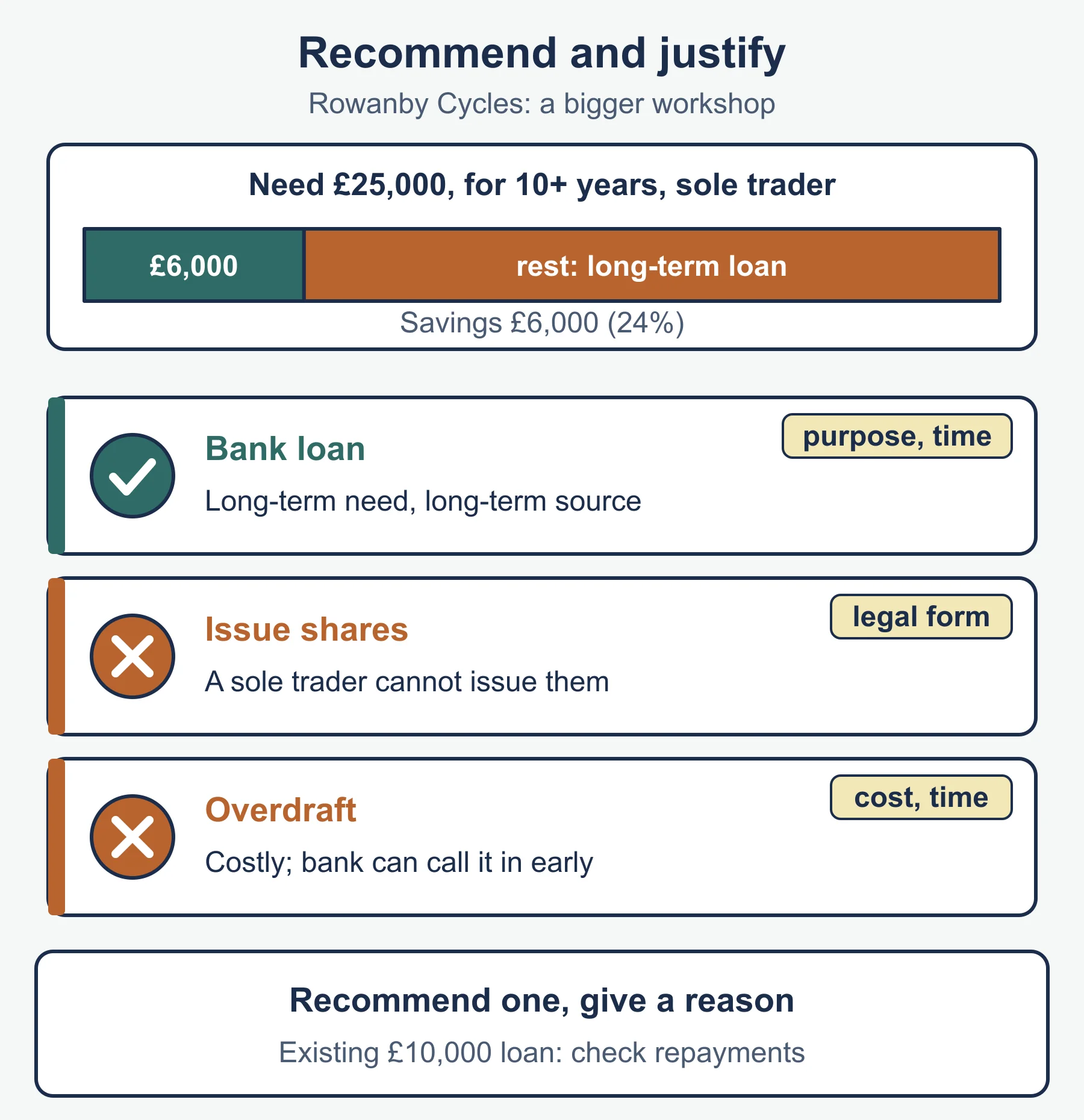
- Recommend one source and give a reason, then say why another source is weaker.
Factors to consider: size of business, legal form of business, amount required, length of time, existing loans, cost, purpose.
Quick matching guide:
| Situation | Likely sensible source |
|---|---|
| Short gap before customers pay | Overdraft or trade credit |
| Big machine, spread the cost | Hire purchase or leasing |
| Long-term expansion of a small firm | Bank loan, with owner’s funds |
| Large growth plan by a company | Issue shares or venture capital |
| New idea needing proof of demand | Crowdfunding |
| Use of money already earned | Retained profit |
Treat this as a starting point. Always check the facts in the question, because they can change the answer.
Answering the question types
| Command word | What to do |
|---|---|
| State, identify | Give the point briefly, with no explanation |
| Define | Give the meaning in a sentence |
| Calculate | Show the working, then the answer with units |
| Explain | Give a point, then a reason or consequence |
| Analyse | Give a point, develop it with a chain of reasoning, and use the case |
| Recommend and justify | Choose one source and give reasons linked to the case |
| Evaluate | Weigh both sides, then reach a judgement and say what it depends on |
A good chain for a finance answer: the source, what it gives the business, then the effect on cash, cost or control. For example: a bank loan gives a fixed sum, so the business can plan repayments, but interest must be paid even in a weak year, which reduces profit.
Use the case. If the stem mentions a sole trader, a company, an existing loan or a short gap in cash, one of your points should refer to it.
Worked reminders
Hire purchase. Machine with a cash price of £6,000. Deposit £1,200 and 12 payments of £440. Total = 1,200 + (12 x 440) = 1,200 + 5,280 = £6,480. Extra cost = £480.
Shares. A company with 120,000 shares issues 30,000 at £0.80. Raised = £24,000. New holders own 30,000 / 150,000 = 20%.
Loan interest. £15,000 at 6% a year gives £900 interest a year, or £3,600 over four years (interest on the full amount).
Grant share. A £6,000 grant towards a £30,000 project covers 20%.
Quick self-test
- State three reasons why a business may need finance.
- Define working capital.
- A business has current assets of £18,600 and current liabilities of £21,000. Calculate its working capital.
- Give one example of a short-term and one of a long-term finance need.
- State two internal sources of finance.
- Explain why a sole trader cannot raise money by issuing shares.
- Give one difference between leasing and hire purchase.
- A shop hires equipment on hire purchase: deposit £900 and 18 payments of £150. The cash price is £3,000. Calculate the extra cost.
- Give one advantage and one disadvantage of a bank overdraft.
- Fifty backers give an average of £80 each through crowdfunding. How much is raised?
- State two factors that affect the choice of a source of finance.
- A grant of £7,500 covers 25% of a project. What is the total cost?
Answers
- Any three of: start-up capital; expansion or growth; replacing non-current assets; investing in new technology; working capital.
- The money a business has available for everyday expenses (current assets less current liabilities).
- 18,600 - 21,000 = -£2,400 (negative working capital).
- Short-term: paying wages and suppliers. Long-term: buying a new building or machine, or expanding.
- Any two of: owners’ investment; retained profit; sale of unwanted assets; working capital.
- Only companies have shares to sell. A sole trader’s business is not a company, so there are no shares to issue.
- With leasing the business never owns the asset. With hire purchase it owns the asset after the final payment.
- 900 + (18 x 150) = 900 + 2,700 = 3,600. Extra cost = 3,600 - 3,000 = £600.
- Advantage: flexible, interest only on the amount used. Disadvantage: expensive if used for long, and the bank can ask for it back at short notice.
- 50 x 80 = £4,000.
- Any two of: size of business; legal form; amount required; length of time; existing loans; cost; purpose.
- 7,500 / 0.25 = £30,000.
Where marks are usually lost
- Defining working capital as “cash” or “money in the bank”.
- Giving an overdraft as the answer to a long-term, large-sum need.
- Saying all businesses can issue shares.
- Listing sources without choosing one when asked to recommend.
- Giving a reason with no link to the business in the case (size, legal form, existing loans, purpose).
- Writing “cheap” or “expensive” with no reason, such as interest charged or ownership given up.
- Mixing up leasing and hire purchase.
- Forgetting to subtract current liabilities, or giving a negative result the wrong sign.
- Treating a grant like a loan, or forgetting that a loan must be repaid with interest.
Frequently asked questions
What is the difference between leasing and hire purchase? Leasing is renting an asset with no ownership. With hire purchase the business pays a deposit and instalments and owns the asset at the end, though it pays more than the cash price.
What is the difference between a bank overdraft and a bank loan? An overdraft is a flexible, short-term facility that lets a business spend more than is in its account up to a limit. A loan is a fixed sum repaid with interest over an agreed period, which suits long-term needs.
Is working capital the same as cash? No. Working capital is current assets minus current liabilities, so it includes inventory and trade receivables as well as cash.
Can every business issue shares? No. Only a company can issue shares; a sole trader or partnership cannot raise finance this way.
Official syllabus
These notes follow the Cambridge IGCSE Business 0264 syllabus for examination in 2027, 2028 and 2029, published by Cambridge University Press & Assessment, section 5.1 Business finance.
Get free revision emails (optional)
Occasional emails with practice questions, worked explanations and links to free resources for the qualification and subjects you choose. No spam, and you can unsubscribe from any email. The free tools on this site never need an email.
Related resources
-
Study guides
IGCSE Business: Cash flow forecast (Cambridge 0264)
Study guide to cash and cash flow forecasts for Cambridge IGCSE Business 0264: features, completing and interpreting forecasts, and fixing cash problems.
Business · Cambridge · IGCSE
Read guide -
Practice questions
IGCSE Business: Cash flow forecast (Cambridge 0264) – Practice Questions
Original practice questions with worked answers on cash flow forecasts for Cambridge IGCSE Business 0264, mixing short answer, calculation and case items.
Business · Cambridge · IGCSE
Try questions -
Revision notes
IGCSE Business: Cash flow forecast (Cambridge 0264) – Revision Notes
Condensed revision notes on cash flow forecasts for Cambridge IGCSE Business 0264: formulas, features, remedies, a self-test and common lost marks.
Business · Cambridge · IGCSE
Revise topic
Related articles
-
teaching
A Level tuition in Dubai: Cambridge or Pearson Edexcel International A Level?
Schools in Dubai and Abu Dhabi teach either Cambridge International AS & A Level or Pearson Edexcel International A Level. How the two are structured, why it matters for tuition, and how online classes from Lahore work.
9 October 2026
-
curriculum guides
Choosing subjects at IGCSE and A Level
How subject choices at 14 and 16 affect university options later, and how to keep pathways open without overloading a timetable.
28 July 2026
Studying this with a teacher
Working through Business IGCSE?
This page is free and stays free. If you would rather be taught it, Marlbridge runs Business classes one-to-one and in small groups of up to 15, online in your own time zone. The first trial class is free. WhatsApp replies within an hour (8am–11pm Pakistan time, every day); email the same day.
Cambridge Business teachers at Marlbridge

