
Revision Notes
IGCSE Business: Cash flow forecast (Cambridge 0264) – Revision Notes
Condensed revision notes on cash flow forecasts for Cambridge IGCSE Business 0264: formulas, features, remedies, a self-test and common lost marks.
- Subject
- Business
- Level
- IGCSE
- Topic
- Financial information and decisions
- Author
- Marlbridge Academic Team
- Updated
- Reviewed by
- Salman Ahmad (what this means)
Aligned to Cambridge IGCSE Business (0264), For examination in 2027, 2028 and 2029. Official specification .
Syllabus page (what it covers and how it is assessed): Cambridge IGCSE Business.
Syllabus points this page covers
0264
- 5.2 Cash flow forecast
Found an error? Report a correction.
Need help with this topic? Request a free trial class for IGCSE Business (0450 / 0264).
These notes condense section 5.2 (Cash flow forecast) of the Cambridge IGCSE Business 0264 syllabus for examination in 2027, 2028 and 2029. Both papers are based on all the subject content. For full explanations and worked examples, read the study guide. Then test yourself with the practice questions. Other links: course hub, printable checklist, free diagnostics and business finance notes.
The syllabus says you will not be assessed on constructing a cash flow forecast. You do need to amend or complete a simple one and interpret it.
Key definitions
| Term | Meaning |
|---|---|
| Cash | Money the business can use at once, in hand or in the bank |
| Cash flow forecast | An estimate of cash expected to come in and go out over future months, showing the expected cash balance |
| Cash inflow | Money received in the month |
| Cash outflow | Money paid out in the month |
| Net cash flow | Inflow minus outflow for the month |
| Opening balance | Cash at the start of the month |
| Closing balance | Cash at the end of the month |
| Overdraft | Bank permission to take out more than the account holds, up to a limit |
Formulas and links between rows
| Result | Calculation |
|---|---|
| Net cash flow | Total inflow - total outflow |
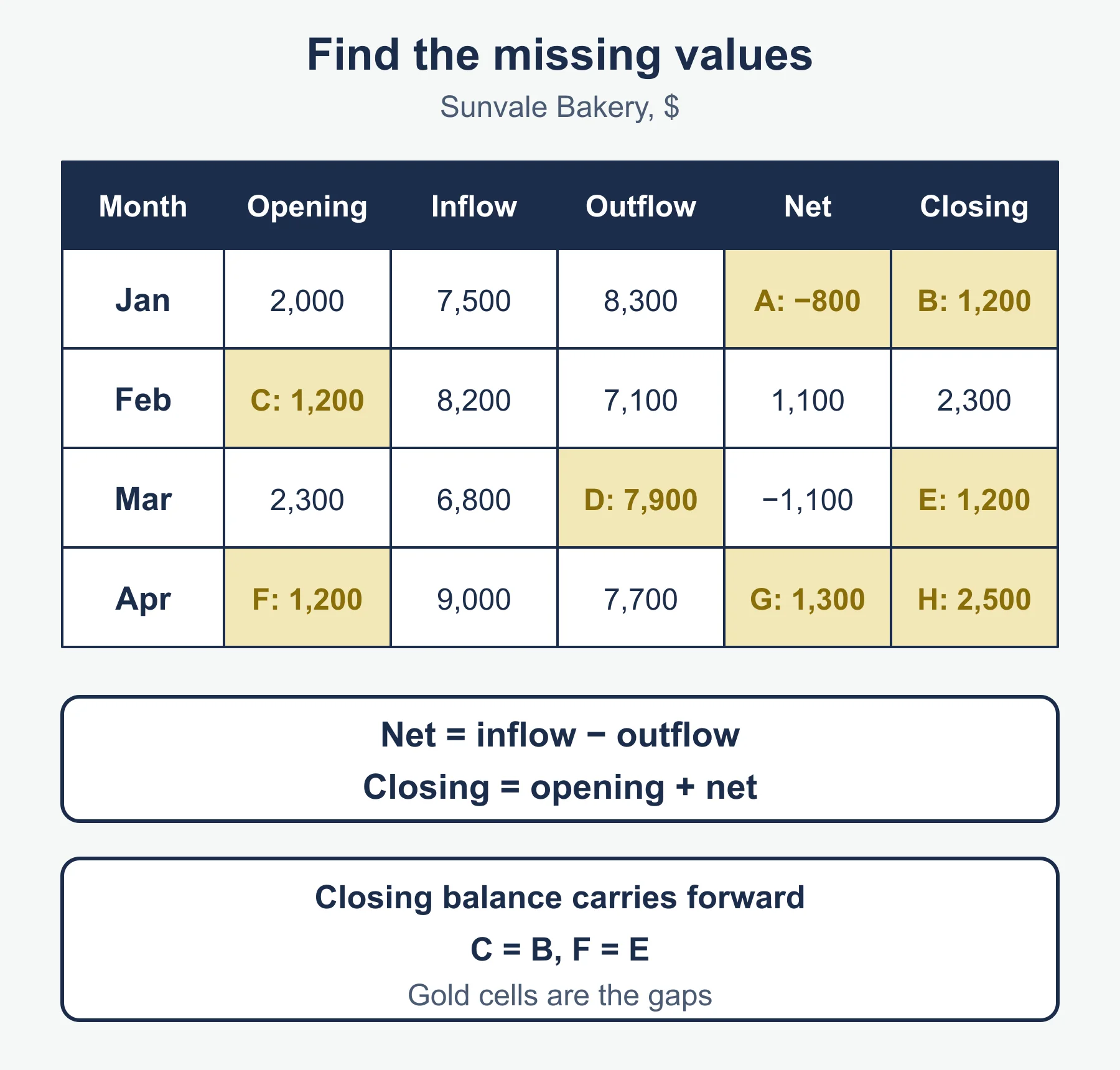
| Closing balance | Opening balance + net cash flow |
| Next month’s opening balance | This month’s closing balance |
| Missing outflow | Inflow - net cash flow |
| Missing opening balance | Closing balance - net cash flow |
Small reminder: opening balance 800, inflow 3,000, outflow 3,500. Net cash flow is -500, so closing balance is 300.
Why cash matters
- Wages, suppliers, rent, bills and loan repayments must be paid in cash when due.
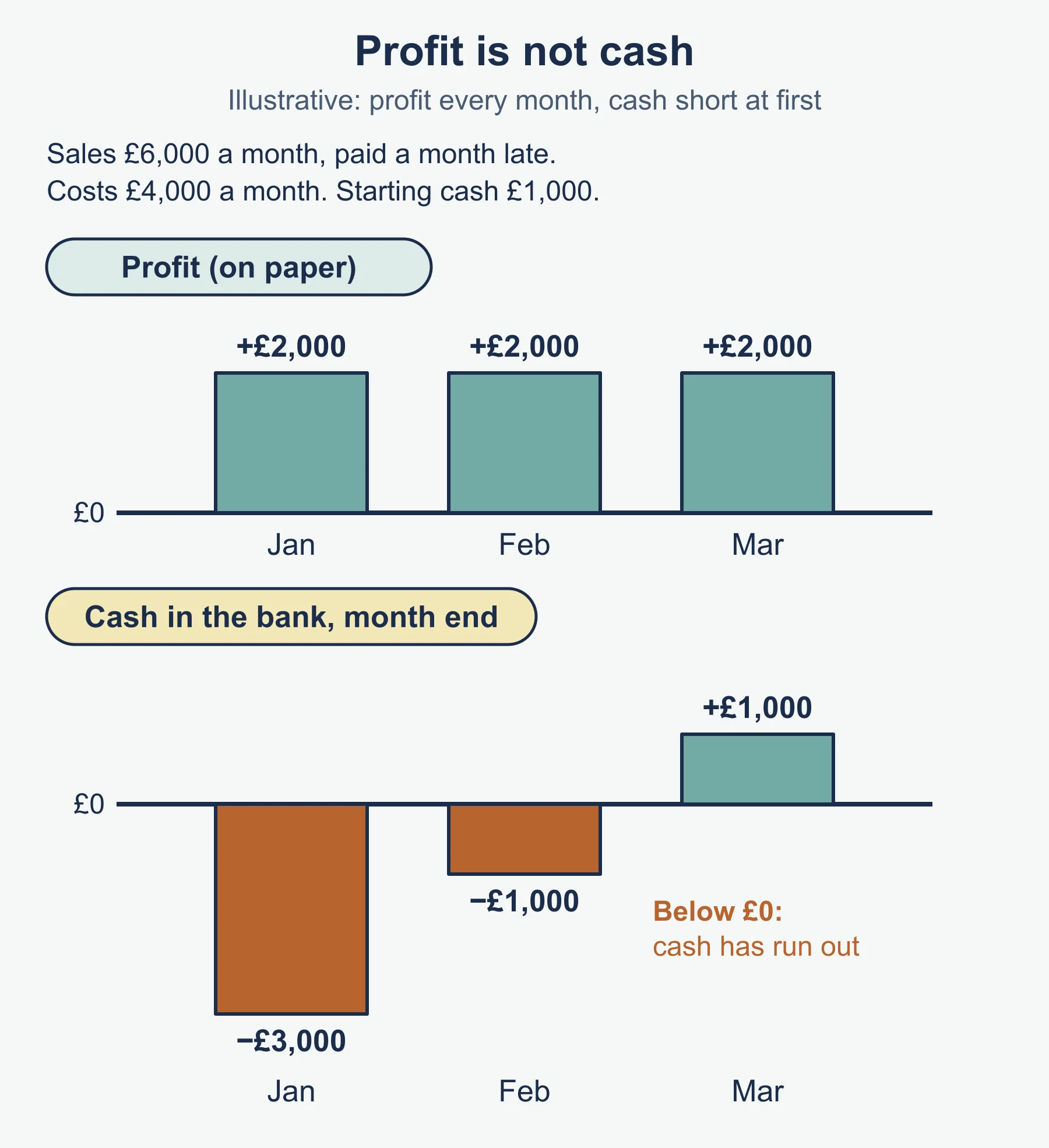
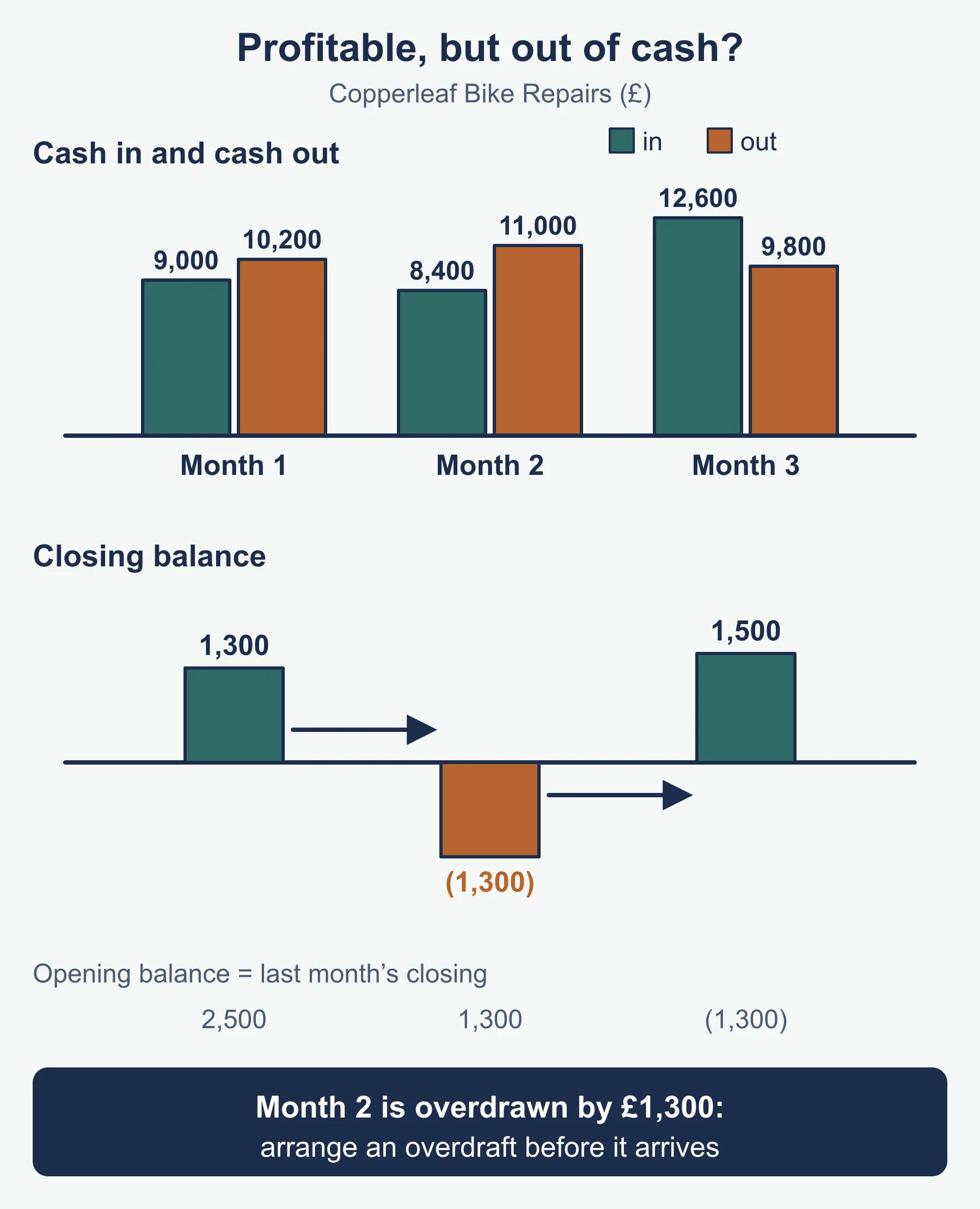
- A business can be profitable and still run short of cash, for example when customers on credit pay late.
- Running out of cash can force a business to stop trading.
- Cash is the focus of the forecast. Profit is a different measure, covered in section 5.3.
Why a business prepares a forecast
- Shows when shortages or surpluses are expected, giving time to act.
- Helps decide when to buy stock or equipment.
- Supports a request to a bank or other lender.
- Lets managers compare forecast with actual figures.
- Limit: it is only an estimate. Late-paying customers, lower sales or higher costs make it wrong.
Method: completing a forecast
- Total the cash inflows for the month.
- Total the cash outflows for the month.
- Net cash flow = inflow - outflow (check the sign).
- Closing balance = opening balance + net cash flow.
- Copy the closing balance into the next month’s opening balance.
- Check any given figures against your own as you go.
If a figure is missing in the middle, work backwards with the formula table above, then check the months either side.
Method: amending a forecast
- Find the month where the cash really moves (for example, the new payment date).
- Remove the amount from the old month and add it to the new month.
- Recalculate net cash flow and closing balance for each affected month.
- Carry the new closing balance forward. Months before the change are unchanged.
- If the item only moves between months inside the forecast, later balances return to the old figures once it has been received or paid.
Method: interpreting a forecast
- Find the months with negative closing balances. Those are the months of expected shortage.
- Look at the trend: rising, falling or seasonal.
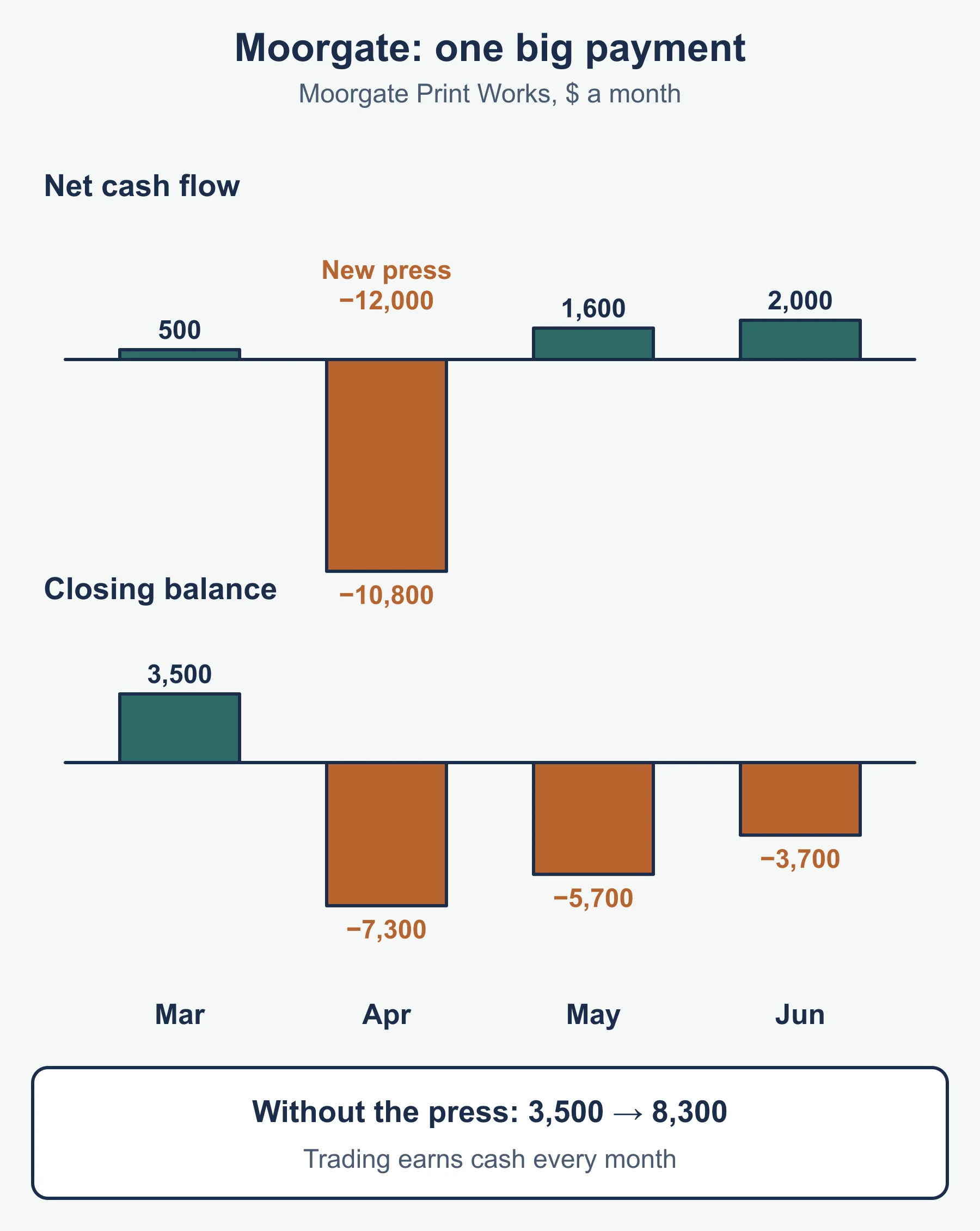
- Find the cause: one-off large payment, or ordinary months with outflow above inflow?
- Separate a negative net cash flow from a negative closing balance. A business may have a negative net figure and still hold cash.
- Comment on reliability: it is made of estimates.
- Always use figures in the answer and state a consequence.
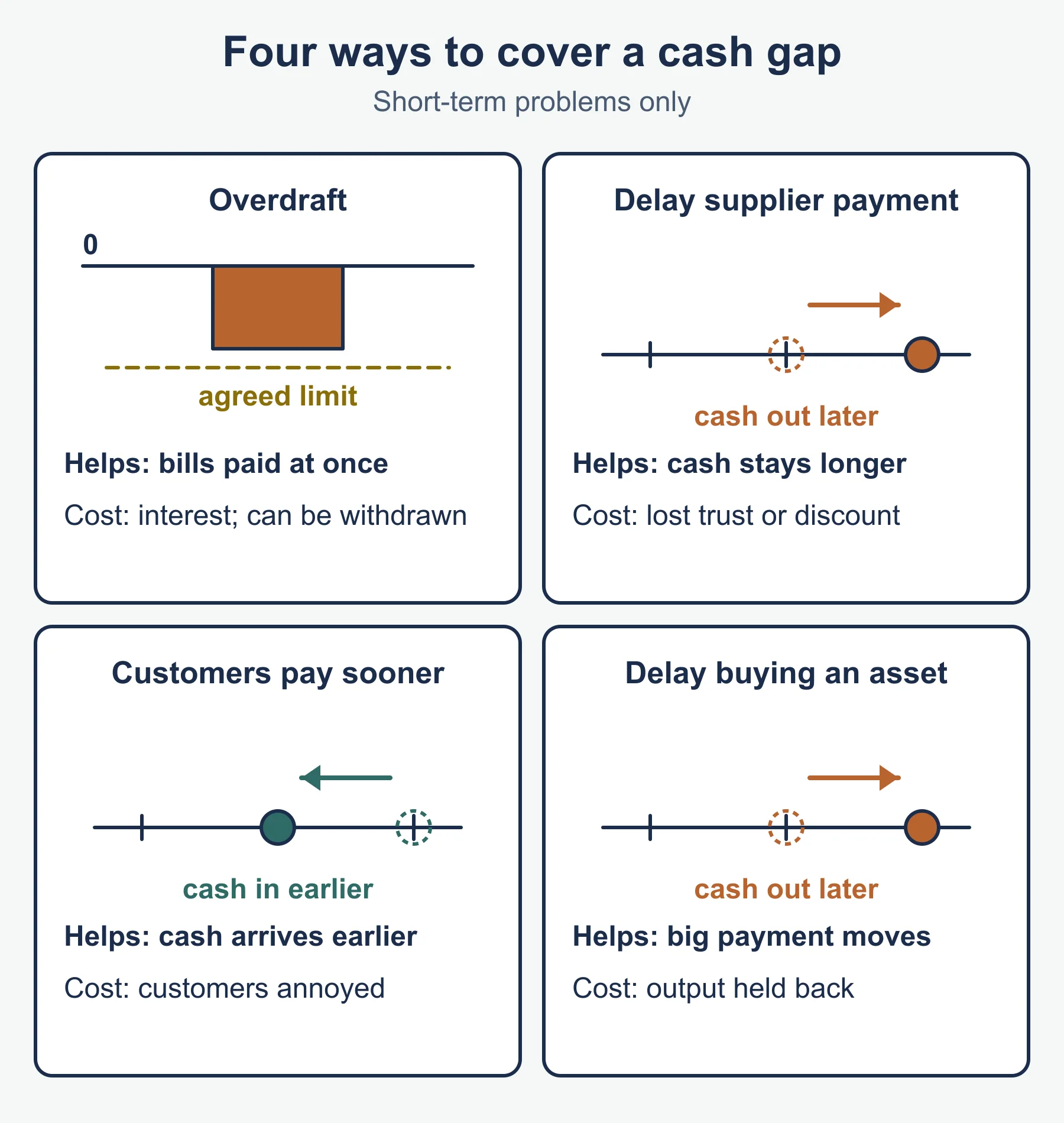
Short-term cash flow problems: the four methods
| Method | Benefit | Drawback |
|---|---|---|
| Overdraft | Immediate access to funds | Interest is charged; bank may withdraw it |
| Delay supplier payments | Cash kept longer | Supplier may stop credit, charge more, or damage trust |
| Ask customers to pay more quickly | Money arrives sooner | May lose customers; a discount lowers income |
| Delay purchase of non-current assets | Large payment moved later | Efficiency or growth held back; breakdowns |
These deal with short-term problems. They move or cover a shortage; most do not increase total income.
Must-know distinctions
- Cash and profit: cash is money moving in and out; profit is a separate measure of performance.
- Net cash flow and closing balance: net is one month’s change, closing is the running total.
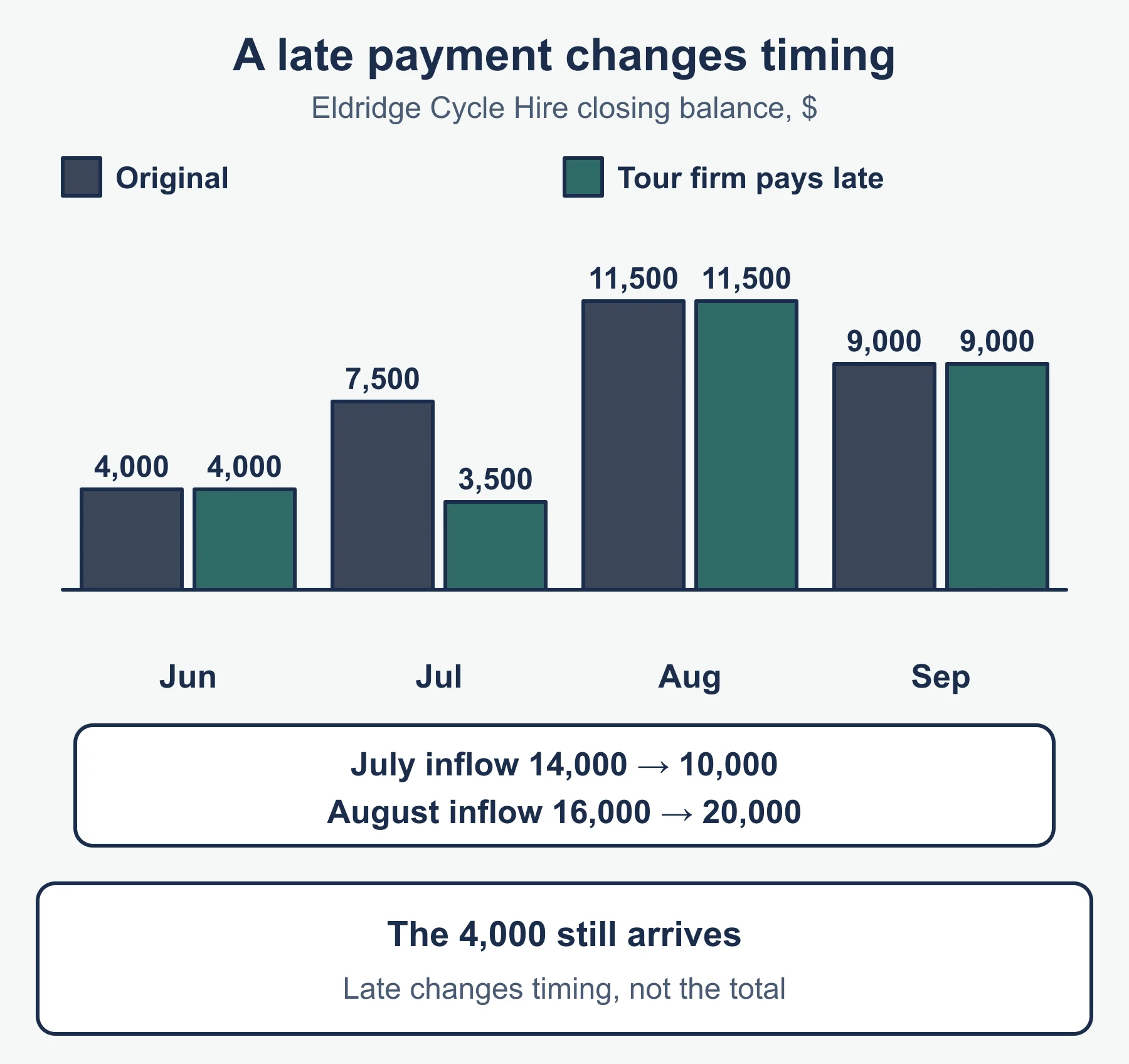
- Late payment and bad debt: late payment changes timing, a debt never paid reduces the total received.
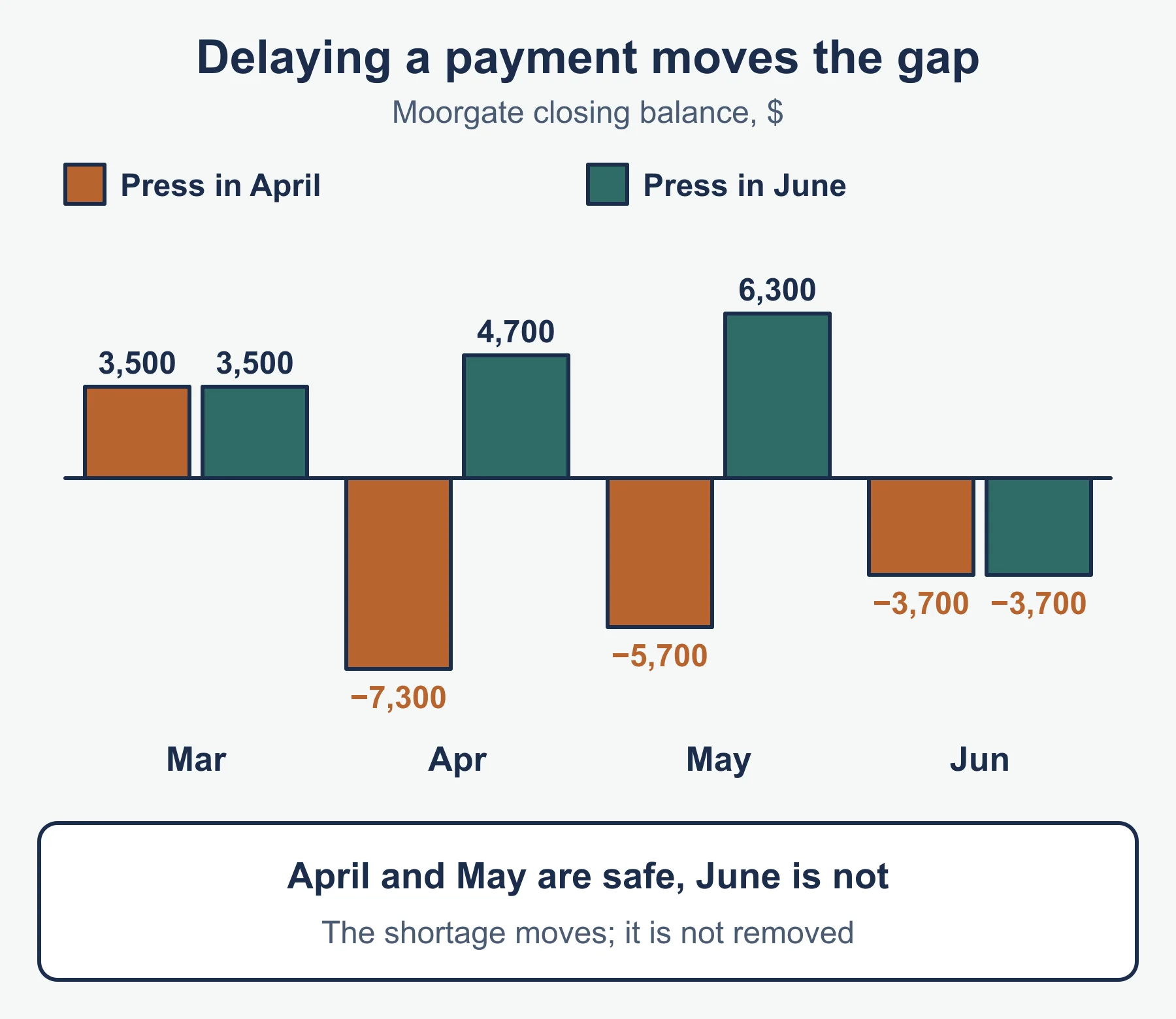
- Delaying a payment and saving money: delaying only moves the date of payment.
- Cash inflow and sales: a credit sale becomes inflow when the customer pays.
Evaluate and justify answers
When asked to recommend or justify a remedy:
- Name the cause of the shortage and its size and timing.
- Choose a method and apply it to the business in the question.
- Give a benefit and a drawback.
- Weigh it against another option.
- Reach a judgement, for example “an overdraft is more suitable than delaying the supplier because the shortage lasts only one month and the supplier is the main source of stock.”
Worked reminder: effect of a remedy
Use Trevane’s figures from the self-test below. Suppose 900 of the April payments to a supplier is delayed until May. April outflow falls to 3,000, so April net cash flow is +200 and the closing balance is 1,100 (up from 200). May outflow rises to 5,200, so May net cash flow is -100 and the closing balance is 1,000, the same as before. The remedy lifted the April balance and left the final balance unchanged. This is the pattern for any delay: cash is held longer, not created.
Command words in this topic
- State, identify, define: one short fact, no development.
- Calculate: show the working line by line and give the answer with its sign.
- Explain: give a reason and link it to the business.
- Analyse: follow a chain of cause and effect using the figures.
- Evaluate, justify, recommend: weigh both sides and finish with a reasoned decision.
Quick self-test
Trevane Candles opens March with 1,500. Forecast inflows are 4,000, 3,200 and 5,100 for March, April and May. Outflows are 4,600, 3,900 and 4,300.
- State what a cash flow forecast is.
- State the formula for closing balance.
- Calculate the net cash flow for March.
- Calculate the closing balance for March.
- State Trevane’s opening balance for April.
- Calculate the closing balance for April.
- Calculate the closing balance for May.
- Explain why a profitable business may still run out of cash.
- State the four ways of overcoming a short-term cash flow problem listed in the syllabus.
- Give one drawback of an overdraft.
- Trevane’s customer owing 1,200 pays in May, not April. Calculate the new closing balances for April and May.
- A month has an opening balance of 2,700 and a net cash flow of -700. Calculate the closing balance.
Answers
- An estimate of the cash expected to come into and go out of a business over future months, showing the expected balance.
- Closing balance = opening balance + net cash flow.
- 4,000 - 4,600 = -600.
- 1,500 + (-600) = 900.
-
- Net is 3,200 - 3,900 = -700, so closing is 900 - 700 = 200.
- Net is 5,100 - 4,300 = 800, so closing is 200 + 800 = 1,000.
- It may sell on credit, so customers pay later than bills fall due. Profit does not mean cash is available when needed.
- Overdraft; delaying supplier payments; asking customers to pay more quickly; delaying the purchase of non-current assets.
- Interest is charged, or the bank can reduce or withdraw the overdraft.
- April inflow is 2,000, net is 2,000 - 3,900 = -1,900, closing is 900 - 1,900 = -1,000. May inflow is 6,300, net is 6,300 - 4,300 = 2,000, closing is -1,000 + 2,000 = 1,000. May returns to the original figure.
- 2,700 + (-700) = 2,000.
Where marks are usually lost
- Not carrying the closing balance forward as the next opening balance.
- Reversing inflow and outflow, so every net figure has the wrong sign.
- Dropping the minus sign on a negative balance, or adding a negative number as if it were positive.
- Describing a forecast as showing profit.
- Writing “the business should borrow” with no method named and no link to the case.
- Giving only an advantage of a remedy when the question asks you to evaluate.
- Saying a late payment reduces the total cash received when it only changes the month.
- Quoting a figure without saying what it means for the business.
- Missing the unit or the month label in a calculation answer.
Frequently asked questions
Do you have to construct a cash flow forecast in IGCSE Business 0264? No. The syllabus says you will not be assessed on constructing a cash flow forecast, but you do need to amend or complete a simple one and interpret it.
What is the difference between net cash flow and closing balance? Net cash flow is one month’s change: total inflows minus total outflows. The closing balance is the running total: the opening balance plus net cash flow.
What are the four ways to solve a short-term cash flow problem? The four methods are a bank overdraft, delaying payments to suppliers, asking customers to pay more quickly, and delaying the purchase of non-current assets. Each has a drawback, such as interest on an overdraft or lost supplier trust.
Does delaying a payment save money? No. Delaying a payment only moves the date when the cash leaves the business; it does not reduce the amount paid.
Official syllabus
Cambridge IGCSE Business 0264 syllabus for examination in 2027, 2028 and 2029, published by Cambridge University Press & Assessment (Cambridge International Education), section 5.2.
Get free revision emails (optional)
Occasional emails with practice questions, worked explanations and links to free resources for the qualification and subjects you choose. No spam, and you can unsubscribe from any email. The free tools on this site never need an email.
Related resources
-
Study guides
IGCSE Business: Profit and loss and Statement of financial position (Cambridge 0264)
Study guide to profit, the statement of profit or loss and the statement of financial position for Cambridge IGCSE Business 0264, with worked examples.
Business · Cambridge · IGCSE
Read guide -
Practice questions
IGCSE Business: Profit and loss and Statement of financial position (Cambridge 0264) – Practice Questions
Original practice questions with worked answers on profit, the statement of profit or loss and the statement of financial position for IGCSE Business 0264.
Business · Cambridge · IGCSE
Try questions -
Revision notes
IGCSE Business: Profit and loss and Statement of financial position (Cambridge 0264) – Revision Notes
Condensed revision notes on profit, the statement of profit or loss and the statement of financial position for Cambridge IGCSE Business 0264.
Business · Cambridge · IGCSE
Revise topic
Related articles
-
teaching
A Level tuition in Dubai: Cambridge or Pearson Edexcel International A Level?
Schools in Dubai and Abu Dhabi teach either Cambridge International AS & A Level or Pearson Edexcel International A Level. How the two are structured, why it matters for tuition, and how online classes from Lahore work.
9 October 2026
-
curriculum guides
Choosing subjects at IGCSE and A Level
How subject choices at 14 and 16 affect university options later, and how to keep pathways open without overloading a timetable.
28 July 2026
Studying this with a teacher
Working through Business IGCSE?
This page is free and stays free. If you would rather be taught it, Marlbridge runs Business classes one-to-one and in small groups of up to 15, online in your own time zone. The first trial class is free. WhatsApp replies within an hour (8am–11pm Pakistan time, every day); email the same day.
Cambridge Business teachers at Marlbridge

