
Revision Notes
IGCSE Business: Profit and loss and Statement of financial position (Cambridge 0264) – Revision Notes
Condensed revision notes on profit, the statement of profit or loss and the statement of financial position for Cambridge IGCSE Business 0264.
- Subject
- Business
- Level
- IGCSE
- Topic
- Financial information and decisions
- Author
- Marlbridge Academic Team
- Updated
- Reviewed by
- Salman Ahmad (what this means)
Aligned to Cambridge IGCSE Business (0264), For examination in 2027, 2028 and 2029. Official specification .
Syllabus page (what it covers and how it is assessed): Cambridge IGCSE Business.
Syllabus points this page covers
0264
- 5.3 Profit and loss
- 5.4 Statement of financial position
Found an error? Report a correction.
Need help with this topic? Request a free trial class for IGCSE Business (0450 / 0264).
These notes condense sections 5.3 (Profit and loss) and 5.4 (Statement of financial position) of the Cambridge IGCSE Business 0264 syllabus for examination in 2027, 2028 and 2029. Read the study guide first for full explanations, then try the practice questions. The course hub, the printable checklist and the free diagnostics help you find weak spots. Both papers are based on all the subject content. You will not be assessed on constructing these statements, only on reading, calculating from and using them. Money is in dollars and every business is invented.
5.3.1 Profit: definitions and importance
| Term | Meaning |
|---|---|
| Revenue | Selling price per unit x number of units sold |
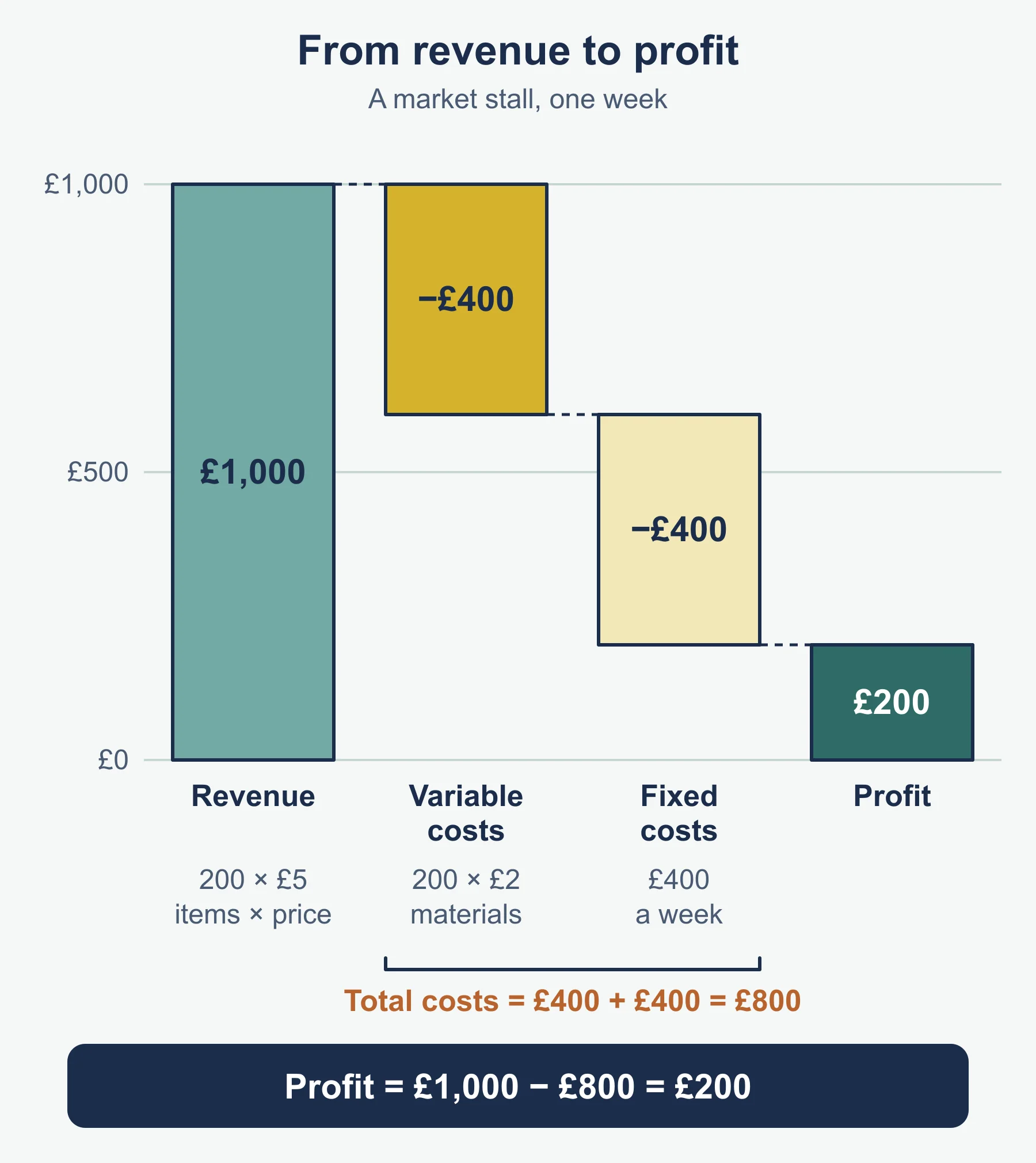
| Profit | Total revenue - total costs (also gross profit - expenses) |
| Loss | Total costs are greater than revenue, so profit is negative |
| Private sector business | A business owned by individuals or groups, not by the government |
| Retained profit | Profit kept in the business rather than paid out |
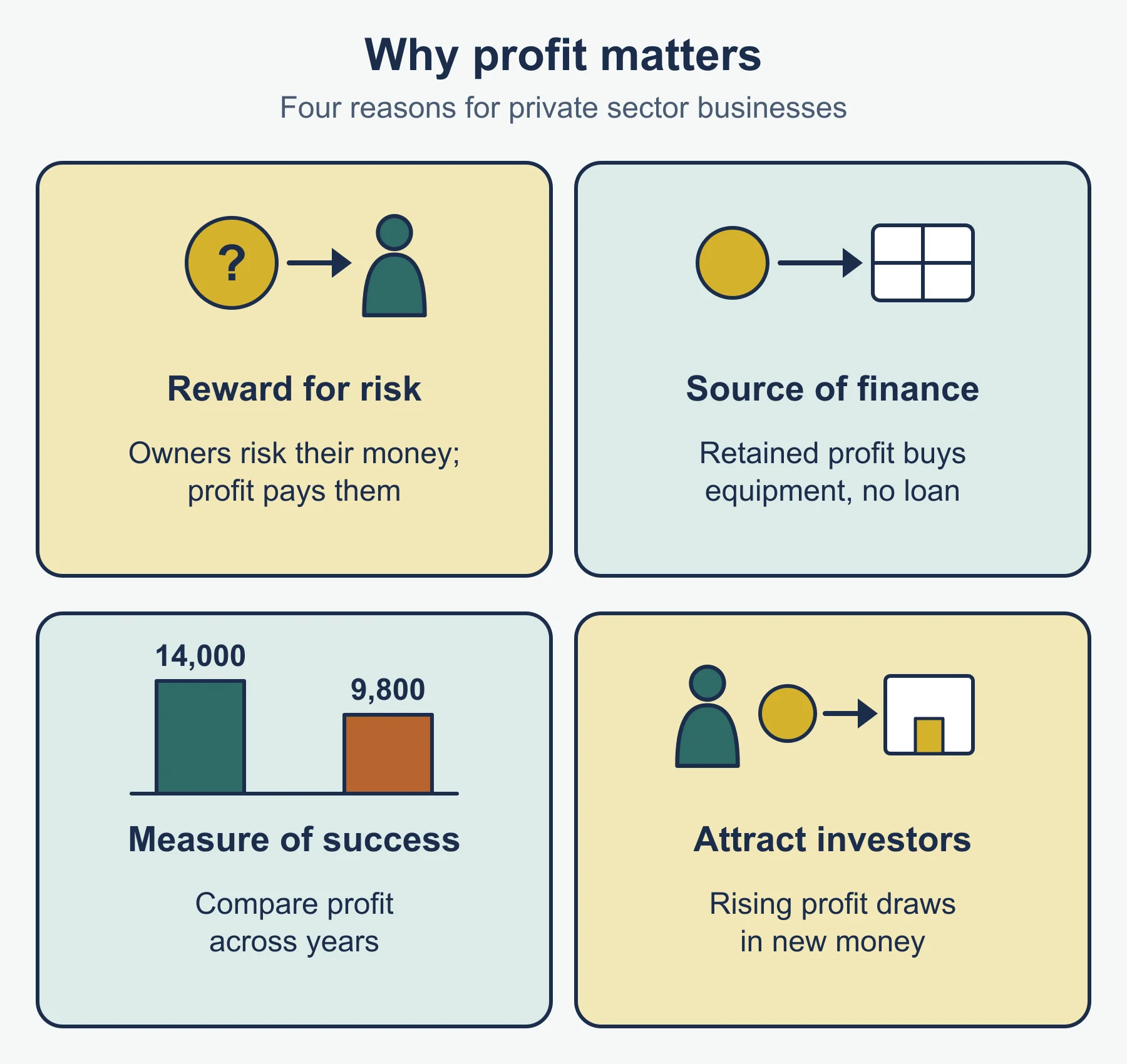
Why profit matters to private sector businesses
| Reason | One-line explanation |
|---|---|
| Reward for risk-taking | Pays owners for putting money in with no guarantee of return |
| Source of finance | Retained profit pays for assets or stock without interest |
| Measure of success | Shows whether income is beating costs, and allows year-to-year comparison |
| Attract investors | Higher or rising profit makes people more willing to invest |
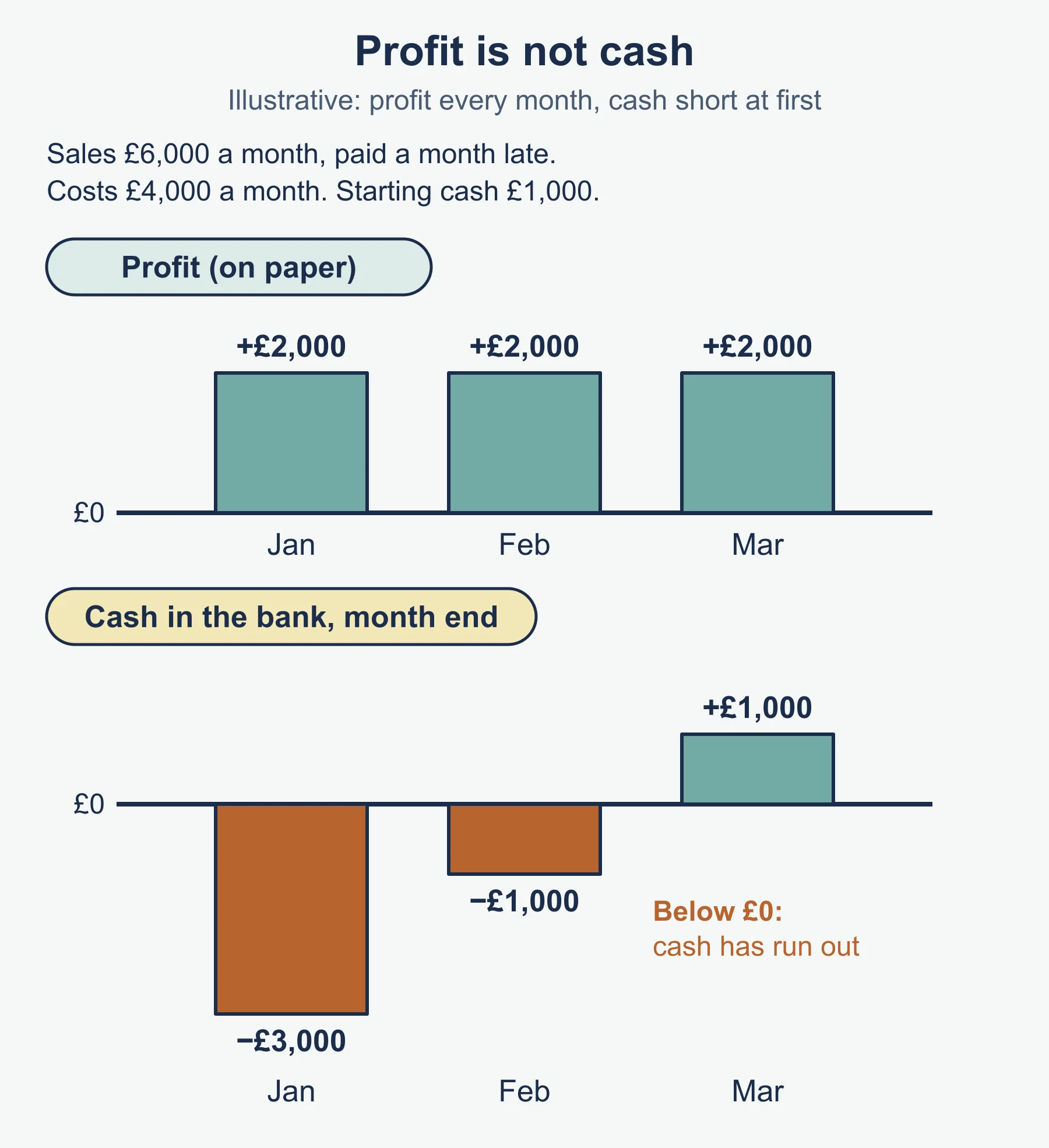
Use the exact reason, then link it to the business in the question. Profit is not the same as cash in the bank.
5.3.2 Statement of profit or loss
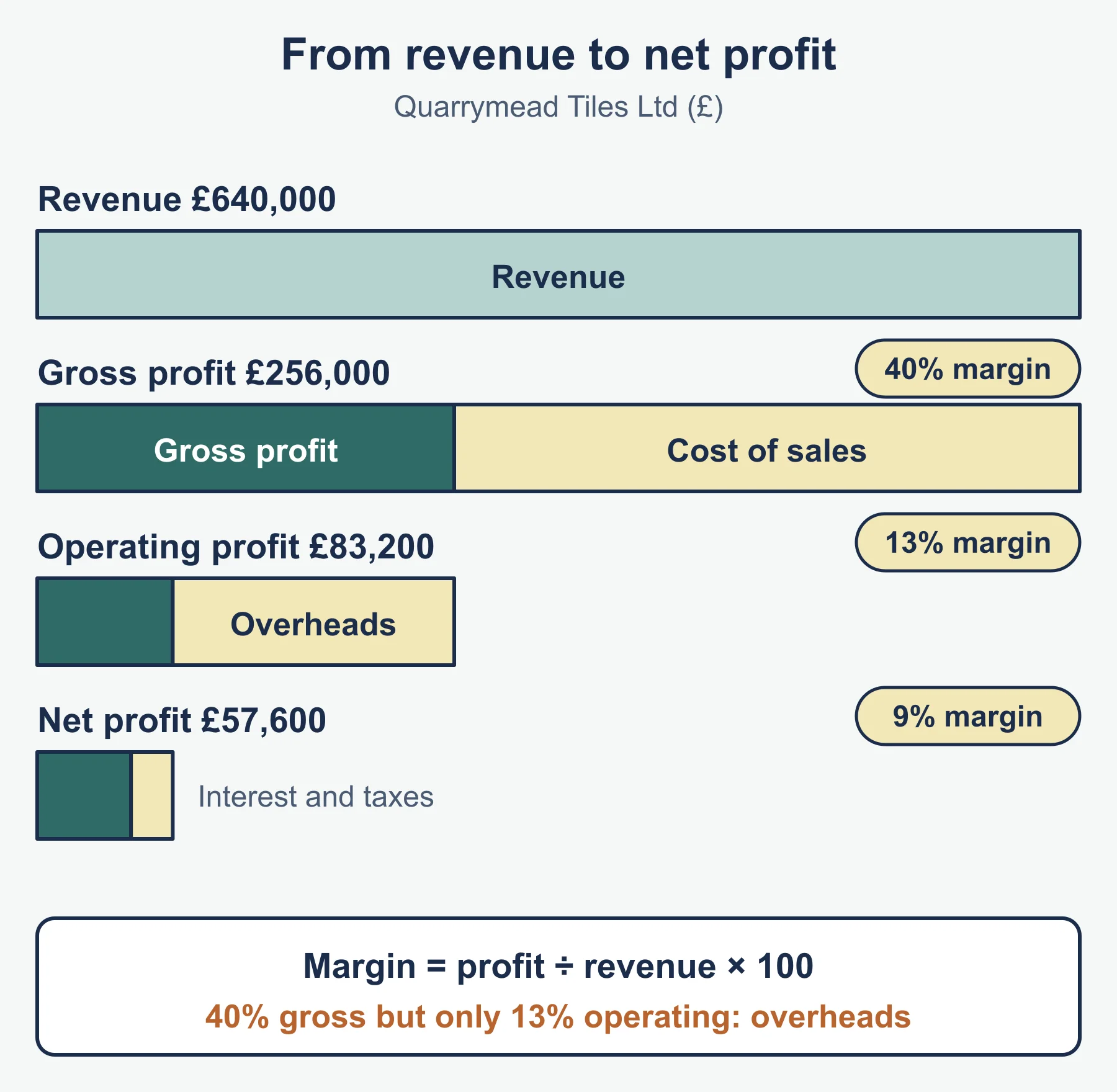
| Line | Standard working |
|---|---|
| Revenue | Price x units sold |
| less Cost of sales | Cost of the goods sold |
| = Gross profit | Revenue - cost of sales |
| less Expenses | Wages, rent, advertising, utilities and so on |
| = Profit | Gross profit - expenses |
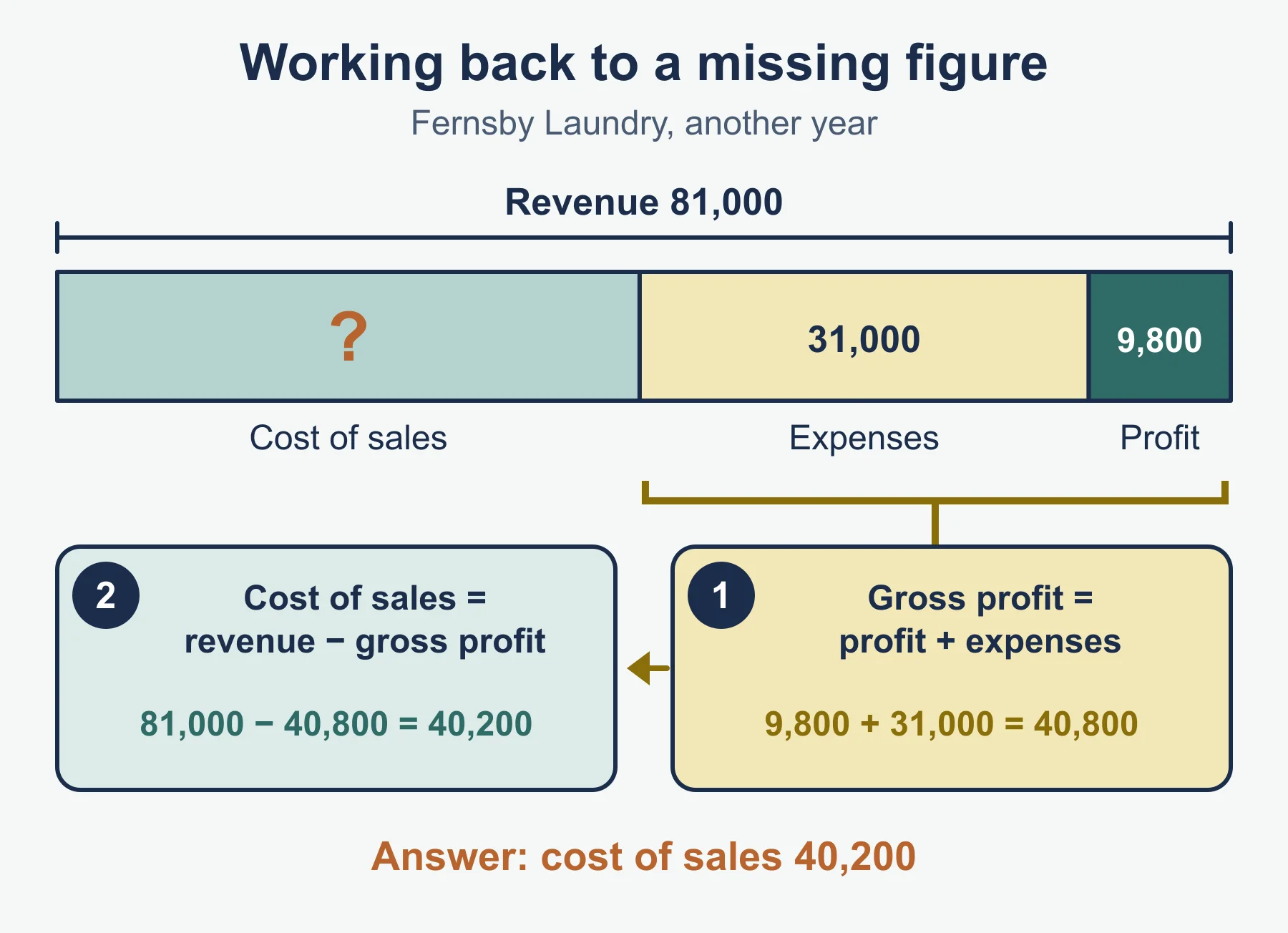
Two rearrangements are useful when a figure is missing.
- Gross profit = profit + expenses.
- Cost of sales = revenue - gross profit.
Method in steps
- Find revenue (multiply price by units if it is not given).
- Subtract cost of sales to get gross profit.
- Add up the expenses.
- Subtract expenses from gross profit to get profit.
- Comment: compare with another year or target, name the line that moved most and give an action.
Quick reminder
Marchbanks Candles sold 7,000 candles at 8 each, with cost of sales of 21,000 and expenses of 27,500.
- Revenue = 7,000 x 8 = 56,000.
- Gross profit = 56,000 - 21,000 = 35,000.
- Profit = 35,000 - 27,500 = 7,500.
Worked decision: profit statement
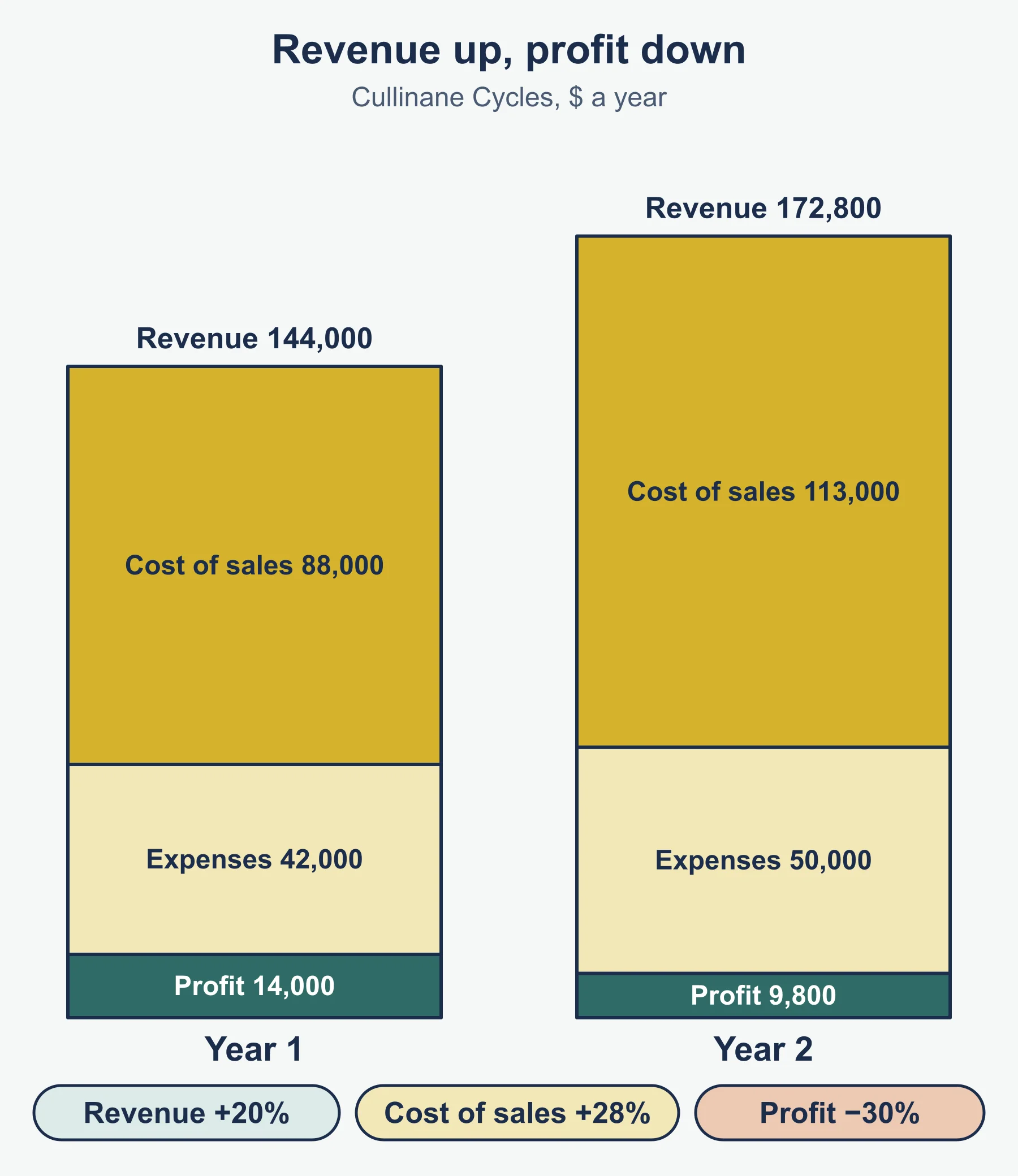
The next year Marchbanks Candles sold 9,000 candles at 8 each. Cost of sales was 30,600 and expenses 33,000. Revenue is 72,000, gross profit 41,400 and profit 8,400.
Revenue rose by 16,000, but cost of sales rose by 9,600 and expenses by 5,500, so profit improved by only 900. A good answer says that most of the extra revenue was absorbed by higher costs, then suggests checking whether the price or the supplier cost can be changed.
Decisions from a statement of profit or loss
| What you see | What it may mean | Possible response |
|---|---|---|
| Revenue up, profit down | Costs rose faster than revenue | Review cost of sales and expenses line by line |
| Low gross profit | Price too low, or cost of sales too high | Raise price, change supplier, cut waste |
| Good gross profit, low profit | Expenses too high | Cut or review expenses |
| Profit rising steadily | Business is succeeding | Keep reinvesting, expand, attract investors |
| Loss | Costs exceed revenue | Cut costs, raise revenue, seek finance to survive |
5.4.1 Statement of financial position
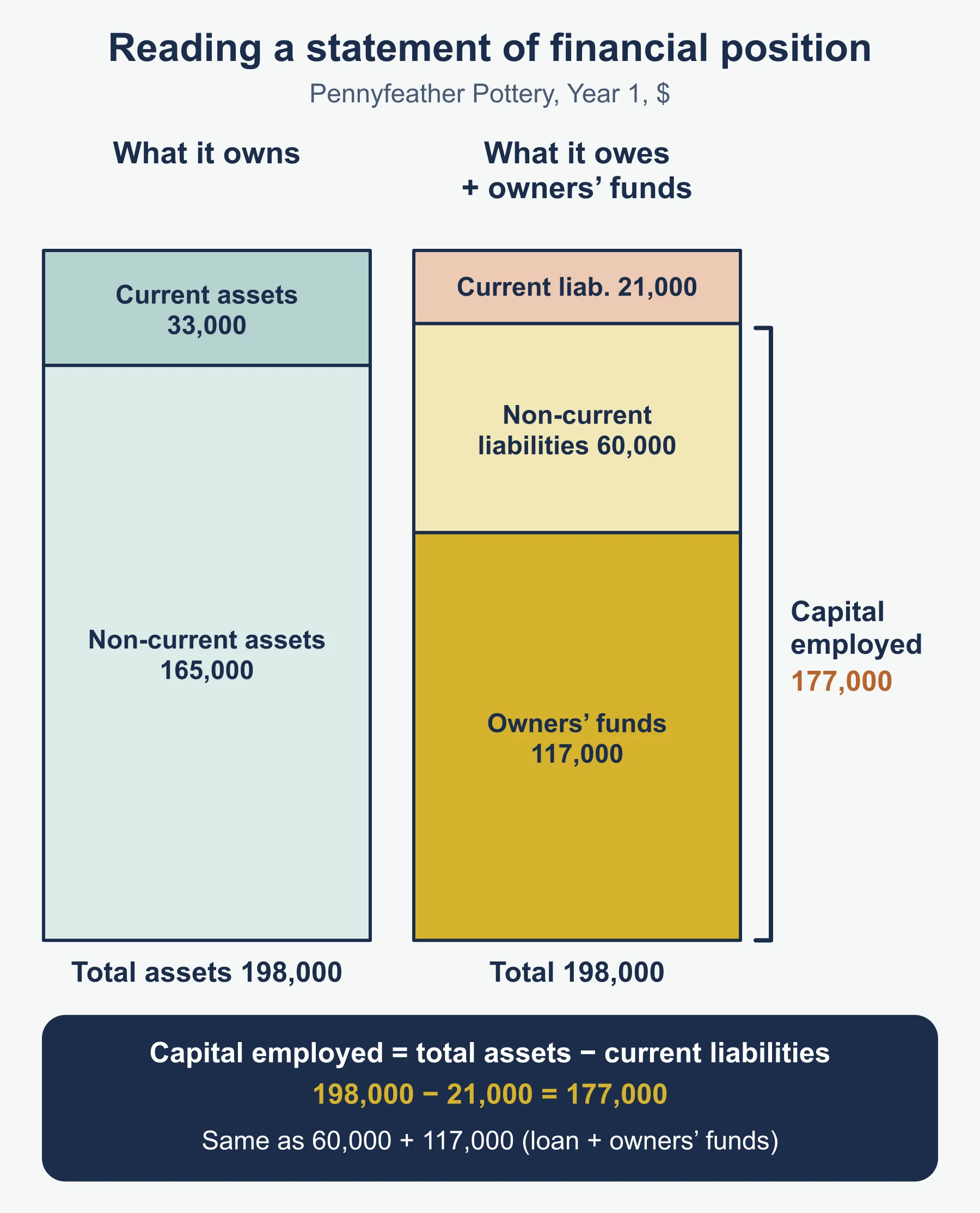
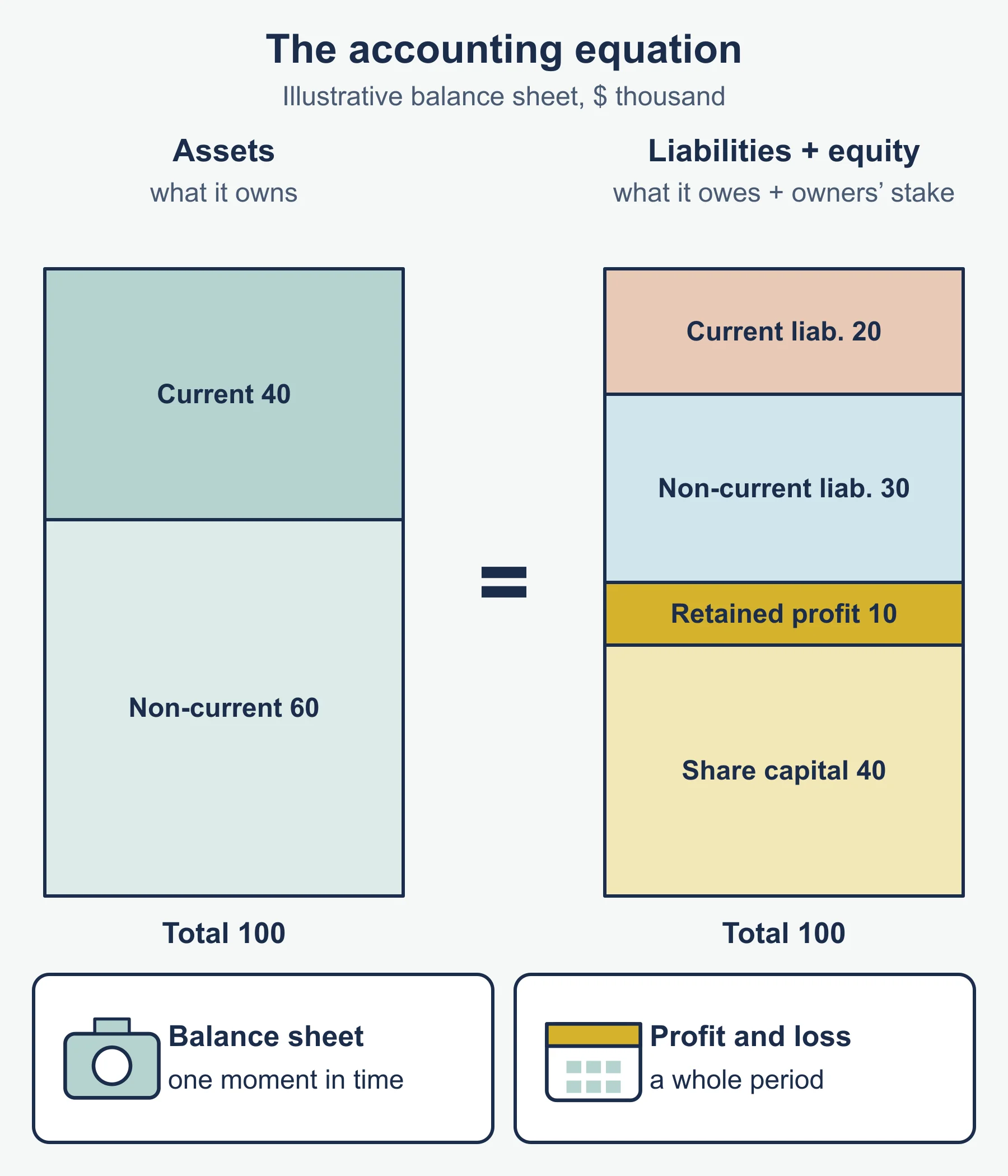
A snapshot of what the business owns and owes on one date.
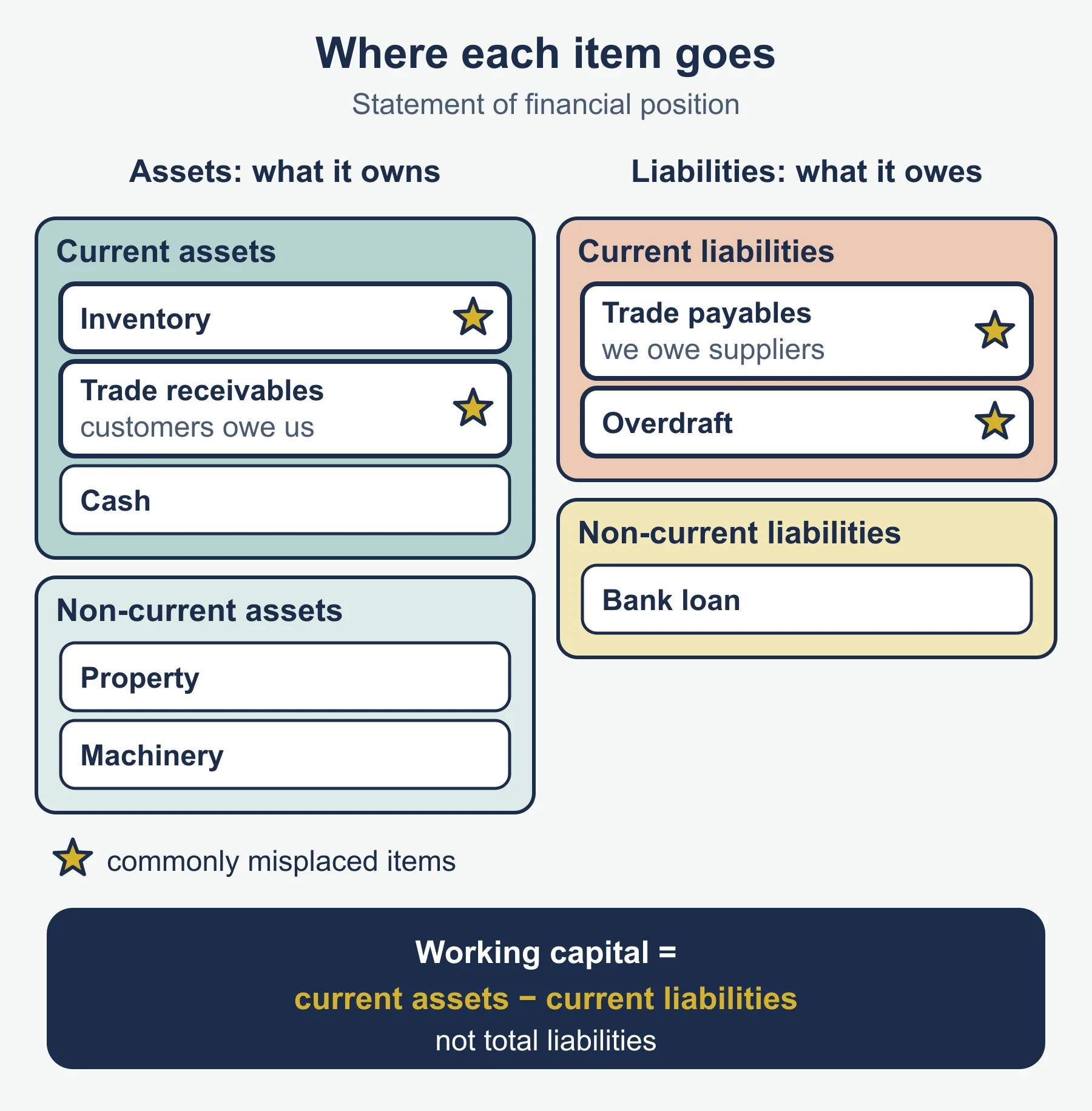
| Element | Meaning | Syllabus examples |
|---|---|---|
| Non-current assets | Owned, kept for more than a year | Property (land and buildings), machinery |
| Current assets | Cash or expected to become cash within a year | Inventory, trade receivables, cash |
| Non-current liabilities | Owed, due after more than a year | Bank loans |
| Current liabilities | Owed, due within a year | Trade payables, overdraft |
Formulae
| Measure | Form | Note |
|---|---|---|
| Total assets | Non-current assets + current assets | Standard form |
| Total liabilities | Current liabilities + non-current liabilities | Standard form |
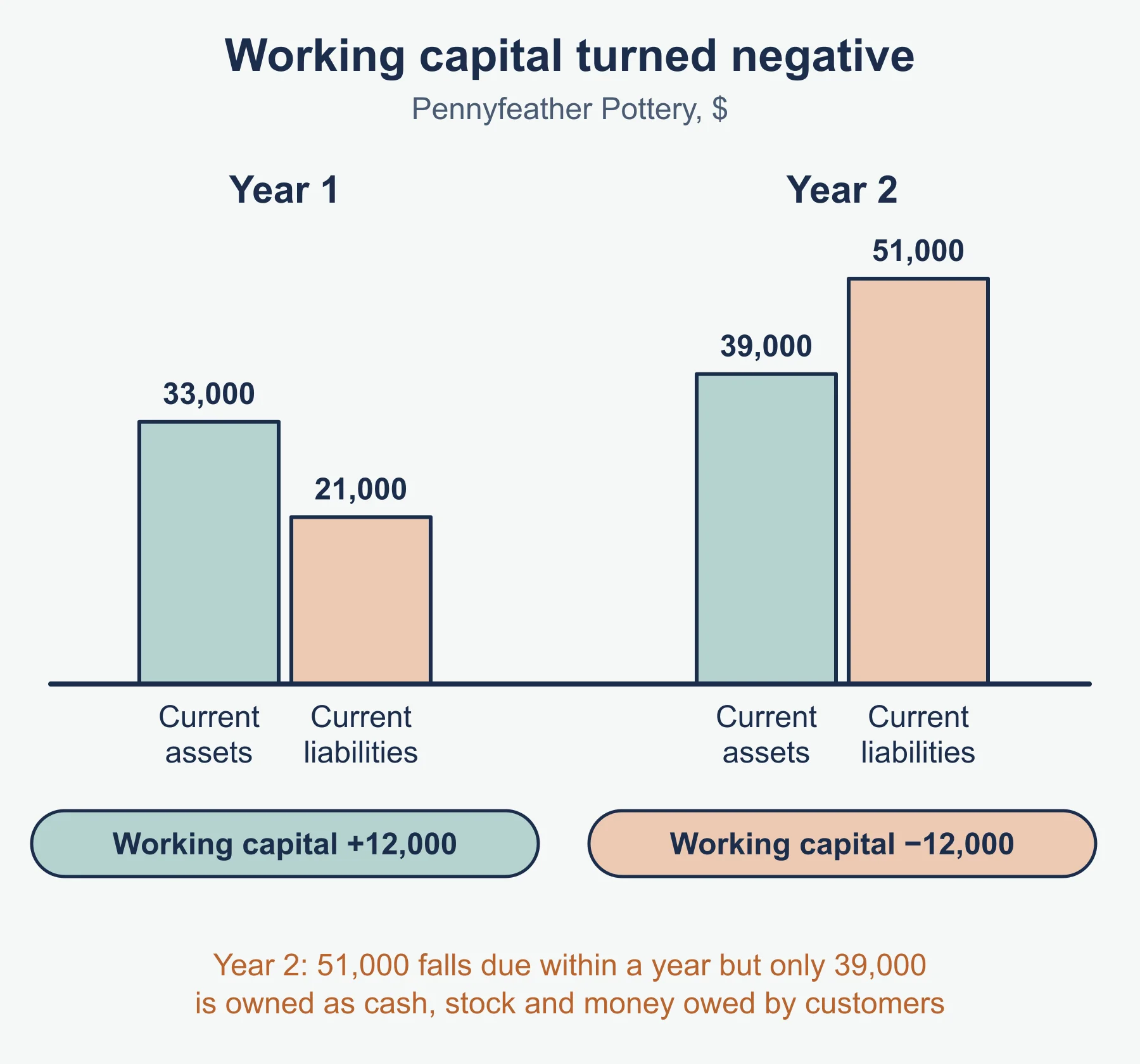
| Working capital | Current assets - current liabilities | In the syllabus formulae |
| Capital employed | Total assets - current liabilities | Standard form. The syllabus names the concept but does not print a formula |
Capital employed also equals non-current liabilities plus the owners’ funds (equity). Equity is the standard name for what total assets less total liabilities leaves.
Must-know distinctions
| Pair | Difference |
|---|---|
| Trade receivables and trade payables | Receivables are owed to the business by customers. Payables are owed by the business to suppliers |
| Inventory and non-current assets | Inventory is held to sell soon. Non-current assets are kept to use over many years |
| Overdraft and bank loan | An overdraft is a current liability. A bank loan repayable after more than a year is a non-current liability |
| Profit and working capital | Profit is a result for a period. Working capital is a position on one date |
| Total liabilities and current liabilities | Working capital uses current liabilities only |
Quick reminder
Ellerslie Joinery has property 64,000 and machinery 16,000. It holds inventory 9,000, trade receivables 5,000 and cash 2,000. It owes trade payables 6,000, an overdraft of 3,000 and a bank loan of 30,000.
- Total assets = 80,000 + 16,000 = 96,000.
- Current liabilities = 6,000 + 3,000 = 9,000. Total liabilities = 9,000 + 30,000 = 39,000.
- Working capital = 16,000 - 9,000 = 7,000.
- Capital employed = 96,000 - 9,000 = 87,000.
Decisions from a statement of financial position
- Positive working capital suggests the business can meet bills due within a year. Negative working capital is a warning.
- Compare current assets with current liabilities, and look at how much is owed overall.
- Check how new assets were paid for. Using an overdraft for a long-term asset weakens working capital.
- Lenders and suppliers use the same figures to judge risk.
- Possible actions: collect money owed sooner, reduce inventory, replace an overdraft with a long-term loan, delay buying assets.
Worked decision: financial position
Ellerslie Joinery then buys machinery for 12,000 and pays by raising its overdraft from 3,000 to 15,000. Non-current assets become 92,000 and current liabilities 21,000, with current assets unchanged at 16,000.
- Working capital = 16,000 - 21,000 = -5,000. It was positive 7,000 before.
- Capital employed = 108,000 - 21,000 = 87,000, which is unchanged.
The business has gained a machine but has less short-term safety. Replacing the overdraft with a longer-term loan would move the debt out of current liabilities.
Quick self-test
- State the syllabus formula for profit using total revenue.
- Name the four reasons the syllabus gives for why profit matters to private sector businesses.
- A shop sold 320 items at 45 each. Calculate its revenue.
- A business has revenue of 50,000 and cost of sales of 31,000. Calculate gross profit.
- Gross profit is 19,000 and expenses are 12,500. Calculate profit.
- Classify each as non-current asset, current asset, non-current liability or current liability: machinery, inventory, trade payables, a five-year bank loan.
- Current assets are 42,000 and current liabilities are 30,000. Calculate working capital.
- Non-current assets are 95,000, inventory is 12,000 and cash is 8,000, with no other assets. Calculate total assets.
- Total assets are 90,000 and current liabilities are 25,000. Calculate capital employed using the standard form.
- Revenue is 70,000 and gross profit is 26,000. Calculate cost of sales.
Answers
- Profit = total revenue - total costs (or gross profit - expenses).
- Reward for risk-taking, source of finance, measure of success, attract investors.
- 320 x 45 = 14,400.
- 50,000 - 31,000 = 19,000.
- 19,000 - 12,500 = 6,500.
- Machinery: non-current asset. Inventory: current asset. Trade payables: current liability. Five-year bank loan: non-current liability.
- 42,000 - 30,000 = 12,000.
- Total assets = 95,000 + 12,000 + 8,000 = 115,000.
- 90,000 - 25,000 = 65,000.
- 70,000 - 26,000 = 44,000.
Where marks are usually lost
- Giving gross profit when the question asks for profit, or the other way round.
- Writing a formula or number with no units or label. Add the dollar sign or the word “units” as needed.
- Putting an overdraft among non-current liabilities, or inventory among non-current assets.
- Using total liabilities instead of current liabilities when finding working capital.
- Listing the four reasons for profit with no link to the business in the question.
- Describing a figure without a conclusion. In a decision question, say what it means for the business and what to do.
- Treating a rise in revenue as proof of success without checking costs.
- Saying a business with profit has plenty of cash. They are different things.
- Giving only advantages in an evaluate or justify question. Weigh both sides, then decide.
Frequently asked questions
What is the difference between gross profit and profit? Gross profit is revenue minus cost of sales. Profit is gross profit minus expenses, which is the same as total revenue minus total costs, so giving gross profit when profit is asked for loses marks.
How do you calculate working capital for Cambridge IGCSE Business 0264? Working capital = current assets − current liabilities. Use current liabilities only, not total liabilities, and a negative answer means the business may struggle to pay what it owes within the year.
Is an overdraft a current or non-current liability? An overdraft is a current liability in the 0264 syllabus list, along with trade payables. Bank loans are non-current liabilities.
Is profit the same as cash? No. A business can record a profit and still run short of cash, for example when customers have not yet paid, so a profitable business can still have negative working capital.
Official syllabus
These notes follow the Cambridge IGCSE Business 0264 syllabus for examination in 2027, 2028 and 2029, published by Cambridge University Press and Assessment. Sections 5.3 and 5.4 sit under “Financial information and decisions”.
Get free revision emails (optional)
Occasional emails with practice questions, worked explanations and links to free resources for the qualification and subjects you choose. No spam, and you can unsubscribe from any email. The free tools on this site never need an email.
Related resources
-
Study guides
IGCSE Business: Analysis of accounts (Cambridge 0264)
Study guide to analysis of accounts for Cambridge IGCSE Business 0264: profitability and liquidity ratios, users of accounts and the limits of ratios.
Business · Cambridge · IGCSE
Read guide -
Practice questions
IGCSE Business: Analysis of accounts (Cambridge 0264) – Practice Questions
Original practice questions with worked answers on analysis of accounts for Cambridge IGCSE Business 0264: ratios, users and limitations.
Business · Cambridge · IGCSE
Try questions -
Revision notes
IGCSE Business: Analysis of accounts (Cambridge 0264) – Revision Notes
Condensed revision notes on analysis of accounts for Cambridge IGCSE Business 0264: ratio formulas, users of accounts, limitations and a self-test.
Business · Cambridge · IGCSE
Revise topic
Related articles
-
teaching
A Level tuition in Dubai: Cambridge or Pearson Edexcel International A Level?
Schools in Dubai and Abu Dhabi teach either Cambridge International AS & A Level or Pearson Edexcel International A Level. How the two are structured, why it matters for tuition, and how online classes from Lahore work.
9 October 2026
-
curriculum guides
Choosing subjects at IGCSE and A Level
How subject choices at 14 and 16 affect university options later, and how to keep pathways open without overloading a timetable.
28 July 2026
Studying this with a teacher
Working through Business IGCSE?
This page is free and stays free. If you would rather be taught it, Marlbridge runs Business classes one-to-one and in small groups of up to 15, online in your own time zone. The first trial class is free. WhatsApp replies within an hour (8am–11pm Pakistan time, every day); email the same day.
Cambridge Business teachers at Marlbridge

