
Study Guides
IGCSE Business: Profit and loss and Statement of financial position (Cambridge 0264)
Study guide to profit, the statement of profit or loss and the statement of financial position for Cambridge IGCSE Business 0264, with worked examples.
- Subject
- Business
- Level
- IGCSE
- Topic
- Financial information and decisions
- Author
- Marlbridge Academic Team
- Updated
- Reviewed by
- Salman Ahmad (what this means)
Aligned to Cambridge IGCSE Business (0264), For examination in 2027, 2028 and 2029. Official specification .
Syllabus page (what it covers and how it is assessed): Cambridge IGCSE Business.
Syllabus points this page covers
0264
- 5.3 Profit and loss
- 5.4 Statement of financial position
Found an error? Report a correction.
Need help with this topic? Request a free trial class for IGCSE Business (0450 / 0264).
This guide covers sections 5.3 (Profit and loss) and 5.4 (Statement of financial position) of the Cambridge IGCSE Business 0264 syllabus for examination in 2027, 2028 and 2029. Both papers are based on all the subject content, so these ideas can appear in a short answer, a data response or a case study. The syllabus says you will not be assessed on constructing a statement of profit or loss or a statement of financial position. You are expected to read them, calculate from them and use them to make decisions.
Next, use the revision notes and the practice questions. The course hub, the printable checklist and the free diagnostics show what to revise next. All money in this guide is in dollars. Every business is invented.
What this unit covers
| Syllabus section | What you must be able to do |
|---|---|
| 5.3.1 What is profit and why it is important | Say what profit is. Explain why profit matters to private sector businesses: reward for risk-taking, source of finance, measure of success, attract investors |
| 5.3.2 Statement of profit or loss | Know the main features: revenue, cost of sales, gross profit, expenses, profit. Make simple calculations with them. Make decisions from simple statements |
| 5.4.1 The main elements of a statement of financial position | Know non-current assets, current assets, non-current liabilities, current liabilities and the concept of capital employed. Calculate total assets, total liabilities and working capital. Make decisions from simple statements |
5.3.1 What profit is and why it matters
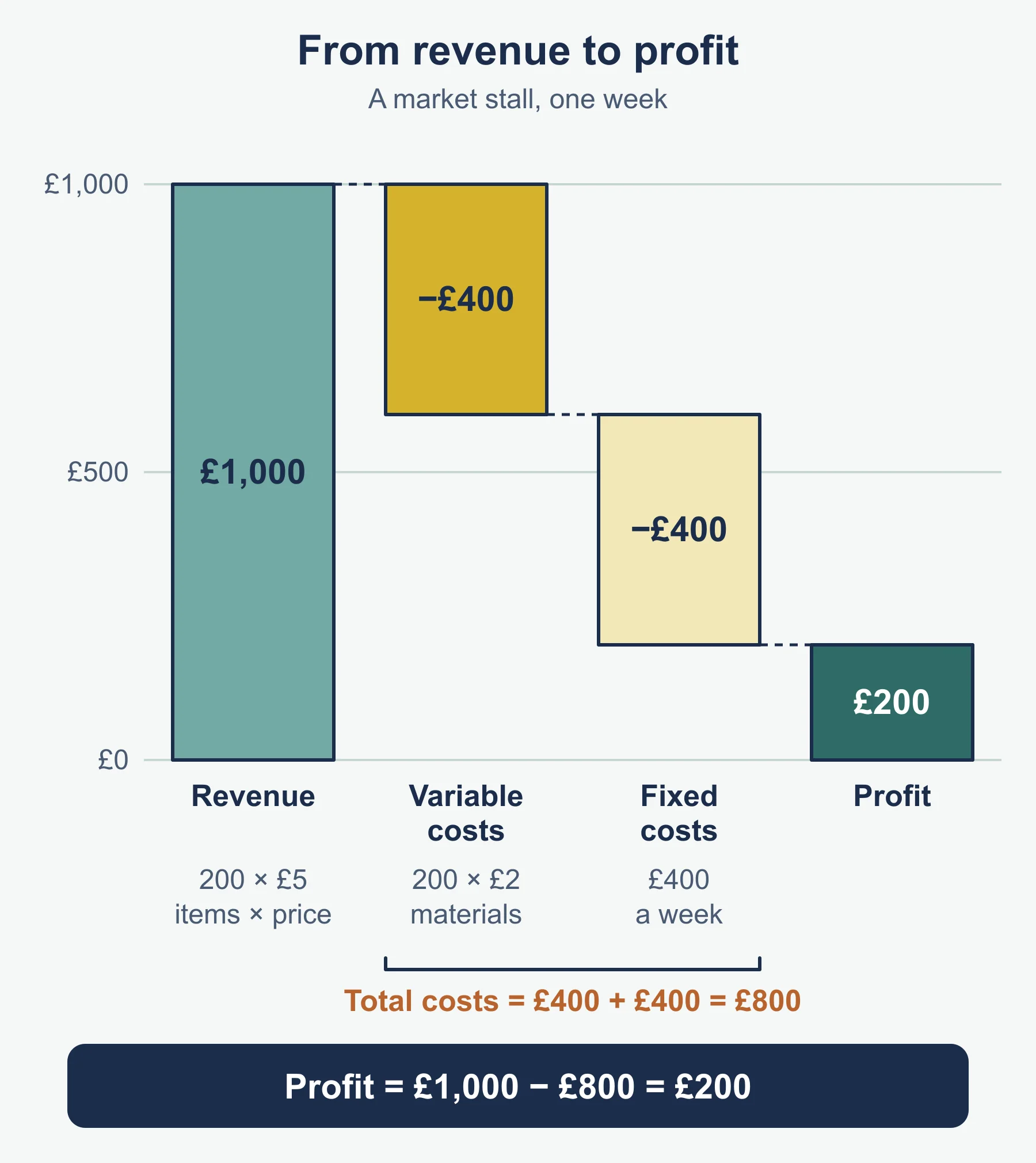
Profit is what is left when a business takes its total costs away from its revenue. The syllabus formula is:
Profit = total revenue - total costs
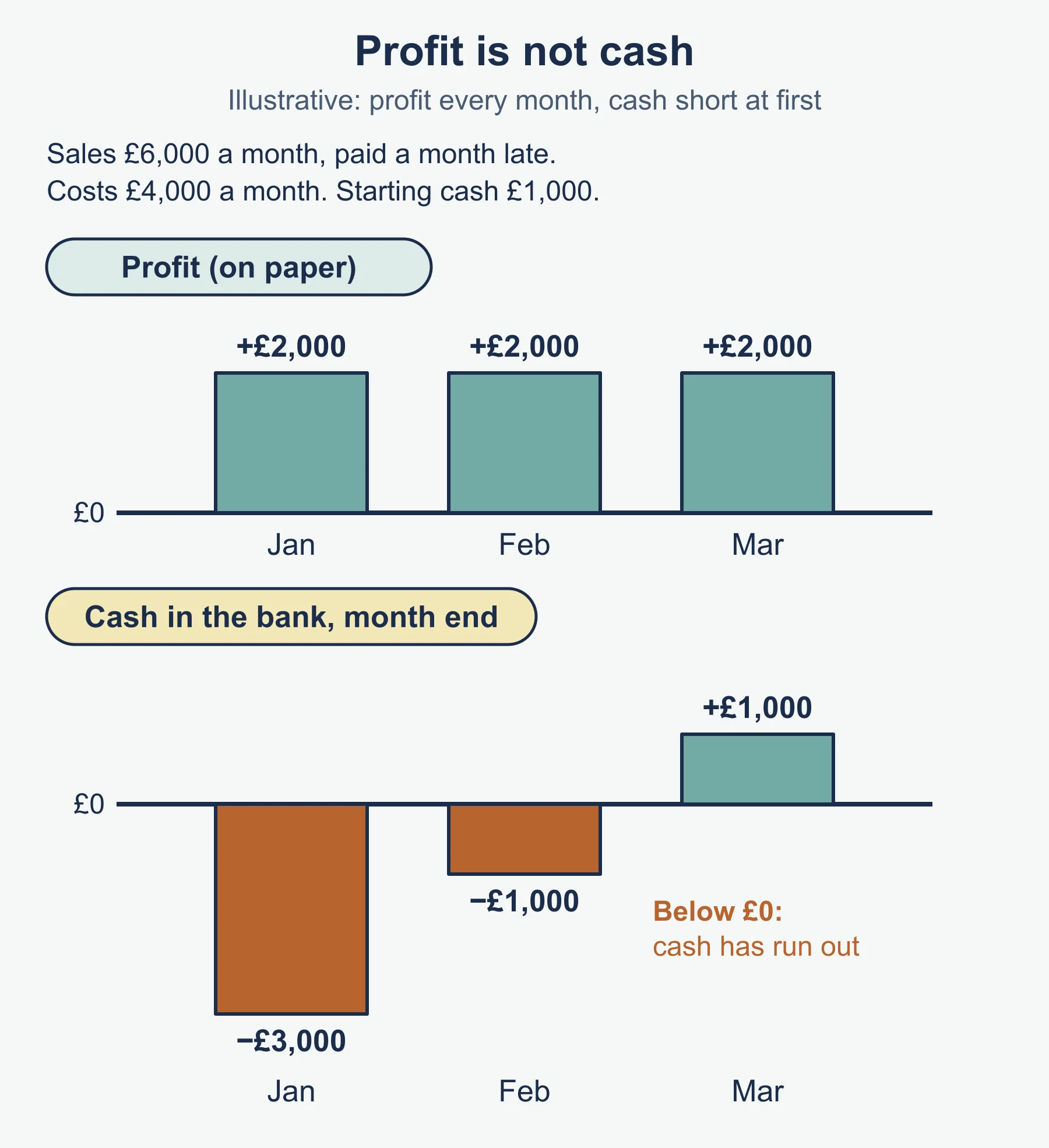
If costs are larger than revenue the result is negative. That is a loss. Profit is also not the same as cash. A business can record a profit and still run short of cash, for example when customers have not yet paid.
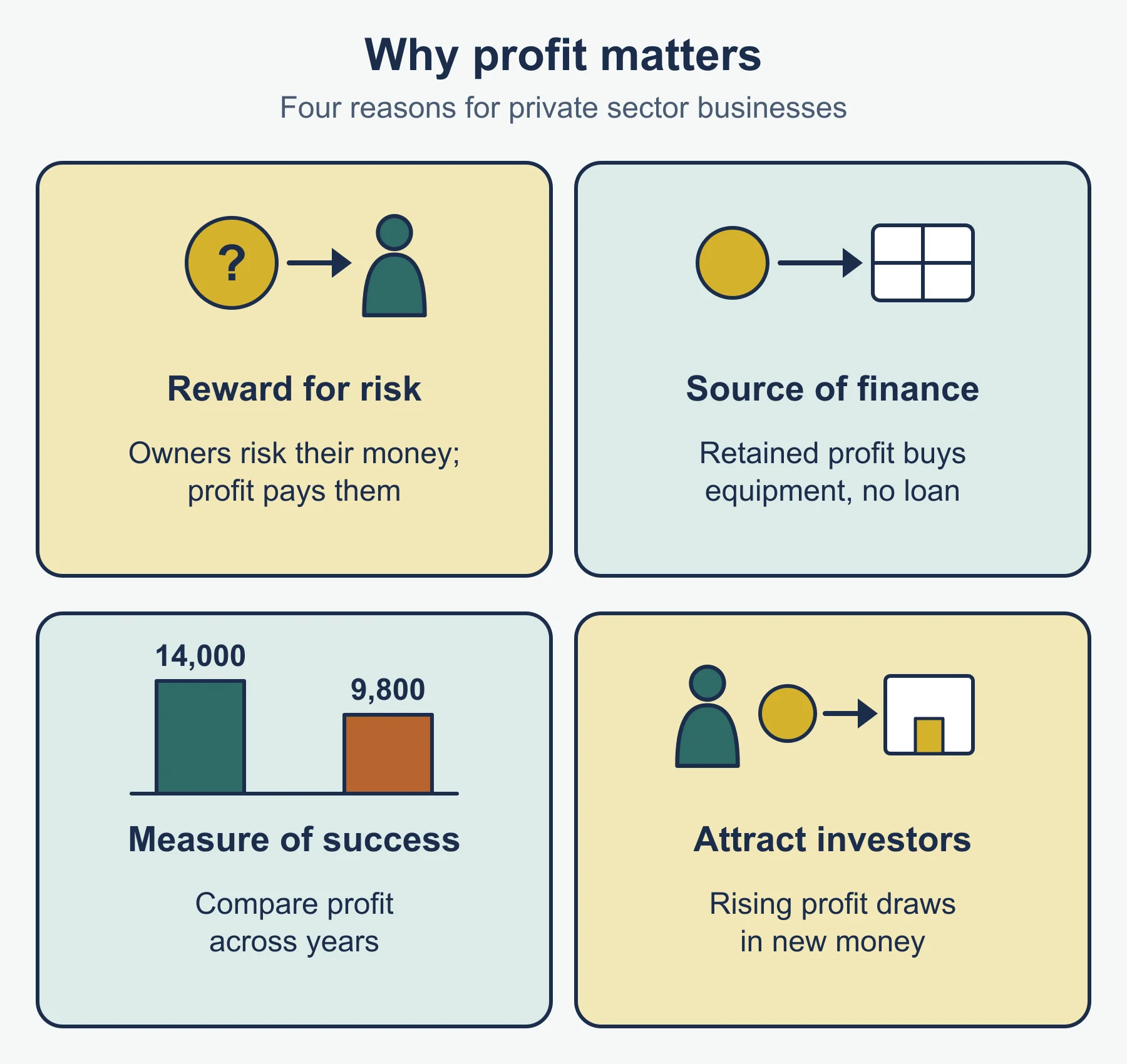
The syllabus lists four reasons why profit is important to private sector businesses. Learn them as four separate points.
| Reason | What it means | Short example |
|---|---|---|
| Reward for risk-taking | Owners put money in without any promise of getting it back. Profit pays them for taking that risk | An owner who invests savings in a workshop expects a return that a bank deposit would not give |
| Source of finance | Profit that is kept in the business (retained profit) can pay for new equipment or stock without borrowing | A shop uses last year’s profit to fit new shelving, so it pays no interest |
| Measure of success | Profit shows whether the business is earning more than it spends. Owners can compare it across years | Profit of 9,800 compared with 14,000 the year before shows a decline |
| Attract investors | People with money to invest look for businesses likely to pay a return | A business with rising profit finds it easier to sell shares or to persuade a partner to join |
Do not write “profit is important because the business needs money”. Say which of the four reasons you mean and link it to the business in the question.
5.3.2 The statement of profit or loss
The statement of profit or loss records the money a business earned and spent over a period, usually a year. Its main features are in the order below.
| Line | Meaning | How it is found |
|---|---|---|
| Revenue | Value of goods or services sold | Selling price per unit x number of units sold |
| Cost of sales | Cost of the goods that were sold (materials, bought-in goods and similar direct costs) | Given in the statement |
| Gross profit | What is left after the cost of sales | Revenue - cost of sales |
| Expenses | Other running costs such as wages, rent, advertising and utilities | Added up from the list |
| Profit | What is left after all costs | Gross profit - expenses |
The syllabus gives profit in two forms: total revenue - total costs, or gross profit - expenses. They give the same answer, because total costs are cost of sales plus expenses.
Worked example 1: reading a statement
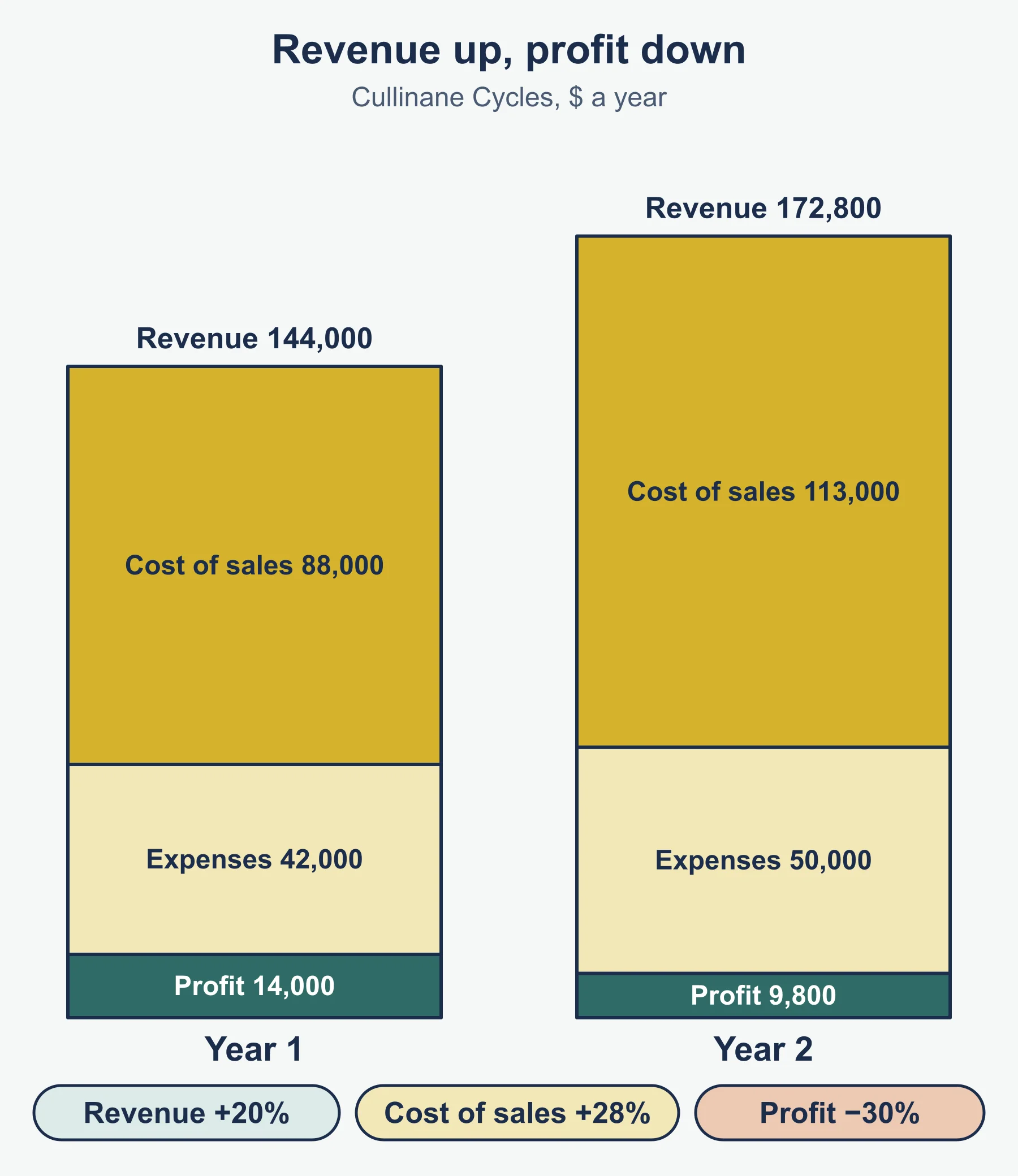
Cullinane Cycles sold 600 bicycles in its first year at 240 each. A year later it sold 720 at the same price. Its figures are below.
| Line | Year 1 | Year 2 |
|---|---|---|
| Revenue | 144,000 | 172,800 |
| Cost of sales | 88,000 | 113,000 |
| Gross profit | 56,000 | 59,800 |
| Wages | 24,000 | 30,000 |
| Rent | 9,000 | 10,000 |
| Advertising | 5,000 | 6,000 |
| Other expenses | 4,000 | 4,000 |
| Total expenses | 42,000 | 50,000 |
| Profit | 14,000 | 9,800 |
Check the working. Year 1 revenue is 600 x 240 = 144,000. Gross profit is 144,000 - 88,000 = 56,000. Expenses are 24,000 + 9,000 + 5,000 + 4,000 = 42,000. Profit is 56,000 - 42,000 = 14,000. For year 2, revenue is 720 x 240 = 172,800, gross profit 59,800, expenses 50,000 and profit 9,800.
Decision from the statement. Revenue rose by 20%, which looks like good news. Cost of sales rose by about 28%, so gross profit rose by only about 7%. Expenses rose by about 19%. Profit fell by 4,200, which is a fall of 30%. A manager should look for the cause. Cost of sales rising faster than revenue suggests that bought-in parts cost more, or that discounts were given. The manager could look for a cheaper supplier, raise the price or check the rise in wages.
The lesson is that rising revenue does not guarantee rising profit. Compare each line, not just the top one.
Worked example 2: finding a missing figure
Fernsby Laundry charges 12 per wash and completed 9,500 washes. Revenue is 12 x 9,500 = 114,000. The cost of sales was 45,600 and expenses were 52,000.
- Gross profit = 114,000 - 45,600 = 68,400.
- Profit = 68,400 - 52,000 = 16,400.
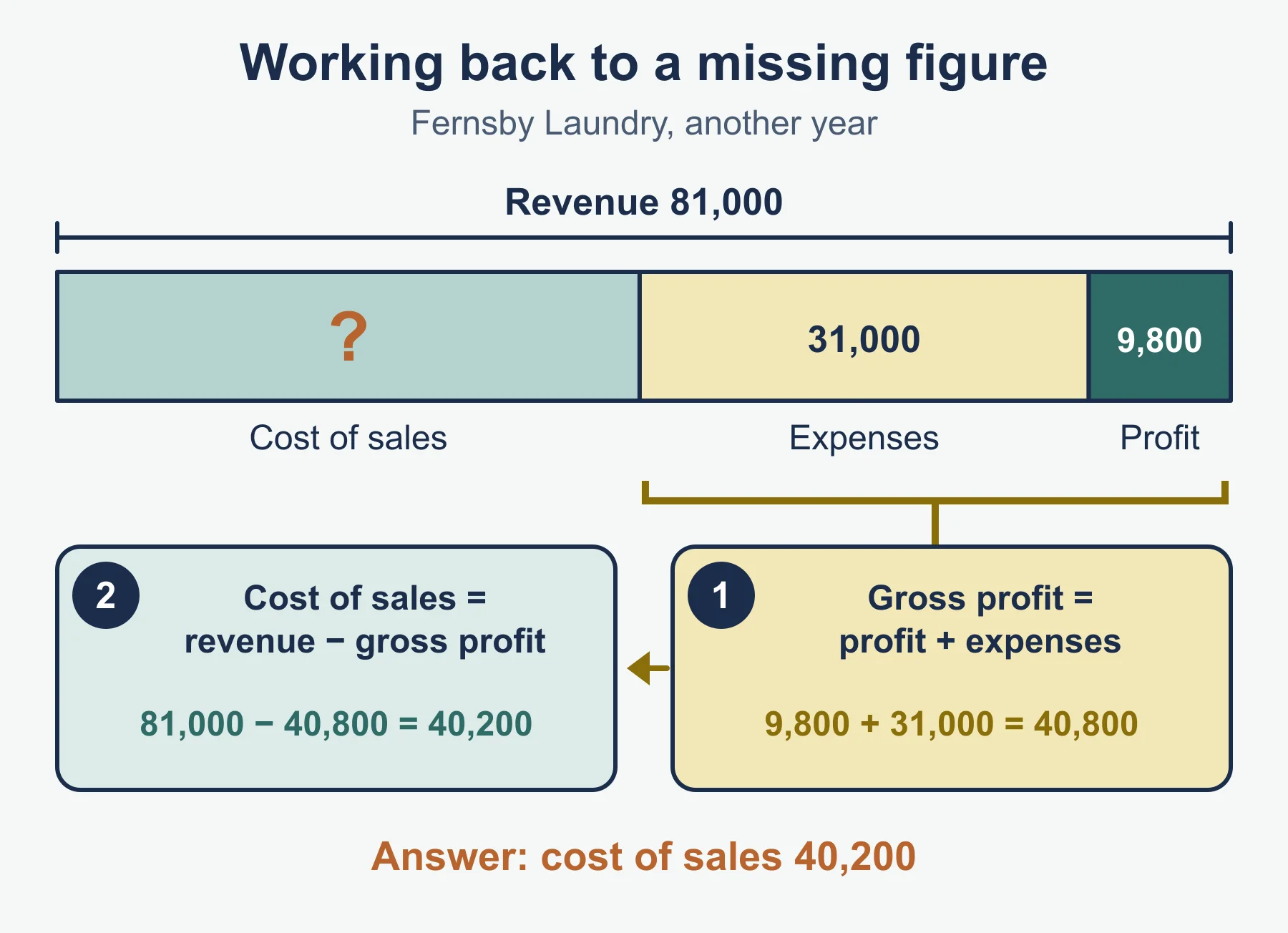
Now work backwards. In another year the laundry had revenue of 81,000, expenses of 31,000 and a profit of 9,800.
- Gross profit = profit + expenses = 9,800 + 31,000 = 40,800.
- Cost of sales = revenue - gross profit = 81,000 - 40,800 = 40,200.
Use the same two formulas and rearrange them.
Making decisions from a statement of profit or loss
Decisions need evidence. Use figures from the statement, then say what they mean.
- Compare years, or compare planned and actual figures. Say which lines moved most.
- If gross profit is low, the cause is revenue (price or volume) or cost of sales. Possible actions are a higher price or a different supplier.
- If gross profit is healthy but profit is low, expenses are the problem. Look for savings in rent, wages or advertising.
- A fall in profit may make investors or lenders cautious. A rise may support a plan to expand or to pay owners a return.
- Remember what the statement leaves out: it does not show cash, borrowing or what the business owns.
5.4.1 The statement of financial position
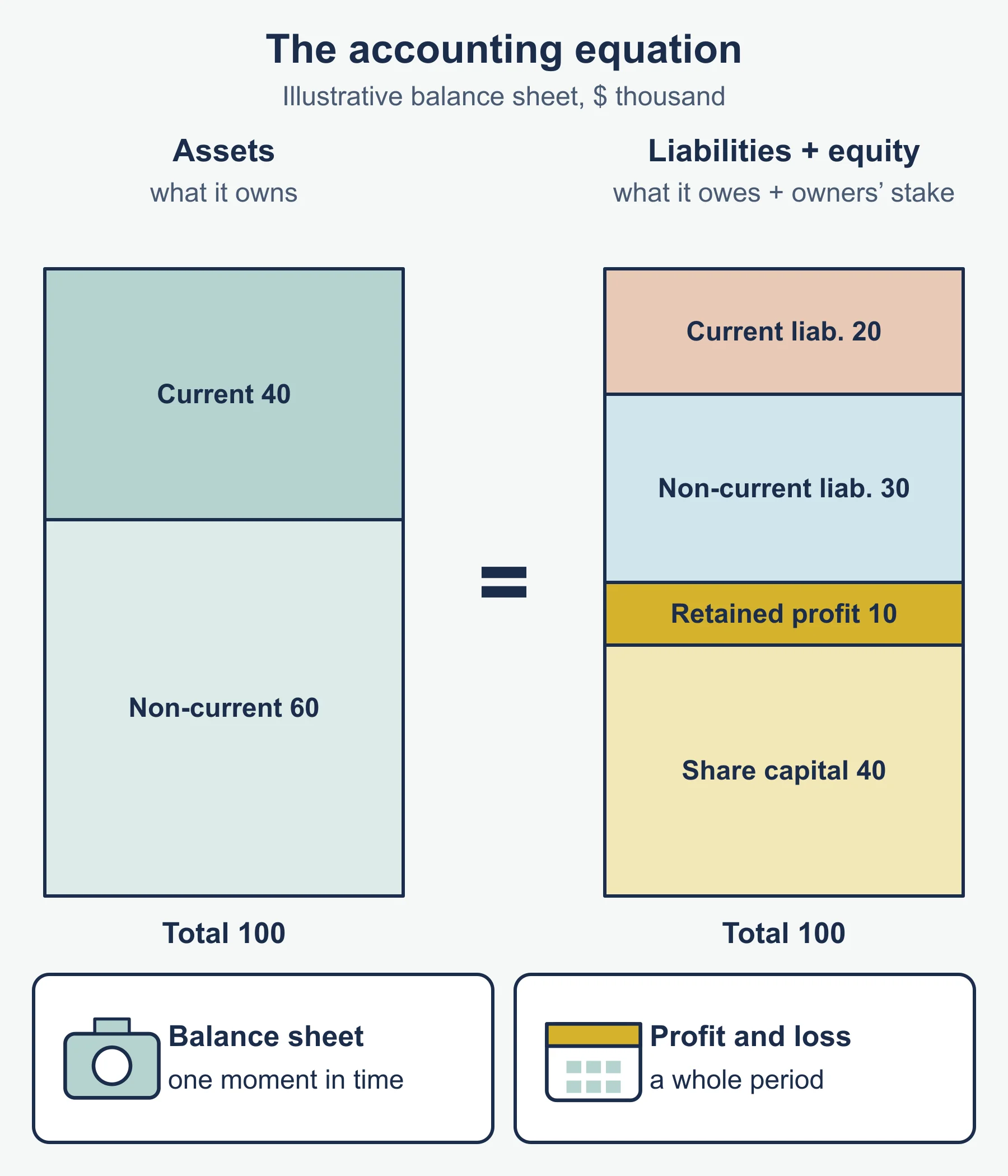
The statement of financial position is a snapshot of a business on one date. It lists what the business owns (assets) and what it owes (liabilities). Profit comes from a different statement. Both are needed.
| Element | Meaning | Examples in the syllabus |
|---|---|---|
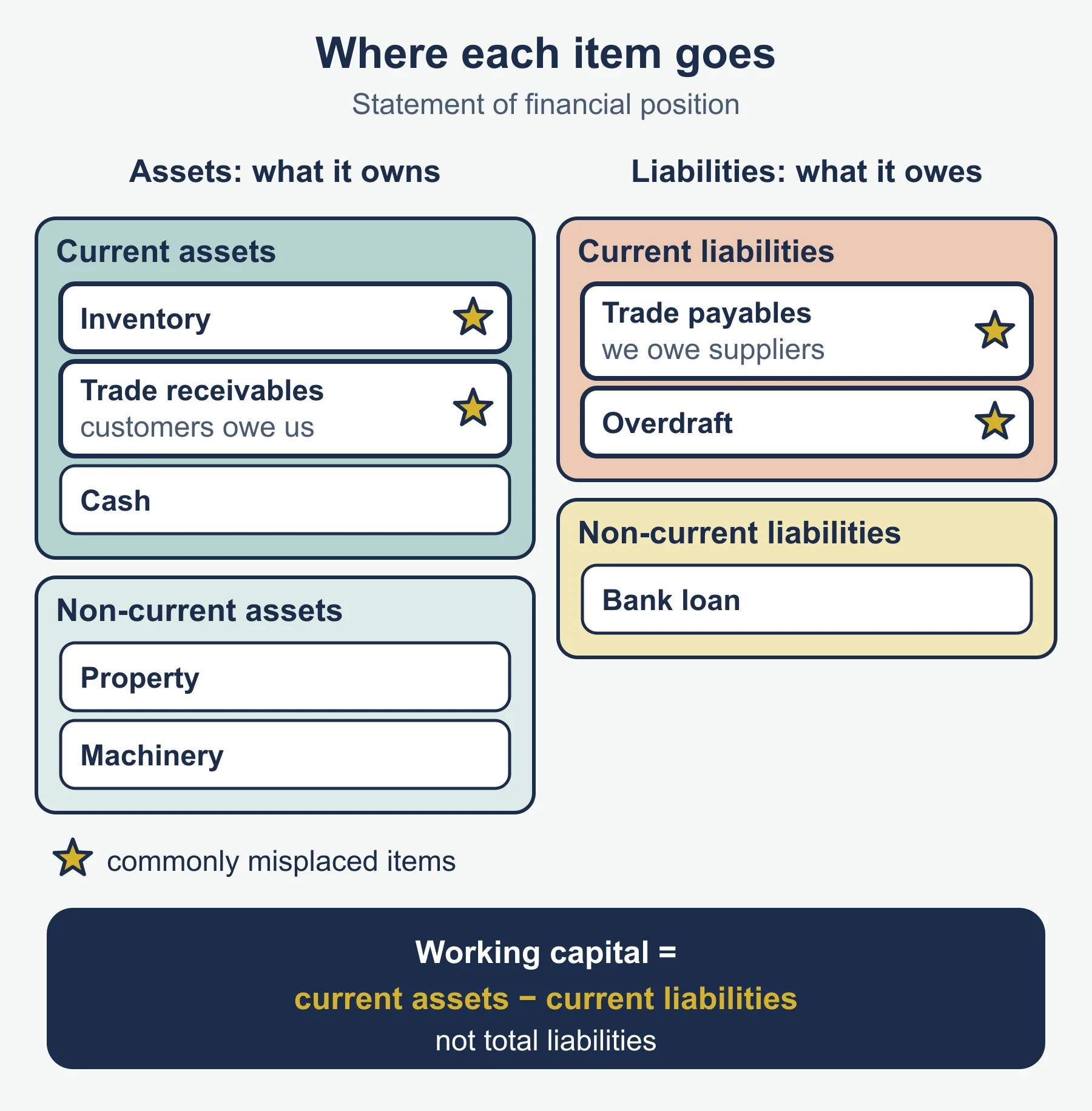
| Non-current assets | Items owned that the business expects to keep for more than a year | Property (land and buildings), machinery |
| Current assets | Items owned that are cash or expected to become cash within a year | Inventory, trade receivables, cash |
| Non-current liabilities | Amounts owed that are due after more than a year | Bank loans |
| Current liabilities | Amounts owed that are due within a year | Trade payables, overdraft |
Trade receivables are money owed to the business by customers who bought on credit. Trade payables are money the business owes to suppliers. Mixing these two up is a common slip.
Calculations
| Measure | Form | Source |
|---|---|---|
| Total assets | Non-current assets + current assets | Standard form |
| Total liabilities | Current liabilities + non-current liabilities | Standard form |
| Working capital | Current assets - current liabilities | Given in the syllabus formulae |
| Capital employed | Total assets - current liabilities | Standard form (the syllabus names the concept but does not print the formula) |
Working capital is the money available to run the business day to day. If it is negative, the business may struggle to pay what it owes in the next year.
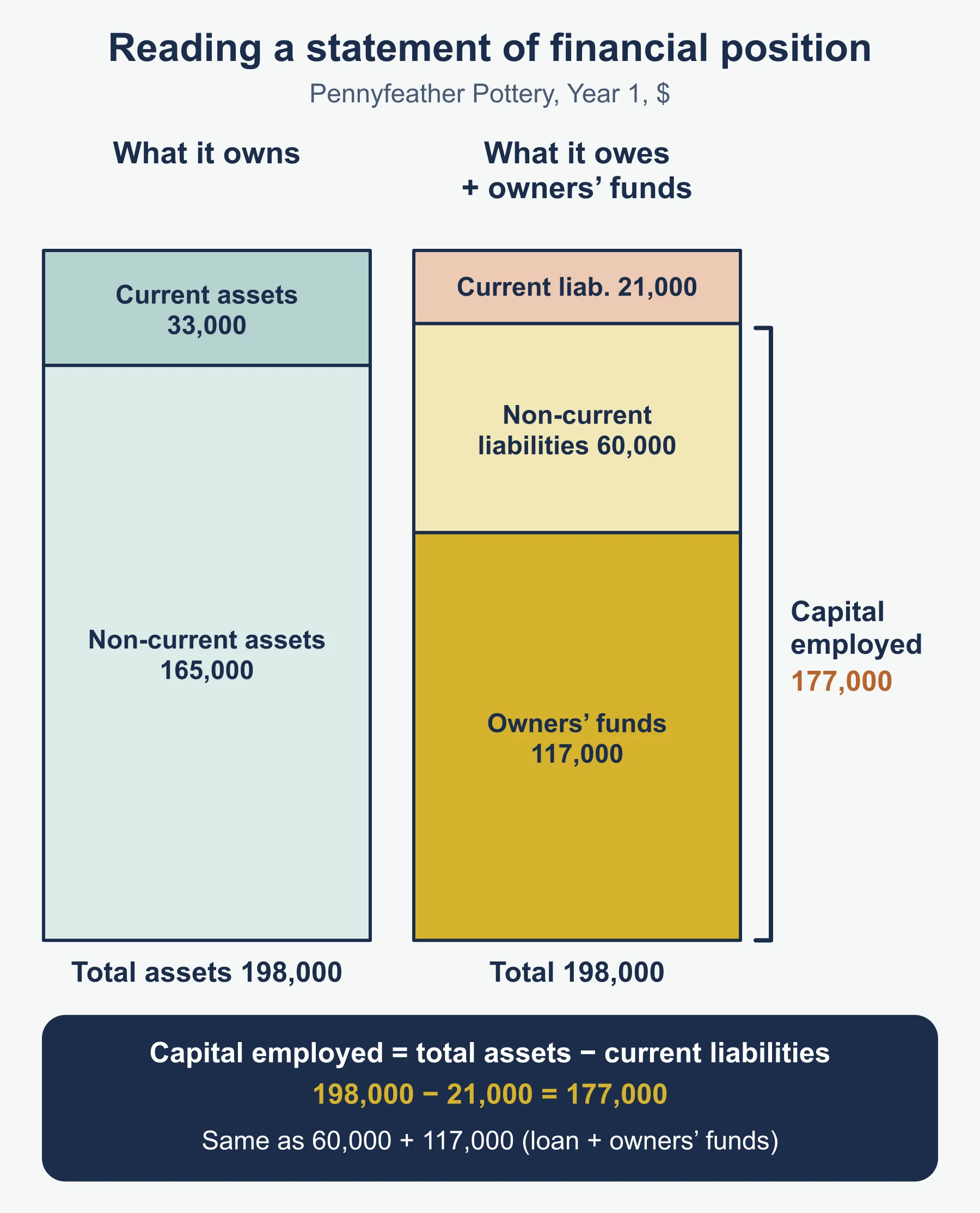
Capital employed is the long-term money invested in the business. It equals non-current liabilities plus the owners’ funds (equity). Both ways of finding it give the same answer, which the example below shows.
Worked example 3: calculating from a statement
Pennyfeather Pottery has this statement of financial position.
| Item | Year 1 | Year 2 |
|---|---|---|
| Property | 120,000 | 120,000 |
| Machinery | 45,000 | 70,000 |
| Total non-current assets | 165,000 | 190,000 |
| Inventory | 18,000 | 22,000 |
| Trade receivables | 9,000 | 15,000 |
| Cash | 6,000 | 2,000 |
| Total current assets | 33,000 | 39,000 |
| Trade payables | 14,000 | 20,000 |
| Overdraft | 7,000 | 31,000 |
| Total current liabilities | 21,000 | 51,000 |
| Bank loan (non-current) | 60,000 | 60,000 |
Year 1:
- Total assets = 165,000 + 33,000 = 198,000.
- Total liabilities = 21,000 + 60,000 = 81,000.
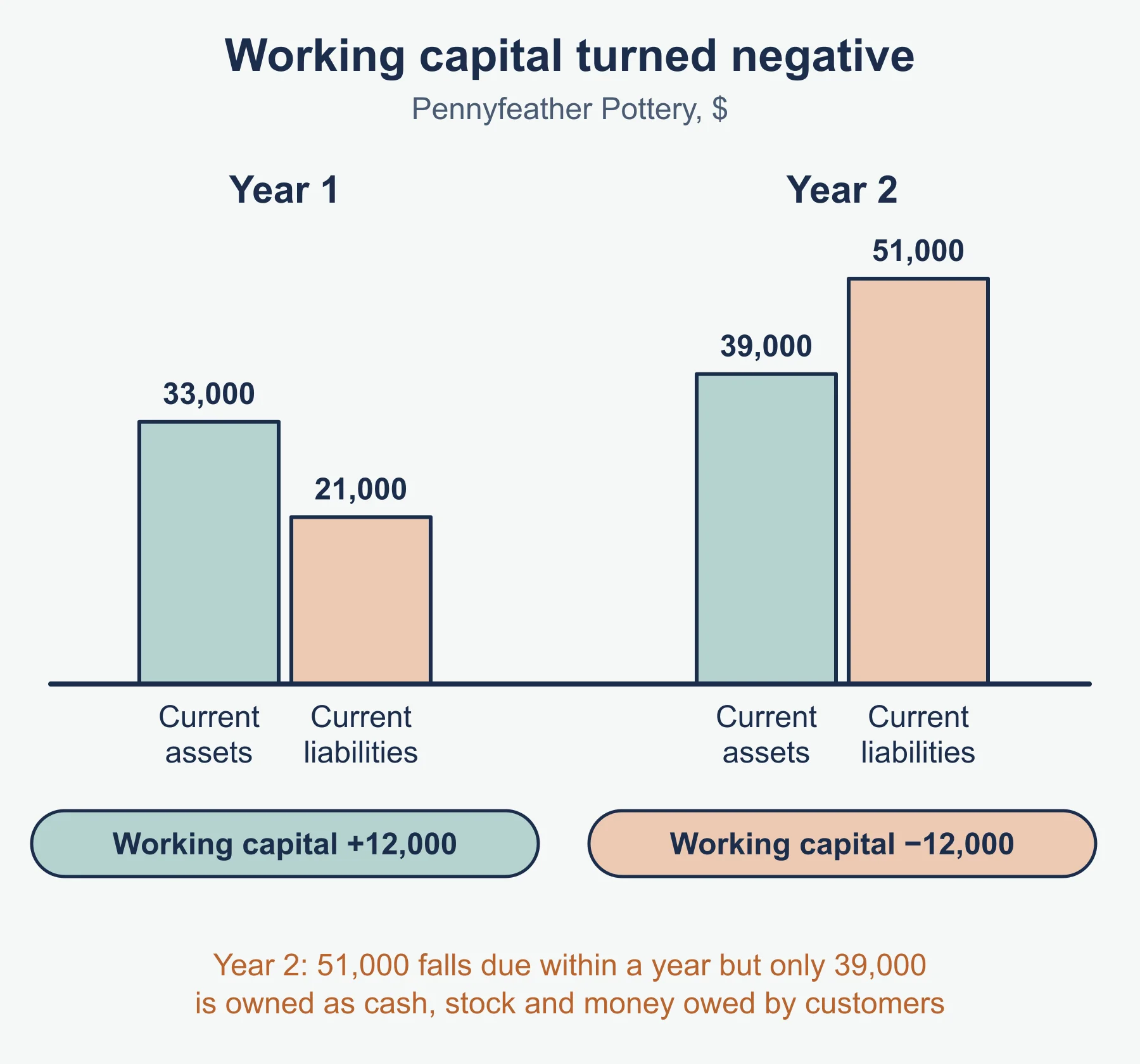
- Working capital = 33,000 - 21,000 = 12,000.
- Capital employed = 198,000 - 21,000 = 177,000.
- Check: total assets - total liabilities = 117,000 is the owners’ funds. Adding the bank loan of 60,000 gives 177,000.
Year 2:
- Total assets = 190,000 + 39,000 = 229,000.
- Total liabilities = 51,000 + 60,000 = 111,000.
- Working capital = 39,000 - 51,000 = -12,000.
- Capital employed = 229,000 - 51,000 = 178,000.
Decision from the statement. Capital employed hardly changed, but working capital fell from positive 12,000 to negative 12,000. The business bought machinery worth 25,000 and paid for much of it by raising the overdraft by 24,000. Cash is only 2,000, while 51,000 is due within a year. The owner should be concerned about paying suppliers on time. Possible actions are to chase customers who owe 15,000, to arrange a longer-term loan in place of the overdraft, or to reduce inventory.
Making decisions from a statement of financial position
- Compare current assets with current liabilities. A large gap in favour of liabilities signals a short-term problem.
- Look at how the business finances itself: a heavy reliance on loans and overdraft means large repayments and interest.
- Check what changed between dates and why. New non-current assets can improve capacity, but how they were paid for matters.
- A lender or supplier may use the same figures to decide whether the business is safe to lend to or to supply on credit.
- A statement of financial position shows one date only. It says nothing about the profit earned in the year.
Common errors
- Writing “profit = revenue - cost of sales”. That is gross profit. Profit also deducts expenses.
- Treating revenue and profit as the same thing.
- Putting an overdraft among non-current liabilities. It is a current liability in the syllabus list.
- Calling inventory a non-current asset. It is a current asset.
- Subtracting total liabilities from current assets to find working capital. Use current liabilities only.
- Giving a number with no comment. In a decision question, say what the figure shows and what the business should do.
Frequently asked questions
Do you have to construct a statement of profit or loss in Cambridge IGCSE Business 0264? No. The syllabus says you will not be assessed on constructing a statement of profit or loss or a statement of financial position. You need to know their main features, make simple calculations with them and make decisions from them.
What is the difference between trade receivables and trade payables? Trade receivables are money owed to the business by customers who bought on credit, and they are a current asset. Trade payables are money the business owes to its suppliers, and they are a current liability.
How do you calculate capital employed? Capital employed = total assets − current liabilities. It equals non-current liabilities plus the owners’ funds, and the syllabus names the concept without printing the formula, so this is the standard form.
Why can profit fall even when revenue rises? If cost of sales or expenses rise faster than revenue, profit can fall. That is why you should compare each line of the statement, not just revenue at the top.
Is inventory a current or non-current asset? Inventory is a current asset, because it is expected to become cash within a year. Non-current assets are items kept for more than a year, such as property and machinery.
Official syllabus
This guide follows the Cambridge IGCSE Business 0264 syllabus for examination in 2027, 2028 and 2029, published by Cambridge University Press and Assessment. Sections 5.3 and 5.4 are in the topic “Financial information and decisions”.
Get free revision emails (optional)
Occasional emails with practice questions, worked explanations and links to free resources for the qualification and subjects you choose. No spam, and you can unsubscribe from any email. The free tools on this site never need an email.
Related resources
-
Practice questions
IGCSE Business: Profit and loss and Statement of financial position (Cambridge 0264) – Practice Questions
Original practice questions with worked answers on profit, the statement of profit or loss and the statement of financial position for IGCSE Business 0264.
Business · Cambridge · IGCSE
Try questions -
Revision notes
IGCSE Business: Profit and loss and Statement of financial position (Cambridge 0264) – Revision Notes
Condensed revision notes on profit, the statement of profit or loss and the statement of financial position for Cambridge IGCSE Business 0264.
Business · Cambridge · IGCSE
Revise topic -
Study guides
IGCSE Business: Analysis of accounts (Cambridge 0264)
Study guide to analysis of accounts for Cambridge IGCSE Business 0264: profitability and liquidity ratios, users of accounts and the limits of ratios.
Business · Cambridge · IGCSE
Read guide
Related articles
-
teaching
A Level tuition in Dubai: Cambridge or Pearson Edexcel International A Level?
Schools in Dubai and Abu Dhabi teach either Cambridge International AS & A Level or Pearson Edexcel International A Level. How the two are structured, why it matters for tuition, and how online classes from Lahore work.
9 October 2026
-
curriculum guides
Choosing subjects at IGCSE and A Level
How subject choices at 14 and 16 affect university options later, and how to keep pathways open without overloading a timetable.
28 July 2026
Studying this with a teacher
Working through Business IGCSE?
This page is free and stays free. If you would rather be taught it, Marlbridge runs Business classes one-to-one and in small groups of up to 15, online in your own time zone. The first trial class is free. WhatsApp replies within an hour (8am–11pm Pakistan time, every day); email the same day.
Cambridge Business teachers at Marlbridge

