
Study Guides
IGCSE Business: Human resource management (HRM) (Cambridge 0264)
Study guide to human resource management for Cambridge IGCSE Business 0264: recruitment, selection, contracts, legal controls and training.
- Subject
- Business
- Level
- IGCSE
- Topic
- People in business
- Author
- Marlbridge Academic Team
- Updated
- Reviewed by
- Salman Ahmad (what this means)
Aligned to Cambridge IGCSE Business (0264), For examination in 2027, 2028 and 2029. Official specification .
Syllabus page (what it covers and how it is assessed): Cambridge IGCSE Business.
Syllabus points this page covers
0264
- 2.1 Human resource management (HRM)
Found an error? Report a correction.
Need help with this topic? Request a free trial class for IGCSE Business (0450 / 0264).
This guide covers section 2.1 (Human resource management (HRM), points 2.1.1 to 2.1.3) of the Cambridge IGCSE Business 0264 syllabus for examination in 2027, 2028 and 2029. All candidates take the same two papers, Paper 1 (Short Answer and Data Response) and Paper 2 (Case Study), and both papers are based on all the subject content. So expect HRM in stimulus material and case studies, not only as recall. Use the course hub and the printable checklist to track progress, then use the revision notes and the practice questions to test yourself. To find weak spots first, try the free diagnostics.
Money figures are in dollars. All businesses and people are invented, and the legal figures (such as a minimum wage) are made up for practice.
What you must be able to do
| Syllabus point | What it means for you |
|---|---|
| 2.1.1 Recruiting and selecting employees | Describe the stages of recruitment, the selection methods, internal against external recruitment, and recommend and justify who to employ |
| 2.1.2 Employment contracts and legal controls | Say what a contract contains, who benefits, and how four legal controls affect employers and employees |
| 2.1.3 Training | Explain why training matters, and compare induction, on-the-job and off-the-job training |
The command words you will meet are listed in the syllabus. Define means give precise meaning. Identify means name or select. Outline means set out the main points. Explain means say why or how and support with evidence. Justify means support a case with evidence or argument.
2.1.1 Recruiting and selecting employees
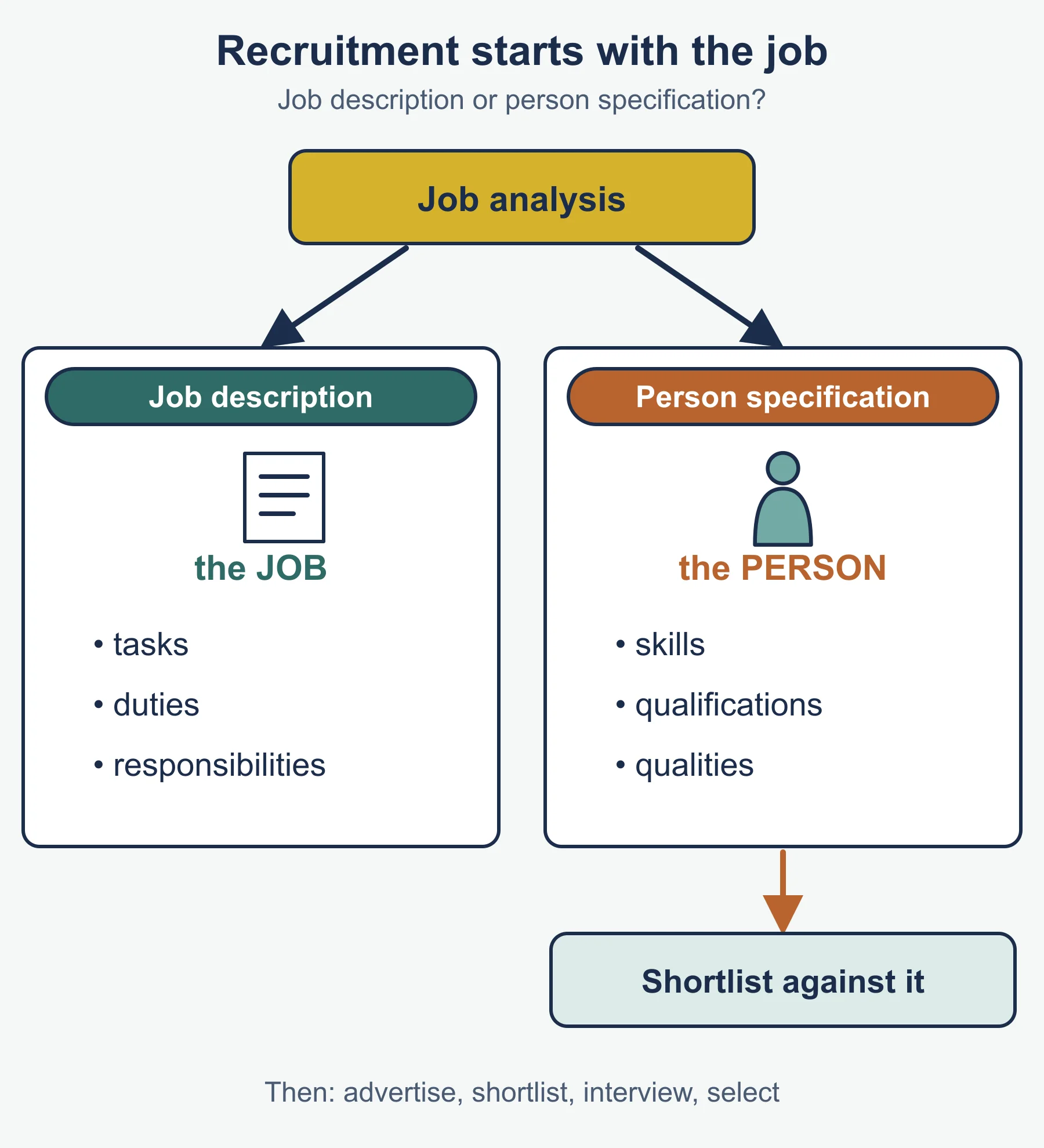
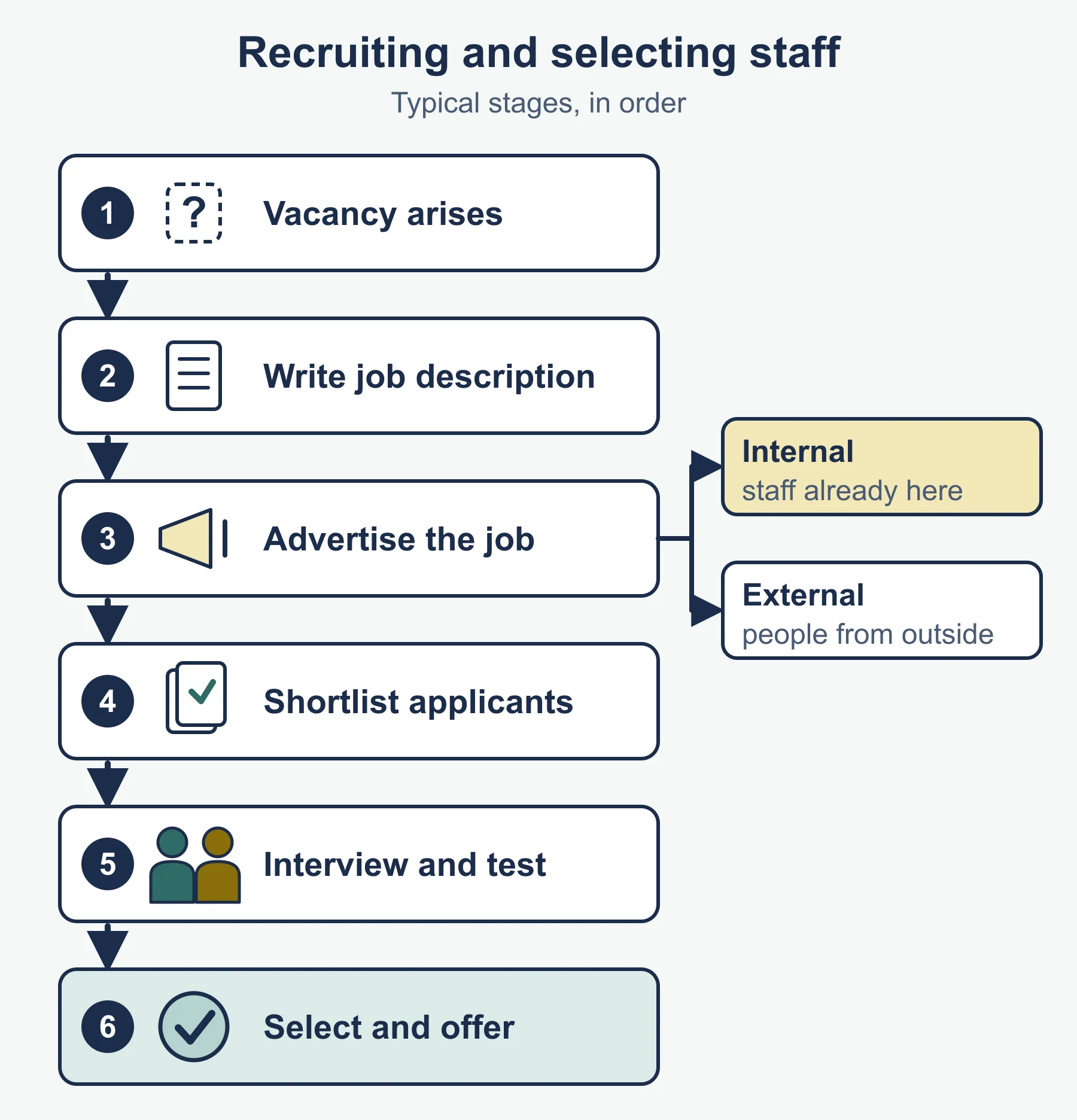
Recruitment is the process of attracting suitable people to apply for a vacancy. Selection is choosing the best applicant from those who apply. The syllabus lists the stages of recruitment as job descriptions, person specifications and job advertisements.
Stages in the recruitment process
- Job description. A document that lists the job title, the main duties and responsibilities, and who the post holder reports to. It says what the job is.
- Person specification. A document that lists the qualifications, skills, experience and personal qualities needed. It says what the ideal person is like. A job description describes the job. A person specification describes the person.
- Job advertisement. The notice that tells possible applicants about the vacancy. It normally gives the job title, a summary of duties, the main requirements, the pay or benefits, and how and when to apply.
Where to advertise matters, because it decides who sees the vacancy. The syllabus names two routes in particular.
| Route | What it is | Advantages | Disadvantages |
|---|---|---|---|
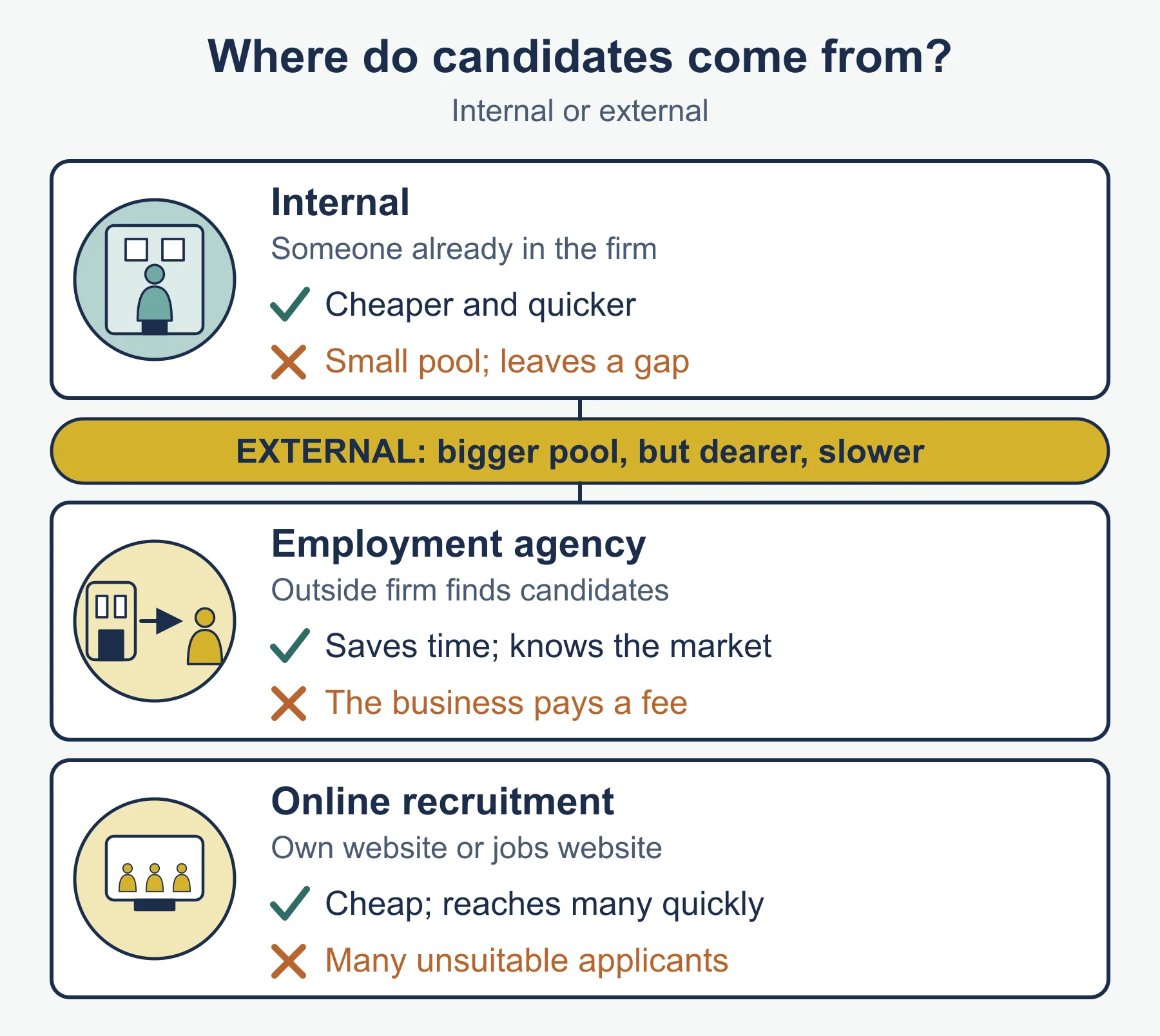
| Employment agency | An outside firm that finds and often shortlists candidates | Saves the business time; knows the labour market | The business pays a fee |
| Online recruitment | Advertising on the business website or a jobs website | Cheap and can reach many people quickly | May attract many unsuitable applicants to sort through |
Selection methods
| Method | What it gives the employer | A limitation |
|---|---|---|
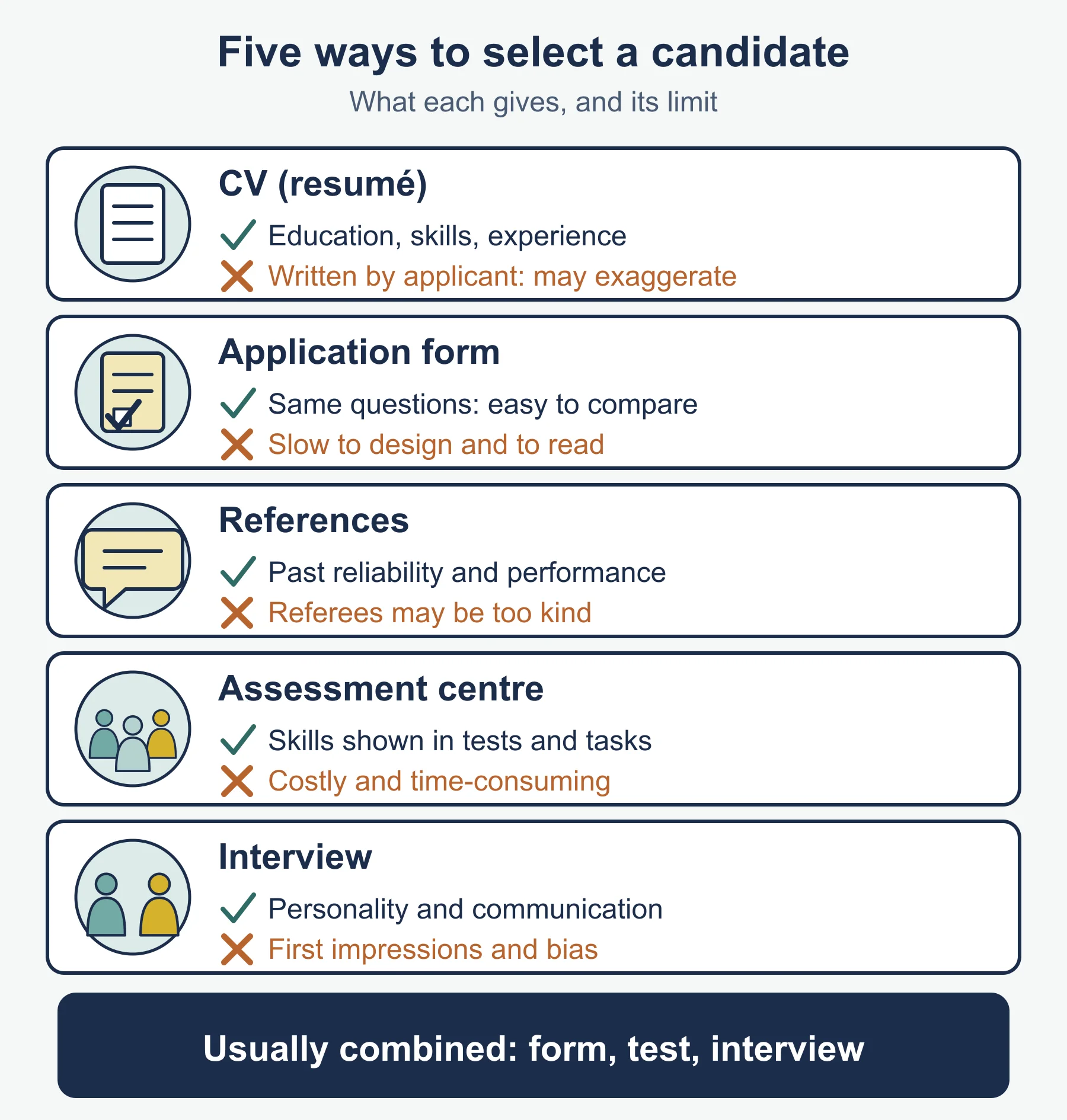
| Curriculum vitae (CV) or resumé | A summary of the applicant’s education, skills and experience | Applicants write it themselves, so it may exaggerate |
| Application form | Every applicant answers the same questions, so comparison is easy | Takes time to design and to read |
| References | Views from a previous employer or teacher about reliability and performance | Referees may be too kind, or slow to reply |
| Testing or assessment centres | Tests, tasks and group exercises show skills in practice | Costly and time-consuming to run |
| Interviews | A face-to-face meeting to judge personality and communication | Can be affected by first impressions and bias |
Businesses usually combine methods. A shortlist might be drawn from application forms, then tested, then interviewed.
Internal and external recruitment
Internal recruitment fills the post with someone already working for the business. External recruitment fills it from outside.
| Advantages | Disadvantages | |
|---|---|---|
| Internal | Cheaper and quicker; the person already knows the business; motivates staff by showing promotion is possible; the employer already knows their record | Fewer applicants to choose from; no new ideas; a gap is created in the job they leave; rejected colleagues may be disappointed |
| External | Larger pool of applicants; new skills and ideas arrive | Costs more and takes longer; the new person needs induction; the employer knows less about them; may demotivate existing staff who wanted promotion |
Worked example: recommend and justify
Cobalt Vale Printers needs a production supervisor. Two candidates reach the final stage.
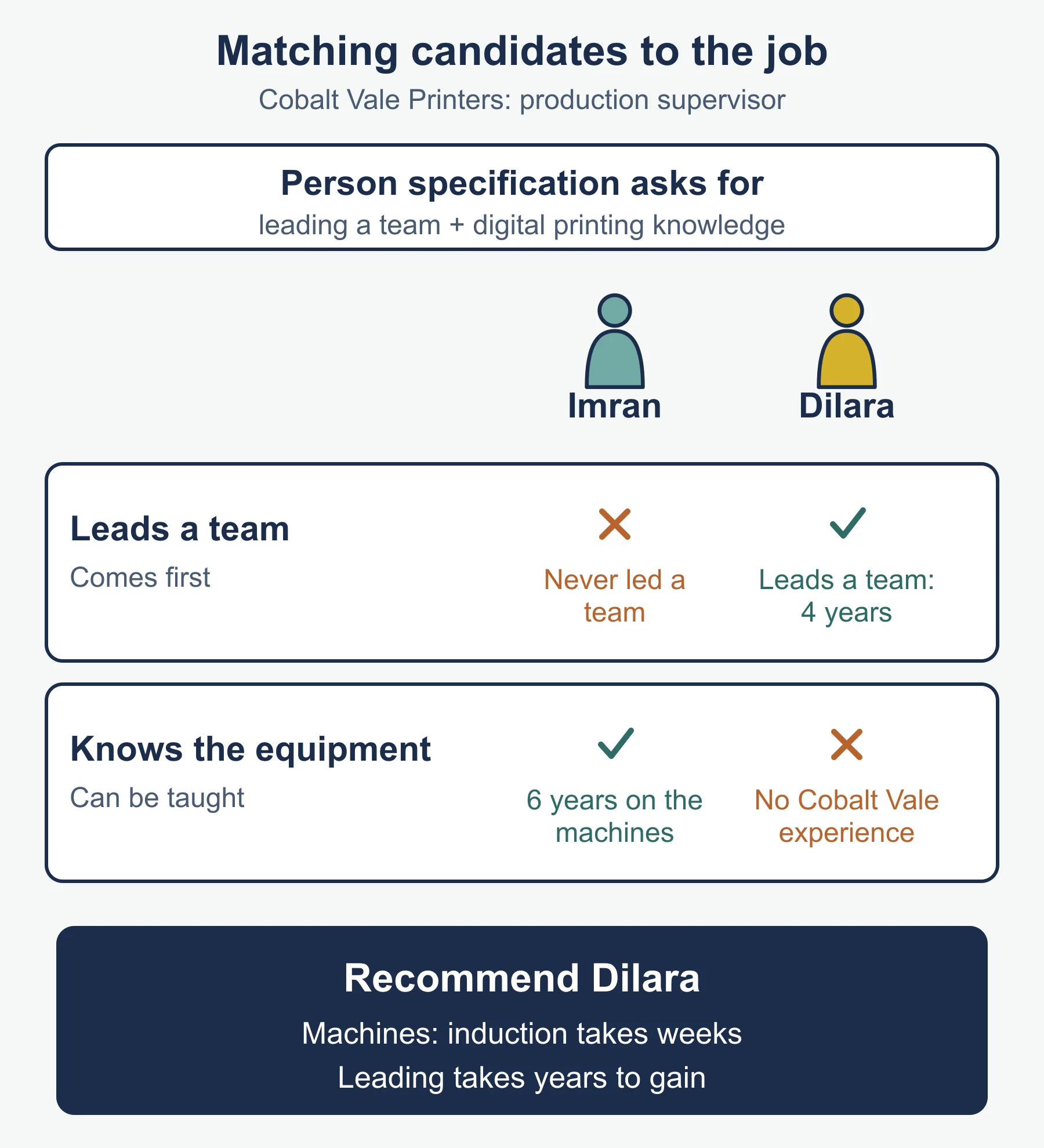
- Imran has worked on the print floor for six years. He knows every machine, but he has never led a team.
- Dilara has run a team of eight at a rival printer for four years. She has no experience of Cobalt Vale’s machines.
The person specification asks for “experience of leading a team” and “knowledge of digital printing equipment”.
A weak answer says “Dilara, because she has more experience”. A strong answer matches evidence to the specification:
I recommend Dilara. The post is a supervisor, and the person specification puts leading a team first, which she has done for four years and Imran has not. Her weaker machine knowledge can be fixed with induction training in a few weeks, whereas leadership experience takes years to gain. The risk is that Imran, a loyal long-serving worker, may feel overlooked, so the manager should explain the decision and discuss a development plan with him.
Notice the pattern: recommend, support with two pieces of evidence from the case, then weigh the main drawback. For a justify question, the support is the evidence and argument.
2.1.2 Employment contracts and legal controls
The main contents of an employment contract
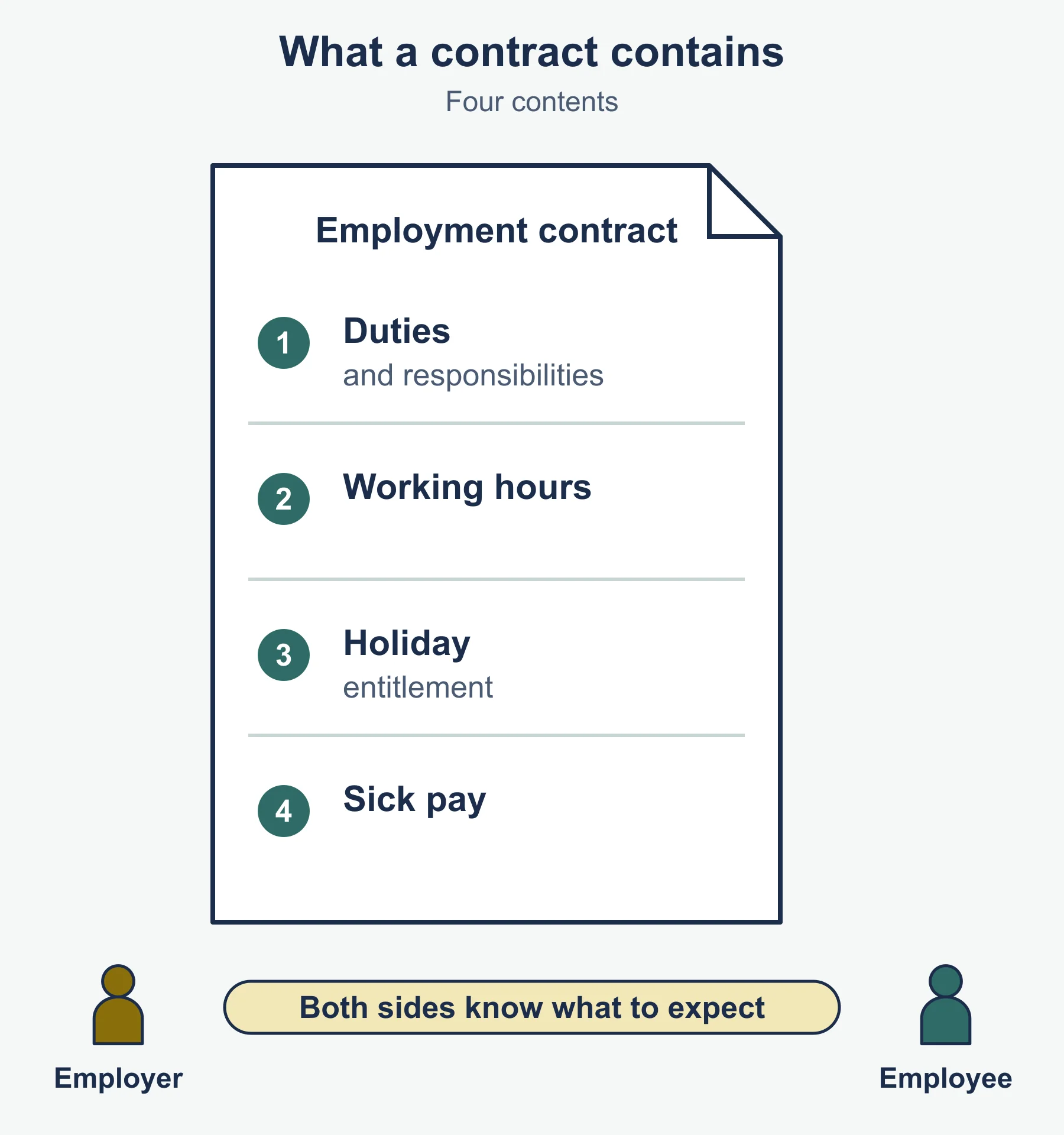
An employment contract is a legal agreement between an employer and an employee setting out the terms of the job. The syllabus names four contents.
- Duties and responsibilities: what the employee must do.
- Working hours: how many hours, and when.
- Holiday entitlement: the paid time off the employee may take.
- Sick pay: whether, and for how long, the employee is paid when ill.
Benefits of contracts
| For the employer | For the employee |
|---|---|
| Both sides know what is expected, so fewer disagreements | Knows the pay, hours and holiday they are entitled to |
| Provides evidence if there is a dispute | Has written evidence if the employer breaks the agreement |
| Can state duties clearly, so the employee can be held to them | Job security is clearer, because the terms cannot be changed without agreement |
Legal controls over employment issues
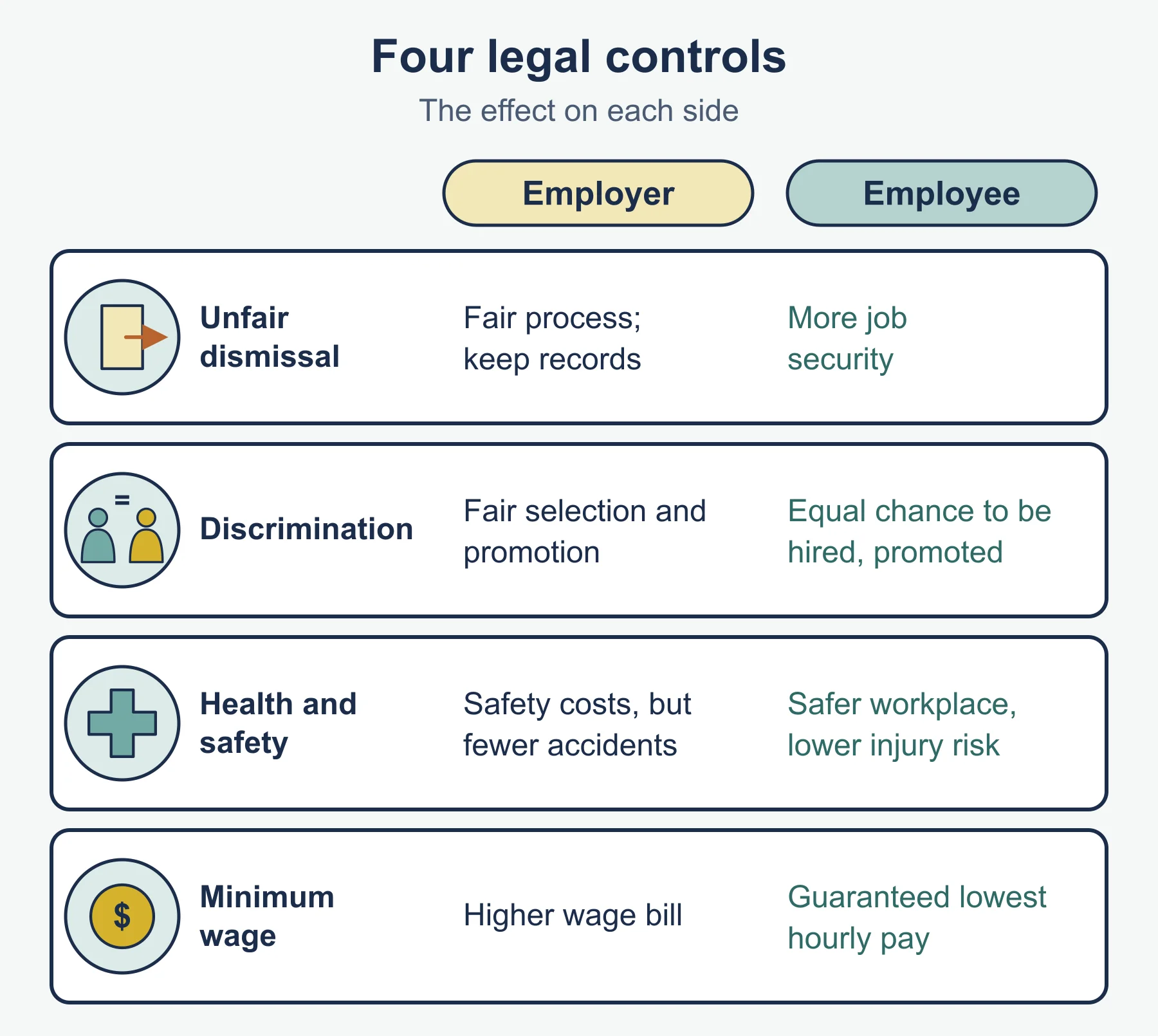
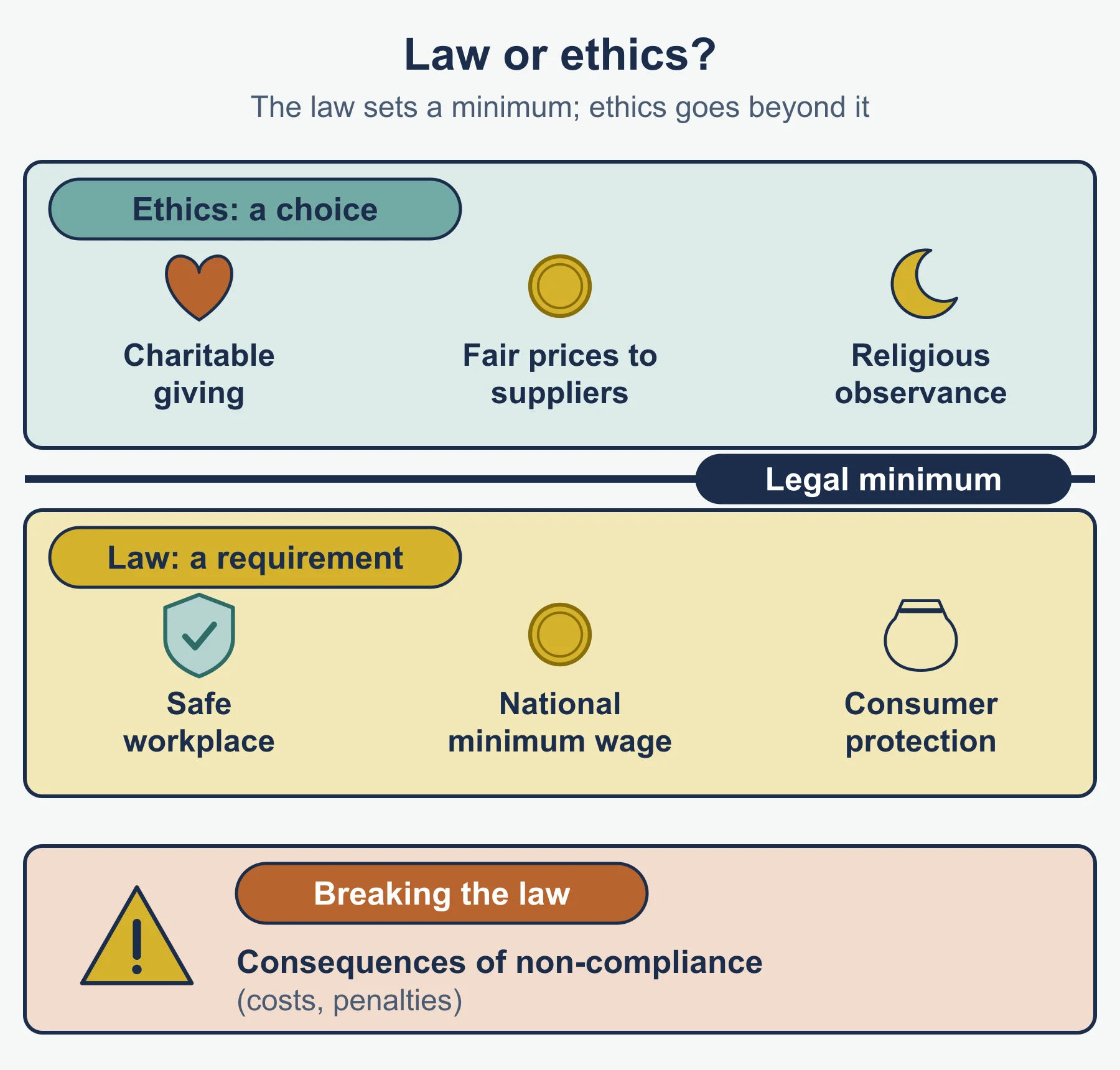
The syllabus lists four areas: unfair dismissal, discrimination, health and safety, and the legal minimum wage. Describe them in general terms. You do not need to quote named laws.
| Control | What it means | Effect on employers | Effect on employees |
|---|---|---|---|
| Unfair dismissal | An employer cannot sack someone without a fair reason | Must follow a proper process and keep records; may face compensation claims | Greater job security and confidence |
| Discrimination | Treating people differently because of, for example, their sex, race, age or religion is not allowed in hiring, pay or promotion | Must use fair selection and promotion; a wider pool of talent; legal and reputation risks if broken | Equal opportunities to be hired and promoted |
| Health and safety | The employer must provide a safe workplace | Costs of safety equipment, training and inspections; fewer accidents and less absence | Safer conditions and lower risk of injury |
| Legal minimum wage | A lowest hourly pay rate that must be paid | Higher wage costs, especially for labour-intensive firms; may raise prices or reduce hiring | Guaranteed minimum income; may increase motivation |
Worked example: checking the minimum wage
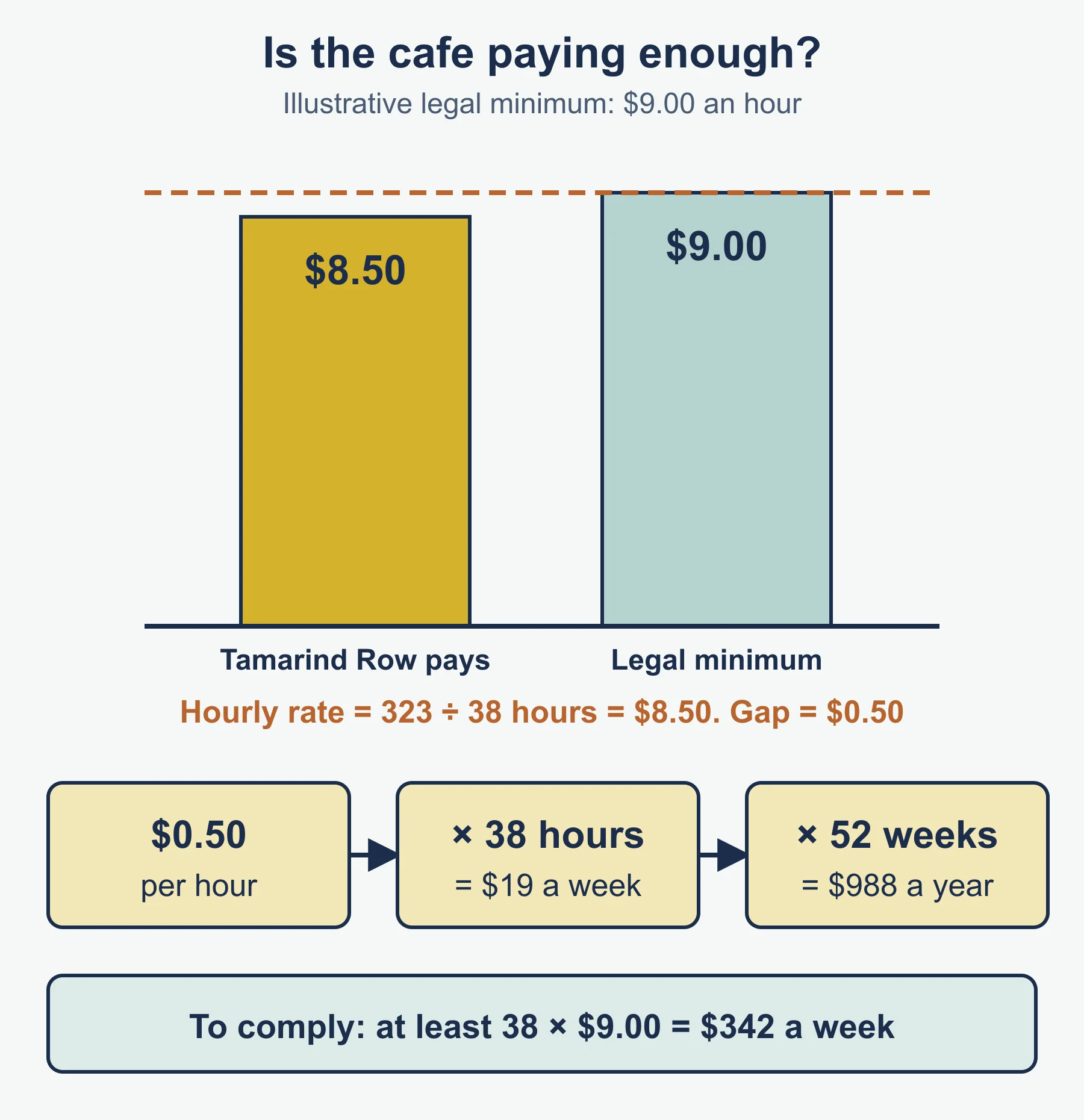
Assume the legal minimum wage in a country is 9.00 dollars an hour. Tamarind Row Cafe pays a waiter 323 dollars for a 38-hour week.
- Hourly rate = 323 ÷ 38 = 8.50 dollars an hour.
- This is below the legal minimum of 9.00 dollars an hour.
- Underpayment per hour = 0.50 dollars. Per week = 38 × 0.50 = 19 dollars. Over a year of 52 weeks = 19 × 52 = 988 dollars.
- To comply, the weekly pay must be at least 38 × 9.00 = 342 dollars.
The effect on the employer is a higher wage bill and possible penalties if it does not comply. The effect on the employee is higher pay.
2.1.3 Training
Training is teaching employees the skills and knowledge to do their jobs better.
Importance of training
| To the business | To employees |
|---|---|
| Higher productivity and quality | Better skills and more confidence |
| Fewer mistakes and accidents | Better chances of promotion and a higher wage |
| Flexible staff who can cover other jobs | Greater job satisfaction and security |
| Helps retain staff, so less recruitment | Meets their own wish to develop |
The business also faces costs, because training costs money, and trained staff may leave for a better paid job elsewhere.
Types of training
| Type | What it is | Advantages | Disadvantages |
|---|---|---|---|
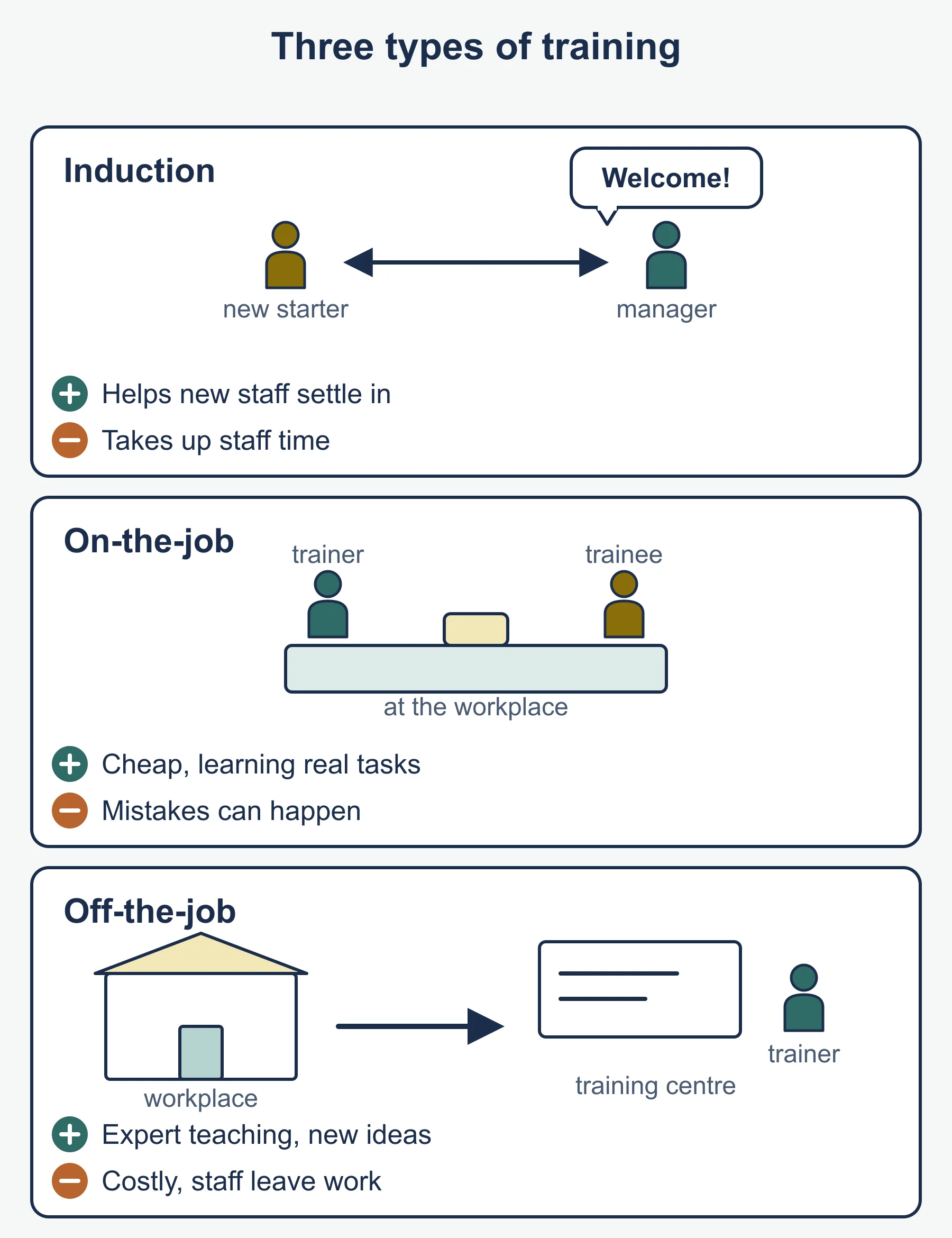
| Induction | Introduction for new employees to the business, its rules, safety and colleagues | Helps new staff settle fast; reduces early mistakes | Takes the time of existing staff; does not teach job skills in depth |
| On-the-job | Learning while doing the job, often next to an experienced worker | Cheap; no travel; training is directly relevant | The trainer is less productive; the trainee may make mistakes or pick up bad habits |
| Off-the-job | Training away from the workplace, at a college or training centre | Experts teach, giving wider skills and qualifications | More expensive; workers are away from their jobs; skills may not fit the business |
Worked example: choosing a type
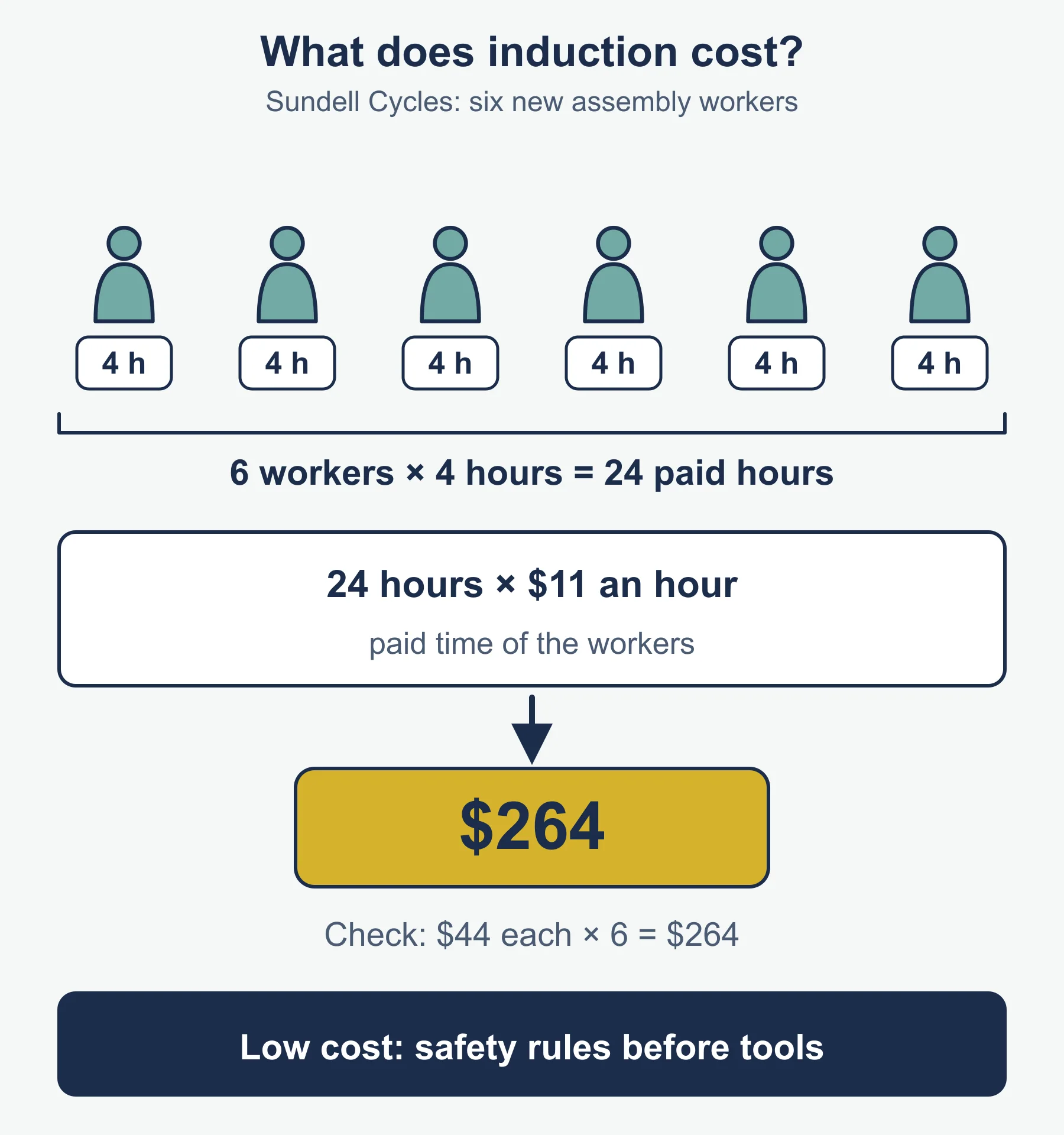
Sundell Cycles takes on six new assembly workers. Induction takes 4 hours each, at a cost of 11 dollars an hour of paid time: 6 × 4 × 11 = 264 dollars. This is low cost for a clear gain, because the workers learn safety rules before touching tools. Next, the firm uses on-the-job training for the assembly skills, since the bikes are built in a specific way that no outside course would teach. One worker also goes on an off-the-job course in wheel building, a skill the whole team can learn from later.
Common errors
- Mixing up the job description (the job) with the person specification (the person).
- Writing “interviews” as the only selection method. Name methods and give a reason for each choice.
- Treating internal recruitment as always better. It is cheaper, but a small pool and no fresh ideas are real drawbacks.
- Describing the effect of a legal control on only one side. The syllabus asks for effects on employers and on employees.
- Giving only a list in a recommend question, with no decision and no evidence from the case.
- Calling induction “training for the job itself”. It introduces the business.
Next steps
Work through the revision notes, then try the practice questions. Check your coverage on the printable checklist, and take a free 10-minute diagnostic.
Frequently asked questions
What is the difference between internal and external recruitment? Internal recruitment fills a post with someone already working for the business, which is cheaper and quicker but gives fewer applicants and leaves a gap. External recruitment fills it from outside, bringing a larger pool and new ideas but costing more and taking longer.
What selection methods can a business use? Methods include CVs or résumés, application forms, references, tests or assessment centres, and interviews. Businesses usually combine methods, as each has a limitation.
What is the difference between on-the-job and off-the-job training? On-the-job training is learning while doing the job, often next to an experienced worker, which is cheap and directly relevant. Off-the-job training happens away from the workplace, at a college or training centre, where experts give wider skills and qualifications.
Why is training important to a business? Training teaches employees the skills and knowledge to do their jobs better. It has costs, and trained staff may leave for other jobs, so a good answer weighs both sides.
Official syllabus
Cambridge IGCSE Business 0264 syllabus for examination in 2027, 2028 and 2029, published by Cambridge University Press & Assessment (Cambridge International Education), section 2.1.
Get free revision emails (optional)
Occasional emails with practice questions, worked explanations and links to free resources for the qualification and subjects you choose. No spam, and you can unsubscribe from any email. The free tools on this site never need an email.
Related resources
-
Practice questions
IGCSE Business: Human resource management (HRM) (Cambridge 0264) – Practice Questions
Original practice questions with worked answers on human resource management for Cambridge IGCSE Business 0264, with short and case items.
Business · Cambridge · IGCSE
Try questions -
Revision notes
IGCSE Business: Human resource management (HRM) (Cambridge 0264) – Revision Notes
Condensed revision notes on human resource management for Cambridge IGCSE Business 0264, with tables, a self-test and common mistakes.
Business · Cambridge · IGCSE
Revise topic -
Study guides
IGCSE Business: Methods of communication (Cambridge 0264)
A full study guide to methods of communication and communication barriers for Cambridge IGCSE Business 0264, with worked examples and common errors.
Business · Cambridge · IGCSE
Read guide
Related articles
-
teaching
A Level tuition in Dubai: Cambridge or Pearson Edexcel International A Level?
Schools in Dubai and Abu Dhabi teach either Cambridge International AS & A Level or Pearson Edexcel International A Level. How the two are structured, why it matters for tuition, and how online classes from Lahore work.
9 October 2026
-
curriculum guides
Choosing subjects at IGCSE and A Level
How subject choices at 14 and 16 affect university options later, and how to keep pathways open without overloading a timetable.
28 July 2026
Studying this with a teacher
Working through Business IGCSE?
This page is free and stays free. If you would rather be taught it, Marlbridge runs Business classes one-to-one and in small groups of up to 15, online in your own time zone. The first trial class is free. WhatsApp replies within an hour (8am–11pm Pakistan time, every day); email the same day.
Cambridge Business teachers at Marlbridge

