
Study Guides
IGCSE Business: Methods of communication (Cambridge 0264)
A full study guide to methods of communication and communication barriers for Cambridge IGCSE Business 0264, with worked examples and common errors.
- Subject
- Business
- Level
- IGCSE
- Topic
- People in business
- Author
- Marlbridge Academic Team
- Updated
- Reviewed by
- Salman Ahmad (what this means)
Aligned to Cambridge IGCSE Business (0264), For examination in 2027, 2028 and 2029. Official specification .
Syllabus page (what it covers and how it is assessed): Cambridge IGCSE Business.
Syllabus points this page covers
0264
- 2.3 Methods of communication
Found an error? Report a correction.
Need help with this topic? Request a free trial class for IGCSE Business (0450 / 0264).
This guide covers section 2.3 (Methods of communication, 2.3.1 and 2.3.2) of the Cambridge IGCSE Business 0264 syllabus for examination in 2027, 2028 and 2029. Every candidate sits Paper 1 (Short Answer and Data Response) and Paper 2 (Case Study). Both papers are based on all the subject content, so this topic can turn up as a short question, in data, or inside a case study. Track your progress on the printable checklist and see the course hub for the rest of the syllabus. Then use the revision notes and the practice questions. If you are not sure where you stand, take a free diagnostic first.
Money figures are in dollars ($). All businesses and people in this guide are invented.
What you must be able to do
| Syllabus point | What it means for you |
|---|---|
| 2.3.1 Why communication is important | Explain what communication does for a business and what goes wrong without it |
| 2.3.1 Methods of communication | Describe meetings (face-to-face or virtual), email, text messages, social media, phone calls (including mobile calls), letters, posters and noticeboards |
| 2.3.1 Advantages and disadvantages | Weigh up each method, using the situation given |
| 2.3.1 Internal and external communication | Tell them apart and sort examples correctly |
| 2.3.1 Recommend and justify | Choose a method for a stated situation and give reasons, including why you rejected others |
| 2.3.2 Examples of barriers | Name and describe barriers |
| 2.3.2 Reasons for barriers | Explain why each barrier arises |
| 2.3.2 Problems caused | Explain what each barrier does to the business |
| 2.3.2 Reducing or removing barriers | Suggest and justify practical fixes |
Why communication is important
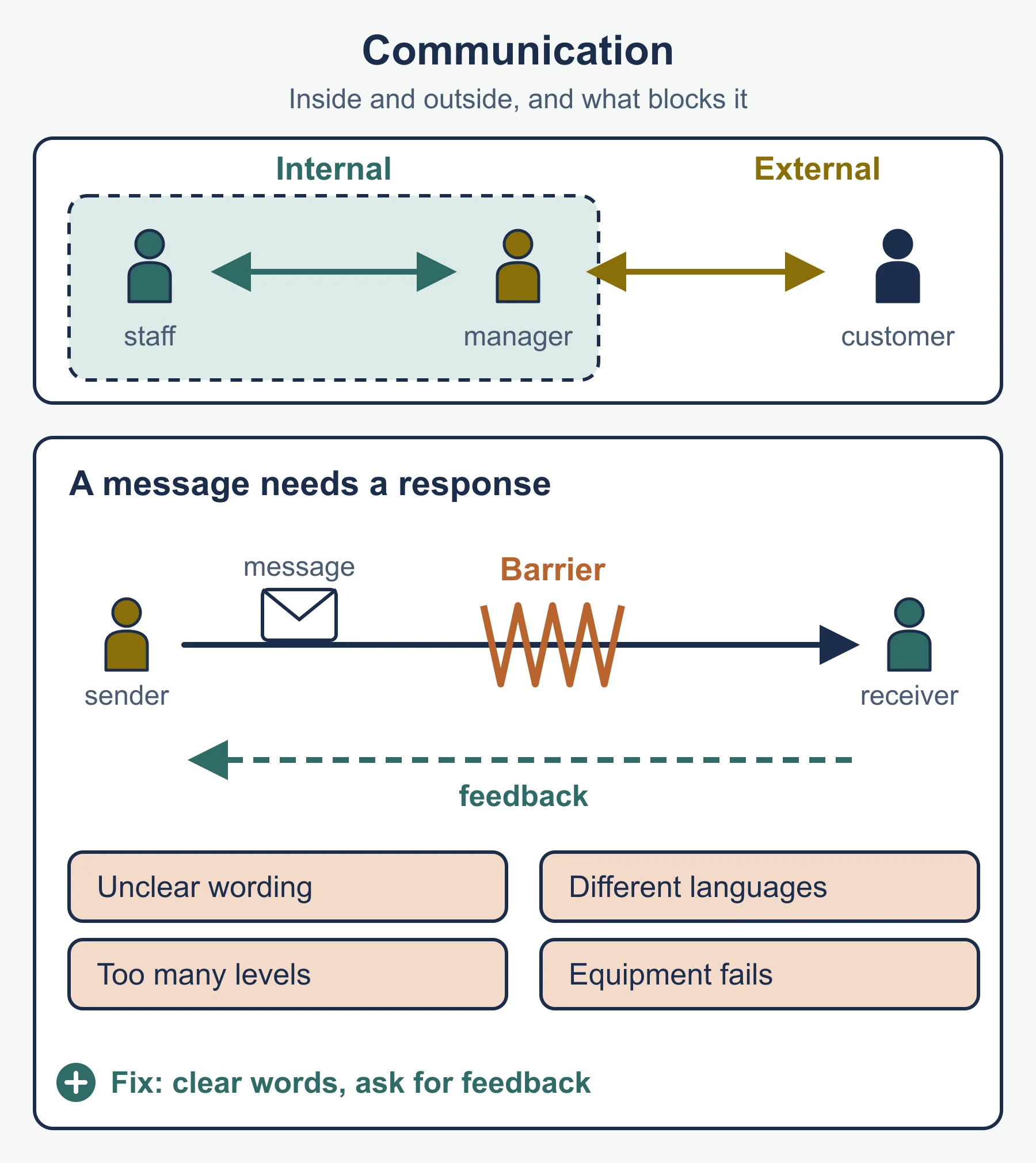
Communication is the passing of a message from a sender to a receiver, so that the receiver understands it and, where needed, replies. A business is a group of people working towards shared aims. They can only do that if they know what to do, when, how and why.
Good communication helps a business in several ways.
- Instructions are clear. Staff know the task, the standard and the deadline, so there are fewer mistakes and less wasted time.
- Decisions are better. Managers who receive accurate information from staff and customers decide on firmer evidence.
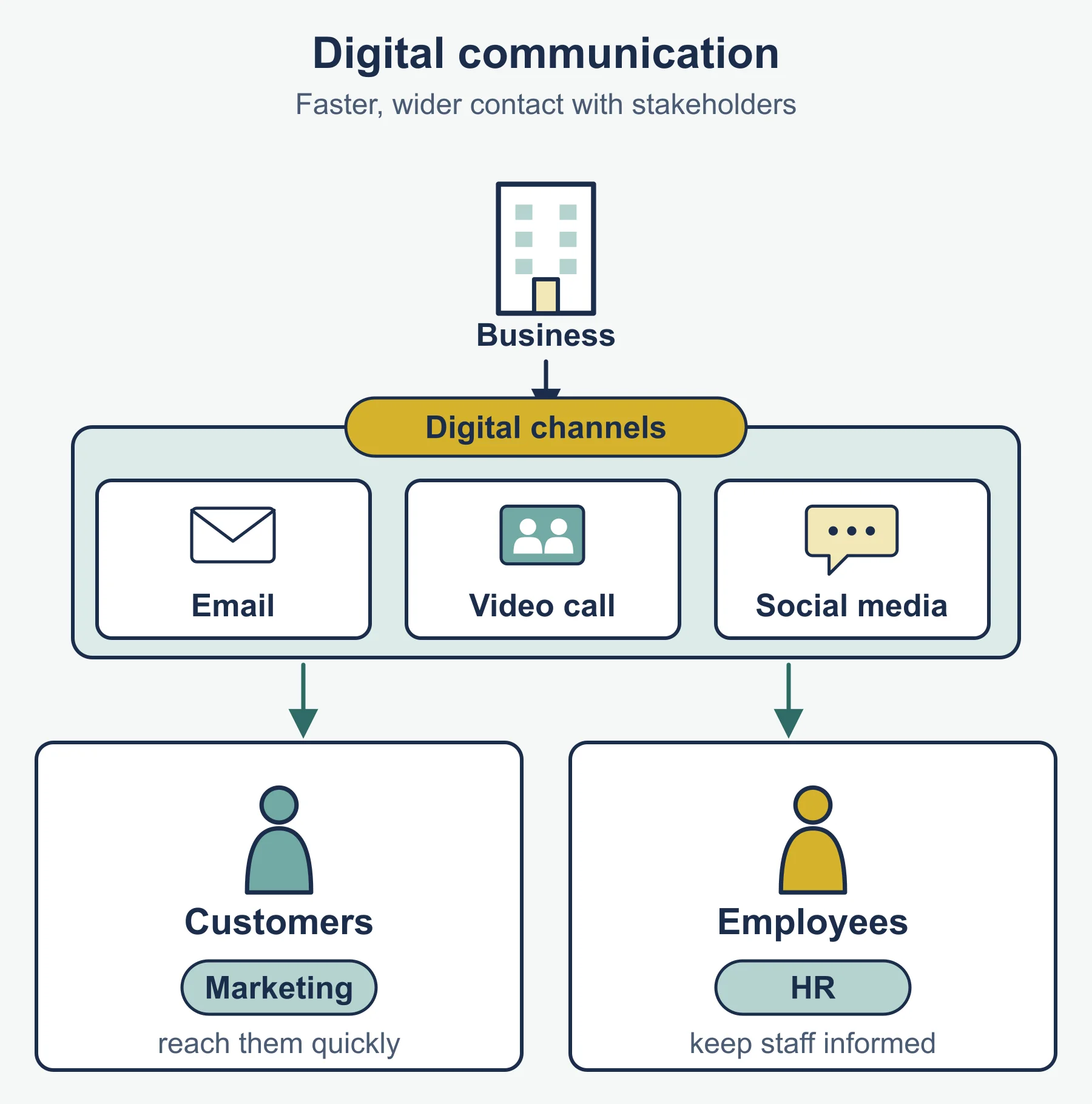
- Customers are kept happy. Quick, clear replies about prices, deliveries and complaints help a business keep its customers.
- Employees feel involved. People who are told about plans are more likely to feel part of the team, which supports motivation (section 2.4).
Feedback completes the process: the sender checks that the message was understood.
Internal and external communication
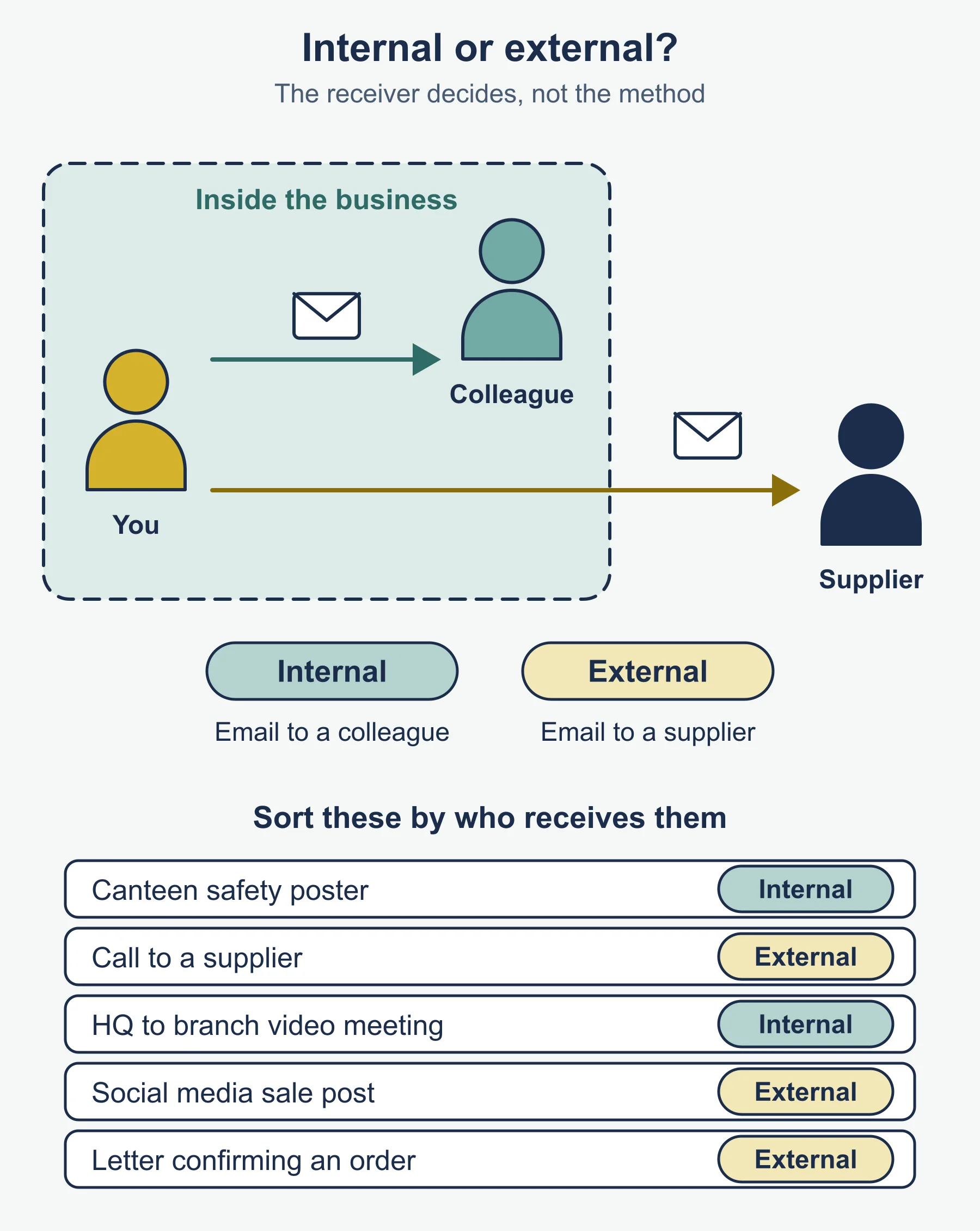
Internal communication takes place between people inside the business, such as a manager telling a team about a new rota, or one department sending figures to another.
External communication takes place between the business and people outside it, such as customers, suppliers, lenders, the local community or the government.
The same method can be used for either. An email to a colleague is internal. An email to a supplier is external. So sort by who the receiver is, not by the method.
| Example | Internal or external? |
|---|---|
| A poster in the staff canteen about a safety rule | Internal |
| A phone call to a supplier to change an order | External |
| A virtual meeting between the head office and a branch | Internal |
| A social media post advertising a sale | External |
| A letter to a customer confirming an order | External |
Methods of communication
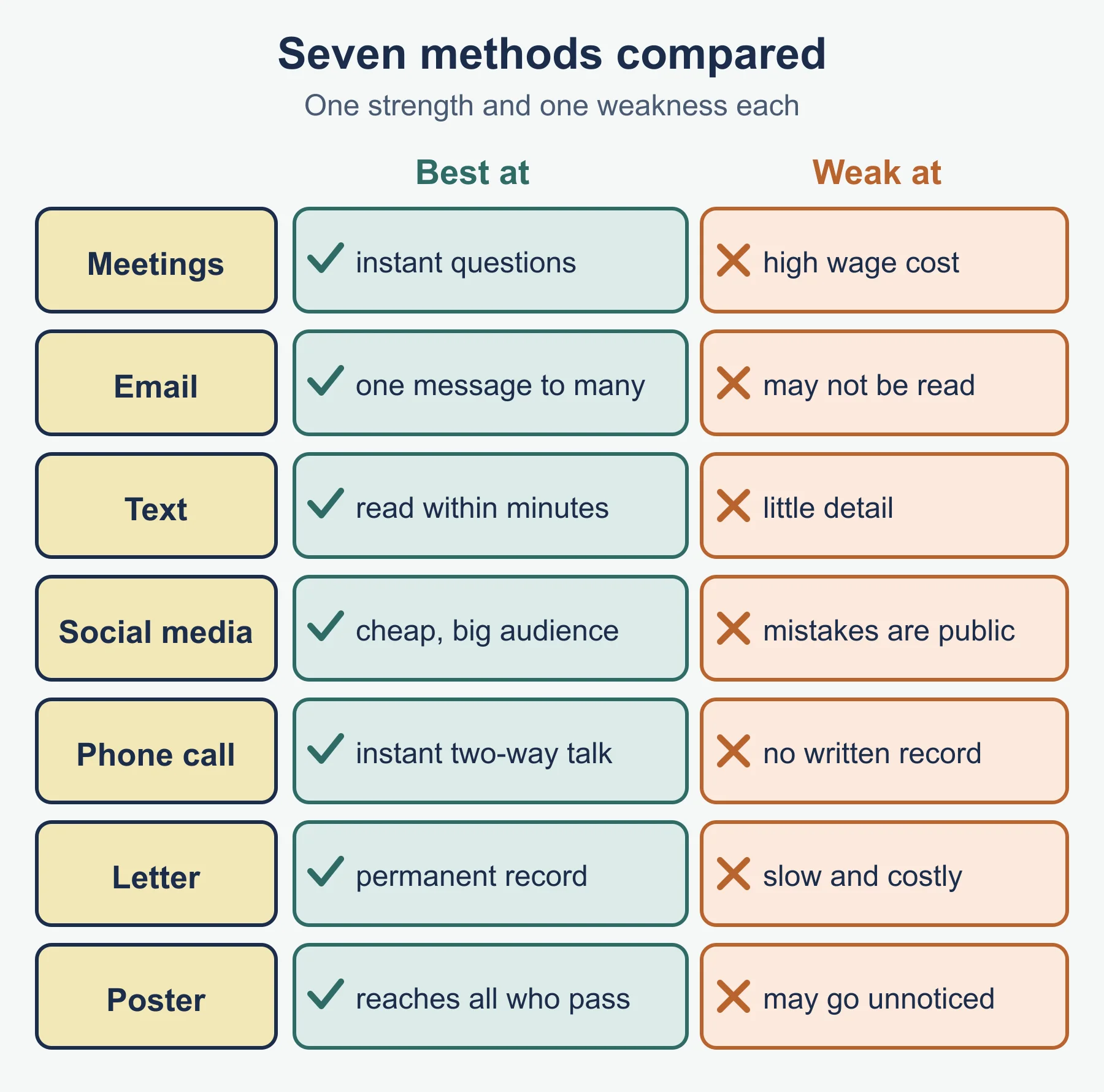
The syllabus names seven groups of method. Learn what each is, then learn one strength and one weakness that depend on the situation.
Meetings (face-to-face or virtual)
People discuss matters together in the same room (face-to-face) or through a video or audio link (virtual).
- Advantages: immediate feedback and questions; tone of voice and body language help understanding; ideas can be shared and decisions made quickly. Virtual meetings also save travel time and cost and let people in different places join.
- Disadvantages: it takes people away from their work, so wage costs are high; it is hard to gather everyone at one time; face-to-face meetings may involve travel; virtual meetings depend on a working connection and can feel less personal; a record has to be made separately.
A written message sent electronically.
- Advantages: fast; low cost per message; one message can reach many people; attachments such as reports can be included; there is a written record.
- Disadvantages: the receiver may not read it quickly, or at all; tone can be misread; it cannot be used by people without a connection; staff may receive too many messages; sensitive matters may feel cold in writing.
Text messages
Short written messages sent to a mobile phone.
- Advantages: very quick; usually read within minutes; cheap; suitable for short alerts such as a delivery time.
- Disadvantages: limited space for detail; informal; the receiver needs a mobile phone with a signal; a business may only hold the number if the customer gave it.
Social media
Posts, comments and messages on social media platforms.
- Advantages: can reach a large audience cheaply; allows two-way contact with customers.
- Disadvantages: messages are public, so mistakes and complaints spread fast; it needs monitoring; the business cannot be sure the right people will see a post; it is not suitable for private or detailed information.
Phone calls (including mobile calls)
Spoken communication by telephone.
- Advantages: immediate two-way contact; tone of voice helps; mobile calls reach staff away from a desk.
- Disadvantages: the receiver may not answer; there is no automatic written record; it is poor for long numbers or detailed data; calls can be costly over long distances.
Letters
Printed messages delivered by post or by hand.
- Advantages: formal; a permanent record; suitable for legal or official matters; can include documents.
- Disadvantages: slow; postage and printing add cost; no immediate feedback; may be lost or ignored.
Posters and noticeboards
Printed information displayed where people will see it, such as a staff room.
- Advantages: reaches everyone who passes; low cost; stays on show; useful for reminders and general rules.
- Disadvantages: the message may not be noticed or read; it cannot be changed quickly for each person; there is no feedback; it is only suitable for non-confidential information; it will not reach staff who are absent or work elsewhere.
Choosing a method: recommend and justify
Recommend and justify ask for a decision and reasons. Look at the features of the situation, then match them to a method. Ask:
- Who is the receiver? One person, a group, or the public? Inside or outside the business?
- How urgent is the message?
- How much detail does it contain?
- Is it confidential or sensitive?
- Is a written record needed?
- Is feedback needed straight away?
- What does it cost in money and time?
- Can the receiver access the method?
Worked example
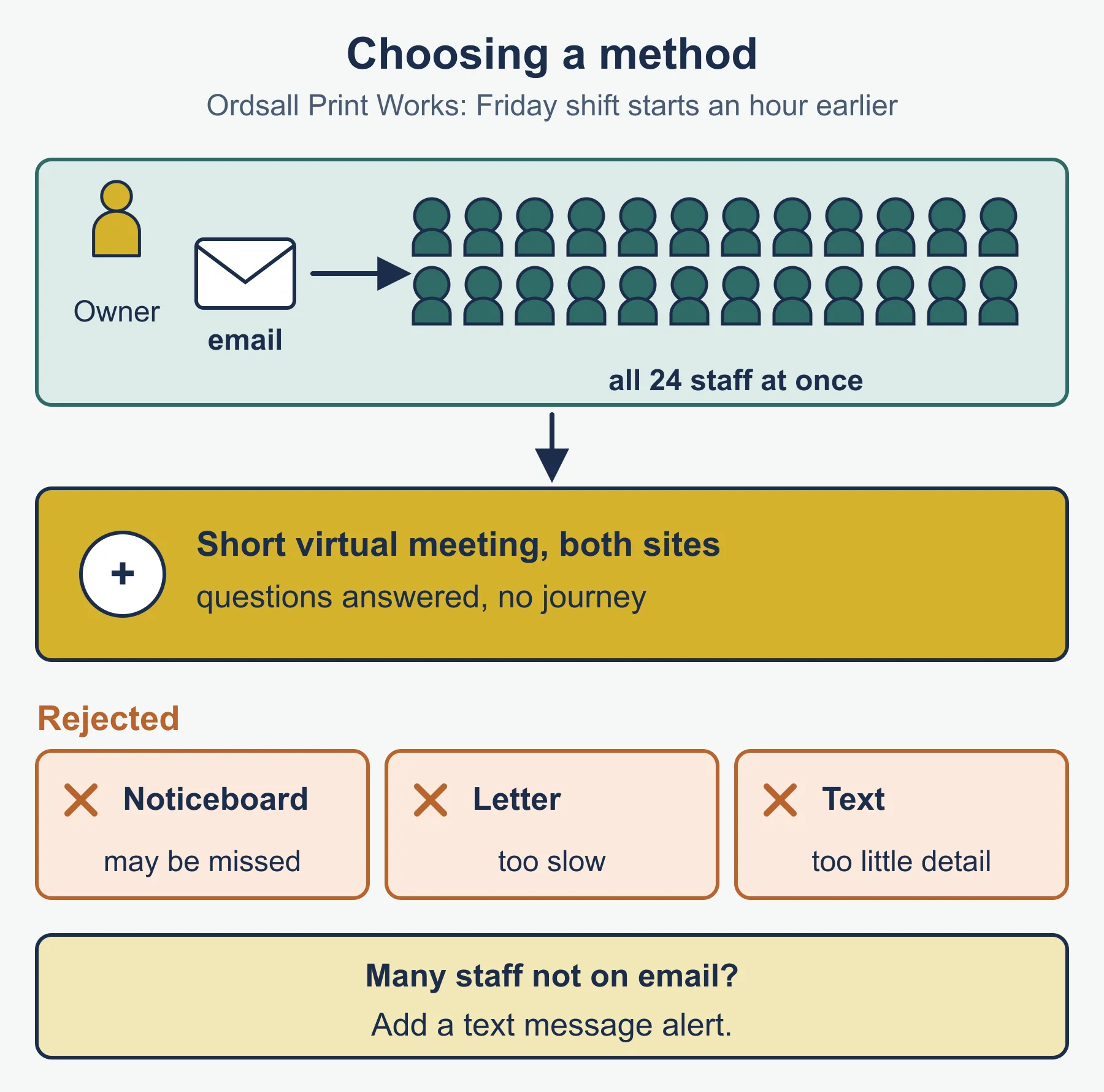
Ordsall Print Works has 24 employees on two sites. The owner, Wanjiru Calder, must tell all staff that the Friday shift will start one hour earlier from next month. He wants everyone to know within two days, and he wants to be sure nobody has misunderstood.
Recommendation: send an email to all staff and follow it with a short virtual meeting for both sites.
Justification:
- The message is short and applies to everyone, so an email reaches all 24 people at once at almost no cost.
- It gives a written record of the exact start time, which avoids later disagreement.
- Wanjiru wants to know staff understand. A short virtual meeting allows questions and feedback, and avoids a journey between sites.
Why not the alternatives? A noticeboard might be missed by staff off on the day it is posted. Letters are too slow for a two-day deadline. Text messages are quick but cannot hold the detail staff may ask about.
Judgement: the combined approach is best because the situation needs both speed and confirmation of understanding. If many staff did not use email, a text message alert could be added.
The pattern: choose, give reasons tied to the facts, reject alternatives, and say what could change the answer.
Communication barriers
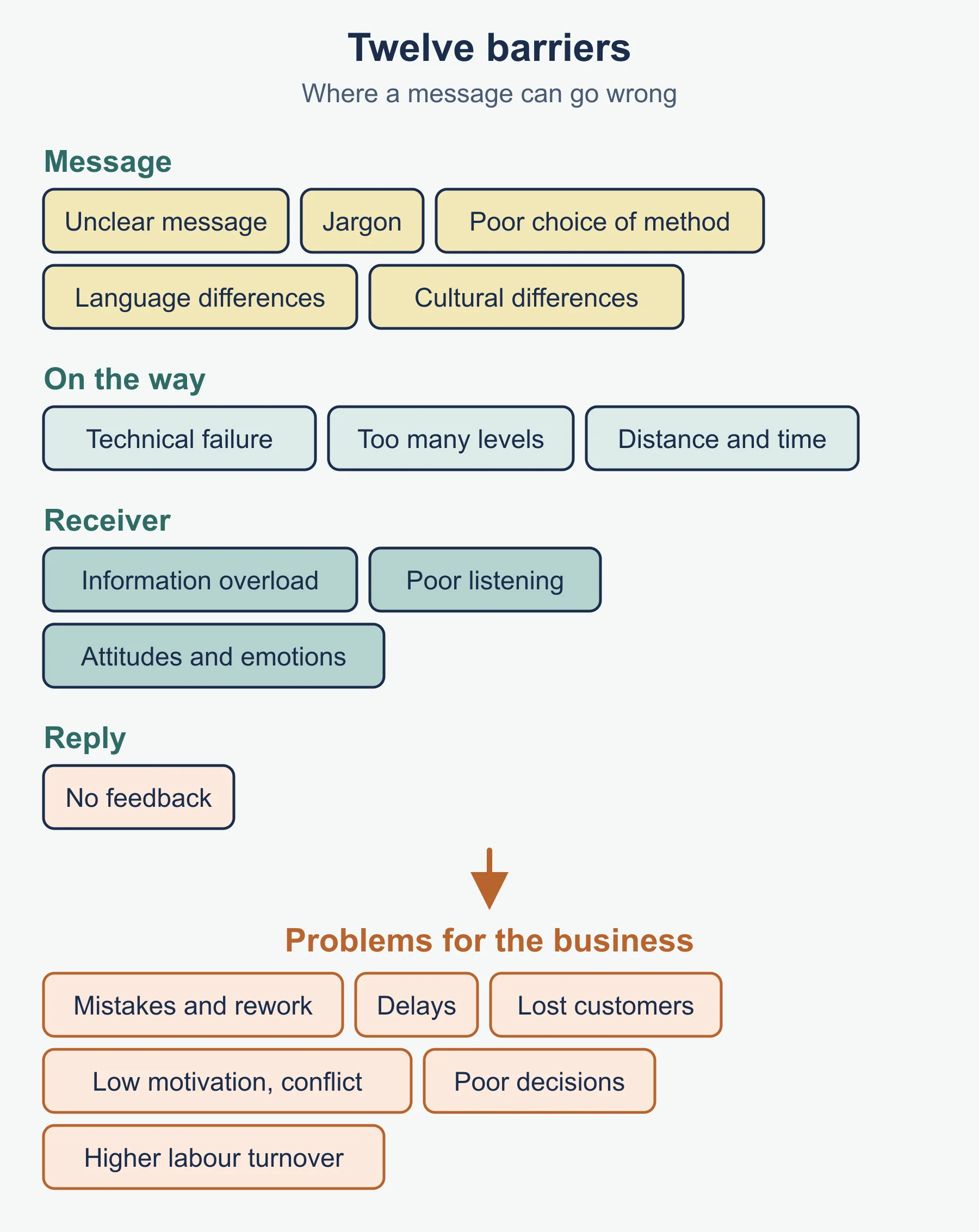
A communication barrier is anything that stops a message being sent, received or understood as the sender intended. The three parts of 2.3.2 are linked: a barrier has a reason, and the reason leads to a problem, which may have a solution.
Examples and reasons
| Barrier | Why it happens |
|---|---|
| Language differences | Staff, customers or suppliers speak different first languages, or a message is translated badly |
| Jargon | Specialist words are used with people who do not know them |
| Poor choice of method | A long, complex message is sent by text, or an urgent one by letter |
| Technical failure | Broken equipment, poor signal or an email that is not delivered |
| Too many levels in the chain of communication | A message passes through many managers and is changed or delayed on the way |
| Information overload | Too many messages, so important ones are missed |
| Poor listening or distraction | The receiver is busy, noisy surroundings, or no attention is paid |
| Unclear message | The sender is vague, writes badly or leaves out key facts |
| Distance and time differences | Sites in different countries cannot talk during the same working hours |
| Attitudes and emotions | A receiver who is angry, worried or does not trust the sender may reject or misread the message |
| No feedback | The sender never learns that the message was misunderstood |
| Cultural differences | Different customs affect how a message is meant and understood |
Use the barrier that fits the facts you are given.
Problems caused by barriers
- Mistakes and rework. Wrong goods are made or sent, which raises costs.
- Delays. A late message means a late decision or delivery.
- Lost customers. Unanswered or misunderstood queries push customers to rivals.
- Low motivation and conflict. Staff who feel uninformed lose commitment, and arguments may follow.
- Poor decisions. Managers acting on incomplete information may choose badly.
- Higher labour turnover. Staff who feel ignored may leave.
Reducing or removing barriers
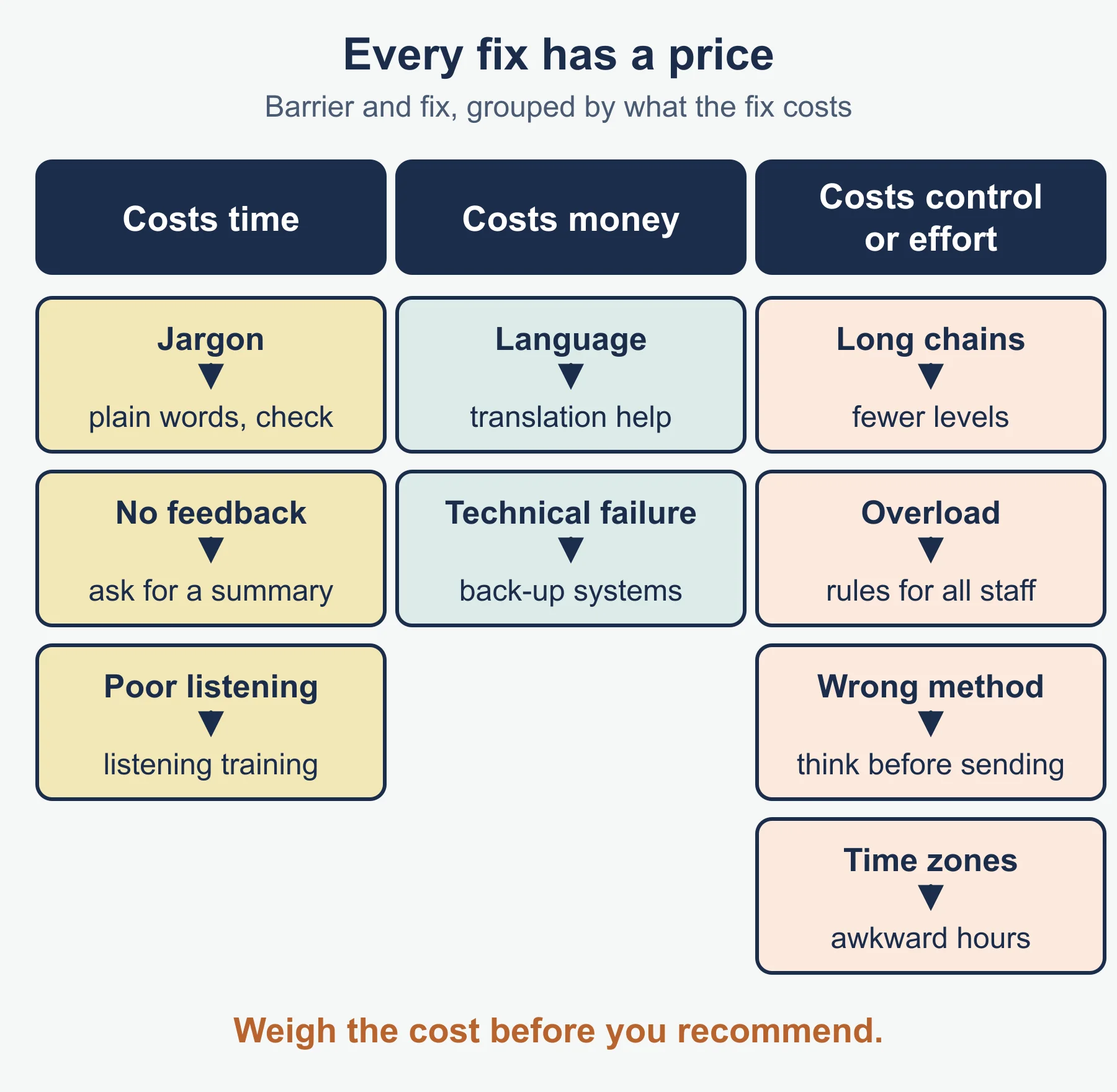
| Barrier | Possible solution | Limit of the solution |
|---|---|---|
| Jargon or unclear wording | Use plain language and check messages before sending | Takes some time |
| Language differences | Use simple language, translation help or training | Translation costs money |
| Wrong method | Match method to purpose, as in the checklist above | Needs managers to think before sending |
| Technical failure | Maintain equipment and have a back-up method | Back-up systems cost money |
| Long chains of communication | Reduce the number of levels or allow direct contact | Managers may lose some control |
| Information overload | Send fewer messages and mark urgent ones clearly | Needs rules that all staff follow |
| No feedback | Ask the receiver to confirm or summarise | Slower to complete |
| Time and distance | Agree overlapping hours for virtual meetings | Some staff work awkward hours |
| Poor listening | Quiet meeting places; training in listening | Training takes time |
Worked example: barriers
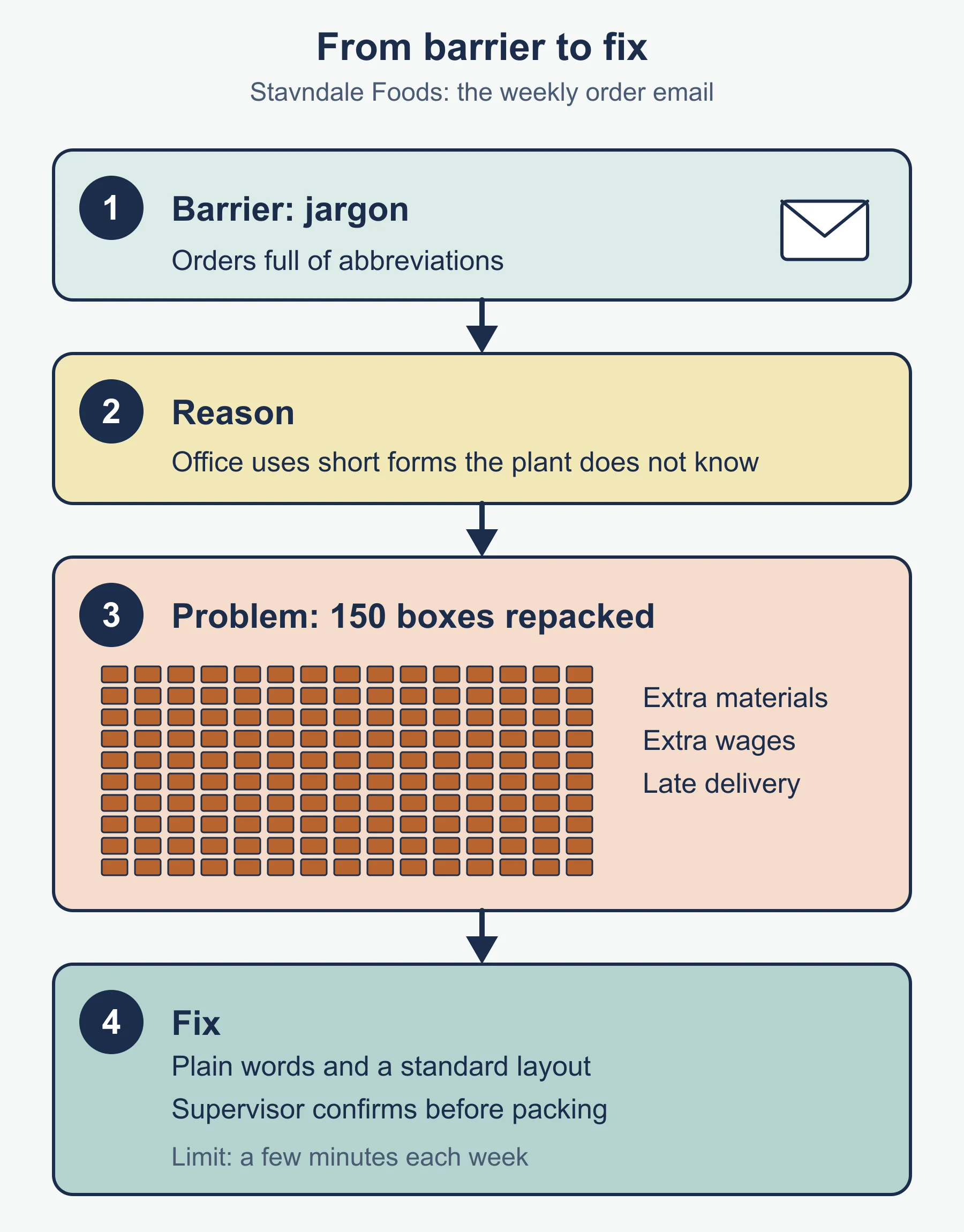
Stavndale Foods has a head office and a packing plant. Oksana Beck, an office manager, emails the plant each week with orders. The plant supervisor, Ruaridh Vance, sometimes finds the orders full of abbreviations, and last week 150 boxes were packed with the wrong label.
- Barrier: jargon and unclear wording in the email.
- Reason: the office staff use short forms that the plant does not know.
- Problem: wrong labels led to 150 boxes being packed again. That costs materials, wages and delivery time, and a late delivery may upset customers.
- Solution: write orders in plain words, with a standard layout, and ask the supervisor to confirm by reply or phone call before packing starts.
- Limit: a confirmation step takes a few minutes each week, but that is small compared with the cost of repacking.
Common errors
- Describing a method without any link to the situation, such as “email is fast” in an answer about an angry customer better reached by phone.
- Listing barriers with no reason or problem, when the question asks for explanation.
- Treating “bad communication” as an example of a barrier. Name the actual barrier.
- Giving the same disadvantage twice in different words.
- Recommending a method with no reason for rejecting the others.
- Giving a solution that does not match the barrier named.
Frequently asked questions
What methods of communication does the IGCSE Business syllabus name? The syllabus names seven groups: meetings (face-to-face or virtual), email, text messages, social media, phone calls, letters, and posters and noticeboards.
What are the advantages and disadvantages of email? Email is fast, cheap per message, can reach many people at once and can carry attachments. However, the receiver may not read it quickly, or at all, and tone can be misread.
What is a communication barrier? A communication barrier is anything that stops a message being sent, received or understood as intended. Examples include language differences, jargon, poor choice of method, technical failure, too many levels in the chain of communication, information overload and no feedback.
How do you recommend a method of communication? Choose a method, give reasons tied to the facts of the situation, explain why the alternatives were rejected, and say what could change your decision.
Official syllabus
Aligned to section 2.3 of the Cambridge IGCSE Business 0264 syllabus for examination in 2027, 2028 and 2029, published by Cambridge University Press & Assessment (Cambridge International Education).
Get free revision emails (optional)
Occasional emails with practice questions, worked explanations and links to free resources for the qualification and subjects you choose. No spam, and you can unsubscribe from any email. The free tools on this site never need an email.
Related resources
-
Practice questions
IGCSE Business: Methods of communication (Cambridge 0264) – Practice Questions
Original practice questions with worked answers on communication methods and barriers for Cambridge IGCSE Business 0264, with calculation and case items.
Business · Cambridge · IGCSE
Try questions -
Revision notes
IGCSE Business: Methods of communication (Cambridge 0264) – Revision Notes
Condensed revision notes on communication methods and barriers for Cambridge IGCSE Business 0264, with tables, a self-test and common mistakes.
Business · Cambridge · IGCSE
Revise topic -
Study guides
IGCSE Business: Motivating employees (Cambridge 0264)
Study guide to motivating employees for Cambridge IGCSE Business 0264: why people work, Maslow, Taylor, Herzberg, and financial and non-financial methods.
Business · Cambridge · IGCSE
Read guide
Related articles
-
teaching
A Level tuition in Dubai: Cambridge or Pearson Edexcel International A Level?
Schools in Dubai and Abu Dhabi teach either Cambridge International AS & A Level or Pearson Edexcel International A Level. How the two are structured, why it matters for tuition, and how online classes from Lahore work.
9 October 2026
-
curriculum guides
Choosing subjects at IGCSE and A Level
How subject choices at 14 and 16 affect university options later, and how to keep pathways open without overloading a timetable.
28 July 2026
Studying this with a teacher
Working through Business IGCSE?
This page is free and stays free. If you would rather be taught it, Marlbridge runs Business classes one-to-one and in small groups of up to 15, online in your own time zone. The first trial class is free. WhatsApp replies within an hour (8am–11pm Pakistan time, every day); email the same day.
Cambridge Business teachers at Marlbridge

