
Study Guides
IGCSE Business: Motivating employees (Cambridge 0264)
Study guide to motivating employees for Cambridge IGCSE Business 0264: why people work, Maslow, Taylor, Herzberg, and financial and non-financial methods.
- Subject
- Business
- Level
- IGCSE
- Topic
- People in business
- Author
- Marlbridge Academic Team
- Updated
- Reviewed by
- Salman Ahmad (what this means)
Aligned to Cambridge IGCSE Business (0264), For examination in 2027, 2028 and 2029. Official specification .
Syllabus page (what it covers and how it is assessed): Cambridge IGCSE Business.
Syllabus points this page covers
0264
- 2.4 Motivating employees
Found an error? Report a correction.
Need help with this topic? Request a free trial class for IGCSE Business (0450 / 0264).
This guide covers section 2.4 (Motivating employees) of the Cambridge IGCSE Business 0264 syllabus for examination in 2027, 2028 and 2029. It teaches both parts of the section: 2.4.1 The importance of a well-motivated workforce and 2.4.2 Methods of motivation. Both papers are based on all the subject content, so this topic can appear in short-answer and data-response questions and in a case study. When you finish, test yourself with the revision notes and the practice questions. Also see the course hub, the printable checklist and the free diagnostics.
What this topic covers
| Syllabus point | What you must be able to do |
|---|---|
| 2.4.1 Why people work | Give reasons people take a job, beyond pay alone |
| 2.4.1 Benefits of a well-motivated workforce | Explain improved labour productivity, reduced absenteeism, lower labour turnover and greater willingness to accept change or new methods of working |
| 2.4.1 Main motivational theories | Explain the ideas of Maslow, Taylor and Herzberg and apply them |
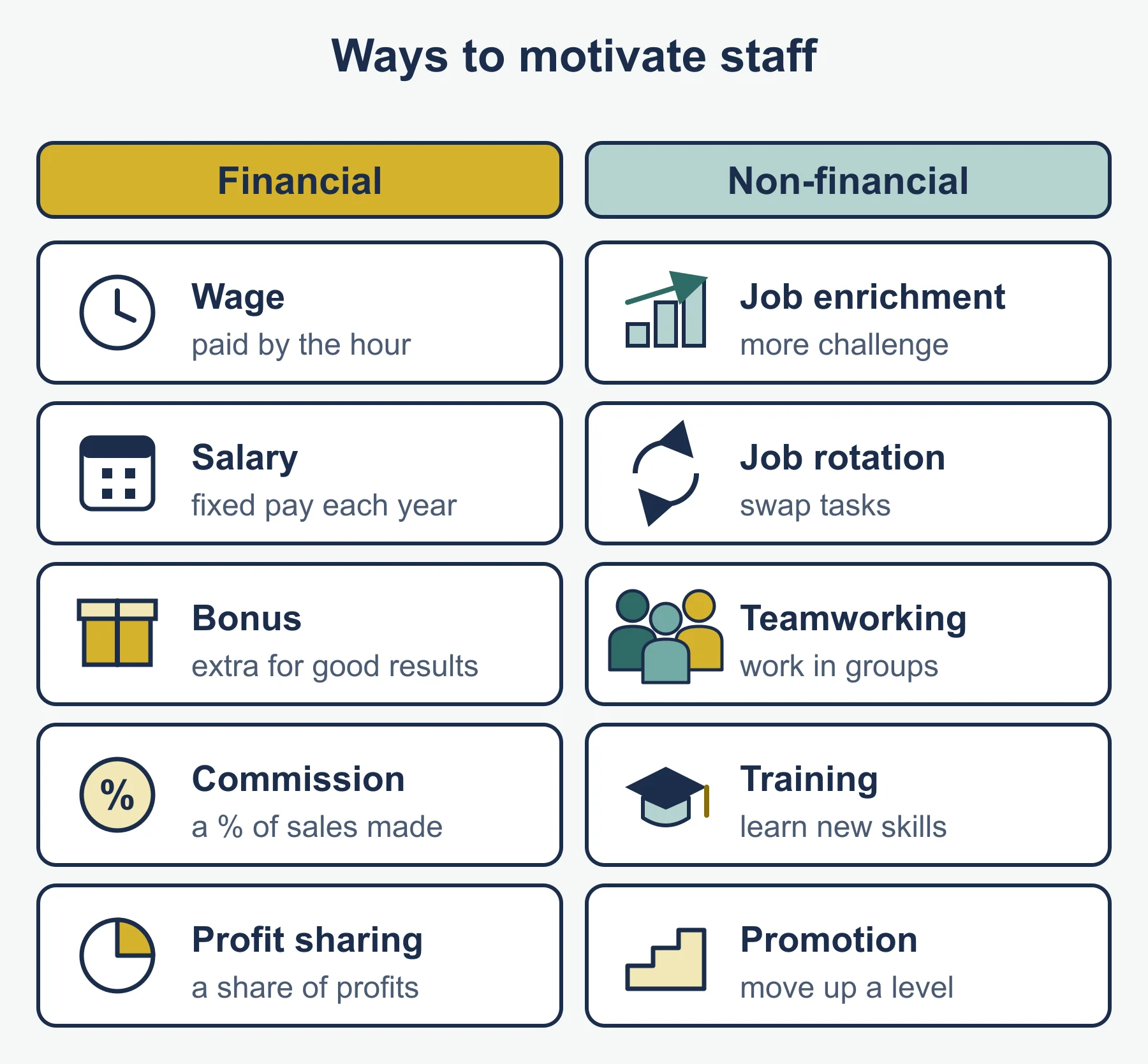
| 2.4.2 Financial methods | Time-based pay, piece-rate, salary, bonus, commission, profit sharing, fringe benefits |
| 2.4.2 Non-financial methods | Job enrichment, job rotation, training, opportunities for promotion, praise, employee of the month |
| 2.4.2 Recommend and justify | Choose the most suitable method for a given situation and defend the choice |
The syllabus names the theorists but does not set out their models line by line. The descriptions of the three theories below give the standard form of each one.
Why people work
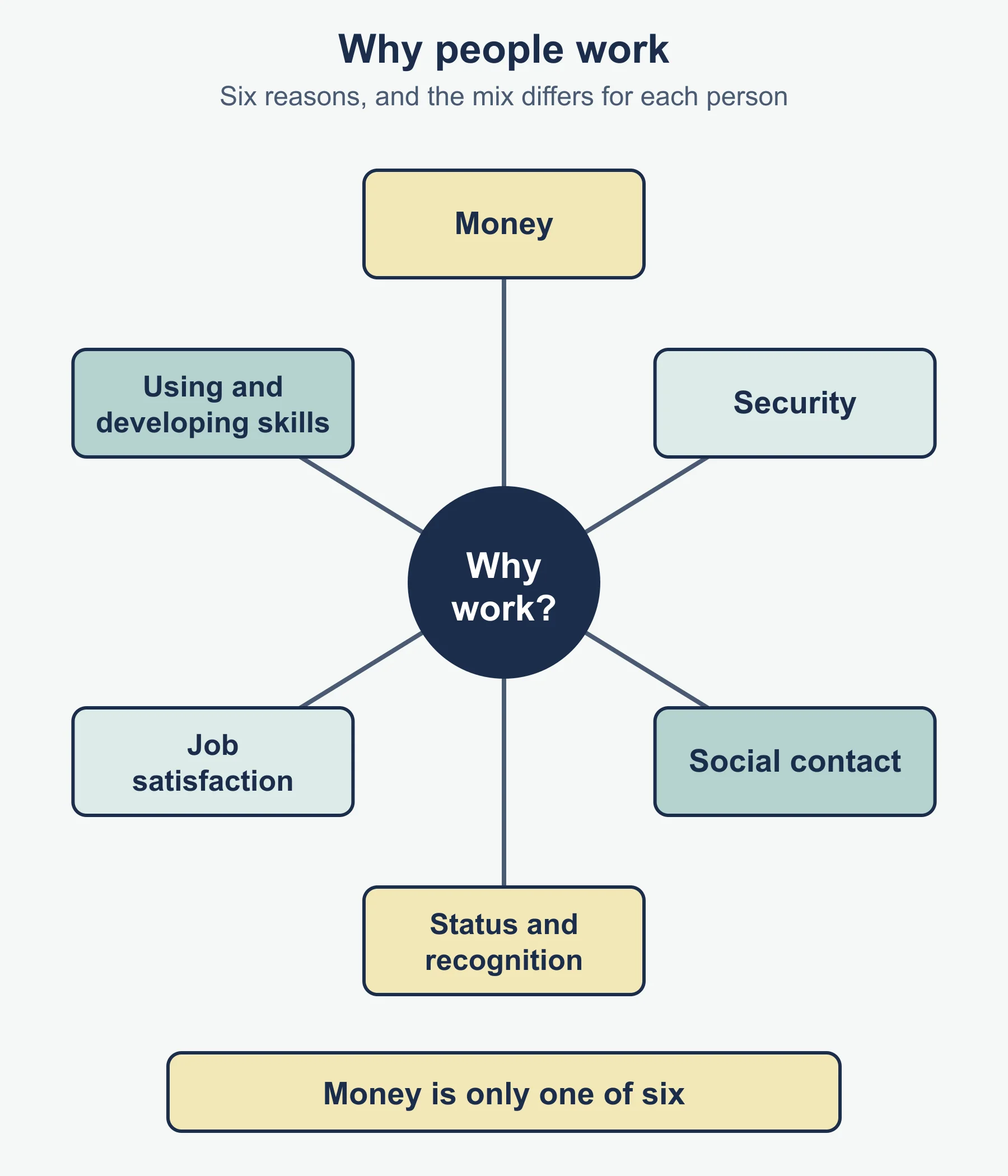
Motivation is the desire to put effort into a job. People work for several reasons, and the mix differs from person to person.
- Money. Pay buys food, housing and other needs and wants. For many people this is the main reason.
- Security. A steady job gives a regular income and some protection against hardship.
- Social contact. Work provides friendships and a sense of belonging to a team.
- Status and recognition. A job title, respect from colleagues and praise give a feeling of worth.
- Job satisfaction. Some people enjoy the work itself, or the sense of achievement from doing it well.
- Using and developing skills. Work can give a chance to learn, to progress and to reach personal goals.
A business that understands the reasons behind its own workers’ choices can pick better ways to motivate them. A part-time student at a cafe may want flexible hours and cash. A senior engineer may want responsibility and a route to promotion.
Benefits of a well-motivated workforce
A motivated worker is more willing to work hard and to stay. The syllabus lists four benefits.
| Benefit | What happens | Effect on the business |
|---|---|---|
| Improved labour productivity | Each worker produces more in the same time | Lower cost per unit, so higher profit or lower prices |
| Reduced absenteeism | Fewer days missed without good reason | Less disruption, fewer temporary replacements |
| Lower labour turnover | Fewer employees leave | Lower recruitment and training costs, and skills stay in the business |
| Greater willingness to accept change | Workers accept new machines, methods or roles | The business adapts faster and with less conflict |
The syllabus formulas list gives labour productivity as output per period divided by number of employees (units per employee). Section 2.4 does not give labour turnover or absenteeism formulas, so treat those two as standard forms.
- Labour productivity = output ÷ number of workers (or hours worked).
- Labour turnover (%) = number of employees who left in the period ÷ average number employed × 100.
- Absenteeism rate (%) = days lost to absence ÷ total days that could have been worked × 100.
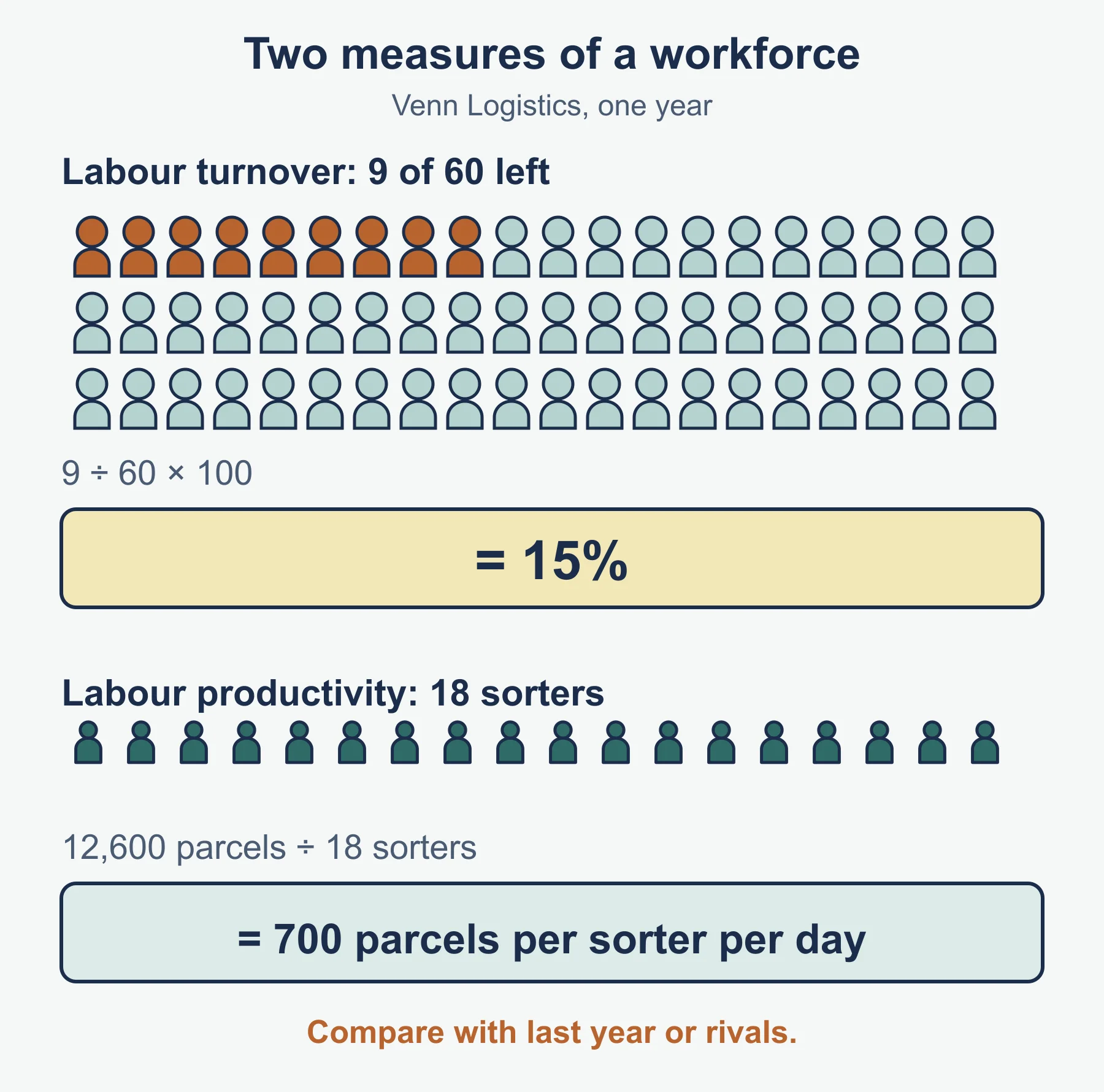
Worked example. Venn Logistics employed an average of 60 people last year and 9 of them left. Its parcel sorters handled 12,600 parcels a day in total, using 18 sorters.
Labour turnover = 9 ÷ 60 × 100 = 15%. Labour productivity = 12,600 ÷ 18 = 700 parcels per sorter per day.
On its own, 15% says little. Compare it with last year’s figure or with similar businesses before you call it high or low.
Motivational theories
Maslow: the hierarchy of needs
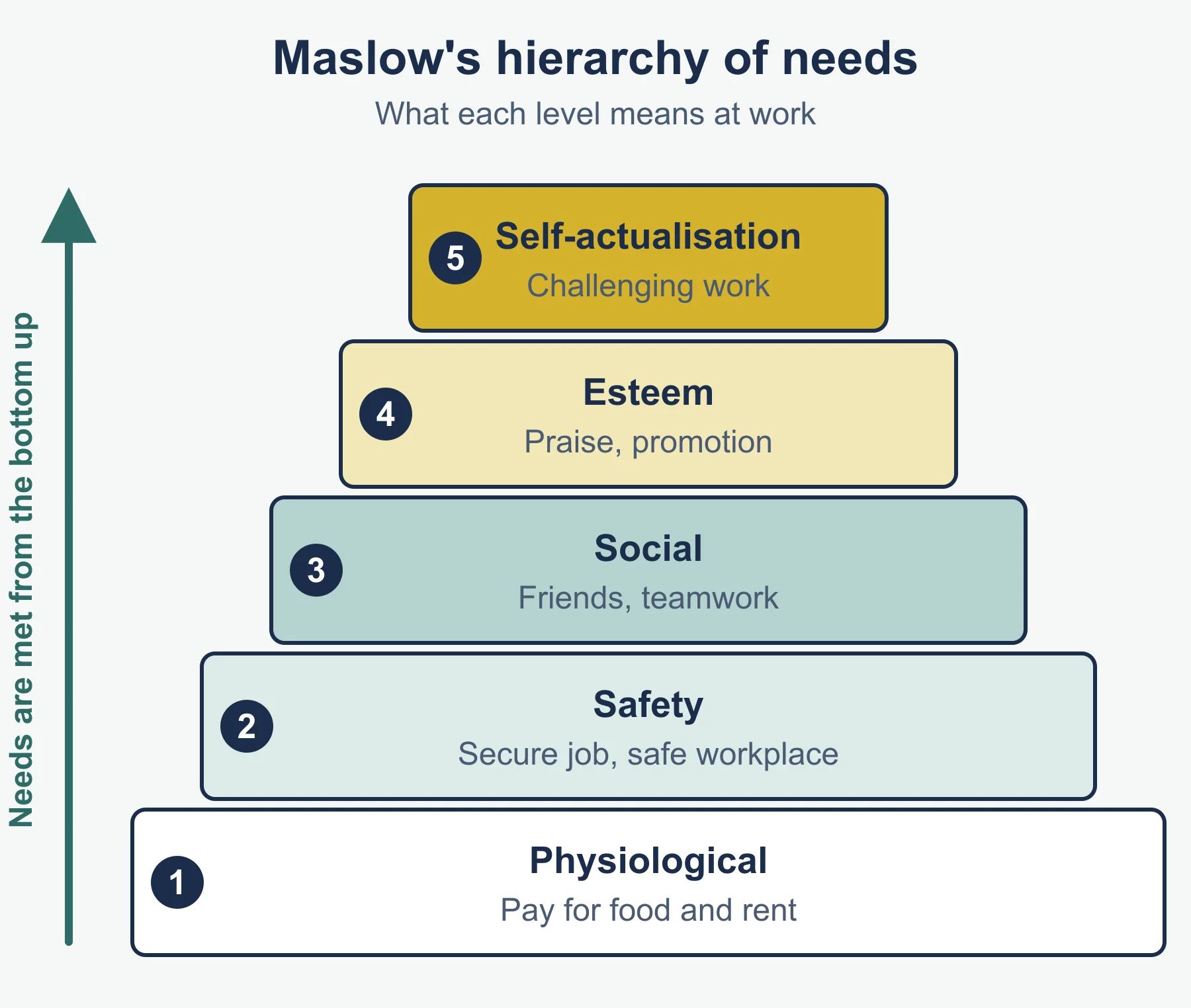
Maslow said people have needs that rise in five levels. A lower need must be mostly met before the next one drives behaviour.
- Physiological needs: food, water, shelter. At work, this means pay enough to live on.
- Safety needs: security and protection. At work, a permanent contract and safe conditions.
- Social needs: belonging and friendship. At work, team activities and good relations.
- Esteem needs: respect and status. At work, praise, titles and promotion.
- Self-actualisation: reaching your full potential. At work, challenging tasks and creative freedom.
The lesson for managers is to find which level a worker is on and offer something at that level. Extra pay does little for someone whose main worry is feeling like an outsider.
Taylor: scientific management
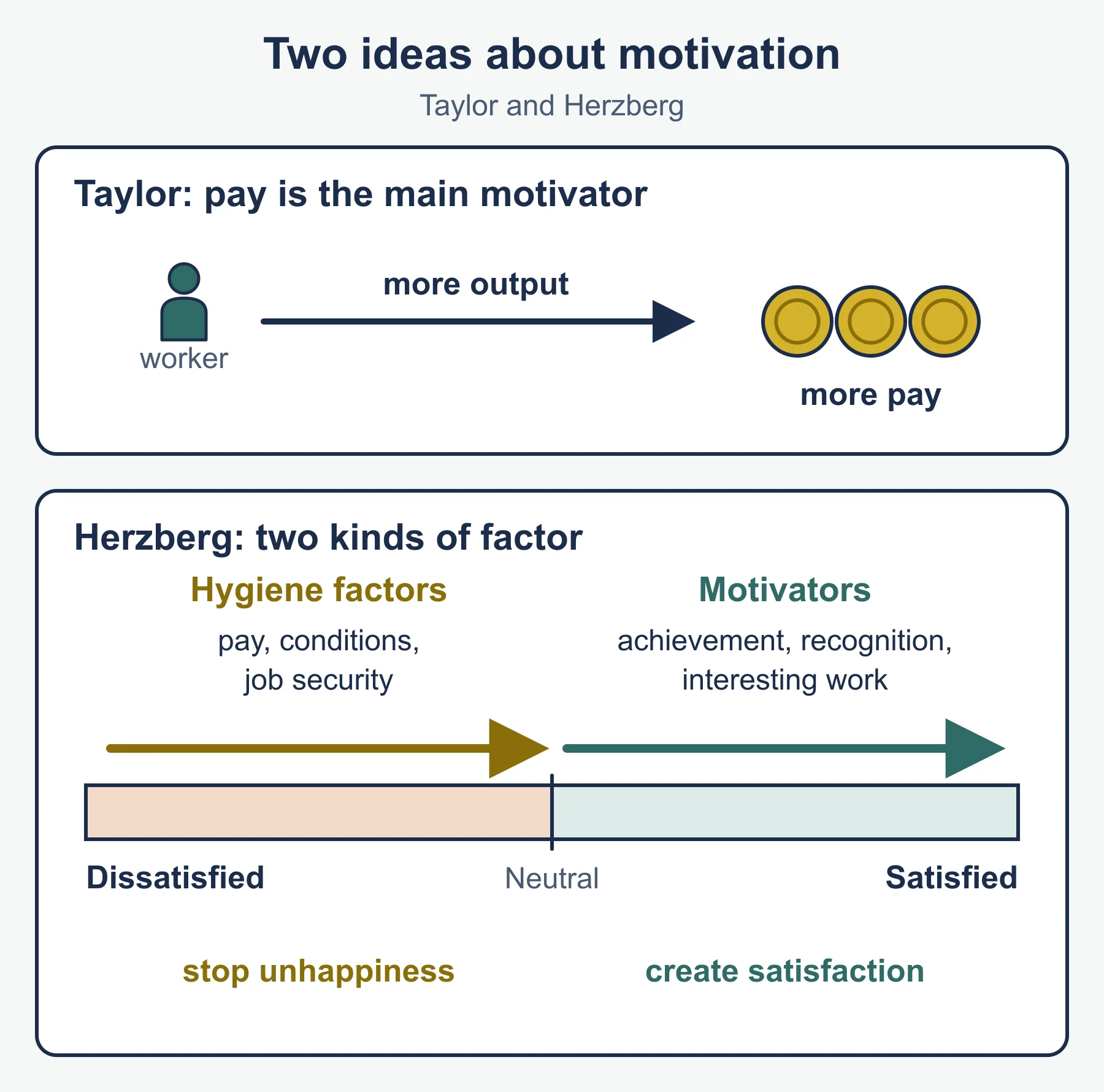
Taylor believed workers are motivated mainly by money. His approach was to study each task, find the quickest method, train workers in it and pay for output. Piece-rate pay is the typical link: the more you produce, the more you earn. The strength of the idea is that it ties reward to effort. The weakness is that it treats people as only interested in pay and ignores boredom, teamwork and quality.
Herzberg: the two-factor theory
Herzberg separated factors at work into two groups.
| Group | Examples | Effect |
|---|---|---|
| Hygiene factors | Pay, working conditions, job security, company policy, supervision | Poor ones breed complaints and unhappiness; fair ones merely stop those complaints, so by themselves they build no extra effort. |
| Motivators | Achievement, recognition, responsibility, the work itself, advancement | They create real satisfaction and encourage extra effort |
For Herzberg, a pay rise stops complaints but does not make people work harder for long. To motivate, a business must redesign the job so that it carries more responsibility and recognition.
Comparing the three
| Theory | Main driver of motivation | Best linked method |
|---|---|---|
| Taylor | Money | Piece-rate, bonus |
| Maslow | Unmet needs at the current level | Depends on the level: pay, security, teamwork, praise, promotion |
| Herzberg | Motivators, once hygiene factors are fair | Job enrichment, recognition, promotion |
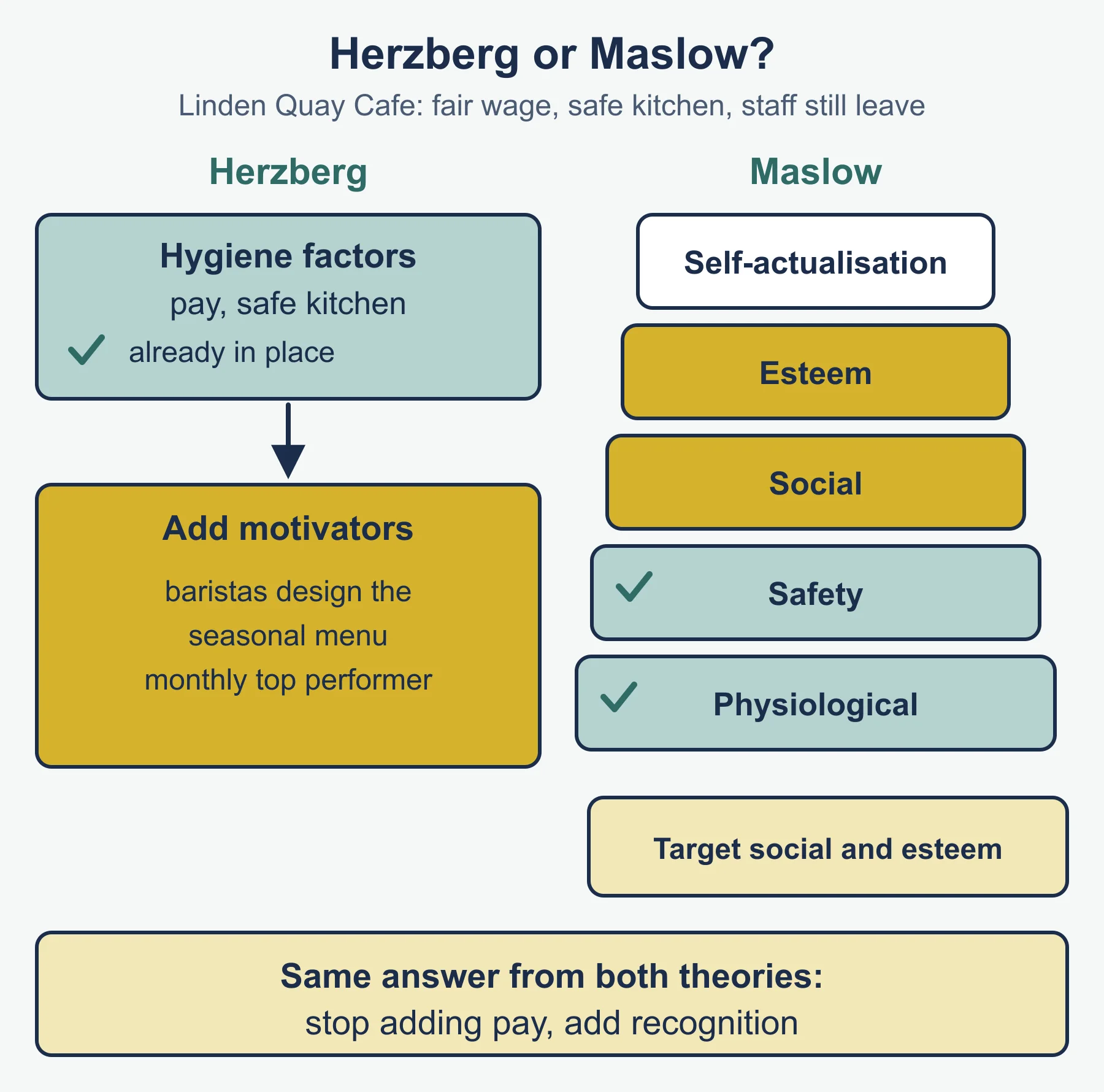
Worked application. Linden Quay Cafe pays its baristas a fair hourly wage and offers a safe, clean kitchen. Staff still leave after a few months. Under Herzberg, pay and conditions are hygiene factors already in place, so the cafe should add motivators: let baristas design the seasonal menu and name a monthly top performer. Under Maslow, the baristas’ physiological and safety needs seem met, so the cafe should target social and esteem needs.
Financial methods of motivation
| Method | How it works | Example calculation |
|---|---|---|
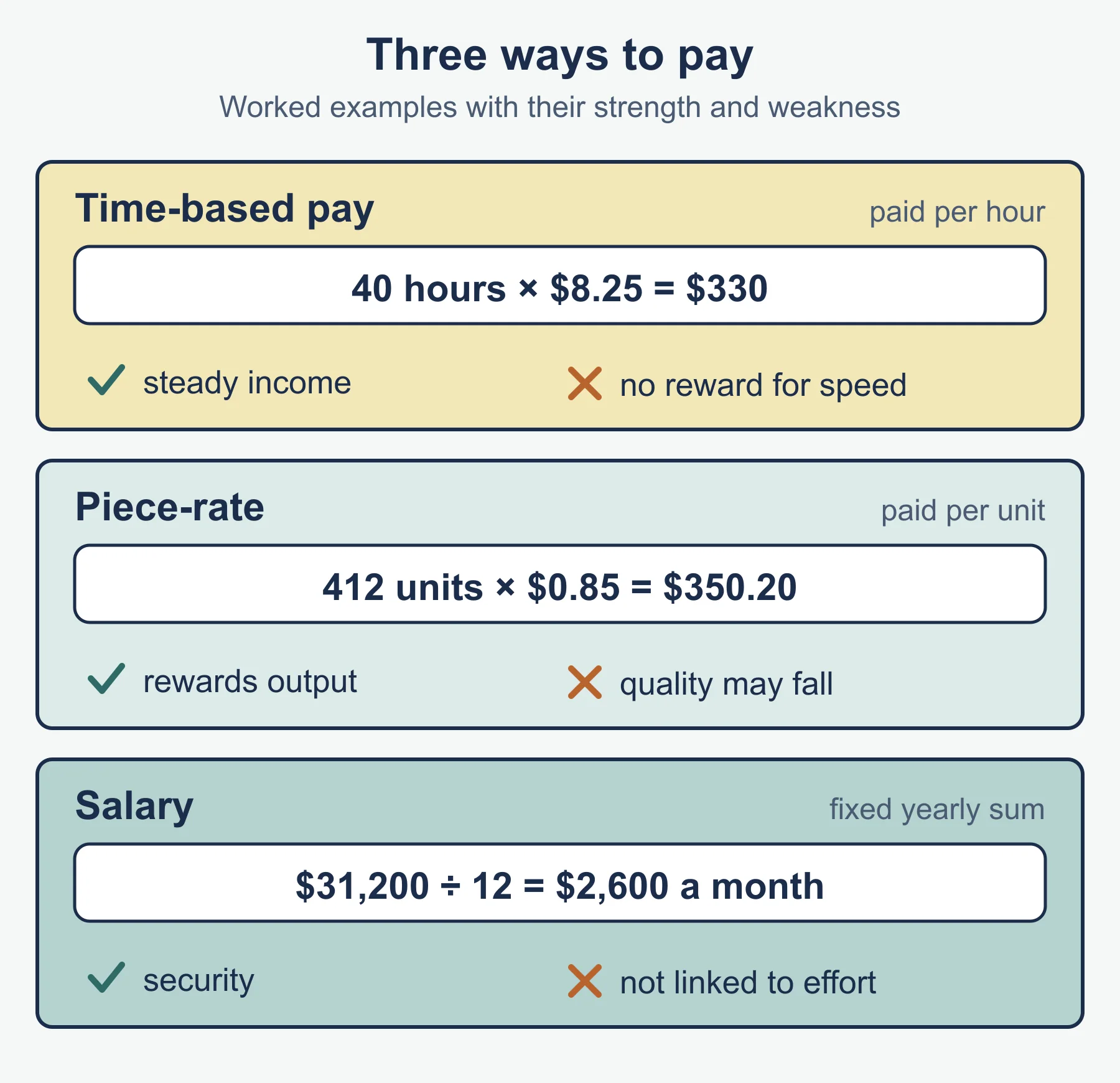
| Time-based pay | Paid per hour worked | 40 hours × 8.25 = 330 for the week |
| Piece-rate | Paid per unit produced | 412 units × 0.85 = 350.20 |
| Salary | Fixed annual sum, paid monthly | 31,200 ÷ 12 = 2,600 a month |
| Bonus | One-off extra payment for meeting a target | A fixed sum for hitting a quarterly target |
| Commission | A percentage of the sales a person makes | 4% of 62,500 = 2,500 |
| Profit sharing | Employees receive a share of profits | A 10% pool of 240,000 = 24,000 shared |
| Fringe benefits | Extras other than pay, such as a company car, health cover or staff discount | Value varies; not a cash wage |
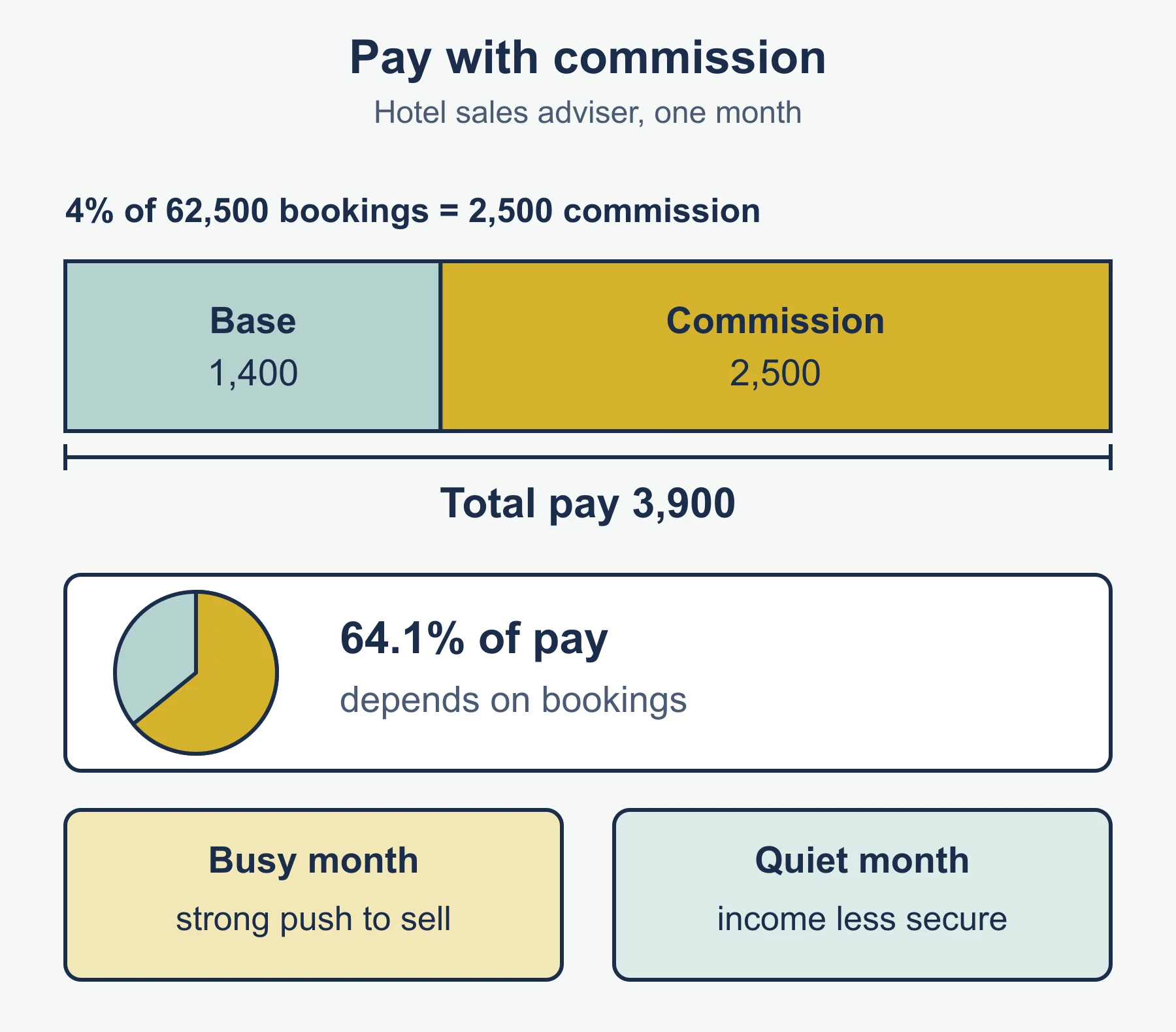
Worked example: commission. A sales adviser at Saffron Ridge Hotel earns a base salary of 1,400 a month plus 4% commission on bookings she makes. Her bookings last month were 62,500.
Commission = 4% × 62,500 = 2,500. Total pay = 1,400 + 2,500 = 3,900. Commission share of pay = 2,500 ÷ 3,900 × 100 = 64.1%.
More than half her pay depends on bookings, so she has a strong reason to sell, but her income is less secure in a quiet month.
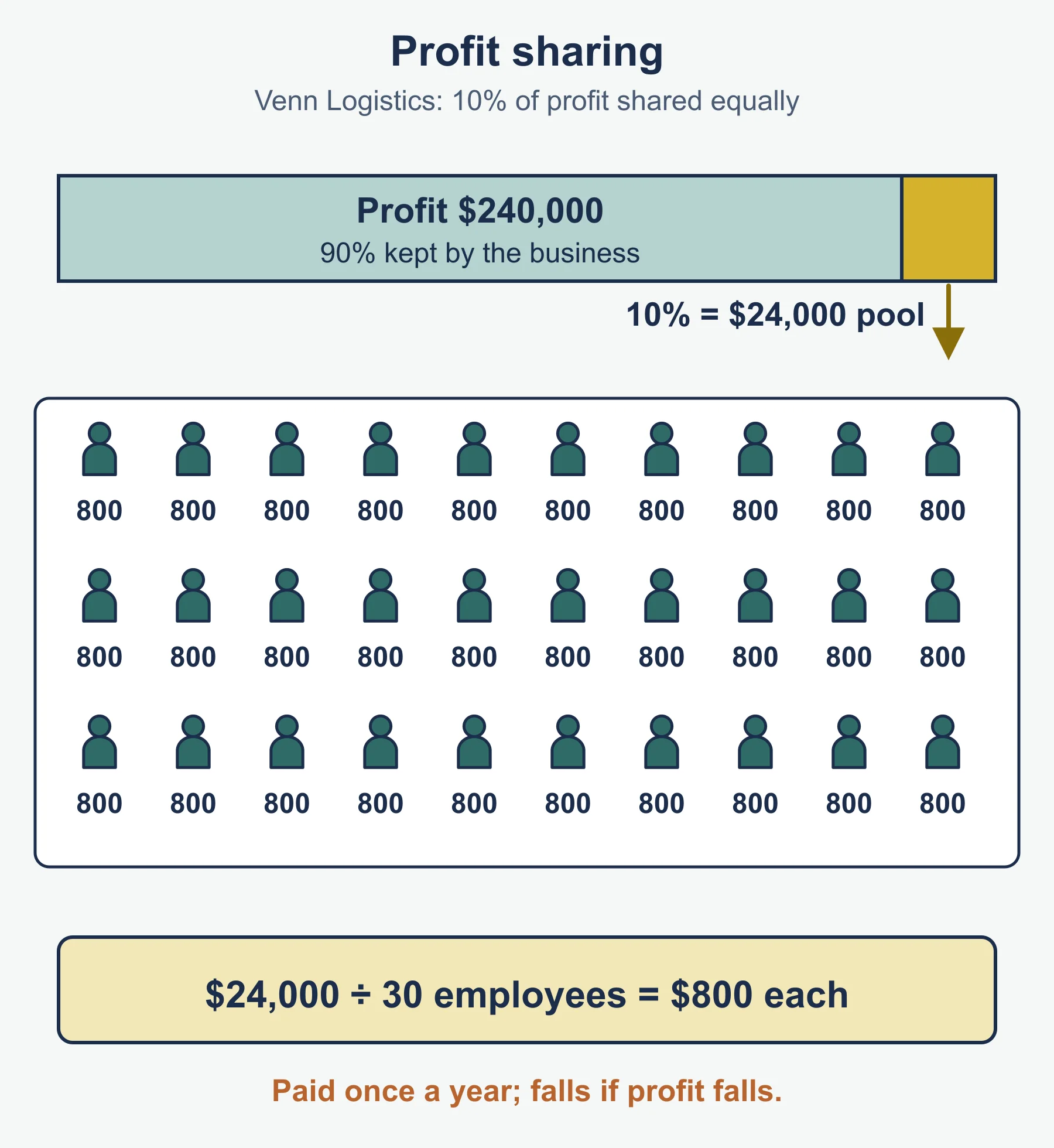
Worked example: profit sharing. Venn Logistics made a profit of 240,000. It shares 10% among 30 employees equally.
Pool = 10% × 240,000 = 24,000. Each employee = 24,000 ÷ 30 = 800.
Because everyone gains when profit rises, staff are encouraged to cut waste and cooperate. The reward only arrives once a year, and it falls if profit falls for reasons workers cannot control.
Advantages and disadvantages of each financial method
- Time-based pay is simple and gives a steady income, but there is no reward for working faster.
- Piece-rate rewards output, but quality may fall and the pay is uncertain. It only suits work where each person’s units can be counted.
- Salary gives security and suits jobs with varied duties. It does not link pay to effort.
- Bonus rewards a target met. It can be paid to teams as well as individuals. The effect fades if workers see it as automatic.
- Commission suits sales roles. It can lead to pushy selling and poor teamwork.
- Profit sharing builds loyalty, but the link between one person’s effort and the payout is weak.
- Fringe benefits are valued by workers, but they cost the business and not every worker wants the same benefit.
Non-financial methods of motivation
- Job enrichment gives workers more challenging tasks, more responsibility and more control over how they work. It links closely to Herzberg’s motivators. It may need extra training and can raise pay expectations.
- Job rotation moves workers between tasks at the same level. It reduces boredom and builds a flexible workforce, but it does not add responsibility, and training takes time.
- Training develops skills and shows the business values the worker. It raises confidence and prepares people for promotion. It costs money, and a worker with new skills can be tempted away by a rival.
- Opportunities for promotion give a career path and a reason to perform. They only work if there are posts to fill, and those passed over may become less motivated.
- Praise costs nothing and meets esteem needs. It must be sincere and specific, or it loses its effect.
- Employee of the month gives public recognition. It is cheap, but staff who never win may feel left out, and it can cause rivalry.
Recommending and justifying a method
When a question asks you to recommend a method for a given situation, follow these steps.
- Read the stem for the workers’ situation: job type, age, how pay is paid now, and what the problem is (low output, high turnover, resistance to change).
- Pick one method that fits that problem.
- Explain how it works, using a fact from the stem.
- Say why it is better than a close alternative, or note its limit.
- State a clear decision.
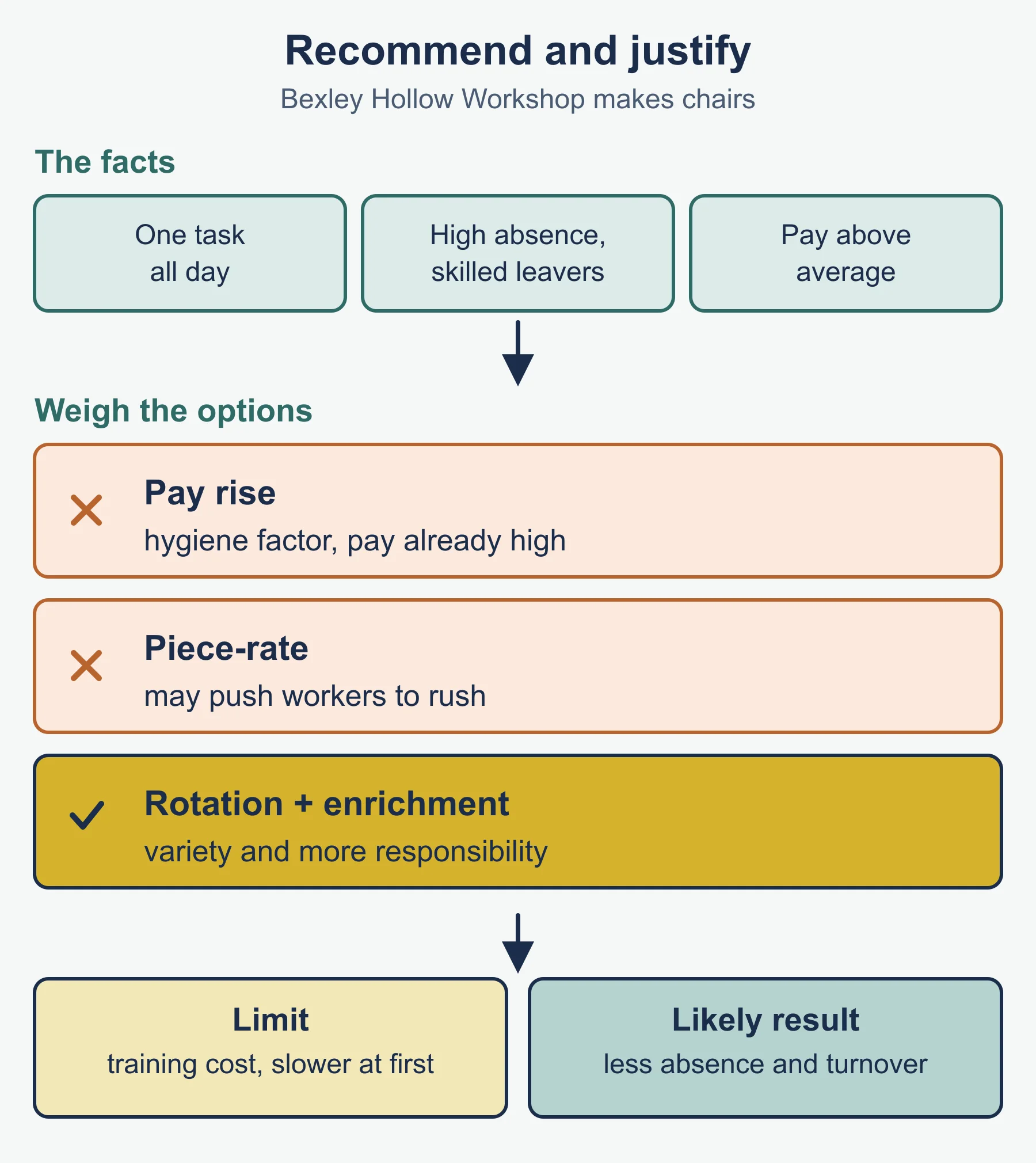
Worked case. Bexley Hollow Workshop makes chairs. Each worker repeats one task all day. Absenteeism is high and several skilled workers have recently left. Pay is above the local average.
A good recommendation is job rotation combined with some job enrichment. Pay is already above average, so a further pay rise (Herzberg’s hygiene factor) is unlikely to fix repetition, and Taylor’s piece-rate may push workers to rush. Rotation gives variety in the short term, and enrichment, such as letting teams plan their own work, adds responsibility. The limit is training cost and a temporary dip in speed. Overall, this is likely to cut absenteeism and turnover because it tackles boredom, the likely cause, and the justification rests on that link.
Common errors
- Writing only “money” for why people work, with no other reason.
- Mixing up job rotation (same level, different tasks) and job enrichment (more responsibility).
- Treating a bonus and profit sharing as the same thing. A bonus rewards a target. Profit sharing divides part of the profit.
- Saying Herzberg’s hygiene factors motivate. They prevent dissatisfaction only.
- Listing methods without linking them to the business in the stem.
- Recommending a method with no reasoned judgement or limit.
Frequently asked questions
What is the difference between job rotation and job enrichment? Job rotation moves workers between different tasks at the same level, which reduces boredom but adds no responsibility. Job enrichment gives workers more challenging tasks, more responsibility and more control over how they work.
How do you calculate labour turnover for Cambridge IGCSE Business 0264? Labour turnover (%) = number of employees who left in the period ÷ average number employed × 100. Section 2.4 of the syllabus does not print this formula, so it is treated as the standard form.
Is a high labour turnover figure always a sign of a problem? Not on its own. A figure such as 15% says little until it is compared with the business’s previous figure or with similar businesses.
Why might a pay rise not motivate workers? In Herzberg’s two-factor theory pay is a hygiene factor, so a rise stops complaints but does not make people work harder for long. Lasting motivation comes from motivators such as responsibility, recognition and achievement.
What are fringe benefits? Fringe benefits are extras other than pay, such as a company car, health cover or a staff discount. Workers value them, but they cost the business and not every worker wants the same benefit.
Official syllabus
This guide follows section 2.4 of the Cambridge IGCSE Business 0264 syllabus for examination in 2027, 2028 and 2029, published by Cambridge University Press & Assessment (Cambridge International Education).
Get free revision emails (optional)
Occasional emails with practice questions, worked explanations and links to free resources for the qualification and subjects you choose. No spam, and you can unsubscribe from any email. The free tools on this site never need an email.
Related resources
-
Practice questions
IGCSE Business: Motivating employees (Cambridge 0264) – Practice Questions
Original practice questions with worked answers on motivating employees for Cambridge IGCSE Business 0264, with calculations and case studies.
Business · Cambridge · IGCSE
Try questions -
Revision notes
IGCSE Business: Motivating employees (Cambridge 0264) – Revision Notes
Condensed revision notes on motivating employees for Cambridge IGCSE Business 0264: theories, pay methods, non-financial methods and a quick self-test.
Business · Cambridge · IGCSE
Revise topic -
Study guides
IGCSE Business: Organisation and management (Cambridge 0264)
Study guide to organisation and management for Cambridge IGCSE Business 0264: structures, delegation, leadership styles, redundancy and trade unions.
Business · Cambridge · IGCSE
Read guide
Related articles
-
teaching
A Level tuition in Dubai: Cambridge or Pearson Edexcel International A Level?
Schools in Dubai and Abu Dhabi teach either Cambridge International AS & A Level or Pearson Edexcel International A Level. How the two are structured, why it matters for tuition, and how online classes from Lahore work.
9 October 2026
-
curriculum guides
Choosing subjects at IGCSE and A Level
How subject choices at 14 and 16 affect university options later, and how to keep pathways open without overloading a timetable.
28 July 2026
Studying this with a teacher
Working through Business IGCSE?
This page is free and stays free. If you would rather be taught it, Marlbridge runs Business classes one-to-one and in small groups of up to 15, online in your own time zone. The first trial class is free. WhatsApp replies within an hour (8am–11pm Pakistan time, every day); email the same day.
Cambridge Business teachers at Marlbridge

