
Study Guides
IGCSE Business: Organisation and management (Cambridge 0264)
Study guide to organisation and management for Cambridge IGCSE Business 0264: structures, delegation, leadership styles, redundancy and trade unions.
- Subject
- Business
- Level
- IGCSE
- Topic
- People in business
- Author
- Marlbridge Academic Team
- Updated
- Reviewed by
- Salman Ahmad (what this means)
Aligned to Cambridge IGCSE Business (0264), For examination in 2027, 2028 and 2029. Official specification .
Syllabus page (what it covers and how it is assessed): Cambridge IGCSE Business.
Syllabus points this page covers
0264
- 2.2 Organisation and management
Found an error? Report a correction.
Need help with this topic? Request a free trial class for IGCSE Business (0450 / 0264).
This guide covers section 2.2 (Organisation and management, points 2.2.1 to 2.2.5) of the Cambridge IGCSE Business 0264 syllabus for examination in 2027, 2028 and 2029. All candidates take Paper 1 (Short Answer and Data Response) and Paper 2 (Case Study), and both papers are based on all the subject content. Expect this topic in stimulus material and case studies, not only as recall. Use the course hub and the printable checklist to track progress. Then test yourself with the revision notes and the practice questions. To find weak spots first, try the free diagnostics.
Money figures are in dollars. All businesses are invented.
What you must be able to do
| Syllabus point | What it means for you |
|---|---|
| 2.2.1 Simple organisational structures | Name the main functional areas. Use the terms levels of hierarchy, chain of command and span of control. Read an organisational chart. Describe flexible working. Weigh part-time against full-time employees |
| 2.2.2 The functions of management | Explain planning, organising, coordinating, commanding and controlling. Give advantages and disadvantages of delegation |
| 2.2.3 Leadership styles | Describe autocratic, democratic and laissez-faire leadership, weigh each one, and recommend and justify a style for a situation |
| 2.2.4 Why reducing the size of the workforce may be necessary | Explain downsizing and redundancy, give reasons, and recommend and justify who to make redundant |
| 2.2.5 The role of trade unions | Say what a trade union is and the benefits of membership for employees |
2.2.1 Simple organisational structures
Functional areas
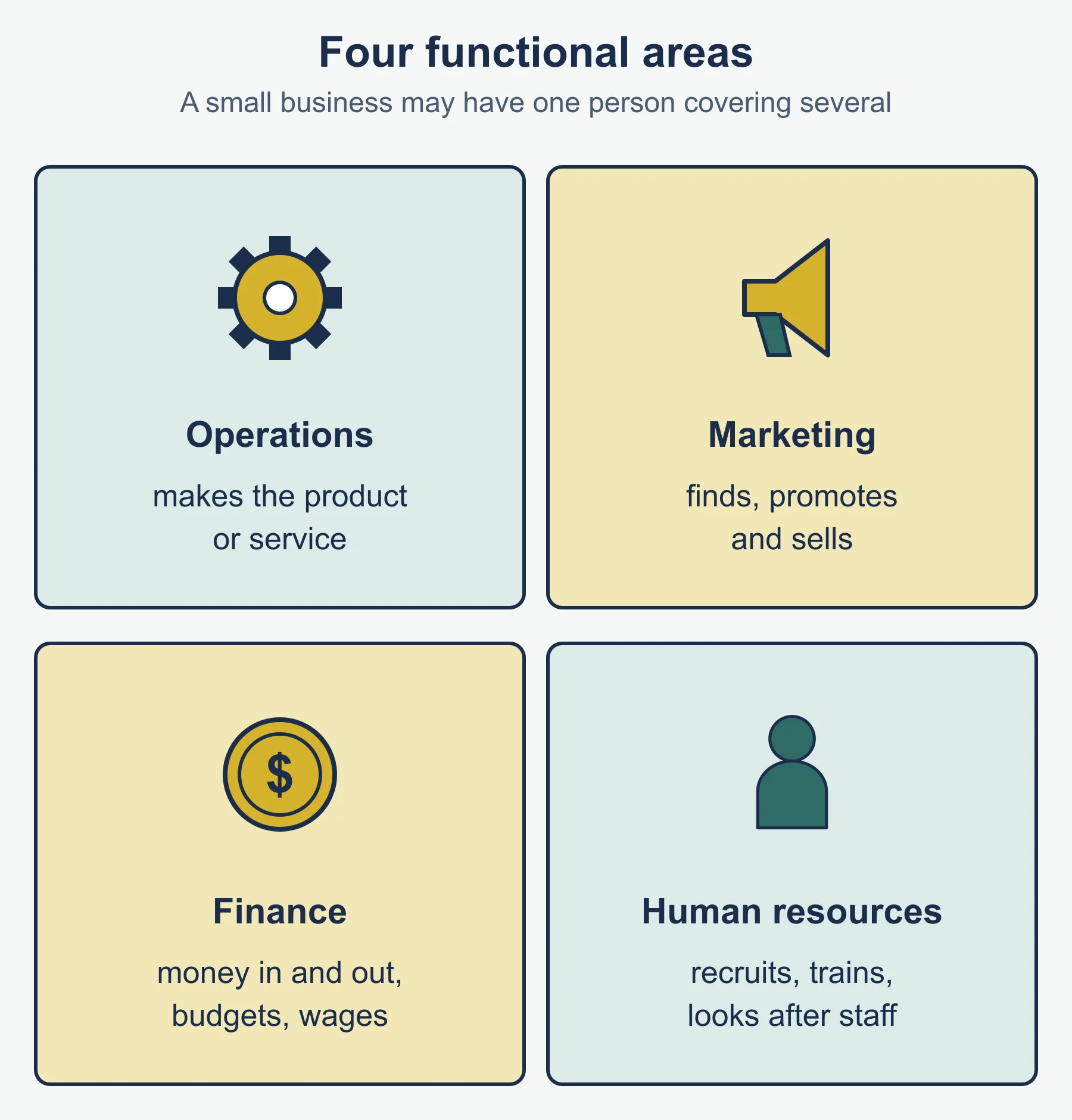
A business divides its work into functional areas. The syllabus gives four examples.
- Operations makes the product or provides the service.
- Marketing finds out what customers want and promotes and sells to them.
- Finance records money coming in and going out, prepares budgets and pays bills and wages.
- Human resources recruits, trains and looks after employees.
A small business may have one person covering several areas.
Hierarchy, chain of command and span of control
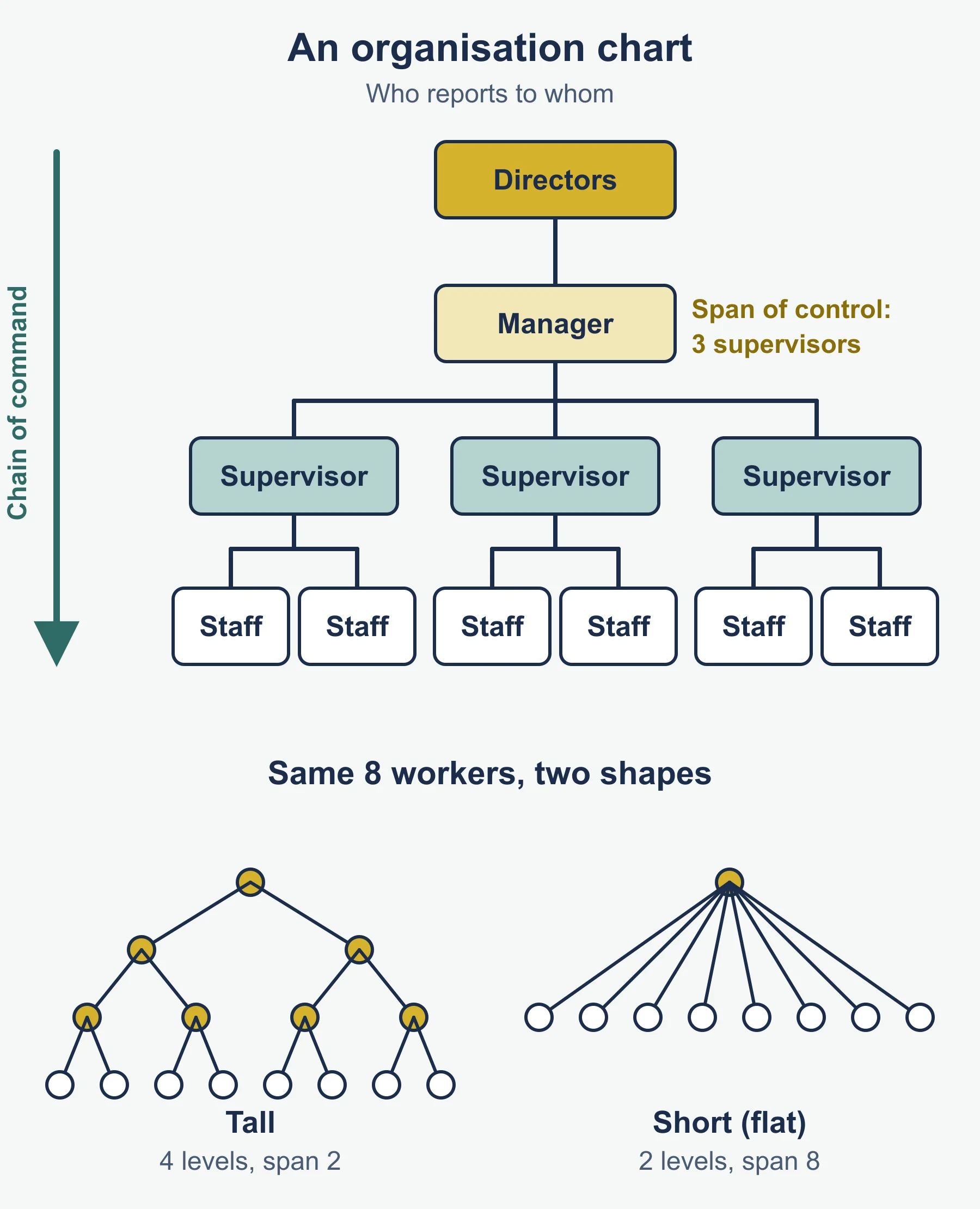
The hierarchy ranks jobs from the top of the business downwards. Each rank is a level of hierarchy.
- The chain of command is the line of authority from the top to the bottom. A long chain has many links. A short chain has few.
- The span of control is the number of employees who report directly to one manager. A wide span means many. A narrow span means few.
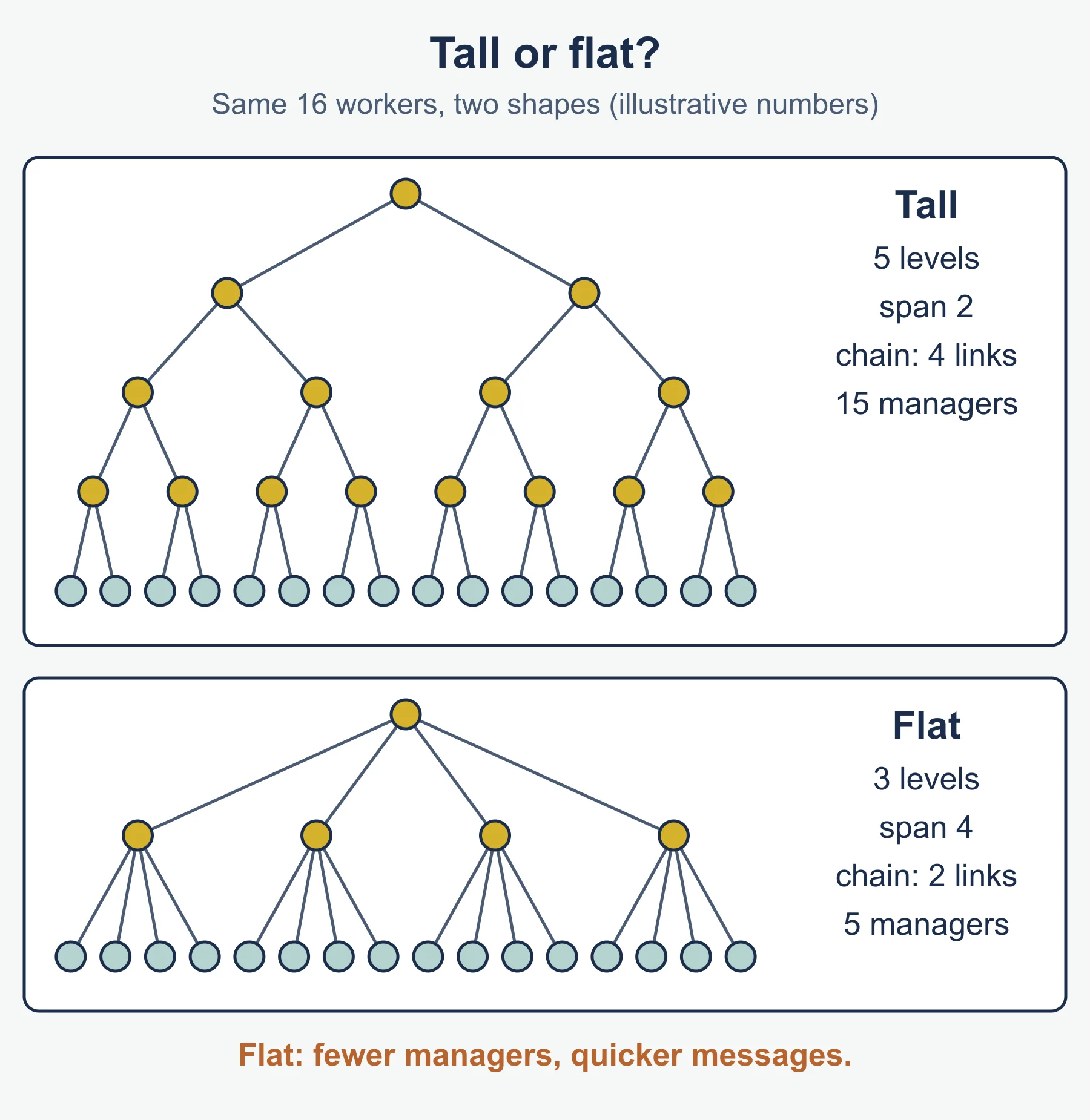
A tall structure has many levels, narrow spans and a long chain of command. A flat structure has few levels, wide spans and a short chain.
| Tall structure | Flat structure | |
|---|---|---|
| Control | Close supervision, which is easier with few staff each | Managers have less time for each person |
| Communication | Messages pass through many people, so they are slower and may change | Messages pass quickly, with fewer people involved |
| Promotion | Many steps, so more chances to move up | Few steps, so fewer chances |
| Costs | Many managers, so higher salary costs | Fewer managers, so lower costs |
Interpreting an organisational chart
Read a chart from the top. Count the levels, then count the boxes directly below each manager. A chart shows who reports to whom, not how well people work together.
Worked example: reading a chart
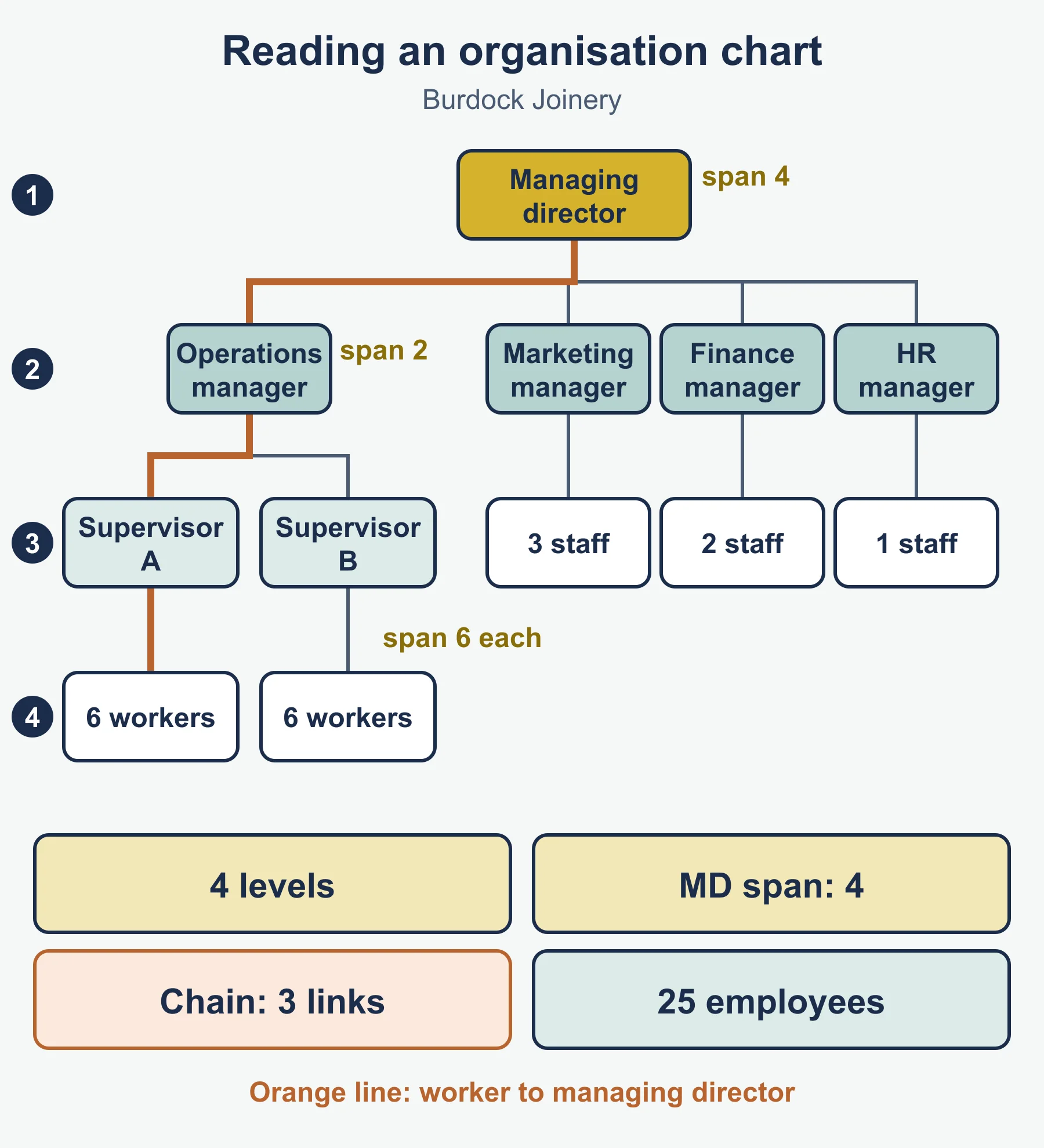
Burdock Joinery has this structure.
Managing director
 |-- Operations manager
 |     |-- Supervisor A --- 6 workers
 |     |-- Supervisor B --- 6 workers
 |-- Marketing manager --- 3 staff
 |-- Finance manager --- 2 staff
|-- HR manager --- 1 member of staff- Levels of hierarchy: managing director, managers, supervisors, workers. That is 4 levels.
- Span of control of the managing director: 4 managers report directly, so the span is 4. The operations manager has a span of 2. Each supervisor has a span of 6.
- Chain of command from a worker in the joinery workshop to the managing director: worker, supervisor, operations manager, managing director. That is 3 links.
- Employees in total: 1 + 4 + 2 + 12 + 3 + 2 + 1 = 25.
With only 4 levels and a short chain the structure is fairly flat, though the finance manager’s span is narrow.
Flexible working
Flexible working lets the pattern of work suit the employee as well as the business. The syllabus names two examples.
- Home working: the employee works from home. Staff save travel time and cost, and the business may need less office space. But supervision is harder and staff may feel isolated.
- Flexible hours: the employee chooses, within limits, when to start and finish. Staff can fit work around family life, which may raise motivation. But meetings and busy-time cover are harder to arrange.
Part-time and full-time employees
| Advantages | Disadvantages | |
|---|---|---|
| Part-time | Cover busy periods without paying for quiet ones. Often easier to recruit | Less commitment may be shown. More people to train and manage. Handovers can go wrong |
| Full-time | More commitment and knowledge of the business. Fewer people to manage. Reliable cover | Paid for all hours, including quiet times. Less flexible if demand changes |
Worked example: cover for a shop
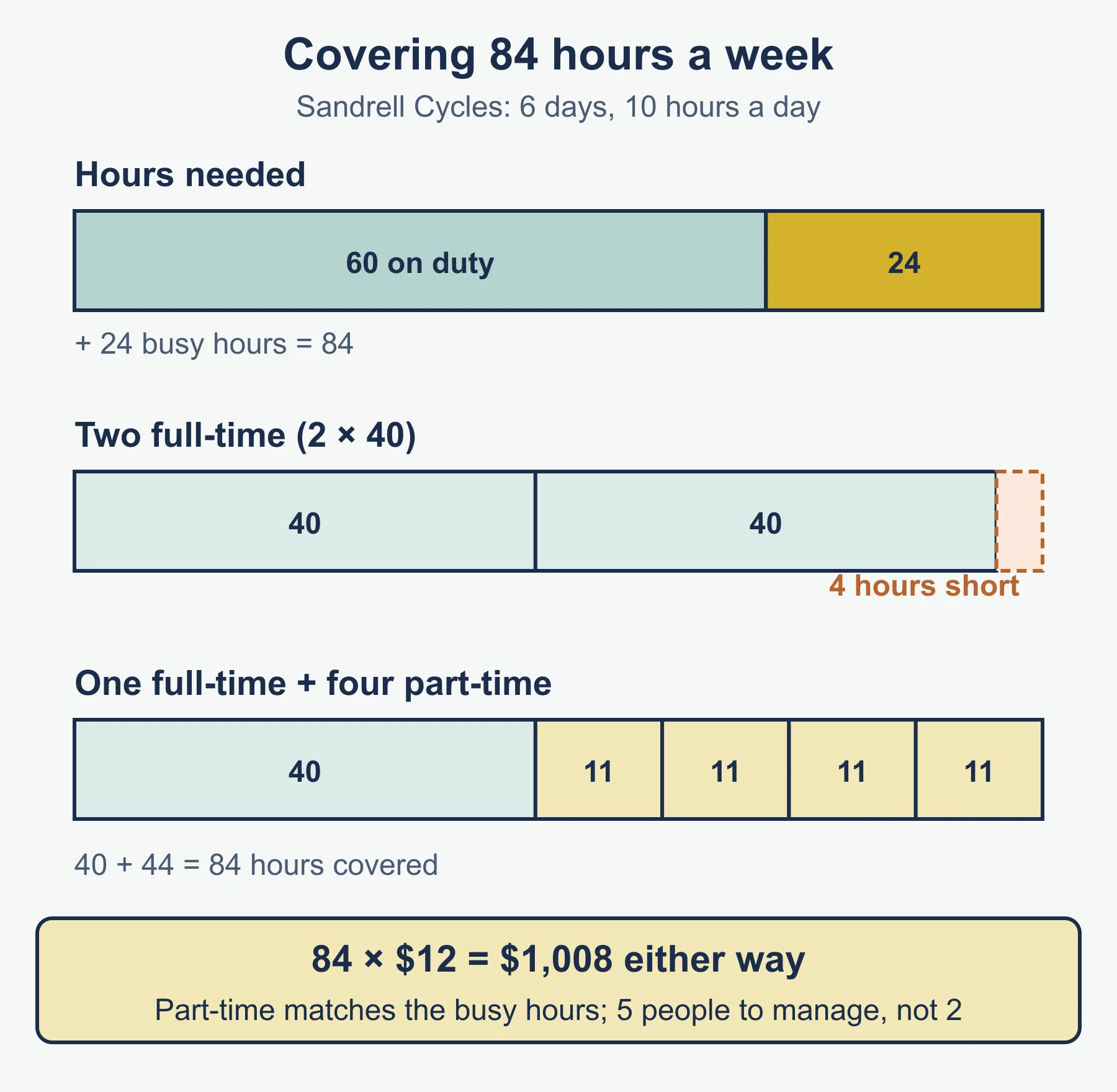
Sandrell Cycles opens six days a week for 10 hours each day. It needs one person on duty at all times, and two people for 4 busy hours each day.
- Hours needed: 6 x 10 = 60, plus 6 x 4 = 24. Total = 84 hours a week.
- Two full-time employees give 80 hours, so the shop is 4 hours short.
- One full-time employee plus four part-timers on 11 hours each gives 40 + 44 = 84 hours.
At 12 an hour the wage bill is 84 x 12 = 1,008 either way, but the part-time option matches staff to the busy periods. The drawback is five people to manage instead of two.
2.2.2 The functions of management
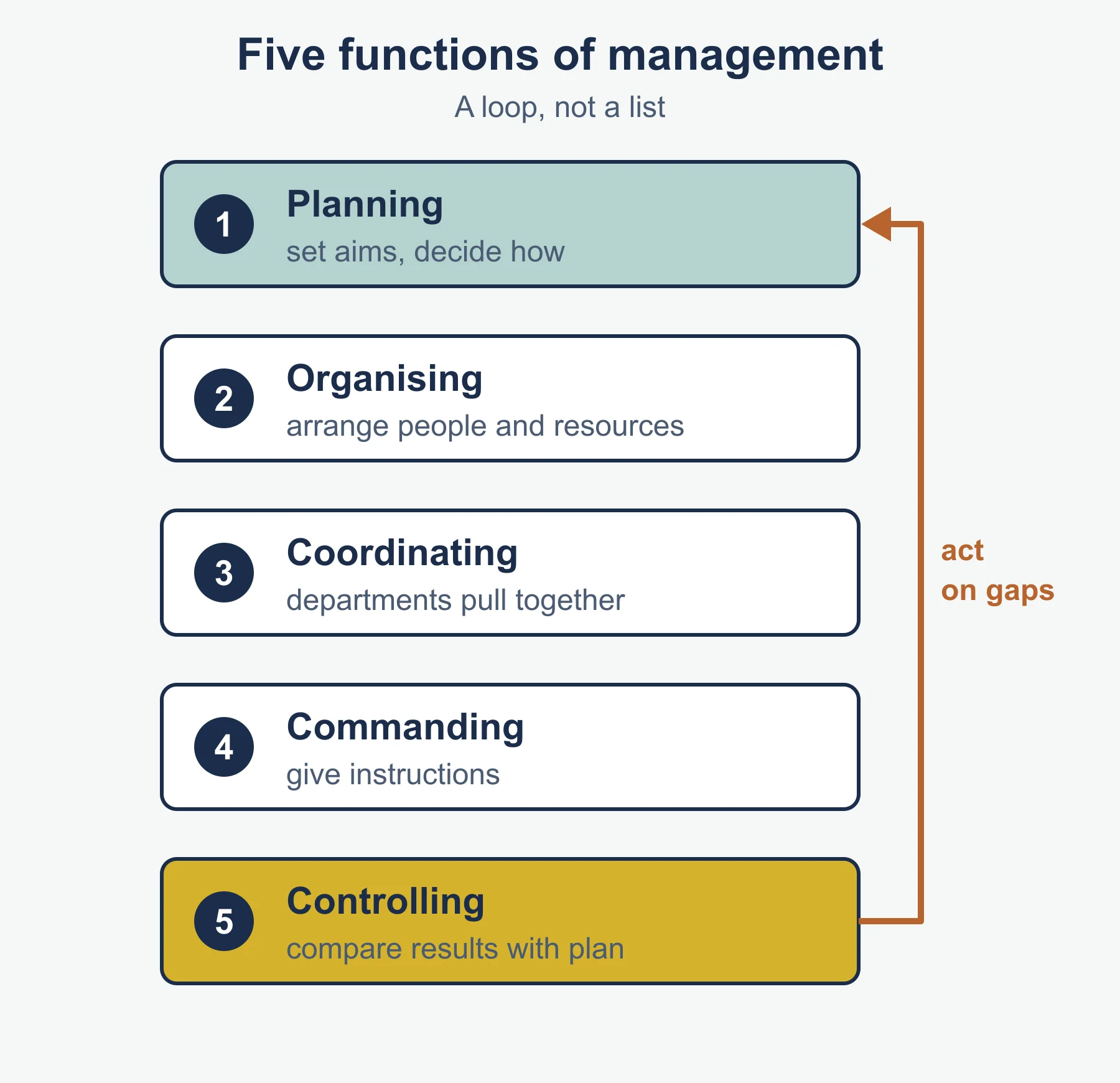
The syllabus lists five functions. Learn each one and be able to spot it in a case.
| Function | What the manager does |
|---|---|
| Planning | Sets objectives and decides how and when to reach them |
| Organising | Arranges people, money, equipment and time so the plan can happen |
| Coordinating | Makes sure the different departments and people work together towards the same aims |
| Commanding | Gives instructions and directs staff so tasks are done |
| Controlling | Compares actual results with the plan and takes action where they differ |
Delegation
Delegation means passing authority to carry out a task, and to make decisions about it, to someone lower in the hierarchy. The manager stays accountable for the result.
Advantages
- The manager has time for work such as planning.
- Employees feel trusted, which can raise motivation.
- Employees gain skills, and decisions are made faster by people close to the problem.
Disadvantages
- The employee may lack skill and make mistakes.
- The manager may lose some control and still be blamed.
- Delegating takes time to explain, and some employees see it as extra work.
Worked example: the value of delegation
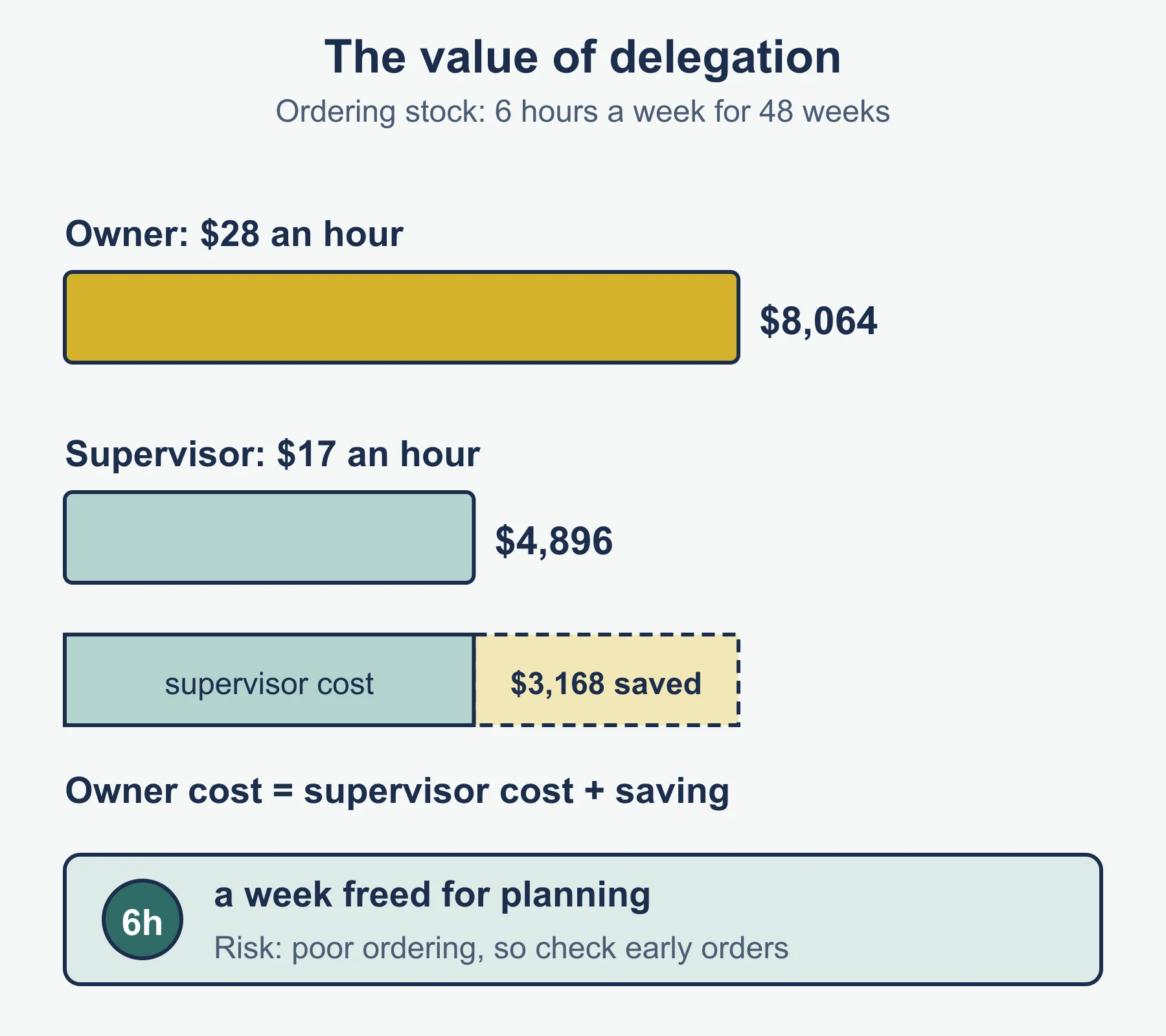
The owner of Sandrell Cycles spends 6 hours a week ordering stock. Her time is worth 28 an hour. A shop supervisor, whose time is worth 17 an hour, could do it. Over 48 weeks:
- Owner: 6 x 28 x 48 = 8,064. Supervisor: 6 x 17 x 48 = 4,896.
- Difference: 3,168.
The owner also gains 6 hours a week to plan promotions. The risk is poor ordering, so she should check the first few orders.
2.2.3 Leadership styles
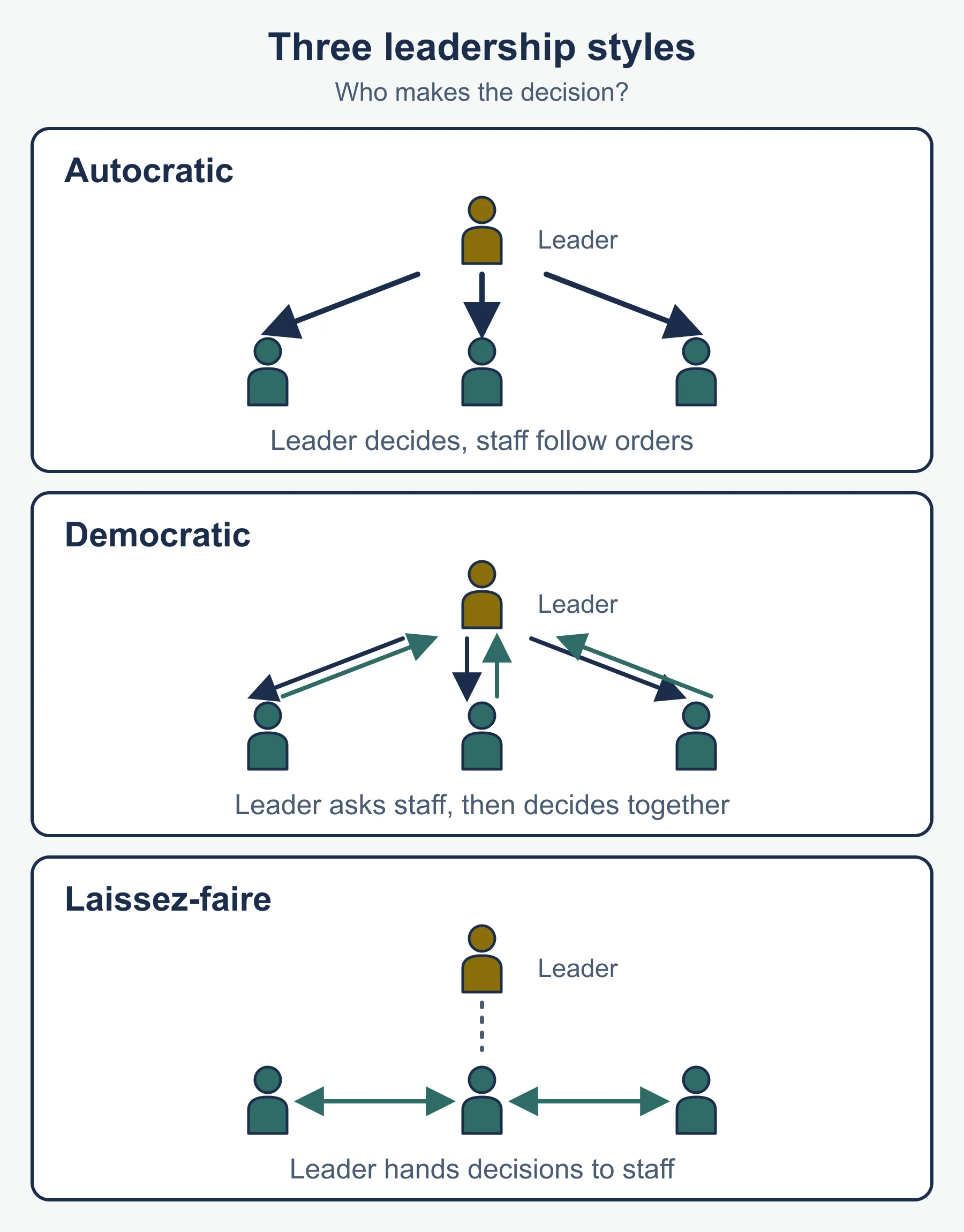
A leadership style is the way a manager directs staff.
| Style | How decisions are made | Advantages | Disadvantages |
|---|---|---|---|
| Autocratic | The leader decides alone and tells staff what to do | Fast decisions, clear direction, suits urgent or unskilled work | Staff may feel unvalued, ideas are lost, motivation and turnover can suffer |
| Democratic | The leader asks staff for views and often decides with them | Uses staff ideas, staff feel involved and motivated | Slower, and the leader may still have to decide when views clash |
| Laissez-faire | The leader sets the aim and leaves staff to decide how | Freedom suits skilled, self-motivated staff and encourages creativity | Little direction, work may lack focus, and weak staff may not cope |
Recommending a style
Look at four things in the case.
- Time: an urgent job favours autocratic leadership.
- Staff skill: experts can handle democratic or laissez-faire leadership. New starters need direction.
- Task: creative work benefits from freedom. A safety task needs strict instructions.
- Current staff mood: high staff turnover suggests that staff want more say.
Then state the cost and why the benefit is larger.
Worked example: choosing a style
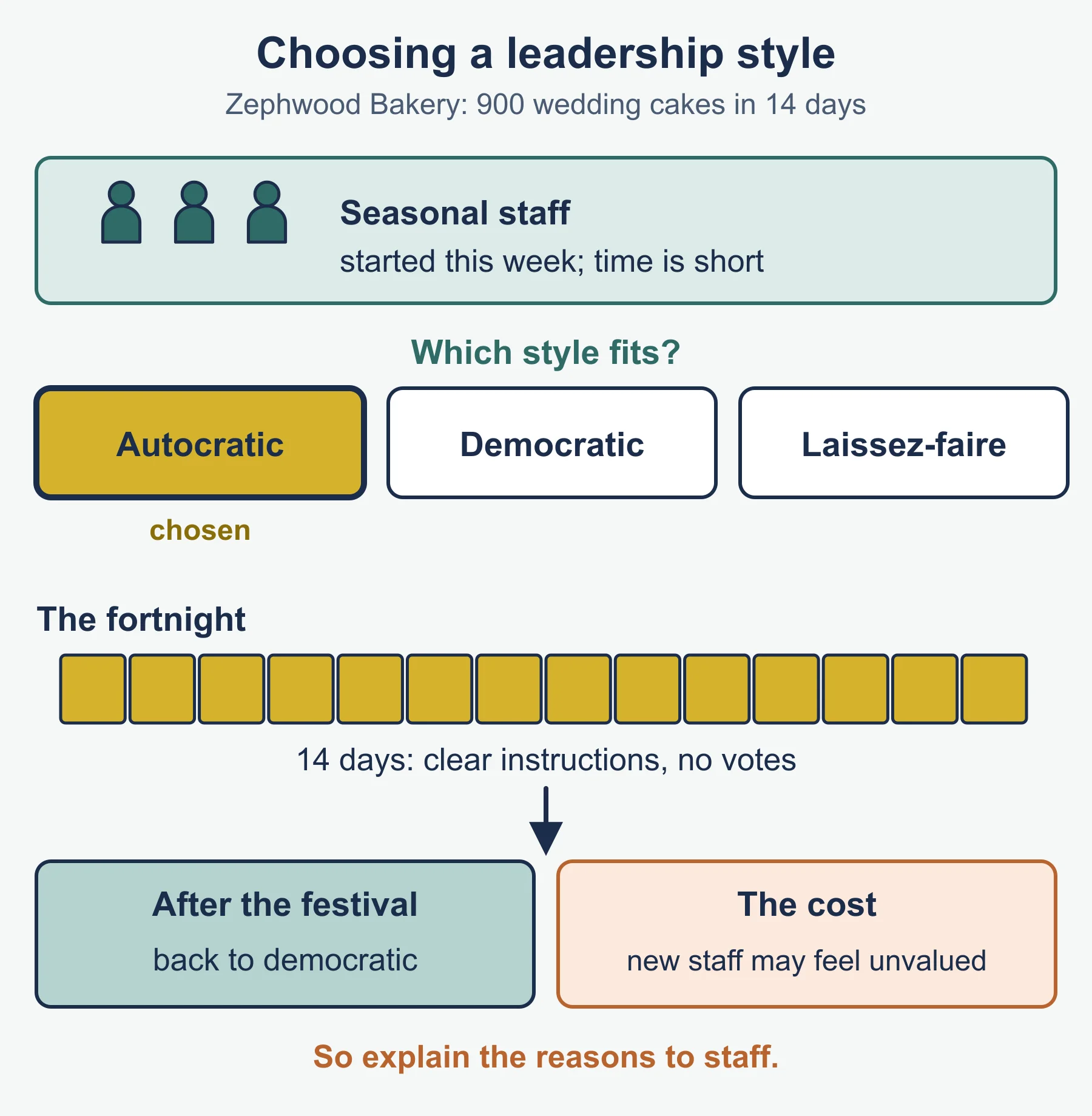
Zephwood Bakery must produce 900 wedding cakes in the fortnight before a festival, using seasonal staff who started this week. The manager’s usual style is democratic.
Recommendation: use an autocratic style for this fortnight. Time is short and the staff are new, so they need clear instructions, and a vote on each decision would waste time. The cost is that new staff may feel unvalued, so the manager should explain the reasons and return to a democratic style after the festival. The answer has a choice, evidence from the case and the cost admitted.
2.2.4 Why reducing the size of the workforce may be necessary
Downsizing means deliberately reducing the number of employees a business has. Redundancy is when an employee loses their job because the job is no longer needed, not because of anything the employee did wrong. A redundant employee is not dismissed for poor work.
Reasons for downsizing
- Automation: machines or software do tasks that people did.
- Reduced demand for products: with fewer sales, the business needs fewer workers.
- Need to lower costs: wages are often the largest cost, so reducing staff may save money.
Redundancy has costs too: payments to those leaving, lower morale among those who stay, and loss of skills. Legal controls such as unfair dismissal (section 2.1.2) mean the choice must be fair and based on reasons.
Worked example: automation
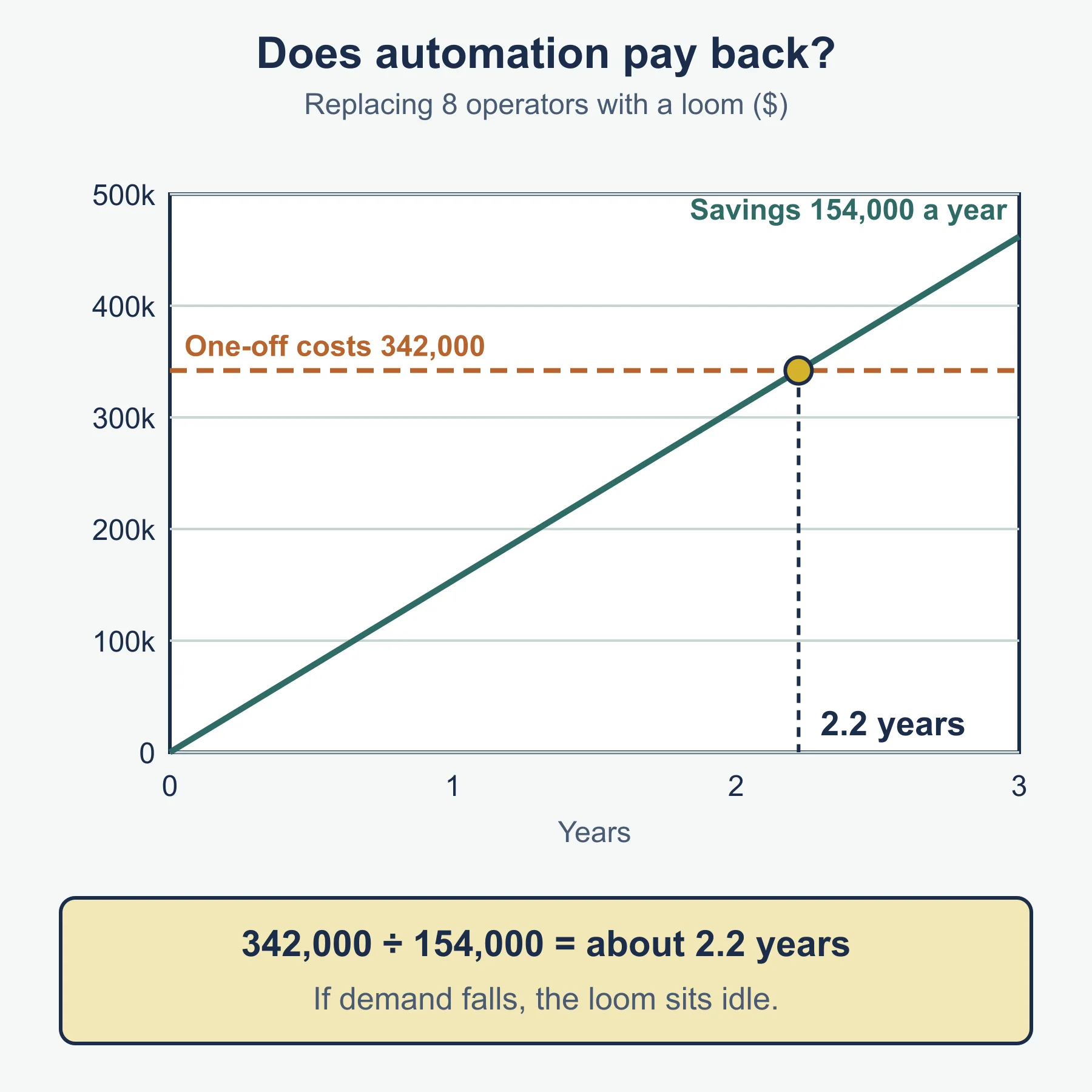
Netherby Textiles plans to replace 8 machine operators, who each earn 21,500 a year, with an automatic loom costing 310,000. The loom adds 18,000 a year in running costs. Each operator who leaves is paid 4,000.
- Wages saved: 8 x 21,500 = 172,000.
- Net annual saving: 172,000 - 18,000 = 154,000.
- One-off costs: 310,000 + (8 x 4,000 = 32,000) = 342,000.
- Time to recover: 342,000 / 154,000 = about 2.2 years.
The plan pays back after about two and a quarter years. But if demand fell, the loom would sit idle and skilled operators would be gone.
Choosing who to make redundant
Questions may ask you to recommend and justify who goes. Use criteria and say what each would mean for the business.
- Skills: does the business still need them?
- Performance and attendance record: a poor record may point towards that person.
- Length of service: long service brings knowledge, and it may also mean a bigger payment.
- Cost: a higher-paid employee saves more but may be experienced.
- Flexibility: can the employee do several jobs or work different hours?
- Role: is the job itself no longer needed?
Choose one person, show why they are a better choice than the others using the data, and admit the downside. Use only grounds given in the case.
2.2.5 The role of trade unions
A trade union is an organisation of workers who join together to protect and improve their interests at work. Members pay a subscription.
Benefits to employees of being a member
- The union can speak for members as a group, for example when talking to the employer about pay and conditions. A group has more influence than one person.
- Members can get advice and support in a dispute with the employer.
- The union can press for safe working conditions and fair treatment.
Answer the question asked: for benefits to employees, do not drift into effects on the employer.
Common errors
- Confusing span of control with the number of levels.
- Saying a flat structure has a long chain of command.
- Describing delegation as just giving out work. Authority to decide must also pass down.
- Treating redundancy as dismissal for poor work.
- Recommending who to make redundant with no reference to the data given.
Continue with the revision notes, then the practice questions.
Frequently asked questions
What is the difference between a tall and a flat organisational structure? A tall structure has many levels of hierarchy, narrow spans of control and a long chain of command. A flat structure has few levels, wide spans and a short chain, so messages pass more quickly and there are fewer managers to pay.
What is delegation in IGCSE Business? Delegation means passing the authority to carry out a task, and to make decisions about it, to someone lower in the hierarchy. The manager remains accountable for the result, so it is more than simply giving out work.
When is an autocratic leadership style the best choice? Autocratic leadership, where the leader decides alone, suits urgent jobs, unskilled or newly started staff and safety tasks that need strict instructions. Its cost is that staff may feel unvalued, so the reasons should be explained to them.
What costs does a business face when it makes employees redundant? It pays the employees who leave, morale may fall among those who stay, and the skills of the departing staff are lost. Legal controls such as unfair dismissal also mean the choice of who goes must be fair and based on reasons.
Official syllabus
Aligned to section 2.2 of the Cambridge IGCSE Business 0264 syllabus for examination in 2027, 2028 and 2029, published by Cambridge University Press & Assessment (Cambridge International Education).
Get free revision emails (optional)
Occasional emails with practice questions, worked explanations and links to free resources for the qualification and subjects you choose. No spam, and you can unsubscribe from any email. The free tools on this site never need an email.
Related resources
-
Practice questions
IGCSE Business: Organisation and management (Cambridge 0264) – Practice Questions
Original practice questions with worked answers on organisation and management for Cambridge IGCSE Business 0264, with short-answer and case items.
Business · Cambridge · IGCSE
Try questions -
Revision notes
IGCSE Business: Organisation and management (Cambridge 0264) – Revision Notes
Revision notes on organisation and management for Cambridge IGCSE Business 0264: key terms, comparison tables, a self-test with answers and mistakes.
Business · Cambridge · IGCSE
Revise topic -
Study guides
IGCSE Business: Human resource management (HRM) (Cambridge 0264)
Study guide to human resource management for Cambridge IGCSE Business 0264: recruitment, selection, contracts, legal controls and training.
Business · Cambridge · IGCSE
Read guide
Related articles
-
teaching
A Level tuition in Dubai: Cambridge or Pearson Edexcel International A Level?
Schools in Dubai and Abu Dhabi teach either Cambridge International AS & A Level or Pearson Edexcel International A Level. How the two are structured, why it matters for tuition, and how online classes from Lahore work.
9 October 2026
-
curriculum guides
Choosing subjects at IGCSE and A Level
How subject choices at 14 and 16 affect university options later, and how to keep pathways open without overloading a timetable.
28 July 2026
Studying this with a teacher
Working through Business IGCSE?
This page is free and stays free. If you would rather be taught it, Marlbridge runs Business classes one-to-one and in small groups of up to 15, online in your own time zone. The first trial class is free. WhatsApp replies within an hour (8am–11pm Pakistan time, every day); email the same day.
Cambridge Business teachers at Marlbridge

